“Planetarity,” “Planetarism,” and the Interpersonal

Jeremy Bendik-Keymer

Case Western Reserve University, Cleveland, Ohio, Once Land of Many Nations

For reasons I have elsewhere explained, I tend not to talk about the “Anthropocene.”[1]  But that does not mean we cannot talk here about other relevant things.  One of them is the notion of the planetary.  With the “Anthropocene,” a natural scientific term colonised the humanities and social sciences by contagion, while with the “planetary,” usage from the humanities and social sciences has taken over a natural scientific term.   In many uses of the humanities and social sciences, the “planetary” isn’t simply a word from geology or astronomy.

I say the “notion” of the planetary, because the concept of the planetary is contested, rejected, vague and equivocal across writers and theorists working in and around social science and the humanities now.  Take Neil Brenner’s social-spatial approach.[2]  “Planetary urbanisation” refers to a “problematique” examining the “urbanisation process” throughout the reaches of the Earth.[3]  Brenner’s team at Harvard’s Urban Theory Lab examined “extreme territories” from deep ocean trenches to orbital space and displayed how capitalist processes organised by state strategies of neoliberal rationality bind the planet through an “urbanisation process.”  Here, the “city” is vestigial; the “hinterlands” and “wilderness” become part of capitalist processes; infrastructures are “scrambled” together, and the planet is reshaped as a space of economic flows containing unsustainable tensions and breaking points needing to be managed, typically by some scale of the neoliberal state.  Although complex in its details, the point is straightforward:  the “planetary” becomes a spatial scale of capitalism in cahoots with neoliberal states.  “Planetary” space is produced through urbanisation processes within capitalism.  To say, as a natural scientist and the general public might, that the Earth is our “planet” is incomplete at best.  The “planet” has been colonised by “planetary” urbanisation.  To study the “planetary” is to study how capitalism’s extreme expansion, innovation, and waste has opened up the planet as a space by which most of us live.[4]

Brenner’s notion of the planetary is descriptive, although not in a positivist manner.  But there are also straightforwardly normative uses of the “planetary.”  Take, for instance, Stefan Pedersen’s recent term “planetarism.”[5]  Confronting the path dependencies created by the inter-national order and its nationalisms, Pedersen argues for a political “imaginary” seeking to supplant the nation state and the international order with governance organised sustainably by “symbiosis.”  This form of socio-ecological politics does not continue the territorially fragmented sovereignty of the long shadow of European imperialism.  Nor does it generate the “fragmentation of agency” resulting from the crisis of international authority built into national sovereignty.[6]  Instead, the planetary “imaginary” of planetarism begins by thinking about how we can govern ourselves in a way that makes our feedback loops with the Earth sustainable for us and for the extant order of life on Earth, irrespective of national territories or sovereignties.  Pedersen’s “planetarism” takes general humanistic goals and argues for them on the basis of having recognised how “planetary” space has been produced unsustainably through the inter-national system. While Pedersen does not focus on the critique of capitalism, one could still say that the “planetary” in his thinking is the name for a set of normative concerns playing catch-up with planetary urbanisation as Brenner understood it.  Pedersen asks us to imagine a just and sustainable “planetary polity” to confront and unwork the unsustainable production of planetary space.

Brenner’s and Pedersen’s fairly straightforward uses of the “planetary” differ, however, from Gayatri Chakravorti’s fluctuating gesture, “planetarity.”[7]  For a quarter century, Spivak has been using the notion of the planetary much in the manner of a disrupter gesture like Derrida’s différance.  Spivak intends the term “planetarity” to point to the negation of our epistemic representations of the planet as a unified field.  As Jennifer Gabrys put it,

“In Spivak’s development of the concept of the planetary, the point is not to generate an evasive figure, but rather to thwart an engagement with the planetary that hinges on uniform epistemic representations.”[8]

By using a word that has connotations around our “planet” but then insisting that it is found in resistance to representing the “planet” in a uniform way, Spivak is obviously on conceptually confusing grounds, but only if one ignores her pragmatics.  Spivak doesn’t speak theoretically when she gestures to “planetarity.” Drawing on our associations with the “planet” while refusing to foreclose the excessive meaning of the [X] that is our “planet” across cultures and people’s lives, Spivak speaks practically, in protest.  The problem with the “planetary” is that it too readily organises power upon a stable representational ground subsuming all people, living beings, and ecologies within its assumptions.  There are just too many words and ways to live with the “planet” to organise them under a regime of “planetary” governance or within scales of “planetary” economy.  In other words, Spivak uses a pragmatic utterance to express a principled, post-colonial, skeptical stance in the face of a socio-ecological concept that, in both a descriptive key that erases pluralism and a normative key that threatens neo-imperialism, wants to recuperate the object of European colonialism: the whole damn globe.

Spivak is right not just to listen to what people say but to look too at what people do with their words.[9]  Pedersen’s “planetarism” could become a way to sort out who is “planetary” from whom is not, folding in a prior decision about the proper representation of the planetary.  Brenner’s “planetary urbanisation” could have the tendency to drive eyes away from describing settlements and economies that are not set up reactively to capitalism and that are yet local.  For both thinkers, to use the pragmatic gesture of “planetarity” might forewarn them from summing things up when it comes to the vast and archaic planet of our vast and ancient humankind. 

At the same time, Spivak’s gesture is ineffective.  As she well knows, words refer to things in context, and skepticism makes sense only within a prior commitment to epistemic virtue.  Brenner is after something and can qualify it.  Pedersen is following a normative direction required by justice and can qualify it too.  If we are to do anything with words, they still must mean something so that we may use them in different ways.  I think that there is a better way to protect pluralism and finitude without sacrificing accuracy or clarity.

Spivak was right to look at the orientation through which people write.  What would be better than a skeptical pragmatics, however, is to approach the planetary through relational reason.  Relational reason is the discrete logic of the interpersonal, as opposed to the practical or the theoretical.[10]  When reasoning relationally, we do not try to grasp objects or be objective in the first instance.  Rather, we try to be true to relationships, beginning with being morally accountable within them.  Only on the basis of being true to relationships can we become practically goal-oriented or theoretically objective without selling out (Brenner), failing our humanity (Pedersen), or dominating and silencing others (Spivak).  The writer who approaches “theory” from relational reason first asks how their authorship can uphold their moral relations by writing.[11]

This is what happens to the “planetary” when relational reason becomes our primary orientation toward it: theory and practice give priority to relational processes that pulverise and pluralise the “planetary.”  This takes place not out of a subtraction of meaning as found within Spivak’s gesture, but in a thickening and particularising of meaning.  Inside the orientation of relational reasoning, the planetary is not something one can grasp for others.  This, following Spivak, is an a priori claim.  When each of us must relate personally to things and to all our relations, your relation to the planet – even how you see and what you call the “planet” – is not something I can settle for you.  At best, we have to work out shared meaning iteratively each time we meet new people and form new relations, a radical pedagogical task at best that shutters the institutional forms and practices of high theory.  No one talks down to or at you in this “school.”  No one schools you, even.  We come to things together.

At the same time, to relate to things personally while minding all our relations is to saturate their meaning with personal connotations, something that particularises and thickens meaning to the point of story.  Here, as in Leibniz’s baroque explored by Deleuze, the folds of relations are negatively infinite.  They keep on going as we relate, without an end in sight.[12]  Particularity and thickening in relationships create a second layer of plurality that functions much as Spivak’s skepticism would.

Lastly, relating to the planetary – not just thinking about it or making it practical (including practically gesturing to it) – improves accuracy, clarity, and normative accountability.  As we relate to each other in moral accountability, we have to be truthful, since we owe that much to each other.  At the same time, we have to be able to answer each other’s claims, or we fail to relate.  Finally, we cannot ignore each other on pain of moral hypocrisy or corruption.  The overall result here is subtle:  understanding urbanisation becomes a social process of forming relationships in moral accountability just as much as it is a process of accurate theorising.  Becoming citizens becomes a process of building trust based on non-domination, equality, and epistemic pluralism just as much as it depends on getting political ideology right.  Relating through the “billion” names of the “planetary” helps think about it and act on a basis that is just.[13]

The limitations of Spivak’s gesture, then, are found in plain sight, like the purloined letter in Edgar Allen Poe’s tale of the same name.  The limitations come from the theoretical posture or by reacting against it.[14]  Have you considered what it would be to relate to the “planetary” in a way that wasn’t primarily theoretical or practical, but that depended on relating to everyone around you being part of the story?[15]

Jeremy Bendik-Keymer holds the Beamer-Schneider Professorship in Ethics at Case Western Reserve University and is an Associate Professor in the Department of Philosophy there.  He is also a Senior Research Fellow with the Earth System Governance Project, Universiteit Utrecht.  His past monographs include The Ecological Life, The Wind ~ An Unruly Living, and Solar Calendar, and Other Ways of Marking Time – all forms of literary philosophy.  Involving Anthroponomy in the Anthropocene: On Decoloniality appears this month.


[1] See my Involving Anthroponomy in the Anthropocene: On Decoloniality (New York: Routledge, 2020).

[2] Neil Brenner, Implosions/Explosions: Towards a Study of Planetary Urbanization (Berlin: Jovis, 2014) and the later essays in New Urban Spaces: Urban Theory and the Scale Question (New York: Oxford University Press, 2019).

[3] Brenner, New Urban Spaces, chapter 10

[4]  See also Steven Vogel, Thinking like a Mall: Environmental Philosophy After the End of Nature (Cambridge, MA: MIT Press, 2015).

[5] Stefan Pedersen, “Plantetarism: A Paradigmatic Alternative to Internationalism,” Globalizations (March 25th, 2020), https://doi.org/10.1080/14747731.2020.1741901

[6]  See Stephen M. Gardiner, A Perfect Moral Storm: The Ethical Tragedy of Climate Change (New York: Oxford University Press, 2011) on the “global storm.”

[7] Gayatri Chakravorti Spivak, “‘Planetarity’ Box 4 (Welt),*” Paragraph (v. 38, n. 2, 2015), 290-292; also “The 2012 Antipode AAG Lecture: Scattered Speculations on Geography,” Antipide (v. 46, n. 1, 2012), 1-12.

[8] Jennifer Gabrys, “Becoming Planetary,” eFlux Architecture (October 2nd, 2018), https://www.e-flux.com/architecture/accumulation/217051/becoming-planetary/

[9]  Vladimir Jankélevith, “Do Not Listen to What They Say, Look at What They Do,” trans. Ann Hobart, Critical Inquiry (v. 22, n. 3, 1996), 549-551

[10] For an overview of how I approach this form of reason, see “Recently Published Book Spotlight: The Wind and Solar Calendar,” Blog of the APA (July 4th, 2019), https://blog.apaonline.org/2019/07/04/recently-published-book-spotlight-the-wind-and-solar-calendar/ and the related post “How Do You Approach Public Philosophy?” Blog the APA (April 23rd, 2019), https://blog.apaonline.org/2019/04/23/how-do-you-approach-public-philosophy/.

[11]  See Shiri Pasternak’s understanding of how her scholarly activity changed by working on behalf of an Algonquin band in her Grounded Authority: The Algonquins of Barriere Lake against the State (Minneapolis: University of Minnesota Press, 2017): She comes to ask, “How am I fulfilling my role in this relationship?” when she acts as a scholar (p. 43).

[12] Gilles Deleuze, The Fold: Leibniz and the Baroque, trans. Tom Conley (Minneapolis: University of Minnesota Press, 1992)

[13]  Kathryn Yusoff, A Billion Black Anthropocenes or None (Minnesota: University of Minnesota Press, 2018)

[14]  Positioning by negating preserves the negated as a major determinant.

[15]  I did.  See my Solar Calendar, and Other Ways of Marking Time (Brooklyn: Punctum Books, 2017).  It’s open access as part of the open access publishing movement.
Contemplative Ecocinema.

anthropocene Zack Walsh.png

Watching Contemplative Ecocinema as Engaged Mindfulness Practice

Zack Walsh

Through this short blog, I would like to introduce you to a group of films that I watch as a part of my spiritual practice. I have been watching these films for over a decade, and find that they are some of the most powerful catalysts for spiritual cultivation, especially in the context of social and ecological transformation. As part of my day job, I regularly ask myself how society can move toward a socially just and sustainable mode of civilization— toward an Ecological Civilization.[i]The power of these films is that they develop certain observational and empathetic qualities that strengthen my personal and professional commitments while enhancing my capacity to respond to planetary suffering. Therefore, I use them as objects of spiritual guidance.

Collectively, I refer to these films using the term ‘contemplative ecocinema,’ since they combine elements of both contemplative cinema and ecocinema.

Screenshot 2017-12-06 06.33.51.png

Contemplative cinema is a genre of art cinema that features long takes, and is often minimalist, observational, and with little or no dialogue. They highlight the importance of atmosphere and the ambiance of the environment, emphasizing the background and the context over actions in the foreground. In this way, they encourage the viewer to enter into an experience of the film, rather than being pulled along a pre-given story structure with an expected outcome.

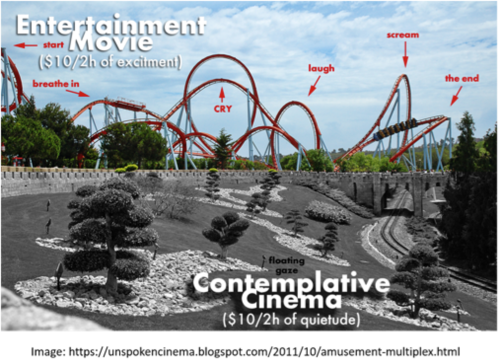
Most films rely on conventional storytelling and film-making methods to engineer filmic experiences that maximize entertainment value. Like an amusement park, they are intentionally constructed to solicit emotional responses that satisfy (which is why consumer research is incorporated into creative decision-making processes). By contrast, contemplative films feature a lot of ambiguity, empty space, and pause for reflection, inviting viewers to relate to the film and make meaning in ways that are personal. They are often very demanding films, because they require careful attention and emotional engagement and may involve subject matter that exposes us to vulnerability. But for this reason, they are also among the most transformative to watch.

Ecocinema is another genre of films that explicitly examines our relationship to ‘nature.’ Often, they present ‘nature’ through non-anthropocentric (biocentric, ecocentric, or posthuman) lenses and address issues of environmental justice.[ii] By doing this, they question the role of the human (Greek, anthropos) in the Anthropocene and challenge us to consider our responsibilities toward other living beings. There are a surprising number of films that fall into either of these categories: contemplative cinema or ecocinema. Though they are not widely distributed, many of them can be easily accessed on the internet. To learn about contemplative cinema, I highly recommend the Unspoken Cinema blog,[iii] and to learn more about ecocinema, I recommend exploring the growing body of ecocinema studies.[iv]

Screenshot 2017-12-04 06.32.21.png

Personally, some of my favorite contemplative ecocinema include: Samsara (dir. Fricke), Visitors (dir. Reggio), Koyaanisqatsi (dir. Reggio), Manufactured Landscapes (dir. Baichwal), Behemoth (dir. Liang), and Our Daily Bread (dir. Geyrhalter). Although I would not technically consider them contemplative ecocinema (since they rely on a more explicit and dialogue-driven narrative structure), I would also highly recommend: Stalker (dir. Tarkovsky), Mindwalk (dir. Capra), Home (dir. Arthus-Bertrand), and Terra (dir. Arthus-Betrand).

The reason I choose these films is personal, and there are substantive differences between them; but in each case, they evoke an affective ecology of objects, sounds, and narratives that implicate me (as a viewer) in an experience of social and ecological injustice, while inducing a variety of personal responses to my felt presence and engagement in those injustices. The original meaning of ‘affect’ within affect studies (traced back to Deleuze’s 1978 lectures on Spinoza) is an “increasing and decreasing capacity to act.”[v] The combination of objects, sounds, and narratives in these films have profoundly transformed my understanding of the human-nature relationship to the extent that they continue to impact me and inform my behavior long after watching.[vi] For example, the film Samsara evokes visceral feelings of heart-break, awe, and beauty that remain inscribed in my memory and deeply inform my resolve to redress injustice. Similarly, my experience watching coal miners suffering from respiratory ailments in Behemoth motivates my ongoing activism in China where air pollution contributes to the deaths of 4,400 people per day.[vii]What is unique about contemplative ecocinema is that it makes the viewer aware of invisible subaltern realities, and in so doing, invites us to take responsibility for our entanglement with social and ecological injustices. Watching these films as an engaged mindfulness practice is an excellent way to cultivate fierce compassion.

To conclude, I would like to invite you to experience contemplative ecocinema. If you consider these films to be sacred objects, as I do, you may consciously choose to watch them at particular times in particular situations with particular people. With respect to one’s tradition, I encourage you to find ways to integrate viewing experiences within your existing spiritual practice. To do that, I offer the following video and some basic instructions for viewing:http://www.youtube.com/embed/fFFtYMJ4ylk?time_continue=25&wmode=opaque&enablejsapi=1

CONTENT WARNING: These images portray scenes of injustice. Please watch mindfully. 

Before watching, set an intention. While watching, maintain a meditative posture. Consider your affective reactions to what you see and hear. Notice how you make sense of the relationships between what the film presents and yourself. After watching, take some private moments to reflect upon and process your experience; then later, consider discussing the film with others.

Endnotes

[i] http://ecociv.org/

[ii] Paula Willoquet-Maricondi, ed., Framing the World: Explorations in Ecocriticism and Film (Charlottesville, VA: University of Virginia Press, 2010).

[iii] http://unspokencinema.blogspot.com/

[iv] Kiu-wai Chu, “Ecocinema,” Oxford Bibliographies, Last modified March 30, 2017, DOI: 10.1093/obo/9780199791286-0252. http://www.oxfordbibliographies.com/view/document/obo-9780199791286/obo-9780199791286-0252.xml

[v] Ondine Park, Tonya K. Davidson, and Rob Shields, Introduction to Ecologies of Affect: Placing Nostalgia, Desire, and Hope, edited by Tonya K. Davidson, Ondine Park, and Rob Shields (Waterloo, ON: Wilfrid Laurier University Press), 4.

[vi] Alexa Weik von Mossner, Affective Ecologies: Empathy, Emotion, and Environmental Narrative (Columbus, OH: The Ohio State University Press, 2017), 7.

[vii] Robert A. Rohde and Richard A. Muller, “Air Pollution in China: Mapping of Concentrations and Sources,” PLoS ONE 10 (8): e0135749. https://doi.org/10.1371/journal.pone.0135749.


Personal Photo.jpg

Zack Walsh is a Senior Researcher of Economics and Governance at the One Project. From 2016-2020, he was a Research Associate at the Institute for Advanced Sustainability Studies (IASS) in Potsdam, Germany where he co-led the A Mindset for the Anthropocene (AMA) project. He has completed doctoral coursework in Process Studies at Claremont School of Theology, and is a fellow of the Courage of Care Coalition and a partner of the Institute for Ecological Civilization.

Please connect: https://cst.academia.edu/ZackWalshhttps://www.facebook.com/walsh.zack, email: zachary.walsh@cst.edu

The Ahuman

Patricia MacCormack

The ahuman is a concept coined in the 2014 collected anthology The Animal Catalyst: Toward Ahuman Theory. It sees posthumanism in a parabolic configuration to challenge both the evolutionary monodirectional linearity of cyber biotechnic-based posthumanism and the increasing use of nonhuman animals in posthumanism as a devolutionary metaphor.

The ahuman’s parabola has in one direction nonhuman animals and in the other something which refuses the privilege and signifying systems of the human but does not institute a new version of posthumanism which would continue those tendencies albeit in a mutated form. The apex of the parabola is the (now defunct myth of the) human. The nonhuman animal and the ahuman are thus close in proximity but absolutely extricated from each other simultaneously.

Ahuman theory comes from two motives. The first is the increasing movement from animal rights to absolute abolition. Animal rights traditionally serves the interests of nonhumans based on equivalences with humans and is a flawed politics of equality (equal to the human) rather than difference. Abolition sees the rights of any entity based on not what it is but that it is. Human compulsions to define animal rights define the animal and the discourse is ultimately one between humans and their dominant perceptions of nonhuman entities in order to vindicate their exploitation of those entities.

So all animal studies is inherently human studies between humans of the other and has no nonhuman benefit except in its capacity to catalyse humans to stop being human. In animal rights and animal studies the nonhuman is imposed within a structure for which it has neither given consent nor has the power of address and for this reason becomes the differend after Lyotard’s description of the victim who cannot be plaintiff because it cannot manipulate the master’s discourse.

Abolitionists are activists against all use of animals acknowledging communication is fatally human so we can never know modes of nonhuman communication and to do so is both hubris and materially detrimental to nonhumans. Abolitionists advocate the end of all use of all animals for all purposes and select words to exchange for those in circulation in describing the oppression of nonhumans – ‘food’ (cannibalism for meat, rape and theft and murder of young for dairy and chicken use, murder), ‘entertainment’ (enslavement), ‘research’ (torture) and so forth.

Abolitionist philosophers are also against the fetishisation of nonhumans in posthuman becomings and refuse the use of human perceptions of nonhuman systems and entities as assimilative and co-optive. In both incarnations, abolitionism remains antagonistic to and is considered radical by animal rights, animal studies and ethology in its refusal to utilize animals.

Abolition, after Serres, follows the tenets of symbiosis which is a form of necessary care and grace which is a leaving (to) be in reference to human-nonhuman inevitable interaction – a natural contract which overthrows the entirely social contract within which most current debates around nonhuman entities occurs and which thus will always exclude them. The second motive for ahuman theory negotiates the question of what becomes of the human when it is neither posthuman cyborg nor animal fetishist. We remain non-nonhuman animals yet we must still acknowledge our biological organism’s place within the ecosophical series of relations.

Ahuman theory promotes catalyzing becoming-other from the majoritarian or all human privilege and renouncing the benefits of the anthropocene. This can occur in infinite ways. Some of the suggestions offered include the use of all manifestations of art to form new terrains of apprehension of the world and encourage new ethical relations between entities, the cessation of reproduction toward an end of the human as a parasitic detrimental species, and thinking differently about death by advocating for suicide, euthanasia and a good life over biotechnologies drive for immortality. However these are few of any variety of tactics which could shift human signifying systems toward ahuman asemiotic reterritorializations of connectivity and novel participations. 

Text first appears as entry under ‘Ahuman’ in

The Posthuman Glossary, Bloomsbury, edited by Rosi Braidotti and Maria Hlavajova (2018)

TIME TO REI(G)N BACK THE ANTHROPOCENE?

Andy Stirling

First published by STEPS centre 2015

I was very lucky to be able to participate in last week’s Stockholm Resilience Centre conference on Transformations 2015: People and Planet in the Anthropocene. Involving a dynamic and highly policy-influential global interdisciplinary community, this was a large, friendly and very interactive meeting. It more-than-fully lived up to the very high standards set by earlier meetings. Discussions were provocative, informative, engaging – sometimes boggling, often inspiring… and a lot of fun.

After some very useful discussions at a session on the recent STEPS Centre book on the Politics of Green Transformations’, I greatly appreciated being asked to join a plenary debate with Marcella D’Souza, Elin Enfors and Laura Pereira on the recently-signed Sustainable Development Goals.

Kicking off the conversation, Elin asked about the implications of this important global initiative for the way science had been framed at this SRC conference. In particular, this focused attention on the opening presentation by Johan Rockström on ‘the Challenge of Sustainable Development in the Anthropocene‘. In his inimitably clear and compelling way, Johan had addressed environmental aspects of Sustainable Development in the precisely-quantified, tightly-integrated terms of ‘planetary boundaries’ – framed according to the very particular lens of ‘the Anthropocene’.

theworld2
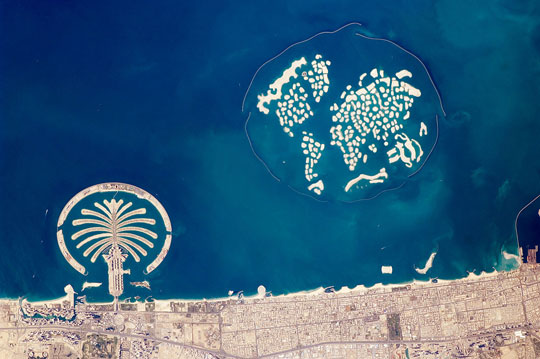
Dubai coastline and three human-made archipelagos…

Not surprisingly given some of my own earlier work and that of STEPS colleagues, my response to this question included a quite strongly critical take on ‘the Anthropocene’ as a way of framing science for Sustainability.

In short, I expressed serious concerns about the kinds of agency asserted in the notion of ‘the Anthropocene’. Without denying the complexities in this – and despite the best intentions – I argued that this mood of externally-oriented control can oppose and undermine the real values essential to Sustainability: instead laying the foundations for planetary geoengineering.

Notwithstanding their own compromises, complications and drawbacks, the principal framings of the Sustainability Development Goals are, by contrast, more about challenging than celebrating incumbent power.

CHALLENGING POWER

Pursuit of the SDGs is not about one notionally-singular human agency exerting outward control. Indeed, interest in externally-oriented domination is arguably closer to the forces that are causing presently exponentially increasing social and environmental impacts.

Instead, progress on the SDGs requires more diverse collective actions – including care, solidarity, accountability, responsibility and self-discipline. And these involve reducing unsustainable impacts from within the diversity of human affairs, rather than asserting some monolithic human control outward over the entire planet.

In order to develop Planetary Boundaries debates in ways that better support the more progressive potential of the Sustainable Development Goals, then, I argued that Planetary Boundaries should be freed from their present close association with the Anthropocene.

So why make such a point? The issues are so important and I admire and share so much with the SRC community, that there is no time or space for self-indulgent academic criticism.

But – for reasons I expand on here – I think the problems I sketched are very substantive and of the utmost importance. Real political choices are being made, about how Sustainability is to be interpreted, the directions in which it is going – and the kinds of futures to which it might lead. With the SDGs just signed, now is the time to reflect and critically deliberate on how best to make the ‘right’ choices (whatever these might variously be seen to be).

With distracting and overbearing aspirations dropped to ‘outward’ Anthropocene planetary control, the nine physical “boundaries” can more effectively face ‘inward’ onto the problematic political-economic structures and interests – helping to substantiate the environmental side of the SDGs and work more closely with their socially progressive grain.

WHERE DOES THE ‘ANTHROPOCENE’ LEAD?

But why such concern that the Anthropocene is so much about externally-oriented control? This is a complex and sophisticated discourse, with diverse voices and implications. And of course, such an emphasis is often far from intentional. Counter-examples can always be found. Yet the dynamics of discourse are not about individual eddy currents, but overall flows of meaning and their political effects.

Whether it be in Paul Crutzen’s foundational Anthropocene idea of humanity “taking control of Nature’s realm“, or John Schellnhuber’s vision of “a self-conscious control force that has conquered the planet” or Johan Rockström’s own framing (with other colleagues) of Anthropocene planetary boundaries as “control variables” – this is clearly mainly about control. And associated work by Johan and others also gives a pretty clear sense of what style of control this is – variously described as non-negotiable, with absolutely no uncertainty”, brooking “no compromise.

Beyond this, burgeoning literatures on planetary management and “earth system governance” further confirm and elaborate what Anthropocene ambitions mean in practice. Despite the complexities and qualifications in many of these sophisticated discussions, what is mainly being targeted are not just particular offending industrial activities, social practices, institutional structures, economic interests or political cultures within human societies. Even this level of control would be daunting – and unprecedented.

But the clue is in the name. What “planetary management” requires, extends far beyond governance of merely human affairs (in all their intractable unruliness). It encompasses aspirationally determining power over the even more recalcitrant “Earth System” itself. Whether acknowledged or not, this is where there begins to entrench, a path that leads to geoengineering.

A COSMOLOGY OF CONTROL

Indeed, in another wonderfully animated talk just before Johan’s own, Australian scholar of ‘big history‘ David Christian outlined a very graphic fourteen billion year ‘origin story’ for the Universe as a whole. Deliberately presented as a creation myth, this reproduced the usual analytic-normative duality of all such narratives: diagnosing in the same theme as the prescription.

And this theme was, again, control: emphasising this time not only how the destiny of humanity, but the identity of life itself, can (and should) be seen in terms of ever-growing capacities to command information in order to control the external world. In this potent allegory, the advent of humans is suggested as a “threshold moment” not just for the Earth, but for the Universe more widely.

The result was a truly forceful cosmology for Anthropocene control. And the upshot of all this for Sustainable Development was well expressed in Johan’s own talk. Anthropocentrically portraying the brief Holocene period as “our Eden”, Johan was very clear that the Anthropocene imperative far transcends visions of merely human self-control. Implying an appropriation of agency over the destiny of the planet as a whole, the aims expand to “returning the Earth to Holocene conditions”.

Behind the compelling banner of reversing mass-industrial destruction, then, it is clear something very different is also going on. The idea is not just to attenuate the present episode of catastrophic damage. On a planet where radical endogenous change has been a norm over geological time, the implication of maintaining Holocene conditions, is the effective flat-lining of even natural oscillations into an indefinite future.

What then has happened to any autonomous agency, or even contingency, on the part of ‘Gaia’ herself? Beyond curbing human impacts, a move is emerging to tame to presumptive internal human ends, the very deep time of the Earth.

A GOOD ANTHROPOCENE?

And this is where there comes to the fore another theme repeatedly returning at the Conference – including in the framing of several sessions. Even merely as an idea, what are we to make of increasing talk of “the good Anthropocene”?

This language might be understandable in the mouths of ‘ecomodernists’ or ‘transhumanists’ – unimaginatively propounding incumbent patterns of power, elite culture and associated innovation. Here, “a good Anthropocene” is one securing ‘business as usual’ for ‘the usual suspects’. But these are the very interests and forces most implicated in entrenching the problems that Sustainable Development Goals seek to challenge.

So, what can “a good Anthropocene” mean among anyone committed to progressive Sustainability? If realising the Anthropocene by definition entails – as is so clear – the effective devastation of the Holocene; what could possibly be “good” about this for environmentalism or social justice? In flirting with notions of “the good Anthropocene” the best of intentions in this community risk opening the door to an especially insidious ecomodernist, transhuman subversion of Sustainability.

“DOMINION OVER CREATION”

Yet, although heralded as new, aspirations to the formidable transhuman powers of the Anthropocene are not unprecedented. Indeed, they are in one guise quite familiar. Far from characterising some notional homogenous destiny for humanity as a whole (itself seen in a one-dimensional way), what is speaking here is a much more parochial (if still longstanding) cultural voice: the foundational Baconian tradition in science.

It was this pioneer of the experimental method, Francis Bacon, after all, who more than four hundred years ago remarkably anticipated Crutzen’s Anthropocene vision, in his own resolve to exercise “dominion over Creation”. Recognising aspirationally that “knowledge itself is power”, Bacon’s task for science was also prophetic: “to put nature on the rack and torture her secrets out of her”.

With deliberate Anthropocene planetary management inevitably amounting to experimentation on a global scale, the metaphor is horribly apt.

But, apparently unlike Crutzen, Bacon presciently noticed a crucial paradox of control – also not without deep implications for the Anthropocene. As attentive as any torturer should be to actualities rather than expedient fictions, Bacon also observed that: “we cannot command Nature except by obeying her”.

EXERCISING CONTROL OR REPRODUCING PRIVILEGE?

In Bacon’s case as in others, then, it seems that domineering rhetorics of control must quietly succumb in the end to more gentle concessions of the recalcitrant complexities of reality.

Indeed, perhaps the point of this language of domination is not so much substantive description as social performance – as much about reproducing privilege as exercising control? Perhaps a similar dynamic drives the hungry uptake of Anthropocene language by some current incumbent interests?

After all, even in the contemporary world, the most powerful political agency – as for instance described by US President Barack Obama’s former Chief of Staff Rahm Emmanuel – must acknowledge that deterministic control is less important than the opportunistic surfing of contingent crises. And British Prime Minister Harold MacMillan underscored the same reality, in lamenting his own ever-present vulnerability to events, dear boy, events.

Even within human affairs, then (let alone beyond), notions of control seem expediently overstated. In Bacon’s times as in our own, it seems that polemics of control tell more about how political cultures wish to represent themselves, than about what they might actually find it possible to do.

A DISCOURSE OF FEAR, NOT OF HOPE

It was on these grounds that I argued at the SRC conference against the Anthropocene vision of externally-oriented control, as a way to frame science for Sustainable Development.

And the point is not just that Anthropocene notions are a contingent distraction. Albeit unintended, the confusing of manifestly disastrous current human impacts for some form of incipient “control” or “domination” of the Earth, is far from politically innocent. It is like invoking responsibility for criminal destruction, as grounds for proprietary rights. And the thrust is not merely oblique, but diametrically opposed to the central values of Sustainability.

This is a discourse of fear, not of hope. It is about subordination, not emancipation. It substitutes imagined certainties of control, for the experienced ambiguities of care.

REMEMBERING THE ROOTS OF SUSTAINABLE DEVELOPMENT

In judging whether all this is simply colourful argumentation, it is worth quickly reflecting on where the Sustainable Development Goals came from in the first place. Neither the Brundtland Commission of a generation ago, nor the equally notable Stockholm Environment Conference nearly a generation earlier, were mainly driven into being by any form of control. The formative dynamics were not those currently-emphasised, in the painstakingly-designed collaborative procedures of Anthropocene ‘planetary management’ or ‘earth systems governance’.

Instead, incumbent powers of many kinds and in many sectors, had to be dragged to these developments – often kicking and screaming! – by agonistic struggle. Although elite interests and top-down instruments played crucial roles at particular points (and leave their abiding imprints – including in the SDGs), the potently persistent momentum behind Sustainability came from messy, plural, unruly collective action by a ‘counterculture’ of social movements, not instrumental ‘evidence-based’ control from above.

And no-one has greater cause for humility in this regard, than those institutions of global elite science that are now so enthusiastically propounding Anthropocene control.

When environmentalism was more about subaltern rebellion rather than incumbent control, mainstream science was as generally opposed to the nascent Sustainability agenda as were other entrenched interests in government and business. And this was as true of the framing of the problems of Sustainability as of the prospective responses.

For instance, it is a Baconian paradigm of control still embedded in conventional ‘sound scientific’ risk assessment that resists to this day, in international trade disputes, the greater illumination of uncertainty by the precautionary principle.

And it was precisely the incumbent economic and political interests for whom general agendas of control are so appealing, who for so long suppressed the crucial innovations that give hope of Sustainability: like renewable energy, recycling, green production, ecological farming, grassroots innovation.

POWER AND KNOWLEDGE

To analyse incumbent science and other institutions in this way, is not idealistic or partisan. It is about realistically appreciating the ubiquitous dynamics of power – including in the framing of knowledge. And why this is so important, is because the Sustainability movement achieved so much over recent decades, that now seems jeopardised by the Anthropecene elision of ‘impacts’ with ‘control’.

It was a key achievement of the Brundtland formula, that environmental goals were linked intrinsically to progressive social imperatives for human wellbeing, social inclusion and political equality.

This is not only important in the consequences of contemporary global political economies, but in the processes through which these are understood. Here, it is crucial that (amidst the inevitable negotiated qualifications) the Brundtland Commission also emphasised the pervasive general importance of democratic struggle – as much in the production of knowledge about Sustainability and what it means, as in the implementation of resulting collective actions.

It is in warping these kinds of imperfect-but-progressive struggles for Sustainability, that I believe any continued move towards an Anthropocene framing of the SDGs would impose its most serious threat.

Along with other current strands in environmentalism, it actually reinforces pre-existing pressures for authoritarianism. With “100 months to save the planet” (now nearly up!), strident voices are already insisting that urgency compels obedience. Democracy is increasingly dubbed a “failure” or a “luxury” that cannot be afforded – or even queried as an “enemy of nature”. The iconically influential environmentalist, Jim Lovelock, insists that “democracy must be put on hold for a while”. Formerly rebellious NGOs now move from seeking to represent social movements against established power, to delivering for incumbency the controlling instruments of “nudge”.

It seems the original emancipatory thrust of Sustainability – combining compellingly the imperatives of social justice and environmentalism – is in real danger of being lost.

SCIENCE AND DEMOCRACY

And – since the original conference question was about the framing of science – it is worth making a final remark specifically about science itself.

It is a further reflection of the above dynamic, that democratic struggle is too often nowadays seen as if necessarily in tension with science. In fact, if science is understood for what it is – rather than how powerful incumbent interests wish to represent it – then nothing could be further from the truth.

Despite the performative rhetoric of Bacon – and alongside this authoritarian tradition – the aspirational dynamics of democratic struggle also form foundational qualities that help distinguish science from many other ways of producing knowledge.

For instance, when compared with knowledges often produced under religious dogma, political orthodoxy or disciplinary doctrine, it is the democratic qualities of idealised scientific practice that (at their best) offer the distinctive robustness of science.

Albeit never fully realised, what is striven for by key institutions of ‘the republic of science’ (like peer review, communitarian sharing, accessibility across class or race or gender, respect for uncertainties and organised scepticism) is the effective reinforcement of democracy. As the motto of the British Royal Society (deliciously paradoxically!) proclaims nullius in verba – ‘not on any authority’. This vision of science is as counter to uncompromising forms of Anthropocene control, as is Sustainability itself.

This concern over the authoritarian control agenda embedded in the Anthropocene is as much about respecting crucial constituting aspirations in science, as about reinforcing democratic struggles that are have always been – and continue to remain – so necessary for progress towards Sustainable Development.

And this is why it is so important that – for all the past connections and complexities – Planetary Boundaries and ‘the Anthropocene’ should actually be seen as crucially distinct. Neither needs the other. Each can be different on its own.

In particular (despite their own shortcomings and suppressions of uncertainty), suitably-developed Planetary Boundaries may potentially help to add further responsibility and accountability on the environmental side, to the wider emancipatory thrust of the Sustainable Development Goals.

What the externally-oriented control of ‘the Anthropocene’ does to Planetary Boundaries, is risk tipping them away from being a potentially progressive intervention, into a more definitely regressive one. Instead of accountable restraints on incumbent political and economic interests, acting as self-discipline inwardly within diverse human societies, they become the “control variables” for outward planetary domination by whatever interests are successful in capturing the notion of a singular-structured humanity.

This undermines the clear challenging of incumbent global interests, as is offered (at their best) by the emancipatory agenda of hope in the Sustainable Development Goals. Instead, if only inadvertently, the Anthropocene framing threatens to reinforce in the Planetary Boundaries, a fear-driven doctrine of technocratic control. And the emphases on control also helps to circumscribe imaginations of other kinds of action, further reinforcing the incumbent interests, concentrated power and detached privilege that are also so dependent on rhetorics of control.

It is these particular political economic configurations – not humanity in some comprehensive sense – that are most implicated in all the social and environmental destruction. It is these identifiable forms of lock-in within societies, which continue to form the most formidable obstacles to transformation. After all, if the problem were ‘humanity’ as a whole in some unqualified way, what hope would there be?

WHAT IS SUSTAINABILITY?

What Sustainable Development is about instead, is the re-entangling of diverse human values and aspirations with the unknowable and uncontrollable complexities and dynamism of the Earth itself.

Here, the three Brundtland pillars of equity, well-being and integrity – now further articulated in the Sustainable Development Goals – are not just specific to human societies or their ecological environments. They also refer to the intimate relations between the two (and how these are understood).

Sustainability is therefore not just about the emancipatory will to advance the human condition, merely to ‘go forward’ – but about enabling the even more audacious possibility of equitable social agency over the directions in which such progress should actually best unfold. It is not about closing down around a single determinate idea of humanity, but about opening up imaginations of the multiple contending kinds of societies in which human ways of being can unfold.

This is a diametrically opposing vision to the monolithic instrumentalism of the Anthropocene. It involves many modes of caring, more than externalised control. It is about acting with solidarity, humility, responsibility, accountability and self-discipline – to express the many different ways in which diverse human societies relate to their disparate experiences of the Earth.

To reduce this to planetary control, risks an irreversible betrayal of the real hope of Sustainability. Fortunately (in ways so inspirationally explored in the community in and around the Stockholm Resilience Centre) humanity has more plural, grounded and vibrant alternative choices – to live more modestly on (not over) the Earth.

What coronavirus reveals about the Anthropocene

March 14th, 2020

David R. Cole

The global pandemic spurned by coronavirus (COVID-19) is well under way. I have no desire to spread further false or misleading information about the disease, as I am not an epidemiologist. However, as I have been thinking quite deeply about the Anthropocene for several years now, I feel well-equipped to relate this outbreak and its spread to the Anthropocene. What is interesting for me as a social commentator, educationalist and philosopher, is what the outbreak is revealing about the state of our global society, how we relate to it, and our thinking about pan-international-social-health-issues:

  1. The virus started in China. This should be no surprise, as China still encourages and allows for live animal markets, borne out of a continuing faith in traditional Chinese medicine. It has been said that the new virus may have been transmitted to humans from bat guano and pangolin meat in a live animal market in Wuhan. The markets are densely populated with humans and wild animals, making transmission of novel viruses such as COVID-19 more likely via bodily excretion and fluid interchanges. From the initial identification of the novel virus in Wuhan, it has now spread to 123 territories or countries as of March 14th, 2020. Clearly, it is an extremely transmissible disease from humans to humans, similar to colds and the flu.
  2. The global reaction to the origination of the disease in China and the wild animal markets is complex. Many countries are now putting local and international quarantine measures and travel bans in place, though many have still not, and many have been slow to act. To an extent, the disease still comes across as being something exotic, unusual, and unlikely to affect us, or with limited effects, despite the evidence to the contrary, suggesting the high transmissibility of the disease, and the relatively high death rate (1-3%), especially amongst older people, and those with underlying health problems. In effect, the first two points are directly related to the Anthropocene: it is something out there, not directly related to us, or connected in a complicated, rather exotic way; it is something that is hard to understand, and that we can really do nothing about, so we may as well go on as before (why should I change my life anyhow?).
  3. The high transmissibility and global spread of the disease points to the international transport options open to us via planes. COVID-19 has been primarily spread internationally out of China via planes, and latterly through local routes of human transport, and human to human contact in situ. All transport routes via planes emit carbon dioxide via the burning of jet fuel, so one of the inverted effects of the COVID-19 outbreak will be to slow the emission of CO2 via a diminished number of international flights, at least until the pandemic subsides. This amounts to a potentially positive result for the Anthropocene. Of course, this reduction in international travel will be reported globally in terms of the loss of jobs and revenue in the airline and tourism industries. This point leads to the connection between the pandemic outbreak and integrated world capitalism (IWC).
  4. World trade is entirely interconnected in the Anthropocene. The outbreak started in China, where much of the world’s manufacturing has been relocated due to low labour costs and the ability of the Chinese to effectively run and control factories. The quarantine and social isolation effects of the virus will lead to a slowing in manufacturing in China and elsewhere as work ceases. As such, and as all industrial processes are presently connected to CO2 release in some way; this will, in addition to the slowing of world travel due to air travel restrictions, lead to a lowering of CO2 emissions, at least for the course of the pandemic. Moreover, the translation of this inevitable slowing in the world economy, will be to directly hit the world stock exchanges and flows of money, as investors and traders have to guess where, when and what the specific effects of the pandemic will be on trade. Hence, one of the most noticeable effects of the COVID-19 virus is to increase the imagined connections between the world economy, global speculation and health, as investors try and read what will happen at these levels. This important aspect of the Anthropocene is mirrored and connected to local effects of the pandemic.
  5. At a local level, every jurisdiction in the world can be seen as a case study of action in the Anthropocene. Governments have already started to announce intertwined health and economic measures to counter the threat of the virus on their populations. Some of these measures will be successful, other will not, because, for example, the injection of large amounts of cash into the economy, will be seen by some as a reason for financial weakness, and could encourage the panic selling of stocks. However, what these actions show is what governments are capable of in times of crises, and, in particular, in times of human health crises, and the accompanying economic effects, as industries struggle to function under changed social conditions of isolation and quarantine. One could say that climate change only receives similar governmental attention when there are direct effects on human populations, such as bush fires and floods.
  6. Concurrently, many ecologists, social activists, and environmentalists have been encouraging action at the local and personal levels to combat the effects of climate change for many years. The COVID-19 crisis shows us, that, however well-meaning, earnest and correct these local efforts might be to combat climate change, and despite the rhetoric of right-wing politicians, saying that we do not live in a globalised world (i.e.: make your country great again), the global interconnections of the Anthropocene, as proved by COVID-19, is unassailable. This interconnection is augmented and morphed through the internet, and the instantaneous transmission of information around the world (however inaccurate and/or ill-informed this might be). As such, local and personal action, and agency as such in the face of threats such as COVID-19, must be backed up by coordinated and extensive action on the global level. This is exactly what has proven to be so hard to mobilise and achieve internationally in terms of climate change in the Anthropocene.
  7. Finally, in many places, a type of panic response to COVID-19 has begun to set in, akin to a science fiction novel. In the anonymity of the suburbs no-one knows what you’re really thinking, so bulk buying toilet paper, pasta, rice and canned goods, might appear to be acceptable because no-one cares. In the end, the pandemic becomes another spectacle to watch on TV whilst self-isolating and quarantined, and like the unfolding of the Anthropocene, we can distance ourselves from it in the position of the spectator, now banned from organized sporting events, but allowed to stockpile food and toilet paper and letting the madness roll on unabated…