AGAINST THE AESTHETICIZATION OF TECHNOFOSSILS

Considering Migrant Labor and Petrochemical Feedstocks in the Future History of Plastic

Plastic and its waste are eye-catching and culturally laden materials. Given that their histories have become entangled with the notion of the technofossil, how can we resist the temptation to aestheticize this material legacy which is accumulating in the rock record? Guiding us through the historical roots, current excesses, and future imaginations of plasticulture in Germany, Spain, and Brazil, historian of technology Andrea Westermann highlights the interconnection of health and environmental hazards as well as consumerism and the exploitation of migrant labor. She calls for including mining and mineral resource issues into future histories of plastic.

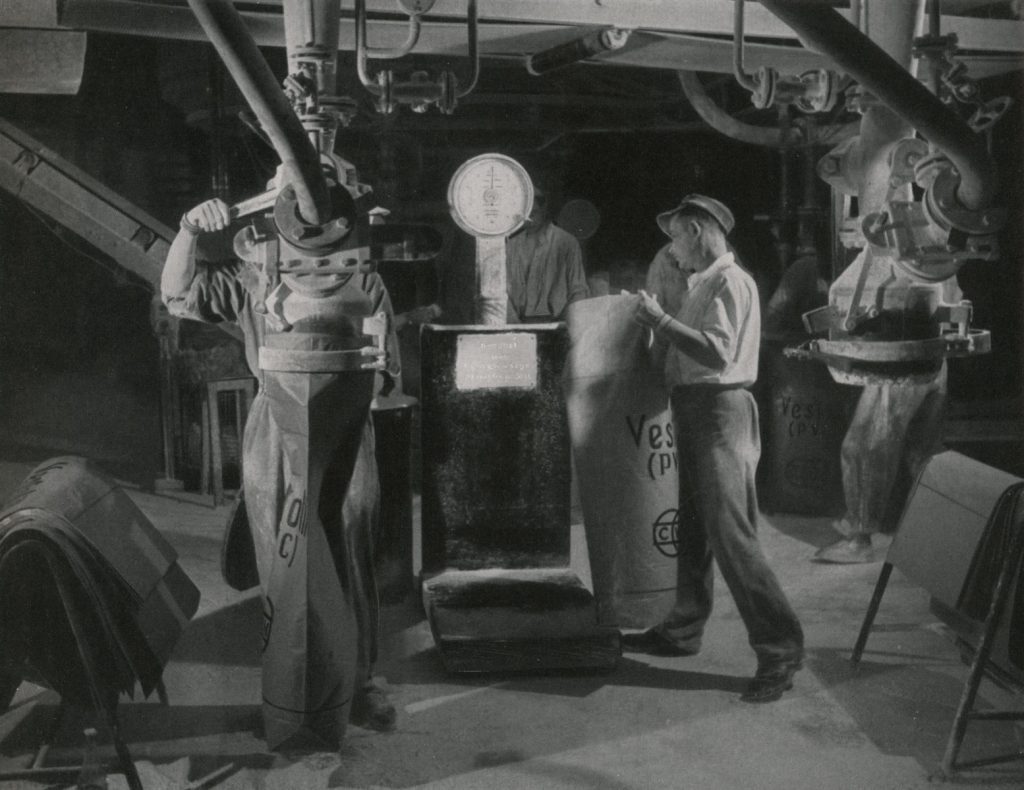
Factory workers bagging and inhaling polyvinyl chloride powder at the Hüls chemical factory in Marl, Germany, some time before 1956. Photograph from Walter Mertzig and Erich Büttgenbach, Kunststoff aus Gas. Düsseldorf: Econ, 1956; © all rights reserved to the original publisher

The technofossil notion and its aesthetic dimensions

Early on, researchers of Earth’s crust first suspected, then found, that the hard rock masses were “a register on which all physical forces acting upon the earth had mapped their successive deeds.” By the 1820s, the fossil-bearing sediments had become, “so to speak, a second control register where organic life had inscribed the various phases of its own parallel development.”August Christoph Carl Vogt, Lehrbuch der Geologie und Petrefactenkunde. 1846; repr. Braunschweig: Vieweg, 1866, pp. 9–10. Merriam-Webster Dictionary defines a fossil as “a remnant, impression, or trace of an organism of past geological ages preserved in the earth’s crust.” Examples include stone imprints of plant stems, leaves, and animal structures (bones, shells), fossilized traces that animals had left behind, and objects preserved in amber. Fossils have long been eagerly collected and much admired. Geology and paleontology have depended, in their study of fossils, on the epistemics and aesthetics of ruination, that is, the material process of decay. Minerals such as petroleum, coal, and metal ores counted as fossils well into the nineteenth century, but have since been removed from the “fossil record.” Still, both the figurative dimension of fossils and the economic value of mineral ores or fossil fuels (note the vestigial semantics!) were crucial in creating the field of geology.

Today’s Anthropocene geologists examine not only the fossil-bearing rock records but also the ongoing accumulation processes in unconsolidated media that might one day turn into crustal matter. They extrapolate the compact lithosphere of the far future from an utterly diverse biosphere, hosting innumerable flows and cycles, actions, organizations, species, and artifacts. Jan Zalasiewicz et al., “The Technofossil Record of Humans,” Anthropocene Review, vol. 1, no. 1: p. 36; Jan Zalasiewicz et al., “When Did the Anthropocene Begin? A Mid-Twentieth Century Boundary Level Is Stratigraphically Optimal,” Quarternary International, vol. 383: p. 199; Nigel Clark et al., “A Solid Fluids Lexicon, Theory, Culture & Society, September 13, 2021: https://doi.org/10.1177/02632764211030976. From these cycles, geologists have picked up on plastic as a candidate for becoming, in Earth’s deep future, an index fossil or technofossil of modern societies—emerging in the stratigraphic record alongside growing carbon dioxide emissions, nuclear radiation, and highly intensive global species exchange and extinction. The 2013 presentation of geologically recycled plastic waste in the form of what has been called “plastiglomerate,” in particular, seemed to corroborate the idea and was widely noticed by the scientific community and the wider public. This stonelike entity found on Kamilo Beach in Hawaii is comprised of melted plastic, beach sediment, basaltic lava fragments, and organic debris. Geologist Patricia Corcoran and others have described plastiglomerate as a “marker horizon of human pollution” in the making. Also using the notion “fossilized” for plastics are: Patricia Corcoran and Charles J. Moore, “An Anthropogenic Marker Horizon in the Future Rock Record,” GSA Today, vol. 24, no. 6 (2014): pp. 4–8; Zalasiewicz et al., “The Technofossil Record of Humans,” pp. 33–43; Sarah Gabott et al., “The Geography and Geology of Plastics: Their Environmental Distribution and Fate,” in Plastic Waste and Recycling: Environmental Impact, Societal Issues, Prevention, and Solutions, ed. T. M. Letcher. New York: Elsevier, 2020, pp. 33–63. The notion of the “marker”—as used in the preceding phrase and in the title of this collection (Anthropogenic Markers)—has had a much more inconspicuous history when compared to the concept of the “technofossil.” For fossils not only feature in the geological record but they also have made recurrent appearances in the history of material culture. In 1866, for instance, the geologist Bernhard von Cotta explained the methodological parallels and affinities he identified between history and geology: “Just like the historian draws his conclusions by interpreting the position and nature of age-old instruments, the geologist draws his conclusions by interpreting the position and nature of the fossil remains of organisms.” Bernhard von Cotta, Die Geologie der Gegenwart. Leipzig: J. J. Weber, 1866, p. 273. Rather than a modern historian, von Cotta here might be referring to an archaeologist. One year later, Karl Marx put the analogy between fossils and the “relics” of tools or machines from the past to work in the social sciences, as did archaeologist and art historian George Kubler, in his longue durée “history of things,” in 1962, when he described man-made artifacts as “fossilized actions.” Andrea Westermann, “A Technofossil of the Anthropocene: Sliding Up and Down Temporal Scales with Plastic,” in Power and Time: Temporalities in Conflict and the Making of History, ed. Dan Edelstein et al. Chicago: University of Chicago Press, 2020, pp. 124, 130.

This entrenched and layered semantics made scholarly claims of plastic, and its fragmented and partly decomposed waste, becoming a globally discernable trace in the rock record of future Earth instantly plausible to many people. Plastic’s material traces would come to indicate past economic actions and cultural activities of by then lost societies. The ongoing interest in plastic things and their nonbiodegradable refuse amassed at lake shores and in marine environments is testament to the persuasiveness of the argument. Contemporary artworks made out of the flotsam and marine waste of mundane plastic commodities and single-service containers even add form and make palpable future technofossils. Julie Decker, ed., preface to Gyre: The Plastic Ocean. London: Booth Clibborn Editions, 2014, p. 12; Heather Davies, “Life & Death in the Anthropocene: A Short History of Plastic,” in Art in the Anthropocene: Encounters among Aesthetics, Politics, Environments and Epistemologies, ed. Heather Davis and Etienne Turpin. London: Open Humanities Press, 2015, pp. 347–58. I discuss some artworks in Andrea Westermann, “A Technofossil of the Anthropocene.” See also, for example, coverage of the marine plastic waste art by photographer Thirza Schaap: Jennifer Lichnau, “Schrecken der Meere,” Süddeutsche Zeitung, September 30, 2021: https://sz-magazin.sueddeutsche.de/kunst/thirza-schaap-kunst-90703. They infuse the concept with beauty and imagination.

Today’s plastic artists join the ranks of their mid and late twentieth-century art and design counterparts who first worked with these new materials. Artists and designers exposed their new synthetic, readily customizable properties, or they benefited from the ability of plastic to assume any desired form without putting particular emphasis on the how and why of their expanded resource base. In the 1960s and 1970s, plastic was definitely defining Western pop culture. The inflatable chair Blow, made by Zanotta out of transparent vinyl, for instance, came to shape the visual and visceral world of things as much as did British model Twiggy wearing a tightly cut vinyl dress. The sonic history of plastic added important nuances, too: think of vinyl as in vinyl records. Elodie Roy, “Another Side of Shellac: Cultural and Natural Cycles of the Gramophone Disc,” in Audible Infrastructures: Music, Sound, Media, ed. Kyle Devine and Alexandrine Boudreault-Fournier (Oxford: Oxford University Press, 2021): https://doi.org/10.1093/oso/9780190932633.003.0010. Environmental design, on the one hand, and artwork created from salvaged debris found in the environment, on the other, shared pop culture’s fascination with plastic while taking a more critical stance, gaining momentum in the 1970s and 1980s. Together, the latter two represent a second thread substantiating and feeding into the renewed wave of plastic “art in the Anthropocene.” See Davis and Turpin’s edited volume Art in the Anthropocene.

Plastiglomerates, 2013. These found object artworks were the subject of a scientific study by geologist Patricia Corcoran, oceanographer Charles Moore, and artist Kelly Jazvac. Photograph by Jeff Elstone, © all rights reserved Kelly Jazvac

There is much to gain from studying the aesthetic history of both plastics and fossils to illuminate how the technofossil metaphor serves as a tool of creative commensuration. Technofossils are aesthetically configured scaling devices: they allow people to slide up and down temporal scales and meditate on the long-term future via the still recognizable “archaeological” state of things. For while the pollution of the global environment with persistent toxins, novel materials, and radioactivity is real, most human-made materials, plastics among them, will, in all likelihood, not be preserved in an artifact-like form as the notion suggests. In other words: the technofossil metaphor offers a shortcut approach to the deep-time imaginary that relieves natural and social sciences scholars as well as the public at large from radically following geologists through the complexities of assumed sedimentary deposition and lithification processes and the metamorphic changes to the chemical structure and properties of plastics. For more details, see Andrea Westermann, “A Technofossil of the Anthropocene.” Like with any scaling operation, the epistemic benefit gained from this scaling device is due to imposing “a filter through which the system is viewed.” It inevitably comes with distractions and topical omissions. Simon A. Levin, “The Problem of Pattern and Scale in Ecology,” Ecology, vol. 73, no. 6 (1992): p. 1,943.

For alternative analyses of plastic’s role in the Anthropocene, historians could turn a blind eye to its aesthetic allure and instead pay attention to the circumstances of its chemical fabrication. Consider, for instance, the photograph (top) that documents not the eventual deposition but the original composition of plastics. It forms part of a marketing publication on vinyl from 1956 whose cover—thick, colored, and soft—was made of the same plastic its pages described in more detail. The men in the photo are bagging recently polymerized polyvinyl chloride powder (PVC or vinyl). We see a busy distribution hub for bulk plastic, where the vinyl powder coming through the tubes on the left and right is repacked in standardized sacks bound for PVC processing plants. We distinguish the brand name. The polymer was (and still is) called Vestolit, produced by Chemische Werke Hüls in Marl, Germany, and now part of a Mexican conglomerate.

The floor, workers’ clothes, and machines are covered in dust; the air is heavy with particulates. In a conventional strategy of industrial photography, the picture makes aesthetic use of the blurred lighting effects caused by air pollution. This technique is used both indoors and outdoors. See, for example, the urban works of Claude Monet around France, and of the Ruhr region, the paintings of Richard Gessner. See also Jesse Oak Taylor, The Sky of Our Manufacture: The London Fog in British Fiction from Dickens to Woolf. Charlottesville: University of Virginia Press, 2016. In doing so, it obscures the fact that the workers were inhaling the dust that had this immediate visual effect of softening the contours of the depicted men and machinery. Through repeated exposure, the dust also had imminent deleterious effects on a worker’s respiratory system. The health effects of PVC particles might manifest and progress many years after exposure has ceased. Moreover, at this point in the history of polymerization technology, considerable quantities of monomer vinyl chloride remained in the finished commodity powder. As was shown in 1973, this monomer was a cancerogenic agent that can induce different types of liver cancers. Andrea Westermann, Plastik und politische Kultur in Westdeutschland (Zurich: Chronos, 2007), 237–314. Given the worldwide production of plastics, vinyl chloride occupational health hazards were detected, denounced, and then studied internationally. From the early 1970s to the late 1980s, the media, consumers, and governments dealt with these unintended health consequences almost as prominently as they do with plastic gyres in the oceans today. This first major crisis for the plastic industry intersected with the more slowly mounting critique of plastic waste. Both problems, new at the time, highlighted and exacerbated each other.

Today, we see a return of the very same reassessment: abundant plastic recast as a health hazard. Plastic-filled ocean gyres have gone from being considered massive accumulations of modern refuse, foreseen and feared by environmental activists since the late 1960s, to epitomizing how societies have cast away their waste only to get it back in due time via Earth’s hydrological, atmospheric, and biochemical cycles. To achieve plastics’ desired properties and functionalities, producers add catalysts, polymerization solvents, plasticizers, metals, dyes, flame retardants, UV stabilizers, antioxidants, and antimicrobials. John N. Hahladakis et al., “An Overview of Chemical Additives Present in Plastics: Migration, Release, Fate and Environmental Impact during Their Use, Disposal and Recycling,” Journal of Hazardous Materials, vol. 344 (2018): pp. 179–99. Once sunk in the ocean, plastic fragments not only leak (some of) these ingredients but also attract free-floating chemicals such as persistent organic pollutants stemming from various sources. Arguably, the potential health and environmental hazards plastics carry are nearly as varied as the polymer chains that form the structure and repository of their material characteristics.

For one thing, we can expect that plastic patches in the oceans and their implications and risks will initiate a wave of political and economic histories that tell how they became objects of bio(geo)chemical research and legal regulation within specific activist and scientific communities around the world. Max Liboiron, Pollution Is Colonialism. Durham, NC: Duke University Press, 2021. For an insightful insider’s outline of the emerging field of microplastics research in marine science and its challenges, see Juliana A. Ivar do Sul, “Why It Is Important to Analyze the Chemical Composition of Microplastics in Environmental Samples,” Marine Pollution Bulletin, vol. 165 (2021): https://doi.org/10.1016/j.marpolbul.2021.112086. The LABPLAS—Land-Based Solutions for Plastics in the Sea project is a current collaboration among various scientific laboratories working on plastics pollution funded by the European Commission, and it is no doubt worth analyzing from a science and technology studies perspective; for more, see https://www.aircentre.org/labplas/. Moreover, I have found additional plastic concentrations of a terrestrial dimension likewise in need of historicization—one observed, one invented: the first the so-called mar de plástico in southeastern Spain, accumulated by Andalusia’s horticulture since the 1970s, and the other the fantastically rich plastic deposit discovered in the Amazonian subsoil, called “the Matacão,” in Karen Tei Yamashita’s novel Through the Arc of the Rain Forest from 1990. The three geographic sites highlight each other’s similarities and dissimilarities, entanglements, and shared genealogies. To the afterlife of plastic as lingering waste, I join an episode of plastics put to industrial work as well as a glimpse into the mining history of plastic. While in this essay my attention is captured, once again, by the imaginary power these sites exude, I suggest thinking, via the example of the Plastic Sea dealt with in the next section, about the interdependency between plastic materials and migrant labor. In the case of the fictitious Matacão, discussed in the third section, I call for studying past and present changes in plastics’ resource base that have too long bypassed historical consideration.

The landbound “Mar de Plástico” in southeastern Spain: Histories of migrant labor

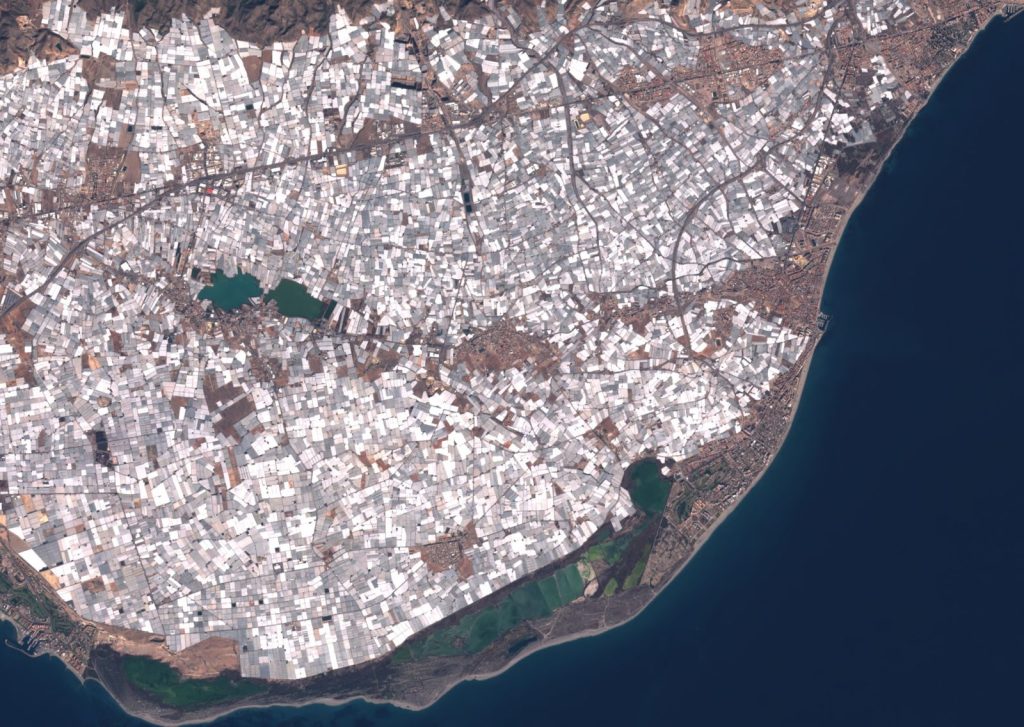
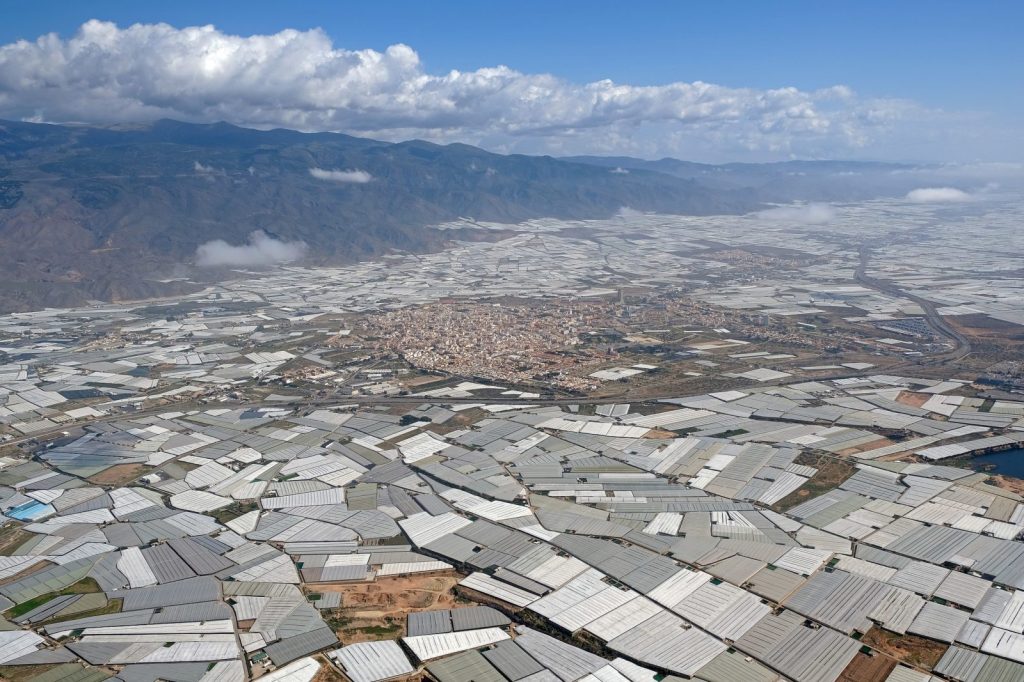
Find here the concise exposure of both the surface phenomenon and the social fact the Plastic Sea epitomizes. “From the lens of a passing satellite, Almería province is one of the most recognizable spots on the planet. The roofs of tens of thousands of closely packed plastic greenhouses form a blanket of mirrored light beaming into space,” historian and journalist Giles Tremlett writes in his 2005 report for the Guardian. Intensive agriculture, he continues,

“turned one of Spain’s poorest corners into Europe’s largest greenhouse. An area so arid and dusty that it provided the backdrop for spaghetti westerns, Almería has made a fortune by covering itself with a canopy of transparent plastic. Above all, it is a monument to the way we now grow our food. Almería, and the area around it, is Europe’s winter market garden.” Giles Tremlett, “Spain’s Greenhouse Effect: The Shimmering Sea of Polythene Consuming the Land,” Guardian, September 21, 2005: https://www.theguardian.com/world/2005/sep/21/spain.gilestremlett. For a forthcoming book-length study, see Arvid van Dam, “Designing the Desert: Making and Unmaking Landscape in the Arid Southeast of Spain” (PhD diss., University of Leeds, 2020). I thank the author for sharing his work.

Today, the largest stretch of Almería’s Plastic Sea extends over 22,000 hectares (or 42,000 soccer pitches) in the Campo de Dalías district. Already 20,000 hectares in 2001, it had nearly reached its current size twenty years ago. The second largest accumulation of plastic greenhouses is a little further east, in the Campo Níjar y Bajo Andarax district, and extends over 9,100 hectares. Consejería de agricultura, ganadería, pesca y desarrollo sostenible, Secretaría General de Agricultura, Ganadería y Alimentación, Cartografía de invernaderos en Almería, Granada y Málaga, 2020: https://www.juntadeandalucia.es/export/drupaljda/producto_estadistica/19/06/Cartografia%20_inv_AL_GR_MA_v201127.pdf, pp. 11–12; Francisco Entrena-Duran, “Expansion of Greenhouse Farming in the Area of El Ejido: A Case Study on the Environmental and Social Consequences of Agroindustry in Southeast Spain,” in Food Production and Eating Habits from Around the World: A Multidisciplinary Approach, ed. F. Entrena-Duran. New York: Nova Science Publishers 2015, pp. 29–44. In the first half of 2021, Almería accounted for 19.8 percent of Spain’s total export value, amounting to 2 billion euros. Numbers from “Peppers led Almeria’s fruit and vegetable exports in the first half of 2021,” HortiDaily.com, August 25, 2021: https://www.hortidaily.com/article/9349198/peppers-led-almeria-s-fruit-and-vegetable-exports-in-the-first-half-of-2021/. On the current market, see Fruit Logistica, European Statistics Handbook, 2020: https://www.fruitlogistica.com/FRUIT-LOGISTICA/Downloads-Alle-Sprachen/Auf-einen-Blick/European_Statistics_Handbook_2020.pdf. Interspersed between the greenhouses of the roughly 15,000 growers are over ninety shanty towns, provisionary settlements housing hundreds of migrant day laborers and their families. Seen from a distance, the settlements add to the canopy but are like hothouses in a distorted mirror: the hovels are provisionary setups, made from vegetable packaging, timber, metal, and discarded and foraged plastic sheeting, without electricity, running water, or sanitation.

The “Mar de Plástico” seen from space. Copernicus Sentinel data 2022

Unlike the ocean garbage patches, the greenhouse plastic concentration does not mark the end of the material’s value chain. It is accumulating while under heavy use and at the crossroads with the value chain of horticulture that makes its way into German, British, and French supermarkets—Lidl, Tesco, Aldi, Sainsbury’s, and Asda. In many respects though, it is the landbound analog to the ocean plastic gyres. Spain’s tide of plastic gradually rose and lapped against the desert inland of Almería after 1970. The development of Campo de Dalías started in 1956. The first greenhouse was constructed in 1963, turning out impressive yields: compared to free-air agriculture, the growth rate was 358 percent for tomatoes, 465 percent for bell peppers, and 362 percent for cucumbers. Greenhouse-grown produce doubled and tripled the gains from open-air-grown vegetables, too. When Almería saw its first regional conference on plastics in agriculture in 1969, the word “plasticulture”—designating such forms of growing produce—had not yet been invented. Greenhouse construction really took off in the early 1970s. Funds started to flow for growers who were dependent on state-sponsored loans; incorporating hothouses and any consequent innovation or technical changes into their operations required a huge investment for peasant families. José Rivera Menéndez, La política de colonización agraria en el Campo de Dalías (1940–1990). Almería, Spain: Instituto de Estudios Almerienses 2000, pp. 52–54.

Satellite pictures confirm the terrestrial dimensions of plastic-supported intensive agriculture. The terrestrial aspects are enhanced and grounded because the plastic infrastructure unites the landscape’s three natural elements. In a 1981 analysis, two agricultural engineers described Almería as both “a desert and an orchard”: “It is curious—and worth emphasizing—that it is precisely the new discovery of this trinity—soil, water, and sun—to which Almería owes its recent progress.” Odón Fernández Lavandera and Antonio Pizarro Checa, “Almería: la tecnica del ‘enarenado’ transforma un desierto,” Revista de Estudios Agrosociales, vol. 115 (1981): pp. 35, 44–46. The environmental embeddedness of greenhouses is argued by Arvid van Dam with the help of the notion “vernacular modern” (“Designing the Desert,” p. 146). According to Van Dam’s research, farmers still appreciate this embeddedness. They argued that Almería agriculture reinvented the region’s soils by putting the once hostile sand to work: farmers covered and padded the planted fields with a layer of sand. As far as I could find out, it was actually beach sand that was mostly used, not inland “desert” sand, referring to yet another Anthropocene problem: sand mining. This prevented the rapid drying out of soils, increased the soil temperature, repelled many insects, and combated the salinity of the soil below. Fernández Lavandera and Pizarro Checa, “Almería: la técnica,” 36; David Tout, “The Horticulture Industry of Almería Province, Spain,” Geographical Journal, vol. 156, no. 3 (1990): pp. 304–12 (on drip irrigation, see p. 306); Rivera Menéndez, La política de colonización agraria. Almería’s farmers clearly also discovered its hidden underground water resources. Moreover, the report’s authors felt that Almería’s agriculture industry had “discovered the new Sun.” Fernández Lavandera and Pizaro Checa, “Almería: la técnica,” 36. The sun was a curse that parched the soil and scorched the plants, but, mediated by plastic, it also allowed farmers to ripen crops in winter time. Plastic protection covers (abrigos) enabled them to “benefit maximally from the temperatures in winter that nature only provided in summer.” Fernández Lavandera and Pizaro Checa, “Almería: la técnica,” 44. The plastic envelopes were also set up to protect the plants from the typically strong winds. Today, hothouse constructions and their sheeting ensure the microclimate and influx of air are strictly regulated: the sheeting catches and maintains the warmth of the sunlight at an optimal temperature range (the opaque plastic roofs are temporally whitened to reflect heat), thus accelerating, intensifying, and optimizing plant growth. The result is earlier, multiple, and higher overall yields. Vinyl tube systems were added for drip irrigation to save water extracted from the aquifers and retain the nutrients within the soil. Fertilizers are also applied via the tubes. For a long time now, the beach sand has taken turns with vinyl mulch to cover the soil in greenhouses. David Tout, “The Horticulture Industry,” 306.

Vinyl was the earliest and counts among the most important types of thermoplastic used in postwar Western Europe. Take West Germany, for instance. A growing range of plastic commodities and the reconstruction of societal infrastructure with plastic helped remodel and furnish the country as a consumer democracy after 1945. Andrea Westermann, Plastik und politische Kultur. The “plastic revolution” or “miracle” in Spain’s fruit and vegetable production jumped in a little later and its arrival stocked West German supermarkets with an affordable year-round offer of once exotic and previously seasonal produce. Both West Germany’s consumer democracy and Spain’s agricultural export politics were plastic-engineered. They also relied on migrant labor. Within Spain, the plastic revolution changed Andalusia’s perceived status from that of an underdeveloped periphery in need of improvement to a political and economic heavyweight. Regional farmers had benefited from internal colonization and development politics that, since the early 1950s, had made abundant groundwater accessible and constructed villages to attract and house people. On the diagnosis of the underdevelopment of southern Spain’s arid landscape, or “desert,” see Eric Swyngedouw, “Modernity and Hybridity: Nature, Regeneracionismo, and the Production of the Spanish Waterscape, 1890–1930,” Annals of the Association of American Geographers, vol. 89, no. 3 (1999): pp. 443–65, https://doi.org/10.1111/0004-5608.00157; on the Franco regime’s politics of improvement, see Rivera Menéndez, La política de colonización agraria en el Campo de Dalías. This mid-twentieth-century agricultural version of Spain’s long history of “regeneration” after imperial decline in the nineteenth century ties into intellectual histories of underdevelopment in Eastern Europe and Latin America; see J. L. Love, Crafting the Third World: Theorizing Underdevelopment in Rumania and Brazil. Palo Alto, CA: Stanford University Press, 1996. See also James C. Scott, Seeing Like a State: How Certain Schemes to Improve the Human Condition Have Failed. New Haven, CT: Yale University Press, 1998.

In both countries, the year 1973 marked a turning point regarding plastic and migrant workers. In March of that year, the German Communist Party’s factory newspaper at Dynamit Nobel AG, with a circulation of 7,000, featured the headline: “Mysterious health hazards in PVC production.” Andrea Westermann, Plastik und politische Kultur, 240. In this chemical factory, located in Troisdorf near Bonn, “guest workers” (Gastarbeiter) were disproportionately assigned dirty jobs. These workers had to climb into the not yet fully automatized autoclaves to scrape off caked-on pieces of vinyl from the inner walls and stirring paddles. The workers’ and migrant workers’ health hazard concerns were embraced by their colleagues, their city, and the national press. The many governmental and industrial institutions dealing with occupational health hazards, usually working under the public radar, suddenly came under close scrutiny.

The “Mar de Plástico” near El Ejido. Photo by kallerna, Wikimedia

Concurrently, Almería’s new status within Spain and beyond included an inversion of migration flows to and from the region for both domestic and international reasons. In 1973, just when Spanish state funds began to support the construction of plastic greenhouses and the plasticulture boom really took off, Northern European countries shut down their labor migration programs one by one, with West Germany setting the example: “This changed the direction of Alpujarra emigration. The new destination was now Campo de Dalías, where people purchased land or worked on the horticultural farms.” Purificación Ruiz Sánchez, “La inmigración al Poniente Almeriense. Alpujarreños y africanos en el Ejido,” in Anuario Etnológico de Andalucía 1995–1997, 1999, p. 109. Germany set the precedent with its 1973 recruitment ban (Anwerbestopp); see the labor ministry’s instruction: “Anwerbestopp 1973,” Bundeszentrale für politische Bildung, November 9, 2011: https://www.bpb.de/geschichte/deutsche-geschichte/anwerbeabkommen/43270/anwerbestopp-1973; José Francisco Jiménez Díaz, “Procesos de desarrollo en el Poniente Almeriense: Agricultores e inmigrados,” Revista de Estudios Regionales, vol. 1 (January 2011): p. 189. Plasticulture’s development increased the demand for manpower and readily absorbed the numbers of workers flocking to Almería “to work seasonally in the greenhouses when they were needed for crop growing activities.” Francisco Entrena-Duran, “Expansion of Greenhouse Farming in the Area of El Ejido,” p. 32.

Migration from the Alpujarra region down to the coast in the 1970s and 1980s was followed first by North then West African labor migrants, as well as workers from Romania. Population growth in Plastic Sea cities like El Ejido and Roquetas de Mar followed suit: in El Ejido, from 30,000 residents in 1980, to 55,000 in 2001, and 83,000 by 2020, and in Roquetas de Mar, from 30,000 in 1990 to 100,000 by 2020. In both cities today, migrants represent around 30 percent of the residents. Social integration remains poor. In 2017, a workers’ guide for Almería stated that most of Europe takes for granted the supermarket shelves full of fruit and vegetables from southern Spain. Hardly anyone knows the working and production conditions that are endured: the hard, often underpaid work and the health consequences. Rosa-Luxemburg-Stiftung (Brussels Office), Guía laboral para el sector del manipulado almeriense trabajo realizado: colectivamente por compañeras y compañeros del Soc-Sat de Almería, 2017, p. 3. This guide is available for field-workers. Documented or undocumented, many migrants work without proper contracts.

Almería’s very own greenhouse effects have been labor migration as well as radical environmental change. Labor migrants suffer from the very same transformations they have helped bring about. Andrea Westermann, “Migrations and Radical Environmental Change: When Social History Meets the History of Science,” NTM Zeitschrift für Geschichte der Wissenschaften, Technik und Medizin, vol. 27, no. 3 (2019): pp. 377–89. Like in the ocean environment with the garbage patches, vinyl and polyethylene in Almería act as media and attractors of chemical compounds, causing hazards in the greenhouses’ microclimates and interacting with pesticides in particular. See a mid-1980s example in F. J. Barahona and J. M. Gomez Vasquez, “Influence of Pesticides on the Degradation of Polyethylene Film Greenhouse Cladding on the Andalusian Coast,” Plasticulture, vol. 65 (1985): pp. 3–10. In 1987, the pesticide residues in vegetables jumped onto Northern European supermarkets’ radar; David Tout, “The Horticulture Industry,” 310. In 2005, toxic plastics were still an urgent problem in workplaces and homes according to Tremlett, “Spain’s Greenhouse Effect.” For workers living in slums, the situation can be more dangerous due to constant exposure. It doesn’t get hot only inside the greenhouses but also inside their shanties. People fear inhaling the toxic fumes the plastic sheeting releases. Furthermore, rainstorms, fires, and government decisions have repeatedly destroyed and dismantled various settlements. Ofelia de Pablo et al., “‘We Pick Your Food’: Migrant Workers Speak Out from Spain’s ‘Plastic Sea,’” Guardian, September 20, 2020: https://www.theguardian.com/global-development/2020/sep/20/we-pick-your-food-migrant-workers-speak-out-from-spains-plastic-sea; “El asentamiento chabolista de Níjar vuelve a ser pasto de las llamas,” Almería Hoy, May 23, 2021: http://www.almeriahoy.com/2021/05/el-asentamiento-chabolista-de-nijar.html; “Desalojan hoy a 60 personas y destruyen 28 chabolas en el paraje Tierras de Almería,” Diaro de Almería, April 29, 2015: https://www.diariodealmeria.es/almeria/Desalojan-destruyen-chabolas-Tierras-Almeria_0_911909390.html. For what happened after the eviction, see Iñigo Mas, “Cientos de inmigrantes viven en chabolas encerrados tras las vallas de fincas agrícolas de Almería,” elDiaro.es, March 27, 2014:s https://www.eldiario.es/andalucia/enclave-rural/cientos-inmigrantes-encerrados-tierras-almeria_1_5002356.html. Industry’s disregard for occupational health, safety, and environmental issues were interpreted as white-collar crimes during the occupational cancer crisis faced by vinyl producers in Western Europe: for years, state bureaucrats had downplayed the company abuses brought to their attention. Given the small-owner status of most farmers, exploitation and violence in the plasticulture context were, by contrast, summarized in 2016 as if belonging to “labor rules […] of another era.” Ana Carbajos, “El cortijo de los desposeídos,” El País, March 9, 2016. For an analysis of the family business sector compared to the migrant labor they employ, see F. Entrena-Durán and J. F. Jiménez-Díaz, “Reacciones y protestas de agricultores e inmigrantes en El Ejido: un municipio español inserto en las dinámicas de la globalización,” Mundo Agrario, vol. 17, no. 34 (2016): http://www.mundoagrario.unlp.edu.ar/article/view/MAv17n34a08. On international rivalry, price pressures, and farmers’ long dwindling competitive advantages, see Fernando Martínez, “El milagro de los invernaderos de Almería, en sus horas más bajas,” El País Economía, June 25, 2010. Despite their knowledge, employers, local and state governments, and the served supermarkets and consumers continue to ignore the health hazards and social injustices inherently incorporated in Almería’s agriculture. Field-worker and union activist Spitou Mendy, who emigrated from Ghana, has repeatedly spoken of slave labor conditions: “I have been working here and struggling for 19 years, many of them under plastic. I have to say the main change in this time is: nothing.” Spitou Mendy, quoted in Clare Carlile, “Campaign: The Fight for Agricultural Workers’ Rights in Southern Spain,” Ethical Consumer, October 1, 2020: https://www.ethicalconsumer.org/ethicalcampaigns/agricultural-workers-rights-almeria. For current labor protests and the fight for new contracts in the fruit and vegetable processing and packaging sector, see the campaign “Formulario adhesión por un convenio digno en el campo y manipulado en almería ‘por un convenio justo ya,’” circulating as a Google Form at https://docs.google.com/forms/d/e/1FAIpQLSepTAb1OreGuskT1wWFjcuC-AERY73P7KcuoJ_ieP2-W0Lc4Q/viewform. The reason for this may be no labor shortage has ever occurred. In 2020, more than 5,000 refugees reached Almería’s shores by boat: the lowest number in a long time, but still enough to bring newcomers into the industry.

Agriculture in Almería is toxic for people. It is problematic for the environment, too. It has caused elemental change on a regional scale and feeds into global environmental degradation. Climate change combined with underground water resources exhausted by agricultural and population growth has forced a heavy reliance on desalinated seawater. Under the imminent threat of extensive landscape desertification in southern Spain, geoengineering has become a routine that must be endured. Alyssa McMurtry, “Soil to Sand: Spain’s Growing Threat of Desertification,” Andalou Agency, July 19, 2019: https://www.aa.com.tr/en/europe/soil-to-sand-spain-s-growing-threat-of-desertification/1535951; Juan García Latorre, Andrés Sánchez Picón, and Jesús García Latorre, “The Man-Made Desert: Effects of Economic and Demographic Growth on the Ecosystems of Arid Southeastern Spain,” Environmental History, vol. 6, no. 1 (January 2001): pp. 75–94, https://doi.org/10.2307/3985232; E. Swyngedouw and J, Williams, “From Spain’s Hydro-Deadlock to the Desalination Fix,” Water International, vol. 41, no. 1 (2016): pp. 54–73, https://doi.org/10.1080/02508060.2016.1107705. Moreover, the plastic sheeting on each greenhouse has to be replaced every four to six years. For decades, companies have disposed of them on nearby dried riverbeds and beaches—estuaries of the Plastic Sea, if you will; winds and heavy downpours then drive them into the Mediterranean. Activist and institutional plastic waste initiatives spurred by discussions on the ocean garbage patches have resulted in collection and recycling projects for agricultural waste in recent years. Now, 85 percent of the 33,000 tons of plastic waste accumulating each year are said to be recycled, which leaves 5,000 tons untreated. Nacho Sánchez, “Los plásticos de la agricultura inundan Almería,” El País, November 6, 2020: https://elpais.com/america/sociedad/2020-11-06/los-plasticos-de-la-agricultura-inundan-almeria.html. Earlier and more recent videos of such waste deposits show what has accrued over time; they do not show what has so far been lost to the sea. For 2015, see Emilio González, “Mar de plástico,” Serbal, September 10, 2015: https://serbal-almeria.com/noticias/94-mar-de-plastico; for 2021, see Manuma Manuel Mata Oliver, “Ayer grabamos este video Gianella y yo,” Facebook, October 26, 2020: https://www.facebook.com/manumafotografia/videos/3279839662127309.

Entomologists and agricultural scientists are indeed working toward adapting to global warming and the imperative to use fewer pesticides. Miguel Giménez–Moolhuyzen et al., “Photosynthesis Inhibiting Effects of Pesticides on Sweet Pepper Leaves,” Insects, vol. 11, no. 2 (2020): p. 69, https://doi.org/10.3390/insects11020069; Antonio Mendoza-Fernández et al., “The Role of Technology in Greenhouse Agriculture: Towards a Sustainable Intensification in Campo de Dalías,” Agronomy, vol. 11, no. 1 (2021): p. 101, https://doi.org/10.3390/agronomy11010101. One entomologist employed by the fruit and vegetable producers in Almería moreover sees a favorable trade-off for the region:

“The contribution of the total horticultural sector, including the supply and commercial industry, is rising to 40 percent of Almeria’s GDP. An impressive figure, considering that this agricultural system only covers 3.4 percent of the provincial territory, allowing a major part of the province to be respected as mostly protected, natural areas.” Jan van der Blom, “Greenhouse Horticulture in Spain: Well On Its Way to Sustainability,” europeanseed blog, April 2019: https://european-seed.com/2019/04/greenhouse-horticulture-in-spain-well-on-its-way-to-sustainability/.

However, as I showed in this section, budgeting and balancing the economic value of natural resources against environmental protection captures only half the problem when it comes to solving future sustainability issues, as it ignores the topic of labor justice.

A plastic woven bag production line in Southwest China, 2017. Photo by Zhangzj cet, Wikimedia

The invented geology of the Matacão plastic deposit: Histories of petrochemical opportunities

Speaking of natural resource budgeting: while the Plastic Sea accrues during the most productive phase of plastic’s lifecycle and the oceans’ plastic gyres represent the end of plastic’s economic life and value, the third terrestrial concentration deals with an imagined plastic geology and the extraction of plastic as a raw material. Karen Tei Yamashita’s huge plastic deposit, discovered in the second half of the twentieth century in the Brazilian Amazon, is the text-generating (and world-making) entity at the center of her ironic and melodramatic novel Through the Arc of the Rain Forest, which is full of sharp ideas on science, consumerism, postcolonialism, and environmental degradation. One day, reckless deforestation combines with heavy rains to wash away the soil and lay bare a strange, impenetrable underground substrate. The spacious surface is slick and shiny and becomes known as the Matacão: a generic name meaning “boulder” in Portuguese. People first suggest that it is “the earth’s mantle rising to the surface or the injection of a cement layer by a powerful multinational.” Karen Tei Yamashita, Through the Arc of the Rain Forest. Minneapolis: Coffee House Press, 1990, p. 17. But early on in the novel, scientists find the Matacão to be a “polyurethane polymer.” Like ore deposits, coal seams, and oil-bearing formations, it is a “fossil” not in the paleontological sense of discrete objects but in the now mostly lost, more encompassing eighteenth- and nineteenth-century usage of the word that also designates the lumped-together, mass-like forms of earth products. Eventually, it becomes clear that the deposit is a technofossil made out of plastic waste. Its genesis has run even quicker than current geologists’ thought experiments that fast-forward time to project the possible emergence of technofossils. In the space of less than a hundred years, plastic waste has turned into rock (many insist on not only a geological but also a spiritual miracle). The fictitious rock masses make recycling dreams come true on an unhoped-for scale. Karen Tei Yamashita, Through the Arc, p. 97. Scientists assert:

“[The Matacão] had been formed for the most part within the last century, paralleling the development of more common forms of plastic, polyurethane and styrofoam. Enormous landfills of nonbiodegradable material buried under virtually every populated part of the Earth had undergone tremendous pressure, pushed ever farther into the lower layers of the Earth’s mantle. The liquid deposits of molten mass had been squeezed through underground veins to virgin areas of the Earth. The Amazon Forest got plenty.” Karen Tei Yamashita, Through the Arc, p. 202. Also see p. 95 of the novel: “The Matacão has been […] a source of curiosity and confusion in the scientific world. Geologists, astronomers, physicists, archaeologists, and chemists were suddenly thrown into an unsettling prerevolutionary state where the basic parameters of scientific truth were undergoing a shift similar to that experienced when Einstein redefined the Newtonian World.”

Like how real-life ocean currents have concentrated global waste streams in garbage patches, in Yamashita’s novel, terrestrial currents and undercurrents entangled in geological processes have mustered the entirety of the globe’s plastic waste into one deposit. A reader might interpret that there was still enough pristine nature in the Amazon Forest worth blemishing, once and forever. At the same time, the reader might come to think that the new plastic deposit is in its rightful place: within the (subterranean) wealth of Amazonas, the world’s exquisitely filled treasure trove. The philosopher Roland Barthes enthused, with uncanny pleasure in 1957—along with most plastic engineers—that plastic ultimately would top all other materials. The Matacão, in its properties (it is even magnetic!) and utmost versatility, outmatches any of the other resources available in the Amazon and considered valuable up until its discovery: lumber, iron ore, gold, manganese ore, and rubber. Karen Tei Yamashita, Through the Arc, pp. 97, 141. Earth has pragmatically adapted to the rhythms of modern history, it seems. It presents to the world a truly cooperative, win-win solution—from the pen of magic realism! The novel is explored in environmental humanities and Asian American studies. See these worthwhile studies: Ursula Heise, “Local Rock and Global Plastic: World Ecology and the Experience of Place,” Comparative Literature Studies, vol. 41, no. 1 (2004): pp. 126–52; Aimee Bahng, “Extrapolating Transnational Arcs, Excavating Imperial Legacies: The Speculative Acts of Karen Tei Yamashita’s Through the Arc of the Rain Forest,” MELUS, vol. 33, no. 4 (2008): pp. 123–44; Matthew S. Henry, “Nonhuman Narrators and Multinatural Worlds,” ISLE: Interdisciplinary Studies in Literature and Environment, vol. 25, no. 3 (2018): pp. 566–83.

This powerful literary genre, first popularized in the early twentieth century, early on exposed Europe’s colonialism. In Yamashita’s novel, the “Brazilian ministry had to create a department to keep track” of public and private mining projects targeting the Matacão. Parliament argues for strict control of this natural resource: “Brazil had once before emptied its wealthy gold mines into the coffers of the Portuguese Crown and consequently financed Britain’s Industrial Revolution; this time, if there was any wealth to be had, it should remain in Brazil.” Karen Tei Yamashita, Through the Arc, p. 96. There is much wealth to be gained: everything from money, body implants, and nature to cities are recast in plastic. Yet the end comes to the Matacão boom as quickly as it began. Hardly a decade or so into this new “plastic age,” a bacterium infests the Matacão deposit, causing its slow but definitive corrosion. “Everything else made of Matacão plastic” is gnawed down too. The world is left in shambles and complete disarray; luckily for the world, though, a return to old materials seems “viable.” Karen Tei Yamashita, Through the Arc, pp. 205–08.

What I find so interesting about the Matacão is that it brings plastic’s resource base to the forefront. If the definition of the Anthropocene as Earth’s socially induced historical present hinges on extrapolations of future interactions between terrestrial and societal scales of change: what, then, about the real-world future of plastic, and its raw material base, for that matter? We currently see a global urge to mitigate or balance interactions between terrestrial and societal scales: new legislation prohibits plastic packaging and individual service containers in the EU and countries such as Indonesia and Malaysia. China is no longer accepting others’ waste exports. This has led to a renewed attempt in Europe to create a more financially attractive political economy of recycling. Costas Velis, Global Recycling Markets: Plastic Waste. A Story for One Player – ChinaISWA Globalisation and Waste Management Task Force, September 2014. Even more encompassing is an international push to create a binding global agreement to address the life cycle of plastics, calling for an UN treaty that commits the world to the reduction of household plastic, efficient plastic waste treatment across all geographies and sectors (agriculture and heavy industry included), and the substitution and detoxification of plastics’ compounds. It also demands that funding be made available to poorer states so they can contribute meaningfully to these plastic reduction efforts. The resolution plans have gained traction. Rwanda and Peru recently presented a draft resolution in Geneva, and seventy-five states have signaled their willingness to start negotiations, envisioned for the spring of 2022. Gegen Plastikmüll, “Mehr als 70 Staaten für weltweites Abkommen,” Neue Zürcher Zeitung, September 2, 2021; Nils Simon et al., “A Binding Global Agreement to Address the Life Cycle of Plastics,” Science, vol. 373, no. 6550 (2021): pp. 43–47, https://doi.org/10.1126/science.abi9010. These efforts, however, are counteracted by trends that experts see creating an overall increase in plastic waste. Roland Geyer et al., “Production, use, and fate of all plastics ever made,” Science Advances (2017): 3(7):e1700782, https://doi.org/10.1126/sciadv.1700782; Laurent Lebreton and Anthony Andrady, “Future scenarios of global plastic waste generation and disposal,” Palgrave Communications, vol. 5, no. 1(2019): p. 6. This is the case because implementing laws is a difficult political feat. The Basel Convention, on controlling transboundary movements of hazardous waste and their disposal, defines waste from products made out of polyethylene (PE), polypropylene (PP), and polyethylene terephthalate (PET) as freely tradable commodities, because these substances are in high demand on recycling markets. Yet this demand does not automatically prevent their export to unmanaged waste disposal sites in Asia, as a recent Greenpeace study has shown. Greenpeace Southeast Asia, “The Recycling Myth 2.0: The Toxic After-Effects of Imported Plastic Waste in Malaysia,” Greenpeace, June 2, 2020: https://www.greenpeace.org/southeastasia/publication/4058/the-recycling-myth-2-0-the-toxic-after-effects-of-imported-plastic-waste-in-malaysia/.

A vinyl record. Photo by Pasi Mammela, CC BY-SA 2.0 from Wikimedia

Another issue is superseding the question of how and why our governments’ fail to regulate plastic waste. It is now fundamental that we find a way for all these regulating efforts to incorporate an understanding of the plastic industry’s own perceived constraints and expectations when it comes to decarbonizing economies. Current analyses highlight this point; see “Revealed: Businesses and Banks behind Global Plastic Waste Crisis, Minderoo Foundation, May 18, 2021: https://www.minderoo.org/plastic-waste-makers-index/news/revealed-businesses-and-banks-behind-global-plastic-waste-crisis. It is time to study the mining industry, petrochemistry, and the materials and engineering sciences as powerful actors and close collaborators in the histories of plastics. One fact to keep in mind is that plastics are one of big oil’s most successful commodities. Big oil companies are contingent on geological expertise. They have, in turn, contributed to organizing and shaping the Earth sciences’ research infrastructure. These interdependencies are worth studying. Annual plastic output has nearly doubled since the beginning of the millennium. Roland Geyer et al., “Production, Use, and Fate of All Plastics,” supplementary material, Table S1 (until 2015). Global plastics production totaled 368 million metric tons in 2019, according to “Annual Production of Plastics Worldwide from 1950 to 2020,” Statista, June 2021: https://www.statista.com/statistics/282732/global-production-of-plastics-since-1950/. Arguably, plastic production will continue to grow exponentially. Currently, “368 million metric tons of virgin plastics are produced annually, with production expected to double by 2040.” Nils Simon et al., “A Binding Global Agreement,” p. 46 (corresponds with the Statista source in the previous footnote). By all accounts, plastic’s future looks bright as ever. If burning fossil fuels for energy production is radically regulated and reduced, then more fossil fuel will be available for plastics production. According to International Energy Agency assessments, petrochemicals will soon become the largest driver of global oil consumption: “They are set to account for more than a third of the growth in oil demand by 2030, and nearly half by 2050.” International Energy Agency, The Future of Petrochemicals: Towards More Sustainable Plastics and Fertilisers, 2018: https://www.oecd.org/publications/the-future-of-petrochemicals-9789264307414-en.htm. This fossil fuel feedstock may or may not become more expensive; views differ in this respect and might be assessed against earlier episodes in the history of plastics.

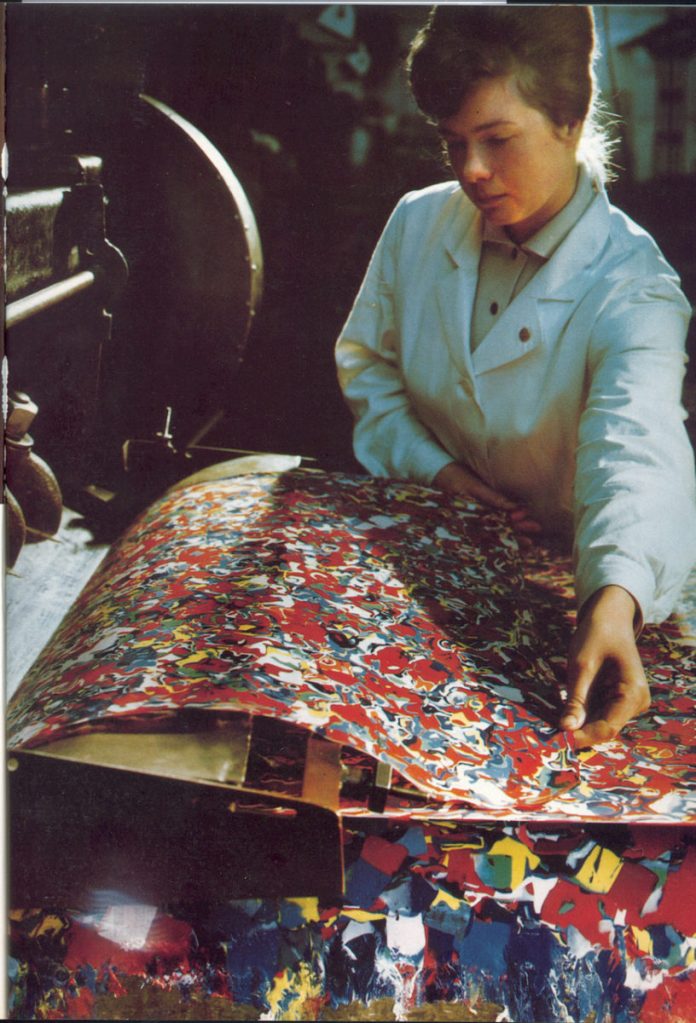
Vinyl foil calender. Courtesy RWWA Köln, signature XIVe 14066: Hundert Jahre Dynamit Nobel 1865-1965, © all rights reserved to the original publisher

Writing the history of the Anthropocene—and the future role of plastics in it

I started this essay with a call for resisting the aesthetic allure of both fossils and plastics when it comes to writing the history of the Anthropocene. Let me end with two thoughts: one about the history of science’s role in writing this history; the other about the future, alternative role of plastic in it. To historians of science, geologists’ efforts to distinguish between “anthropocenic” and “anthropogenic” markers while formalizing the stratigraphic boundary of the new geological present conforms to the logics of the geological time scale—logics that the suggestion of an Anthropocene epoch has already stretched considerably. At the same time, the Anthropocene Working Group’s need for societies’ “long enough” reach into Earth’s possible future amounts—inadvertently, perhaps—to nullifying the political attention and consequences that Anthropocene discussions have had so far. From a history-of-science perspective, for instance, it is obvious that the high political stakes involved have turned into a sine qua non for carving out the emerging field of Anthropocene geology.

In turn, the methods and scope of the history of science are being affected by Anthropocene discussions as well. I expect further blurring of the boundaries that set it apart from social, economic, and political history, or critical geography and anthropology. Historians of science and environmental historians already study the disciplinary politics within the Earth sciences and, concurrently, analyze societal politics as their flip side and context. They study geological concepts while at the same time using them to better chart and explain those historical spaces where societal actions have started to intersect with terrestrial processes. See the insightful essay Benjamin Steininger, “Ammonia Synthesis on the Banks of the Mississippi: A Molecular-Planetary Technology,” Anthropocene Review, vol. 8, no. 3 (2021): pp. 262–79. Yet another attempt is Andrea Westermann, “Enrichment and Dilution in the Atacama Mining Desert: Writing History from an Earth-Centered Perspective,” Geschichte und Gesellschaft, vol. 46, vol. 4 (2020): pp. 634–61. Just like other historians (think of Dipesh Chakrabarty as the historian of subalternity) and social scientists, they have started to reframe the inspiring questions Earth scientists have posed according to their own professional standards and interests—because historical and Earth historical times have been co-evolving for a while now and will continue to do so. For the different social sciences, see, for instance, Nigel Clark and Bronislaw Szerszynski, Planetary Social Thought: The Anthropocene Challenge to the Social Sciences. New York: Polity, 2020; Andrea Westermann and Sabine Höhler, “Writing History in the Anthropocene: Scaling, Accountability, and Accumulation,” Geschichte und Gesellschaft, vol. 46, no. 4 (2020): pp. 579–605; Andrew Bauer et al., “Anthropocene: Event or Epoch?,” Nature, vol. 597 (September 16, 2021): p. 332. See also Adam Bobbette’s contribution to the Anthropocene Markers project, “A Javanese Anthropocene?”: https://www.anthropocene-curriculum.org/contribution/a-javanese-anthropocene/

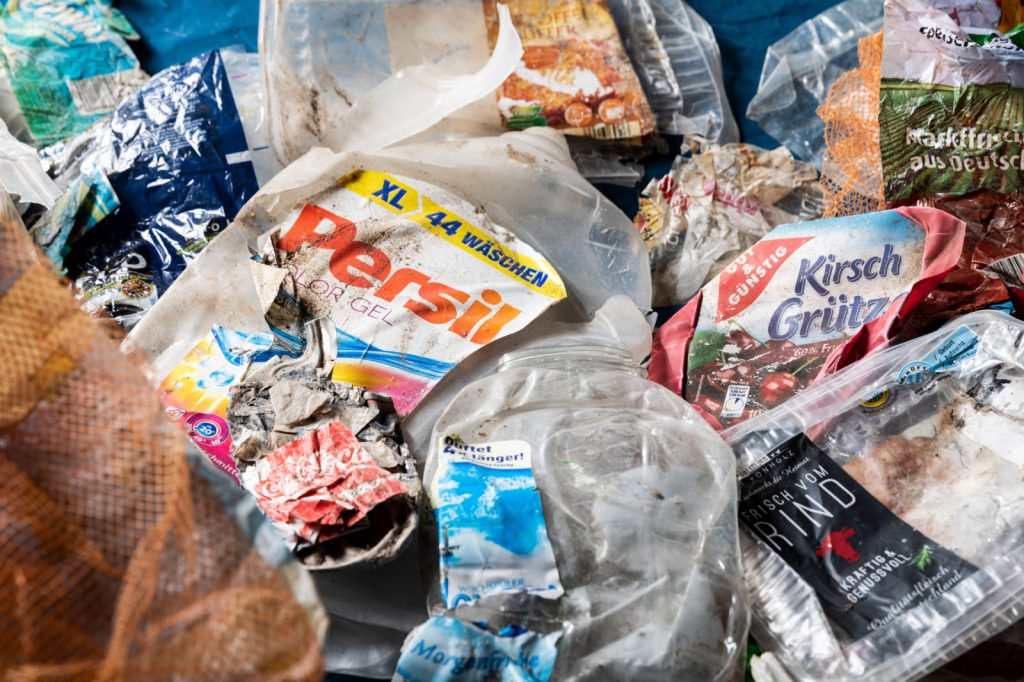
Plastic waste from Germany was found during a Greenpeace research 2019 on waste disposals in Malaysia. Plastic packages from washing powder like Persil and other German brands have been exported in Malaysia. Greenpeace hat Plastikmuell aus Deutschland waehrend ihrer Recherche 2019 auf Deponien in Malaysia gefunden.
  • When control mechanisms fail: German plastic waste is not sent to Malaysia for recycling purposes only. It also lands in local landfills. © all rights reserved Fred Dott/Greenpeace

Activists, scientists, artists, schoolchildren, and many other people around the world have collected plastic waste from the oceans’ garbage patches and from their local beaches. Over the past decade, they have come to interpret such fragments as fossilized cultural objects. Making plastic waste a marker of the Anthropocene has helped establish a better understanding of the cumulative and persistent effects of societal action. This waste-centered—mostly post-consumer-waste-centered—account has sidelined, though, the many histories of (migrant) labor that are, in their own ways, entangled with the histories of mining, production, and industrial uses of plastic; histories this essay has sought to call to mind. In so doing, it attends to the imperative voiced within Anthropocene studies to consider both terrestrial and societal scales, assess historical and political accountability, and combine phenomena of economic and biogeochemical accumulation. Andrea Westermann and Sabine Höhler, “Writing History in the Anthropocene”; Sara Wylie, Max Liboiron, and Nicholas Shapiro, “Making and Doing Politics through Grassroots Scientific Research on the Energy and Petrochemical Industries,” Engaging Science, Technology, and Society, vol. 3 (2017): pp. 393–425. Also see the initiative directed by historian Michelle Murphy, Talking the Land and the Refinery; more information is available at “Talking The Land and the Refinery,” Technoscience Research Unit, March 31, 2020: https://technoscienceunit.org/2020/03/31/talking-the-land-and-the-refinery/. Each of the three pileups of plastic analyzed in the preceding sections makes clear that environmental sustainability and socioeconomic justice are two faces of the same coin. This becomes even more obvious when these two issues are considered together. The myriad alliances of consumer citizens, workers’ unions, migration organizations, ocean activists, and environmental health activists, but also state regulators and other institutions of political decision-making are currently working toward this recognition.

There are historical precedents for the co-construction of the future of plastics—precedents that come with some caveats. In the case of West Germany fifty years ago, plastic waste and the health hazards discovered to be linked to the production of vinyl inspired people write to newspaper editors, confront the authorities regarding the need for industry regulation, and remind manufacturing companies of their responsibilities to consumers. Andrea Westermann, “When Consumer Citizens Spoke Up: West Germany’s Early Dealings with Plastic Waste,” Contemporary European History, vol. 22, no. 3 (2013): pp. 477–98. West Germany, like many European states, saw an astonishing upsurge in consumer protection and environmental laws in the 1970s and 1980s. Matthew Hilton, Prosperity for All: Consumer Activism in an Era of Globalization. Ithaca, NY: Cornell University Press, 2009, pp. 153–84; Andrea Westermann, “When Consumer Citizens Spoke Up.” However, these improvements in health and safety excluded large parts of the global population.

The plastics industry reacted with containing the damage any such regulation politics could have for sales growth. Recycling has been one answer companies were forced to pursue. As has become clear over the years, they did so half-heartedly and, in all likelihood, also deceptively. Citizens and social scientists alike have recurrently noted that recycling has remained just the latest promise attached to plastics that’s “always just about to happen.” Andrea Westermann, Plastik und politische Kultur, p. 314; Samantha MacBride, Recycling Reconsidered: The Present Failure and Future Promise of Environmental Action in the United States. Cambridge, MA: MIT Press, 2012. Through the carefully entertained utopianism of recycling, the oil and chemical industries together with industrial plastic users have succeeded fairly well in preserving self-regulation over politically binding restrictions, as well as fostering consumers’ wishes to buy and further entrenching their habits to throw away, by appeasing public concerns for plastic’s unwanted effects. Andrea Westermann, “When Consumer Citizens Spoke Up,” pp. 493–97; Bartow J. Elmore, Citizen Coke: The Making of Coca-Cola Capitalism. New York; W. W. Norton, 2016; Laura Sullivan, “Plastic Wars: Industry Spent Millions Selling Recycling—to Sell More Plastic,” NPR, March 31, 2020: https://www.npr.org/2020/03/31/822597631/plastic-wars-three-takeaways-from-the-fight-over-the-future-of-plastics. I thank Kate Brown for reminding me of this strategy and its political consequences. I think that visions of future plastics markets should no longer conform to the interests of corporate protagonists in the petrochemical sector and its downstream industrial users alone. The recycling markets of plastic are already up for political discussion and public scrutiny; but so are the feedstocks, production, and commercial uses of plastic.

Andrea Westermann earned her PhD in History from the University of Bielefeld with a dissertation on Plastic and Political Culture in West Germany. She specializes in the history of earth sciences, environmental history, environmental migration, and the history of material culture.

1 August Christoph Carl Vogt, Lehrbuch der Geologie und Petrefactenkunde. 1846; repr. Braunschweig: Vieweg, 1866, pp. 9–10.

2 Jan Zalasiewicz et al., “The Technofossil Record of Humans,” Anthropocene Review, vol. 1, no. 1: p. 36; Jan Zalasiewicz et al., “When Did the Anthropocene Begin? A Mid-Twentieth Century Boundary Level Is Stratigraphically Optimal,” Quarternary International, vol. 383: p. 199; Nigel Clark et al., “A Solid Fluids Lexicon, Theory, Culture & Society, September 13, 2021: https://doi.org/10.1177/02632764211030976

3 Also using the notion “fossilized” for plastics are: Patricia Corcoran and Charles J. Moore, “An Anthropogenic Marker Horizon in the Future Rock Record,” GSA Today, vol. 24, no. 6 (2014): pp. 4–8; Zalasiewicz et al., “The Technofossil Record of Humans,” pp. 33–43; Sarah Gabott et al., “The Geography and Geology of Plastics: Their Environmental Distribution and Fate,” in Plastic Waste and Recycling: Environmental Impact, Societal Issues, Prevention, and Solutions, ed. T. M. Letcher. New York: Elsevier, 2020, pp. 33–63. 

4 Bernhard von Cotta, Die Geologie der Gegenwart. Leipzig: J. J. Weber, 1866, p. 273. Rather than a modern historian, von Cotta here might be referring to an archaeologist. 

5 Andrea Westermann, “A Technofossil of the Anthropocene: Sliding Up and Down Temporal Scales with Plastic,” in Power and Time: Temporalities in Conflict and the Making of History, ed. Dan Edelstein et al. Chicago: University of Chicago Press, 2020, pp. 124, 130. 

6 Julie Decker, ed., preface to Gyre: The Plastic Ocean. London: Booth Clibborn Editions, 2014, p. 12; Heather Davies, “Life & Death in the Anthropocene: A Short History of Plastic,” in Art in the Anthropocene: Encounters among Aesthetics, Politics, Environments and Epistemologies, ed. Heather Davis and Etienne Turpin. London: Open Humanities Press, 2015, pp. 347–58. I discuss some artworks in Andrea Westermann, “A Technofossil of the Anthropocene.” See also, for example, coverage of the marine plastic waste art by photographer Thirza Schaap: Jennifer Lichnau, “Schrecken der Meere,” Süddeutsche Zeitung, September 30, 2021: https://sz-magazin.sueddeutsche.de/kunst/thirza-schaap-kunst-90703.

7 Elodie Roy, “Another Side of Shellac: Cultural and Natural Cycles of the Gramophone Disc,” in Audible Infrastructures: Music, Sound, Media, ed. Kyle Devine and Alexandrine Boudreault-Fournier (Oxford: Oxford University Press, 2021): https://doi.org/10.1093/oso/9780190932633.003.0010. 

8 See Davis and Turpin’s edited volume Art in the Anthropocene

9 For more details, see Andrea Westermann, “A Technofossil of the Anthropocene.” 

10 Simon A. Levin, “The Problem of Pattern and Scale in Ecology,” Ecology, vol. 73, no. 6 (1992): p. 1,943. 

11 This technique is used both indoors and outdoors. See, for example, the urban works of Claude Monet around France, and of the Ruhr region, the paintings of Richard Gessner. See also Jesse Oak Taylor, The Sky of Our Manufacture: The London Fog in British Fiction from Dickens to Woolf. Charlottesville: University of Virginia Press, 2016. 

12 Andrea Westermann, Plastik und politische Kultur in Westdeutschland (Zurich: Chronos, 2007), 237–314. 

13 John N. Hahladakis et al., “An Overview of Chemical Additives Present in Plastics: Migration, Release, Fate and Environmental Impact during Their Use, Disposal and Recycling,” Journal of Hazardous Materials, vol. 344 (2018): pp. 179–99.

14 Max Liboiron, Pollution Is Colonialism. Durham, NC: Duke University Press, 2021. For an insightful insider’s outline of the emerging field of microplastics research in marine science and its challenges, see Juliana A. Ivar do Sul, “Why It Is Important to Analyze the Chemical Composition of Microplastics in Environmental Samples,” Marine Pollution Bulletin, vol. 165 (2021): https://doi.org/10.1016/j.marpolbul.2021.112086. The LABPLAS—Land-Based Solutions for Plastics in the Sea project is a current collaboration among various scientific laboratories working on plastics pollution funded by the European Commission, and it is no doubt worth analyzing from a science and technology studies perspective; for more, see https://www.aircentre.org/labplas/.

15 Giles Tremlett, “Spain’s Greenhouse Effect: The Shimmering Sea of Polythene Consuming the Land,” Guardian, September 21, 2005: https://www.theguardian.com/world/2005/sep/21/spain.gilestremlett. For a forthcoming book-length study, see Arvid van Dam, “Designing the Desert: Making and Unmaking Landscape in the Arid Southeast of Spain” (PhD diss., University of Leeds, 2020). I thank the author for sharing his work.

16 Consejería de agricultura, ganadería, pesca y desarrollo sostenible, Secretaría General de Agricultura, Ganadería y Alimentación, Cartografía de invernaderos en Almería, Granada y Málaga, 2020: https://www.juntadeandalucia.es/export/drupaljda/producto_estadistica/19/06/Cartografia%20_inv_AL_GR_MA_v201127.pdf, pp. 11–12; Francisco Entrena-Duran, “Expansion of Greenhouse Farming in the Area of El Ejido: A Case Study on the Environmental and Social Consequences of Agroindustry in Southeast Spain,” in Food Production and Eating Habits from Around the World: A Multidisciplinary Approach, ed. F. Entrena-Duran. New York: Nova Science Publishers 2015, pp. 29–44.

17 Numbers from “Peppers led Almeria’s fruit and vegetable exports in the first half of 2021,” HortiDaily.com, August 25, 2021: https://www.hortidaily.com/article/9349198/peppers-led-almeria-s-fruit-and-vegetable-exports-in-the-first-half-of-2021/. On the current market, see Fruit Logistica, European Statistics Handbook, 2020: https://www.fruitlogistica.com/FRUIT-LOGISTICA/Downloads-Alle-Sprachen/Auf-einen-Blick/European_Statistics_Handbook_2020.pdf.

18 José Rivera Menéndez, La política de colonización agraria en el Campo de Dalías (1940–1990). Almería, Spain: Instituto de Estudios Almerienses 2000, pp. 52–54.

19 Odón Fernández Lavandera and Antonio Pizarro Checa, “Almería: la tecnica del ‘enarenado’ transforma un desierto,” Revista de Estudios Agrosociales, vol. 115 (1981): pp. 35, 44–46. The environmental embeddedness of greenhouses is argued by Arvid van Dam with the help of the notion “vernacular modern” (“Designing the Desert,” p. 146). According to Van Dam’s research, farmers still appreciate this embeddedness.

20 As far as I could find out, it was actually beach sand that was mostly used, not inland “desert” sand, referring to yet another Anthropocene problem: sand mining.

21 Fernández Lavandera and Pizarro Checa, “Almería: la técnica,” 36; David Tout, “The Horticulture Industry of Almería Province, Spain,” Geographical Journal, vol. 156, no. 3 (1990): pp. 304–12 (on drip irrigation, see p. 306); Rivera Menéndez, La política de colonización agraria.

22 Fernández Lavandera and Pizaro Checa, “Almería: la técnica,” 36.

23 Fernández Lavandera and Pizaro Checa, “Almería: la técnica,” 44.

24 David Tout, “The Horticulture Industry,” 306.

25 Andrea Westermann, Plastik und politische Kultur.

26 On the diagnosis of the underdevelopment of southern Spain’s arid landscape, or “desert,” see Eric Swyngedouw, “Modernity and Hybridity: Nature, Regeneracionismo, and the Production of the Spanish Waterscape, 1890–1930,” Annals of the Association of American Geographers, vol. 89, no. 3 (1999): pp. 443–65, https://doi.org/10.1111/0004-5608.00157; on the Franco regime’s politics of improvement, see Rivera Menéndez, La política de colonización agraria en el Campo de Dalías. This mid-twentieth-century agricultural version of Spain’s long history of “regeneration” after imperial decline in the nineteenth century ties into intellectual histories of underdevelopment in Eastern Europe and Latin America; see J. L. Love, Crafting the Third World: Theorizing Underdevelopment in Rumania and Brazil. Palo Alto, CA: Stanford University Press, 1996. See also James C. Scott, Seeing Like a State: How Certain Schemes to Improve the Human Condition Have Failed. New Haven, CT: Yale University Press, 1998. 

27 Andrea Westermann, Plastik und politische Kultur, 240. 

28 Purificación Ruiz Sánchez, “La inmigración al Poniente Almeriense. Alpujarreños y africanos en el Ejido,” in Anuario Etnológico de Andalucía 1995–1997, 1999, p. 109. Germany set the precedent with its 1973 recruitment ban (Anwerbestopp); see the labor ministry’s instruction: “Anwerbestopp 1973,” Bundeszentrale für politische Bildung, November 9, 2011: https://www.bpb.de/geschichte/deutsche-geschichte/anwerbeabkommen/43270/anwerbestopp-1973; José Francisco Jiménez Díaz, “Procesos de desarrollo en el Poniente Almeriense: Agricultores e inmigrados,” Revista de Estudios Regionales, vol. 1 (January 2011): p. 189. 

29 Francisco Entrena-Duran, “Expansion of Greenhouse Farming in the Area of El Ejido,” p. 32.

30 Rosa-Luxemburg-Stiftung (Brussels Office), Guía laboral para el sector del manipulado almeriense trabajo realizado: colectivamente por compañeras y compañeros del Soc-Sat de Almería, 2017, p. 3. This guide is available for field-workers. Documented or undocumented, many migrants work without proper contracts. 

31 Andrea Westermann, “Migrations and Radical Environmental Change: When Social History Meets the History of Science,” NTM Zeitschrift für Geschichte der Wissenschaften, Technik und Medizin, vol. 27, no. 3 (2019): pp. 377–89.

32 See a mid-1980s example in F. J. Barahona and J. M. Gomez Vasquez, “Influence of Pesticides on the Degradation of Polyethylene Film Greenhouse Cladding on the Andalusian Coast,” Plasticulture, vol. 65 (1985): pp. 3–10. In 1987, the pesticide residues in vegetables jumped onto Northern European supermarkets’ radar; David Tout, “The Horticulture Industry,” 310. In 2005, toxic plastics were still an urgent problem in workplaces and homes according to Tremlett, “Spain’s Greenhouse Effect.” 

33 Ofelia de Pablo et al., “‘We Pick Your Food’: Migrant Workers Speak Out from Spain’s ‘Plastic Sea,’” Guardian, September 20, 2020: https://www.theguardian.com/global-development/2020/sep/20/we-pick-your-food-migrant-workers-speak-out-from-spains-plastic-sea; “El asentamiento chabolista de Níjar vuelve a ser pasto de las llamas,” Almería Hoy, May 23, 2021: http://www.almeriahoy.com/2021/05/el-asentamiento-chabolista-de-nijar.html; “Desalojan hoy a 60 personas y destruyen 28 chabolas en el paraje Tierras de Almería,” Diaro de Almería, April 29, 2015: https://www.diariodealmeria.es/almeria/Desalojan-destruyen-chabolas-Tierras-Almeria_0_911909390.html. For what happened after the eviction, see Iñigo Mas, “Cientos de inmigrantes viven en chabolas encerrados tras las vallas de fincas agrícolas de Almería,” elDiaro.es, March 27, 2014:s https://www.eldiario.es/andalucia/enclave-rural/cientos-inmigrantes-encerrados-tierras-almeria_1_5002356.html. 

34 Ana Carbajos, “El cortijo de los desposeídos,” El País, March 9, 2016. For an analysis of the family business sector compared to the migrant labor they employ, see F. Entrena-Durán and J. F. Jiménez-Díaz, “Reacciones y protestas de agricultores e inmigrantes en El Ejido: un municipio español inserto en las dinámicas de la globalización,” Mundo Agrario, vol. 17, no. 34 (2016): http://www.mundoagrario.unlp.edu.ar/article/view/MAv17n34a08. On international rivalry, price pressures, and farmers’ long dwindling competitive advantages, see Fernando Martínez, “El milagro de los invernaderos de Almería, en sus horas más bajas,” El País Economía, June 25, 2010. 

35 Spitou Mendy, quoted in Clare Carlile, “Campaign: The Fight for Agricultural Workers’ Rights in Southern Spain,” Ethical Consumer, October 1, 2020: https://www.ethicalconsumer.org/ethicalcampaigns/agricultural-workers-rights-almeria. For current labor protests and the fight for new contracts in the fruit and vegetable processing and packaging sector, see the campaign “Formulario adhesión por un convenio digno en el campo y manipulado en almería ‘por un convenio justo ya,’” circulating as a Google Form at https://docs.google.com/forms/d/e/1FAIpQLSepTAb1OreGuskT1wWFjcuC-AERY73P7KcuoJ_ieP2-W0Lc4Q/viewform

36 Alyssa McMurtry, “Soil to Sand: Spain’s Growing Threat of Desertification,” Andalou Agency, July 19, 2019: https://www.aa.com.tr/en/europe/soil-to-sand-spain-s-growing-threat-of-desertification/1535951; Juan García Latorre, Andrés Sánchez Picón, and Jesús García Latorre, “The Man-Made Desert: Effects of Economic and Demographic Growth on the Ecosystems of Arid Southeastern Spain,” Environmental History, vol. 6, no. 1 (January 2001): pp. 75–94, https://doi.org/10.2307/3985232; E. Swyngedouw and J, Williams, “From Spain’s Hydro-Deadlock to the Desalination Fix,” Water International, vol. 41, no. 1 (2016): pp. 54–73, https://doi.org/10.1080/02508060.2016.1107705. 

37 Nacho Sánchez, “Los plásticos de la agricultura inundan Almería,” El País, November 6, 2020: https://elpais.com/america/sociedad/2020-11-06/los-plasticos-de-la-agricultura-inundan-almeria.html. 

38 For 2015, see Emilio González, “Mar de plástico,” Serbal, September 10, 2015: https://serbal-almeria.com/noticias/94-mar-de-plastico; for 2021, see Manuma Manuel Mata Oliver, “Ayer grabamos este video Gianella y yo,” Facebook, October 26, 2020: https://www.facebook.com/manumafotografia/videos/3279839662127309

39 Miguel Giménez–Moolhuyzen et al., “Photosynthesis Inhibiting Effects of Pesticides on Sweet Pepper Leaves,” Insects, vol. 11, no. 2 (2020): p. 69, https://doi.org/10.3390/insects11020069; Antonio Mendoza-Fernández et al., “The Role of Technology in Greenhouse Agriculture: Towards a Sustainable Intensification in Campo de Dalías,” Agronomy, vol. 11, no. 1 (2021): p. 101, https://doi.org/10.3390/agronomy11010101

40 Jan van der Blom, “Greenhouse Horticulture in Spain: Well On Its Way to Sustainability,” europeanseed blog, April 2019: https://european-seed.com/2019/04/greenhouse-horticulture-in-spain-well-on-its-way-to-sustainability/. 

41 Karen Tei Yamashita, Through the Arc of the Rain Forest. Minneapolis: Coffee House Press, 1990, p. 17. 

42 Karen Tei Yamashita, Through the Arc, p. 97. 

43 Karen Tei Yamashita, Through the Arc, p. 202. Also see p. 95 of the novel: “The Matacão has been […] a source of curiosity and confusion in the scientific world. Geologists, astronomers, physicists, archaeologists, and chemists were suddenly thrown into an unsettling prerevolutionary state where the basic parameters of scientific truth were undergoing a shift similar to that experienced when Einstein redefined the Newtonian World.” 

44 Karen Tei Yamashita, Through the Arc, pp. 97, 141. 

45 The novel is explored in environmental humanities and Asian American studies. See these worthwhile studies: Ursula Heise, “Local Rock and Global Plastic: World Ecology and the Experience of Place,” Comparative Literature Studies, vol. 41, no. 1 (2004): pp. 126–52; Aimee Bahng, “Extrapolating Transnational Arcs, Excavating Imperial Legacies: The Speculative Acts of Karen Tei Yamashita’s Through the Arc of the Rain Forest,” MELUS, vol. 33, no. 4 (2008): pp. 123–44; Matthew S. Henry, “Nonhuman Narrators and Multinatural Worlds,” ISLE: Interdisciplinary Studies in Literature and Environment, vol. 25, no. 3 (2018): pp. 566–83. 

46 Karen Tei Yamashita, Through the Arc, p. 96. 

47 Karen Tei Yamashita, Through the Arc, pp. 205–08. 

48 Costas Velis, Global Recycling Markets: Plastic Waste. A Story for One Player – ChinaISWA Globalisation and Waste Management Task Force, September 2014. 

49 Gegen Plastikmüll, “Mehr als 70 Staaten für weltweites Abkommen,” Neue Zürcher Zeitung, September 2, 2021; Nils Simon et al., “A Binding Global Agreement to Address the Life Cycle of Plastics,” Science, vol. 373, no. 6550 (2021): pp. 43–47, https://doi.org/10.1126/science.abi9010

50 Roland Geyer et al., “Production, use, and fate of all plastics ever made,” Science Advances (2017): 3(7):e1700782, https://doi.org/10.1126/sciadv.1700782; Laurent Lebreton and Anthony Andrady, “Future scenarios of global plastic waste generation and disposal,” Palgrave Communications, vol. 5, no. 1(2019): p. 6. 

51 Greenpeace Southeast Asia, “The Recycling Myth 2.0: The Toxic After-Effects of Imported Plastic Waste in Malaysia,” Greenpeace, June 2, 2020: https://www.greenpeace.org/southeastasia/publication/4058/the-recycling-myth-2-0-the-toxic-after-effects-of-imported-plastic-waste-in-malaysia/

52 Current analyses highlight this point; see “Revealed: Businesses and Banks behind Global Plastic Waste Crisis, Minderoo Foundation, May 18, 2021: https://www.minderoo.org/plastic-waste-makers-index/news/revealed-businesses-and-banks-behind-global-plastic-waste-crisis

53 Roland Geyer et al., “Production, Use, and Fate of All Plastics,” supplementary material, Table S1 (until 2015). Global plastics production totaled 368 million metric tons in 2019, according to “Annual Production of Plastics Worldwide from 1950 to 2020,” Statista, June 2021: https://www.statista.com/statistics/282732/global-production-of-plastics-since-1950/

54 Nils Simon et al., “A Binding Global Agreement,” p. 46 (corresponds with the Statista source in the previous footnote). 

55 International Energy Agency, The Future of Petrochemicals: Towards More Sustainable Plastics and Fertilisers, 2018: https://www.oecd.org/publications/the-future-of-petrochemicals-9789264307414-en.htm

56 See the insightful essay Benjamin Steininger, “Ammonia Synthesis on the Banks of the Mississippi: A Molecular-Planetary Technology,” Anthropocene Review, vol. 8, no. 3 (2021): pp. 262–79. Yet another attempt is Andrea Westermann, “Enrichment and Dilution in the Atacama Mining Desert: Writing History from an Earth-Centered Perspective,” Geschichte und Gesellschaft, vol. 46, vol. 4 (2020): pp. 634–61. 

57 For the different social sciences, see, for instance, Nigel Clark and Bronislaw Szerszynski, Planetary Social Thought: The Anthropocene Challenge to the Social Sciences. New York: Polity, 2020; Andrea Westermann and Sabine Höhler, “Writing History in the Anthropocene: Scaling, Accountability, and Accumulation,” Geschichte und Gesellschaft, vol. 46, no. 4 (2020): pp. 579–605; Andrew Bauer et al., “Anthropocene: Event or Epoch?,” Nature, vol. 597 (September 16, 2021): p. 332. See also Adam Bobbette’s contribution to the Anthropocene Markers project, “A Javanese Anthropocene?”: https://www.anthropocene-curriculum.org/contribution/a-javanese-anthropocene/

58 Andrea Westermann and Sabine Höhler, “Writing History in the Anthropocene”; Sara Wylie, Max Liboiron, and Nicholas Shapiro, “Making and Doing Politics through Grassroots Scientific Research on the Energy and Petrochemical Industries,” Engaging Science, Technology, and Society, vol. 3 (2017): pp. 393–425. Also see the initiative directed by historian Michelle Murphy, Talking the Land and the Refinery; more information is available at “Talking The Land and the Refinery,” Technoscience Research Unit, March 31, 2020: https://technoscienceunit.org/2020/03/31/talking-the-land-and-the-refinery/

59 Andrea Westermann, “When Consumer Citizens Spoke Up: West Germany’s Early Dealings with Plastic Waste,” Contemporary European History, vol. 22, no. 3 (2013): pp. 477–98. 

60 Matthew Hilton, Prosperity for All: Consumer Activism in an Era of Globalization. Ithaca, NY: Cornell University Press, 2009, pp. 153–84; Andrea Westermann, “When Consumer Citizens Spoke Up.”

61 Andrea Westermann, Plastik und politische Kultur, p. 314; Samantha MacBride, Recycling Reconsidered: The Present Failure and Future Promise of Environmental Action in the United States. Cambridge, MA: MIT Press, 2012. 

62 Andrea Westermann, “When Consumer Citizens Spoke Up,” pp. 493–97; Bartow J. Elmore, Citizen Coke: The Making of Coca-Cola Capitalism. New York; W. W. Norton, 2016; Laura Sullivan, “Plastic Wars: Industry Spent Millions Selling Recycling—to Sell More Plastic,” NPR, March 31, 2020: https://www.npr.org/2020/03/31/822597631/plastic-wars-three-takeaways-from-the-fight-over-the-future-of-plastics. I thank Kate Brown for reminding me of this strategy and its political consequences. 

How I Learned to Stop Worrying and Love the Term Anthropocene

Published online by Cambridge University Press

Timothy Morton

Abstract

Not a day goes by in the 2010s without some humanities scholars becoming quite exercised about the term Anthropocene. In case we need reminding, Anthropocene names the geological period starting in the later eighteenth century when, after the invention of the steam engine, humans began to deposit layers of carbon in Earth’s crust. Paul Crutzen and Eugene Stoermer’s term has been current since 2000.1 In 1945, there occurred “The Great Acceleration,” a huge data spike in the graph of human involvement in Earth systems. (The title’s Kubrick joke stems from the crustal deposition of radioactive materials since 1945.) Like Marx, Crutzen sees the steam engine as iconic. As this is written, geologists such as Jan Zalasiewicz are convincing the Royal Society of Geologists to make the term official.

Cambridge Journal of Postcolonial Literary Inquiry , Volume 1 , Issue 2 , September 2014 , pp. 257 – 264

DOI: https://doi.org/10.1017/pli.2014.15

The term is remarkable: it names the intersection of human history with geological time, as Baucom argues. Anthropocene ends the concept nature: a stable, nonhuman background to (human) history. Should this not be welcome for scholars rightly wary of setting artificial boundaries around history’s reach?

The term has arisen at a most inconvenient moment. Anthropocene might sound to post-humanists like an anthropocentric symptom of a sclerotic era. Taking their cue from the anti-humanism of Foucault and to some extent Derrida, others may readily recall the close of Foucault’s The Order of Things: “man” is like a face drawn in sand, eventually wiped away by the ocean tides.2 Foucault, grandfather of post-humanism, appears less upset than the Matthew Arnold of “Dover Beach” at the prospect of this construct’s obliteration.

What a weirdly prescient image of global warming, with its rising sea levels and underwater government meetings.3 But how ironic, given that humans evidently created global warming, an entity massively distributed in both time and space, an entity persisting for one hundred thousand years.4 There we were, happily getting on with the obliteration business, when this term shows up. Within it, the human returns at a far deeper geological level than mere sand.

Moreover, global warming’s erasure of the human by Earth systems such as the water cycle happens in a grittier way than the “discourse of man,” which is what Foucault meant. It is more than a semiotic obliteration. Gladly to use Anthropocene is not simply to talk of power-knowledge institutions disposing humans, nor even of dispositifs that include nonhumans. What Anthropocene names is mass extinction—the sixth one in the four-and-a-half-billion-year history of life on Earth. This is indeed an inconvenient truth for scholars convinced that any hint of talk about reality smacks of reactionary fantasy.

The Sixth Mass Extinction Event, caused by humans—not jellyfish, not dolphins, not coral. The panic seems more than a little disingenuous, given what we know about global warming, and given what we humanities scholars think we like to say about the role of humans in creating it, as opposed to, say, Pat Robertson or UKIP (the UK Independence Party). A Fredric Jameson would perhaps smile somewhat ruefully at the dialectic of scholars who refuse the very concept of reality and totalization, while global mega-corporations frack in their backyards.

One simply cannot just palm off global warming on other beings or even on a particular group of humans, or argue that the Sixth Mass Extinction Event doesn’t really exist. The humanities have often argued via Foucault via Heidegger via Kant that there are no accessible things in themselves, only thing-positings, or thingings of Da-sein, or thing discourses. Only things insofar as they correlate to some version of the (human) subject. The blank screen on which these fantasies are projected turns out not to be blank at all, but rather to consist of unique, discrete entities (a new philosophical movement, derived from the obverse of Heidegger, calls them objects) with a “life” of their own no matter whether a (human) subject has opened the epistemological refrigerator door to see whether they are lit up in the clearing. And some entities formerly known as blank screens (and violently treated as such) are overwhelming human beings.

Foucault’s image of the sandy face is a metaphor for what some now call correlationism.5 Correlationism asserts that reality cannot be seen directly, but can only be correlated with something like a (human) subject. The “man” episteme begins for Foucault in 1800. To say the least, this is ecologically uncanny. The year 1800 is the moment of the steam engine—the veritable engine of the Anthropocene; it is also the moment of Hume and Kant, whose thought inaugurated correlationism: Hume by arguing that cause and effect was a construct based on a congeries of associations, Kant by grounding this argument in synthetic judgments a priori in a transcendental subject (a subject that isn’t “little me”). At the very moment at which philosophy says you can’t directly access the real, humans are drilling down ever deeper into it.

But what is this “human”? Evidently the term as used here is not essentialist, if essentialist means metaphysically present—here I do align myself with Kant and his subsequent lineage holders, including Heidegger, who inspired Lacan, who taught Foucault. This presence derives ultimately from a persistent default ontology in the long moment in which the Anthropocene is a rather disturbing fluctuation. This is the ten-thousand-year “present” I call agrilogistics, the time of a certain logistics of agriculture that arose in the Fertile Crescent and went viral, eventually requiring steam engines and industry to endure.6 The algorithm of Fertile Crescent agriculture consists of numerous subroutines: eliminate contradiction and anomaly, establish boundaries between the human and the nonhuman, maximize existence over and above any quality of existing. Now that agrilogistics covers most of Earth’s surface, we can see its effects as in a polymerase chain reaction: they are catastrophic.

Social space is in a sense physical, lived philosophy. So it might be important to get at what is driving the Anthropocene and its global warming. The metaphysics of presence is intimately caught in the history of global warming. Derrida and Heidegger were rightly determined to perform some form of Destruktion upon it. Reverse engineering agrilogistics, one discovers its occluded inner logic. A piece of that logic asserts that to exist is to be constantly present. Here is the field, I can plough it, sow it with this or that, or nothing, yet it remains, constantly. The entire system is construed as constantly present, rigidly bounded, separated from nonhuman systems—despite the obvious existence of nonhumans to maintain it (try to ignore the cats). To achieve constant presence, not just in thought but also in social and physical space requires persistent acts of violence, and such an achievement is itself violence.7 Why? Because it goes against the grain of (ecological) reality, which consists of porous boundaries and interlinked loops, rather like Derrida’s arche-writing, subtending the very scripts that underwrite agrilogistical space, with its neatly ploughed lines of words, many of their first lines pertaining to cattle—a one-size-fits-all term for anything a (male) human owns. Patriarchy, rigid social hierarchies, and general conditions approaching near death (Agamben’s bare life or Derek Parfit’s bad level) were the almost immediate consequence, yet the virus persisted, like an earworm or a chair, no matter how destructive to the humans who had devised it.8

Humans, not lemons, generated the logistics of agriculture that now covers most of Earth and is responsible for an alarming amount of global warming emissions all by itself. Its generation had unintentional or unconscious dimensions. No one likes having their unconscious pointed out, and ecological awareness is all about having it pointed out. That alone explains some negative reactions to Anthropocene.

That I claim humans exist and made the Anthropocene by literally drilling into rock does indeed make me a kind of essentialist. Because my essentialism is without a metaphysics of presence, however, I am a weird essentialist, in the lineage of Irigaray, an avatar of this line of (non-agrilogistical) thought: to exist is to flicker with nothingness, defying the supposed law of noncontradiction hardwired into agrilogistical space.

Such a thought seems as ridiculous as the idea that I might be suggesting that we regress to a pre-agrilogistical time. One of the rituals of theory class is that as a condition of inclusion one is expected to convey something like “Well, I’m not an essentialist”; “Well, I’m not endorsing that French feminist biological essentialism.” Inert as that characterization is—of Irigaray, Cixous, and essentialism—this is something that comes out of our mouths as easily as things come out of an Easy Bake Oven.

Likewise, the ridicule with which the idea of social spaces that are not agrilogistical (hence not traditionally capitalist, communist, or feudal, or any manner of formations over its ten-thousand-year span) is greeted, as is the inverse variant, the insistence that humans should exert enough violence to “return” themselves to a pre-agrilogistical existence (John Zerzan, archivist of the Unabomber Ted Kaczinski). Such reactions are both symptoms of agrilogistical space as such—both assume that to have a politics is to have an enormous, overarching, Easy Think concept. So one is derided as a primitivist or an anarchist. The editing of laughter out of thought is curious and should be studied. “Of course, I’m not advocating that we actually try a social space that includes nonhumans in a noncoercive and nonutilitarian mode. That would be loopy.” Or “Eliminate the evil loops of the human stain. Anyone with prosthetic devices such as glasses is suspect. Return to year zero.” A taboo against loops operates in both cases. This is significant because loops characterize ecological systems—and ecological awareness, which takes an uncanny noir form as the detective with the fancy gizmos finds out that he is the criminal—having used the fancy gizmos to make fancy gizmos to perceive that very thing.

Aside from claims of anthropocentrism and essentialism, let us examine more closely the modes in which denial of the Anthropocene speaks.

First of all, colonialism: the Anthropocene is the product of Western humans, mostly Americans; the term unjustly lumps together the whole human race.

Although the desire for it emerged in America first, chronologically, it turns out that everyone wants air-conditioning. On this issue, I am in perfect accord with Dipesh Chakrabarty.9 Likewise, obesity is not simply American, for the same reason. Desire is the logical structure of consumerism, and desire is logically prior to whatever “need” is (as Lacan argues)—histories of consumerism notwithstanding, histories that tend to repeat fall narratives not unrelated to ecology: “First we needed things, then at point x we wanted things, and that put us into an evil loop.” Neanderthals would have loved Coca Cola Zero.

Secondly, racism: the term implies that humans altogether are responsible. Yet the term really means white humans, and they go unmarked: blaming all people for a white problem whose whiteness is suppressed.

Yet human need not be something that is ontically given: we can’t see or touch or designate it as present in some way (as whiteness, or not-blackness, and so on). There is no positive content to the human that one can directly perceive. So Anthropocene isn’t racist. Racism exists when one fills in the gap between what one can see (all kinds of beings starting car engines and shoveling coal into steam engines) and what these entities are with some kind of aesthetic putty, such as whiteness. Racism effectively erases the gap, implicitly reacting against what Hume and Kant did to reality (hence Heidegger hence Derrida and so on). Since Kant, there has been some kind of irreducible rift between what an entity is and how it appears, such that science handles data, not actual things.

It should now be evident that I am myself a correlationist. I do not believe that the finitude of the human–world correlate is incorrect; I do not claim that it can be burst asunder, for instance by mathematics.10 I merely hold that we should release the anthropocentric copyright control on correlationism, allowing nonhumans like fish (and perhaps even fish forks) the fun of being incapable of accessing the in-itself, whether by knowledge or by perception or by some other means, such as physical proximity.

Anthropocene may not be colonialist or racist, but surely it must be a blatant example of speciesism? Is it not claiming that humans are special and different in having created it?

Indeed, humans and not dolphins invented steam engines and drilled for oil, but this is not a sufficient reason to suppose them special or different. Etymology notwithstanding, species and specialness sharply differ. Darwin’s Origin of Species is ironically titled. There are no species—and yet there are. They have no origin—and yet they do. A human consists of nonhuman components and is directly related to nonhumans. Yet a human is not a fish. A swim bladder, from which lungs derive, is not a lung in waiting. There is nothing remotely lunglike about it.11 A life-form is what Derrida calls arrivant, or what I call strange stranger: it is itself, yet uncannily not itself at the same time.12

The Darwinian concept is precisely not the Easy Think, Aristotelian tool for telling telologically what species are for: ducks are for swimming, Greeks are for enslaving barbarians. . . . Marx adored Darwin for that.13 Because species in this sense does not coincide with me, an actual human being as opposed to a pencil or a duck, it is not speciesist. Like the racist, the speciesist fills the gap between phenomenon and thing with a kind of paste, an easy-to-identify content. That is precisely what one is incapable of seeing, yet there are ducks and spoonbills, which are not humans.

Species appears superficially easy to think: after all, contemporary texts from Sesame Street (“We Are All Earthlings”) to Live Aid’s “We Are the World” seem to convey it, along with racism and speciesism.14 Yet for me to know, through the very reasoning with which I discern the transcendental gap between phenomenon and thing, the being that manifests this reasoning, might be like a serpent swallowing its own tail, putting itself in a loop. What appears to be superficially the nearest—my existence qua this actual entity—is phenomenologically the most distant thing in the universe. The Muppets and so on inhibit the necessary ecological thought—the uncanny realization that every time I turned my car ignition key I was contributing to global warming and yet was performing actions that are statistically meaningless. When I think myself as a member of the human species, I lose “little me”—yet it wasn’t tortoises that caused global warming.

Fourthly, there is the idea that Anthropocene is hubristic. Yet the term deploys the concept species as something unconscious, not as some entity that can ever be totally explicit. Humans did it, but they did it with the aid of prostheses and nonhumans such as engines, factories, and cows—let alone viral ideas about agricultural logistics living rent-free in minds. So Anthropocene is not hubristic at all. It means humans—already a mess of lungs and bacteria and nonhuman ancestors and so on—along with their agents such as cows and factories and thoughts, agents that can’t be reduced to their merely human use or exchange value. For instance, these assemblages can violently disrupt both use and exchange value in unanticipated (unconscious) ways: one cannot eat a California lemon in a drought.

So the Anthropocene is the first truly anti-anthropocentric concept. The fact that it is far from hubristic is also why geoengineers are incorrect, if they think it means we now have carte blanche to put gigantic mirrors in space or flood the ocean with iron filings. Earth is not just a blank sheet for the projection of human desire: this desire loop is predicated on entities (Earth, coral, clouds) that also exist in loop form, in relation to one another and in relation to humans. The argument for geoengineering goes like this: “We have always been terraforming, so let’s do it consciously from now on.”15 Yet making something conscious doesn’t mean it’s nice. We have always been murdering people. How is deliberate murder more moral? Psychopaths are exquisitely aware of the suffering they consciously inflict. In relation to life-forms and Earth systems, humans have often played the role of the Walrus concerning the oysters:

“I weep for you,” the Walrus said:

“I deeply sympathize.”

With sobs and tears he sorted out

Those of the largest size,

Holding his pocket-handkerchief

Before his streaming eyes.16

Consider the Freudian-slip absurdity of James Lovelock’s analogy of Jekyll and Hyde for science and engineering: “Only big science can save us. We know big science has been like Mr. Hyde for the last two centuries, but please know, we have a kindly inner doctor Jekyll. Let us be Jekyll. Please. Please trust us, trust us.”17 Unaware of its tone, Lovelock’s sentences sound exactly like Mr. Hyde, as does Jekyll’s own self-justification in the eponymous novel. Moreover, one can’t get rid of the unconscious that easily. Here is an example: “I know I’m an addict so now I’m going to drink fully aware of that fact.” And being aware of “unconscious biases” is a contradiction in terms.

The concept unconscious is profoundly related to the notion of interdependence, the ecological fact par excellence. It is weird, which is to say, in a loop: weird derives from the Old Norse, urth, meaning twisted or entwined.18 Be nice to bunnies and you are not being nice to bunny parasites. I am far from asserting that we should not care because we cannot get ecological action perfect: quite the opposite. In an ecological age, cynical reason collapses into just another form of hypocrisy. Ecological awareness is about becoming friendly with hypocrisy, not because one doesn’t care but because one does.19

There are some substitutes. For instance, why not call it Homogenocene? This is just a euphemism. The substitute is true insofar as the logistics driving the Anthropocene depend upon an implicit ontology of the Easy Think Substance. In a more urgent sense, however, the concept is false and truly anthropocentric. The iron deposits in Earth’s crust made by bacteria are also homogeneous. Oxygen, caused by an unintended consequence of bacterial respiration, is a homogenous part of the air. Humans are not the only homogenizers.

Having attuned to an Anthropocene we humanities scholars might accept, let us consider some significant aspects of the Anthropocene that are highly congruent with the humanities.

Crutzen himself is now having cold feet about 1784, his initial dating. He sees the data spike of 1945 called The Great Acceleration, and believes, like most good scientists, in the law of non-contradiction. The data spike looks present and self-evident in that metaphysical way objected to previously. The boundary between this true beginning and what came before must be rigid and thin. There cannot be two boundaries at once, or a fuzzy boundary, but mathematicians, philosophers, literature scholars, and artists are not bound by this law. (Nor indeed are contemporary young quantum theorists, who are beginning to assume that there is not a boundary between the classical and quantum levels.)20

One could imagine The Great Acceleration differently. One could see it as a catastrophic yet logical extension of the smooth-seeming periodicity of agrilogistics. In the humanities we have been thinking for a while about how historical moments are never rigidly bounded. Yet feudalism is not capitalism. The Renaissance is not post-modernism. Rather, they exist but are retroactively posited and necessarily contested, and not thin and easy to identify. More fundamentally, time as such cannot be established as an Easy Think Substance, as a linear succession of atomic now-points, no matter how large or small; otherwise Zeno’s paradoxes arise. The present can be defined to arbitrary size: one nanosecond, a billion years. We are living “in” a present moment that includes, to name a few, the Anthropocene and agrilogistics and the catastrophe (if you are anaerobic) called oxygen: an ever-widening set of concentric temporalities. The reader will immediately note the congruence with Baucom’s essay.

There is a finite already, a sort of longtime-already (as opposed to an always-already). Agrilogistics began as a smooth wave that lurched into the Anthropocene. Earth systems were in a harmonious-seeming periodic cycle for ten thousand years.21 We have become accustomed to call the periodic cycling of Earth systems nature; the term’s ecological value is dangerously overrated. Nature as such is a ten-thousand-year-old human product—not just a discursive product, but also a geological one. Its wavy elegance was simply revealed as inherently violent, as when in an epileptic fit one’s brainwaves become smooth right up until one goes into seizure.

Yet alongside the longtime-already, there may indeed be an always-already. How did humans fall for agrilogistics in the first place? There must be something in the structure of thought that locks onto the human desire to abolish anxiety and know where the next meal is coming from. Humanities scholars, supposed experts in what human being might be, need to examine the structure of thought. How did human minds get behind a scheme now known as both cockamamie and seemingly incontestable?


Footnotes

Timothy Morton is Rita Shea Guffey Chair in English at Rice University. He gave the Wellek Lectures in theory at University of California–Irvine in 2014. He is the author of Hyperobjects, The Ecological ThoughtEcology without Nature, nine other books, and one hundred essays on philosophy, ecology, literature, food, and music.


References

1

Crutzen, Paul and Stoermer, Eugene, “The Anthropocene,” Global Change Newsletter 41.1 (2000): 17–18Google Scholar Check for full text.

2

Foucault, Michel, The Order of Things: An Archaeology of the Human Sciences (New York: Random House, 1994)Google Scholar Check for full text, 387.

3

I refer to the action performed by the government of the Maldives in 2009.

4

I call such entities hyperobjects. Morton, Timothy, Hyperobjects: Philosophy and Ecology after the End of the World (Minneapolis: University of Minnesota Press, 2013)Google Scholar Check for full text.

5

Meillassoux, Quentin, After Finitude: An Essay on the Necessity of Contingency, trans. Ray Brassier (New York: Continuum, 2009)Google Scholar Check for full text, 5.

6

Morton, Timothy, Dark Ecology (New York: Columbia University Press, 2015)Google Scholar Check for full text.

7

Derrida, Jacques, “Violence and Metaphysics,” Writing and Difference, trans. Alan Bass (London and Henley: Routledge and Kegan Paul, 1978), 79–153Google Scholar Check for full text.

8

Diamond, Jared, “The Worst Mistake in the History of the Human Race,” Discover Magazine (May 1987), 64–66Google Scholar Check for full text. Parfit, Derek, Reasons and Persons (Oxford and New York: Oxford University Press, 1984), 381–390Google Scholar Check for full text, 419–441.

9

Chakrabarty, Dipesh, “The Climate of History: Four Theses,” Critical Inquiry 35 (Winter 2009): 197–222Google Scholar Check for full text.

10

Meillassoux and Ray Brassier hold this position.

11

Darwin, Charles, The Origin of Species, ed. Gillian Beer (Oxford and New York: Oxford University Press, 1996)Google Scholar Check for full text, 160.

12

Derrida, Jacques, “Hostipitality,” Angelaki, trans. Barry Stocker with Forbes Matlock, 5.3 (December 2000): 3–18Google Scholar Check for full text; Morton, Timothy, The Ecological Thought (Cambridge: Harvard University Press, 2010), 14–15Google Scholar Check for full text, 17–19, 38–50.

13

Gillian Beer, “Introduction,” in Darwin, The Origin of Species, vii–xxviii (xxvii–xviii).

14

Street, Sesame, “We Are All Earthlings,” Sesame Street Platinum All-Time Favorites (Sony, 1995)Google Scholar Check for full text; USA for Africa, “We Are the World” (Columbia, 1985).

15

See for instance Robinson, Kim Stanley, Red Mars (New York: Random House, 1993)Google Scholar Check for full textGreen Mars (New York: Random House, 1995); Blue Mars (New York: Random House, 1997).

16

Carroll, Lewis, Alice Through the Looking Glass in The Annotated Alice: The Definitive Edition, ed. Martin Gardner (New York: Norton, 2000)Google Scholar Check for full text, 187.

17

Lovelock, James, The Revenge of Gaia: Earth’s Climate Crisis and the Fate of Humanity (New York: Basic Books, 2006), 6–7Google Scholar Check for full text, my paraphrase.

18

Oxford English Dictionaryweird, adj. http://www.oed.com, accessed April 9, 2014.

19

Morton, , Hyperobjects, 134–158Google Scholar.

20

See for instance Aaron O’Connell et al., “Quantum Ground State and Single Phonon Control of a Mechanical Ground Resonator,” Nature 464 (March 17, 2010): 697–703.

21

Jan Zalasiewicz, presentation at “History and Politics of the Anthropocene,” University of Chicago, May 2013.

The “Anthropocene” in Philosophy: The Neo-material Turn and the Question of Nature

Manuel Arias-Maldonado

Cambridge online

Contemporary social science seems to be addicted to “turns,” both as markers of theoretical shifts and as tools of disruption of established categories. All kinds of such turns are thus vindicated on a constant basis, from the digital to the aesthetical. Of course, some turns are more convincing than others – or, at least, they succeed in attracting attention and thus become more convincing for that simple reason. Either way, turns seem to be the new normal as far as academic research is concerned: they boost the reflection on a given topic, provide legitimacy to the latter, and create new combinations and recombinations as the new viewpoint is duly applied to existing topics or traditions of thought. In this chapter, two such turns will be connected as a means to illuminate a wider issue; namely, the nature of nature. In other words, I study the way in which both nature’s reality and the social understanding of nature have evolved in the last decade or so.

On the one hand, there is the Anthropocene; that is to say, the Anthropocene turn that is taking place as the concept is gaining more and more recognition in both the natural and the social sciences. The proposition that human beings are now a geological force in their own right, so that social and natural systems have become coupled, is supported by a great deal of scientific evidence (see Castree, Chapter 2). Although there are a good number of dissenters, the conversation is increasingly focused on the meaning and interpretation of the notion rather than on its plausibility. After all, the Anthropocene is both a state of socio-natural relations and an epistemic tool that invites us to see such relations from a new standpoint (Arias-Maldonado 2015). As Clive Hamilton and colleagues suggest, “In the Anthropocene, social, cultural and political orders are woven into and co-evolve with techno-natural orders of specific matter and energy flow at a global level, requiring new concepts and methods in the humanities” (Hamilton, Bonneuil, Gemenne, Hamilton, Bonneuil and Gemenne 2015: 4). And this is the case whether or not geologists officially recognize the Anthropocene as a new geological time or epoch, since the evidence gathered by the different scientific disciplines that measure human impact on earth is enough to make the term the best possible depiction of the socio-natural entanglement. To some, in fact, the Anthropocene is mainly a cultural idea that creates new political and ethical possibilities (Purdy 2015: 16–17). This shows that the idea of the Anthropocene has gained already some autonomy from its scientific foundation, which will, however, remain relevant as the ultimate source of legitimacy for the former. If there had not been such a material process of human colonization, the Anthropocene turn would have never taken place.

In this regard, it can be said that the Anthropocene confirms that nature has morphed into human environment. Obviously, nature as a deep structure of causation – a raw material upon which all existence rests – remains in place. But that does not make the change less significant, especially in the light of the ever deeper human interventions in “deep nature,” as Kate Soper (Soper 1995) named it. Genetic engineering and synthetic biology are two apt examples of a reinforced human ability. At a different level, climate change is an unintended consequence of the same process; that is, the human colonization of nature. These material transformations suggest that the Anthropocene turn revolves mainly around the hybridization of nature, as it becomes less and less autonomous with respect to human actions and social processes. To sustain a clear separation between these two realms is now more difficult than ever (Castree, Chapter 2). For Hamilton and colleagues, the Anthropocene should even be the foundation for a new way of seeing reality: “Grand shifts in philosophical understanding are always built on new ontologies, new understandings of the nature of being” (Hamilton, Bonneuil, Gemenne, Hamilton, Bonneuil and Gemenne 2015: 8). The suggestion is twofold: the Anthropocene is in itself a new material reality, and it opens up the possibility of understanding nature – writ large – in a new fashion.

Enter the neo-material turn – sometimes also called “ontological” – that has taken place in the social sciences for some years now. Needless to say, materialism is not a novelty in the history of thought, but the original way in which it has been reformulated by a number of scholars and the variety of disciplines that it covers (from sociology to geography and philosophy, not to mention technology studies and anthropology) merits the special recognition that it has been granted – as a proper “turn,” that is. Above all, new materialists have rejected the deterministic explanations of early materialism, embracing instead key insights from post-structuralists and constructivists (Fox and Alldred 2016: 6). Paradoxically, then, a materialist shift that can be largely explained as an answer to the exhaustion of the linguistic turn that had dominated the social sciences since the early 1970s is also an outcome of such a paradigm. Be that as it may, the neo-material turn has brought about a new view of the material world with quite an emphasis on techno-scientific advancements, based upon a rejection of traditional dualisms such as body/mind or nature/culture (Pellizzoni 2015: 72). The latter should thus not be seen as distinct realms, but as part of a continuum in which entities are relational and in constant flux. As we shall see, this has important implications for agency, as the capacity to produce the social world extends far beyond human actors to the nonhuman and even the inanimate.

As it happens, these two turns can be fruitfully connected, although the connection itself will not be exempt from complications. Yet a constructive dialogue between new materialism and the Anthropocene concerning the nature of nature – as well as socio-natural relations – is worth the effort, as they help to illuminate each other in unexpected ways. How does the Anthropocene relate to new materialism? In which ways can new materialism help us to understand, conceptualize, or deal with the Anthropocene? And what does this all mean for the old but contested question of nature? Does a materialistic approach even allow the view that nature has ended? And also, what does the Anthropocene say about new materialism? How should we see the claims of the former under the light of the latter? The remainder of this chapter will deal with these questions, while searching for new answers to the old interrogation about nature in the new circumstances the Anthropocene has brought about.

New Materialism and the Anthropocene (I): Ontology

New materialists should be well suited to understanding classical environmental concerns. Diane Coole (Coole 2013) has argued that one of the most recognizable features of new materialist thinking is a renewed attention to material changes and processes that are currently under way – complex and volatile transformations that are congruent with the new materialist ontology. Environmentalism has always emphasized the material character of socio-natural relations, pointing to earth’s limits and to the actual damage done to ecosystems and nonhuman species. Besides, human colonization of natural systems resulting in the Anthropocene may very well be regarded as one of those “material changes and processes” Coole refers to. After all, a key Anthropocene insight is precisely that human action throughout history has altered the reality of nature, so that the latter can hardly be conceived – except in an abstract way – as a universal and timeless essence. Attention must thus be paid to actual nature, to the nature that we can observe, that is engaged in multiple exchanges with human beings and societies, being transformed by them while in turn constraining or influencing them. As we are about to see, this reciprocal influence is also recognized by new materialism, albeit in a particular and ultimately flawed way.What distinguishes the new materialist ontology, and how well does it explain the puzzles posed by the Anthropocene? Despite a number of differences among its advocates, a number of basic features can be singled out. Coole and Frost summarize the neo-materialist position in this way:

Our existence depends from one moment to the next on myriad micro-organisms and diverse higher species, on our own hazily understood bodily and cellular reactions and on pitiless cosmic motions, on the material artifacts and natural stuff that populate our environment, as well as on socioeconomic structures that produce and reproduce the conditions of our everyday lives. In light of this massive materiality, how could we be anything other than materialist?

(Coole, Frost, Coole and Frost 2010: 1)

Yet the “matter” so invoked is a process rather than a state: being is less important than becoming. That is so because the old passive matter described by the mechanist tradition is replaced by a lively and vibrant one that is always transforming itself. Such dynamic self-organization lacks a plan: as it is not teleologically prefigured, matter’s emergence cannot be predicted. Nature is just one of its configurations, but the neo-materialist emphasis on matter’s unpredictability suggests that its future cannot be predicted either, despite the long-standing attempt by natural scientists to find patterns and laws in the unfolding of natural systems. Moreover, the very idea of nature as a separated realm is rejected by neo-materialism as an anachronistic categorization. Phenomena are closely intertwined, and entities lack clear boundaries, all sharing the same ontology – a “flat one,” as Bruno Latour (Latour 1993) puts it, that does not privilege entities or agencies, as they are constantly emerging in new configurations and assemblages across a horizontal plane. This matter, however, is multiple: those entities and structures are multidimensional and move with variable speeds. It should be noted that new materialism is informed by modern physics’ description of the underlying structure of reality as a field of subatomic particles. All things, living and nonliving, are constituted by the same basic elements. Connolly (Connolly 2013a) describes this ontological position as a “protean monism.” Under the surface, outer differences collapse.

Crucially, this view drives new materialism to the claim that agency is distributed across a vast range of entities and processes. This is a key and controversial insight that reverberates strongly in the debate on the Anthropocene. It is opposed to a long-standing Western tradition shaped by anthropocentrism and humanism, where agency – the ability to produce changes in the world – has been primarily assigned to human beings. New materialism thinks otherwise, claiming that even categories such as agency, self-consciousness, or rationality are abstractions that hide a complex and manifold process of reciprocal influence between different agentic capacities. The latter are distributed across a vast range of beings and entities, both human and nonhuman. Agency, in short, is decoupled from humanity and is said to emerge in diverse situations and unexpected ways (Burke and Fishel, Chapter 5).

This is formulated by Bruno Latour in his well-known actor-network theory, where a distinction is made between human actors and nonhuman actants, both possessing agentic capacities. The novelty is that the latter are explicitly ascribed to nonhuman beings and even inanimate entities, that is, actants that have efficacy: they produce effects and affects, influence human actors by encouraging or blocking them, alter a given course of events, and so forth. On her part, Jane Bennett (Bennett 2010) espouses a new vitalism – or enchanted materialism – that, dwelling on Latour’s actants, develops a whole “political ecology of things” in which matter is vital and active rather than passive and hence submissive to human ends. In her view, the very idea of a dead matter calls for an active human manipulation and should be corrected by emphasizing the “interfolding network of humanity and nonhumanity” that produces culture, subjectivity, and the social world. Her main example is telling: that of an electrical power grid that must be included in the “agentic assemblage” that explains a blackout. The notion of the assemblage is often invoked: temporary and unpredictable associations of actors and actants that exhibit agentic capacities. In the words of Karen Barad, though, “there is less an assemblage of agents than there is an entangled state of agencies” due to the “inescapable entanglement of matters of being, knowing, and doing, of ontology, epistemology, and ethics” (Barad 2007: 23 and 3).Ontology, it should be mentioned, is at stake. Neo-materialism ascribes generative powers and inventive capacities to materiality, thus proposing a new ontology that stresses immanence rather than transcendence. Matter being vital and agential, it cannot be conceived in a Cartesian way anymore, especially since even inorganic matter is taken as “alive.” The distinctions between organic and inorganic, animate and inanimate, human and natural are ontologically inconsistent according to new materialists, so that,

if everything is material inasmuch as it is composed of physicochemical processes, nothing is reducible to such processes, at least as conventionally understood. For materiality is always something more than “mere” matter: an excess, force, vitality, relationality, or difference that renders matter active, self-creative, productive, unpredictable.

(Coole, Frost, Coole and Frost 2010: 9)

It is interesting to note that this view has not been completely absent from the environmental debate, as Biesecker and Hofmeister (Biesecker and Hofmeister 2006 and Biesecker, Hofmeister, von Egan-Krieger, Schultz, Thapa and Voget 2009) show. Although they do not go so far as new materialists and in fact approach the subject from a different angle, they stress that nature is a dynamic entity that changes on its own and changes in contact with humanity. Nature lives and is in itself productive, forming a non-separable unity of productivity and re-productivity with humanity. And it comes as no surprise that Marx (Marx 2009) himself, an old materialist, talked of a socio-natural “metabolism.” What new materialism suggests is that ontology must also be reconsidered along with the primacy of human agency. Yet this is a contestable idea.

New Materialism and the Anthropocene (II): Agency

At first sight, new materialism can help us to explain the Anthropocene, because it offers a framework that emphasizes the vitality of matter and the transformative power of agentic assemblages that comprise both human actors and nonhuman actants. By pointing to the geological dimension of planetary change, the Anthropocene seems also to displace human agency, or at least dissolve it into a wider field of agentic assemblages, as climate change would show. In fact, climate change would in turn act as an actant that constrains human actions, producing new ecological circumstances to which some form of adaptation is demanded. Moreover, the Anthropocene would be far from a deliberate effect of human actions, thus demonstrating how alive and productive matter is. From this viewpoint, the Anthropocene itself involves a rematerialization of human societies, as the biophysical basis of their existence and its changing quality – as the favorable conditions provided by the Holocene give way to an unpredictable new geological age – make themselves present in a dramatic way.

As its very name suggests, however, the Anthropocene is at odds with new materialism. After all, it puts human beings at the center in an admittedly peculiar manner: they would have massively transformed the planet without being aware of the scale of such change. But that does not make human beings any the less protagonists, a prominent role that does not fit well with neo-materialist claims about the distributed quality of agency. This is the much-discussed core of the Anthropocene turn: the unexpected capacity of human beings to become, by displaying their transformative powers, a major geological force. In this regard, an obvious problem of the neo-materialist account is that – despite offering a new view of socio-natural relations – it blurs the distinction between humans, nonhumans, and things. Such emphasis in connection and agency does not say anything about why assemblages are produced in the first place, or whether any causality can be established (Fuller 2000; Kirsch and Kirsch and Mitchell 2004). Neo-materialism seems to fall into the trap of fetishism, in that it attributes intrinsic qualities to entities and categories that are “extrinsic,” that is, defined (at least in part) socioculturally (Bakker and Bridge 2006: 14). If we think of the Anthropocene, is it the outcome of an indefinite number of agentic assemblages or rather, the effect of one prevalent agentic capacity, that of humans?

The latter seems more likely. Thus, a balance must be kept between the recognition of the unintentional agentic capacities of nonhuman actants, on the one hand, and the far more powerful human agency, both intentional and unintentional, on the other. As this vast, transformative agentic capacity has been exerted throughout history as part of the human attempt to adapt to nature – an aggressive adaptation that involves adapting nature to human ends – the Anthropocene has been produced: a massive colonization of nonhuman matter that now exhibits multiple signs of direct and indirect human intervention. If we just talk of agentic assemblages that coproduce reality, we are neglecting the fact that some agencies are more significant than others. This is also the case with nonhuman agencies, as some actants accumulate more powers than the rest. For instance, it has been claimed that the Anthropocene is the age of “hyperobjects” (Morton 2013), defined as things that are massively distributed in time and space relative to humans – the biosphere, the Florida Everglades, the climate – and involve profoundly different temporalities from the human ones. Regarding human powers, they are outstanding even when they are not intentional – as when the increase in population in a given territory impacts on biophysical systems without anybody having planned it. In fact, when human beings act unintentionally but produce effects on the world, they might be considered human actants rather than actors. In either case, they show an exceptional ability to transform, influence, and colonize nature. Be the underlying ontology as it may, this ability has left its mark on socio-natural history. And it is history that counts. Actually, evolutionary history sets another limit to the neo-materialist view, insofar as human ultrasociality (the fact that human beings cooperate more efficiently than other species thanks to language and culture as storage and transmission devices of useful information) can be singled out as a key explanation for the Anthropocene – an ultrasociality that gradually, but sometimes exponentially, increases human transformative powers (see Gowdy and Krall 2013).

However, human exceptionality is sometimes recognized by neo-materialists, albeit implicitly. Coole (Coole 2013: 460) has argued that “responsibility” should be considered as an agentic capacity, in order to underline that human beings are particularly responsible for the endangering of planetary systems and the massive extinction of nonhuman species. She is careful enough to point out that she does not refer to “moral agency.” Yet if human beings can be particularly responsible, do they not act more decisively than nonhuman actants? Moreover, if they can be warned about the damage they produce, it is because they can be forced to restrain those powers or to channel them in a different direction. As William Connolly (Connolly 2013b) has aptly argued, humans may not be the center of things, but they think more profoundly about their situation than other species and thus have a greater responsibility; surely an indication of agency, if there ever was one.

New Materialism and the Anthropocene (III): Hybridity

A more promising convergence takes place between new materialism and the Anthropocene regarding the notion – and the reality – of hybridization. Although neo-materialist thinkers are not solely concerned with the hybridity of nature, the latter is encompassed within the hybrid quality of matter, so that a fruitful dialogue can be established between neo-materialist accounts of hybridization and the socio-natural entanglement as revealed – or confirmed – by the Anthropocene. After all, the latter is grounded on the premise that natural and social systems are now “coupled” (Liu, Dietz and Carpenter 2007). And although this coupling does not necessarily involve an actual hybridization, in the sense that something new is produced, there is no lack of examples – from climate change to species alteration, from anthropogenic biomes to newly found rock formations that mix plastic and natural components. Hybridization is arguably one of the key features of a post-natural understanding of nature – a view reinforced by the Anthropocene.

Neo-materialism sees hybridization as the effect of breaking down old dualisms, such as those separating subject and object or the natural and the artificial. If the world is made up of heterogeneous materialities that form transient and unpredictable assemblages with agentic capacities, reality itself cannot be but hybrid, as there are no clear or fixed boundaries inside it. The human being itself has been presented as a “cyborg,” a mixture of organic and technological constituents (Haraway 1991). As for nature, its ontology is less significant than its history – one that assembles the natural, the artificial, the social, and the cultural in a way that can only produce a “quasi-object” that is both material and discursive. That is at least Bruno Latour’s view (Latour 1993Latour 2004, and Latour 2005), one for which “naturalness” does not exist anymore, nor did it ever really exist: it was a cultural representation based upon the denial of hybridity.

For Latour, Western societies have emerged through the interaction of two processes: one of purification (involving the separation of the human world from the world of things and the scientific study of the world of nature) and one of hybridization, as we are caught in networks of interactions and relations between more or less natural and more or less social phenomena. That is why the human social world has never been pure and we have never been modern: it was all a delusion. Therefore, supposedly “natural” objects are actually nature–culture objects that are produced by social practices. Haraway (Haraway 2007) has also talked about “naturecultures” to conceptualize a similar phenomenon. On their part, Cudworth and Hobden (Cudworth and Hobden 2011 and Cudworth and Hobden 2015) advocate a “complex ecologism” that assumes the coevolution and co-constitution of social and natural systems in dynamic configurations, developing relations of dependency and reciprocity within complex natural/social systems. In the same vein, Swyngedow (Swyngedow 1999: 47) has pointed out how the process of hybridization has ontological priority over any natural essence, describing it as a process of production, of becoming, of perpetual transgression. Interestingly, though, he claims that historical materialism offers a better explanation of the former than neo-materialism, given the latter’s propensity to blur any distinction between different agencies – thus downplaying the exceptional human powers that seem to have brought about the Anthropocene itself.

It could be argued that the process of hybridization commingles society and nature in a promiscuous, productive way, generating new forms that result from their reciprocal influence. In other words, this process allows for change in all parties as they relate to one another, while at the same time it produces a novelty that cannot be reduced to its component parts (Hinchliffe 2007: 51). It is in this respect that a relational view of materiality makes sense – one that shows that the competencies and capacities of things are not intrinsic, but derive from association (Bakker and Bridge 2006: 16). Therefore, neo-materialism seems to offer a more convincing ontology than traditional dualist positions, as it emphasizes entanglements and connections over divisions and hierarchies.

But how well does the Anthropocene fit with this view? If we take it to be a given state of socio-natural relations, what does it teach us about hybridity and hybridization? And what about nature itself? On a general level, of course, the Anthropocene même could be seen as a hybrid: the novelty created by the intermingling of social and natural systems, a socio-natural entanglement whose main driver has been the transformative powers of the human species in its quest for adaptive survival; an aggressive adaptation, however, that includes both intentional and unintentional alterations of pristine nature. Perhaps climate change is the most obvious example of such hybridity, as the climate system has been unintentionally altered by human activity. But the latter has also left its mark on the components of ecosystems, as biologist Erle C. Ellis has tried to show. He has introduced the notion of “anthropogenic biomes” in order to describe how the unit of ecological analysis (the biome) can no longer be understood as being purely “natural,” as recent studies suggest that human-dominated ecosystems now cover more of earth’s surface than “wild” ecosystems (Ellis and Ramankutty 2008; Ellis and Cutler 2013). This has been produced by deliberate as much as by unintentional human activity – but human all the same – over the last centuries. Ellis has even cautioned that “natural” biomes have never been the norm, as human beings have been treading the earth for a very long time.

Similarly, Young (Young 2014) has called for a “biogeography of the Anthropocene” that adapts to a new reality where hybridization is the new normal. This includes the developing of methods that allow the study of “novel species assemblages.” It has also been argued that “speciation by hybridization” might become one of the key signatures of the Anthropocene, as human development boosts diversity in unexpected ways: new anthropogenic habitats contain some new species previously rare or absent, while the ensemble of new and old habitats, together with climate change, increases habitat, evolutionary origination accelerates, and hybridization brings formerly separated species into contact (Thomas 2013). At the same time, species invasions have become normalized, a process by which some generalist species – those accommodating best to human systems – take over large portions of the planet, pushing out the specialist species that developed in isolation. Zoologist Gordon Orians has a name for this: the “Homogocene” (Rosenzweig 2011). Finally, in what looks like a phenomenon tailored for neo-materialist observers, hybridization can also combine “natural” and “artificial” inorganic matter, as the rock formations found in a Hawaiian beach demonstrate: formed from melting plastic in fires lit by humans who were camping or fishing, they are cobbled together from plastic, volcanic rock, beach sand, seashells, and corals ( Corcoran, Moore and Jazvac 2014). Tellingly, they have been named “plastiglomerate” – a humble but significant assemblage that could very well serve as a symbol for the Anthropocene as a whole.

As Noel Castree (Castree 2014; see also his contribution to this volume, Chapter 2) has argued, some human geographers see the Anthropocene as an opportunity to rethink old Western categories that foster a false separation between human beings and the nonhuman world. Moreover, this has implications for conservation and ecosystem management, as a post-natural paradigm is emerging that is grounded on the hybrid character of current “nature” (Lorimer and Driessens 2013; Marris 2013). Castree points out that many conservationists now accept that “natural biomes” are a myth – one that is grounded on a “purified” view of nature hardly tenable in the Anthropocene age. In truth, this purity view has long been challenged by cultural historians (Cronon 1996). Yet the angle from which the argument is put forward is new: not the cultural construction of nature but the ultimate materiality of it. This is interesting because, as we have seen, Latour’s view of nature as a hybrid involves both matter and discourse, physical realities as much as narratives and figurations. Yet this is not the kind of hybrid that the Anthropocene produces, as the latter reinforces the material dimension of socio-natural relations without overlooking its cultural dimension. Ultimately, what is at stake here is the social construction of nature – or rather, the validity of such a position.

In part, neo-materialism is an attempt to go beyond the realist–constructivist debate, taking the side of a newly found reality in which the distinction between nature and culture collapses under the unanimity of matter. This turn has resonated in geography as well, where a materialist revolt took place against the emphasis on the social dimension of nature: resource and environmental geography have conceptualized nature in predominantly physical terms (Bakker and Bridge 2006: 8). Waste studies, for instance, have accentuated an engagement with materiality as transformation and process (Kirsch 2012: 438). Such an emphasis also possesses a normative side, as this re-ontologization of nature is seen to remind us of its resistance against human transformative efforts, a quality that the constructivist account may help to obscure (Fitzsimmons 1989). Yet this resistance is weaker than it used to be, as human efforts are now more fruitful in more and more realms. Be that as it may, though, these views confirm that constructivism must incorporate the physical dimension of the socio-natural relation in order to be credible. In other words, a material version of constructivism is to be developed: the recognition of the fact that any social construction of nature is first and foremost a material reconstruction of nature, a process which, of course, is conditioned in turn by cultural representations of nature. Through this process, nature is transformed into human environment, so that it can be said to be a hybrid in at least two senses: as the Latourian quasi-object, where matter and ideas merge, and as a product of the complex process of hybridization that results in new socio-natural forms.

Remarkably, the social construction of nature reaches more and more deeply into nature due to the increase of human manipulative abilities – as genetic engineering and synthetic biology attest. This means that our understanding of what it means to reconstruct nature must change, since it cannot be restricted anymore to “shallow” nature (Demeritt 2002: 776). In turn, this leads to the existential question: does nature still exist? To put it differently: is a reconstructed and hybridized nature, the nature of the Anthropocene, natural at all? The question is not trivial, as the prior reference to conservation strategies shows.

Nature Questioned

At first glance, there is nothing new in the claim that nature has ended. For over two decades, this event has been announced repeatedly, either by sociologists interested in risk or by environmentalists resigned to accept a sad reality (McKibben 1990; Giddens 1991; Beck 1992). Despite the grandeur of the statement, it is a simple idea: nature can no longer be defined by its independence from human beings and society. Socio-natural relations currently exhibit a number of features that reinforce this entanglement: hybridization, transformation, and manipulation. It is not that nature is seen as dead matter in a mechanistic fashion; rather, the process by which human beings colonize the natural world has reached a quantitative degree that makes for a qualitative change. This is reflected in the social sciences, where simple “nature” has been replaced by concepts such as social nature, second nature, or hybrid nature (Pollini 2013: 30). An uncomplicated nature is not on offer anymore.

Yet natural beings and forms stay out there, as a living proof in the eyes of many environmentalists of the nonsensical character of this absurdly anthropocentric claim. Even climate change can be seen as a denial of this premature death, reminding human beings of their dependency on the living conditions provided by natural systems. Moreover, nature cannot end: we should not conflate the shallow nature that is manifest in nonhuman beings and wild landscapes with the set of causal powers and deep structures upon which our social activity ultimately depends. In this regard, Valerie Plumwood (Plumwood 2006: 135) speaks of “elements of independence” that demonstrate the indestructibility of nature. All in all, this quarrel has been taking place for a long time now.

However, the Anthropocene seems to reinforce the claim that nature has ended. As the evidence about the socio-natural intermingling stacks up, the pristine autonomy of nature seems harder to defend. The latter existed before humans, whereas we are writing now after history and thus after nature. Erle C. Ellis (Ellis 2011: 1027) reaches the same conclusion: “From a philosophical point of view, nature is now human nature; there is no more wild nature to be found, just ecosystems in different states of human interaction, differing in wildness and humanness.” What Ellis is suggesting is that we should forget about the supposed essence of nature and focus instead on the socio-natural interaction as it is. Again, history trumps ontology. And from this standpoint we can simultaneously acknowledge nature’s “elements of independence” and a state of relations marked by the coupling of social and natural systems, the development of more and more human manipulative abilities, as well as a hybridization process accelerated under the unpredictable conditions provided by the Anthropocene. To talk about the end of nature in the Anthropocene, then, is to claim that natural processes can no longer be defined as independent of human influence (except in a very general sense), as well as to observe that natural forms and processes have been influenced by human beings to a very high degree. It makes no difference whether this colonization has been intentional or unintentional, and the same goes for the visibility or invisibility of such influence: a dog may bear no traces of human manipulation of the species, but that does not make it less true.

Interestingly, neo-materialism seems to travel in the opposite direction. But it does so by operating on a different level; namely, that of matter. As the latter becomes rather than is, it makes scant sense to talk about nature’s “end.” This is especially patent in the case of the new vitalism advanced by Jane Bennett (Bennett 2010), for whom nature is less a passive object of human action than a dynamic entity that changes on its own as well as in contact with human actors, while constraining and influencing them as well. She goes on to argue that nature’s definition should make room for this natural creativity, so that the very term “nature” describes a process of morphing, formation, and deformation – the outcome of the strange conjunctions of things in motion. Therefore, if a “creative not-quite-human force capable of producing the new” is recognized as the main source of change, nature simply cannot ever end – it is just transformed. That is why she describes a “vibrant matter.”

However, the neo-materialist position is not incompatible with the claim that nature has ended and can, in fact, help to illuminate it. Leaving aside for a moment the theory of agency defended by neo-materialists, the key here lies in the distinction between matter and nature: as they are not necessarily the same thing, neo-materialism may very well serve as an additional foundation for a post-natural conception of nature in the Anthropocene. The reason is that matter lies below nature or is contained within it, but is not identical with it: nature would be a phenomenon of matter, which remains as the noumenon that often escapes our senses. At first sight, matter would seem to be tantamount to “deep nature,” so that this further reconceptualization might appear as unnecessary. But it is something else: matter in the neo-materialist understanding encompasses both shallow and deep nature, as well as the world of things and artifacts, as they all are made of it and, at a subatomic level, there are no differences among them. Therefore, nature can be said to end without matter ending at all. To put it differently: nature’s end is not the same thing as nature’s death, as the former can take place without the latter also happening. Because even if nature ceases to be autonomous with respect to humanity, matter retains its autonomy as a vital force that underpins the visible world. This vitality is, however, captured by human beings for their own goals through a number of techniques, in such a way and to such degrees that the distinction between shallow and deep nature becomes increasingly untenable. As we saw earlier, human agentic capacities are prevalent over those of nonhuman actants – a hierarchy that neo-materialism fails to recognize, but without which it is hard to make any sense of the Anthropocene. There is a distributive agency, to be sure, but one where human actors possess more influence than others.

On the other hand, such enhanced capacities do not provide anything close to human “control” of nature, as environmentalists rightly point out. For them, it is another proof of the impossibility of nature’s end. But that is not necessarily the case, since the end of nature can take place in the precise sense that has been explained above, while an increasingly self-reflective control of socio-natural relations gradually takes shape. This is not a perfect control, but an increased one that proves to be sufficient for realizing a number of human goals – among them the protection of species and ecosystems.

What emerges from this reconceptualization is actually a post-natural understanding of nature; that is, one that accepts that we are not dealing with old nature anymore but rather, with a transformed, hybridized, humanized one. A questioned nature thus leads to a new formulation of the question of nature.

Ontology in the Anthropocene: Does It Matter?

So far, I have taken the Anthropocene as a valid scientific observation, which in turn is deduced from a number of measurable facts that can be compared with previous data, in order to make a statement about the current state of socio-natural relations. To accept the basic facts communicated by scientists, of course, is not compulsory: it is well known that science is not isolated from society, and thus, a perfectly neutral scientific knowledge does not seem feasible. That said, the impact of sustained human activity on the planet seems uncontroversial, and the Anthropocene provides a new framework for studying the socio-natural entanglement, as well as a new vantage point from which to make normative claims about it. Thus, I would distinguish between the acceptance of the Anthropocene as a scientific observation and the conversation about its causes, meanings, representations, narratives, and normative implications.

In this chapter, I have reflected upon the relationship between neo-materialist thinking and the Anthropocene. The former’s emphasis on matter over nature, on becoming over being, on a distributed over a human-centered agency, poses an interesting challenge for environmental thinking, as it offers new answers for old questions concerning socio-natural relations and, ultimately, their long-term sustainability. But how can we translate this into normative language? And what are the implications for environmental policy practice? In sum, what would a post-natural agenda entail for both environmental thinking and policy practice?

To begin with, such normative translation is not easy; at least not in the case of neo-materialist claims concerning ontology and agency. If nature, as well as the distinction between the natural and the human, dissolves into matter, what is left? Which would the object of environmental thought then be? Therein lies the danger of hollowing out not just “nature,” but even socio-natural relations themselves. In other words, to talk about matter is, despite the ontological verisimilitude of neo-materialist claims, normatively sterile. Besides, there is a limit to the explanatory capacity of this approach as far as socio-natural relations are concerned: the loss of biodiversity might be irrelevant on a molecular level, as matter is simply transformed, but the same cannot be said if we adopt an ecological or a moral viewpoint. As for agency, similar issues can be raised, since a distributional view of the former cannot fully explain human impacts on the environment. Furthermore, placing too much emphasis on nonhuman agency and suprahuman processes such as those of geology or deep time may give the impression that human action does not count for much, thus weakening the case for political involvement and sustainable policies.

On the other hand, the neo-materialist case for hybridity should prove more helpful as a contribution to devising a post-natural understanding of nature that is both non-reductionist and nuanced. Hybridity, as manifested in a spectacular fashion in the Anthropocene hypothesis, means that society and nature are irrevocably entangled. In that sense, nature does not exist anymore. But this claim is not to be taken literally. Instead, the natural should be seen as a matter of degrees, as hybrids have a composition and a history that allow us to establish their place in the nature–social continuum. This has undeniable implications for environmental policy and the environmental research agenda. As Adams (Adams 2016) has pointed out, new conservation strategies can thus be conceived wherein the idea of a pristine or untouched nature is discarded. At the same time, the complexity of this socio-natural entanglement demands explanation on a number of levels, ranging from the ecological to the technological and, of course, the technonatural. Future emphasis should not be placed on the entity called “nature,” but rather, on socio-natural relations in all their complexity.

Conclusion

Human beings have been asking themselves about the nature of nature for millennia. Now, this question looks more pressing than ever – as the coupling of social and natural systems brought about by the aggressive adaptation that is typical of the human species has reached such a degree that a new geological epoch has been announced. In the Anthropocene, it is not just ecosystems or species that become endangered, but rather, the whole planet. Human transformative powers go more and more deeply into natural forms, processes, and even causal structures. As a result, leaving the risk of unsustainability aside, nature seems to lose its autonomy with respect to human beings and social systems. The question thus arises as to whether nature is still nature – or whether its end can finally be proclaimed. This chapter has tried to shed light on this intricate question by crossing the Anthropocene literature with that of neo-materialism, as both epistemological turns can fruitfully engage in a dialogue about the different aspects of nature’s nature: from ontology to reproduction, from agency to representation. Neo-materialism proves to be an interesting angle from which to observe nature in the Anthropocene: its emphasis on matter, its claim about distributive agencies, as well as its view on hybridity illuminate the current state of socio-natural relations and thus the wider interrogation about nature. It also exhibits some limitations, the most troublesome of all being the neglect of human agency as the main source of natural transformation. In this sense, it is the Anthropocene that serves as a correction for neo-materialism. At the same time, though, the distinction between matter and nature creates new possibilities for framing the controversial “end of nature.” By doing this, neo-materialism indirectly contributes to the urgent task of formulating a post-natural understanding of nature for the Anthropocene age.


References

Adams, William M. 2016. Geographies of Conservation I: De-extinction and Precision Conservation. Progress in Human Geography, published online 18 May.Google Scholar Check for full text

Arias-Maldonado, Manuel. 2015. Environment and Society: Socionatural Relations in the Anthropocene. Heidelberg: Springer.Google Scholar Check for full text

Bakker, Karen, and Bridge, Gavin. 2006. Material Worlds? Resource Geographies and the “Matter of Nature”. Progress in Human Geography 30 (1): 5–27.CrossRefGoogle Scholar Check for full text

Barad, Keith. 2007. Meeting the Universe Halfway: Quantum Physics and the Entanglement of Matter and Meaning. Durham: Duke University Press.CrossRefGoogle Scholar Check for full text

Beck, Ulrich. 1992. Risk Society. Towards a New Modernity. London: Sage.Google Scholar Check for full text

Bennett, Jane. 2010. Vibrant Matter: A Political Ecology of Things. Durham: Duke University Press.Google Scholar Check for full text

Biesecker, Adelheid and Hofmeister, Sabine. 2006. Die Neuerfindung des Ökonomischen. Ein (re)produktionstheoretischer Beitrag zur sozialökologischen Forschung. Munich: Oekom.Google Scholar Check for full text

Biesecker, Adelheid and Hofmeister, Sabine. 2009. Starke Nachhaltigkeit fordert eine Ökonomie der (Re)Produktivität. In Die Greifswalder Theorie starker Nachhaltigkeit, edited by von Egan-Krieger, Tanja, Schultz, Julia, Thapa, Philipp Pratap, and Voget, Lieske, 1679–1692. Marburg: Metropolis-Verlag.Google Scholar Check for full text

Castree, Noel. 2014. Geography and the Anthropocene II: Current Contributions. Geography Compass 8 (7): 450–463.CrossRefGoogle Scholar Check for full text

Connolly, William. 2013a. The “New Materialism” and the Fragility of Things. Millennium: Journal of International Studies 41: 399–412.CrossRefGoogle Scholar Check for full text

Connolly, William. 2013b. The Fragility of Things: Self-Organizing Processes, Neoliberal Fantasies, and Democratic Activism. Durham: Duke University Press.CrossRefGoogle Scholar Check for full text

Coole, Diane. 2013. Agentic Capacities and Capacious Historical Materialism: Thinking with New Materialisms in the Political Sciences. Millennium: Journal of International Studies 41 (3): 451–469.CrossRefGoogle Scholar Check for full text

Coole, Diane, and Frost, Samantha. 2010. Introducing the New Materialisms. In New Materialisms. Ontology, Agency, and Politics, edited by Coole, Diane and Frost, Samantha, 1–43. Durham and London: Duke University Press.CrossRefGoogle Scholar Check for full text

Corcoran, P., Moore, C., and Jazvac, K.. 2014. An Anthropogenic Marker Horizon in the Future Rock Record. Geological Society of America Today, 24 (6): 4–8.Google Scholar Check for full text

Cronon, William, ed. 1996. Uncommon Ground. Rethinking the Human Place in Nature, New York: W. W. Norton and Company.Google Scholar Check for full text

Cudworth, Erika, and Hobden, S. 2011. Posthuman International Relations. Complexity, Ecologism, and Global Politics. London: Zed Books.Google Scholar Check for full text

Cudworth, Erika, and Hobden, S. 2015. Liberation for Straw Dogs? Old Materialism, New Materialism, and the Challenge of an Emancipatory Posthumanism. Globalizations 12 (1): 134–148.CrossRefGoogle Scholar Check for full text

Demeritt, D. 2002. What is the “Social Construction of Nature”? A Typology and Sympathetic Critique. Progress in Human Geography 26(6): 767–90.CrossRefGoogle Scholar Check for full text

Ellis, Erle C. 2011. Anthropogenic Transformation of the Terrestrial Biosphere. Philosophical Transactions of the Royal Society A 369: 1010–1035.CrossRefGoogle ScholarPubMed Check for full text

Ellis, Erle C. 2013. Anthropocene. In Encyclopedia of Earth, edited by Cutler, J.. Washington, DC: Environmental Information Coalition, National Council for Science and the Environment.Google Scholar Check for full text

Ellis, Erle C., and Ramankutty, Navin. 2008. Putting People in the Map: Anthropogenic Biomes of the World. Frontiers in Ecology and the Environment 6 (8): 439–447.CrossRefGoogle Scholar Check for full text

Fitzsimmons, Margaret. 1989. The Matter of Nature. Antipode 21: 106–120.CrossRefGoogle Scholar Check for full text

Fox, Nick, and Alldred, Pam. 2016. Sociology and the New Materialism. Theory, Research, Action. London: Sage.Google Scholar Check for full text

Fuller, Steve. 2000: Why Science Studies has Never been Critical of Science: Some Recent Lessons on How to be a Helpful Nuisance and a Harmless Radical. Philosophy of the Social Sciences 30: 5–32.CrossRefGoogle Scholar Check for full text

Giddens, Anthony. 1991. The Consequences of Modernity. Cambridge: Polity.Google Scholar Check for full text

Gowdy, John M. and Krall, Lisi. 2013. The Ultrasocial Origin of the Anthropocene. Ecological Economics 95: 137–147.CrossRefGoogle Scholar Check for full text

Hamilton, Clive, Bonneuil, Christophe, and Gemenne, François, eds. 2015. Thinking the Anthropocene. In The Anthropocene and the Global Environmental Crisis. Rethinking Modernity in a New Epoch, edited by Hamilton, Clive, Bonneuil, Christophe, and Gemenne, François,1–13. Abingdon: Routledge.CrossRefGoogle Scholar Check for full text

Haraway, Donna. 1991. Simians, Cyborgs, and Women: The Reinvention of Nature. New York: Routledge.Google Scholar Check for full text

Haraway, Donna. 2007. When Species Meet. Minneapolis: University of Minnesota Press.Google Scholar Check for full text

Hinchliffe, Steven. 2007. Geographies of Nature. Societies, Environments, Ecologies. London: Sage.Google Scholar Check for full text

Kirsch, Scott 2012. Cultural Geography I: Materialist Turns. Progress in Human Geography 37(3): 433–441.CrossRefGoogle Scholar Check for full text

Kirsch, Scott, and Mitchell, Don. 2004. The Nature of Things: Dead Labor, Nonhuman Actors, and the Persistence of Marxism. Antipode 36: 687–705.CrossRefGoogle Scholar Check for full text

Latour, Bruno. 1993. We Have Never Been Modern. Cambridge, MA: Harvard University Press.Google Scholar Check for full text

Latour, Bruno. 2004. Politics of Nature. How to Bring the Sciences into Democracy. Cambridge: Harvard University Press.Google Scholar Check for full text

Latour, Bruno. 2005. Reassembling the Social: An Introduction to Actor-Network Theory. Oxford: Oxford University Press.Google Scholar Check for full text

Liu, Jianguo, Dietz, Thomas, Carpenter, Stephen R., et al. 2007. Complexity of Coupled Human and Natural Systems. Science 317: 1513.CrossRefGoogle ScholarPubMed Check for full text

Lorimer, Jamie, and Driessens, Clemens. 2013. Wild Experiments in the Oostvaardersplassen: Rethinking Environmentalism in the Anthropocene. Transactions of the Institute of British Geographers 39(2): 169–181.CrossRefGoogle Scholar Check for full text

Marris, Emma. 2013. Rambunctious Garden. New York: Bloomsbury.Google Scholar Check for full text

Marx, Karl. 2009. Ökonomisch-philosophische Manuskripte. Frankfurt: Suhrkamp.Google Scholar Check for full text

McKibben, Bill. 1990. The End of Nature. New York: Anchor Books.Google Scholar Check for full text

Morton, Tim. 2013. Hyperobjects. Philosophy and Ecology after the End of the World. Minneapolis and London: University of Minnesota Press.Google Scholar Check for full text

Pellizzoni, Luigi. 2015. Ontological Politics in a Disposable World. The New Mastery of Nature. Surrey: Ashgate.Google Scholar Check for full text

Plumwood, Valerie. 2006. The Concept of a Cultural Landscape: Nature, Culture and Agency in the Land. Ethics and The Environment 11(2): 115–150.CrossRefGoogle Scholar Check for full text

Pollini, Jacques. 2013. Bruno Latour and the Ontological Dissolution of Nature in the Social Sciences: A Critical Review. Environmental Values 22: 25–42.CrossRefGoogle Scholar Check for full text

Purdy, Jeremiah. 2015. After Nature. A Politics for the Anthropocene. Cambridge and London: Harvard University Press.CrossRefGoogle Scholar Check for full text

Rosenzweig, Michael L. 2011. The Four Questions: What Does the Introduction of Exotic Species Do to Diversity? Evolutionary Ecology Research 3: 361–367.Google Scholar Check for full text

Soper, Kate. 1995. What Is Nature? Oxford: Blackwell.Google Scholar Check for full text

Swyngedow, Eric. 1999. Modernity and Hybridity: Nature, Regeneracionismo, and the Production of the Spanish Waterscape, 1890–1930. Annals of the Association of American Geographers 89: 443–465.CrossRefGoogle Scholar Check for full text

Thomas, Chris. 2013. The Anthropocene Could Raise Biological Diversity. Nature, 502 (7): 3.CrossRefGoogle ScholarPubMed Check for full text

Young, Kenneth R. 2014. Biogeography of the Anthropocene: Novel Species Assemblages. Progress in Physical Geography 38(5): 664–673.CrossRefGoogle Scholar Check for full text

Climate Change vs Nihilism: Leading Meaningful Lives in the Anthropocene

W. Russ Payne

Original blog here

Many people already recognize moral reasons for driving less, eating less meat, supporting public policies aimed at mitigating climate change and so forth. And most will see acting on those moral reasons as calling for personal sacrifices for the sake of distant and future people and life. But the degree of sacrifice called for is as much a function of our values and interests as it depends on what we are actually called on to do or not do. Little philosophical attention to climate change has critically addressed the underlying values and interests that drive climate change. Here, I will argue that these are ultimately nihilistic and that addressing climate change presents an opportunity to lead more meaningful lives. The argument will proceed by first examining some of the blind spots in thinking of climate change as a Tragedy of the Commons (TOC). We’ll then consider the variety of nihilism implicit in complacency about climate change. Finally, I’ll introduce Irving Singer’s naturalistic account of meaning in life and show how on this account, acting on climate change is a path out of nihilism and towards a more meaningful way of life.

Game Theory and its Limitations

We may be most familiar with hearing climate change addressed as a kind of collective action problem. Indeed the moral problem of climate change does share some of the features of a classic TOC. But this theoretical model has important limitations, perhaps most notably concerning the intergenerational and geopolitical aspects of climate change. The agents who are in a position do something about avoiding the worst results are not the ones that will suffer the worst of the consequences. Stephen Gardiner has made the moral hazards of such asymmetries a central feature of his treatment of Climate Change.[1]

Beginning with well understood models and exploring their limitations can be a reasonable strategy for inquiry. But models can obscure their limitations as well and the TOC does this in assuming a prior understanding of the interests of the parties involved. This pre-empts critical examination of the values that drive climate change and the role these play in leading, or failing to lead, meaningful lives.

Collective action problems like the prisoner’s dilemma or the tragedy of the commons reveal how choices that appear rational for individuals can lead to outcomes that are collectively disastrous. The interesting feature of collective action problems is that what seems rational relative to the interests of the individual turns out to be irrational for the collective, including that individual. In the classic case, individual farmers deem it rational to turn another sheep out on the village commons because as part owners of the commons they only bear some of the cost of feeding that additional sheep and yet they reap the full reward when it comes time to take the sheep to market. When every farmer reasons after this fashion for one additional sheep and then another, the commons gets exploited to the point where its carrying capacity is so diminished it’s of negligible value to anyone. At the end of the day, the seemingly rational choices of each farmer result in a commons that is of no value to any individual and all are worse off. The general recipe for a tragedy of the commons is just self-interested, rational individuals having free access to a limited commonly held good. As a corollary, we can note that the only way to avoid a tragedy of the commons is to eliminate one or more the ingredients in the general recipe. For practical purposes, this generally means adopting policies that regulate access to the commons.

This much will seem quite familiar to most of you. Here I want to raise concerns about the broadly consequentialist framework presumed by models like the TOC. Game theoretic models like the TOC do not assume anything as specific as classic hedonic utilitarianism. But they do treat our values and rational interests as a given. The conflicts between what is individually and collectively rational in such models are a function of those presupposed rational interests. In the prisoner’s dilemma, for instance, the collectively disadvantageous outcome of more jail time arises only on the assumption that each suspect is concerned only with minimizing jail time. But suppose instead that the suspects are in love and care only about maximizing their time outside prison together. In this case, cooperation is rational for each both individually and collectively. No dilemma is generated. Because the interests of individuals are assumed in game theoretic models like the prisoner’s dilemma and the TOC, the focus on these models will tend to pre-empt critical evaluation of interests and values. But, the ethical problems we face in adressing climate change concern not just matters of finding rational means to given ends. They are also, perhaps centrally, concerned with the worthiness of the ends we pursue as we dig up and emit carbon. Considering nihilism and meaning in life affords a useful framework for evaluating the worthiness of our ends.

Nihilism

Nihilism is popularly understood as the view that nothing matters at all. All values are valueless and human life is absurd according to this sort of Nihilism. Paul Katsafanas finds a very different view of nihilism in the thought of Nietzsche.[2]  Katsafanas argues that nihilism in Nietzsche should be understood not as the devaluation of values generally, but as the devaluation of “higher values.” Zarathustra’s encounter with the last man is offered as the dramatic portrayal of Nietzsche’s conception of nihilism:

The earth has become small, and on it hops the last man, who makes everything small. His race is as ineradicable as the flea-beetle; the last man lives longest. ‘We have invented happiness,’ say the last men, and they blink. . . . . Who still wants to rule? Who obey? Both require too much exertion. No shepherd and one herd! Everybody wants the same, everybody is the same: whoever feels differently goes into the madhouse ‘Formerly all the world was mad’, say the most refined, and they blink. . . . ‘We have invented happiness,’ say the last men, and they blink.

Nietzsche’s last man has not rejected value all together. He still values his happiness, his comfort, complacency and convenience. What the last man lacks are higher values. These are values that place demands on us, give us purpose, inspire our passions and orient our communities.[3] It is tempting to think that such higher values must be transcendent in some sense. If not set by Divine decree, higher values must, it seems, be found beyond us. How else could they make demands on us. Skepticism about the external reality of higher values could then lead us into the nihilism of the last man. Nietzsche’s last man does provide a prescient vision of our own cultural moment, when students come to philosophy classes assuming as a matter of common sense that all values are subjective. Subjective values place no demands on us and inspire passion or form the basis of community only until our concern shifts to new and different subjective values. A consumerist conception of the good life as the life of getting whatever you happen to want is ideally suited to this sort of nihilist. Nietzsche provides a clear diagnosis of consumerism as a variety of nihilism, and one we might easily ignore precisely because it is so pervasive.

Nietzsche was anxious about the pending loss of higher values and held out little hope for resurrecting the higher values that had previously animated civilization. I don’t plan to venture where Nietzsche despaired. Instead, I’ll appeal to a more contemporary naturalistic account of meaning in life with the ultimate goal of arguing that the crisis of climate change presents an opportunity to escape from the nihilism of consumerism and Nietzsche’s last man and to lead more meaningful lives.

Nihilism doesn’t imply caring about nothing, it just involves failing to care about things in the right way. This much in Neitzsche let’s keep, but we needn’t also follow Nietzsche in thinking that transcendent higher values are essential to leading a meaningful life. In a shift roughly analogous to the move from foundationalism to holism in epistemology,[4] we might instead take caring about things in the right way to involve internal coherence rather than transcendent or fundamental values.

Meaning in Life: Singer’s Naturalistic Approach

As a form of life I can identify in specific ways with all other forms of life. Like me, all life forms seek a good of their own. Even when I pluck a fish from a river and obliterate its vital force to feed my own, I can’t help but regard that vitality as a good thing. Irving Singer likens this vital force, this seeking a good of one’s own, to Spinoza’s conatus and Nietzsche’s will to power[5] and deems it a source of meaning in life. Vitality is not the only or even the most fundamental source of meaning in life on Singer’s view. But it is a source of meaning that inexorably binds us to the rest of life on this planet. Pursuing interests that undermine vitality on the planet puts us at odds with ourselves. And this, being at odds with ourselves, I’ll suggest, is the essence of nihilism.  Leading a meaningful life requires a degree of coherence among our values.

In considering what it takes to lead a meaningful life we needn’t assume that our purposes, lives or the fate of humanity matter in any transcendent sense, to the universe at large, for example, or to any supernatural deity. We also needn’t assume that there is some correct answer to questions about the meaning of life. Our central concern is just with meaning in life. We must ultimately contend with arguments for the absurdity of human purposefulness based on the idea that the fate of humanity is of no significance to the universe at large. But we shouldn’t assume up front that arguments to this effect are cogent.

Singer argues that absurdist views like those advanced by Sartre, Camus and Nagel overlook the possibility that meaning is something we bring to life through our own purposefulness.[6] On Singer’s naturalistic approach, meaning in life doesn’t depend on any external grand design. He contends that we bestow value on things through caring about them. For Singer, if something matters to us, it matters, and this is sufficient for meaning. He’s prepared to grant that a person who devotes his life to collecting bottle caps still leads a meaningful life. Regarding love as a source of meaning in life, Singer contends that,

Love is not merely a contributor – one among others- to a meaningful life. In its own way it may underlie all other forms of meaning. . . Seen from this perspective, meaning in life is the pursuit of love, circuitous and even thwarted as that can often be.[7]

Love, for Singer, has both an appreciative aspect where we find value in the beloved, and an aspect of caring where value is bestowed on the beloved. The beloved is made important through our caring. The value we bestow on things through caring about them is a source of meaning in life. Singer proposes that our regard for vitality understood as a generalized “love for life” in all of its forms can be seen as a kind of bedrock source of meaning in life. But we love many and assorted things beyond this.

Meaning grounded in love appears to be morally neutral since one can love bad things. Nazi’s committed atrocities on the basis of their love for an ideology of racial supremacy. Singer must grant that there is meaning in this devotion. However, a point from Harry Frankfurt on the closely related matter of self-love is pertinent. [8]  When some of our loves stand in conflict with others, the value we thereby bestow is compromised. The love for an ideology of racial supremacy distorts, obscures or obliterates the love for people generally, grounded in the degree to which we can identify with fellow human beings. Resolving the internal conflict the ideology of racial supremacy demands somehow turning a blind eye to humanity of others. This failure of love represents unrealized, indeed spurned, meaning in life. Meaning in life is compromised by loving incoherently.

In the case of climate change, many of us similarly find ourselves internally conflicted. We do value the convenience and comforts of high consumption lifestyles and yet we value the continued flourishing of humanity and the planet. We now have a view on which it is clear how this internal conflict undermines meaning in our lives. The mere presence of this conflict is not enough to indicate nihilism. When we find a moral crisis in this conflict and strive to resolve it, we seek a more meaningful life. But to acquiesce in this conflict is to give in to nihilism understood as valuing incoherently.

That self love and meaning in life demand internal coherence among the things we care about sheds helpful light on the vigor with which climate change is denied by some in spite of the clear scientific evidence. What is at stake isn’t just the pleasure of a high consumption lifestyle, but an ill informed and misguided sense of meaning and purpose built around that lifestyle. The coherence required for a sense of meaning can be sustained only by denying the science. Climate deniers can sustain the illusion of leading meaningful lives only at the price of obliviousness. Yet, in spite of their willful ignorance, their loves remain in conflict.

Many more of us are stuck in the middle, grasping the science at some level and yet loving lifestyles that are ultimately at odds with our love for life in general. And so we are at odds with ourselves. Nihilism threatens. The cure is to face our own crisis of values more deliberately, examine our values and re-align our interests with the life-loving values we must ultimately recognize as indispensable.

Final Thoughts

Garrett Hardin argues that appeals to conscience will be self-defeating in the face of a tragedy of the commons. Those who are responsive to appeals to their better nature merely afford greater opportunities for exploitation of the commons by those who lack scruples as the conscientious forego their own interests. Worse yet, appeals to conscience are pathological in that they undermine psychological integrity by placing people in a double bind. We all recognize that we are imposing burdens on future humans and other living things when we burn fossil fuels. Now suppose we make a moral argument for reducing our individual carbon footprints. According to Hardin, the message of this argument will be twofold. We condemn those who don’t make sacrifices to reduce their carbon footprints as moral reprobates. At the same time “we secretly condemn [the person who is responsive to the appeal to conscience] for a simpleton who can be shamed into standing aside while the rest of us exploit the commons.”[9] The conclusion Hardin drives at is that only mutual coercion mutually agreed upon can save us from a tragedy of the commons.

I fear that Hardin’s argument places us further double bind. For how are we to get to mutually agreed upon mutual coercion without appeals to conscience in cases like climate change where the inter-generational and geopolitical aspects give the privileged the option of “buck-passing”, as Gardiner puts it,[10] distancing ourselves personally from the worst of the tragic consequences and accountability for those consequences. Ultimately, mutually agreed upon mutual coercion is necessary, but the dynamics of climate change require that this be the product of conscience, not an alternative to it.

There remains an open question concerning whether an individual is morally absolved for exploiting the commons in the absence of mutually agreed on mutual coercion. From a consequentialist perspective it might appear so since futile efforts yield no good consequences. My personal efforts to reduce emissions might be so insignificant as to be deemed futile. But this is shallow even as a consequentialist analysis since it neglects the value I find in leading a more meaningful life. Efforts I make to fight climate change, whether these involve activism or shrinking my personal carbon foot print afford an opportunity for me to build greater meaning in my life by reconciling internal conflicts among my loves. I can’t reconcile my love for driving with my general love for life in all its forms. I do, however, have an opportunity to lead a more meaningful life through cultivating a love for cycling. I might even aspire one day to walk. Such shifts in my interests, the things I care about, bring greater unity to my loves and the result is a more meaningful, more coherently purposeful life.

As a callow graduate student I inadvertently started a family. After sharing the news that I was soon to be a parent, one of my professors told me that having a child is something that’s rational to do, but only after the fact. The advent of this loving relationship so completely changes one’s interests that the resulting value structure will lead us to find many things rational that weren’t before. The moral crisis of climate change impresses upon us our kinship with future lives, human and otherwise. As soon as we take up the burden of love for future and distant life, our lives are enriched with meaning and the game theoretic equilibria are upended.  As we seek coherence between our present interests and our concern for life like us that is more distant, the interests and values that generate tragedy are displaced by interests and values that heal.

[1] Stephen Gardiner, The Perfect Moral Storm (New York, New York: Oxford University Press, 2011)

[2] Paul Katsafanas, “Fugitive Pleasure and the Mingingful Life: Nietzsche on Nihilim and Higher Values”, Journal of the American Philosophical Association (2015) 395-416.

[3] Katsafanas, 406.

[4] Katsafanas would resist understanding Nietzche’s higher values simply as foundational values. His developed view of Nietzsche’s conception of higher values includes a role as final ends that can justify others, but more than this. Foundational values are not necessarily higher values.

[5] Irving Singer, The Creation of Value (Baltimore, Maryland: John Hopkins University Press, 1992), 88.

[6] Irving Singer, The Creation of Value, 33-40.

[7] Irving Singer, The Pursuit of Love (Baltimore, Maryland: The John Hopkins University Press, 1994), 2.

[8] On the more specific but highly relevant issue of self-love, Frankfurt argues that conflicted love undermines self-love. Self love demands whole heartedness which in turn requires coherence. This view complements Singer nicely and helps to explain the failure of love that undermines meaning in life when our loves are in conflict. Finding meaning in life demands a kind of internal coherence in the structure of our values, a coherence that can result in harmony in our purposes. Harry Frankfurt, The Reasons of Love (Princeton, New Jersey: The Princeton University Press, 2004), 91-99.

[9] Garrett Hardin, “The Tragedy of the Commons,” Science 162 (1968): 1246-1247.

[10] Stephen Gardiner, The Perfect Moral Storm, 148-59.

Celebrities and Climate Change

Michael K Goodman, Julie Doyle, Nathan Farrell

OXFORD RESEARCH ENCYCLOPEDIA, CLIMATE SCIENCE

Summary and Keywords

Since the mid-2000s, entertainment celebrities have played increasingly prominent roles in the cultural politics of climate change, ranging from high-profile speeches at UN climate conferences, and social media interactions with their fans, to producing and appearing in documentaries about climate change that help give meaning to and communicate this issue to a wider audience. The role afforded to celebrities as climate change communicators is an outcome of a political environment increasingly influenced by public relations and attuned toward the media’s representation of political ideas, policies, and sentiments. Celebrities act as representatives of mass publics, operating within centers of elite political power. At the same time, celebrities represent the environmental concerns of their audiences; that is, they embody the sentiments of their audiences on the political stage. It is in this context that celebrities have gained their authority as political, social, and environmental “experts,” and the political performances of celebrities provide important ways to engage electorates and audiences with climate change action.

Contemporary celebrities work to shape how audiences and publics ought to feel about climate change in efforts to get them to act or change their behaviors. These “after data” moments are seen very clearly in Leonardo DiCaprio’s documentary Before the Flood. Yet, with celebrities acting as our emotional witnesses, they not only might bring climate change to greater public attention, but they expand their brand through neoliberalism’s penchant for the commoditization of everything including, as here, care and concern for the environment. As celebrities build up their own personal capital as eco-warriors, they create very real value for the “celebrity industrial complex” that lies behind their climate media interventions. Climate change activism is, through climate celebrities, rendered as spectacle, with celebrities acting as environmental and climate pedagogues framing for audiences the emotionalized problems and solutions to global environmental change. Consequently, celebrities politicize emotions in ways that that remain circumscribed by neoliberal solutions and actions that responsibilize audiences and the public.

Keywords: celebrity, climate change, affect, emotion, embodiment, spectacle, neoliberal, commodification, activism, media

Introduction

Given the increasing pervasiveness of celebrities in humanitarian and environmental campaigning since the late 1990s—as spokespeople for NGO campaigns (Anderson, 2013) and as creators of their own organizations (Alexander, 2013)—it is surprising that relatively little research has been undertaken to explore celebrity involvement in climate change campaigning and communication. Indeed, as the COP21 negotiations in December 2015 indicated, high-profile A-list celebrities were the “charismatic megafauna” (Boykoff, Goodman, & Littler, 2010) in Paris: They lent global star power to this high-profile political event by “expertly” navigating the intersections between media, politics, and science through speeches at the UN conference from actors Leonardo DiCaprio and Alec Baldwin, and former celebrity politician and actor, Arnold Schwarzenegger. With the rise of “Celebritus Politicus” (Goodman, 2013) in recent years, it is not surprising that a global political event about the future of our planet would garner elite celebrity endorsement, yet research on understanding this growing “celebritization of climate change” (Boykoff & Goodman, 2009, p. 395) is relatively scarce.

Climate change communication scholars and practitioners have over the last decade called for more culturally meaningful and socially relevant forms of climate change communication that connect it to the cultural values, and mediated/social practices of our everyday lives (Boykoff, Goodman, & Curtis, 2009; Doyle, 2011; Moser & Dilling, 2008). Celebrities have arguably provided a significant response to these challenges, using their Celebrities and Climate Change celebrity status to draw media and cultural attention to climate change, helping to bring it within the popular cultural sphere, as well as utilizing their fan bases to mobilize engagement and action via social media (Alexander, 2013). But, they have done so through what might be termed the “spectacle”: highly visible, eye-catching, and visually exuberant media appearances that have the potential to distract audiences from the “real” environmental issues under scrutiny. Here, then, celebrities provide an important human dimension to climate change beyond polar bears and melting glaciers to develop a kind of “human embodiment of the spectacle” (Goodman, Littler, Brockington, & Boykoff, 2016) in the ways they utilize their very bodies to garner media and audience attention around environmental activism. Yet concurrently, these visible embodiments may render climate change as monetized and meaningless media performances rather than interventions related to the intricate social practices of the everyday or political realms.

This article explores these tensions to understand what is politically, socially, and ethically at stake in the growing celebritization of climate change. How is it that celebrities have come to be the preferred spokespeople for climate change at global scientific events, and in what ways might their involvement reshape the cultural politics of climate on a global, national, and everyday level? In order to explore these questions this article reviews a set of distinct and interrelated literatures from celebrity and media studies, cultural geography, development studies, and environmental and climate communication. The first part of the article examines the research on the historical developments of celebrity culture within mainly Western contexts in order to situate the changing media and political landscape through which celebrities have gained their authority as political, social and environmental “experts.” In doing so, it explores the emerging literature on celebrity activism in relation to humanitarian and environmental issues and considers the problematic ways in which politics and a commodified culture are mutually entwined and reinforced through the practices of celebrity. The article then moves on to examine the small amount of existing research on celebrity involvement with climate change specifically, and simultaneously draws upon the work of climate change communication scholars and practitioners to consider the possibilities and limitations of celebrity work on climate change. This allows an exploration of the broader sociopolitical-economic factors that shape celebrity work on climate change in the context of a media consumer culture, and a more specific investigation of celebrity’s role in (potentially) making climate change more visible and embodied for Western audiences.

From there, the article examines campaigns from 2014–2016, in which celebrities offer novel engagements with climate change, helping to move public discourse beyond scientific data, and facilitating more emotional and visceral connections with climate change. The article ends by speculating upon the challenges generated by such emotional particularly when undertaken by celebrities who may politicize emotions that remain circumscribed by neoliberal solutions and action.

Celebrity Politics, or the Politics of Celebrity

In order to understand the role celebrities play in the cultural politics of climate change, it is important to establish how celebrities have come to occupy privileged position within 21st-century media, culture, and politics. Throughout history, famous or well known individuals have featured commonly within many cultures across the globe (Braudy, 1997), reflecting and re-inscribing the characteristics held in esteem within their particular societies. Consequently, historical fame reflected social structures that valorized rigid class distinctions and legitimized the inherited positions of social elites (Inglis, 2010). Despite these historical precedents of fame, contemporary celebrity culture is commonly understood within academic literature as a phenomenon of predominantly Western origin, arising in the 20th century (Schickel, 2000, p. 21; see also Rojek, 2012).

However, just as historical fame acted as an indicator of the moral, political, or economic orthodoxies of a society, due to the corresponding elevation of those individuals who embodied such ideals to the level of “famous,” contemporary celebrity culture reveals much about current global societies. In this instance, celebrity reflects and validates, to some degree, ideas of social mobility and the political ascendancy of the crowd, and is informed by what P. David Marshall credits as the “twinned discourses of modernity: democracy and capitalism” (Marshall, 2001, p. 4). As both of these intertwining discourses work to emphasize and centralize the individual—in the respective roles of citizen or consumer—it stands to reason that celebrity, with its “capacity to house conceptions of individuality and simultaneously to embody or help embody ‘collective configurations’ of the social world” (Marshall, 2001, pp. xi–xii), would assume such a primary position within current global cultures. Celebrities are simultaneously socially exceptional hyper-individuals and the embodiment of the affective will of their audiences. That the 20th and 21st centuries have witnessed a significant increase in the agency and territorial reach of the mass media industries within which many celebrities have forged their fame (Turner, 2013, p. 3), further helps to solidify their position. Richard Dyer, whose work on film stars (Dyer, 1979, 1986) provided a foundation for later scholarly work on celebrity, considers that stars reflect socially acceptable modes of being. They are role models for particular ways of being someone of a certain gender, ethnicity, sexuality, class, etc. This imbues celebrities with considerable power and influence, which led to them being considered a type of “powerless elite” (Alberoni, 1972).

However, in more recent decades, the political activity and possible influence of celebrity upon formal politics has become more pronounced, particularly as politics has become increasingly mediatized and more heavily influenced by public relations. Developed as a means of explaining the “process of change in which politicians tend to adapt to various constraints imposed by the media” [original emphasis] (Asp, 2014, p. 351); “mediatization” refers to the ways in which aspects of social and political discourse are shaped to fit the structures and conventions of contemporary media platforms of communication. One outcome of mediatization is the convergence of celebrity and political cultures. This is further enabled by publics who, as John Corner and Dick Pels (2003) suggest, “want to vote for persons and their ideas rather than for political parties and their programmes.” In this context, Corner and Pels write, “political style” becomes a key “focus for post-ideological lifestyle choices, which are indifferent to the entrenched oppositions between traditional ‘isms’ and their institutionalization.” Instead, “more eclectic, fluid, issue-specific and personality-bound forms of political recognition and engagement” (2003, p. 7) are enacted. Consequently, the role of the political leader, “who must somehow embody the sentiments of the party, the people, and the state” has become aligned with the role of the celebrity, “who must somehow embody the sentiments of an audience” (Marshall, 2001, p. 203).

Outcomes of this emerging political formulation include the “celebrity politician” and the “political celebrity.” Defining and developing a taxonomy of celebrity politicians is a primary focus for some of the academic literature. John Street, for example, categorizes two types. Celebrity Politician Type 1 is represented by “the traditional politician who engages with the world of popular culture in order to enhance or advance their preestablished political functions and goals” (Street, 2004, p. 437). Celebrity Politician Type 2 “refers to the entertainer who pronounces on politics and claims the right to represent peoples and causes, but who does so without seeking or acquiring elected office” (Street, 2004, p. 438). Van Zoonen (2005) offers a more detailed typology of celebrity politician, the focus of which is the relative distance of the individual to traditional centers of political power. She focuses on four key points along a spectrum that runs from traditional politician and political insider, to political insider with mass media appeal, to political outsiders, to the celebrity performer who is also a political outsider. This article focuses more on the celebrity who pronounces on politics (Street, 2004) and the celebrity performer (Van Zoonen, 2005), rather than the celebrity politician, to explore the celebritization of climate change.

Consistent with this literature, Boykoff and Goodman (2009) develop a taxonomy informed by the institutional background of the individual. They offer a more diverse range of celebrity types that includes celebrity actors, celebrity politicians, celebrity athletes, celebrity business people, celebrity musicians, and celebrity public intellectuals, thus indicating the potential for different access points for audiences and forms of affective engagements with climate change. This is explored in more detail in the “CELEBRITIES AND CLIMATE CHANGE” section of this article. What unites the various manifestations of the Celebrity Politician and/or Political Celebrity is that they provoke concerns among some commentators regarding “the trivialisation of public affairs” (Gitlin, 1997, p. 35); concerns that can be traced, perhaps, as far back as Daniel Boorstin’s dismissal of celebrity as the human “pseudoevent” (1963). Indeed, for Eric Louw (2010), celebrity politics amounts to a form of “pseudo politics.” Similarly, Daryl West expresses concerns about a political system “where star power is weighted more heavily than traditional political skills, such as bargaining, compromise and experience” (West, 2008, p. 83). Celebrities, it is thought, might crowd out more expert voices from public discourse. However, any consideration of the role of celebrities in the politics of climate change must account for the necessity of climate change being made culturally meaningful and accessible to a wide range of audiences beyond scientific and political discourse—a function that celebrities may be better placed to undertake given the dependency of their celebrity status on mediatization (Driessens, 2013).

Other scholars, perhaps taking their cue from Marshall and Street, turn away from questions of the legitimacy celebrities’ political interventions in terms of a potential dumbing down. Seeing this as something of a false dichotomy, they accept that celebrity activists serve as the embodiment of the affective responses of their audiences to a range of social and/or environmental concerns. They seek, instead, to determine the cultural, political, economic, and institutional factors that facilitate this and determine its form. One factor is the celebrity’s status as outsider to political establishments (Cooper, 2008). This is particularly the case when considering the decline in trust of traditional politicians and institutions, and the suspicion among the electorate that “politicians are in it for themselves and that they serve special interests” (West, 2008, p. 79). Nonpoliticians such as celebrities, West argues, are by contrast “considered more trustworthy and less partisan” (West, 2008, p. 79) because “[i]n a world where entangling alliances are the rule, these individuals are as close to free agents as one can find” (West, 2008, p. 81).

Celebrity Activism

The celebrity activist’s status as an embodied representation of the affective will of their audience, then, both reflects and informs the relationship of both to elite institutions: They are outsiders. However, as Van Zoonen suggests, the successful political celebrity projects a persona that has inside experience of politics but is still an outsider to political institutions (van Zoonen, 2005, p. 84). This distance from formal politics lends celebrity activists a type of moral authority, the meaning of which is transferrable to the cause with which they are associated. Yet, celebrity activists can provide clear qualitative benefits to humanitarian and environmental causes associating the cause with aspects of their public persona. They can, as Richey and Ponte suggest, “guarantee the cool quotient” of campaigns concerning issues that might otherwise be unappealing to mass publics (Richey & Ponte, 2011, p. 37). These qualitative benefits, provided by entertainment celebrities to environmental organizations, work in tandem with clear quantitative benefits: Celebrities can attract significant public attention for a cause (Anderson, 2013). This is a valuable asset for a social or environmental organization as the competitive nature of the “attention economy” increases (van Krieken, 2012).

Such ideas move scholarship of celebrity beyond concerns of a potential democratic deficit caused by celebrities’ political interventions. This is replaced by an understanding that, as Wheeler suggests, “[c]elebrities engaging in partisan or causal affairs can bring a guile and persuasiveness in using the media, which may reinvigorate politics with new ideas” (Wheeler, 2013, p. 24). The question that prompts much research on celebrity politics is what might these “new ideas” be? In the case of this article, what new ideas can celebrities bring to the politics of climate change? And how might these approaches reflect and reinforce existing political and economic orthodoxies? Accepting that celebrities might “teach us how to think and act politically” (Ross, 2011, p. 5), academics have questioned the types of discourses and practices into which audiences and consumers are being interpellated. For example, Boykoff and Goodman (2009) point to branding as a determinant of celebrity political intervention, hinting at the commercial nature of celebrity culture and opening up the possibility for tensions between the political economy of the celebrity industry, on the one hand, and the needs of social and environmental causes, on the other.

Given that the production and maintenance of celebrity status is dependent upon the interrelated processes of commodification, mediatization and personalization (Driessens, 2013), these pressures are not surprising. Lisa Ann Richey and Stefano Ponte’s Brand Aid (2011) offers a sophisticated analysis of these tensions, where social and environmental campaigning meet cause-related marketing and corporate social responsibility initiatives, through a series of case studies of brands that give financial aid in a way that gives aid to brands. In other words, through ethical consumerism, initiatives such as Product (RED), for example, rather than focus on poverty in the Global South, celebrate the agency of consumers in the Global North “solve” such problems through their choice of consumer purchases. Celebrity, in such instances, becomes a means to market these ideas to citizen-consumers and lends campaigns the types of moral authority. Goodman (2013) goes further to identify a “novel ‘species’ of celebrity called Celebritus Politicus” whose members “have situated and also have worked to situate themselves as a stylised form of the neoliberalized governance of the problems of environment and development.”

In its most simplistic sense, neoliberalism is understood as “a political-economic project which advocates, first, a strong free-market economic system, facilitated by and unrestricted by the state and, second, the use of the market as a model for other areas of political and social life” (Farrell, 2015, p. 256). Individual manifestations of this philosophy vary historically, geographically, and culturally. However, they often involve unique combinations of processes such as the privatization of state assets; the deregulation of markets, and/or the re-regulation of areas of civic life in a manner more favorable to markets; the turning of people and objects into commodities to be bought and sold through the processes of commodification, such that natural assets are converted into goods tradeable within a market; the commercialization of institutions and sectors not previously oriented toward for-profit practices—such as charity, health care, or education; the marketization of sectors of society in which such commercialized institutions may function; the individualization of societies, such that populations are encouraged to self identify as discrete individuals, operating as entrepreneurs or consumers, rather than part of collective groupings; and entrepreneurialization. The methods of social and environmental campaigns involving celebrities so often feature consumer practices, and encourage supporters to identify with the subject position of “consumer” engaging in moral activity within a market place (Richey & Ponte, 2011). Consequently, Celebritus Politicus both reflects and contributes “to the moral authority of a hegemonic market-led governance of sustainability” (Goodman, 2013, pp. 72–73). In a sustained but far less empirically grounded critique, Ilan Kapoor argues that celebrity humanitarianism “legitimates, and indeed promotes, neoliberal capitalism and global inequality” (Kapoor, 2013, p. 1).

Concerns about the commercial imperatives of celebrity involvement in environmental and humanitarian advocacy and activism thus characterizes much scholarly work in this area. Other important contributions highlight, for example, the colonial nature of Global North-South relations as embodied by celebrity activists. Repo and Yrjölä (2011), for instance, analyze media representations of Western celebrities engaged in development campaigns in Africa, and trace the lineage of such portrayals back to colonial narratives concerning popular European figures and their travels to the “dark continent.” Such media representations work to subtly promote ideas of the rational White, European man, as a binary opposite to the irrational African subject (also, Biccum, 2016). Taking account of these critiques, this article now examines existing scholarly research on celebrity involvement with climate change to explore the possibilities and limitations of this work in creating more culturally meaningful and affective engagements with this issue in the context of a neoliberal commodity culture.

Celebrities and Climate Change—Media, Politics, and Commodity Culture

Much of the earliest work on celebrity and climate change seeks to provide conceptual and theoretical frameworks through which to make sense of, and analyze, the celebritization of climate change, laying the foundations for specific case studies of climate celebrities in later scholarly work (Alexander, 2013; Anderson, 2013; Boykoff & Olson, 2013; Doyle, 2016; McCurdy, 2013). Anderson’s (2011) review of celebrity involvement in climate change was the first of its kind, signaling a growing academic interest in celebrity work on climate change. However, with very little published research in this area to draw upon at the time (notable exceptions being Boykoff & Goodman, 2009; Smith & Joffe, 2009), Anderson brings together work on media coverage of climate change, news media sources, and the PR packaging of news/politics, celebrity advocacy in environmentalism, celebrity culture and democratization, and public perceptions of climate change, to explore how the contemporary media and political landscape has shifted to include a wider variety of voices, beyond scientists, to publicly speak about climate change.

Anderson argues that as news media increasingly rely upon PR agencies to provide content, voices and sources are increasingly more packaged, in turn facilitating the amplification of celebrity voices within news stories. Anderson explains that the symbolic power that celebrities can bring to climate change, particularly if supported by the work of an established environmental NGO (such as Greenpeace), importantly shifts the issue from the domain of science into popular culture. Celebrities thus act as mobilizing agents (like NGOs) to raise awareness and potentially shape public opinion: particularly important at a time when world news coverage of climate change peaked in 2009 and then fell, following the “Climategate” scandal. As news actors in their own right, celebrities can provide “a powerful news hook with a human interest angle, crystallizing issues that may otherwise be perceived as relatively removed from people’s everyday lives” (Anderson, 2011, p. 535). Yet, Anderson concludes that increasing the visibility of climate change through celebrity work represents a “double edged sword” (p. 543). For example, while environmental NGOs have used celebrities for “symbolic leverage” to gain access to news media, thus bringing attention to an issue, there is a lack of public trust in celebrities as spokespeople for the environment and climate change (see Smith & Joffe, 2009). Rather than characterizing celebrity involvement in climate change politics as “either democratization or distraction,” she thus calls for more “ethnographic research into the impact of celebrity advocacy on public perceptions of climate change and trust” (Anderson, 2011, p. 543): a call that is subsequently taken up by researchers working on public perceptions of climate imagery (O’Neill, Boykoff, Niemeyer, & Day, 2013).

In one of the first journal articles to critically explore the celebritization of climate change, Boykoff and Goodman make the case for a nuanced understanding of celebrities as non-state actors involved in “the cultural politics of climate change” (Boykoff &Goodman, 2009, p. 396), rather than dismissing celebrities as mere distraction (Wieskel,2005). Through the confluence of “science, celebrities, and politics,” they explore how celebrities have become “authorized speakers” on climate change in the context of a “Politicized Celebrity System” (p. 396). By identifying a system, Boykoff and Goodman (2009) call attention to the multifarious ways in which celebrities as authorized speakers operate within a broader media and political landscape that highlights the interconnected and contested dimensions of celebrity as brands, performances, and images that circulate through the political economies of news, media, and entertainment, and whose signs are variously consumed by audiences. Calling attention to these spaces of interaction that produce, sustain, and contest celebrity work (on climate change), enables a more complex understanding of the socio-economic-political conditions that characterize and shape the ways in which celebrities speak on climate change, and to also help illuminate the material implications of celebrity work in shaping beliefs, attitudes, behaviors, values, and types of (in)action on climate change.

Representative of a more nuanced approach to the study of celebrity climate politics, Boykoff and Goodman (2009); see also Boykoff & Olson, 2013) suggest employing a celebrity typology to highlight how different cultural factors (through diverse celebrity types) may shape different forms of discourse and action on climate change. Drawing upon the “circuits of culture” model (Du Gay, 1997) from cultural studies, as well as Carvalho and Burgess’s (2005) reinterpretation of this model in their analysis of news media coverage of climate change in the U.K. press, Boykoff and Goodman (2009) suggest employing a “Cultural Circuits of Climate Change Celebrities model” to focus our attention upon celebrity status as the means by which celebrities gain their “privileged spaces of interaction” (p. 402). What Boykoff and Goodman point to is the ways that climate celebrities’ images, words, and deeds circulate within and around the cultural sphere across media and meditated conversations about climate change.

Their framework foregrounds three key relations that underpin celebrity climate work: celebrities as commodities (i.e., goods to be bought and sold); celebrity bodies, performances and embodiment (i.e., the ways that celebrities embody certain environmental politics); and celebrities as signs/values (i.e., images to be marketized for social and economic value). While commodity culture is central to the development of contemporary celebrity culture (Driessens, 2013; Rojek, 2001; Turner, 2004), the implications for considering the effects of celebrity work on climate change in particular are important here. Although celebrities can raise awareness of this issue through their elevated media voices, it is the question of what is being consumed and the extent to which this alters audience beliefs and values, or impacts upon courses of political, social, or personal action on climate change, that is key: a concern that continues to underpin subsequent scholarly work in this field (Doyle, 2016; McCurdy, 2013).

Individualism as a form of neoliberal consumer identity arguably has limited capacity to engender large-scale collective changes required for mitigating and adapting to climate change. As such, individualism is a key issue for scholars examining celebrity involvement with climate change communication and campaigning. As high-profile commodities and images circulating within culture, Boykoff and Goodman are concerned about the celebrity being viewed as the “heroic individual” (2009, p. 404), further entrenching individual responses to climate change through neoliberal commodity actions—such as purchasing green products, or carbon offsetting—that distract from “the articulation of discourses calling on systemic and large-scale political, economic, social, and cultural shifts that will likely be necessary to address the multifarious problems and difficult choices associated with modern global climate change” (p. 404). Anderson similarly echoes this concern when she notes that research on celebrity involvement in environmental and climate politics “points to a tendency for the celebritization of climate change to promote individualist rather than collective frames of action” (Anderson, 2011, p. 535). Indeed, in an interesting observation on the rise of celebrity endorsements of climate change in the media, Keeling (2009) notes the impact of such endorsements on climate mitigation practices such as carbon trading: “Celebrities are commodities and increasingly the atmosphere is beginning to be thought of as another commodity, with a price and value being placed on it” (Keeling, 2009, p. 50). While celebrities may have helped bring climate change into the popular imagination, it is the very nature of their celebrity status and its problematic rise and fall that could impinge upon media coverage in the long term, as celebrity climate failures such as Live Earth in 2007 or DiCaprio’s 11th Hour documentary are deemed more newsworthy than successes (Keeling, 2009).

Can Celebrities Help Make Climate Change More Visible and Felt?

While much earlier (and subsequent) scholarly work on celebrity and climate change situates celebrities within their socioeconomic networks and practices of global media, politics, entertainment, consumer culture, and neoliberalism, with its attendant dimensions of individualism and commodification, there are also important points through which celebrities can potentially reach out to audiences precisely because of their celebrity status as “intimate strangers” (Schickel, 2000) using their affective capacities to get audiences to feel certain emotions (Marshall, 2001; Nunn & Biressi, 2010). Celebrities’ capacity to communicate and engage with diverse audiences through (social) media and popular culture could bring climate change awareness—and its perceived distance—into different social and cultural spheres, particularly for younger audiences (Alexander, 2013).

Indeed, climate change communication research over the last 20 years (see Moser, 2010) highlights that persistent barriers to communication and engagement have prevailed, with climate change perceived as a distant, remote, and future threat for Western audiences (Boykoff, 2011; Doyle, 2011), unless its impacts have been experienced personally. As such, scholars have explored the role of imagery, framing/discourse, ideology, and values in communicating climate change, and how these forms of meaning-making shape public understanding of, and engagement with, this issue. Researchers and practitioners are increasingly calling for more localized, emotional/affective, and participatory modes of communication that more clearly link to, as well as challenge, people’s existing social values and identity in order to make climate change understood and felt at the level of the everyday. Two key opportunities for climate communication through celebrity work coalesce here: the potential to personify and make climate change more visible and salient as a human (rather than simply an environmental) issue; and the role of celebrities as human signs who can embody and generate a range of feelings and affects about climate change. Here, though, the confluences of visibility/image and embodiment through celebrity are problematic. Boykoff and Goodman’s (2009) observation that celebrities literally and figuratively embody climate change politics refers to the media performances of celebrities as commodities. As such, these human embodiments problematically focus upon the celebrity body as a politicized site that embodies economic relations, transforming into what Goodman (2010) later discusses as “spectacular” visuals that deflect attention away from the political cause under question.

While maintaining this critical perspective on climate celebrities and the spectacles they create, reviewing the research on climate imagery highlights some of the potential that celebrities offer in terms of generating different types of imagery to make climate change more culturally meaningful. Earlier research by Doyle (2007, 2009) on environmental NGO campaigning highlighted the problematic role of photographic imagery in prioritizing climate impacts to non-human nature (particularly polar bears and melting glaciers) at the expense of humans, as well as reinforcing the notion of “visible truth” and “bearing witness” as a representational condition of climate change knowledge and its communication. Focusing upon humanitarian and development NGOs, Manzo (2010) found a wider repertoire of climate imagery used, including humans and non-human nature, but criticized the ways in which humans affected by climate change were positioned through a colonial gaze that rendered climate change as happening to geographically “distant others.”

More recent work by O’Neill (2013) has demonstrated a broader range of images of climate change within news media in the United Kingdom, United States, and Australia, with people being the most frequent theme, followed by impacts. Celebrities were present in the people theme—a finding that supports earlier research by Smith and Joffe (2009) into climate imagery in U.K. press coverage. Smith and Joffe note that celebrities are often visualized in activist modes, for example, at demonstrations, and that such images help personify climate change for a British audience. In contrast, research on climate imagery within Canadian print media by DiFrancesco and Young (2010) found that while human beings were the most common form of imagery, celebrities made a minimal appearance, demonstrating national differences in terms of celebrity saliency in the context of climate change. Yet, even as celebrities become visually associated with climate change, further research by O’Neill et al. (2013) finds that people in the United Kingdom, United States, and Australia, perceive images of celebrities to undermine the saliency of climate change.

Taken together, these findings identify an increase in celebrity images within the visual iconography of climate change, while simultaneously indicating the public’s lack of trust of celebrity involvement with climate change. Celebrities, it is suggested, are not helpful in terms of raising awareness and facilitating action on climate change. However, it is important to acknowledge the current lack of textual or ethnographic research in this area beyond still imagery within print or online media, particularly as social media, rather than print news or news websites, are the main source of news for women and young people (Reuters Institute for Journalism, 2016). Given that celebrity culture is largely youth and female oriented, different types of imagery (such as video), celebrities, media, and consumption practices would need to be analyzed.

Importantly, this research also points toward a diversification of voices in climate change communication beyond scientists and NGOs (Anderson, 2011). Historically, environmental NGOs, and particularly Greenpeace, were the main non-state actors making climate change meaningful to the public through their campaign and communication strategies (Doyle, 2007), “bearing witness” to climate impacts through photographic documentation (Doyle, 2009). Goodman and Barnes (2011) have explored how celebrities bear witness to suffering by visiting “spaces of poverty.” Thus, have celebrities become the new witnesses of climate change? What are the spaces that celebrities are visiting/embodying/signifying within the cultural politics of climate change, and how do these reinforce, challenge, and/ or advance different forms of public and political engagement? These questions will be explored in the next section.

Indeed, if we return to the question of the embodiment of climate activism by climate celebrities, the potential for celebrities to offer more affective, and effective, forms of public engagement can be explored by diversifying the range of celebrities, media forms, and demographic groups analyzed. For example, Alexander (2013) explores the use of Twitter by U.S. actor Ian Somerhalder, star of The Vampire Diaries, to engage his youth fan base with environmentalism and climate change. The assumed “authenticity” of Somerhalder’s apparently self-created tweets, including his appreciative tweets to his followers, are important in creating a two-way relationship with his fans, helping build an affective relation. Alexander analyses the forms of communication used by Somerhalder in promoting environmental advocacy, finding both a marketing approach (of small step changes and altering consumption practices) and values-based approach (advocated by Crompton, 2008) that focuses upon relationship building, rather than external status, as a means of enabling more long-term pro-environmental behavior change. While tensions occur between these two discourses—partly due to Somerhalder’s celebrity status—his use of social media enables the “collectivism of the social media generation” (Alexander, 2013, p. 364) to be aligned with the ethical/moral values he communicates. In doing so, Alexander is hopeful for the emergence of more “eco-celebrities such as Somerhalder, role models and objects of desire with embedded spiritual/environmental values and collaborative modes of address” (p. 365). Indeed, given the increasing level of overwhelm and hopelessness associated with climate change (Moser, 2016), and the need for more emotionally resonant and participatory modes of communication and engagement, we wonder if celebrities who are able to engage with young people specifically through social media and popular culture, might find more hopeful ways of facilitating social and political action, in “cool” (Richey & Ponte, 2011) and creative ways. The next section explores some of these questions.

Emerging Climate Celebrities After Data: Emotion, Affect, and Journey in Novel Modes of Climate Engagement

Considering celebrities as contemporary forms of “climate muses”—regardless of how potentially commodified or individualizing in action or outcome—the nature of celebrity reflections and media production around climate have shifted over time. They have changed in both the format—from telling audiences about climate change to witnessing its impacts for us—and also characteristics—from knowledge and exhortations for action to affective and emotional appeals to audiences and the public. Through a brief overview of some of the key celebrity interventions in climate change discourses, here we explore how celebrity involvement in climate change pedagogies has formed part of a shift in climate change communication. This has moved from dry accounts of the latest scientific knowledge about the changing climate, to stories of personal and/or literal journeys upon the climate landscape and those of climate-related impacts. Indeed, as the header on Leonardo DiCaprio’s documentary Before the Flood (2016) suggests, “the science is settled, the future is not.” This section works to briefly explore these shifts in what we might call novel “modes” of climate change celebrity engagements, from climate celebrities as narrow pseudo-experts and green lifestyle gurus to the newly expanded role of a climate change witnesses who work as on-the-ground correspondents telling audiences the stories of ordinary people and everyday ecologies at threat from climate change. In doing so, this section builds on the previous research previously analyzed to pose questions that, we argue, necessitate further research and suggest where research on celebrity and climate change communication might find fruitful possibilities.

From An Inconvenient Truth to Before the Flood: Getting Emotional About Climate Change Through New Modes of Media and Celebrity Performance Celebrities and Climate Change

Al Gore’s Academy Award winning documentary in An Inconvenient Truth was designed to provide its audience the latest data, information, and knowledge about climate change and the threat it posed to the planet. Simply put, it attempted to educate and convince the public in minute PowerPoint detail about the rise in CO emitted by humans and the corresponding rise in global average temperatures. At roughly the same time, the Leonardo DiCaprio-produced documentary the 11th Hour was also designed to teach the public about climate change. Utilizing the “talking head” appearances of numerous environmental movement figures such as Paul Hawken, Wangari Maathai, Bill McKibben, and David Suzuki, all voiced-over by DiCaprio, it spread the word about climate change exclusively through climate “experts.” Equally, 2007’s Live Earth concerts intended to raise global-scale awareness about climate issues educating the public about climate change through “enviro-tainment” in order to make these politicized, educational-focused encounters more audience friendly. These three celebrity-fronted climate change media events utilized celebrities to not just bring attention to the issue, but also act as public pedagogues who could speak about the science of climate change and vouch for its “reality.”

In profound contrast, more contemporary celebrity climate interventions are quite different. While celebrities are still public pedagogues, they intervene in ways that intend and create alternative, novel, and more complex outcomes. Such interventions offer, we suggest, “After Data” media modes of discourses, practices, and audience connections. For example, one important recent After Data climate change celebrity intervention comes in the form of the documentary Before the Flood (2016; BTF). We briefly discuss BTF in order to illustrate the ways that more contemporary celebrity-fronted climate change media—and the role of the celebrities themselves—have moved us into novel, more affective modes of celebrity climate change engagement and framing.

BTF is a heavily resourced and visually stunning documentary film produced and narrated by, but also starring, Leonardo DiCaprio. In the film, he goes on a “witnessing” journey as the UN Ambassador of Peace to see the firsthand impacts of climate change in the Arctic, the island nation of Kiribati, the oil sands of Alberta, and the polluted streets of Shanghai. Unlike the 11th Hour, this is a significant personal journey for DiCaprio shot through with stories of his early childhood to the ways he has been ridiculed and critiqued by conservative pundits. This is a journey that has DiCaprio front and center as our serious, earnest and caring, emotive and affective guide and male “lead.” He solemnly implores us to do something about the climate in front of the UN, sheepishly admits he has a larger carbon footprint than most people, and is angrily confronted by an Indian conservationist about America’s grotesque levels of material and energy consumption. As Fisher Stevens, the film’s director, stated about DiCaprio: “. . . it’s nice to film someone like Leo who has the quality of charisma. We wanted Leo to meet the experts and make the experts more palatable, so that everyone could understand them” (G’Sell, 2016). Importantly, on the ground and emplaced encounters with nature, experts, environmentalists, and elite politicians and business leaders are specifically interspersed with ordinary people and communities “performing” their emotive responses to the everyday ways they are being impacted by climate change.

Before the Flood is one of the most watched documentaries of all time with over 60 million views across multiple media platforms (Calvario, 2016). Unlike previous climate change interventions, BTF accentuates and showcases emotions and affects throughout the film: the smiles and sincerity of Elon Musk who is ready to deploy his battery business and entrepreneurial skills in service of a carbon-free future; the dire warnings of Ban Ki-Moon; and, of course, those of the main witnessing muse of DiCaprio who marvels at the “violence” of icebergs calving into the ocean, the surprise of being confronted about his own personal climate impacts, and his hopeful tone in discussions of easy climate “wins.” The narrative that DiCaprio crafts and the images he shows us are as emotional and affective at their core as they are “rational” and “statistical” in the climate science that should underpin our feelings. The “‘debate’ about climate change is over” (BTF, 2016) the film’s website shouts—the word “debate” firmly squeezed between quotation marks—as we move into the human-induced era of the Anthropocene. As a review of the BTF in The Hollywood Reporter states (DeFore, 2016), “Maybe movie stars can sway public opinion more effectively than tightly reasoned activist docs full of hard data and compelling narratives. Here’s hoping.” BTF illustrates the distinct shift to an After Data mode of climate change intervention whereby the emotional registers of climate change—be they of the “star” celebrity, those they are talking to or those feeling the impacts of global environmental change—are what define and carry the narrative arcs of these new forms of spectacular environmental media (Goodman et al., 2016).

Feeling the Atmosphere Through Star Power: Initial Thoughts and Potential Future Directions

While space does not allow a fuller exploration of this novel After Data mode of celebrity climate change media outputs and engagement, we do want to provide some short thoughts on why, we think, this shift has occurred and some of its implications. Why this shift, then? Several potential and further “testable” reasons come to mind. One of these seems quite simple: According to a Pew Research Center Global study, the majority of those in their study of global attitudes to climate change from the United States (74%) and United Kingdom (77%) believes global climate change is either very or somewhat serious (Stokes, Wike, & Carle, 2015). Moreover, 69% of those polled from the United States supported action as part of an international agreement, while in the United Kingdom 79% responded similarly (Stokes et al., 2015). Given these shifting public attitudes and beliefs, narratives and urgings have to shift into new registers to not just gain audience attention but spur public action for those who “believe” but also as a strategy to engage the remaining “non-believers.”

At the same time, however, these polling numbers belie the fact that there are still large numbers who maintain partisan denialist and skeptical outlooks on climate change—including many powerful political figures in the media—as any quick read of the comments section attached at almost any climate change article on the Web will lay bare. In particular, there is growing concern over “climate silence,” which is the worry that there are not enough public, media, or even personal discussions about the severity and impacts of climate change (Romm, 2016); emotional climate celebrities are perhaps working to maintain climate change as a topic worthy of continued urgent and critical public discussion. In a way, no matter what, these shifts in celebrity-fronted climate media are quite astute given the knowledge/action gap —whether that be individual action or policy action—that has come to bedevil larger scale, immediate solutions to the climate conundrum. In some ways, the moves to these impact and emotional registers through celebrity media interventions is not just about making these new tropes and registers “fashionable” but also utilizing them in ways that might work to cut through not just the normalized, everyday media cacophony, but as a means by which to transcend the knowledge/action gap to spur more and greater action.

Furthermore, if Dan Brockington’s (2014) work on the role of celebrities in the realms of humanitarianism rings true, then one of the key audiences for these new interventions might actually not be the general public but rather other elites and those in power in order to make affective connections and get them to work for more and better climate policy. DiCaprio’s position as Peace Ambassador is certainly what this is about so his documentary seems like a logical extension of this elite-to-elite emotionally tinged communication.

A second reason for these movements might also be quite simple, if somewhat problematic: These shifts might be about maintaining and expanding these celebrities’ brands as eco-warriors to both use but also expand their fan base in a desire to create greater cultural, political, and economic capital for themselves. As Jo Littler (2008) has so astutely put it, being socially conscious and politically active is part of the very job description of celebrities operating in the early 21st century, such that caring is not just a part of their brand but caring works to create economic value for the “celebrity industry complex” that is behind even these climate change interventions. Thus, the move to more emotional and impactful registers is not mutually exclusive from the creation of value nor deepening of the celebrity industrial complex, but instead go right to the heart of the “conspicuous redemption” Boykoff and Goodman (2009) discussed as one of the characteristics of climate celebrities. As argued earlier, climate change celebrities are commodities in human form that generate cultural and economic capital but are also caring commodities that embody, perform, and work to elicit the concerns, emotions, and behaviors of care and responsibilities in audiences. As the old adage goes, climate change celebrities are “doing well by doing good” and more research is needed to determine not just what the impacts of their notions of “the good” are but also how audiences’ react to these changing registers in contemporary climate change media.

Discussion and Conclusion: From Accentuated Celebrity Emotion and Affect to More Vociferous Climate Action?

By way of a brief conclusion, we offer a short discussion of what we feel some of the implications might be with this more emotionally charged celebrity-fronted climate change media that seems to have ushered in our proposed After Data era of climate communications. First, as suggested throughout this section, the example of BTF works through a different set of framings than previously offered by earlier “numbers” and “science” focused climate media interventions by articulating and fully accentuating emotion and affect through narrative arcs and encounters of the impacts of climate change on people and nature, communities and ecologies. Thus, the overall “feel” of these novel celebrity-fronted climate media outputs is one of a greatly heightened emotional register, the desire here for the audiences—and of course wider publics—to emotionally and viscerally connect with and through recognized celebrities to those people and places witnessing and experiencing climate change.

Second, not only have the engagements and outputs of celebrity-fronted media interventions shifted, so too has the role of climate change celebrities themselves: They now work as morally tinged, affective pedagogues, framing for us through emotional discursive reflections, embodiments, deeds, and performances how and in what ways we should feel about climate change impacts and what to do about them. In addition climate change celebrities have taken on the novel roles of emotive climate journalists and investigative documentarians, allowing us to see and feel firsthand the impacts of climate change. Climate change celebrities, through this new “witnessing” mode of their persona and performances become “affective translation devices” who emote about climate change but also report, interpret, and explore those communities and ecologies impacted by climate change. No longer are climate change celebrities sales people and endorsers of the products of brand “climate science,” but instead they are witnesses to, and the affective voices of, the Anthropocene. In a twist, then, on the byline from BTF, given these contemporary climate change celebrity media engagements, the science of climate change might be settled but how to feel about it is certainly not.

Third, and directly connected to the previous two points, the emotive climate change media and the celebrity engagements and performances that facilitate novel climate affects normalize emotion as a response and as a motivational force to “solve” climate change. In this, celebrity performances of affect also normalize the celebrities themselves: They feel as ordinary people and so should and must we. They care—showing this in words, deeds and affect—and so should and must we. They are ordinary, they are authentic, they are genuine, and, most importantly, they are believable. Their performances of ordinary emotion—a kind of performance of a non-performance as it were—are those designed for maximum authenticity such that we too can and should feel, we too can and should do. For example, as the director put it about DiCaprio’s role in BTF,

We wanted Leo to be Everyman. Obviously, he lives a very rarefied life, but in this film he plays a kind of Everyman in terms of this issue. He actually has a good effect on the experts during interviews; they want him to understand, to make it clear . . . It was important to humanize Leo, to make him seem vulnerable. And he was vulnerable; we all were. When you’re walking on ice in the Arctic you have trust people to tell you where to walk or you’re gone. When you’re in Greenland, you take a wrong step and you shoot down the rapids. When you’re in a helicopter flying over bushfires in Sumatra, it can be pretty terrifying. The fact that Leo is willing to go there and do all this—none of us made any money on this film, and certainly he didn’t—it shows that he really cares.

(G’Sell, 2016)

Yet, climate change celebrities are also, at the very same time, extraordinarily, or better yet, extraordinarily ordinary in ways that are also about authenticity and connection. Their extraordinariness provides them that heightened perch from which to feel, from which we want to watch them feel, and to which we are supposed to respond. They are, but also are not, outside of their elite status through their emotive behaviors and concerned words. It is this vacillation between and among elite and not elite, ordinary and extraordinary, every day and spectacle, through their media performances that allows climate change celebrities the ability and multiple identities from which to attempt to transcend climate politics. Affect and emotion are wielded here as sorts of “transcending” tools to cut across audience political identities and get them in the “gut” or “heart” from which care, responsibility, and action will flow. But of course, as we know, there really is no transcending of politics either in general nor in this highly charged case of climate change. Rather, a better way to see all of this might be that these novel modes of affective climate media and celebrities work to specifically politicize emotion and affect in the context of climate change in ways and to ends that have yet to be seen but which have also begun to define the After Data era of the climate mediascape.

Fourth, the proposed pathways to change and climate change solutions through these new emotive climate media interventions have potential implications and offer up important new questions, particularly the gendered modes of engagement and action this may generate. What if emotion and affect, the core entryway to raising awareness and spurring public action, don’t gain the traction that these celebrities hope? Moreover, will these attempts actually overcome the knowledge and now, emotion and action gaps that might appear and be maintained? This begs a further question: Perhaps these moves to affect and impacts are missing the point in that some of the issues with lack of rapid movements on climate impacts are less about feelings and more about what the audience does (Mendick, Allen, & Harvey, 2015) with the science, knowledge, and data around climate change? Either way, further research needs to explore the ways that the public and climate media audiences actually engage in shifting everyday actions or broader political action in light of our suggested affective shifts in climate change celebrity media.

A second issue of concerns is the ways that climate celebrities and their media interventions, affect, and emotion or not, work to set up particular pathways to solutions. Thus, we might be more emotive about climate change, but if the solutions celebrities propose include the typical “weak brew” of more and better conscious capitalism, sustainable consumption, and individual responses of light bulb changing, then it seems that even the historic Paris Agreement might now not mean much. Critical interrogation of what affective climate celebrities propose as solutions, like the overall public impact of the turn to impacts and emotions in climate media, is greatly needed.

Finally, we end this section with a more speculative and possible set of implications worthy of critical questions. Namely, will science and data return as a celebrity-endorsed product as climate change impacts accelerate and we get deeper into the Anthropocene? Will the science of mitigation and resilience come to the forefront of celebrity performances? In particular, it seems as if feeling more deeply about climate change might not be enough as the “climate denialist in chief” of Donald Trump begins to move on reversing U.S. climate policy and creating much wider global impacts in terms of the Paris Agreement. Or will these accentuated affects spur greater and more vociferous climate action that might cross both social media and city streets in unprecedented ways working to combine knowledge, pedagogy, affect, and celebrity in ways unforeseen as of yet? The new roles and performances of climate change celebrities will be fascinating to watch, if nothing else, as we potentially move into even more dangerous times in the Anthropocene.

References

Alberoni, F. (1972). The powerless “elite”: Theory and sociological research on the phenomenon of the star. In P. D. Marshall (Ed.), The celebrity culture reader (pp. 108– 123). Oxon, U.K.: Routledge.

Alexander, J. (2013). The case of the green vampire: Eco-celebrity, Twitter and youth engagement. Celebrity Studies, 4(3), 353–368.

Anderson, A. (2011). Sources, media, and modes of climate change communication: The role of celebrities. Wiley Interdisciplinary Reviews: Climate Change, 2(4), 535–546.

Anderson, A. (2013) Together we can save the Arctic: Celebrity advocacy and the Rio Earth summit 2012. Celebrity Studies, 4(3), 535–546.

Asp, K. (2014). Mediatization: Rethinking the question of media power. In K. Lundby (Ed.), The mediatization of communication (pp. 349–374). Boston: De Gruyter.

Biccum, A. R. (2016). What might celebrity humanitarianism have to do with empire? Third World Quarterly, 37(6), 998–1015.

Boorstin, D. J. (1963). The image. Harmondsworth, U.K.: Pelican Books.

Boykoff, M. T. (2011). Who speaks for the climate? Making sense of mass media reporting on climate change. Cambridge, U.K.: Cambridge University Press.

Boykoff, M. T., & Goodman, M. K. (2009). Conspicuous redemption? Reflections on the promises and perils of the celebritization of climate change. Geoforum, 40, 395–406.

Boykoff, M. T., Goodman, M. K., & Curtis, I. (2009). Cultural politics of climate change: Interactions in everyday spaces. In M. Boykoff (Ed.). The politics of climate change (pp. 136–154). London: Routledge.

Boykoff, M., Goodman, M. K., & Littler, J. (2010). Charismatic megafauna: The growing power of celebrities and popular culture in climate change campaigns. Retrieved from http://www.kcl.ac.uk/sspp/departments/geography/research/Research-Domains/Contested-Development/BoykoffetalWP28.pdf.

Boykoff, M. T., & Olson, S. K. (2013). “Wise contrarians”: A keystone species in contemporary climate science, politics and policy. Celebrity Studies, 4(3), 276–291.

Braudy, L. (1997). The frenzy of renown: Fame and its history. New York: Random House.

Brockington, D. (2014). Celebrity advocacy and international development. London: Routledge.

BTF (Before the Flood). (2016). The Crisis. Retrieved from https:// http://www.beforetheflood.com.

Calvario, L. (2016, November). “Before the Flood”: Leonardo DiCaprio’s climate change doc gets record 60 million views. IndieWire. Retieved from http://www.indiewire.com/2016/11/before-the-flood-climate-change-documentary-record-60-millionviews-1201747088/.

Carvalho, A., & Burgess, J. (2005). Cultural circuits of climate change in U.K. broadsheet newspapers, 1985–2003. Risk Analysis, 25(6), 1457–1469.

Cooper, A. (2008). Celebrity diplomacy. London: Routledge.

Corner, J., & Pels, D. (2003). Introduction: The re-styling of politics. In J. Corner & D. Pels (Eds.), Media and the restyling of politics: Consumerism, celebrity and cynicism (pp. 1–18). London: SAGE.

Crompton, T. (2008). Weathercocks and signposts: The environment movement at a crossroads. Godalming: WWF-UK. Available at http://assets.wwf.org.uk/downloads/weathercocks_report2.pdf?_ga=1.87535128.166954044.1449492312.

DeFore, J. (2016, September 9). “Before the Flood”: Film review. The Hollywood Reporter. Retrieved from http://www.hollywoodreporter.com/review/before-floodreview-927190.

DiFrancesco, D. A., & Young, N. (2010). Seeing climate change: The visual construction of global warming in Canadian national print media. Cultural Geographies, 18(4), 517–536.

Doyle, J. (2007). Picturing the clima(c)tic: Greenpeace and the representational politics of climate change communication (1994–present). Science as Culture, 16(2), 129–150.

Doyle, J. (2009). Seeing the climate?: The problematic status of visual evidence in climate change campaigning. In S. Dobrin & S. Morey (Eds.), Ecosee: Image, Rhetoric, and Nature (pp. 279–298). New York: State University of New York Press.

Doyle, J. (2011). Mediating climate change. Farnham, U.K.: Ashgate.

Doyle, J. (2016). Celebrity vegans and the lifestyling of ethical consumption. Environmental Communication, 10(6), 777–790.

Drake, P., & Higgins, M. (2006). I’m a celebrity, get me into politics: The political celebrity and the celebrity politician. In S. Holmes & S. Redmond (Eds.), Framing celebrity: New directions in celebrity culture (pp. 87–100). London: Routledge.

Driessens, O. (2013). The celebritization of society and culture: Understanding the structural dynamics of celebrity culture. International Journal of Cultural Studies, 16(6), 641–657.

Dyer, R. (1979). Stars. London: BFI.

Dyer, R. (1986). Heavenly bodies. London: Routledge.

Farrell, N. (2012). Celebrity politics: Bono, product (RED) and the legitimising of philanthrocapitalism. The British Journal of Politics & International Relations, 14(3), 392–406.

Farrell, N. (2015). ‘Conscience capitalism’and the neoliberalisation of the nonprofit sector. New Political Economy, 20(2), 254–272.

Franklin, B. (2004). Packaging politics: Political communication in Britain’s media democracy. London: Arnold.

Du Gay, P. (Ed.). (1997). Production of culture/cultures of production. London: SAGE; The Open University.

Gitlin, T. (1997). The anti-political populism of cultural studies. In M. Ferguson & P. Golding (Eds.), Cultural Studies in Question (pp. 25–38). London: SAGE.

Goodman, M.K. (2010). The mirror of consumption: Celebritization, developmental consumption and the shifting cultural politics of fair trade. Geoforum, 41(1), 104–116.

Goodman, M. K. (2013). Celebritus politicus, neoliberal sustainabilities and the terrains of care. In G. Fridell & M. Konings (Eds.), Age of icons: Exploring philanthrocapitalism in the contemporary world (pp. 72–92). Toronto: University of Toronto Press.

Goodman, M. K. & Barnes, C. (2011). Star/poverty space: the making of the ‘development celebrity.’ Celebrity Studies, 2(1), 69–85.

Goodman, M. K., & Littler, J. (2013). Celebrity ecologies: Introduction. Celebrity Studies, 4(3), 269–275.

Goodman, M. K., Littler, J., Brockington, D., & Boykoff, M. T. (2016). Spectacular environmentalisms: Media, knowledge and the framing of ecological politics. Introduction to special issue of Environmental Communication, 10(6), 677–688.

G’Sell, E. (2016, October 22). The new “Inconvenient Truth”: Leonardo DiCaprio’s new documentary wants to challenge climate change skeptics. Salon.

Inglis, F. (2010). A short history of celebrity, Woodstock, Oxfordshire: Princeton University Press.

Kapoor, I. (2013). Celebrity humanitarian. Oxon, U.K.: Routledge.

Keeling, S. (2009). What if? Media, celebrity and climate change. Weather, 64(2), 49–50.

van Krieken, R. (2012). Celebrity society. Oxon, U.K.: Routledge.

Littler, J. (2008). “I feel your pain”: Cosmopolitan charity and the public fashioning of the celebrity soul. Social Semiotics, 18(2), 237–251.

Louw, P. E. (2010). The media and political process. London: SAGE.

Manzo, K. (2010). Imaging vulnerability: The iconography of climate change. Area, 42(1), 96–107.

Marshall, P. D. (2001). Celebrity and power. Minneapolis: University of Minnesota Press.

McCurdy, P. (2013). Conceptualizing celebrity activists: The case of Tamsin Omond. Celebrity Studies, 4(3), 311–324.

Mendick, K., Allen, K., & Harvey, L. (2015). Turning to the empirical audience: The desired but denied object of celebrity studies? Celebrity Studies, 6(3), 374–377.

Moser, S. C. (2010). Communicating climate change: History, challenges, process and future directions. Wiley Interdisciplinary Reviews: Climate Change, 1(1), 31–53.

Moser, S. C. (2016). Reflections on climate change communication research and practice in the second decade of the 21st century: What more is there to say? Wiley Interdisciplinary Reviews: Climate Change, 7(3), 345–369.

Moser, S. C., & Dilling, L. (Eds.). (2008). Creating a climate for change communicating climate change and facilitating social change. Cambridge, U.K.: Cambridge University Press.

Nunn, H., & Biressi, A. (2010). A trust betrayed: Celebrity and the work of emotion. Celebrity Studies, 1(1), 49–64.

O’Neill, S. (2013). Image matters: Climate change imagery in U.S., U.K. and Australian newspapers. Geoforum, 49, 10–19.

O’Neill, S., Boykoff, M., Niemeyer, S., & Day, S. (2013). On the use of imagery for climate change engagement. Global Environmental Change, 23, 413–421.

Repo, J., & Yrjölä, R. (2011). The gender politics of celebrity humanitarianism in Africa. International Feminist Journal of Politics, 13(1), 44–62.

Reuters Institute for the Study of Journalism. (2016). Digital News Report 2016. Available at http://reutersinstitute.politics.ox.ac.uk/sites/default/files/Digital-News-Report-2016.pdf.

Richey, L. A., & Ponte, S. (2011). Brand aid: Shopping well to save the world. Minneapolis: University of Minnesota Press.

Rojek, C. (2001). Celebrity. London: Reaktion.

Rojek, C. (2012). Fame attack: The infatuation of celebrity and its consequences. London: Bloomsbury.

Romm, J. (2016, October 3). End climate silence: The most important thing you can do to fight global warming. Climate Progress. Retrieved from https://thinkprogress.org/endclimate-silence-cbe439a31a8e.

Ross, S. J. (2011). Hollywood left and right: How movie stars shaped American politics. Oxford: Oxford University Press.

Schickel, R. (2000). Intimate strangers: The culture of celebrity in America. Chicago: Ivan R. Dee. Smith N. W., & Joffe, H. (2009). Climate change in the British press: The role of the visual. Journal of Risk Research, 12(5), 647–663.

Stokes, B., Wike, R., & Carle, J. (2015). Global concern about climate change, broad support for limiting emissions. Pew Research Center. Available at http:// http://www.pewglobal.org/2015/11/05/global-concern-about-climate-change-broadsupport-for-limiting-emissions/.

Street, J. (2004). Celebrity politicians: Popular culture and political representation. The British Journal of Politics & International Relations, 6(4), 435–452.

Turner, G. (2004). Understanding celebrity. London: SAGE.

Turner, G. (2013). Understanding celebrity (2d ed.). London: SAGE.

West, D. M. (2008). “Angelina, Mia, and Bono: Celebrities and International Development. In L. Brainard & D. Chollet (Eds.), Global development 2.0 (pp. 74–84). Washington, DC: Brookings Institute.

Wheeler, M. (2013). Celebrity politics. Cambridge, U.K.: Polity.

Wieskel, T. C. (2005). From sidekick to sideshow—celebrity, entertainment, and the politics of distraction. American Behavioral Scientist, 49(3), 393–409.

van Zoonen, L. (2005). Entertaining the citizen: When politics and popular culture converge. Lanham, MD: Rowman & Littlefield.

Notes:

(1.) See Moser (2016) for an excellent summary of climate communication research in the last five years, and its potential future directions.

(2.) The COP21 Paris Accords are a ray of light here, and it might be interesting to consider the impacts of these media interventions and indeed the role of affect and emotion both before Paris and after as well as how further interventions might be called upon in light of the “climate change denier in chief” in form of Trump coming to power in the United States.