Do Androids Dream of Electric Sheep? Borders in the Anthropocene

Robert Horsfield

Horsfield Exchanges 2021 8(2), pp. 84 98

Abstract
This article performs a close reading of the Philip K. Dick novel, Do Androids Dream of Electric Sheep? While developing the argument for an ‘ironic’ usage of the concept of the Anthropocene. This ironised conception is one that intends to countenance both the Anthropocene’s strength as a designation of human impact on the non-human and the important, valid critiques responding to the Anthropocene. Philip K Dick’s work, in particular Do Androids Dream of Electric Sheep? is a superb illustration of such an ironic dynamic because of the dual narrative structure present. For example, Do Androids Dream of Electric Sheep? raises questions about human identity that, while metaphysical, have great significance materially for the characters in the novel, and can be understood as a form of structural discrimination. To demonstrate this ironic duality that should be brought to the Anthropocene, the article draws on Nick Land’s essay Kant, Capital, and the Prohibition of Incest: A Polemical Introduction to the Configuration of Philosophy and Modernity.

Man is the pie that bakes and eats itself, and the recipe is separation.

Alasdair Gray, Lanark
https://creativecommons.org/licenses/by/4.0/

Introduction: Why Do Androids Dream of Electric Sheep?

When thinking of Philip K Dick in relation to climate change, the obvious place to start is his novel The Three Stigmata of Palmer Eldritch. Temperatures of 180°C in formerly temperate zones such as New York make emigration from Earth necessary, while the high capitalist society (ever present in Dick’s works) seeks to profit from the immiserating circumstances in which the colonists find themselves via the Perky P Layouts (miniature recreations of 20th century life) and the communal hallucinogenic CAN-D. The anguish of living apart from a dying Earth is a central component of the narrative in The Three Stigmata of Palmer Eldritch. However, while global warming underpins the novel, and although one can discover motifs of ecological disaster in almost any major Dick story (e.g., references to synthetic leather and fake food), Do Androids Dream of Electric Sheep? (hereafter referred to as DADES?) is the novel most thoroughly saturated by questions pertaining to the Anthropocene and late capitalist society, and, more specifically, the question of borders.

DADES? presents anxieties about the human as a citizen against a scenario of economic scarcity, migration, and enhanced borders. In the novel, Earth is not devastated by climate change but by a nuclear war known as World War Terminus. The first and most visible consequence of this devastation is the death of almost all animal life. The second is the fallout that is always at work degrading the human faculties of the remaining human inhabitants, most importantly mental and reproductive. Combined, these comprise the stick part of the deal motivating the human population to leave earth for off-world colonies in hope of a better future. Earth is heavily depopulated and clung onto by those who cannot bring themselves—or are not allowed—to leave.

Like many of Dick’s other novels, it is characterized by a ‘deep ontological doubt [and] profound questioning of every reality claim’ (Miller, 2017: 18). Another Dick hallmark DADES exhibits is its ‘double marking’ or the complex relationship of ‘two narrative levels, so that each of the elements in a Dick novel has two antithetical uses which can be exercised simultaneously, the one corresponding to a socio-political, the other to an ontological-metaphysical reading of the novel’ (Ibid: 23). In other words, the explorations of what it means to be a living creature in Do Androids are not separate from their social or political implications. What distinguishes Do Androids from other novels in Dick’s oeuvre is the anxiety the novel’s interior world has about separating the two.

An Ironic Anthropocene

The epigraph chosen for this article reflects the multi-faceted nature of the diagnosis implied in the Anthropocene, of division. A powerful criticism of the employment of the term Anthropocene is that it is far too broad and all-encompassing in its implications to properly delineate a historical period in which humans have played a significant role in shaping the earth’s geological structure. It is also potentially problematic in that it arguably obscures the specific historical, political, social, and economic forces behind the actual changes. In their persuasive chapter, titled ‘Who is the Anthropos?’ from their book The Shock of the Anthropocene, Bonneuil and Fressoz cite the example of the Yanomami Indians, ‘who hunt, fish, and garden in the Amazonian forest, working three hours a day with no fossil fuel’ to ask the question: ‘should [they] feel responsible for the climate change of the Anthropocene?’ (Bonneuil & Fressoz, 2014: 70). In ‘On the poverty of our nomenclature’, Eileen Crist argues that: As a cohesive discourse, [the Anthropocene] blocks alternative forms of human life on Earth from vying for attention. By upholding history’s forward thrust, it also submits to its totalizing (and, in that sense, spurious) ideology of delivering “continuous improvement”… By affirming the centrality of man—as both causal force and subject of concern—the Anthropocene shrinks the discursive space for challenging the domination of the biosphere, offering instead a techno-scientific pitch for its rationalization and a pragmatic plea for resigning ourselves to its actuality. (Crist, E. 2016: 25)

Simultaneously, given the scale and complexity of the trends we are confronted with when attempting to comprehend the trends latent in a term such as the Anthropocene, and given the problem of determining exactly which force is responsible for the current ecological crisis – in the words of Donna Haraway, ‘[all] the thousand names are too big and too small; all the stories are too big and too small’ (Haraway, 2015: 160) – this article will employ an ironic use of the term Anthropocene, as unstable as it is in its unfolding. This is also intended to reflect the unstable categories in DADES and what Quentin Samuel Miller describes as ‘a complex and porous narrative about shifting environmental paradigms’ (Miller, 2017: 4). This narrative duality, or doubling of the metaphysical and the material, is a dynamic I wish to bring to bear on the Anthropocene discourse. The very fact that the term or discourse of the Anthropocene is contentious and viewed as an ideological palimpsest by some critics can be employed as a useful shorthand for indicating both the conventional, original usage and the significant critical response.

To help guide me through this doubling I will refer to Nick Land. Land drew on Blade Runner, the film adaptation of DADES? for some of his most notable work in Machinic Desire and Meltdown. However, I will draw from Land’s first short essay Kant, Capital, and the Prohibition of Incest: A Polemical Introduction to the Configuration of Philosophy and Modernity, in order to illustrate the doubled, ironic Anthropocene in Dick’s novel. The reason for this decision comes from the startling correspondence between this essay’s formulation of a metaphysics of capitalist modernity via its reading of racist technologies, and the political economy in DADES?. A further reason is that Kant, Capital, and the Prohibition of Incest makes its argument on philosophical and political levels, a duality appropriate for reading a Philip K. Dick novel.

Inhibited Synthesis of the Anthropocene

Land’s thesis in Kant, Capital, and the Prohibition of Incest stems from the premise that the Bantustans of Apartheid South Africa are a microcosm of capitalism’s fundamental structure. As Bantustans served to keep the black population at arm’s length from the wealthy white population, they established a political distance between both whilst maintaining geographical proximity for black economic exploitation. Land argues that the same relationship exists between the global metropolises and the colonial periphery. Colonised peoples yield their resources and labour to capital but are excluded from the nations acquiring this wealth. Land argues for this relationship by explicating the relationship between Kant’s conception of synthetic a priori and the theory of trade conceived by Claude Levi-Strauss.

Kant’s theory of synthetic a priori knowledge is for Land the philosophical reflection of capital’s accumulation of wealth, the signature of ‘an enlightenment society’ that ‘wants both to learn and legislate for all time’ (Land, 2011: 63). This is because synthetic a priori is a form of knowledge that ‘is both given in advance by ourselves [a priori], and yet adds to what we know [synthetic]’ (Ibid: 64). This conceptual framework is inherently inhibitive for Land, because it is a theory of knowledge that attempts to explain difference in advance, and therefore to capture that difference through anticipation.

This reading of Kant is then applied to Levi-Strauss’ account of ‘rich food’, food ‘given to another to consume, and received from another’, which is food that derives its quality of richness not from its relation to class, but ‘upon a differentiation between tribes’ (Ibid: 68). The rich food is an external object given to another tribe; it comes from outside (Ibid: 68). The rich food exchanged, ‘the primordial element of trade’ (Ibid: 69) alongside women for marriage, develops a new bond of kinship, one of alliance instead of filiation (Ibid: 68).

Land concludes that Kant’s conception of synthetic a priori knowledge is the philosophical culmination and base for the commodity. By producing a synthetic a priori model for experience, what is novel in the other finds itself contained. Ensconced as such, what is exterior to a conceptual system is anticipated, processed by that anticipation, and thus primed for commodification; the rich food can be taken without the risk of marriage.
This, per capitalism’s function, includes people with their labour, and gives formal structure to the conception of a ‘Bantustan’ relationship between the metropolis and the periphery. A person’s labour as a commodity is taken in the ‘trade’ – economic proximity – but the accompanying marriage, or cultural exchange, is kept at a political distance. In this tensile relationship which Land terms ‘inhibited synthesis […] which can be awkwardly described as patriarchal neo-colonial capital accumulation’ (Land, 2011: 63), capitalist modernity is caught in an intractable contradiction, wherein its need for profit fuels an infinite requirement for the other, which it is politically unable to imbibe. What generates the contradiction in inhibited synthesis is what Land calls ‘exogamic dissipation’ – extending Strauss’ inter-tribal exchange via marriage to the cultural exchange – or the dissolution of patriarchal cultural and ethnic identities through the continuous engagement people must have with those outside their traditional ties of kinship, such as those inculcated by a nationality. A limited example of this occurred with the emergence of the urban proletariat in the wake of the industrial revolution, when those who were forced into the cities for work encountered each other, became conscious of their commonality and began to agitate for their own interests. Land proposes something larger and more radical, a global explosion in the potentiality of exogamic ‘marriages’ alongside the ‘trade’ as conceptualized by Levi-Strauss. Such a global dissipation of identities and traditional bonds of kinship would also dissolve capitalism. This global dissipation of the old patriarchal and provincial structures would generate a universal, fraternal, and horizontal kinship that could not tolerate exploitation. On this basis, capitalist modernity exhibits proto-fascist traits, Land argues, because it is constantly flirting with its own extinction. Capitalist modernity enacts policies and builds infrastructures, such as the Bantustan, in order to keep ‘kinship and trade… systematically isolated from each other.’ (Ibid: 62).

Borders in the Anthropocene

Neocolonialist capitalism has consistently employed brutal immigration policies and racist practices both within and outside of western countries in order to perpetuate the synthetic inhibition, but it has done so with zones permitting the free movement of labour – the most prominent and formal of these being the European Union’s Schengen Area, bounded by ‘Fortress Europe’, a concept used to describe the complex of securitised immigration policies towards those who seek to cross the European Union’s external borders, especially its southern one (Pinos, 2009: 3). This system has been described as ‘a means to filter out and exclude the discomforting other… that is to say, the outsiders who challenge the EU’s borders of comfort’ (italicised for emphasis, Ibid: 4).

Additionally, the nationalist renaissance across Europe and North America, especially with its emphasis on border control, presents an intensification of the inhibitive process, as those countries attempt to reverse the forces that are eroding the privileges of their bourgeois classes at both the geopolitical and socioeconomic levels. In his 2016 review of Martin Heidegger’s black notebooks, Malcolm Bull introduces Branko Milanović’s concept of citizenship rent—‘the increased income you get from doing the same job in one country rather than the other’—in order to make the following comments:

At a time when the long-heralded decline of the West is finally becoming an objective reality, the ‘lower middle class of the rich world’ stands in an ambiguous position. Geography still counts for almost everything… But if these trends continue, citizenship rents will decline further, and citizenship itself will be devalued as an asset… What makes the current moment unique is that the ontological decline of the West has fallen into step with the decline in income differentials, and attachment to place isn’t just a matter of becoming indigenous and making yourself at home in the world, but of stubborn attachment to a particular position in the global economic order (Bull, 2016). i

Bull gives an account for a neocolonial order that is attempting to reassert itself through a reaffirmation of xenophobic identity in order to maintain economic pre-eminence. Without recourse to reorganizing the world’s resources for a more equitable distribution of wealth, capitalism and populations turn to a state of vicious retreat behind border walls. The forces behind the inhibition of synthesis reassert themselves through strengthened technologies of racism.

What makes for a bleaker future is that there is every indication that the climatic and ecological deprivations associated with the Anthropocene will exacerbate this fundamental situation. As many parts of the world follow a trajectory towards the uninhabitable, as farming yields decline, and as land and nations shrink or even disappear, the far right nationalist rhetoric of blood and soil becomes very literal, ‘because climate change isn’t just about things getting hotter and wetter: under our current economic and political model, it’s about things getting meaner and uglier’ (Klein, 2016). At the time of writing this article, the UN does not legally recognise climate change as a qualifying criterion for refugee status, and there is therefore ‘no formal, legal protection for these affected people.’ (Beeler, 2018). The arguments specifically put forward against offering legal protection include the fears of aggravating pre-existing chauvinist sentiments, ‘[making] things worse for the very people the refugee convention aims to protect.’ (Ibid).

This reluctance to afford the climate migrant refugee status contains a tacit acknowledgement by the system of nation-states manifested in the UN of the political potential of mass migration, especially when considering the numbers of people who will be dislodged by the climate crisis; a billion per degree of temperature increase (Seaton, 2020: 48). The disruption those fleeing pose to the infrastructure of synthetic inhibition – of borders, formal nationalities, and the accompanying security systems – has the potential to overwhelm it, rending apart the international infrastructure of borders capital still depends upon, effectively dissolving them, by making encounters between peoples and their others unavoidable. Fleeing the Bantustan destroys it.

This synthesis must be resisted at any cost for capitalist modernity to survive. Anti-immigrant policies and the refusal to coordinate a comprehensive rescue policy between European countries, for example, has meant that the chance of death for a person crossing the Mediterranean between January and July 2018 was 1 in 18 (Crisp, 2018). A list compiled by UNITED recorded the death toll of people trying to cross the Mediterranean and enter Europe between the 1st January 1993 and the 5th May 2018 at 34,361 (UNITED, 2018). Simultaneously, such a large and systematic human cost requires a hierarchy of racial worth. A hierarchy that, I argue, inhabits DADES?

Reading Do Androids Dream of Electric Sheep?

When looking to understand the ideology within DADES?, the passage most useful to gain an insight into its world’s political economy is the brief, explosive portion of an advertisement the character J. R. Isidore listens to as he shaves:
The TV set shouted, ‘- duplicates the halcyon days of the pre-Civil War Southern states! Either as body servants or tireless field hands, the custom tailored humanoid robot – designed specifically for YOUR UNIQUE NEEDS, FOR YOU AND YOU ALONE – given to you on your arrival absolutely free, equipped fully, as specified by you before your departure from Earth; this loyal, trouble-free companion in the greatest, boldest adventure contrived by man in history will provide-‘ it continued on and on. (Dick, 1997: 18)
This, Isidore informs the reader, is part of a propaganda push from the Washington-run space colonisation program, the chief economic drive in World War Terminus’ nuclear wake. It is the promise of an organic android to fulfil ‘YOUR UNIQUE NEEDS’, the you being a human, a citizen of earth meeting the novel’s UN’s criteria for humanity; your unique needs, which encompasses not just physical needs but emotional and symbolic. A few lines down the government propaganda features an interview with a recent immigrant to Mars, and she is asked, '"Mrs Klugman, how would you contrast your life back on contaminated earth with your new life here in a world rich with every imaginable possibility?”’ (Dick, 1997: 18), Klugman answers:
I think what I and my family of three noticed most was the dignity.’ ‘The dignity, Mrs Klugman?’ the announcer asked. ‘Yes’ Mrs Klugman, now of New New York, Mars, said. ‘It’s a hard thing to explain. Having a servant you can depend on in these troubled times… I find it reassuring.
(Dick, 1997: 18-19)

Mrs Krugman’s soft, short sentences (Krugman has three sentences compared to the direct advertisement’s two), her hesitation, and the vagueness in her answer, of reassurance, complements the first part of the hysterical, shouted propaganda. Whereas the official pronouncement is explicit in its hyperbolic description of the android’s utility, Mrs Krugman’s vagueness makes a sentimental appeal and gestures to the fantastical dimension of owning sentient labour. The kernel of the propaganda and advertising for the driver of the ‘greatest, boldest adventure contrived by man’—the android—includes a self-comparison to the chattel slavery of nineteenth century America.What raises the passage from a crude comparison between sentient mechanical labour and slavery, however, is Dick’s apparently heavy-handed allusions to the latter, which on first reading can be dismissed as crude commentary. The propaganda is at pains to make an explicit comparison between the organic androids and slaves of the Antebellum South. Because the comparison is diegetic, an extra dimension comes into play. The android’s physical labour is not the sole source of the android’s appeal as a commodity. The experience of slave-owning itself is commoditised and standardised, sold as an essential aspect of human individuality. The white supremacist pastoral of the Antebellum (‘pre-war’) cathects the memory of a pre-war earth. The individual is re-centered (‘YOU’) as the focal point of economic expansion and activity in the wake of the destruction caused by the capitalist civilization that generated the same project of hyper-individuality. This recentering is a buttressing of a specific identity, of an anthropocentric identity, that merges totally with a bourgeois identity. Dick’s material grounding of DADES in relation to a specific period of American history enables an interpretation of the novel in the context of the Anthropocene and a distinctly self-conscious Eurocentric anthropocentrism. This anthropocentrism derives from a desire to preserve and strictly regulate a human identity in order to maintain social cohesion for a new economic project that intends to recapture that Eurocentrism.

There are two discrete geographical zones in Do Androids Dream: Earth and the colonies, each of distinct significance. Despite Earth’s devastation, and despite the economic momentum being with the colonies, organic androids are restricted by law from leaving the colonies. Because androids are built exclusively for their labour power—even Rachael Rosen is a salesperson for her ‘uncle’, Eldon Rosen—any extra-instrumentality can pose a risk to the anthropocentric economic order. For this reason, illegal immigration—both geographical and ontological—requires lethal policing.

Bounty hunters are disavowed agents of Earth-based law enforcement, employed on a low salary and a commission-based ‘retirement’ bonus. Earth’s remaining civilian population is unaware of the extent to which androids are pursued and murdered on earth, because, says Pris Stratton, ‘[y]ou people aren’t supposed to know’ (Dick, 1997: 113) ‘I think,’ Isidore said, ‘you’re mistaken.’ Never in his life had he heard of such a thing. Buster Friendly, for instance, had never mentioned it. ‘t’s not in accord with present-day Mercerian ethics,’ he pointed out. (Dick, 1997: 113)

Isidore lives in a civilization formally recognising, after World War Terminus, all conventional terrestrial life as sacred. However, this does not constitute a bulwark against destructive economic or capitalist tendencies. As he does with the Anthropocene, avant la letter, Philip K. Dick depicts an Eremocene, the age of human loneliness in a time of mass extinction, coined by E.O. Wilson (Wilson, E. O., 2013), in DADES. It does not present the spectre of ecological loneliness as a catalyst for the discontinuation of capitalism or domination, but as a vehicle for a penetrating, fetishising commodification. Its apogee is the monthly Sidney’s Catalogue, pricing every animal according to its scarcity, and the integration of this pricing into social relations. Deckard is motivated in his work by the hope of owning a ‘living’ organic animal, like his peers. In the Freudian sense of the word fetish, animal life becomes a substitute mediating the affirmation of anthropocentrism and bourgeois, patriarchal values. Abortion is an offence punishable by death, and there exists a class of people officially known as ‘special’, within which there are subcategories of intellectual disability pejoratively referred to as ‘chickenheads’ and ‘antheads’, (Isidore himself is a chickenhead). Those who are ‘special’ are the most affected by the environmental effects of radiation, and forbidden to leave, much like those who are most affected by the policies of capitalist imperialist countries are those who face the largest obstacles to their escape. Subjected to the hierarchy of human identity, they are unsuitable for the novel’s UN colonization project.

While the crumbs of surviving nature are transformed into fetishised objects, Dick imagines the remains of abandoned human habitations assuming nature’s role as the source of the negative and uncanny. Isidore senses this energy, named Kipple, keenly throughout the novel:
From the useless pole lamp in the living room it oozed out, meshing with the empty and wordless descent of itself from the fly-specked ceiling. It managed in fact to emerge from every object within his range of vision, as if it – the silence – meant to supplant all things tangible. (Dick, 1997: 20)

Kipple is the name for the cumulative, entropic presence of consumer goods abandoned after the mass migration from Earth, presenting an oppressive weight and stripped of their utility, unmoored by human depopulation. It complements the destabilization of anthropocentrism brought about by the increasingly sophisticated androids, in a manner eluding the techniques of android policing. It is telling that this most acute description of Kipple’s effect comes from Isidore immediately after he turns off the TV screaming the advertisement for androids. Kipple is, in fact, the reason Isidore turns on the TV in the first place. The collective experience of Mercerism seems to have come from a move to counter that destabilization, although the Mercerian hoax is of unknown origin (Ibid: 158):
‘I didn’t think it was true,’ he said full of relief. ‘Why didn’t you?’ She swivelled to stare intently at him… ‘B-b-because things like that don’t happen. The g-g-government never kills anyone, for any crime. And Mercerism –’ ‘But you see,’ Pris said, ‘if you’re not human, then it’s all different.’ (Dick, 1997: 122)

Mercerian ethics, by which empathy becomes an official institution and bulwark of the human species, correspond with corporate and UN intentions to perpetuate the political economy of slavery by operating across both socio-political and metaphysical-ontological narratives. Mercer’s appearance outside of the empathy boxes to Deckard late in the novel do seem to contradict Buster Friendly’s debunking. However, the appearance presents itself as an ideological validation of his bounty hunting job and social role:
‘Am I outside Mercerism, now?’ Rick said. ‘As the chickenhead said? Because of what I’m going to do in the next few minutes?’ Mercer said, ‘Mr Isidore spoke for himself, not for me. What you are doing has to be done.’ (Dick, 1997: 166)

Mercer offers no explanation for why the retirements must take place beyond tautology, but if Mercer’s conversation with Isidore is any indication, Mercer’s position is fatalistic and permissive. The only positive action Mercer takes in his appearance to Deckard is to warn him of Pris (Dick, 1997: 166). It is here that Mercerian ethics and the accompanying empathy industry aligns most explicitly with their counterpart, the Voigt-Kampff test, as technologies of racism. Further, Mercer’s empathy box experience is not only the prime example of doubling in the novel, but also comes closest to the double rendition of Kantian subjectivity Land describes. The Mercerian phenomenon as illustrated above allows for an experience of alterity that is circumscribed through ritual and its predetermined end. However, when Deckard and Isidore encounter the androids personally, they must confront the ambiguity of the other themselves.

Deckard as Race Scientist

Regardless of his personal doubts as to the business of retiring androids, Deckard in his professional capacity is only troubled, not compromised, when it concerns his sexual interest (Rachael Rosen) and his aesthetic tastes (Luba Luft’s singing), not because he considers androids beings who warrant care. Like bourgeois ideation concerning immigrants, Deckard’s valuation of androids is predicated on their use-value or their capacity to disrupt. Nevertheless, Deckard is disturbed by his encounters with the other. His relationships with the androids, especially with Rachael, chime with Land’s assessment of modernity’s appropriative movements: ‘a profound but uneasy relation to an outside that both attracts and repels it.’ (Land, 2011: 64)

Consider Deckard’s perspective on android retirement. As violent and graphic as the following passages are, and despite the deliberately inconsistent deployment of pronouns, they contain no details about each android’s viscera or tissue:

…the .38 magnum slug struck the android in the head and its brain box burst. The Nexus-6 unit which operated it blew into pieces, a raging, mad wind which carried throughout the car. (Dick, 1997: 73)

The laser beam, aimed with skill… bifurcated Inspector Garland’s head. He slumped forward… the corpse teetered on its chair and then, like a sack of eggs, it slid to one side and crashed to the floor. (Ibid: 96)

The beam missed its mark but, as Resch lowered it, burrowed a narrow hole, silently, into her stomach. She began to scream…. Like the picture, Rick thought to himself, and, with his own laser tube, killed her. Luba Luft’s body fell forward, face down, in a heap. It did not even tremble. (Ibid: 103)

He fired at her as, imploringly, she dashed toward him. The android burst and parts of it flew…‘I’m sorry, Mrs Baty,’ Rick said, and shot her. (Ibid, 168)
He shot Roy Baty; the big man’s corpse lashed about, toppled like an over-stacked collection of separate, brittle entities.
(Ibid: 168)

Aside from the mentions of reflex circuits and brain ‘boxes’, Deckard fails to describe the entrails, and the reader only receives Isidore’s perspective of the corpses second-hand, through Deckard. This is strange; although the android’s physiognomy differs from a human’s, it is not simply the case that androids are composed of materials corresponding to real-life robotics. The alternative to the Voigt-Kampf test is the Boneli test, consisting of ‘a bone marrow analysis’ by which a person’s humanity ‘can be organically determined,’ (Ibid: 43) suggesting that the android’s tissue is near identical to a human’s. This is before the other utility of an android – sex – is considered. Phil Resch and Deckard both have sex with androids, and Resch reports the commonplace practice of illegal android mistresses on the colonies, telling Deckard ‘[sure] it’s illegal, but people do it anyhow.’ (Ibid: 110). Androids are, for the most part, physiologically human. Deckard’s perception and self-narrativising of his social function as a bounty hunter reflects his troubled disavowal.

Nevertheless, the androids do differ from humans. For Isidore, the androids Pris, Irmgard, and Roy seem ‘strange… As if a peculiar and malign abstractness pervaded their mental processes’ (Ibid: 119). However, the novel leaves open the question of whether this malignity is innate to the androids or relational. The Voigt-Kampf test demonstrates uncanny accuracy in distinguishing androids from humans by measuring empathy. By measuring physical responses to questions, othering becomes a technological practice, even when the questions themselves are explicitly absurd and steeped in the civilization’s social mores. Humans are sufficiently standardized in their fetishization of pre-android life that the Voigt-Kampf test can be applied to anyone with the same decisive result. Garland’s observation to Rick, that:
It’s a chance anyway, breaking free and coming here to Earth, where we’re not even considered animals. Where every worm and wood louse is considered more desirable than us put together. (Dick, 1997: 94) …does not go far enough; animal life as a commodity literally constitutes the metric that determines whether extra-instrumental androids are executed. Empathy is just ‘a way of proving something that humans can do… based on the human’s word.’ (Ibid: 158)

Fetishised as such, empathy becomes a form of scientific racism repurposed to deny the androids sovereignty as citizens and denies their right to free movement. The androids have no option but violence to escape their slavery:
‘He doesn’t understand yet,’ Pris said in a sharp, brittle stentorian voice, ‘how we got off Mars. What we did there.’ ‘What we couldn’t help doing,’ Roy Baty grunted. (Ibid: 124)
The political economy of Dick’s world bears striking similarities to the current climate-accelerated political economy of ours. In addition to the simple fact that the androids, like migrants, are valued significantly less than charismatic megafauna, the android, when escaping their enslavement and entering Earth, much like a person escaping to a country of the global North, dissolves their clear identity as an unperson. They are visible as a sapient, feeling being. They enter the liminal space, on the lip of Land’s synthesis. Insofar as they impersonate a recognizable role (Garland or Luft for example), the android assumes citizenship of Earth, plausible to their fellow person. This, to recapitulate, is why I argue that people migrating to the global North are resisted most violently at the point of crossing the border. Equally, Land himself argued in his conclusion to Kant, Capital, and the Prohibition of Incest that ‘[a] revolutionary war can only be fought in hell,’ as ‘[the] state apparatus of an advanced industrial society can certainly not be defeated without a willingness to escalate the cycle of violence without limit,’ (Land, 2011: 79) for this very reason. Land envisages the ascension of feminine (i.e. non-patriarchal) amazons to overthrow the capitalist reality and destroy the inhibition. The android neatly assumes this role, as its figure presents the ‘uncontrollable eruption of feminine (i.e. migrant) alterity into the father’s heartland’ (Ibid: 62).

Conclusion

As is true in many of Philip K. Dick’s stories, what happens to how the characters think about the world in DADES (as opposed to the changes in the world itself) assumes more importance to the narrative. Despite the arrival of android amazons, no revolution arrives at the end of the novel; an exhausted Deckard returns to his wife after a long day of work. Isidore shrinks miserably away under the shadow of Kipple. Isidore’s lack of understanding and his distress as he watches the androids torture the spider spring from his strict adherence to Mercerian and UN orthodoxy, allows him to appreciate the androids as people a priori. Because he honestly believes the anthropocentric dogma, he can move beyond its ideological entrapment, into a new modernity. The androids would kill the spider, and Deckard would disdain it because of its low status in the animal hierarchy. Isidore wishes to care for it and keep it. The Anthropocene as a term and discursive project, instead of being discarded, should be retained also, with the intention that its universalizing project develops a new ecological and human kinship, a new synthesis. The nurturing societies are tasked with ensuring the Anthropocene’s continuation, whether they move to a post-capitalist future or not.

References

Beeler, C., 2018 UN compact recognizes climate change as climate change driver for the first time, 11 December. Available at: https://www.pri.org/stories/2018-12-11/un-compact-recognizes-climate-change-driver-migration-first-time [Accessed: 22 September 2020].

Bonneuil, C. and Fressoz, J-B., 2014. The Shock of the Anthropocene. London: Verso Books.

Bull, M., 2016.’Great Again’, from The London Review of Books, 20 October. Available at: https://www.lrb.co.uk/v38/n20/malcolm-bull/great-again [Accessed: 10 February 2019].

Crisp, J., 2018, One in 18 migrants die crossing the Mediterranean as death rate soars amid divisions over EU rescue policy, The Telegraph, 3 September. Available at: https://www.telegraph.co.uk/news/2018/09/03/migrant-death-rate-mediterranean-rises-despite-fewer-crossings/ [Accessed: 5 October 2020].

Crist, Eileen, “On the Poverty of Our Nomenclature”, from Anthropocene or Capitalocene? Nature, History, and the Crisis, ed. By Jason Moore, 2016. London: PM Press, pp. 14-33.

Dick, P. K., 1997. Do Androids dream of Electric Sheep? London: Voyager.

Klein, N., 2016., Let them drown: The Violence of Othering in a Warming World, The London Review of Books, 2 June 2016. Available at: https://www.lrb.co.uk/v38/n11/naomi-klein/let-them-drown [Accessed: 10 February 2019].

Land, N., 2011. “Kant, Capital, and the Prohibition of Incest: a Polemical Introduction to the configuration of philosophy and modernity”, from Fanged Noumena: Collected Writings 1987 – 2007. London: Urbanomic Press.

Miller, Q. S., 2017. The Android in the Anthropocene: A Material Ecocritical Reading of Philip K Dick’s Do Androids Dream of Electric Sheep? MA Thesis, Montana: Montana State University. Available at https://scholarworks.montana.edu/xmlui/bitstream/handle/1/12801/MillerQ0517.pdf?sequence=4&isAllowed=y#:~:text=THE%20ANDROID%20IN%20THE%20ANTHROPOCENE%3A%20A%20MATERIAL%20ECOCRITICAL,English%20MONTANA%20STATE%20UNIVERSITY%20Bozeman%2C%20Montana%20April%202017 [Accessed: 10 February 2019].

Seaton, L., Painting Nationalism Green. New Left Review, 124. Available at: https://newleftreview.org/issues/ii124/articles/lola-seaton-painting-nationalism-green [Accessed: 20 January 2021].

UNITED, 2018, The List. Available at https://uploads.guim.co.uk/2018/06/19/TheList.pdf [Accessed: 10 February 2019].

Wilson, E. O., 2013, Beware the Age of Loneliness, The Economist, 13 November. Available at: https://www.economist.com/news/2013/11/18/beware-the-age-of-loneliness [Accessed: 5 October 2020].

Robert is a graduate of the University of Warwick, the University of Leeds, and the University of Westminster. When not writing he divides time between his full-time job in the NHS and his other full-time job with his cat. A version of this paper was presented at the 2019 Utopian Studies Society Conference in Prato.

Endnotes
i https://www.lrb.co.uk/v38/n20/malcolm-bull/great-again

To cite this article:
Horsfield, R., 2021. Do Androids Dream of Electric Sheep? Borders in the Anthropocene. Exchanges: The Interdisciplinary Research Journal, 8(2), 84-98. Available at: https://doi.org/10.31273/eirj.v8i2.584.

SLOTERDIJK’S ANTHROPOTECHNICS

Patrick Roney & Andrea Rossi

John Hopkins/Koc University

Original article here

The works of Peter Sloterdijk (b. 1947) have become more readily available in recent years to the English-speaking world, 1 and so too has the recognition that his thought represents a major contribution to the ongoing discussions about globalization and its discontents, some of which are becoming increasingly catastrophic, particularly at this moment in time. Although often identified as philosophical or theoretical in nature, a survey of Sloterdijk’s corpus reveals a voluminous writing with a far wider scope, one that includes among its foci art and aesthetics, ecological concerns, most notably climate change, religion and its history, the crisis of liberal democracies and the political overall, an extensive attempt at Nietzschean-inspired diagnoses of the ills of modernity and modernization, and the development of a new topological history of human in-dwelling or “en-housing” [Ge-häuse] that goes by the name of Spherology (BubblesGlobesFoams; see Rashof). This list of subjects here does not even touch on Sloterdijk’s multifarious styles of writing. Oftentimes philosophical and interrogative but also very often oriented around the construction of a narrative, some which are quite grand, Sloterdijk’s styles are interspersed with polemical, playful, and provocative elements. 2

Nonetheless, there are clear elements of continuity and lines of thought within this oeuvre, one of which is without a doubt the notion of anthropotechnics (see especially Sloterdijk, You Must ChangeArt of PhilosophyNach Gott 210–28; “Anthropo-technology”). It is our contention that far from being one of several occasional topics found in Sloterdijk’s work, anthropotechnics is central to his ever-expanding diagnoses of modernity and its history – a history that now finds itself in a profound crisis. Our aim in this issue is to foreground and to initiate what we hope will be a deeper engagement with the many aspects and implications of this problematique.

Like most of Sloterdijk’s key terms, anthropotechnics defies easy conceptualization. As a first approximation, it refers to that cluster of phenomena pertaining to the technological modification of the human at both the physical and psychological levels. Its scope, however, encompasses a much broader set of issues and perspectives that are at once sociological, anthropological, ethical, philosophical, and political, and which in fact aim to cast light – a different, a diagonal light – on the history of human culture as a whole. The contours of anthropotechnics emerge in Sloterdijk’s work through a patient, if seemingly unsystematic accumulation of historical analyses and a multiplication of theoretical viewpoints elaborated over more than two decades, most of which would be impossible to reconstruct here. 3 Instead, our aim will be to outline a general horizon of concerns that will begin, following Sloterdijk’s own suggestion, with the characterization of anthropotechnics as a “manoeuvre” (You Must Change 4), one whose purpose is to actively intervene into the current Western and indeed world situation where, under the pressure of modernization, peoples are increasingly and “dangerously” exposed to the deterritorializing forces of globalization, of ecological crisis, and of technologies such as genetic engineering and artificial intelligence. Anthropotechnics is as much a practice and a provocation as it is a theory, something that we would like to explore, in particular, in relation to three of its central theoretical moments, which are also the ones around which most of the essays in this issue revolve. These are respectively, the technological, the ascetic, and the immunological constitution of humanity.

Sloterdijk’s first mention of the term “anthropotechnics” occurred in the late 1990s, in a piece that created an immediate controversy, “Rules for the Human Park” (Not Saved 193–216; Couture 77–84). The text was meant in part as an intervention into ongoing debates over the new technologies of genetic engineering and the “indistinct” and “frightening” questions that they raise concerning humanity’s future. Here, it had already become apparent how much Sloterdijk’s approach to the ethico-political implications of these and other anthropo-technologies would differ from those of some other prominent authors who have taken part in that debate. Rather than point to the threats posed by biogenetics to individual autonomy, human nature, or the humanitas of man, as one finds in different ways in the work of Habermas, Fukuyama, or Sandel, Sloterdijk focused, in a deliberately polemical way, on the notion and practice of breeding (Züchten) – a most eerie word to a German ear – in the specific sense of the ways in which technology embodies and enhances human plasticity, i.e., the human capacity for self-formation. To quote one of his later texts, “humans encounter nothing strange when they expose themselves to further creation and manipulation, and they do nothing perverse when they change themselves autotechnologically” (Sloterdijk, “Anthropo-technology” 16). Anthropotechnics can thus be characterized in a preliminary way as an ontological determination of the co-constitution of anthropos and techne and their historical permutations rather than as a traditional theory of human nature as animal rationale (cf. Duclos, “Anthropotechnics”).

Even though Sloterdijk is not alone in his attempt to link the human and the technological from the ground up (see, e.g., Simondon; Stiegler; Haraway), still the scope that he gives to their relation proves to be much wider than is the case in many recent philosophies of technology. Technology, for Sloterdijk, includes not only material artifacts, machines, media, or other types of technical “exo-somatization,” but also, more broadly, any cultural practice aimed at consciously transcending and remodeling the human being, his self-understanding and stance in the world. Anthropotechnics belongs, in other words, to a wider constellation centered around the notion of askesis as a technology of the self, that is, as a set of praxes or, if one prefers, of arts of life, as articulated most notably in the works of Michel Foucault and Pierre Hadot. Here lies a second fundamental dimension of anthropotechnics: it functions as a general ascetology, a new science in which the history of ascetic practices in all of their disparate manifestations becomes visible not in terms of a more conventional perspective that focuses on abnegation and self-renunciation, but “positively,” as a system of anthropotechnical praxes that embody the fundamental ethical imperative to go beyond one’s existing conditions towards a new state of being that appears as either impossible or “monstrous” in relation to the habits, the norms and the enclosed protective systems of everyday social life. 4

Anthropotechnics as a general ascetology thus paves the way for a historical analysis where “charioteers and scholars, wrestlers and church fathers, archers and rhapsodists come together, united by shared experiences on the way to the impossible” (Sloterdijk, You Must Change 64). It forms a narrative of the multifarious ways in which human beings, both individually and collectively, have shaped, “bred,” and cultivated themselves, from the beginnings of advanced civilizations – when the first “acrobats,” “the wise men, the illuminated, the athletes, the gymnosophists, the sacred and profane teachers” made their appearance (194) – to the contemporary industry of self-enhancement and genetic engineering. Even the latter can and must be grasped as part of “a broad tableau of human ‘work on oneself’” (10) rather than as unnatural threats to our humanitas created by a new breed of institutionalized Dr Frankensteins. Genetic engineering is but the latest ring in a long chain of cultural experimentations, broadly understood, by means of which human beings step into the open of the world and immunize themselves against possible harm coming from the outside.

This last mention of anthropotechnics and ascetology as a general practice of stepping into the opening of the environing world or alternatively, as a practice of world-formation, introduces the third and final moment that we wish to highlight here: anthropotechnics as part of a general immunology. This theme, which occupies a large portion of Sloterdijk’s writings since the 1990s and culminates in the great spatial-ontological investigations of the Spheres trilogy, 5 bears a strong affinity with Heidegger’s existential analysis of Dasein as unheimlich, as not-being-at-home in the world, although it is by no means the same. One can get a better sense of Sloterdijk’s approach from his remark that “human beings are living beings that do not come to the world, but rather come into the greenhouse” (Not Saved 120). The world, in the sense of the sheer outside, is not an especially hospitable place, and pace the survivalist mindset, human beings that are exposed to it for too long do not last. Greenhouses – literally, those climatically controlled, enclosed, protective spaces that foster life and growth – are our natural dwellings. Humans need incubators, shelters, and artificial containers – in short, material and symbolic immunity scaffoldings – to protect themselves from a world that they are not well equipped at birth to inhabit. They are somehow compelled to form their world rather than simply expose themselves to its sheer facticity – the world is never given in such a brute manner. Hence, anthropotechnics appears a branch of a general immunology, as a comprehensive system of layered immunity structures that includes the biological, the social, and the symbolic. The latter is the specific focus of anthropotechnics, which may accordingly be defined as the study of

the symbolic or psycho-immunological practices on which humans have always relied to cope – with varying success – with their vulnerability through fate, including mortality, in the form of imaginary anticipations and mental armour [and] the methods of mental and physical practising by which [they] have attempted to optimize their cosmic and immunological status in the face of vague risks of living and acute certainties of death. 6As should hopefully be clear by now, immunology, particularly at the symbolic level, entails more than just a prophylactic insulation from external dangers. The life of practice is never just a matter of survival or adaptation, as a crude form of pragmatism or biologism would have it; practice requires a controlled yet creative exposition to the outside (Duclos, “Falling”). In the interplay between the defensive retreat to an inside and the ecstatic opening to the world, the human looks out towards new horizons in the form of “vertical attractors,” to use the language of You Must Change Your Life, through which s/he may discover a different life. For Sloterdijk, immunology underlies, in this sense, the most basic dynamics of human culture:

In order to cope with the self-endangerments that increase for sapiens-beings from their unique biological position, they have produced an inventory of procedures for the formation of the self, which we discuss today under the general term “culture,” [which encompasses] all those ways of ordering, techniques, rituals, and customs with which human groups have taken their symbolic and disciplinary formation “into their own hands.” (Not Saved 126–27)Not only technology, but also politics, ethics, religion, art, and athleticism, to name but a few, might be reinterpreted accordingly, since life as a whole is only “the success phase of an immune system” (449).

The main coordinates of Sloterdijk’s anthropotechnical maneuver are thus delineated: the human, whose essence is technological, and whose technological essence impels it to transcend itself ascetically, is at the same time the subject who, through practice, must form the world it inhabits to shelter itself from the abyss of sheer exteriority.

Through this conceptual framework, we are now in a position to gesture, however tentatively, to the dangers as well as the opportunities associated with Sloterdijk’s diagnosis of modern anthropotechnics, and of the “Great Catastrophe” that he evokes at the end of You Must Change Your Life, which looms on our horizons today as never before. The crises that we are experiencing may be regarded as technological, ascetic, and immunological, which are now unfolding at virtually every level, including the viral, social, environmental, economic, and political. In a purely schematic way, modernity for Sloterdijk appears torn between its attempt to expand and democratize the life of practice, and the dilution, if not the sheer erasure, of its vertical dimension – i.e., the prospect of a radical transformation, a metanoia, a leap to the most improbable as the condition of possibility of any asceticism (You Must Change 315–435; Nach Gott 211–16). Never has humanity been as enthused by the prospect of a total and permanent transformation as in our age, but Sloterdijk is also aware that up until now this has failed to produce anything other than “a cybernetic optimization system,” where we “are guaranteed all human rights – except for the right to exit from facticity” (You Must Change 437). Despite his recognition of the essentially technological essence of man, Sloterdijk does not ignore how recent technologies – which, needless to say, extend well beyond biogenetics – tend to be mobilized primarily as “life-augmenting and life-increasing accessories” that direct life and the imperative to change one’s life only to the flat, horizontal perspective of enhancing or making more comfortable our existing life rather than transforming it. Divested of its vertical dimension and therefore of its ecstatic opening to the outside, immunity turns, to draw on the insights of another author who has long been preoccupied with similar questions, into auto-immunity (Esposito).

However vaguely, Sloterdijk seems nonetheless to detect a new paradigm looming on the horizon – or the need or the hope for one – which he refers to as “co-immunity.” In the face of the utter impossibility that things could still go on just as they have been for the last half century or more, humanity is, and will increasingly be called upon to realize “that shared life interests of the highest order can only be realized within a horizon of universal co-operative asceticisms,” ones that transcend “all previous distinctions between own and foreign,” and “the classical distinctions of friend and foe” (Sloterdijk, You Must Change 451–52). What this might entail, apart from an ill-defined, environmentally tinted cosmopolitanism remains an open question. Sloterdijk’s contention here seems to be simply that the crisis itself, whose religious overtones he stresses throughout You Must Change Your Life, may give rise to a new verticality, a new “unconditional overtaxing” in the form of an “absolute imperative” (442) – a dimension which modern, and above all contemporary anthropotechnics, would seem to have forsaken long ago. What is certain, though, is that like any ascetic exercise, this new imperative would not evince a clear and certain aim, but would, at the very most, be heard as a call to “rehearse the most improbable as the most certain” – “certum est quia impossibile,” as Tertullian wrote (You Must Change 334). At its most incisive, Sloterdijk’s anthropotechnics represents an attempt to reawaken this call – a call to which this issue and the essays contained in it have tried critically to pay heed, as a tribute, so to speak, to its necessary improbability.

Notes

1 Cf., for example, Couture; Elden; Schinkel and Noordegraaf-Eelens.

2 On Sloterdijk’s philosophical styles, see Hoban.

3 For a genealogy of the concept of “anthropotechnics” in Sloterdijk, see Lucci.

4 For a critical appraisal of Sloterdijk’s ascetology, see Ahmadi.

5 For an introduction to this theme, see Mutsaers, ch. 5.

6 Sloterdijk, You Must Change 9. Ascetology is in this sense only a branch of General Immunology, which also encompasses the study of biological and social immunity, the second of which Sloterdijk explores at length in the Spheres trilogy.

bibliography

  • Ahmadi, Amir. “Peter Sloterdijk’s General Ascetology.” Critical Horizons 18.4 (2017): 333–46. Print. [Taylor & Francis Online][Web of Science ®][Google Scholar]
  • Couture, Jean-Pierre. Sloterdijk . Cambridge: Polity, 2015. Print. [Google Scholar]
  • Duclos, Vincent. “Anthropotechnics: On the Relationship between Technology and Humanity according to Peter Sloterdijk.” Sociétés 131.1 (2016): 41–49. Print. [Web of Science ®][Google Scholar]
  • Duclos, Vincent. “Falling into Things: Peter Sloterdijk, Ontological Anthropology in the Monstrous.” New Formations 95 (Jan. 2019): 37–53. Print. [Crossref][Google Scholar]
  • Elden, Stuart , ed. Sloterdijk Now! Cambridge: Polity, 2012. Print. [Google Scholar]
  • Esposito, Roberto. Immunitas: The Protection and Negation of Life . Cambridge: Polity, 2011. Print. [Google Scholar]
  • Foucault, Michel. The Hermeneutics of the Subject . New York: Picador, 2005. Print. [Crossref][Google Scholar]
  • Fukuyama, Francis. Our Posthuman Future: Consequences of the Biotechnology Revolution . New York: Picador, 2003. Print. [Google Scholar]
  • Habermas, Jürgen. The Future of Human Nature . Cambridge: Polity, 2003. Print. [Google Scholar]
  • Hadot, Pierre. Philosophy as a Way of Life: Spiritual Exercises from Socrates to Foucault . Hoboken: Wiley-Blackwell, 1995. Print. [Google Scholar]
  • Haraway, D. “A Cyborg Manifesto: Science, Technology and Socialist-Feminism in the Late Twentieth Century.” Feminism/Postmodernism (Thinking Gender) . Ed. L.Nicholson . Routledge: London, 1989. 50–57. Print. [Google Scholar]
  • Hoban, Wieland. “The Language of Give and Take: Sloterdijk’s Stylistic Methods.” Sloterdijk Now! Ed. StuartElden . Cambridge: Polity, 2012. 114–32. Print. [Google Scholar]
  • Lucci, Antonio. “L’animale Acrobatico. Origini e Sviluppo del Concetto di Antropotecnica nel Pensiero di Peter Sloterdijk.” Esercizi Filosofici 7 (2012): 78–97. Print. [Google Scholar]
  • Mutsaers, Inge. Immunological Discourse in Political Philosophy. Immunisation and its Discontents . London: Routledge, 2016. Print. [Crossref][Google Scholar]
  • Rashof, Sascha. “Spheres: Towards a Techno-Social Ontology of Place/s.” Theory, Culture & Society 35.6 (2018): 131–52. Print. [Crossref][Web of Science ®][Google Scholar]
  • Sandel, Michael J. The Case against Perfection: Ethics in the Age of Genetic Engineering . Cambridge, MA: Harvard UP, 2009. Print. [Crossref][Google Scholar]
  • Schinkel, Willem , and LiesbethNoordegraaf-Eelens , eds. In Medias Res. Peter Sloterdijk’s Spherological Poetics of Being . Amsterdam: Amsterdam UP, 2011. Print. [Crossref][Google Scholar]
  • Simondon, Gilbert. On the Mode of Existence of Technical Objects . Minneapolis: U of Minnesota P, 2017. Print. [Google Scholar]
  • Sloterdijk, Peter. “Anthropo-technology.” New Perspective Quarterly 21.4 (2004): 12–19. Print. [Crossref][Google Scholar]
  • Sloterdijk, Peter. The Art of Philosophy: Wisdom as a Practice . New York: Columbia UP, 2012. Print. [Google Scholar]
  • Sloterdijk, Peter. Bubbles: Spheres Volume I: Microspherology . Los Angeles: Semiotext(e), 2016. Print. [Google Scholar]
  • Sloterdijk, Peter. Foams: Spheres Volume III: Plural Spherology . Los Angeles: Semiotext(e), 2016. Print. [Google Scholar]
  • Sloterdijk, Peter. Globes: Spheres Volume II: Macrospherology . Los Angeles: Semiotext(e), 2014. Print. [Google Scholar]
  • Sloterdijk, Peter. Nach Gott . Frankfurt: Suhrkamp, 2017. Print. [Google Scholar]
  • Sloterdijk, Peter. Not Saved. Essays after Heidegger . Cambridge: Polity, 2017. Print. [Google Scholar]
  • Sloterdijk, Peter. You Must Change Your Life . Cambridge: Polity, 2014. Print. [Google Scholar]
  • Stiegler, Bernard. Technics and Time Vol. 1. The Fault of Epimetheus . Palo Alto: Stanford UP, 1998. Print. [Google Scholar]

The Rise and Fall of Biopolitics: A Response to Bruno Latour

Joshua Clover

original article here

How swiftly do genres of the quarantine emerge! Notable among them is the discovery of the relation between the present pandemic and onrushing climate collapse. The driving force of this genre is not holy shit two ways for a lot of people to die but the realization, or hope, that the great mobilizations of state resources currently being unspooled to address COVID-19 prove the possibility of a comparable or greater mobilization against ecological catastrophe, an even greater threat if somewhat less immediate. There is to be sure a certain mixing of analogies: in the United States, confronting climate change is conventionally likened to the New Deal or Marshall Plan, schemes to hedge against the charisma of communism, while addressing the pandemic decisively takes the language of war itself, a “war footing,” “wartime president,” and so on. This is an interesting slippage, no doubt, though both analogies rely on a vision of preserving global hegemony. Insert rueful laugh.

Bruno Latour provides a recent example of this genre; it appeared dually in Le Monde and Critical Inquiry on 25 March, here under the title “Is This a Dress Rehearsal,” and in French under the more prosaic but imperative “Health Crisis Demands We Prepare for Climate Change.”[1] The short piece is filled with the author’s habits of mind such as the inevitable “Latour Litany,” a list of all the various actors human and inhuman in an “entire network,” enumerated with an insistent leveling of its contents where what matters is that all these actors stand in ratio with each other, mute equivalents. It is as if exchange value had taken up a side hustle as a theorist. The goal is to demonstrate yet again the indistinction of nature and society toward discovering the obvious truth that “The pandemic is no more a ‘natural’ phenomenon than the famines of the past or the current climate crisis.”

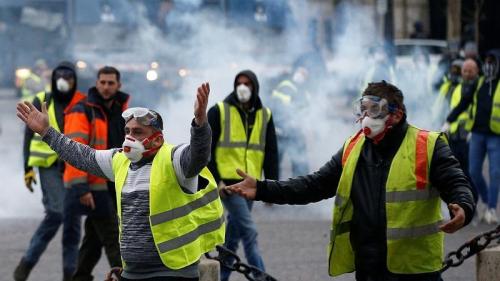
But here problems arise for the comparison, as the author himself admits. Writing from France, he notes that Emmanuel Macron’s capacity to confront the pandemic is not of a kind with even his least gesture toward (purported) climate abatement, recalling how his gas tax was met not with relief and a thirst for more but with the riots of the Gilets Jaunes movement. Per Latour, this is because Macron — and ostensibly other leaders — have not forged the kind of new state that climate collapse will require. Instead, “we are collectively playing a caricatured form of the figure of biopolitics that seems to have come straight out of a Michel Foucault lecture.”

He means Foucault’s final lecture on the theme Society Must Be Defended, describing a new kind of power. Whereas once “Sovereignty took life and let live,” he writes, we discover toward the end of the eighteenth century “the emergence of a power that . . . in contrast, consists in making live and letting die.” This is the famous formula of biopolitics: the sovereign power to make live and let die.

Latour notes that this power’s deployment in the present moment includes “the obliteration of the very many invisible workers forced to work anyway so that others can continue to hole up in their homes.” Rightly so — this is a peculiarly awful time to be a delivery worker, from the warehouse or restaurant to the driver anxiously tossing a box on your porch. Recent days have presented an even more devastating turn: recent pronouncements by various governmental figures who, noting the economic devastation of COVID-19, proclaimed that people would have to abandon quarantine procedures after a fortnight at the very most and return to work so as to avoid cratering the economy. This despite the medical certainty that this would lead to more transmissions and more deaths. Forty-four years and five days after Foucault’s lecture, Donald Trump tweeted, WE CANNOT LET THE CURE BE WORSE THAN THE PROBLEM ITSELF. AT THE END OF THE 15 DAY PERIOD, WE WILL MAKE A DECISION AS TO WHICH WAY WE WANT TO GO! If this was in any way opaque, two days later Texas Lieutenant Governor Dan Patrick speculated, “are you willing to take a chance on your survival in exchange for keeping the America that America loves for its children and grandchildren? And if that is the exchange, I’m all in.”

But this course of action is not speculative at all: rather it seems to be the express plan of the state, coming soon. Look, to save the economy, we’re gonna have to kill some folks. Like, a lot. Horrified humans immediately noted this was a blood sacrifice to capitalism and who could disagree? This is the most dramatic political development since the early hours of millennium if not very much longer. It must seem like the apotheosis of biopolitics: a crackpot sovereign deciding at national scale who will be made to live, who let die.

Except for the way in which this was, in the clearest manner, the reverse. By 22 March, Goldman Sachs was already predicting an unparalleled 2.5 million new jobless claims; this would prove optimistic.

CLOVER

Meanwhile the Senate tinkered with its relief bill. The massive transfers to corporations were a given, for which 2008 now appears as a dress rehearsal. The haggling endeavored to dial in the exact size of the direct payment to citizens. It would need to restore enough aggregate demand to keep the economy breathing (a ventilator of sorts) while taking care not to give a single prole the incentive to be, in the face of a global and terrifying pandemic poised to kill millions absent assiduous measures taken by all, lazy. And it is to this delicate measure that presidents must also dance, not the measure decided on by the legislature, but the measure of that abstraction “the economy.” Nothing could have thrown Foucault’s formulations about sovereignty and regimes of power, and especially the limits of these ideas, into clearer relief than this week’s pronouncements, provisions, and data.

This is not to say there is no such thing as biopolitics nor any power to make live and let die. Clearly there is; clearly it is this that is wielded by all the Trumps great and small. Nonetheless it is apparent that the sovereign is not sovereign. Rather he is subordinated entirely to the dictates of political economy, that real unity of the political and economic forged by capital and its compulsions. Make live and let die is simply a tool among others in this social order whose true logic, from Trump’s tweet to Dan Patrick to the Senate bill, is the power employed always as a ratio of make work and let buy.

Here we must take a final turn toward where we began and reenter the genre named at the outset. The link between coronavirus and climate is more direct than mere analogy, two threats that challenge our senses of scale and temporality and so seem to demand something like a state to address them. Rather it turns out that one shows us the character of the other with horrific lucidity. We should not be surprised to discover that, like the 2008 economic collapse, the pandemic has significantly reduced emissions globally. The reductions have been particularly marked in China and Italy, the two most devastated nations. We might expect, glancing at the rate of spread and those unemployment numbers, that we will see similar results from the United States. Maybe we will get right with the Paris Accords after all.

This is not to say that we should imagine the virus as a redeemer; that is a particularly grotesque fantasy. Its role in a temporary retreat of planetarily fatal emissions is nonetheless informative. Ecological despoliation is a consequence not of humans, as the name “Anthropocene” and Latour’s essay suggest, but of industrial production and its handmaidens, and only forces which can bring that to heel allow us to prepare for climate change. Capital, with is inescapable drive to reproduce itself, is not some actor in a network, equivalent to other actors, but an actual cause. The compulsion to produce, and to produce at a lower cost than competitors, in turn compels the burning of cheap and dirty fuels to drive the factories, to move the container ships, even to draw forth from the ground the material components of “green energy” sources. The Gilets Jaunes did not riot because they object to ecological policies but because the economy dictates that they find jobs in places they cannot afford to live, and to which they must therefore commute. As long as the compulsions of production for profit and of laboring to live persist, climate survival will be beyond the reach of any state.

yellow_vests

We must take this fact with the utmost seriousness: that Foucault’s new regime of power appears in the late eighteenth century, which is to say, alongside the steam engine and the industrial revolution, which is also to say, alongside the liftoff of anthropogenic climate change. We need to stop fucking around with theory and say, without hesitation, that capitalism, with its industrial body and crown of finance, is sovereign; that carbon emissions are the sovereign breathing; that make work and let buy must be annihilated; that there is no survival while the sovereign lives.

29 March 2020


Joshua Clover is a professor of English at the University of California, Davis.  He is also a faculty member in the Department of Comparative Literature and affiliated faculty in the French and Italian departments, Film Studies Program, and the Designated Emphasis in Critical Theory. He is affiliated with the Mellon Research Initiative in Racial Capitalism. His most recent book is Riot. Strike. Riot: The New Era of Uprisings (2016).


[1] This translation mine; the remainder come from the English text.

Is This a Dress Rehearsal?

Bruno Latour

The unforeseen coincidence between a general confinement and the period of Lent is still quite welcome for those who have been asked, out of solidarity, to do nothing and to remain at a distance from the battle front. This obligatory fast, this secular and republican Ramadan can be a good opportunity for them to reflect on what is important and what is derisory. . . . It is as though the intervention of the virus could serve as a dress rehearsal for the next crisis, the one in which the reorientation of living conditions is going to be posed as a challenge to all of us, as will all the details of daily existence that we will have to learn to sort out carefully. I am advancing the hypothesis, as have many others, that the health crisis prepares, induces, incites us to prepare for climate change. This hypothesis still needs to be tested.

LENT

What allows the two crises to occur in succession is the sudden and painful realization that the classical definition of society – humans among themselves – makes no sense. The state of society depends at every moment on the associations between many actors, most of whom do not have human forms. This is true of microbes – as we have known since Pasteur – but also of the internet, the law, the organization of hospitals, the logistics of the state, as well as the climate. And of course, in spite of the noise surrounding a “state of war” against the virus, it is only one link in a chain where the management of stocks of masks or tests, the regulation of property rights, civic habits, gestures of solidarity, count exactly as much in defining the degree of virulence of the infectious agent. Once the entire network of which it is only one link is taken into account, the same virus does not act in the same way in Taiwan, Singapore, New York, or Paris. The pandemic is no more a “natural” phenomenon than the famines of the past or the current climate crisis. Society has long since moved beyond the narrow confines of the social sphere.

Having said that, it is not clear to me that the parallel goes much further. After all, health crises are not new, and rapid and radical state intervention does not seem to be very innovative so far. One need only look at President Macron’s enthusiasm to take on the figure of head of state that he has so pathetically lacked until now. Much better than terrorist attacks – which are, after all, only police business – pandemics awaken in leaders and those in power a kind of self-evident sense of  “protection” – “we have to protect you” “you have to protect us” – that recharges the authority of the state and allows it to demand what would otherwise be met with riots.

But this state is not the state of the twenty-first century and ecological change; it is the state of the nineteenth century and so-called biopower. In the words of the late Alain Desrosières, it is the state of what is rightly called statistics: population management on a territorial grid seen from above and led by the power of experts.[1] This is exactly what we see resurrected today – with the only difference that it is replicated from one nation to the next, to the point of having become world-wide. The originality of the present situation, it seems to me, is that by remaining trapped at home while outside there is only the extension of police powers and the din of ambulances, we are collectively playing a caricatured form of the figure of biopolitics that seems to have come straight out of a Michel Foucault lecture. Including the obliteration of the very many invisible workers forced to work anyway so that others can continue to hole up in their homes – not to mention the migrants who, by definition, cannot be secluded in any home of their own. But this caricature is precisely the caricature of a time that is no longer ours.

There is a huge gulf between the state that is able to say “I protect you from life and death,” that is to say from infection by a virus whose trace is known only to scientists and whose effects can only be understood by collecting statistics, and the state that would dare to say “I protect you from life and death, because I maintain the conditions of habitability of all the living people on whom you depend.”

Think about it. Imagine that President Macron came to announce, in a Churchillian tone, a package of measures to leave gas and oil reserves in the ground, to stop the marketing of pesticides, to abolish deep ploughing, and, with supreme audacity, to ban outdoor heaters on bar terraces. If the gas tax triggered the yellow-vests revolt, then imagine the riots that would follow such an announcement, setting the country ablaze. And yet, the demand to protect the French people for their own good and from death is infinitely more justified in the case of the ecological crisis than in the case of the health crisis, because it affects literally everyone, not a few thousand people – and not for a time but forever.

It is clear that such a state does not exist — and maybe fortunately so. What is more worrying is that we do not see how that state would prepare the move from the one crisis to the next. In the health crisis, the administration has the very classic educational role and its authority coincides perfectly with the old national borders – the archaism of the sudden return to European borders is painful proof of this. In the case of ecological change, the relationship is reversed: it is the administration that must learn from a multiform people, on multiple scales, what will be the territories upon which people are trying to survive in many new ways as they seek to escape from globalized production. The present state would be completely incapable of dictating measures from above. If in the health crisis, it is the brave people who must relearn to wash their hands and cough into their elbows as they did in primary school, in the case of the ecological mutation, it is the state that finds itself in a learning situation.

But there is another reason why the figure of the “war against the virus” is so unjustified: in the health crisis, it may be true that humans as a whole are “fighting” against viruses – even if they have no interest in us and go their way from throat to throat killing us without meaning to. The situation is tragically reversed in ecological change: this time, the pathogen whose terrible virulence has changed the living conditions of all the inhabitants of the planet is not the virus at all, it is humanity! But this does not apply to all humans, just those who make war on us without declaring war on us. For this war, the national state is as ill-prepared, as badly calibrated, as badly designed as possible because the battle fronts are multiple and cross each one of us. It is in this sense that the “general mobilization” against the virus does not prove in any way that we will be ready for the next one. It is not only the military that is always one war behind.

But finally, you never know; a time of Lent, whether secular or republican, can lead to spectacular conversions. For the first time in years, a billion people, stuck at home, find this forgotten luxury: time to reflect and thereby discern that which usually and unnecessarily agitates them in all directions. Let’s respect this long, painful, and unexpected fast.

26 March 2020

[The post was originally published in French with La Monde]


Bruno Latour is an emeritus professor associated with Sciences Po médialab.


[1] Alain Desrosières, The Politics of Large Numbers: A History of Statistical Reasoning,  trans. Camille Naish (Cambridge, Mass., 2002).

GLOBALIZATION AND THE CHALLENGE OF THE ANTHROPOCENE

[[Chapter 5, in Ino Rossi, ed. (2020) Challenges of Globalization and Prospects for an Inter-civilizational World Order (Springer Nature Switzerland)]]

Leslie Sklair

This piece argues that if globalization was one of the leading ideas in the social sciences from the 1990s to the first decade of the new millennium, the Anthropocene can now be considered as a leading idea in the social sciences, the humanities and also in some of the creative arts. The Anthropocene, strictly speaking, is a geological concept, coined in recognition of increasingly de-stabilizing human impacts on the planet. The controversies around the origins of the Anthropocene mirror those around the chronologies of globalization – are they ancient or modern phenomena? The label Anthropocene was intended to replace the Holocene epoch (roughly the last 10-12,000 years) in the geological nomenclature (see Steffen et al. 2011) and to establish the discipline of Earth System Science (ESS, see Hamilton 2015, Angus 2016).

The idea of the Anthropo-scene appeared around 2015, and was first systematically set out in an article in the journal Social Studies in Science to highlight the ‘rich, inchoate and multi-disciplinary diversity of this Anthropo-scene… [proposing] five ways in which the concept of the Anthropocene has been mobilized: scientific question, intellectual zeitgeist, ideological provocation, new ontologies and science fiction’ (Lorimer 2017: 117). Adding the intervention of creative artists, this is a useful way of organising a vast literature.

GLOBALIZATION AS SOCIAL SCIENCE, ANTHROPOCENE AS GEOLOGICAL SCIENCE, ANTHROPO-SCENE AS TOTALIZING NARRATIVE

The initial popularity of globalization as a motif for the social sciences and humanities was little short of astonishing. Introduced in the print media around 1960, the term first started to be used systematically by scholars and journalists in the 1980s, and by the turn of the millennium it was to be found everywhere, applied to almost everything (Ritzer 2012). In the words of The Economist in 2009, ‘The concept globalization was popularised by an American journalist, Thomas Friedman, in his book “The World is Flat”. Published in 2005, it reached the top of several bestseller lists with its headline message that the world is now just one big integrated market’ (<http://www.economist. com/node/14031230>). The idea of the Anthropocene was ‘officially’ announced to the wider scientific community in a short communication in the journal Nature[1] (probably the most influential science publication in the world) entitled ‘Geology of mankind’ (Crutzen 2002) – in retrospect, an unfortunate title. An article in the Guardian (London) highlighted the male bias in science in general and in the group leading the Anthropocene campaign in particular – this attracted hundreds of comments (Raworth 2014).

Critics of the ideas of globalization and of the Anthropocene share many characteristics. For example, the literature on globalization is suffused with a good deal of fatalism, popularly known as TINA (there is no alternative). Even some progressive academics, popular writers and political and cultural leaders seem to accept that there is no alternative to capitalist globalization and that all we can do is to try to work for a better world around it (Giddens 2000). And this is where the challenge of the Anthropocene to existing conceptions of globalization starts to bite. In 2009, the historian of fossil capitalism Andreas Malm, declared: ‘Forget the Anthropocene, we should call it the Capitalocene’ (quoted in Moore’s edited book of 2016: xi). While sympathising with the sentiment, I think that there are many reasons to claim that the Anthropocene is an apt label for the human impact on the planet. It is inclusive of the human enterprise, and though different levels of responsibility can be apportioned, most people on Earth (rich and poor) are understandably complicit through what I have labelled the culture-ideology of consumerism (Sklair 2001, 2002). Rebranding Anthropocene as Capitalocene conveniently lets anti-capitalists off the hook to fly around the world critiquing capitalism and making our own ecologically destructive consumer choices. Just as we are all living in a globalised world that world is also the Anthropocene. And it is taking place within and being intensified through the system of capitalist globalization fortified by hierarchic states.

What, then, does the idea of the Anthropocene have to offer that the immense body of globalization research does not already offer? The first and most obvious answer to this question must focus on the efforts of Earth System scientists to establish connections between the economic, social, and cultural spheres and the Earth System itself. Lorimer makes the distinction between the scientific agenda of the Anthropocene for Earth System science, and its rapid absorption into the intellectual zeitgeist. I would suggest, however, that the evidence permits another reading of the situation, namely that many ESS researchers (including some of the most influential) framed their concept of the Anthropocene in a way that directly invited diverse publics into the fold, creating popular and transdisciplinary appeal. This, I would argue, can be clearly seen from what may be labelled the ‘official canon’ of the Anthropocene as a scientific reality. In their collective introduction to the topic in the authoritative Philosophical Transactions of the Royal Society,Steffen, Grinevald, Crutzen, and McNeill (2011) conclude that the Anthropocene might be compared to the Darwinian revolution. Even more boldly (and alarmingly) these three leading Earth scientists and one of the most influential world historians of our time, state: ‘Darwin’s insights into our origins provoked outrage, anger and disbelief but did not threaten the material existence of society of the time. The ultimate drivers of the Anthropocene, on the other hand, if they continue unabated through this century, may well threaten the viability of contemporary civilization and perhaps even the future existence of Homo sapiens’ (ibid: 862). Unusually for an article announcing a new field of scientific inquiry in a most prestigious natural science publication, this suggests that the Anthropocene is of direct relevance to planetary survival.

Further evidence of the enthusiasm of the promoters of the Anthropocene concept to welcome the social sciences, humanities, and the arts into the broad tent of ‘Anthropocene studies’ comes from the Anthropocene Working Group (AWG). This was established in 2009 to prepare the scientific community and the general public for the theoretical and practical challenges that lay ahead. The chairman was Jan Zalasiewicz (Professor of Paleobiology at the University of Leicester) who, through his writings, media outreach, and promotional skills, has done as much as anyone to disseminate the idea of the Anthropocene in scientific and public spheres. In December 2009 in correspondence with Davor Vidas (an international law of the sea scholar) Zalasiewicz wrote: ‘I would be glad to discuss the wider implications [of the Anthropocene] to your field of study, because while we are aware of the general societal implications of this term, the possible practical implications for international law [of the sea] would be of considerable interest in our examination of this term.’[2]

The Royal Society of Great Britain accepted a proposal for a thematic set of papers on the Anthropocene, to appear in their Proceedings journal.  The first theme was ‘Historical perspectives and concept of the Anthropocene’, followed by eight geological and ecological topics. The last, ‘societal responses to the Anthropocene’, is of particular significance for my argument – like the article by Steffen et al., wide enough to encourage participation from practically anyone. In his annual AWG report for 2014, Zalasiewicz wrote: ‘This has been another eventful year in the rapidly growing field of what one might term “Anthropocene studies”.’ Also highlighted were the major Anthropocene project at Berlin’s Haus der Kulturen der Welt (HKW), the equally significant Deutsches Museum/Rachel Carson Center Anthropocene exhibition in Munich, the incorporation of the Anthropocene as a major theme in the Smithsonian Institution’s ‘Deep Time’ exhibition, three new Anthropocene journals and general books and films on the topic in the pipeline – all examples of prestigious outreach and what research funding bodies term ‘impact’.[3]

The inaugural meeting of the AWG was hosted and financially supported by HKW in Berlin in October 2014. This meeting included discussion of various technical questions concerning the measurement of the Holocene-Anthropocene boundary, whether the Anthropocene should be considered as ‘a unit of Earth history or human history’, and the issue of the ‘Anthropocene as a time unit and a material unit to be visualized by geoscientists and other interested communities.’ A session on ‘Human Impacts and Their Consequences’ ranged far and wide over critical assessment of science-political solution pathways, and a ‘research agenda beyond sustainability, linking scientific practice with societal relevance and local to global strategies of knowledge production’. Zalasiewicz summed up these ‘exchanges’ as follows: ‘a set of dialogues between members of the Anthropocene Working Group and social scientists, thinkers, and artists, a serial thread of conversations that draws from a vast range of expertise, disciplines, and practices. … engaging with research methods in the lab or field, at the desk or in the studio.’ This was followed in June 2015 by ‘The Anthropocene Project’ at the Tate Modern, an exhibition at the Barbican in London, and similar events in many other cities around the world. This suggests that in the case of the Anthropocene the dire warnings of C.P. Snow’s ‘two cultures’ thesis (chronicling the dangers of the separation of the sciences from the humanities and arts) were finally being taken to heart by all sides.[4] My view is that globalization as a sociological concept has always been too frail to sustain the theoretical and substantive burdens loaded on to it. The ‘global’ has always seemed too big and often lacking the specificity necessary for any sort of scientific rigour and no doubt some think the same about the Anthropocene.

GENERIC, CAPITALIST, AND ALTERNATIVE ANTHROPOCENES

In order to address political and methodological problems I originally distinguished three modes of globalization in theory and practice, what we may term the ‘silent qualifiers’ of globalization – namely generic, capitalist, and alternative globalizations (Sklair 2009). Now, after studying the Anthropocene (and -scene), it appears to me that the same ‘silent qualifiers’ can also be applied – generic, capitalist, and alternative Anthropocenes (same names, different contents).[5]

By generic Anthropocene I mean the simple ideas that living creatures have always had a multitude of impacts on the Earth System which itself is constantly changing in various ways, and that the evolution of humankind represented a quantitative transformation of these impacts (particularly with respect to city building, agriculture, and infrastructure). By capitalist Anthropocene I mean that the industrialization made possible by fossil fuels, exploited via capitalist relations of production, set in motion qualitative transformations of these impacts on the Earth System (Malm 2015). The difference between the generic and the capitalist Anthropocenes and, by implication, between the quantitative and the qualitative impacts on the planet, is caught by the distinction that geologists have made between the Holocene and the Anthropocene. The Holocene represents the previous 12,000 years of relative planetary stability, notably moderate temperature fluctuations and other functions favourable to life on the planet; the capitalist Anthropocene represents an end of relative planetary stability and a far less predictable, possibly catastrophic future. In the opinion of many Earth scientists and Anthropocene popularisers one possible outcome is the end of life as we know it on the planet. However, like capitalist globalization, in the capitalist Anthropocene such alarming messages are rapidly dealt with by diluting them through a variety of what we might label ‘reassurance narratives’. For example, the Steffen et al. (2011) paper cited above concludes on an optimistic note reassuring us that human intelligence and ingenuity is prepared for the challenge of the Anthropocene. The most influential statement of this view comes from the prestigious Stockholm Resilience Centre research on planetary boundaries (PB). An authoritative report on the status of these boundaries, while highlighting the dangers (several boundaries already breached, others on the edge) concludes: ‘Nevertheless, by identifying a safe operating space for humanity on Earth, the PB framework can make a valuable contribution to decision-makers in charting desirable courses for societal development’ (Steffen, Richardson, Rockström, et al. 2015: 475). The ideas of ‘safe operating space’ and the frequently quoted ‘Welcome to the Anthropocene’ are only the most common of the Anthropocene reassurance narratives which have come to be associated with the label ‘good Anthropocene’. The parallels with globalization as theory and practice are striking. Equivalent reassurance narratives for the downsides of capitalist globalization are ‘the rising tide lifts all boats’ blurring the evidence of global and local class polarization, and ‘ecological modernization’ (also propagated by good Anthropocene enthusiasts) blurring the evidence of global and local ecological unsustainability (see Leichenko & O’Brien 2008, Sklair 2002: 48-58) – the capitalist Anthropocene avant la lettre! In the media these reassurance narratives successfully morph from challenges to opportunities, successfully trumping (no pun intended) pessimism with optimism, pushing existential threats into the shadows.[6] Engaging creatively with the science-politics of the Anthropocene, Stengers (2015) shows that as scientists went public on the Anthropocene before all the geological results were established (waiting for more definitive markers could be catastrophic), the anthropogenic climate-change deniers could keep the debate going, opening up the unenviable choice between merchants of fear or merchants of doubt.[7] Latour keeps this conversation going. Science and politics are both frail human endeavours, he argues. Anthropocene politics ‘is not a rational debate … [it is] incredibly easy to make two sides emerge even when there is only one’ (Latour 2015:147).

There is a large literature on climate change denial (Boykoff & Olson 2013), much less on Anthropocene denial (but see the exemplary case study by Casagrande et al. 2017, where this is conceptualised as ‘ecomyopia’). Unsurprisingly, comparisons have been made between climate change denial and Holocaust denial: ‘Climate change and the Holocaust are not equivalent, but that does not mean there is no climate denial’ (Jacques 2012: 10). While it would be quite wrong to identify the slogan ‘Welcome to the Anthropocene’ with climate change or Anthropocene denial, I would argue that even when used ironically it does create an atmosphere of scepticism about the severity of the situation, which can implicitly lead to denial. The slogan adorned a front-page story in the Economist magazine in May 2011, the title of a 3-minute film introducing the UN Rio+20 summit in June 2012, and in 2014 a major exhibition ‘Welcome to the Anthropocene: The Earth in Our Hands’ opened in the Deutsches Museum, Munich. A review of this exhibition concludes with a sharp critique of what I mean by the capitalist Anthropocene reassurance narrative: ‘the Anthropocene idea has prompted many scholars and activists to point out the radical environmental injustice of the epoch and to critique the capitalism that has led to it. We see neither in this exhibit. Instead, it offers a relatively benign vision of a changing planet. The change is not pictured as threatening, in spite of being rapid. The exhibit says Welcome to the Anthropocene, not Goodbye to the World You Knew’ (Jørgensen & Jørgensen 2016: 237).[8] Several books, articles and mass media references to ‘Welcome to the Anthropocene’ suggest that there is a middle way between the generic Anthropocene and extreme capitalist Anthropocene denial, and that the idea of the ‘good, welcoming Anthropocene’ provides it. We may, after all, be having to think about planetary survival sooner rather than later.[9]

The debates around Anthropo-scene ideologies take different forms from those around globalization (see Sklair 2017). Capitalist ideologues generally adopted neoliberal forms of globalization, though by no means all (in and out of the transnational corporations and think tanks) took this position. My fourfold model of the transnational capitalist class (TCC) attempted to demonstrate alliances between corporate, political, professional and consumerist fractions, but was sensitive to intra-TCC differences and sometimes open warfare between the fractions, though usually resolved in the interests of Big Business and the Big State (Sklair 2001). In the case of capitalist globalization it was always obvious that there were powerful globalizing forces at work – the consequences of the digital revolution in all spheres of life and social organization made this difficult to deny. The political problem was and is: can capitalist globalization work for everyone or does it have an inbuilt tendency towards class polarization, inequality, and ecological disaster? Chinese President Xi at Davos in 2017 lectured the world with an impassioned defence of globalization and President Trump in the White House in 2018 promised to make America great again by resisting globalization. The politics of the Anthropocene do not rest on such obvious foundations. And, more to the point, I would argue that while globalization and especially climate change regularly appear in the mass media, albeit frequently in misleading and sensationalist terms (Boykoff 2011), the Anthropocene is still relatively unknown outside some bubbles in the worlds of science, academe, culture critique, and creative arts.[10]

Adding to Lorimer’s remarks on science/climate fiction and the Anthropocene (2017: 128-31), I can offer some comments on how the sciences are catching up with science fiction in a desperate attempt to prepare for the worst-case Anthropocene scenario – namely, what do we do when planet Earth becomes no longer able to support human life? [11] Two issues appear to be paramount, first the practical possibility of physical escape from a doomed planet, and second, the identification of planets that hold out prospects of supporting human life. Both are now being investigated by leading scientists and entrepreneurs with the financial backing of private benefactors and public money. Planning for physical escape from a doomed planet, does not receive much publicity, but it is clearly underway. In 2017 BBC2 screened a documentary, ‘The 21st century race for space’. Hosted by the genial Professor Brian Cox, a leading science populariser in the UK, it took viewers on a tour of cutting-edge research locations all around the world. Cox explained: ‘surprisingly, some of the boldest efforts at putting humans into space are now those of private companies started by a handful of maverick billionaire businessmen’.[12] These include Richard Branson (Virgin Galactic), Jeff Bezos (founder of Amazon and Blue Origin) and Elon Musk (Spaceport America and SpaceX) and their initiatives in privately financed space flight, space tourism, asteroid mining, and dreams of colonies on Mars. But, says Cox, ‘their true ambition is to ensure the survival of the human race by crossing our solar system and colonizing Mars in the next decade.’ Building space ships is one problem, the next is ensuring the voyagers survive the journey, and then to find somewhere eventually for them to land and make a home. This is the search for a new planet Earth. The late Stephen Hawking, had for some years been arguing that the human species will have to relocate to a new planet within 100 years. This documentary gave him one more platform to disseminate his views.

The search for another planet Earth or a planet that can be terraformed to serve as a new home for humans is also underway.[13] Professor Hawking and several other distinguished scientists worked with Breakthrough Initiatives, a programme of scientific and technological exploration, probing the big questions of life in the Universe. The website (<https://breakthroughinitiatives.org&gt;) explains: ‘Are we alone? Are there habitable worlds in our galactic neighborhood? Can we make the great leap to the stars? And can we think and act together – as one world in the cosmos? … Breakthrough Listen is a $100 million program of astronomical observations in search of evidence of intelligent life beyond Earth. … A complete survey of the 1,000,000 nearest stars, the plane and center of our galaxy, and the 100 nearest galaxies. All data will be open to the public.’ This is serious money supporting serious efforts by serious scientists in what has been labelled exoplanet studies, namely the study of planets outside our solar system that orbit a star. A recent publication on exoplanet astrobiology states: ‘The discovery of seven new exoplanets orbiting the relatively close star TRAPPIST-1 forces us to rethink life on Earth. It opens the possibility to broaden our understanding of coupled system dynamics and lay the foundations to explore a path to long-term sustainability by entering into a cooperative ecological-evolutionary dynamic with the coupled planetary systems’ (in Kelley 2017).[14] Behind all this effort is the fear of the worst-case Anthropocene scenario, a fear that seems to put all forms of globalization into a new, rather parochial, perspective. However, this would be a premature judgement.

CONCLUSION

I have argued that the emerging discipline of Anthropocene (and -scene) studies is poised to absorb globalization as the new meme for 21st century thinking about our world as a whole and possible futures. The Anthropocene has the unique capacity to pose questions about planetary survival, and globalization has the unique capacity to explain local-global dynamics. The critical point will arrive if and when sufficient numbers of ordinary people all over the world begin to realize that geoengineering, new technologies, and Artificial Intelligence machines will not save us from the ravages of the Anthropocene. Stephen Hawking, for example, campaigned vigorously against AI, warning that robots could destroy humanity – another sphere in which capitalist globalization confronts the Anthropocene.[15] If it is not too late to secure planetary survival, alternative Anthropocenes (i.e. intelligent reworkings of human impacts on the Earth System and its constituent eco-systems) may start to replace the current dysfunctional capitalist and state systems that exacerbate existing problems. A necessary aspect of these reworkings would be innovative reformations of global-local relations. Such initiatives are already under way in thousands of small communities all round the world, seeking routes to zero-carbon living, producing their own food, and detaching themselves from the growth obsession of capitalism and its variants. It is important to acknowledge that diluted versions of these strategies are also to be found in the rhetoric of the capitalist ‘good Anthropocene’, propounded by corporate interests, national governments, and international organizations in terms of getting to grips with climate change. Climate change summits over the last 50 years have made some progress at local, national, and global levels, but the optimism of the negotiators and most of the mass media often seems pathetically naïve in comparison with the evidence-based pessimism of many Earth System scientists.

The key, in my view, is the issue of degrowth, now a rapidly expanding transnational intellectual and social movement (D’Alisa et al. 2014). With the mantra of endless growth integral to the survival of both global capitalism and the state system, it seems obvious that capitalism and the centralised hierarchical state are incompatible with planetary survival in the long-term (perhaps even in the shorter-term, if we are to take Stephen Hawking and others like him seriously). However, the proponents of degrowth like everyone else, are yet to deal convincingly with the formidable problems of existing global inequalities and their root causes. Studying more carefully small-scale self-reliant communities and their strategies of disengagement with the capitalist market and the state may offer one way of starting to deal with these problems and creating alternative Anthropocenes within which alternative globalizations may thrive. Fortunately, the Anthropocene is also a digital era, which raises the possibility for opportunities to create local democratically organized communities, networking on many different geographic and socio-political scales. This, in my view, is the best prospect for alternative globalizations and alternative Anthropocenes. So, if the worst comes to the worst, even this remote possibility of long-term planetary survival might become a little less remote and the future for our descendants a little less desperate.[16]

REFERENCES

Anderson, K. (2015). Ethics, Ecology, and the Future: Art and Design Face the Anthropocene. Leonardo, 48 (4), 338-347.

Angus, I. (2016). Facing the Anthropocene: Fossil capitalism and the crisis of the earth system. New York: Monthly Review Press.

Boykoff, M. (2011). Who Speaks for the Climate? Making sense of mass media reporting on climate change. Cambridge: Cambridge University Press.

Boykoff, M. and Olson, S. (2013). ‘Wise contrarians’: a keystone species in contemporary climate science, politics and policy. Celebrity Studies, 4(3), 276-291.

Casagrande, D., Jones, E., Wyndham, F., Stepp, J. & Zarger, F. (2017). Ecomyopia in the Anthropocene. Anthropology Today, 33(1), 23-25.

Cook, J. et al. (2015). Consensus on consensus: a synthesis of consensus estimates on human-caused global warming. Environmental Research Letters, 11, 1-6.

Crutzen, P. & Stoermer, E. (2000). The ‘Anthropocene’. IGBP Newsletter, 41, 17-18.

Crutzen, P. (2002). Geology of mankind. Nature, 415 (January), 23.

D’Alisa, G., Demaria, F. and Kallis. G. (Eds) (2014). Degrowth: A Vocabulary for a New Era. London: Routledge.

Dalby, S. (2016). Framing the Anthropocene: the good, the bad and the ugly. The Anthropocene Review, 2(2), 102-106.

Ellis, E. (2018) Anthropocene: A very short introduction. Oxford: Oxford University Press.

Giddens, A. (2000). The Third Way and its Critics. Cambridge: Polity.

Hamilton, C. (2015). Getting the Anthropocene so Wrong. The Anthropocene Review, 3(1), 33-51.

Hamilton, C., Bonneuil, C., & Gemenne, F. Eds. (2015). The Anthropocene and Global Environmental Crisis: Rethinking modernity in a new epoch. London & New York: Routledge.

Jacques, P. (2012). A General Theory of Climate Denial. Global Environmental Politics, 12 (2), 9-17.

Jørgensen, F. & Jørgensen, D. (2016). The Anthropocene as a History of Technology: ‘Welcome to the Anthropocene’. Technology and Culture, 57 (1), 231-237.

Kelley, P. (2017). <http://www.washington.edu/news/2017/09/06/earth-as-hybrid-planet-new-classification-scheme-places-anthropocene-era-in-astrobiological-context/>

Knoespel, K. (2012). Reading and Revolution on the Horizon of Myth and History: Kim Stanley Robinson’s Mars Trilogy. Configurations, 20 (1-2), 109-136.

Latour, B. (2015). Telling friends from foes in the time of the Anthropocene. In C. Hamilton et al., Eds. op cit., 145-55.

Leichenko, R. and O’Brien, K. (2008). Environmental Change and Globalization: Double Exposures. Oxford: Oxford University Press.

Lorimer, J. (2017). The Anthropo-scene: A guide for the perplexed. Social Studies of Science, 47(1), 117–142.

Malm, A. (2016). Fossil Capitalism: The rise of steam power and the roots of global warming. London: Verso.

Moore, J. (Ed.) (2016). Anthropocene or Capitalocene? Nature, History, and the Crisis of Capitalism. Oakland CA: PM Press.

Oreskes, N. & Conway, E. (2012) Merchants of Doubt – How a Handful of Scientists Obscured the Truth on Issues from Tobacco Smoke to Global Warming. London: Bloomsbury.

Raworth, K. (2014). ‘Must the Anthropocene be a Manthropocene?’ <https://www.theguardian.com/commentisfree/2014/oct/20/anthropocene-working-group-science-gender-bias>.

Ritzer. G. (Ed.) (2012). The Wiley-Blackwell Encyclopedia of Globalization. Malden MA: Wiley-Blackwell, five volumes.

Robin, L. & Muir, C. (2015). <https://umaincertaantropologia.org/2015/05/02/slamming-the-anthropocene-performing-climate-change-in-museums-recollections/>

Sklair, L. (2001). The Transnational Capitalist Class, Oxford: Blackwell.

Sklair, L. (2002). Globalization: Capitalism and its Alternatives, Oxford: Oxford University Press.

Sklair, L. (2009). The emancipatory potential of generic globalization. Globalizations, 6 (4), 523-37.

Sklair, L. (2016). Half-Baked. Philosophica Critica, 2 (2), 103-16.

Sklair, L. (2017). Review Article: Sleepwalking through the Anthropocene. British Journal of Sociology, 68 (4), 775–784.

Sklair, L. ed. (2021). The Anthropocene in Global Media: Neutralizing the Risk. London: Routledge.

Steffen, W., Grinevald, J., Crutzen, P. and McNeill, J. (2011). The Anthropocene: conceptual and historical perspectives. Phil. Trans. R. Soc. A, 369, 842-867.

Steffen, W., Richardson, K., Rockström, J. et al. (2015). Planetary Boundaries: Guiding human development for a changing planet. Science, <http://science.sciencemag.org/content/347/6223/1259855>

Stengers, I. (2015). Accepting the reality of Gaia: a fundamental shift. In Hamilton et al., op cit. (Eds), 134-44. 

Swanson, H.A., Bubandt, N. and Tsing, A. (2015). Less than one but more than many: Anthropocene as science fiction and scholarship-in-the-making. Environment & Society, 6, 149–166.

Wark, M. (2015). Molecular Red: Theory for the Anthropocene. London: Verso.


[1] Crutzen and Stoermer (2000) was a more technical article on the Anthropocene in the newsletter of the International Geosphere–Biosphere Programme. Stoermer is also credited with introducing the term (see Angus 2016: 33ff., Ellis 2018: Chap.1).

[2] In 2009 Vidas organised a major international conference on ‘The World Ocean in Globalization,’ perhaps the first scholarly conference to link globalization and the Anthropocene.  Unattributed quotes below can be accessed from the AWG website newsletters dated from 2009 to 2014, <https://quaternary.stratigraphy.org/workinggroups/anthropocene/>.

[3] On these and other scholarly and creative arts events, see Robin & Muir (2015), Anderson (2015) and Swanson et al. (2015).

[4] See <http://s-f-walker.org.uk/pubsebooks/2cultures/Rede-lecture-2-cultures.pdf> The major figure for the Anthropocene in this context is the Indian historian Dipesh Chakrabarty (2009, 2012, 2016).

[5] I deal with generic and capitalist Anthropocenes in this section, for alternative Anthropocenes see my conclusion.

[6] The institutional support for these views could be labelled the ‘Philanthropocene’(philanthropic institutions and foundations propagating ‘good’ Anthropocene narratives).

[7]  See Oreskes and Conway (2012). Relevant here is the literature on consensus in science – the multidisciplinary survey of Cook et al. (2015) has had more than 300,000 downloads.

[8] For a thorough discussion of debates around the ‘good Anthropocene’, see Dalby (2016).

[9] Compare: ‘Welcome to the Anthropocene’ with ‘Welcome to the Holocaust’; or the prizewinning book ‘Adventures in the Anthropocene’ with ‘Adventures in the Holocaust’; or the art exhibition and conference entitled ‘Postcards from the Anthropocene’ with ‘Postcards from the Holocaust’; or ‘Romancing the Anthropocene’ with ‘Romancing the Holocaust’. These comparisons might seem ridiculous (even offensive) now, but if the worst comes to the worst …

[10] For an edited collection based on a research project to establish how the Anthropocene is represented in the mass media in local languages all over the world, see Sklair ed. (2021).

[11] Kim Stanley Robinson’s novel Mars Trilogy, tells the story of the colonization of Mars. The richness and remarkable prescience of Robinson’s writing are ample rewards for the effort required to read all three volumes. See Wark (2015: ch.4), and Knoespel (2012), who provides a useful glossary of the main themes.

[12] See <https://www.research.manchester.ac.uk/portal/en/media/bbc-two-the-21st-century-race-for-space(50aba912-8932-4dd2-8e28-c72a7821be49).html>

[13] Usually, terraforming is defined as making other planets more like Earth. However, I consider it more fruitful to expand the definition to include Earth and bring terraforming into debates about nature, infrastructure, technology, bio- and geoengineering.

[14] Kelley summarises the paper – originally published in the journal Anthropocene. I do not cite it because I do not entirely understand it, however the conclusion in Kelley, quoting one of the authors, seems to imply something like the relationship between Earth and Mars in Robinson’s trilogy.

[15] In the long Harvard Business Review (July 2017) cover story on AI, notable for their absence are the words citizen, democracy, ethics, morality, responsibility, values.

[16] For example <https://transitionnetwork.org/news-and-blog/activism-in-the-anthropocene>; see also Sklair (2016).