‘a grandiose time of coexistence’: Stratigraphy of the Anthropocene

Claire Colebrook

It seems the only response to the vogue for Anthropocene thinking is ambivalence: yes, we are finally –perhaps – thinking beyond our own time and interests, but we are doing so by way of a parochial conception of the species (‘anthropos’), accompanied by a resurgence of seemingly counter-humanist rhetorics that are all too human. Calling the Anthropocene the ‘capitalocene’, to name just one gesture, restores earlier political narratives that explain human history by way of a trajectory of labour, and allows the goodness of the notion of the proper polity to remain in place.  The Anthropocene is not a simple invocation of ‘humanity’ or ‘the human,’ but an explanation of a now-universal predicament, generated by the historically, economically, culturally and politically singular mode of being of some humans.  The logic of the Anthropocene and its mode of universality is akin to that of the universal history of Anti-Oedipus: there is nothing necessary or inevitable about the history of capitalism and humanism, and yet once that history has taken place capitalism’s system of abstraction, exchange and axiomatics enables the comprehension of all previous social assemblages; all other social forms are now seen as different from capitalism to the extent to which they impeded radically deterritorialized exchange:

… it is correct to retrospectively understand all history in the light of capitalism, provided that the rules formulated by Marx are followed exactly.

First of all, universal history is the history of contingencies, and not the history of necessity. Ruptures and limits, and not continuity. For great accidents were necessary, and amazing encounters that could have happened elsewhere, or before, or might never have happened, in order for the flows to escape coding and, escaping, to nonetheless fashion a new machine bearing the determinations of the capitalist socius. …

…if we say that capitalism determines the conditions and the possibility of a universal history, this is true only insofar as capitalism has to deal essentially with its own limit, its own destruction—as Marx says, insofar as it is capable of self-criticism (at least to a certain point: the point where the limit appears, in the very movement that counteracts the tendency). In a word, universal history is not only retrospective, it is also contingent, singular, ironic, and critical (Deleuze and Guattari 1983, 140).

Capitalism makes sense of its prehistory, enabling a universal and all-encompassing narrative that explains every other social form as its precursor.  One might say the same for Deleuze and Guattari’s mode of philosophy: its grasp of life in all its stratifications, all the ways in which it unfolds to infinity, takes place from a singular history of philosophy (from Greece to the present) that is then able to consider philosophy as such, and art as such as having a potentiality not limited to its Western or human form (1994).  This brings us to the heart of the inclusive disjunction of the Anthropocene.  It might seem as though commitment to the problem of the Anthropocene requires either that we abandon post-humanism and post-colonialism and accept a unity of the human (however retrospective), or we refuse the all-inclusive narrative and insist on attributing the force of the Anthropocene to some humans (the Capitalocene, the Corporatocene, the Plantationoscene).  Deleuze’s and Guattari’s philosophy insists both that we accept (at least) a 1000 plateaus, or all the different stratifications that make sense of the whole (including geology, semiology, military history, literary history, epigenetics, metallurgy, musicology and zoology), and that one of these strata – philosophy, emerging from a world of humans and capital – has the capacity to think stratification as such.   I would suggest that this is a fruitful way to think about the Anthropocene; it is not the narrative of all narratives that explains and justifies a series of other narratives (including Marxism, feminism and post-colonialism).  It is both yet one more way of understanding the whole existing alongside any others, and a way of organizing and subsuming all others.   One might imagine, in the manner of a counter-factual, another history of humanity that did not generate the resource-depleting and ecosystem-transforming practices to the degree of intensity that would yield geological inscription (and such forms of humanity did, and still do, exist).  However, once one has ‘arrived’ at a certain Anthropocene awareness, all those other modes of humanity not only appear to be proto-Anthropocene, but also caught up in its ultimate effect.  And yet, it is just this seemingly nuanced notion of the Anthropocene, and its subsequent qualifications that generates a hyper-humanism, along with a hyper-moral reterritorialization.  ‘We’ are now all human.

This is not to say that one should blithely accept a single, guilty but now repentant ‘anthropos.’  Nor is it to suggest that one accepts the partial attribution of the Anthropocene to some humans, and then turns to those innocent humans (or another human potentiality) to offer an escape from the Anthropocene.  It is, rather, a way of thinking about intensifying the tendency of the Anthropocene, and to move from its re-territorialization (the creation of a unified humanity, even if only some were responsible), to a higher deterritorialization.  Just as one might, from the vantage point of late capitalism, write a universal history of the emergence of ‘our’ specific grasp of abstraction from this singular history, one might ask what other stratifications might be imagined, after the Anthropocene.

If I invoke stratigraphy in the title of this essay I do so in order to intensify the geological stratification that opens the thought of the Anthropocene.  From a geological perspective, stratigraphy allows humans in a certain time-frame to discern a broader and inhuman history beyond their ken.  One might say that doing so is an occurrence of deterritorialization: an aspect of the earth becomes a way of coding, reading and generating another temporality (beyond the human history of the earth).  This temporality, as given in the positing of the Anthropocene, is that of a species emerging and then altering the very conditions and scale through which it has come to exist and understand itself.  But rather than geological stratification and deterritorialization as the time and frame that makes sense of all others, one must resist the reterritorialization that would allow this stratification to co-opt all others.  Far from displacing ‘the human’ the geological stratigraphy of the Anthropocene has subsumed and restored earlier grand narratives, especially Marxism which has benefited from this regained human unity.  Other stratifications are possible: rather than humans reading the earth, recognising a history of capital and industry, and then dividing humanity according to those guilty of destruction of the earth as a living system opposed to the meek who shall inherit the earth, one might think of other planetary scales where organic life has no prima facie value.  Or, one might consider non-human minor modes of stratification: both those in which there is no sense of the human (societies thinking in terms of the relations among human and non-human persons, or societies of living forms that do not include humans).  When Deleuze’s writes of stratigraphy, it is not in reference to a single timescale of geology but a mode of reading that diverges into multiple and incompossible lines.  What lines of time does an image or perception unfold? (Deleuze 1989, 243-44).  Everything is stained with prior histories, potential accounts of emergence, layers that open multiple and mutually destructive futures.  If we read the earth in terms of geological strata, then we conclude that a species emerges, takes its toll on its own conditions of life, ends a certain mode of life, and then humanity comes to a close.    While the Anthropocene posits a single geological time read through the strata of the earth, there are Indigenous cultures that inscribe the space of the earth and its various dimensions within a milieu of non-human life (rivers that are the outcome, or depict the shape of, past battles between lizard spirits and bird spirits); even Ancient Greek myth placed this world and its human relations after the event of a battle of the Titans.

In this essay I would like to pursue the possibility of resisting both an uncritical zeal for the Anthropocene, and of an all-too-easy dismissal.  But rather than situate the problem between the Anthropocene and its possible others (the capitalocene, the corporatocene, the misanthropocene), I want to draw upon Deleuze and Guattari’s conception of inclusive disjunction (Deleuze and Guattari 1983, 154); rather than an either/or forced choice, one might see any field as composed of contrary tendencies which, when stabilized or stratified, nevertheless see each strata with one side facing organization and another side opening out to deterritorialization (Deleuze and Guattari 1987, 4).  To stratify is to mark out a difference, but also to be proximate with forces tending towards the collapse and proliferation of differences.  Rather than say that we must accept the judgment of the Anthropocene or choose some other scale or frame, it is possible to accept the stratigraphy of the Anthropocene and see it as existing with divergent and incompossible non-Anthropocene worlds.  Put more simply: it is the case that there is a species that calls itself ‘man’ and that discovers itself to be an agent of geological force; it is also the case that there is no such thing as ‘man,’ and that planet earth has sustained forms of life (human and non-human) that are not folded around a conception of universal humanity or species being. 

Deleuze was critical of arguments that were structured by the logic of ‘on the one hand…. on the other hand,’ or that distributed judgment according in terms of more or less agreement.  Such a mode of thinking, he argued, was ‘thermodynamic’ – as though questions could be resolved by establishing a golden mean, accepting the concepts we are given and negotiating the pros and cons (Deleuze 1994, 225).   The reverse of such an equalization and homogenization (where we accept the terms of a single plane and then negotiate its limits and violence), is a fractured judgment maintaining the full force of incompossible worlds (that not only have multiple strata, but that stratify differently).  Each unfolding of the world bears its own coherence, but may be utterly incoherent and impossible in relation to the other (Deleuze 1993, 67).  One can affirm that history and life have proceeded in such a way that there is now one globe, one humanity and no escape from species-thinking; and also affirm that ‘the human’ is but one fragment of a world that is composed of different modes of existence, including human and non-human persons, and timescales that map neither onto the deep time of the Anthropocene, nor the time-frame of the history of humanity, nor of philosophy as it understands itself.  (Deleuze’s own work may seem to privilege the trajectory of Western philosophy finally arriving at the capacity to release itself from the delusions of a privileged plane of transcendence, finally becoming one again with the world, immanence and pure perception; and yet, his work is one of the few attempts to define truth not as relative within a single plane of man or culture, but as true for every different unfolding of the world: not the relativism of truth, but truth of the relative [Deleuze 1993, 61].)  This embrace of incompossibility is a way of finding a path beyond bad conscience; incompossibility is not quite the opposite of ‘either/or’ logic, but its multiplication: humanity is doomed, and there is no such thing as humanity, and we must insist on the inescapable unity of the humanity, and we must destroy any illusion of unity, and we must bid a happy farewell to this hapless species, and we must resist all notions of ‘game over,’ and refuse the exisgency of saving ‘ourselves’ at all costs.  All of these imperatives – if accepted – have a way of composing the whole, but all are accompanied by other stratifications.  Rather, then, than thinking of tipping points, stark choices and wake up calls, we might question the implicit ‘we’ of the Anthropocene (a ‘we’ that is at its most forceful precisely when it refuses any simple ‘anthropos’ and aims to inflect ‘the’ Anthropocene with smaller-scale but still compatible and human narratives, such as the story of capitalism.)

What the Anthropocene seems to have imposed upon us is one mode, temporality and logic of stratigraphy, where the deep time of the earth’s discernible layers becomes the privileged scale for other times and spaces.  (We might affirm that ‘other’ cultures have the same insights, but all truths assemble on one plane, the plane of the earth read geologically, with each strata indicating a before and after.) But there is another way to think stratigraphically that does not accept the plane of thought as it is so constituted; one might think beyond the plane of a universal human history where the final realization of our species being includes us in a global polity whether we like it or not. Are we really thinking if we accept the value of a concept (such as ‘the Anthropocene,’ or ‘the human’) and then qualify all the ways in which either the concept or our attempts to respond to it will fall short?  Rather than accept the globe and its stratifications as the strata that explain all others, one might say – following A Thousand Plateaus – that events should be considered stratigraphically, as creating thresholds that tend in contrary directions; concepts, events, and encounters create multiple tendencies that unfold various worlds, some of which are not readable in terms of the the other.  This is not to say that everything is relative; it is to say that the complexity of concepts requires acute analysis and that a concept’s contrary tendencies should be intuited precisely rather than distributed into degrees of more and lessI would therefore suggest that one of the ways in which we might think fruitfully about the Anthropocene is by first rejecting the moral axiology it has seemed to prompt, where one is compelled to be either for the Anthropocene’s trumping of all other scales and worlds, or against its reiterated and unthinking use of the global ‘anthropos.’ One should not be compelled into the distribution and compromises of this (still too blunt) concept of the Anthropocene. 

One might refer to this logic of distribution (especially in its most refined deconstructive mode) as one of necessary impossibility or the double bind.  Without – say – some concept of humanity in general, or even the Anthropocene, one would not be able to negotiate questions of justice and inclusion at the global level, and yet that very gesture of inclusiveness and recognition violently excludes modes of existence that neither comport themselves to the world with a strong sense of ‘the human,’ nor contribute to the earth-system-altering forces that initiated the Anthropocene.  One might say, if one were to accept distributive thinking, that one cannot do without ‘humanity’ as ‘we’ look to a future that may be violent for us all, even if that very gesture constitutes a violence in its own right.  One would see concepts such as the Anthropocene as being insufficiently capable of capturing all the differences among humans, while also creating too much difference between ‘the human’ and others.  Negotiating the Anthropocene by way of deconstruction would see this necessary impossibility as fruitful, messianic and radically futural; what appears as impossible offers itself as the grandest of futural possibilities (Keller 2015, 100).  It may well be that generating the notion of ‘anthropos’ as the single species united in its destructiveness attributes blame to an unjustifiable (and non-existent) humanity in general, but this same violent attribution also opens a thought of the future when justice and recognition will have a greater extension, beyond any of today’s hegemonic forms of the human.  While the concept of the post-human seems to have been rendered problematic by the claims of the Anthropocene by requiring us to return to the unavoidable reality of the human (Chakrabarty 2009), one of the more robust ways of approaching the human as a problem would be by way of deconstruction’s recognition of a necessary complicity with metaphysics.  Deconstruction is not (as Zizek has claimed) simply a form of ‘common sense’ that sees a conflict between universals and particulars (Zizek 1992, 29); on the contrary, it refuses to simply settle with common sense’s conflicts, and insists on a virtual ‘humanity to come’ that would always disturb any actual or closed ‘humanism’ (Burns 2013, 138).  It does not abandon the infinite force of concepts; it does not rest with notions of ‘humanity in general’ being unattainable, but it does recognize that the unavoidable violence of inclusion is the only way to avoid a ‘worse’ violence of no ethics at all, of abandoning the thought of every single other in any thought of who ‘we’ are (Thomson 2005, 65).  Even so, deconstruction is a highly sophisticated instance of negotiating concepts according to inclusion and exclusion, or the ethical and the violent – good and evil (Anderson 2012).  In this respect at least, deconstruction seems to capture the dominant problem of the Anthropocene: on the one hand its extension covers over the difference of what humans actually are, even if – on the other hand – it is a way of thinking beyond narrow and enclosed cultural groupings.  One way of thinking about the difficulty of concepts would therefore be by a form of judgment that distributes and divides the good from the bad: on the one hand the Anthropocene opens political thought beyond a timescale of cultures and states to consider the impact of humanity at the level of the earth as a living system, forcing ‘us’ to recognize impacts beyond the scale of politics in its human-human dimension; on the other hand, the very force of the concept – its operation at a strata that pays little heed to subtle cultural differences – repeats the blindness to other modes of existence that exacerbated Western industrialism’s ecology destroying historical trajectory (Dibley 2012).  This imposed universality, or retrospective universality, or negative universal history is not at all mitigated by the qualification that the Anthropocene was the consequence of certain human histories and activities and not the human ‘as such.’  For it is precisely this differentiation of the human – its distribution and historicization according to narratives of capitalism, industrialism and colonialism – that sustains a single human history where some wage war on the milieu at the expense of others.

I want to suggest that it is time to think stratigraphically about the Anthropocene, now that the Anthropocene has settled into a concept that seems to operate by way of distribution – calling upon ‘us’ to acknowledge its global force while nevertheless being wary of its violent disrespect for difference.  Of course, in the narrow or literal sense, the Anthropocene is a concept of stratigraphy, but there is another multiple stratigraphy articulated and embedded in Deleuze and Deleuze and Guattari’s work.  In What is Philosophy? they argue for a time that is philosophical rather than chronological/historical, and that is stratigraphic in a manner that surpasses a strictly geological stratigraphy.  We could say that one way of thinking about our present is at the scale of geology where something like the Anthropocene becomes possible, and some humans would constitute a species defined by a capacity to alter the earth as a living system.  Alongside this stratification there would be others: thinking of literature as made up of stylistic periods, such that one could argue whether a text was Romantic or Modernist that would have little to do with its calendar date; Platonism, Kantianism, Epicureanism are not movements bound to a date, individual or school but exist as potentialities for anyone doing philosophy (with it always being the case that certain Kantians or Cartesians have little to do with philosophical history, or with reading specific authors).  Outside of intellectual histories it would be possible to think of (at least) a thousand plateaus.  The entire history of philosophy, of art, of politics and any other way of thinking time, exists virtually and is transformed with every new event.  All these histories are not only different ways of spatializing time, stratifying and overlaying its differences side by side; they also converge and diverge.  It is possible to tie the Anthropocene to industrialism, imperialism, white supremacy and patriarchy, but there are also other stratifications   When Deleuze and Guattari compose a seemingly sequential/chronological history – in Anti-Oedipus and its transition from primitivism to despotism to capitalism – their project is nevertheless marked by the theorization of ‘archaisms.’  The world we live in now – a world where there is nothing other than exchange, no value other than the capacity to enter into market networks (especially as the ‘knowledge economy’ takes hold) – is at once the expression of a potentiality for quantitative flows which in previous epochs had been warded off, at the same time as our world of the present is accompanied by the ongoing existence of despotisms and tribalisms.  Such archaisms cannot be distributed geographically or geo-politically but exist alongside each other, stratigraphically: the far right in the United States is as committed to the free exchange of the market without intervention, as it is to a centralized, top-down and despotic control of bodies (including the prohibition on abortion, the teaching of creationism, and various other precepts).  The virtue of thinking politics stratigraphically is evident when one thinks about other concepts, such as that of the ‘cultural dominant.’  The latter notion defines a period of time by the logic that captures most thought and behavior, and then explains residual or resistant forms in relation to the dominant.  Such a conception is chronological and forward moving, and simply irreversible.  Capitalism would emerge with the ongoing creation of networks of exchange, increasing consumer freedoms and the constitution of the subject, but would nevertheless allow some practices and spaces to lag behind.  By contrast, stratigraphy – as A Thousand Plateaus makes abundantly clear – sees every event at every point in time in virtual relation to every ‘present.’  Not all these relations are actualized.  It may well be that nothing is to be gained from seeing this grain of sand here and now in relation to the invention of the steam engine or the invasion of what came to be known as Australia, but the grain of sand, the steam engine and white Australia (like all events) converge and diverge.  One may be able to read the planet in a pebble (Zalasiewicz, 2010) A.or a grain of sand, even if most of the universe is too dim and distant to be rendered with any distinction. Understanding Mahler’s symphonies requires intuiting the rhythms and refrains that compose emergent birdsong and animal territories, but those territories – in turn – are intuitable as refrains because of the compositions of every composer from plain chant and Bach to Mahler and Messiaen. One might want to object that art, however emergent its conditions might be, has a capacity to stand alone and be read and repeated beyond its context.  One can listen to Mahler or Messiaen without ever having heard folksong or birdsong; but in such a case what is not being heard is fully real and virtual.  Imagine if a text, such as Joyce’s Ulysses were the one text to survive the destruction of ‘civilization:’ everything that allows that text to make sense would no longer be readable, present, actual or retrievable, but would nevertheless have a virtual existence, which one refer to as sense.  Perhaps there are events, perceptions, inscriptions and vibrations that would, if brought into relation, generate a whole new Shakespeare; if those relations are never actualized they are nevertheless fully real and virtual.  What sense, then, might unfold from the Anthropocene considered as a concept?  It may well be that for our actual world, with our inscriptions and perceptions the recent geological narrative of stratification gives an order to the history we have lived; but the movement of the Anthropocene and its grasp of the whole might, as a concept, open the thought of all the other ways in which inhuman timelines might stratify the present, creating different relations – even if those relations are not actual.  What world might be realized if one thought of all the histories that did not take place, had white colonization not almost completely erased other non-humanist understandings of the earth?  Rather than allowing one stratification to order all others, and then be inflected by sub-narratives (such as the history of capital, colonialism or patriarchy), one might superimpose a thousand tiny anthropocenes, or all the lived and unlived potentialities of the earth.  Every point in the whole has the potential to illuminate the infinite and open whole of which it is but one perception, with every perception possessing greater or lesser clarity and distinction of the whole of which it is a creative part. 

If A Thousand Plateaus is stratigraphic at the level of composition, it is so because it not only operates by way of a whole series of divergent scales, at once explaining the world by way of semiotics, then genetics, then forces of war or desire, but also because within each plateau the conditions of emergence and potentiality exist alongside actuality and generated stabilities.  Rather than say that capitalism is a dominant with older residual forms still lagging behind, one can see any form or event at any time as existing alongside all others with different degrees and thresholds of actualization.  This is what A Thousand Plateaus performs in its mode of composition, which is the realization of the mode of philosophizing described in What is Philosophy?  The latter text adds another dimension to this task of stratigraphic thinking, the plane of immanence.  The history of ideas for the most part presupposes a plane of the thinking self, while Deleuze and Guattari’s history in Anti-Oedipus explains social formations by way of the organization of bodies and relations of desire. By contrast, A Thousand Plateaus intimates, in a mode of reverse intuition, that each way of accounting for relations by way of the formation of a plane is an aspect of the plane of immanence, the plane that is nothing more than the ongoing and dynamic open whole of all these planes, the plane of immanence:

Can we say that one plane is “better” than another or, at least, that it does or does not answer to the requirements of the age? What does answering to the requirements of the age mean, and what relationship is there between the movements or diagrammatic features of an image of thought and the movements or sociohistorical features of an age? We can only make headway with these questions if we give up the narrowly historical point of view of before and after in order to consider the time rather than the history of philosophy. This is a stratigraphic time where “before” and “after” indicate only an order of superimpositions. Certain paths (movements) take on sense and direction only as the shortcuts or detours of faded paths; a variable curvature can appear only as the transformation of one or more others; a stratum or layer of the plane of immanence will necessarily be above or below in relation to another, and images of thought cannot arise in any order whatever because they involve changes of orientation that can be directly located only on the earlier image (and even the point of condensation that determines the concept sometimes presupposes the breaking-up of a point. Or the conglomeration of earlier points). …

Philosophical time is thus a grandiose time of coexistence that does not exclude the before and after but superimposes them in a stratigraphic order (Deleuze and Guattari 1994, 58-59).

I quote this passage at length for several reasons.  First, it offers a concept of stratigraphy that would be a ‘grandiose superimposition.’  In this respect one would think of the geological stratigraphy that generates the claim of the Anthropocene as historical and chronological.  One of the dominant features of Anthropocene discourse has been its narrative and human frame: debates about just who the ‘anthropos’ of the Anthropocene is, and just when the shift in the living system of the earth occurred, accompany the strictly geological claim that there is a discernible strata.  Indeed, one might say that the reason Deleuze and Guattari deploy the stratigraphic and geological metaphor is in order to exit the ‘before and after’ logic of metaphor.  They are not transposing a geological concept onto philosophy, but they are intuiting the ‘grandiose’ force made possible by the concept.  If one can think stratigraphically, then one would not say that philosophical concepts and periods are superimposed ‘like’ geological strata, but that superimposition or coexistence ‘is’ the plane of immanence, with all the temporalities, chronologies, histories and events of life existing at once – nothing is the ground or foundation for anything else.  Second, and more specifically, if one can think of geological explanation and stratification as one layer of time, existing alongside the history of philosophy, and the history of social formations, and if this stratigraphic superimposition thinks as if there were no before and after, one would generate a new ethics and a new politics. 

Rather than think of tipping points, of game over, of closing windows, or of opportunities (finally) for achieving justice and victory for all of us, now – we might think of those potentialities that are not of this world, and are not of our history.  There is the time and history of the Anthropocene, a time and history of techno-science, human ‘progress,’ globalism, consumption, expansion and survival.  There are other times and histories, including all those that were vanquished by colonialism and capitalist imperialism.  Now, it may be true that appealing to those other planes of thought – where ‘the human’ does not operate as a ‘silent presupposed ‘we,’ and where the future of ‘us’ as a species does not control the imaginary – would do nothing to help ‘us’ survive.  There have been, and still are, modes of existence that are not marked by a sense of ‘the human,’ and certainly not by a panic regarding the non-existence of human intelligence.  In this respect one might oppose those arguments today that seek to sustain ‘man’ as pure intellect – either by fetishizing the future or privileging ‘intelligence’ as the definitive human potentiality – with styles of living (such as Australian Indigenous culture to name just one example) that see the past, time, space and the earth as populated and given meaning and sense by way of non-human persons.  The ‘anthropos’ of the Anthropocene is constituted through – among other things – a geological comportment to the world, and a capacity to read human time and survival within a frame of deep time.  Anthropocene man is the man not only of universal history and species recognition, but also the man of sustained self-identity and ecological concern, where such concern is framed by the right to life.  Today’s discourses of climate change ethics and Anthropocene studies are predominantly concerned with how ‘we’ would live on, including how ‘we’ might learn from other cultures.  They reflect upon, delimit, accuse and unify the human from the point of view of the subject who surveys history and adopts the distance of critique and judgment.  (Jacques Derrida, in response to Foucault, suggested that this hyperbolic violence of reason was unavoidable; any attempt to place Western reason within a broader history would itself be an act of unifying, critical and elevated reason [Derrida 1978.)  Anthropocene man, the man who finds himself again as a geological agent, and then reflects upon his viability for ‘the’ future, operates as yet one more transcendence that organizes all other strata.  What would it mean to think as if such an inescapable, universalizing horizon were one strata among others?  We might ask whether ‘other’ cultures that don’t have a sense of ‘the human’ might enable the capacity to think of the world in a manner not divided between human and non-human, man and his others, universal humanity and its differentiation.  Here, I think, we encounter one of the most difficult problem’s of Deleuze’s oeuvre, and (in a related manner) one of the most profound questions opened by the concept of the Anthropocene.  As I have already argued, Deleuze was opposed to arguments that stayed within a certain distribution or orientation of thinking, and then negotiated ‘both sides’ of the argument: ‘on the one hand…on the other hand….’  The difficulty, therefore, is thinking beyond already constituted interior and exterior orientations of thinking.  One might say that nothing marks Western thought more than the ongoing history of self-overcoming, of renewing oneself by way of an ‘outside.’  Philosophy must purge itself of all contingent, received, historically-bounded and specific attachments, constantly erasing its own presuppositions.  One of the ways this has been achieved is by modern anti-foundationalism; if there is nothing timeless, necessary, natural or essential about thinking, then thought finds itself through a process of constant self-erasure.  In practical form this often takes an anthropological turn; one might imagine other cultures or times without ‘our’ sense of self, without binary sexes, without concepts of ownership, without Romantic love, without a sense of ‘art’ or ‘mind’ or ‘guilt’ (and so on).  Nothing would be more internal to the West than emptying itself of its own content by way of finding difference in ‘the other.’  When ‘we’ ask if there might not be a good Anthropocene, or whether climate change might not be the opportunity to find the justice we have always imagined, we are thinking as if there were only one time and only one history. 

Despite Deleuze, and Deleuze and Guattari’s, own work offering an outside to thought that seems to repeat, yet again, a long tradition of thought re-finding itself by way of its own self-annihilation, I would suggest that something more provocative can be found in the stratigraphic method.  If one were to take stratigraphic time seriously, one might think of other worlds and other forms of existence still existing in the present, regardless of their functionality or feasibility for our future.  What might it be like to live as if one were not defined and sustained by the parochial desire for our own living on?  Here is where the Deleuzian challenge to thought and its outside truly opens another space: thought has its own outside, and in this case the Anthropocene is predominantly the result of scaling ‘up’ or opening to a thought of deep time, but it is always a deep time unfolded from the point of view of man.  If one thinks of stratigraphy beyond geology, one might not remain within the layers of time that are readable in the earth’s strata, but consider all those once-lived, no-longer-lived, possible and inhuman worlds that – from the present – can appear only as unthinkable or monstrous.  To take just two examples: it appears that post-Apocalyptic culture can only envisage our future as a wasteland in which we yearn for the pleasures of the present.  (One might think here of Oblivion [2013], where the central character played by Tom Cruise has retained records that he plays wistfully, fragile books, a baseball cap and an astounding recollection of the last played Superbowl.)   Beyond the popular imaginary and the ongoing discourse of what ‘we’ must do to be or become sustainable, there is also the high-brow assumption that the loss of what defines itself as ‘the human’ (intelligence) might be catastrophically risked and lost (Bostrom 2014).  The more profound outside or radical exterior would deface what seems most intimate and interior, ‘our’ right to life and the value of life in what ‘we’ take to be its current form.  What if living otherwise were something that would be more destructive than the attrition of climate change?  What if, rather than holding on and eking out an existence as best we can, we were to act and think as if our world and our time were one among others and not the only life with a right to survive?  Imagining those worlds that are not our own – whether actual, past, or virtual – might do nothing to restore or save the present, and might not offer anything for thought as it has defined itself so far.  At a quite banal level one might say that Western thought and its accompanying practices of imperialism, colonization, barbarism and enslavement have destroyed many worlds and potential worlds that would not have generated what calls itself the Anthropocene, but even if those worlds cannot provide any exit from the Anthropocene for us, they might intimate an ethics that was genuinely affirmative of stratigraphic time.  Such an ethics would think and act as if one’s time were not one’s own, as if a thousand other temporalities existed alongside every now.  Rather then than thinking about recycling, minimizing one’s carbon footprint, purchasing a smaller car and buying local produce – all actions designed to sustain this present into ‘our’ future – one might act and think as if this present, with all its desires and interests were not worthy of our care.

Original essay posted here:

Works Cited:

Bostrom, Nick, 2014. Superintelligence: Paths, Dangers, Strategies. Oxford: Oxford University Press, 2014.

Burns, Shannon. 2013. ‘Hospitality to Trauma: Ethics After Auschwiz.’ ‪Re-reading Derrida: Perspectives on Mourning and Its Hospitalities. Ed. Tony Thwaites, Judith Seaboyer. Lanham: Lexington Books. 131-140.

Chakrabarty, Dipesh. 2009. ‘The Climate of History: Four Theses.’ Critical Inquiry 35.2 (Winter 2009), pp. 197-222.

Deleuze, Gilles. 1989. Cinema 2: The Time-Image. Trans. Hugh Tomlinson and Robert Galeta.  Minneapolis: University of Minnesota Press.

Deleuze, Gilles. 1993. The Fold: Leibniz and the Baroque. Trans. Tom Conley. Minneapolis: University of Minnesota Press.

Deleuze, Gilles. 1994. Difference and Repetition. Trans. Paul Patton. London: Athlone Press.

Deleuze, Gilles and Felix Guattari. 1983. Anti-Oedipus: Capitalism and Schizophrenia. Trans. Robert Hurley, Mark Seem, and Helen R. Lane. Minneapolis: University of Minnesota Press.

Deleuze, Gilles and Felix Guattari. 1987. A Thousand Plateaus: Capitalism and Schizophrenia. Trans. Brian Massumi. Minneapolis: University of Minnesota Press.

Deleuze, Gilles and Felix Guattari. 1994. What is Philosophy? London: Verso.

Derrida, Jacques. 1978. ‘Cogito and the History of Madness.’ In Writing and Difference Trans. Alan Bass. London and New York: Routledge. 36–76.

Dibley, Ben. 2012. ‘“Nature is Us:” The Anthropocene and Species-Being.” Transformations. Issue No. 21   2012 — Rethinking the Seasons: New Approaches to Nature

Keller, Catherine. 2015 Clouds of the Impossible: Negative Theology and Planetary Entanglement. New York: Columbia.

Thomson, Alex. 2005. Deconstruction and Democracy. London: Continuum.

Zalasiewicz, J. A. 2010. The Planet in a Pebble: A Journey into Earth’s Deep History. Oxford: Oxford University Press.

Zizek, Slavoj. 1992. Enjoy Your Symptom!: Jacques Lacan in Hollywood and Out. London: Routledge.
Claire Colebrook

Confronting the Scope and Complexity of the Cybersphere: A Transdisciplinary View

By: Daniel Stokols,

In 1969 scientists at the US Department of Defense’s Advanced Research Projects Agency (DARPA) successfully sent and received electronic data between two computers, one located at UCLA and the other at Stanford Research Institute in Palo Alto.  Later that year, two additional computers at the University of Utah and UC Santa Barbara joined the DARPAnetwork.   From its humble beginnings in the Sixties, the Internet soon mushroomed into a global “network of computer networks”.  Mobile communication technologies followed with the first commercially available handheld cell phones introduced in 1983.  By early 2019, there were more than 4.5 billion Internet users and 5 billion mobile phone users worldwide [1].

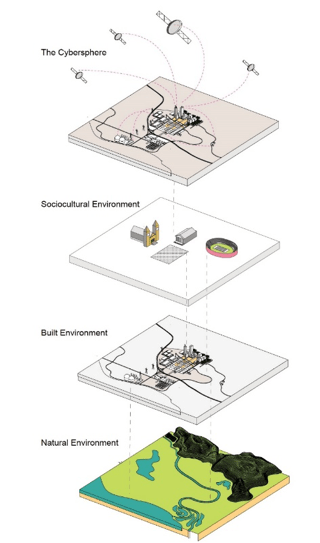
Today’s cybersphere is vast in scope and complexity, encompassing numerous digital information and communication technologies (ICTs) such as computing hardware and software, and the Ethernet and WiFi communication infrastructures that run the Internet and World Wide Web.  Mobile devices that send and receive email, voicemail, text messages, video, and graphical data are also part of the cybersphere, as are the web browsers, search engines, social media, and cell phone “apps” people use to access commercial, recreational (e.g., online gaming, cinema), educational, news, health support, and other “virtual communities”. The cybersphere further includes the app-driven sharing economy, the Internet of Things (in which billions of devices with sensors and IP addresses stream data to each other continuously), GPS navigation, autonomous vehicles and weapons systems, augmented and virtual reality (AR, VR), robotic manufacturing and health care devices, 3-D printing, “smart city” infrastructures, blockchain, cryptocurrencies like Bitcoin, the Deep Web (not accessible through standard search engines), and the Dark Net, or digital underworld.  These technologies all require rapid transmission and processing of digital data and they now permeate every facet of people’s interactions with their natural, built, and sociocultural surroundings.  Connections between the cybersphere and these other environmental domains are described in my recent book Social Ecology in the Digital Age [2] and sketched in Figure 1.

Figure 1. Interconnections between the natural built, sociocultural, and cyber dimensions of human environments

The proliferation of cyber technologies since the 1970s has made it difficult to gain a comprehensive view of their scope and impacts on behavior, health, and sustainability.  Researchers in particular fields address topics most closely related to their own disciplines. For instance, computer scientists focus predominantly on the structure and reliability of hardware and software systems; psychologists measure the impacts of digital multi-tasking and information overload on individuals’ cognition, behavior, and well-being; sociologists probe the influence of social media on political polarization and rates of cybercrime; neuroscientists track brain functioning relative to individuals’ immersion in digital communications; and sustainability scientists study the impacts of cyber technologies on electricity consumption, carbon emissions, and climate change.

These different lines of research have deepened our understanding of specific cyber technologies, yet it’s also important to move beyond discipline-based studies toward a more holistic, transdisciplinary view of the cybersphere writ large – the rapidly expanding portion of human environments comprised of multiple interrelated technologies.  We need new concepts and metrics to describe our virtual surroundings.  Viewing the cybersphere as a broad domain of environmental influence suggests several new research questions.  For instance, what are the cumulative impacts of chronic exposure to cyber technologies on psychological and physical well-being over a specified period?  The evidence from behavioral and cognitive research is mixed, suggesting that a person’s exposure to particular technologies (like social media, wearable fitness devices, virtual reality simulations) is linked to both positive and negative outcomes—for instance, using e-Health apps to achieve healthier lifestyles, or suffering identity theft on social media).  How might we assess these varied outcomes of virtual life in relation to people’s encounters with diverse digital technologies over a given period?   To address that question, we need to account for people’s exposure to multiple facets of the cybersphere such as the number and frequency of their digital communications (e.g., via email, text messaging, and participation in virtual communities such as World of Warcraft and Second Life; and the kinds of social media they engage with on a daily, weekly, or monthly basis [3].

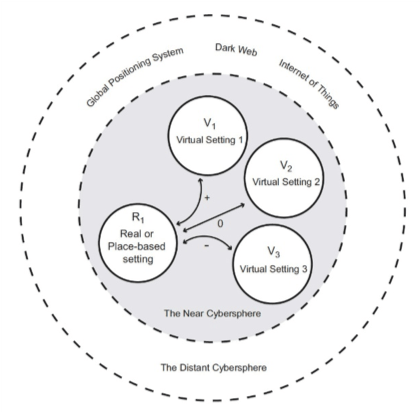
New concepts and metrics for assessing individuals’ cumulative exposure to their virtual surroundings are shown in Figure 2.  The near-cybersphere (situated in the inner circle of the diagram) consists of all the connections between a physical place (e.g., a bedroom, classroom, or office) and the various digital transactions that occur there.  The links between physical places, on the one hand, and a person’s digital spaces, on the other, are referred to as real-virtual (R-V) environmental units.  Connections between between real and virtual environments may be mutually complementary, neutral, or conflicted as depicted by the virtual settings in Figure 2 (V1, V2, and V3) that are linked to a real place-based environment (R1).  Complementary R-V units exist when one’s place-based and virtual activities are well-aligned and mutually supportive (e.g., using online resources in a classroom setting to illustrate key points covered in lecture).  In contrast, conflicted R-V units are where the activities in the real and virtual settings interfere with each other (e.g., checking social media or texting while driving a vehicle).  In neutral R-V units, the place-based and virtual activities neither support nor contradict each other.

Figure 2.  Near and distant regions of the cybersphere.

The R-V units shown in Figure 2 are attached to a single place, yet individuals participate in many different environments on a daily or weekly basis.  To arrive at an overall assessment of people’s routine exposures to multiple R-V settings, the frequency and variety of their digital experiences across residential, work, neighborhood and other environments must be considered.  It’s also important to weigh potential impacts of the distant cybersphere on personal or societal well-being. Although people are aware of the R-V cyberspaces they encounter in their daily lives (e.g., Facebook, Instagram, Uber), they are usually not cognizant of the myriad digital transactions that occur in the distant cybersphere.  Examples of remote cyber events are the navigation signals invisibly sent by orbital satellites to GPS-equipped vehicles, or the nefarious acts of cybercriminals in faraway places who commit identity fraud or disrupt local power grids and water distribution systems.  Even though people are oblivious to these hidden cyber events, they can take a profound toll on personal and collective well-being.

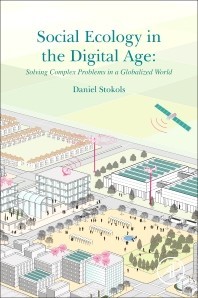
A transdisciplinary conception of the cybersphere also is needed to estimate the cumulative impacts of digital technologies on energy consumption, greenhouse gasses, and societal sustainability.  In the late 20th Century, some information scientists insisted that cyber communications were non-material or “weightless” flows of digital data [4, 5].  Today, however, we know that these invisible flows of data have a substantial physical footprint on the ground, as they rely heavily on a vast array of interlinked computers, “cloud” servers, WiFi equipment, smart phones and other devices to create, share, and store digital information [6-8].  These material features of our virtual world consume massive amounts of electrical energy and generate substantial greenhouse gases.  Recent research suggests that the digital currency Bitcoin, alone, now consumes more than one-half percent of the earth’s energy budget and by 2030 digital communications technologies will consume nearly 50% of the world’s power supply [9, 10].  Whereas cyber technologies such as smart city infrastructures help to reduce waste and conserve natural resources, their burgeoning power requirements diminish some of their benefits.  It’s estimated that the Internet of Things will subsume 31 billion interconnected cyber devices by 2020 [1].  Yet, we still lack reliable measures of their future energy demands and the power requirements of many other technologies like autonomous vehicles, 3-D printing, and robotic manufacturing; nor do we have accurate estimates of their potential socioeconomic costs such as growing unemployment caused by workplace automation. A transdisciplinary, holistic view of the cybersphere is crucial for confronting these complex challenges in the coming years.

The book is now available on ScienceDirect. Want your own print copy? Order via the Elsevier store and enter code STC319 at the checkout to save up to 30%.

Original post here

References:

  1. Statista, https://www.statista.com/. 2019.
  2. Stokols, D., Social ecology in the digital age: Solving complex problems in a globalized world. 2018, London, UK: Academic Press.
  3. Misra, S. and D. Stokols, A typology of people–environment relationships in the Digital Age. Technology in Society, 2012. 34: p. 311-325.
  4. Coyle, D., The weightless world: Strategies for managing the digital economy. 1998, Cambridge, MA: MIT Press.
  5. Negroponte, N.P., Being Digital. 1995, New York: Vintage Books.
  6. Berkhout, F. and J. Hertin, De-materializing and re-materializing: Digital technologies and the environment.Futures, 2004. 36: p. 903-920.
  7. Coroama, V.C., et al., The direct energy demand of Internet data flows. Journal of Industrial Ecology, 2013.17(5): p. 680-688.
  8. Nardi, B., et al., Computing within limits. Communications of the ACM https://cacm.acm.org/magazines/2018/10/231374-computing-within-limits/fulltext, 2018. 61(10): p. 86-93.
  9. Andrae, A.S. and T. Edler, On global electricity usage of communication technology: Trends to 2030.Challenges, 2015. 6(1): p. 117-157.
  10. AAAS. Bitcoin estimated to use half a percent of the world’s electric energy by end of 2018https://www.eurekalert.org/pub_releases/2018-05/cp-bet051018.php. 2018, May 16  Feb 20, 2019].

For a critical theory of the Anthropocene

Anne FREMAUX

The ‘Anthropocene’ concept was initially launched as a lens for understanding the destructive power of humanity on nature and as a warning concerning the unpredictable, long-lasting, and potentially threatening effects of human action for human and non-human life. It underlines, indeed, the fact that technologically enhanced human activities have grown to such a scale that they have become significant geological forces competing with other natural processes, such as volcanic phenomena or variations of the Earth’s orbit around the sun. This new geological period identifies human species as a leading telluric force which is literally ‘terra-forming and transforming our home’ (Barry, 2016: 107). Although initially well-intentioned, this concept is questionable. If the goal is to help us become less self-human-centred and more reflective about the harm we do to the world, if the core idea of this concept is to gain some humility about our place in the universe, is the naming of an entire geological era after ourselves, the best way to achieve it? My contention, here, is that human supremacists and anti-environmentalists have seized the opportunity of this concept as a justification for further environmental destruction. As Mitchell (2014) says, ‘the existing concept of the “Anthropocene” magnifies and sometimes even valorises radical anthropocentrism, reverence of human agency and the desire to gain mastery over nature’ (n.p.). In other words, the term itself contributes to the problems it is supposed to address. First, it pushes the logic which has created the predicament to its extreme by suggesting that humans can shape the planet and re-create it in their image. Second, it perpetuates the ontological dichotomy between humans and nature in which human agency is treated as a force acting upon rather than in or as a part of nature. Third, and aside from ontological implications, this concept offers an apolitical and ahistorical account of the ecological crisis by designating an undifferentiated ‘Anthropos’ responsible for the large-scale changes that take us outside of the stable Holocene.

From the perspective of the Earth System Sciences, the earth is indeed going through a huge change, leaving behind us the thousands of years of exceptional stability of climate temperatures and sea levels that characterized the Holocene to enter a new epoch of climate instability, uncertainty, and significant climate related socio-environmental transformations. Earth System Science (ESS)’s approach considers feedback mechanisms inherent in forces that escape our analytical models and sudden collapse thresholds of ecosystems as carrying unpredictable consequences that will change the conditions of life on Earth. It offers a nonlinear view of the future of our planet understood as a complex system, ultimately very vulnerable and unpredictable (fraught with structural indeterminacies).

The Anthropocene, considered as an ecological predicament, is therefore rather an era of ‘nonknowledge’ or rational ignorance linked to uncertainties and ontological indeterminacy than a period of human mastery and domination of earth systems. But further, it also displays the helplessness (impotence) of already accumulated scientific knowledge to trigger necessary changes. Indeed, the issue today is not any longer to get a clearer picture of the situation by accumulating scientific data but to understand ‘how we entered the Anthropocene despite very consistent warnings, knowledge and opposition’ (Bonneuil and Fressoz, 2016: 79; original emphasis). The accumulation of empirical facts and scientific findings on the predicament of our planet, no matter how detailed and alarming they are ‘can never be’, as Blühdorn explains, ‘a substitute for normative judgments’ (2015: 159). The lack of ethical, philosophical, and political judgements associated with the neoliberal management of environmental issues, explains, indeed, the depth and acuity of the ecological crisis.

A paradigmatic example of the apolitical treatment of the Anthropocene is the ecomodernist talk of a ‘good Anthropocene’. Ecomodernists or ‘neo-greens’, (also called ‘eco-pragmatists’ or ‘neo-environmentalists’) advocate the decoupling of the human economy from nature in order to save it, celebrate the ‘end of nature’ as well as ‘the death of environmentalism’, encourage the use of technology to counter the side-effects of technology, and especially call for a ‘neoliberal conservation’ guided by economic rationality and human-centred managerialism’ (Asafu-Adjayeet al., An Ecomodernist Manifesto, 2015). Such a techno-optimist and neoliberal view celebrates ‘the “age of human” as the achievement of the cornucopian dream to create and recreate the planet according to our wishes’ (Fremaux & Barry, 2019). However, in such unsure and endangered times, nothing appears less appealing than Latour’s and ecomodernists’ invitation to ‘love our monsters’ (Latour, 2012; Nordhaus & Schellenberger, 2011), that is the dramatic and dangerous side-effects of our technologies (such as global climate change, nuclear waste, presence of radionuclides, microplastic particles and aluminum in the core elements of matter, alteration of fundamental chemical cycles, etc.) As Crist and Rinker warn us: ‘[t]o rip into the planet’s rhythms, cycles, and interconnections, as the civilisation we have created is doing, signals human folly, not mastery’ (2010: 13).

The techno-optimistic association made by those who wish to maintain the present fatal trajectory, between the Anthropocene and a new age of further mastery and control contradicts our conception of the Anthropocene as an era fraught with uncontrolled and unpredictable ‘human-induced changes’. There is, indeed, a conceptual gap between saying that humans ‘influence’ nature and arguing, as ecomodernists do, that humans are now ‘creating’ it. Contrary to the latter position, it is now obvious that human (impotent) power has become ‘uncontrollable’ and ‘unmanageable’: that’s what one may call the ‘non-mastery of our mastery’. The Anthropocene ‘dominant narrative’, i.e. the ‘good Anthropocene’ given by some scientists (Crutzen included) and post-environmentalists fails to recognize the predicament in which we are and the fact that the new ‘geology of humankind’ is not so much the era of (mastered) human domination on earth but rather the era of (uncontrolled) human destruction of earth.

We have entered a world of boundaries, a material world of ecological limits but also a symbolic world of scientific limits (what post-normal sciences call the ‘unknown unknowns’, Ravetz 2006). Therefore, this is not the traditional (modern and ‘mostmodern’) narrative of progress, control, and mastery which will help us inhabit the Anthropocene but rather the recognition of our ignorance and limitations. Western people must realize that the traditional set of knowledge held by orthodox disciplines, from economics and political science to biological and natural sciences, cannot guide us any longer with accuracy and certainty in these turbulent times. Navigation in ‘heavy weather’ like the one characterizing postnormal times demands virtues such as humility, modesty, and accountability for the present but also for the future, for those who are on the deck as much as for those who are in the engine-room and in the holds (socio-environmental justice). The legacy of the Anthropocene will be legible for the millennia to come and requires that Western people start to inhabit and consciously live within ‘deep time’, or in other terms, that they extend their thinking ahead of short-term interests to the next generations and the less privileged as well as to non-human beings. The Anthropocene calls indeed for shared solidarity between humans (different generations, Global North and Global south), but also with our non-human companions on this planet.

At the time of writing, and even though the Anthropocene Working Group nominated by the International Commission on Stratigraphy (ICS) has voted last April by a majority to designate a new geological epoch the ‘Anthropocene’, neither the ICS itself nor the International Union of Geological Sciences (IUGS) have officially approved the term as a recognized subdivision of geologic time. Without an official accreditation, the Anthropocene remains a paradigm, a ‘claim’ rather than a validated scientific concept. Nevertheless, this concept has already become a powerful idea used by environmentalists and conservationists but also by policymakers, artists, activists, historians, journalists, writers, as well as social scientists. The word ‘Anthropocene’ has become a ‘buzzword’ which already encounters a great success, even before its geological confirmation. This success entails the pressing need for a more critical Anthropocene research agenda (as opposed to calls for a depoliticized and techno-focused ‘good Anthropocene’). If the Anthropocene has been an opportunity for some scientists and academics to revive Promethean modern dreams of technological mastery of nature and present these within an apolitical ‘naturalizing’ narrative which puts science and experts at the centre, there is also the possibility to develop another narrative and present the Anthropocene as an epoch of great danger and indeterminacy – and for scientists themselves, an age of ‘impotent power’ – which calls, therefore, for prudence and humility, for human decentring, and for shifting the attention from ecological modernization to the building of ecological democracies and a sustainable global civilization that give a significant voice to civil societies. Against the ecomodernist techno-optimistic ‘neoliberal Anthropocene’, the alternative would be a humbler ‘democratic Anthropocene’, in which humans repair and sustain the world instead of destroying it and calling, afterwards, for its artificial and incentivized reproduction and replacement.

NB.: most of the arguments developed here are extracted from:

Fremaux A. (2019), After The Anthropocene: Green Republicanism in a Post-Capitalist World. New York: Palgrave.

References:

Asafu-Adjaye, J., Blomquist, L., Brand, S., Brook, B. W., Defries, R., Ellis, E., . . . Lynas, M. (2015). An Ecomodernist Manifesto. Retrieved From Https://Static1.Squarespace.Com/Static/5515d9f9e4b04d5c3198b7bb/T/552d37bbe4b07a7dd69fcdbb/1429026747046/An+Ecomodernist+Manifesto.Pdf

Barry, J.(2016). Bio-Fuelling The Hummer? Transdisciplinary Thoughts On Techno-Optimism and Innovation in The Transition from Unsustainability. In E. Byrne, G. Mullally & C. Sage (Eds.), Transdisciplinary Perspectives On Transitions to Sustainability (pp. 106-123). London: Routledge.

Blühdorn, I. (2015). A Much-Needed Renewal of Environmentalism? In C. Hamilton, C. Bonneuil & F. Gemenne (Eds.), The Anthropocene and The Global Environmental Crisis. Rethinking Modernity in A New Epoch (pp. 156-168).

Bonneuil, C., & Fressoz, J.-B. (2016). The Shock of the Anthropocene. London, New York: Verso.

Crist, E., & Rinker, H. B. (2010). Gaia in Turmoil: Climate Change, Biodepletion, And Earth Ethics in an Age of Crisis. Cambridge, MA: MIT Press.

Fremaux, A., & Barry, J. (2018 forthcoming) The ‘Good Anthropocene’ and Green Political Theory: Rethinking Environmentalism, Resisting Ecomodernism. In F. Biermann, & E. Lövbrand (Eds.), Anthropocene Encounters. New Directions in Green Political Thinking (Working Title). Cambridge, MA: MIT Press.

Latour, B. (Winter 2012). Love Your Monsters in Love Your Monsters: Postenvironmentalism and The Anthropocene. Breakthrough Journal, Retrieved From Http://Thebreakthrough.Org/Index.Php/Journal/Past-Issues/Issue-2/Love-Your-Monsters

Mitchell, A. (2014). Making A ‘Cene’. Blog, February 23, 2014. Retrieved From Https://Worldlyir.Wordpress.Com/Tag/Paul-Crutzen/

Nordhaus, T., & Schellenberger, M. (Eds.). (2011a). Love Your Monsters: Postenvironmentalism and The Anthropocene. Oakland, Ca: The Breakthrough Institute.

Ravetz, J. R. (2006). Post-Normal Science and The Complexity of Transitions Towards Sustainability. Ecological Complexity, 3(4), 275-284.

Thinking Anthropocenically

Denis Byrne and Paul James

The Anthropocene is a phenomenon which has taken up residence in our minds and our research practices. Some might argue for variations in naming the phenomenon — the Capitalocene,[1] the Chthulucene,[2] and so on — but the process through which humans have come fundamentally to impact the planet is now too well documented and measured to be dismissed. The concept of the ‘Anthropocene’ entered the purview of researchers in the Institute for Culture and Society by way of a cultural shock. We, along with many others, have been forced to recognise that many environmental ‘systems’ are no longer independent of human social action.[3] We find, for example, that the carbon emitted by everyday activities, which are intrinsic the complex lives of so many of us, have contributed to changing the world’s climate. Now, even our simplest activities, once avidly pursued with all their unintended ecological consequences, are revealed to have a ‘carbon footprint’.

The reality of the Anthropocene cuts the ground cleanly out from under the doctrine of Progress, the ideology which underpinned the industrializing West’s esteem and confidence, as well as serving to excuse industrial capitalism’s negatives, including environmental pollution and workplace death and injury.[4] Recognising the passing of Progress, we structure this essay around an alternative conception of human history over the last few centuries as a kind of dance, or what one might call the ‘Anthropocene shuffle.’ This essay represents the coming together of two perspectives on the contemporary global environmental crisis — those of archaeology (Denis) and of social theory (Paul).

Four Steps Back and One Step Forward

As a research institute focused on finding better ways of living in a rapidly changing world, we find it no longer possible to study ‘the social’ independent of ‘the environmental’. But if the environment or nature can no longer be thought of as just a background to or setting for the social, and if it is accepted that the human-social permeates the earth system, equally — and this has also come as a shock — we must now contend with the realization that earth’s many ‘sub-systems’, which we were brought up to see as being all around us, are actually also inside us as biosocial beings. The environment is no longer just out there. To be sure, the environment continues to be the integrative space in which we exist, but thinking in this double way — as both context and constitutive being — requires basic changes to our research vocabulary, thinking and practice.

This is why we have chosen, following its Greek etymological roots, to define ‘ecology’ as a domain of the social — along with economics, politics and culture. It is the domain that concerns the materiality of the intersection of the social and the environmental, just as culture concerns the meaning of social relations, including the relations of that intersection. The environment in this sense comes to be understood as that which both grounds our existence (in every way) and exists far beyond even the most expansive definitions of the social or the ecological. This means that it no longer even makes sense, except in very well-defined circumstances, to talk of the ‘more-than-human’ to describe the environment. We can no longer be comfortable with treating the human as the point of departure for all beings and things, as if they are only ‘more-than’ us.[5] At same time, any suggestion that becoming post-human is a viable politics, ignores the contradictions entailed in leaving behind what constituted us as humans across the natural/social history of our being.

Hence, in our research thinking, there is first the need for taking a few steps backward from the mainstream (modern) centring of the human and also from the fashionable (postmodern) flattening of ontological difference into a single plane of being. Full recognition of the complexities and contradictions of the Anthropocene would force this upon us.

Backward Step 1. Recognize that non-human being is constitutively enmeshed in human being — but not as an ontological flattening of the human and natural.

‘Social space was never exclusively human’, as Timothy Morton puts it.[6] But this doesn’t just mean we share this space with nonhumans or that we relate to nonhumans within social space; it means also that nonhumans are present in the space of our bodies in old and new ways. We have long known we embody nonhumans in the form of bacteria and we now know there are around ten times the number of microbial cells in the human body as there are human cells. But in addition to this old ecological enmeshment with nonhumans, we have produced the elements of new kinds of enmeshment. For example, over the 240 years since we have been burning serious amounts of coal for industrial production and power generation, millions of us have breathed in significant volumes of fine particles released by this burning. It is partly with this in mind that Kathryn Yusoff proposes that we rethink the Anthropocene as being characterised by a ‘corporeal geology of/in the blood, rather than a universal stratigraphic trace in some future geologic record’.[7] The chemicals in makeup and other skin products, for example, constitute one ecology of this embodiment, becoming part of who we are even as we present the surface of ourselves through them.

The so-called ‘material turn’ in the humanities and social sciences has led us beyond conceding agency to materials such as iron ore, alloys such as aluminium and glass, and complex objects like phones and houses, to an understanding ‘nonhumans’ (noting that the concept of ‘nonhuman’ needs to be used judiciously) as having a vibrancy and integrity of their own. This amounts to a retreat from the generalized modern idea in the West that humans have a monopoly on these qualities,[8] but it also opens the way to new kinds of problems of understanding and attribution. Just as the prior materialism of Marxism was criticised for sometimes entertaining the sin of technological determinism, the new materialism is in danger of both over-generalizing the agency of things, technologies and objects, while excusing us humans as dominant actors on planet earth. If everything is an actor in the same way as human beings, then coal and concrete must be as culpable for climate change as the humans whose life-worlds were built upon these materials, … and, more pointedly, the humans who continue to advocate for these materials when their massive use has been shown to compromise the sustainability of the planet.

Why is it, as political paeans to the beauty of coal are sung by political advocates across the world, avant garde social theory has turned in the same direction? The flat ontology of Actor Network theory, for example, provides a non-hierarchical view of human-nonhuman relations, but ANT’s conception of objects as mediating relations between humans has opened it to the critique of being underwritten by an anthropocentricism in which things are primarily of interest to us when seen to be involved in human projects. Here an assiduous critique of anthropocentrism can be distinguished from the recognition of our mixed poetic tendency towards anthropomorphism. Anthropomorphism is sometimes good poetics, and sometimes, in attributing human-like capacities to others, turns into a bad re-centring of those human capacities as describing the way of all things. Does coal act? Yes, but not with intention, feeling or subjective agency. Through continuing anthropocentrism, things are too often enrolled or domesticated as quasi-humans, so disguising their ‘thingly otherness’.[9] Things, objects and unknown beings clearly exceed their relations with humans. As Graham Harman points out, ‘the vast majority of relations in the universe do not involve human beings, those obscure inhabitants of an average-sized planet near a middling sun, one of 100 billion stars near the fringe of an undistinguished galaxy among at least 100 billion others.’[10] This means that we while we need to recognize that non-human being is constitutively enmeshed in human being (Backward Step 1), it is equally important that in the process of that recognition we do not to flatten the ontological meaning of either the human or the natural.

The tendency we have to ‘socialize’ nonhumans and give them dubious anthropomorphized agency is understandable given the enormous number of objects that have been tailored for human use, the number of species whose bodies and lives have been changed by us, and the number of rivers, coastlines, forests, swamps, soils and airs that show unmistakable signs of our impact. It is this that the Anthropocene has been named for but, equally, our susceptibility to being deafened by our own noise and hence to be unable to imagine a world without us is a real obstacle to of our mobilizing against the reproduction of Anthropocenic relations.

In all of this we are pointing to the extent to which it has become increasing difficult to practice humanities and social science research within the space formerly understood as social space or (more narrowly) human space, without rethinking what it means to talk of ‘the social’ and what it means to be ‘human’.

Backward Step 2. Excavate carefully and then learn from the negative debris of the Anthropocene.

There was only a relatively small interval in time between the idea of geological strata being introduced through the work of scientists like Georges Cuvier and James Lyell — a bit over 200 years — and the 1950s when we began laying down to lay down the elements of what would qualify as our own geological strata.[11] Archaeologists are classically thought of as excavating remains of the human past buried in the earth, but as the Anthropocene strata takes shape as a layer accumulating on the earth’s surface, some are turning to interrogate this layer as an archaeological object in its own right.[12] A mass of textual, audio, visual and other records testify to Earth’s history in the period since the early 1950s, but there is an argument to be made that — in addition to these sources — we should allow the objects of the Anthropocene to signify themselves. Objects do play active roles in history. Objects do ‘speak’ (if we understand the term ‘speak’ to be only a poetic expression of a thingly acting we do not have the words for). The plastic water bottle, for example, has material potentialities that have proven to be highly significant in the commodification of drinking water.[13] It speaks to the profound effects of the simple everyday activity of sipping as degrading nature as we have known it.

The word ‘interrogate’ used above is actually not a well-chosen word for archaeology’s full relationship with things. As a practice, it engages in  a peculiar form of ‘care, obligation, and loyalty to things’.[14] A certain intimacy with objects builds up over the many hours spent uncovering, handling, gazing at, and wondering about them. This practice of care gestures to a kind of ‘engaged research’[15] where the engagement extends to things as well as humans. It extends also to caring for nonhuman species and their habitats, to the soil, the sea and the air.

On a drift beach in northern Norway, the archaeologist Þóra Pétursdóttir has recently excavated parts of a deposit of wrack, which she describes as ‘matter in motion’.[16] She understands the fragments of driftwood, plastic bottles, synthetic rope and netting, net floats, and a variety of other plastic objects (now tangled up with kelp and seaweed and with beach pebbles and sand) as having ‘escaped human relations’ to drift across the sea until coming to dwell in the circulating surface waters of the North Atlantic Current, and to eventually be deposited by storms and tides in Eidsbukta Cove. The plastic things in the wrack are ‘unruly’ objects: we made them but they are by no means domesticated, subjugated, or predictable.[17] The refusal of plastics to biodegrade — they break up into small and smaller pieces but their molecules remain intact — ensures that they are on their way to becoming part of the geology of the Anthropocene. It is the very persistence of such objects, and the hyper-objects they coalesce into, that underpins this era.

It is because so much human waste does persist after being discarded, and that it persists in a dynamic state of accumulation, that it poses such a threat to us and other living beings. In Pétursdóttir’s archaeology these waste objects are regarded neither negatively nor positively. How can they be negative? After all, it is not they that have precipitated the Anthropocene; we have. This care-full troweling away at the material record of the recent past provides for an archaeology of both us and dark matter that has left the ambit of our direct agency. It is not an archaeology of our prehistoric, classical, or early modern predecessors, but of the ‘we’ who are the enactors and inheritors of the Great Acceleration.[18] In these terms, it is possible to recognize these rubbish gyres as positive in their negativity — they are material signs (positive in the sense that they communicate a new reality) of our own excess (negative in the sense that we are now dangerously exceeding the of limits of the planet). In other words, the social relations concerning these objects are negative, and we still need to do something about those relations.

Backward Step 3. Afford processes that we once saw as positive their full complex Anthropocenic negativity, and remember that such processes can change the prior condition of nature.

As the world comes to accept that we do live in the period of the Anthropocene, old concepts and new are being reworked or revived to mask the continuation of destructive human practices that are not sustainable. Even perfectly good concepts such as sustainability and resilience are being co-opted. The concept of ‘reclamation’, for example, has in the past been seen as a positive act, and it continues to be so for those living in the ‘progressive’ present: from developers talking of reclaiming swamp lands to oil-sand miners treating land reclamation as a form of custodial responsibility.[19] Coastal reclamations are a telling example. Notwithstanding the new (and shocking) move to describe coastal reclamation as a means of responding to climate change,[20] coastal reclamation is an exemplar of the ‘artificial earth’ of the Anthropocene which arises when coastal waters are in-filled in order to extend humanity’s terrestrial habitat seawards. There is an over-reaching conceit in the word ‘reclamation’ and its presumption that the seascape we claim back is already incipiently landscape for human habitation.[21]

In the current era of anthropogenic sea-level rise, you’d think we would be too busy defending what land we have to contemplate extending further into the sea. But globally the rate of coastal reclamation is increasing rather than abating. In China, for example, where almost half the country’s coastal wetlands were lost to reclamation between 1950 and 2000 and where 11,000 kilometres of coastline is now under some form of reclamation, major new reclamations are either under way or on the drawing board, providing space for container ports, urban expansion, theme parks and fish farms.[22]

Once reclamations have been in place for a certain amount of time, they often assume the attribute of being hard to see, something which is especially true of those created for agriculture, parkland, and housing estates. Through the work of bacteria and earthworms, the infill of the reclamation may soon become a living soil, supporting trees and other plants. The reclamation’s surface assumes a beguiling naturalness — and indeed in some ways it is natural (this is the complexity of emeshment that we pointed to earlier). However, the exact location of the boundary line where the reclamation was sutured to the natural landscape quickly becomes blurred in our memories, and the human once again makes over the natural. Familiarity in this case breeds not contempt but a kind of topographic forgetfulness, which we can arguably no longer afford. In order to ensure the Anthropocene is as short/thin as possible,[23] one of the things we need is topographic remembrance. Engaged research can contribute to keeping this past-present relation to the fore.

More than that, coastal reclamations are not so much about creating new land as creating a certain kind of land: abstracted flat land.[24] Our first large-scale efforts at levelling were to do with agriculture: hill slopes terraced to create flat fields for crops. (This is why the Anthropocene is sometimes called the Plantationocene). The flatlands of river deltas became premium habitats for agriculture. In areas where rivers carried large volumes of sediment downstream, much of it to be deposited to form delta mudflats, people constructed bunds to encourage tidal waters to drop their sediment load, sediment which gradually accumulated to form cultivable fields. This way of mimicking natural processes in order to ‘grow’ land began in China’s Pearl River Delta began around 1,400 years ago, became more common in the Southern Song dynasty (1127–1279 AD) and greatly intensified from the 1740s.[25] Over time, new agricultural reclamations were added to the outer edge of older ones to create lateral bands of flat land, extending in a ripple effect out from the original coastline. These patterns show up clearly on the satellite imagery available on Google Earth and Baidu Map. What changed in the Pearl River Delta with the economic reform era, beginning in the late 1970s after the death of Mao, was that — with the aid of earth-moving machinery — a new kind of ‘reclamation’ appeared. It was one created by transporting, often over considerable distances, sand, urban waste, concrete from demolished buildings, and rock from highway cuttings. One of the hallmarks of the Anthropocene is a greatly enhanced human ability to move materials through space, and a great deal of this movement occurs in the context of creating new flatlands as platforms for human living.

The spread of coastal reclamations is not currently one of the series of global indicators being used to demonstrate that human activity has become the prime driver of change in the Earth system  (the sum of the planet’s interacting physical, chemical, biological and human processes).[26] But it has in common with such indicators as water-use, large dam construction, and carbon dioxide in the atmosphere, the fact that what has changed dramatically from around the 1950s is the accelerating scale of human impact.[27]

Backward Step 4. Recognize that the Anthropocene involves not just an empirical acceleration of impact, but also a qualitative change — in this case, the emergent possibility of reconstituting the nature of nature.

The concept of ‘the Great Acceleration’, for all of its strengths, remains a set of empirical measures concerning human impact. This signals the current dominance of scientific object-oriented thinking. However, as is perhaps more obvious to humanities and social science researchers — perhaps less so in the sciences — this impact can be understood both quantitatively and qualitatively. From the time in the early 2000s when the term first took off, the definition of the Anthropocene became the period in which humans have had a defined scientifically measureable quantitative impact upon the planet. To understand the full measure of this impact, however, we need to take a step back to an older form of qualitative studies — cultural and political studies before the flattening of theory — which could talk of thresholds of change and dialectics of continuity.

The Anthropocene is said to have begun in the eighteenth century, tout court. What this epochal and flat historicising misses completely is the way in which humans across the past half-century or so have gone beyond just having an impact upon geo-nature. Certainly, we continue with our determined empirical impact, exploring the farthest reaches of nature, pushing it around with bulldozers, ripping it into trucks, dropping it into the ocean to ‘reclaim’ more coastlines, ploughing long lines through it, burning it for energy, and gently contouring it for parks and gardens. But now, and conterminously, something more than that is happening.

We talked earlier of the human technique of mimicking nature or reconstructing the contours of nature. In the eighteenth and nineteenth centuries, the speed of human colonization of the Earth certainly increased very rapidly, and continues today, through the ‘settlement’ of nature as territory and the colonization of indigenous populations. However, beyond that, we are now seeing a reconstitution of the foundations of prior nature. Since the middle of the twentieth century, techno-science has been busy reconstituting the very building blocks of nature: atoms, cells, genes, and so. Other building blocks which were missing or only incipiently part of the scientific lexicon in the mid-twentieth century — quarks, the higgs boson, genes, ripples in space/time, nucleotides and chromosomes — are now being interrogated for what they can offer human desires. (Here, interrogated is the right word.) What came to public consciousness with the splitting of the atom in 1945, intervention in the nature of nature, has now extended to everything, from nano-technology production, bio-engineering, stem cell therapy, and DNA manipulation to geo-engineering and terra-forming. Over the past few decades, humans have begun meta-colonizing the planet — sometimes just to understand it better, sometimes in order to save it, but most often in order to exploit it a higher level of intensity.

A certain kind of science is central to this process — technoscience. Without cultural studies, sociology and social theory — the humanities and social sciences — we cannot understand how this kind of science is different from earlier pure and applied science that worked with nature. A proponent of a flat ontology will ask: Is not gene manipulation just an empirical extension of brushing pollen from one variety of wheat onto another variety to produce more ‘robust’ hybrids? Have humans not talked of atoms since the time of the Classical Greeks and the writings of ‘Leucippus’ and Democritus?

What then has changed in a qualitative sense? In short, some lineages of science now seek to control the nature of nature, to manipulate what once were called its ‘building blocks’ and to intervene in its systemic processes. Through this seeking, humans now have the capacity with the touch of a single button to destroy life on this planet as we know it (since 1952, with the phenomenon of nuclear winter) and the technical possibility of creating synthetic life-forms — since 2010, with the chemical construction of a Mycoplasma mycoides bacteria. As it was reported, at the time the emphasis was on scientific breakthrough and human control as good thing:

Craig Venter, the pioneering US geneticist behind the experiment, said the achievement heralds the dawn of a new era in which new life is made to benefit humanity, starting with bacteria that churn out biofuels, soak up carbon dioxide from the atmosphere and even manufacture vaccines.[28]

There it is again — the idea that in going further, deeper, into the business of changing nature we will save us from ourselves. To the contrary, it is only by recognizing the full force of the point that we have the capacity to reconstitute the very basis of nature that adequate understanding of the social life in the Anthropocene starts to hit home. Our home, planet earth, is in deep trouble, and it only by researching the tensions of this Anthropocentic entanglement and contributing to thinking about living otherwise, that we will have the capacity to respond systematically. Making new life-forms with four bottles of chemicals is not going to save us. Overall our argument is that by taking these ‘backward’ steps in thinking we can move to a positive ethics of care. Such an ethics is one that neither confuses empathy for objects with decentring the massive human impact upon the Earth, nor confuses increased ‘control’ over nature with the act of living within the limits of the planet.

Forward Step 1. Develop an Anthropocenic Perspective

There are many ways of researching how humans have colonized planet Earth. The concept of the archaeosphere is one useful way of drawing attention to the fact that vast areas of the Earth are now covered by the modified soils and terraced hillslopes of agriculture, the concrete and asphalt paving of roads, airports and container ports, the underground infrastructure of tunnels, pipes and wiring below our cities, the burgeoning landfill sites, and reclamations which extend coastlines out into the sea.[29] This archaeosphere is a layer of varying thickness expanding at an accelerating rate, to the point that we have now become a geological agent, something which becomes starkly apparent in areas such as Japan’s main island of Honshu where sixty per cent of the coastline is now classified as ‘artificial’, which is to say that for the most part it is concrete. Honshu has swapped much of its pre-existing coastline of beaches, dune fields and wetlands and for an ocean of concrete that forms a platform for the enactment of contemporary life — forklifts drive over it, kids bounce balls on it — but it is also a fossil-in-waiting, destined to be preserved in the geological record.

Most of Honshu’s concrete dates from the time of Japan’s post-war ‘economic miracle’, beginning in the mid-1950s, and it is representative of a surge in the creation of concrete surfaces (platforms) that began at that time in many parts of the world and has gathered pace ever since. As an Anthropocene marker, this is much easier for most people to grasp than the plutonium traces which fell to earth following nuclear testing in the 1950s and which are now widely agreed to constitute the best marker for dating the beginning of the Anthropocene Epoch – in other words, for dating its lower bounding surface.[30] However, as humanities and social science scholars we need to study a much fuller complexity — material layers, natural and human continuities, and constitutive changes

The ability of people to grasp the Anthropocene as a material reality seems a crucial prerequisite for any widespread popular mobilisation against the dark future which the Anthropocene portends. The Anthropocene has, of course, a tangible presence in the effects of global warming: the increasing frequency of heatwaves and superstorms, global ice-melt, and sea-level rise. Some of these are as graspable as signs of a long-term problem for the Earth as is the spread of the archaeosphere. But the archaeosphere has qualities of its own which lend it advantage in the quest to make the Anthropocene visible. To begin with, it is right under our feet: the park lawns where we walk our dogs, the metro tunnels through which we ride to work. By the same token, however, the everydayness of this artificial-natural ground can make it hard to see for what it is — a vast and spreading weed-mat that makes life impossible for most of our fellow species. Moreover, we need to research the non-palpable processes and structures that both continue to legitimize and take further the colonization of nature.

A challenge for those working in the social sciences and humanities is thus to find new ways of lending visibility to the Anthropocene, in all its dimensions. What is needed is an Anthropocenic perspective tailored for everyday life. Academics in the social sciences and humanities are central to such a venture, using the sensitive methods that they have developed for simultaneously engaging with and stepping back from everyday life. This may prove essential for the perspective advocated here, providing a view of the world that is at once familiar and strange. In order to be able to see the Anthropocene what may be needed is that of jolt to the senses and intellect whereby the other side of the ordinary snaps into focus.

The archaeosphere, other than being under the feet of most of the time, also has an historical depth and spread that offers us one window on where the Anthropocene came from. Present-day carbon emissions have their feet in the Industrial Revolution; the current proliferation of plastic begins with early twentieth-century celluloid products designed to imitate natural materials such as ivory, tortoise shell and horn[31]; freeways have a history in the nineteenth-century macadam road construction process, traces of which are easy to find in present-day cities. Seeing the history of the Anthropocene in today’s materiality is an exercise in futuring as much as in historicising. It is one of the practices (whether academic or everyday) that equip us be agents of interpretative change. The idea of an Anthropocene perspective, a way of seeing the Anthropocene as distinct from (but not instead of) naming it, goes back to the earlier point about caring. We shouldn’t turn our backs on the material world we have made, however dystopic it might at times seem. By the same token, the new material turn should not distract us from simultaneously seeking to understand the kinds of sociality that frame the current crisis.

Original article in ICS report here: https://www.westernsydney.edu.au/__data/assets/pdf_file/0005/1453919/ICAS1183_2017-18_ICS_Annual_Review_FA_Web.pdf

Denis Byrne: https://www.westernsydney.edu.au/ics/people/researchers/dr_denis_byrne

Paul James: https://www.westernsydney.edu.au/ics/people/researchers/professor_paul_james


[1] J. Moore, 2015, Capitalism in the Web of Life: Ecology and the Accumulation of Capital, Verso, London.

[2] D. Haraway, 2016, Staying with the Trouble: Making Kin in the Chthulucene, Duke University Press, Durham.

[3] Here we use the concepts of ‘system’ and ‘sub-system’ advisedly as simplifying scientific metaphors for manifold processes too complex to name other than as a series of abstractions. This does not make the use of the terms illegimate. It makes them a heuristically useful so long as as they are not reified as things in themselves.

[4] C. Bonneuil and J-B Fressoz, 2016, The Shock of the Anthropocene, Verso, London.

[5] This of course was not how it was intended by the person who coined the term: D. Abram, 1996, The Spell of the Sensuous: Perception and Language in a More-than-Human World, Pantheon Books, New York.

[6] T. Morton, Humankind: Solidarity with Nonhuman People, Verso, London, p. 139.

[7] K. Yusoff, 2018. ‘Epochal Aesthetics: Affectual Infrastructures of the Anthropocene’, e-flux 29 March, p. 204. http://www.e-flux.com/architecture/accumulation/121847/epochal-aesthetics-affectual-infrastructures-of-the-anthropocene/.

[8] And in our modern hubris it should not be forgotten that customary and traditional peoples long lived with animate matter, understood along different ontological valences from the analogical to the cosmological.

[9] G. Harman, 2016, Immaterialism: Objects and Social Theory, Cambridge, Polity Press; B. Olsen, 2013, ‘The Return to What?’, in A. González-Ruibal (ed.), Reclaiming Archaeology: Beyond the Tropes of Modernity, London, Routledge, p. 293.

[10] Harman, Immaterialism, p. 6.

[11] The base horizon of this strata is marked by deposits of plutonium from nuclear testing in the 1950s and the presence of an altered carbon chemistry, these being identified in core samples at a steadily increasing number of globally distributed sites (Davis and Todd 2017; Waters et al. 2017). Other markers include traces on/in the ground of mass extinction, waste from petrochemical products including plastic, and the spread of artificial earth.

[12] M. Edgeworth, 2014, ‘Archaeology in the Anthropocene: Introduction’, Journal of Contemporary Archaeology vol. 1, no. 1, pp. 73–7; J.M. Erlandson and T.J. Braje, 2013, ‘Archaeology and the Anthropocene’, Anthropocene no. 4, pp. 1–7. P. Pétursdóttir, 2017. ‘Climate Change? Archaeology and the Anthropocene’, Archaeological Dialogues, vol. 24, no. 2, pp. 175–205.

[13] G. Hawkins, E. Potter and K. Race, 2015, Plastic Water: The Social and Material Life of Bottled Water. Cambridge, MIT Press, pp. 4–5.

[14] B. Olsen, 2012, Archaeology: The Discipline of Things, Berkeley, University of California Press, p. 1.

[15] P. James, 2015, ‘Engaged research’, in H. Barcham (ed.), Institute for Culture and Society: 2014 Annual Review, University of Western Sydney, Penrith.

[16] Pétursdóttir, ‘Climate Change?’, p. 190.

[17] On the unruliness of things see B. Olsen, ‘The return of what?’ in A. Gonzalez Ruibal (ed), Reclaiming Archaeology: Beyond the Tropes of Modernity, pp. 289-296. London: Routledge, here p. 295..

[18] W. Steffen, W. Broadgate, L. Deutsch, O. Gaffney and C. Ludwig, 2015. ‘The Trajectory of the Anthropocene: The Great Acceleration’, The Anthropocene Review vol. 2, no. 1, pp. 81–98.

[19] See sustainability.suncor.com/2017/en/environment/reclamation.aspx (last accessed 4 April 2018) for Suncorp’s description of reclamation.

[20] http://www.eco-business.com/videos/more-land-less-sand-singapores-latest-reclamation-project/

(last accessed 4 April 2018).

[21] D. Byrne, 2017. ‘Remembering the Elizabeth Bay Reclamation and the Holocene Sunset in Sydney Harbour’, Environmental Humanities, vol. 9, no. 1., pp. 40–59.

[22] Zhijun Ma, D.S. Melville, Jianguo Liu, Hongyan Yang, Wenwei Ren, Zhengwang Zhang, T. Piersma and Bo Li, 2014, ‘Rethinking China’s New Great Wall’, Science, vo.346, no. 6212, pp. 912–14.

[23] Haraway, Staying with the Trouble, p. 100.

[24] On the abstraction of land see J.C. Scott, Seeing Like a State: How Certain Schemes to Improve the Human Condition have Failed, Newhaven, Yale University Press

[25] Wei Zhang, Yang Xu, A.J.F. Hoitink, M.G. Sassi, Jinhai Zheng, Xiaowen Chen and Chi Zhang, 2015, ‘Morphological Change in the Pearl River Delta, China’, Marine Geology no. 363, pp. 202–19.

[26] Steffen, et al., ‘The Trajectory of the Anthropocene:

[27] International Geosphere-Biosphere Programme, The Great Acceleration. 2015. http://www.igbp.net/globalchange/greatacceleration.4.1b8ae20512db692f2a680001630.html

[28] The Guardian,

[29] M. Edgeworth, 2016, ‘Grounded Objects: Archaeology and Speculative Realism’, Archaeological Dialogues, vol. 23, no. 1, pp. 93–113.

[30] C.N. Waters, J. Zalasiewicz, C. Summerhays, I.J. Fairchild, N.L. Rose, N.J. Loader… Matt Edgeworth. 2017. ‘Global Boundary Stratotype Section and Point (GSSP) of the Anthropocene Series: Where and How to Look for Potential Candidates’, Earth-Science Reviews no. 178, pp. 379–429.

[31] J. Meikle, 1995, American Plastic: A Cultural History, Rutgers University Press, New Brunswick.

Rethinking the Anthropocene as Carnivalocene

David Chandler

Writing in the mid-1960s, Russian literary theorist and philosopher, Mikhail Bakhtin famously understood medieval carnival to reveal the truth of life’s rebelliousness against the authoritarian rule of official culture. Carnival was important to Bakhtin as it expressed an immanent liveliness that exceeded the regulatory controls of church and state and disrupted the binary hierarchies of power, distinguishing the governing and the governed, high culture from the low, and those with power from those without. Carnival was a world of freedom from external constraint: a world of immanent becoming, rather than transcendental laws: ‘Carnival is not a spectacle seen by the people; they live in it… While carnival lasts there is no life outside it. During carnival time life is subject only to its own laws, that is the laws of its own freedom.’ (Bakhtin, 2009: 7)

In most treatments in the discipline of International Relations, the Anthropocene and the ethos of carnival could not be further apart. The Anthropocene, formally a concept derived from geological debate over the level of human impact upon the earth’s geomorphology, is often treated merely in terms of the potential security implications of climate change and global warming. Nothing to probe here, just another set of problems which require the assembling of expertise, resolving some organisation issues, perhaps some lobbying and resource redistribution, and then we can be on our way. There seems to be something a little soulless about this rationalist problem-solving approach, whether it’s cast in terms of addressing a planetary crisis, a global problem or even a plain old-fashioned international one (see Burke et al, 2016). It often seems that we are missing out on the disruptive commotions occurring across other disciplines and, even more so, on their expressive eruptions of joy and celebration. It is these more affective aspects of the contemporary condition that we often fail to grapple with and that I wish to foreground in this short piece.

Because we are so used to seeing problems as governmental opportunities – enabling the advocacy of new legislative, economic or military regimes, new modalities of international cooperation or empowering global activist networks – it can be difficult to take the Anthropocene seriously. When contemporary theorists talk about living after ‘the end of the world’ (Morton, 2013) we assume they are making dire predictions about the future or perhaps speaking metaphorically. Everything looks very much as it did before: states; governments; international summits; the whole works. Those able to remember the 1990s went through a similar experience, when people talked about globalisation and how the compression of time and space ‘changes everything’ (see, Rosenberg, 2000). Pretty much everything looked the same but at the same time it wasn’t. Our easy distinctions and separations – modernist binaries – were called into question – not all of them, just the more obvious state-like ones, sovereignty/ anarchy, war/ peace, combatant/ non-combatant, protectorate/ democracy.

In the Anthropocene everything still pretty much looks the same, there are still states, global hierarchies, inequalities and exclusions, poverty, wars, conflicts, exploitations and oppressions; everything one would need to keep IR theory in business. But the changes that happened beneath the surface – the non-visible ones, that were first spotted lurking in discourses of globalisation – have quickened their pace. Hardly any binaries or distinctions are now left standing. First they came for the state-based binaries and now they have come for the rest: culture/ nature, subject/ object, human/ non-human, living/ non-living, figure/ ground, thought/ matter. These are the binaries held to be at the heart of modern or Enlightenment thought, said to have separated the human as subject from the world as object. As long as modernity seemed to be achieving its promises of progress, its epistemological and ontological assumptions went largely unchallenged. Today, the liberal world of the imagined ‘social contract’ and escape from ‘the state of nature’ seems dangerously elitist and stupidly hubristic (Serres, 1995; Latour, 2018). If only the Anthropocene could be put back in the box of problems to be solved, like climate change and global warming. Unfortunately it cannot be. The Anthropocene, like globalisation before it, is not a problem we are facing: it is a condition we are in.

To understand that condition perhaps it would be better to think of the Anthropocene more in terms of the Carnivalocene. The Anthropocene is a time of high emotional intensity, an affective release of the energies and frustrations pent up during the slow implosion of modernity. In the Anthropocene, the world is turned upside down, as all traditional authorities and hierarchies are challenged: the Anthropocene as carnival. Just as with carnival, the Anthropocene is a deeply intense, material experience: a wild romp of the grotesque and the transgressive, emphasising our shared character of Earthly being. It is about the body not the mind. Life is at the centre of the Carnivalocene: not the regulated, ritualised life of separated entities, fixed essences and linear causal chains, but the free-flowing, unregulated and ungovernable life of flux, change and unpredictability. The Carnivalocene cannot be governed, transgression is the norm; life is lively and here to party and to disrupt.

In the Carnivalocene, life comes to the fore in ways, which, we are regularly told, displace figure and ground. The environment/ nature/ the geological forces of the Earth, become the central actors, no longer the background or stage for a merely human drama (Serres, 1995; Latour, 2018; Clark and Yusoff, 2017). Ghosts and monsters become our grotesque guides in the Arts of Living on a Dying Planet (Tsing et al, 2017). Ghosts and monsters both point us towards life’s entanglements: enmeshed in disruptive processes of becoming, they are the return of our uncared for side effects and externalities. The Carnivalocene threatens each and every achievement of modernity with the return of the repressed and the excluded in the form of blowbacks and feedbacks impossible to predict or to control. In carnival, co-species contaminations, symbiogenetic interminglings and cross-species entanglements come to the forefront. Every attempt to regulate, control and order the world seems to make the problems worse as unintended consequences, unforeseen side-effects, unaccounted for externalities and extended networks of interaction and interdependence can make even small interventions catalyse tipping points towards catastrophic new phase transitions. New antibiotic medications breed new drug-resistant bacteria, new and higher sea walls lead to higher levels of flood devastation, new technologies and data processing capacities bring new levels of error and infringements of privacy, new ways of securing reveal new threats and create new insecurities.

In carnival, the lowly and forgotten are put on the same plane as the high and the mighty. We can read from Michael Marder how ‘plants quietly subvert classical philosophical hierarchies and afford us a glimpse into a lived (and growing) destruction of Western metaphysics’ (2013: 53). Anna Tsing tells us how fungal spores fill our stratosphere, challenge species boundaries and turn our ideas of sexual reproduction upside down (2015). María Puig de la Bellacasa investigates the lively power of soil webs of ‘multilateral relational arrangement in which food, energy, and waste circulate in nonreciprocal exchanges’ of care circulating through more than human relations (2017: 192). Natasha Myers explains how molecular life is lively in a perspective that is neither vitalist nor mechanical and how cells and molecules are ‘active participants in the agencements that shape their growth, development, and reproduction’ (2015: 235). Stefanie Fishel writes biopolitics in reverse in the understanding that microbial life can help us rethink the political ‘by affirming life as vital and relational rather than as a purely mechanical reaction against that which is Other’ (2017: 108). The list goes on.

Understanding the Anthropocene in terms of the Carnivalocene might enable IR to think the contemporary condition in more affective and experimental ways. However, it is important to bear in mind that while the Carnivalocene may, like Bakhtin’s carnival, turn the world ‘inside out’ (2009: 11), the old order, which was merely suspended, does not look set to return, and certainly not in a rejuvenated manner. If carnival does become a condition of stasis rather than one of release, rupture and return (as in the classical adaptive cycle of resilience theory, Wakefield, 2018) then the Carnivalocene may yet turn out to be a dark time for those looking for resources for disciplinary renewal. The carnival of the Carnivalocene is far from the family-friendly, corporate-sponsored, community-policed fun day out type of carnival, where everyone goes happily back to work the day after.

Original article published here: https://www.e-ir.info/2019/04/11/rethinking-the-anthropocene-as-carnivalocene/

Personal website: http://www.davidchandler.org/ 

References

Bakhtin, M. 2009. Rabelais and His World. Bloomington: Indiana University Press.

Burke, A., Fishel, S., Mitchell, A., Dalby, S. and Levine, D. J. 2016. ‘Planet Politics: A Manifesto from the End of IR’, Millennium: Journal of International Studies 44(3): 499–523.

Clark, N. and Yusoff, K. 2017. ‘Geosocial Formations and the Anthropocene’, Theory, Culture and Society 34(2–3): 3–23.

Fishel, S. R. 2017. The Microbial State: Global Thriving and the Body Politic. Minneapolis: University of Minnesota Press.

Latour, B. 2018. Down to Earth: Politics in a New Climatic Regime. Cambridge: Polity Press.

Marder, M. 2013. Plant-Thinking: A Philosophy of Vegetal Life. New York: Columbia University Press.

Morton, T. 2013. Hyperobjects: Philosophy and Ecology after the End of the World. Minneapolis: University of Minnesota Press.

Myers, N. 2015. Rendering Life Molecular: Models, Modelers, and Excitable Matter. Durham: Duke University Press.

Puig de la Bellacasa, M. 2017. Matters of Care: Speculative Ethics in More Than Human Worlds. Minneapolis: University of Minnesota Press.

Rosenberg, J. 2000. The Follies of Globalisation Theory: Polemical Essays. London; Verso.

Serres, M. 1995. The Natural Contract. Ann Arbor: University of Michigan Press.

Tsing, A. 2015. The Mushroom at the End of the World: On the Possibility of Life in Capitalist Ruins. Princeton: Princeton University Press.

Tsing, A., Swanson, H., Gan, E. and Bubandt, N. (eds) 2017. Arts of Living on a Dying Planet. Minneapolis: University of Minnesota Press. Wakefield, S. (2018) ‘Inhabiting the Anthropocene back loop’, Resilience: International Policies, Practices and Discourses 6(2): 77-94