Education in the Anthropocene: Futures Beyond Schooling


Dr. Zachary Stein

Scholar at Ronin Institute

This excerpt will soon be a chapter in Dr Stein’s forthcoming book: Education in a time between worlds.


Introduction: Education In A Time Between Worlds


Civilizations are mortal.

—Susan George


This paper offers some reflections and speculations about the contemporary possibilities for large-scale adoptions of integral educational practices at the level of a nation-state or global community. I take as a starting place the idea that the years between 2000 and 2050 represent a critical turning point in the history of humanity and the planet. This belief is based on results from the field of world-systems analysis as well as a growing body of scientific research suggesting that we have entered a new geological epoch known as the Anthropocene. The term was brought to prominence by Paul Crutzen, a Nobel Prize winning atmospheric chemist, and has been reverberating through scientific, cultural, and political discourses ever since.[i] From the Greek roots anthropo, meaning “human” and –cene meaning “new,” this term is now being used to mark a formal unit of geologic epoch division, suggesting that humanity has so impacted the Earth’s basic physical constituents (especially its atmospheric and chemical composition) that our age constitutes a new geological phase of planetary development.

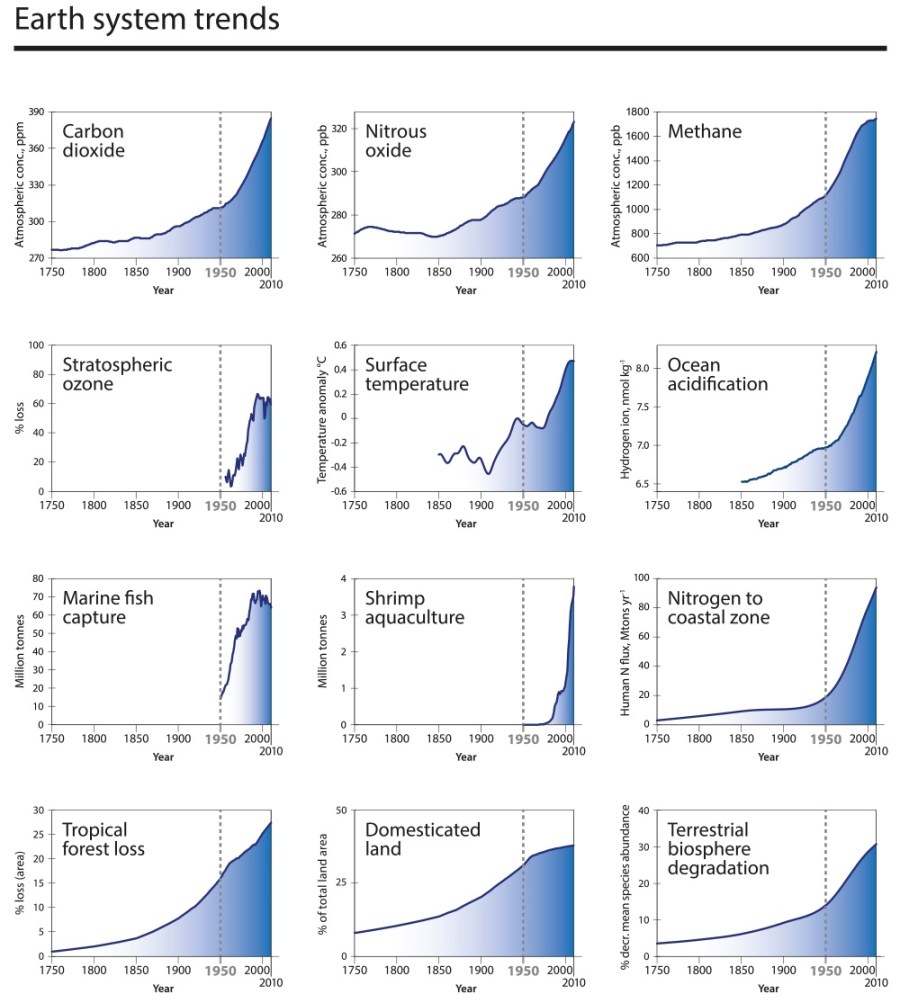
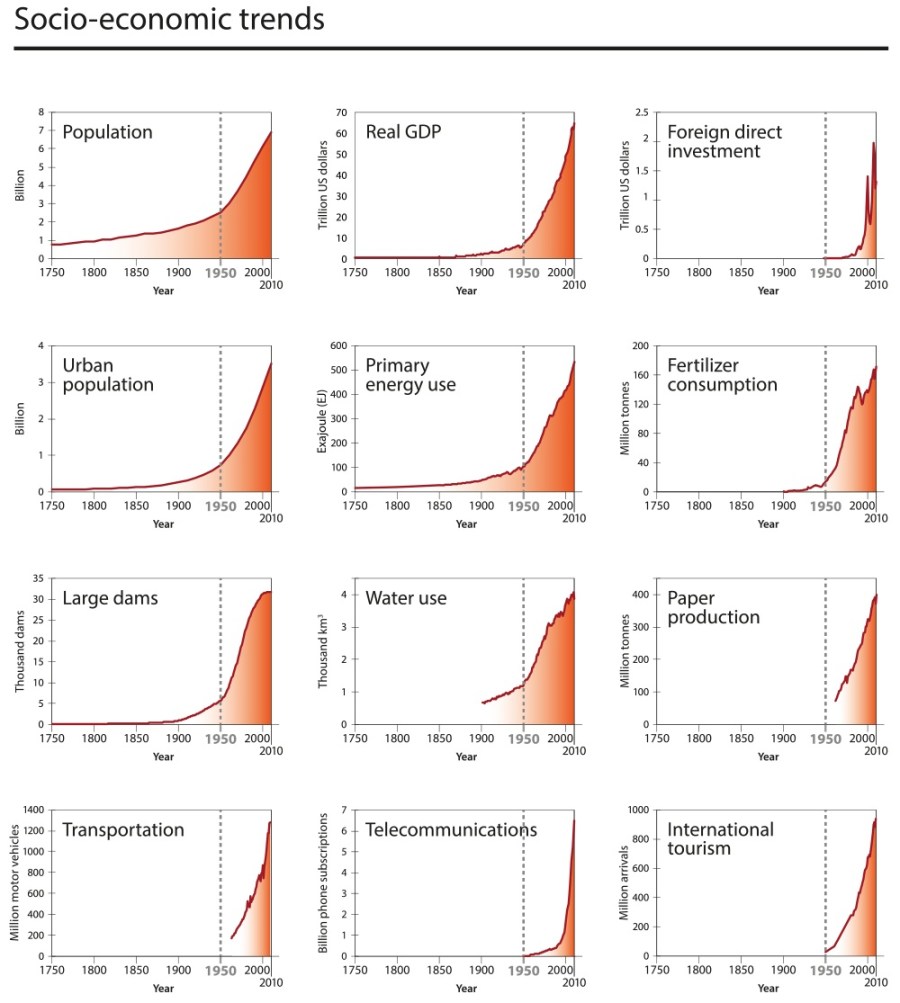
This is only one of the latest scientific concepts to show the extent to which humanity’s fate is now intertwined with the fate of the planet itself. Our decisions in the next decades will determine the future of the biosphere, the Earth’s geological trajectory, and, of course, our survival as a species. This is not some controversial science. Even climate change skeptics have to recognize the power of nuclear weapons to wipe the biosphere from the face of the planet’s hard rock mantel. It is also impossible to overlook the sheer scope and impact of massive human infrastructures, such as cities, dams, canals, and highway systems, which impact whole landscapes and ecosystems. In particular, Earth-system and socio-economic trends generative of the Anthropocene have been accelerating since 1950 (see Figures 1 and 2).

It appears the Earth is in our hands, and we are not prepared for the responsibility. Our species is reeling from the shock that comes from realizing that it is up to us to assure the continuation of the Earth’s life supporting systems. We are existentially intertwined in a common destiny, both as a species and as a biosphereric community—a vast web of life now depends on our stewardship. This is a profound educational challenge and an historical opportunity.

great_accel-12graph-SE

great_accel-12graph-ES

Figures 1 & 2: Earth system and socioeconomic trends charts from: Steffen, Broadgate, Deutsch, Gaffney & Ludwig (2015). The trajectory of the Anthropocene: The Great Acceleration. Anthropocene Review, 2.1.


It is important to understand that the recent genesis of the Anthropocene is a direct result of the modern capitalist world-system, which began to emerge during the 16th century, and which represents today the largest functionally integrated social unit the human species has ever created. The idea of “world-systems” is essential for any serious thinking about evolutionary futures for the human species.[ii] World-system analysis is a growing trans-disciplinary field, encompassing economics, politics, sociology, and history. It suggests that the existence and continuation of the capitalist world-system has fundamentally changed the very frontiers of human possibility and fundamentally altered the self-regulatory processes of the biosphere itself.

The modern world-system is now perilously close to literally encompassing all of humanity while at the same time exhausting the biosphere. This is something never achieved before by any existing historical world-system. Based on the analysis of long-term global trends in economics and political history, world-systems analysts argue that we have reached a crucial moment in geohistory. When a world-system reaches its structural limits an evolutionary crisis ensues and a fundamentally new kind of world-system must be painfully and violently born.[iii] We are currently in just such an evolutionary crisis; we inhabit a transition between world-systems. This is the second educational challenge and opportunity of our time.

Today we are witnessing simultaneous and interactive crises playing out between our broadest social structures and their biospheric corollaries. In the midst of all this external transformation there are, of course, related changes in human consciousness, culture, personality, and capability. Our global crises have an interior dimension.[iv]

Popular media and culture suggest that we live in a time of identity crises, a time in which the self-understanding of humanity is changing. Throughout the world basic institutions of government, finance, and education are suffering a crisis of legitimacy, as the basic principles upon which public culture is founded have deteriorated. We have no shared sense of purpose or shared ethical worldview upon which to base constitutional governance. The resources of the lifeworld (for meaning-making and identity creation) have become almost as depleted as the resources of the natural world.

Humanity’s inability to understand itself is part of a cascading planetary phase shift; our identity crisis is coinciding with the climax of the Anthropocene. The educational healing and transformation that needs to take place is in large part a matter of reconstructing our self-understanding as a species. Future educational configurations will require a response not only to the current global environmental and economic crises, but also to the current global identity crisis. This is the third great educational challenge and opportunity of our time.

In this essay I trace these themes into the domains of schools, education, and learning. I argue that the external crises (of world-system and biosphere) and the internal crises (of identity and legitimation) both require a fundamentally new approach to education that entails the end of what we have known as schooling. The external crises demand radically new infrastructures and technologies, a change in the basic platforms of educational technology (from blackboards and notebooks to screens and tablets), which is already making simplistic notions of schooling obsolete. The internal crises demand a reconstruction of academic knowledge and a release from the hidden curriculum of schools, which foster outdated modes of socialization and limiting forms of self-understanding.

The vision of education I offer is one in which dynamic forms of abundance and universal access replace static forms of scarcity and competition-based access. Education must no longer be something that is kept behind closed doors and that requires special privileges and capital to get. In a world pushed to the brink of crisis, education, like energy, must be made abundant, free, and healthy, if our species is to survive. Everyone everywhere must have access to educational resources that are good, true, and beautiful, even if only so that solutions can be found in time for the billions of community-level problems that are reverberating across our planet as it reels in crisis. Integral education looks beyond post-industrial schooling and current trends in global education reform and toward a radically different set of educational possibilities, which assume that the world of tomorrow will be very different from the world of today.

To be clear, I must deal with certain likely misunderstanding upfront, because the terms “schooling” and “educational technology” come fully loaded with preconceptions. Firstly, the vision of integral education I offer is not one of “home schooling” or “un-schooling” where parents shoulder the burden of education alone or with a small group of others who are “off the educational grid” in proper libertarian fashion. The re-imagined schools I envision are no longer really schools, that is true. But they are nevertheless truly places in which the village raises the child. This does involve higher levels of parental engagement, and I make account of that by arguing for labor market reforms that would provide parents with space and time to create learning communities. I argue later on that the possibilities of education are directly tied into macro-economic conditions and reforms, such as stipends for educationally active parents, or a basic income guarantee for all citizens, make possible radically new forms of education in which life- long learning and complex intergenerational relationships are central. An integral meta-theory of education allows us to see the concrete utopian possibilities that exist within specific alternative economic and institutional contexts; it hones our realistic social imaginations, which can access social worlds slightly adjacent to our own—we want to be exploring actual possible futures of schooling.

As radical as this may sound, what I am arguing for here is also a position that embraces the accomplishments of our historically public schools. Schools are not to be dismantled or shut down, let alone sold off to private enterprises, as is now being done worldwide in what is the largest privatization of educational institutions in history.[v] Our great school systems need to be repurposed and redesigned, transformed into unprecedented institutions that are a combination of public libraries, museums, co-working centers, computer labs, and daycares. Funded to the hilt, staffed by citizen-teacher-scientists, these public and privately supported educational hubs would be the local centers of regionally decentralized pop-up classrooms, special interest groups, apprenticeship networks, and college and work preparation counseling. Giant schools built on the model of the factory at the turn of the last century can be gutted, remodeled, and reborn metaphorically and literally, to create the meta-industrial one-room schoolhouses of the future. In these places technologies will enable the formation of peer-to-peer networks of students and teachers, of all ages, from all across the local region (or the world through video), and without coercion or compromise. What enables these safe, efficient, hubs of self-organizing educational configurations are fundamentally new kinds of educational technologies, which put almost unlimited knowledge in the palm of every person’s hand.

This vision of truly game-changing educational technologies is already on the lips of many educational innovators. I argue here that an actual and desirable revolution in schooling based on new educational technologies will only take place after a radical critique of current trends in educational technology has taken place. Many existing self-declared “educational technologies” are grounded in reductive human capital theory, which simplifies the nature of learning and limits ideas about the purposes of education. As I explain below, not all informational environments are educational environments. Search engines and social networking sites are not epistemologically reflective, nor or they transformationally challenging, both of which are important aspects of truly educational environments. Technology facilitated informational environments often have no teacherly authority. Most open-source web-content platforms cede all authority to the learner, which is the classic mistake of progressive and constructivist pedagogies. An integral meta-theory of education allows us to consider the levels of development that unfold as a part of all learning processes, and to thus grasp the ethical importance of appropriately exercising teacherly authority.

The modern sciences of learning, which are ignored in the design of most educational technologies, tell us that learning is optimized when it involves sustained interpersonal relationships, emotional connection and embodiment, and dynamically interactive hands-on experiences. Based on the best of what we know about learning, educational technologies should be bringing people together away from screens. Technologies should not be isolating individuals alone in front of screens. Part of an integral education is a set of design principles for integral educational technologies. These entail that the best educational technologies are those that facilitate real in-person relationships and peer-to-peer networks. The technology should not be the focus of attention, but a scaffold for group participation through content generation and pedagogically sophisticated instructions. The key is good practices and activities taking place away from the screen. The computer is not the new teacher in the meta-industrial one-room-school house; the computer is the new chalk board and text book, a technology that enables teaching and learning, and that works best when it is put to the side after sparking a conversation or activity.

With these key ideas foreshadowed and the general context set I will now turn to considerations about the current educational landscape and begin to make the argument that schools must be re-imagined if we are to survive this time of planetary transformation. Then I turn to consider the main facets of a minimalist integral meta-theory of education, which sets the stage for an exploration of educational technologies trends, peer-to-peer networks, and the beginnings of an integral education platform. I argue that we should begin to design technologies and direct the resources of our communities toward a radically different set of educational futures, where the categories of schooling—such as GPA, class rank, standards and tests, aged-normed classes, subject majors, etc.—are the meaningless categories of a bygone bureaucracy. Our task as educators today is to evolve the very form of schooling itself, looking beyond the institutional vestiges of a prior era and toward the emergence of educational configurations of almost unimaginable abundance, freedom, and efficiency. Educational networks must be created to facilitate the emergence and stabilization of those capacities and mindsets that are necessary for our historical moment. These are, almost by definition, unattainable through conventional schooling. This is where integral education will thrive in the decades to come: in the places where communities find new ways to work together to solve the problems facing their children and themselves: where new stories about our humanity are emerging; where new social possibilities are arising in the space between world systems; where the future of the biosphere and civilization are seen as intertwined.


[i] The term “Anthropocene” entered the Oxford English Dictionary remarkably late, in June 2014. That is 15 years after it is agreed to have been first coined, see: Angus I. (2015) “When Did the Anthropocene Begin… and Why Does It Matter.” Monthly Review, vol 67 no 4; Purey, J. (2015) After Nature: A Politics for the Anthropocene.

[ii] Wallerstein. I. (2007) World-Systems Analysis.

 [iii] Ibid.

[iv] Wilber, K. (1995) Sex, Ecology, Spirituality.

[v] This has been document on global scale, see: Sahlberg (2012). Finnish lessons: what can the world learn from educational change in Finland. But it starts with policy changes beginning in the US, see: Ravitch, D. (2013) Reign of Error: The Hoax of the Privatization Movement and the Danger to America’s publics Schools.

Originally published at: http://www.zakstein.org/education-in-the-anthropocene-re-imagining-schools-in-the-midst-of-planetary-transformation/


Two extracts from Green Earth

Kim Stanley Robinson

Chapter 14: Is there a technical solution?


No one thinks it will ever happen to them until suddenly they are in the thick of it, thoroughly surprised to be there.

A tornado in Halifax Nova Scotia; the third and catastrophic year of drought in Ireland; major floods on the Los Angeles River: these kinds of anomalies kept happening, at a rate of more than one a day around the world. Sooner or later almost everyone got caught up in some event, or lived in the midst of some protracted anomaly, for the weather events were both acute and chronic, a matter of hours or a matter of years.

Still it was hard to imagine it would ever happen to you.

At the poles the results were particularly profound, because of major and rapid changes in the ice. For reasons poorly understood, both polar regions were warming much faster than the rest of the planet. In the north the break-up of the Arctic Ocean’s sea ice had led to the imminent extinction of many species, including the polar bear, and the stall of the Gulf Stream. In the south it had resulted in the rapid break-up of the giant ice shelves hugging the Antarctic coast, unblocking the big glaciers falling into the Ross Sea so that they became “ice rivers,” moving so rapidly down their channels that they were destabilizing the West Antarctic Ice Sheet, the biggest variable in the whole picture: if this sheet came off its underwater perch on the sea floor, the world would suffer impacts greater by far than what had been witnessed already, most especially a rapid rise in sea level, up to as much as seven meters if the whole sheet came off.

Still it was hard to imagine it would ever happen to you.

There were further ramifications. The ocean bottom, where it drops from the continental shelves to the abyssal seafloor, is in many places a steep slope, and these slopes are coated by thick layers of mud that contain methane in the form of clathrates, a chemical form of freezing that cages molecules of the gas in a frozen matrix. As ocean temperatures rose, these chemical cages were being destabilized, and release of the methane could then cause underwater avalanches in which even more methane was released, rising through the water and rejoining the atmosphere, where it was a greenhouse gas much more powerful than carbon dioxide. Warmer atmosphere meant warmer ocean meant released methane meant warmer atmosphere meant—

It was a complex of cycles—geologic, oceanic, and atmospheric—all blending into each other and affecting the rest. The interactions were so complex, the feedbacks positive and negative so hard to gauge in advance, the unforeseen consequences so potentially vast, that no one could say what would happen next to the global climate. Modelling had been attempted to estimate the general rise in temperature, and actually the models had been refined to the point that there was some agreement as to the outside parameters of possible change, ranging from about a two to an eleven degree C. rise—a big range, but that’s how uncertain any estimates were at this point. And even if the estimates could have been tighter, global averages did not reveal much about local or ultimate effects, as people were now learning. There were non-linear tipping points, and now some of these were beginning to reveal themselves. The stall of the Gulf Stream was expected to chill the winter temperatures in the northern hemisphere, especially on both sides of the Atlantic; further effects were much less certain. The recent two-year failure of the monsoon was not understood, nor its violent return. China’s drought was ongoing, as was the longest-ever El Nino, called the Hypernino. Desertification in the Sahel was moving south at an ever-increasing rate, and South America was suffering the worst floods in recorded history because of the rain brought by the El Nino. It had rained in the Atacama.

Wild weather everywhere, thus the most expensive insurance year ever, for the eighth year in a row. That was just a number, an amount of money distributed out through the financial systems of the world; but it was also a measure of catastrophe, death, suffering, fear, insecurity, and sheer massive inconvenience.

The problem they faced was that everything living depended on conditions staying within certain tight climactic parameters. The atmosphere was only so thick; as Frank put it once, talking to Anna and Kenzo, when you drive by Mount Shasta on US Interstate Five, you can see the height of the liveable part of the atmosphere right there before your eyes. No permanent human settlement on Earth was higher than Shasta’s summit, at 14,200 feet, so the mountain served to show in a very visible form just how thick the breathable atmosphere was—and the mountain wasn’t very tall at all, in comparison to the immense reach of the plateau the highway ran over. It was just a snowy hill! It was sobering, Frank said; after you saw the matter that way, looking at the mountain and sensing the size of the whole planet, you were changed. Ever afterward you would be aware of an invisible ceiling low overhead containing all the breathable air under it—the atmosphere thus no more than the thinnest wisp of a skin, like cellophane wrapped to the lithosphere. An equally thin layer of water had liquefied in the low basins of this lithosphere, and that was the life zone: cellophane wrapping a planet, a mere faint exhalation, wisping off into space. Frank would shake his head, remembering that vision driving over the shoulder of Shasta. At that moment the world had said to him, I AM.

Still, it was hard to imagine.


Chapter 15: Autumn in New York


The most beautiful regatta in the history of the world convened that year on Midsummer Day, at the North Pole.

The sun hung at the same height in the sky all day long, blazing down on open water that appeared more black than blue. A few icebergs floated here and there, dolmens of jade or turquois standing in the obsidian sea. Among them sailed or motored some three hundred boats and ships. Sails were of every cut and color, some prisming as they bent to the shifts of a mild southern breeze. All possible rigs and hulls were there: catamarans, schooners, yawls, ketches, trimarans; also square-riggers, from caravels to clipper ships to newfangled experiments not destined to prosper; also a quintet of huge Polynesian outriggers; also every manner of motor launch, rumbling unctuously through the sailboats; even a lot of single-person craft, including kayakers, and wind-surfers in black drysuits.

The fleet jockeyed until their skippers linked up and formed a circle centered on the pole, rotating clockwise if seen from above. Everyone thus sailed west, following the two rules that birds use when flocking: change speed as little as possible, keep as far apart from everyone else as possible.

Senator Phil Chase smiled when the flocking rubric was explained to him. “That’s the Senate for you,” he said. “Maybe it’s all you need to get by in life.”

This was the fifth midsummer festival at the Pole. Every year since the Arctic Ocean had opened in summer, a larger and larger group of sea craft had sailed or motored north to party at the pole. By a happy coincidence, the North Pole itself, as determined by GPS, was marked this year by a tall aquamarine iceberg that had drifted over it. In the immediate vicinity of this newly-identified “Pole Berg” idled many of the largest ships in the fleet. As always, the gathering had a Burning Man aspect, its excess and fireworks leading many to call it Drowning Man, or Freeze Your Butt Man.

This year, however, the party had been joined by the Inuit nation Nunavut and the Intergovernmental Panel On Climate Change, who had declared this “The Year of Global Environmental Awareness,” and sent out hundreds of invitations, and provided many ships themselves, in the hope of gathering a floating community that would emphasize to all the world the undeniable changes already wrought by global warming. The organizers were willing to accept the risk of making the gathering look like a party, or even God forbid a celebration of global warming, in order to garner as much publicity as possible. Of course a whole new ocean to sail on was no doubt a cool thing for sailors, but all the missing Arctic ice was floating down into the North Atlantic at that very moment, changing everything. IPCC wanted people to see with their own eyes that abrupt climate change was already upon them.

                                               #

 But of course there were many people there who did not regard the polar party in its official light, just as there were many in the world who did not worry overmuch about entering the Youngest Dryas. On the sail up to the festival, some of them had encountered an oil tanker making a dry run on a Great Circle route from Japan to Norway that passed near the pole: the Northwest Passage was open for business at last. Oil could be shipped directly from the North Sea to Japan, cutting the distance by two-thirds. Even if oil was passé now, Japan and the North Sea oil countries were nevertheless awfully pleased to be able to move it over the Pole. They were not ashamed to admit that the world still needed oil, and that while it did, there would be reasons to appreciate certain manifestations of global warming. Shipyards in Glasgow, Norway, and Japan had been revitalized, and were now busy building a new class of Arctic Sea tankers to follow this prototype, boldly going where no tanker had gone before.

Here at the Pole on Midsummer Day, things looked fine. The world was beautiful, the fleet spectacular. In danger or not, human culture seemed to have risen to the occasion. Noon of summer solstice at the North Pole, a glorious armada forming a kind of sculpture garden. A new kind of harmonic convergence, Ommmmmmmm.

                                               #

On one of the bigger craft, an aluminium-hulled jet-powered catamaran out of Bar Harbor, Maine, a large group of people congregated around Senator Phil Chase. Many of them were bundled in the thick red down jackets provided to guests by the National Science Foundation’s Department of Polar Programs, because despite the black water and brilliant sun, the air temperature at the moment was 24 degrees Fahrenheit. People kept their hoods pulled forward, and their massed body warmth comforted them as they watched the group around Chase help him into a small rainbow-colored hot-air balloon, hanging over the top deck straining at its tether.

The World’s Senator got in the basket, gave the signal; the balloon master fired the burners, and the balloon ascended into the clear air to the sound of cheers and sirens, Phil Chase waving to the fleet below, looking somewhat like the Wizard of Oz at the moment when the wizard floats away prematurely.

But Phil was on a line, and the line held. From a hundred feet above the crowd, Phil could be seen grinning his beautiful grin. “Here we are!” he announced over the fleet’s combined radio and loudspeaker array; and of course millions more saw and heard him by satellite TV. A big buoy clanged the world to order as Phil raised a hand to still the ships’ horns and fireworks.

“Folks,” he said, “I’ve been working for the people of California for seventeen years, representing them in the United States Senate, and now I want to take what I’ve learned in those efforts, and in my travels around the world, and apply all that to serving the people of the United States, and all the world.”

“President of the world?” Roy Anastopholous said to Charlie, and began to laugh.

“Shh! Shh!” Charlie said to Roy. They were watching it on TVs in different parts of DC, but talking on their phones as they watched.

“It’s a crazy thing to want to do,” Phil was conceding. “I’m the first to admit that, because I’ve seen what the job does to people. But in for a penny in for a pound, as they say, and we’ve reached a moment where somebody who can handle it needs to use the position to effect some good.”

Roy was still giggling. “Be quiet!” Charlie said.

“—there is no alternative to global cooperation. We have to admit and celebrate our interdependence, and work in solidarity with every living thing. All God’s creatures are living on this planet in one big complex organism, and we’ve got to act like that now. That’s why I’ve chosen to announce my candidacy here at the North Pole. Everything meets up here, and everything has changed here. This beautiful ocean, free of ice for the first time in humanity’s existence, is sign of a clear and present danger. Recall what it looked like here even five years ago. You can’t help but admit that huge changes have already come.

“Now what do those changes mean? Nobody knows. Where will they lead? Nobody knows. This is what everyone has to remember; no one can tell what the future will bring. Anything can happen, anything at all. We stand at the start of a steep ski run. Black diamond for sure. I see the black diamonds twinkling everywhere down there. Down the slope of the coming decades we will ski. The moguls will be on us so fast we won’t believe it. There’ll be no time for lengthy studies that never do anything, that only hope business as usual will last for one more year, after which the profiteers will take off for their fortress mansions. That won’t work, not even for them. You can get offshore, but you can’t get off planet.”

Cheers and horns and sirens echoed over the water. Phil waited for them to quiet back down, smiling happily and waving. Then he continued:

“It’s one world now. The United States still has its historical role to fulfill, as the country of countries, the mixture and amalgam of all humanity, trying things out and seeing how they work. The United States is child of the world, you might say, and the world watches with the usual parental fascination and horror, anxiety and pride.

“So we have to grow up. If we were to turn into just another imperial bully and idiot, the story of history would be ruined, its best hope dashed. We have to give up the bad, give back the good. Franklin Roosevelt described what was needed from America very aptly, in a time just as dangerous as ours: he called for a course of ‘bold and persistent experimentation.’ That’s what I plan to do also. No more empire, no more head in the sand pretending things are okay. It’s time to join the effort to invent a global civilization that we can hand off to all the children and say, ‘This will work, keep it going, make it better.’ That’s permaculture, as some people call it, and really now we have no choice; it’s either permaculture or catastrophe. Let’s choose the good fight, and work so that our generation can hand to the next one this beautiful world.

“That’s the plan, folks. I intend to convince the Democratic Party to continue its historic work of helping to improve the lot of every man, woman, child, animal and plant on this planet. That’s the vision that has been behind all the party’s successes so far, and moving away from those core values has been part of the problem and the failure of our time. Together we’ll join humanity in making a world that is beautiful and just.”

“We’ll join humanity?” Roy said. “What is this, Democrats as aliens?” But Charlie could barely hear him over the ship horns and cheers. On the screen he could see they were beginning to reel Phil in like a big kite.


Extracts first published in Green Earth by Kim Stanley Robinson (London: Harper, Voyager).


From OOO to P(OO)

McKenzie Wark

I have been reading the work of Timothy Morton with pleasure for many years now. Originally a scholar of English romantic poetry, I find his work reads best as poetry, or perhaps a poetics, as a singular Mortonian vision of the world – or in this case, a vision of the absence of the world. For his most recent book is called Hyperorbjects: Philosophy and Ecology after the End of the World (Minnesota, 2013).

I have some problems with it as theory, however, and will try to outline here where my own thinking and Morton’s both overlap and diverge. Perhaps bodies of work are a case of what Morton calls hyperobjects: spooky, nonlocal, pervasive entities that are at once in us which we are in. In which case best way to proceed is simply to map one onto the other and find the edges where such things resonate.

One of the merits of Morton’s work is its attention to twenty-first century problems. Morton: “To those great Victorian period discoveries, then – evolution, capital, the unconscious – we must now add spacetime, ecological interconnection, and nonlocality.” (47) If one suspends disbelief and reads him texts as a science fiction poetics, one starts to breath the (overly warm, possibly radioactive) air of the times. Branching off from Alphonso Lingis, Morton offers a phenomenology for the strange and untimely objects one increasingly seems to encounter –hyperobjects.

But first, objects. Morton: “Objects are unique. Objects can’t be reduced to smaller objects or dissolved upwards into larger ones. Objects are withdrawn from one another and from themselves. Objects are Tardis-like, larger on the inside than they are on the outside. Objects are uncanny. Objects compose an untotalizable nonwhole set that defies holism and reductionism. There is thus no top object that gives all objects value and meaning, and no bottom object to which they can be reduced. If there is no top object and no bottom object, it means that we have a very strange situation in which there are more parts than there are wholes. This makes holism of any kind totally impossible.” (116)

In short, Morton declares victory in advance for the poets. The world is made of things that elude any other kind of knowing. This is even more the case with hyperobjects, which stick to being, which are viscous, nonlocal, temporally weird and detectable only through the waves they make coming in or out of phase with other, more banal kinds of objects.

Mortonian poetics is a species of the genre of object oriented ontology (ooo), which is itself a kind of poetic realism. One in which entities are shy and retiring, like an octopus squirting a jet of ink as it disappears. There’s no transcendental leap outside of this world of hyperobjects, and as such a ‘world’ can not be said to appear at all, if by world we mean that which can be said to exist over and against me.

There’s no more bracketing off of a separate world, as “we are no longer able to think history as exhaustively human…” (5) There’s no outside. We’re always inside hyperobjects and hyperobjects are always passing through us, whether the hyperobject is radioactive waste or global warming. This poetics brings us to an uncanny place – the end of the world.

Morton’s aim is to wake us from the dream of a world ending, to the realization that it has ended already. There’s no outside, no separation. “Because they so massively outscale us, hyperobjects have magnified this weirdness of things for our inspection…. What if hyperobjects finally force us to realize the truth of the word humiliation itself, which means being brought low, being brought down to earth itself?” (12, 17)

The book makes use of many examples from modern science, but I am resistant to the attempt to subsume such examples within ooo. Morton: “science doesn’t necessarily know what it is about.” (10) But surely the reverse is even more the case, as Morton almost acknowledges: “You have to wonder whether your poem about global warming is really a hyperobject’s way of distributing itself into human ears and libraries.” (175) One needs climate science to understand hyperobjects, as it is a key example, but not vice-versa. As always with ontology, ooo comes after the labor of producing a knowledge of affairs and adds a supernumerary interpretation to it.

As a species of the genus speculative realism, ooo wants to have an alternative to what Quentin Meillassoux calls (after Merleau-Ponty) correlationism, where for there to be knowledge of a thing there need be a corresponding subject. The ooo species approaches this by generalizing the Heideggerian theme of the withdrawal of the tool itself in the act of performing its tool-function, by positing that all objects withdraw from each other in this manner. The subject-object relation then becomes just a subset of all object-object relations, in which objects always withdraw from each other, and relate to each other aesthetically, through the face they present.

Morton uses an example from Husserl. Holding a coin, one sees its face. But you can’t see the other side of the coin as the other side. You can only flip it over and make it this side. But I think the thing to pay attention to is not the mystery of the other side or the limits of seeing just this side, but the labor of the flipping. Hence I would want to move on from the contemplative thought of ooo to what it cannot but acknowledge in passing but continually represses: the labor or praxis via which a thing is known.

But to say labor is not to say subject. It is not to return to correlationism. For labor is always a mix of the human and inhuman. To say ‘tool’ is to partly say, and then erase, labor. Particularly when one gets to modern means of knowing the world, the apparatus of labor and techne becomes a vast and inhuman thing. This is the case in a pertinent example such as climate science, as I discussed in Molecular Red. There it’s an array of satellites, computers, terrestrial weather stations, forms of international cooperation of scientific labor, elaborately agreed upon standards and so on. Climate science, like all modern science is an inhuman apparatus via which the nonhuman world is mediated in such a way that humans can comprehend it.

Contra Morton, I don’t think Niels Bohr’s Copenhagen Interpretation of quantum mechanics is not correlationist at all. Morton writes of “Bohr as thinking quantum events as if they were “correlations to (human) instruments.” (37) But why is the instrument ‘human’? Is not the instrument an inhuman thing that mediates the nonhuman to the human? Again, there’s a collapsing of the space in which praxis occurs here.

For Morton, we are always inside objects. We are neither at the center nor the edge, and if they are hyperobjects they maybe massive, pervasive and weird. But I don’t think it’s the object that withdraws; I think its ooo that occludes the ways in which objects are known in the first place, which is in three steps.

First, there’s the particular praxis that produces a knowledge. Whether the praxis is labor or science, its always a cyborg mix of human effort and inhuman apparatus.

Second, there’s the generalization of that praxis in the form of metaphors and images. This is also a kind of labor, an intellectual labor, a mix of human talk and inhuman apparatus of communication.

The third step is the erasure of the other two. First there’s the praxis of doing science about quantum mechanics or climate change. Second there’s the production of the metaphor of the hyperobject, and third the erasure of the dependence of this metaphor on that prior praxis. In this case, the metaphor will then be claimed to be what precedes all those other steps when it is actually a later derivation.

Objects and even hyperobjects then appear as objects of contemplation, circulating all around us, free from the labor that produced a knowledge of them as such. Here I think Morton’s version of a speculative realism has the same limitation as the work of Quentin Meillassoux, (about which I have written here and here.) Where Meillassoux produces the spectacle of the absolute, Morton produces instead a contemplative relation to the ambience of the long duration. This is progress, however. As Morton wisely notes, it is harder to imagine the long duration than to imagine eternity.

Meillassoux thinks the problem with phenomenology is the finitude of the human subject that correlates to the object of knowledge. Morton thinks it’s the privileged transcendental sphere. Morton: “Kant imagines that although we are limited in this way, our transcendental faculties are at least metaphorically floating in space beyond the edge of the universe, an argument to which Meillassoux himself cleaves in his assertion that reality is finally knowable exclusively by (human) subjectivity. And that is the problem, the problem called anthropocentrism.” (17) But what Morton offers instead is a contemplative access to the immanence of the strange and the weird. But we’re stuck with the problem ooo shares with speculative realism, and speculative realism shares with at least some other species of phenomenology: the erasure of praxis.

We’re left in some version of the eternal gap between the phenomena of the senses and their contemplation versus the essence of things that cannot be known. Interestingly, Morton chooses to concentrate on the contemplation of the gap between essence and appearance itself: “a thing just is a rift between what it is and how it appears.” (18) ‘Just is’, that is, once we have erased the inhuman praxis that produced it as an object of contemplation in the first place.

This is where Hyperobjects gets most interesting: as an aesthetics. By paying attention to the periphery of sensation, the ambient tone, the interference patterns, certain hyperobjects can be detected in everyday life (but only if we know in advance through other means that they are there.) “The ground of being is shaken. There we were, trolling along in the age of industry, capitalism and technology, and all of a sudden we received information from aliens, information that even the most hardheaded could not ignore, because the form in which the information was delivered was precisely the instrumental and mathematical formulas of modernity itself. The Titanic of modernity hits the iceberg of hyperobjects.” (19) Except that it doesn’t. This is like a Platonic myth. Information did not come “from aliens” but from the natural sciences. What modernity hit was (for example) information produced  by the praxis of the natural sciences about anthropogenic climate change.

There is already a name for the iceberg: the Anthropocene. What’s with the compulsion of humanities scholars to want to refuse this name we did not coin? Language is our job, of course. Its galling to have to admit that the relevant data here comes from without, from other ways of knowing, which bring with them other ways of naming, and other conventions about the rights of names. Somehow I just don’t think that insisting on the right to name things we did not discover is going to cut much ice.

One can indeed think the Anthropocene as a new historical age in which nonhumans are no longer excluded. Or one can do the reverse, which is perhaps more challenging, and is the point that earth sciences have arrived at: a new stage of geology in which humans are included. That to me is the truly strange thing to think.

However, there are elements in Morton useful for a twentieth century critique of separation. He does not inquire far as to where they come from, but he is hard on the case of modes of thought that assume a prior distinction, between the social and the natural, between self and world, between foreground and background. There are even forms of environmentalism that are caught up in this need for something separate, to be left alone. But this is no longer really possible. “Its oil we must thank for burning a hole in the notion of world.” (34) Its products are now everywhere, not least as that metonym for the Anthropocene, the hyperobject of global plastic residue. The geologists now even find strata of plastic rock being laid down as we speak.

Morton offers a brief glimpse of an aesthetic adequate to the viscous, pervasive nature of the oil-based world. It’s the rhapsodic, ambient, field-based art of a certain moment in modernism: Jackson Pollock, John Cage, William Burroughs. A contemporary extension might be Reza Negarestani’s astonishing Cyclonopedia, a book in which oil is the central character, a malign stain, a memory of sunlight, erupting from the bowels of the earth to change the course of history. Morton: “modernity is the story of how oil got into everything.” (54)

But what I think is to be resisted in Morton is the gesture that makes this poetics a higher truth than that of other practices of knowledge. Borrowing an image from The Matrix, Morton writes: “The mirror of science melts and sticks to our hand.” (36) He wants the viscous hyperobject to somehow be both before and beyond the realm of science, which as Karen Barad would have it, does require a kind of stabilizing of a closed space within an apparatus where observations can be made, repeated, recorded and then communicated.

It may be useful to have poetics (in the plural) that take the specific results of particular sciences and experimentally generalize them. This is what Bogdanov called tektology. But I think we start to get into trouble when we assume that poetics is a higher power. Morton is far less attentive to its limits than to the limits of scientific modes of knowing. So yes, let’s attend to Jackson Pollock, but maybe attend also to how the promotion of his work in postwar America is tied to the suppression of an art that directly addressed the class struggle or racial oppression, or how it partook in the cult of the male genius which is the very opposite of any approach to creation as the product of a field or an emergence from an ambience.

A good example of both the uses and the limits of a poetic and metaphoric extension of specific results from particular sciences is Morton’s use of the nonlocal as a metaphor. Here he has in mind things like nuclear radiation and endocrine disruptors, things that are waste products of modernity but which can’t be kept separate, which get into everything. Atmospheric carbon might be another example. They are examples of what I would call, following John Bellamy Foster, metabolic rift.

It was Marx who opened this metaphoric extension, thinking outwards from the metabolism of separate organism towards the thought that the whole planet is one metabolism. Marx was already starting to think the breakdown of such processes. In his time, it was flows of phosphorous and nitrogen. Now one could extend that thought to atmospheric carbon, complex hydrocarbon compounds, or radioactive isotopes produced by nuclear reactions. Thought of as metabolic rift, or as Jason Moore calls it metabolic drift, one can stay close to the science of geochemistry and need not add too many additional concepts.

It is indeed the case that one has to think causality in a contemporary way to understand such things: association, correlation and probability are all we have to go on. These days, empirical observations only make sense within computer simulated models of earth system processes. This is only weird or strange from the point of view of 19th century models of science. As contemporary science, the aesthetics of this are now quite ordinary, and need to be thought now as such.

One kind of science that really does still seem spooky and weird is quantum mechanics. But again, this is only so if one tries to sustain some sort of 19th century realism, from the point of view of which quantum mechanics seems to point to a troubling and contradictory reality. Niels Bohr really did have a solution to this, but it’s one that meets strong resistance from those who really need to maintain a faith in a reality that is out there, and separate. One way to read Bohr is as offering a realism not of the object of knowledge but of its practice, but where its practice takes place within the inhuman space of the apparatus.

This is Bohr’s complementarity: an apparatus gets a result; another apparatus gets another result. The results are a product of the apparatus. What is separate is the artificial space and time of the apparatus. One is to resist the temptation to say too much about what the results from within the apparatus might say about what we imagine to be the real and separate world beyond what the praxis of the experiment might say about itself.

But rather than affirm that the apparatus produces the phenomena, something that has the status of a fact, Morton proceeds the opposite way. Rather than stick with the limited recording of an object that an apparatus can produce, he wants to say that the real objects withdraw. Fine, but this is to speak of something that in its very nature is beyond observation, beyond any knowledge, but can only be an effect of a poetic art or speculative discourse.

It is a poetics which runs many risks of simply generalizing habits of mind or extrusions of current social relations onto the cosmic scale. It can lead to statements that are just not true: “OOO is deeply congruent with the most profound, accurate, and testable theory of physical reality available. Actually it would be better to say it the other way around: quantum theory works because it’s object-oriented.” In the space of two sentences, an alleged congruence becomes by fiat a foundation.

From thence we end up doing everything Ernst Mach warned us not to do: subordinating the genuine oddness of the praxis of science and the particular results it gets to a worldview which presumes to speak to a higher reality. Thus Morton: “Unlike the Copenhagen Interpretation, the ontological interpretation is noncorrelationist: particles withdraw from one another, not because humans are observing them in certain ways, but because the implicate order is withdrawn from itself.” (43) This is an imaginative solution to an imaginary problem. Bohr’s approach is not correlationist. To say so excludes the inhuman nature of the apparatus. It might be appealing to imagine objects withdraw, but poetry is not the unacknowledged legislator for the sciences.

Sometimes the praxis of science will simply blow a hole through our speculative worldviews. Thus I agree with Morton that once one has even a poor layperson’s grasp of something like quantum nonlocality, it is hard to call oneself a materialist, or even a ‘new’ materialist any more. In the Marxist tradition there were three responses to this.

One was to sever any connection between what materialism might mean as a scientific worldview and what it might mean when applied to social and historical formations. A second was to formulate a ‘dialectical materialism’ that could keep abreast of the sciences. A third was to shift from statements about the materialism of the world to a critique of the materialism of the production of knowledge about the world.

The first path was that of western Marxism and of much critical theory today. I think Morton and I might agree that (call it what you like) the hyperobject, the Anthropocene or metabolic rift renders it obsolete. There is no separate world of the social. The second path was that of Engels, reinvented in a way by new materialism in a Deleuzian vein, and by ooo in a Heideggerian one. Rather than separate itself from the sciences, it claims to be about something prior to them. I put Morton in this camp.

The third that of the ‘Machists’ such as Bogdanov, reinvented in a different register by Donna Haraway and Karen Barad. The merit of this third path is that it keeps critical thought in touch with the sciences, like the first path, but limits its ambitions. It respects the methods of the sciences and does not claim access to a superior reality. It looks critically at how ideas from the social world end up in the sciences, but also works creatively on how the sciences can produce figures that might be metaphorically extended to other domains. But it does not claim its second-order generation of such metaphors is a first order knowledge of something more fundamental than what scientific knowledge might know.

There is certainly a benefit to the poetics Morton opens up. From the point if view of the hyperobject, “Locality is an abstraction.” (47) Here is a useful reversal of perspective: “… in an age in which hyperobjects start to oppress us with their terrifying strangeness – we will have to acclimatize ourselves to the fact that locality was always a false immediacy.” (48) One can put this alongside the rather different critique of the folk politics of the Invisible Committee in Srnieck and Williams.

But I simply cannot accept statements such as: “The object is already there. Before we look at it. Global warming is not a function of our measuring devices.” (49) What’s missing here is the proper sequence via which knowledge is produced. A theory of global warming is confirmed, by computer modeling based (in part) on measuring devices, which then retrospectively comes to describe a state prior to the result of this praxis.

The particular pleasure to be had here is poetic: “Like God taking a photograph, the nonhuman sees us…” (50) And “We are poems about the hyperobject Earth.” (51) Indeed all life-forms become poems about nonlife, songs to the geo-trauma of being. Well and good. Until this: “Is the beyond of that might explain the poem more real than the here of the poem? There is no way to tell.” (53) There are ways to tell, and they are partial and fallible. They are the various kinds of praxis of knowledge and labor, here as always rendered invisible to the contemplative soul. What is withdrawn in ooo is always labor. In the absence of which magical thinking returns.

Hyperobjects exhibit difficult spatial properties, being both molecular and global in scale at once. They are also temporally difficult. They need to be thought on very long timescales. In a brilliant insight – and a point against Meillassoux – Morton notes that “These gigantic timescales are truly humiliating in the sense that they force us to realize how close to the Earth we are. Infinity is far easier to cope with.” (60)

In a lovely metaphor, Morton has it that after relativity theory, “time and space emerge from things, like the rippling flesh of a sea urchin or octopus.” (63) But here again, the significance of experimental proof is only fleetingly acknowledged. “Hyperobjects end the idea that time and space are empty containers than entities sit on.” (65) No, physics does, once as theory, and then as theory confirmed by quite particular experimental apparatus.

Hyperobjects are not only spatially and temporally weird, for Morton they even exist in a higher dimension. They manifest through phasing, or interference patterns, when they encounter more mundane objects. This whole argument rests on an analogy: “If an apple were to invade a two-dimensional world, first the stick people would see some dots as the bottom of the apple touched their universe, then a rapid succession of shapes that would appear like an expanding and contracting circular blob, diminishing to a tiny circle, possibly a point, and disappearing.” (70) Like the Tralfamadorians in Vonnegut’s Slaughterhouse 5, “A high enough dimensional being could see global warming itself as a static object. What horrifyingly complex tentacles would such an entity have, this high-dimensional object we call global warming?” (71)

For Morton, the mathematical description is not what underlies the object, it is a paraphrase. Not being a Platonist on such questions, I can quite agree. However, I can’t agree with Morton’s attempt to make a poetics of the object an intimation of a higher reality. The so-called flat ontology of ooo needs to be countered with a flat epistemology, one which does not a priori assign a hierarchy to ways of knowing, but rather holds open the question of which forms of knowledge have priority in which domain, and more importantly, what their modes of relation should be. Like Bogdanov, I think the goal is not to assert a hierarchy of one form of knowledge over others, be it the sciences or philosophy or poetry. The goal might rather be a comradely cooperation of modes of knowing as a subset of ways of laboring.

Thus I admire the literary quality of this metaphoric leap: “hyperobjects are disturbing clowns in an Expressionist painting, clowns who cover every available surface of the painting, leering into our world relentlessly.” (76) But I can assign no a priori truth value to this way of claiming a knowledge of the world. Unlike Morton, I want a consistently indexical or metonymic approach to what a form of knowledge praxis does. A known thing is an index of unknown things. But one must always keep in view the means by which the indexical sign is made out of the world. And one should try to assume the bare minimum about that world beyond what the index traces.

Or, one could speculatively imagine a lot of objects, even ‘withdrawn’ ones but assign them no reality besides being possibilities in the mesh of language. And so one can say: “The abyss is not an empty container, but rather a surging crowd of beings…” (80) Or, contra Morton, one can write as Meillassoux does of a universe after the style of Mallarmé that could collapse at any time and exists as and for no reason at all. To think that being reveals itself in such language, even in a veiled or withdrawn state, is really just the via negativa of logos.

To see it as something more Morton has recourse once again to an analogy. What if hyperobjects were to mind as base was to superstructure? “My thinking is thus a mental translation of the hyperobject – of climate, biosphere, evolution – not just figuratively, but literally.” Once again, notice that what is withdrawn from view here is praxis. The mind pulls the pattern of the world by reflecting on itself as itself.

What makes it a more appealingly contemporary aesthetic is its indirectness. Like deconstruction, “for every system of meaning, there must be some opacity for which the system cannot account.” (89) But it may be over-reaching to think that one can speak in the place of that opacity in domains other that writing, of the “magic of real objects that subtend the object system.” (89) It can produce an attractive metaphysics: “Appearance is the past, essence is the future. The strange strangeness of a hyperobject, its invisibility – it’s the future, somehow beamed into the ‘present.’” But metaphysics is here meta in the sense of supernumerary.

Hyperobjects offer an ecology without matter, without the present, dwelling, one assumes, in the futurity of essence. “The present is precisely nowhere to be found in the yawning Rift opening between the future and past, essence and appearance… The present does not truly exist. We experience a crisscrossing set of force fields, the aesthetic-causal fields emanated by a host of objects… Time is a flurry of spells and counter-spells cast by objects themselves… The unknown soul of things, the essence, remains on the hither side…” (92-94) Here we have a, rather than definitely the, way of thinking outside some kind of self/other or object/subject binary, even if that problematic dualism has been re-inscribed on another axis.

There’s no environment as something separate, out there. “The idea that we are embedded in a phenomenological lifeworld, tucked up like little hobbits into the safety of our burrow, has been exposed as a fiction.” (104) Rather, there’s an all too intimate relation with hyperobjects, which far exceed us yet pass through us, like radiation or dioxins. I agree with Morton that responding to all this with the rhetoric of sustainability (or even resilience) is insufficient. But unlike him I think this may mean more, rather than less attention to molecular flows, be they of oil or oil-based polymers. Earth systems sciences are never going to give us complete answers – like any verifiable knowledge they depend on the separations performed by particular apparatus – but more rather than less attention to such disciplines seems tactically the thing on which to insist right now.

Morton thinks we have to abandon the category of nature, which he takes to mean something like environment, a background, a thing apart. Hence his famous slogan ecology without nature. I appreciate the rhetorical gambit here, but I don’t know if in the long run this is a good tactic. One would have thought that ecology was an even more troubling term: oikos plus logos, as if there could be a logic or truth to metabolism within which the satisfaction of human social needs is achieved. I actually take the theory of the hyperobject to mean: there is no ecology. There is no homeostatic cycle of life that could be restored through the withdrawal of human interference.

Nature is a rather more tricky term. To shorthand Raymond Williams, its root meaning is connected to birth (natality). It has meant at least three different things. Firstly, the quality of a thing. Secondly, the force that directs the world. Thirdly, the material world itself. The human can be included or not in any of its definitions. It may not actually be possible to think ecology without nature, as ecology is just a point in the space of possible meanings of nature itself. As he himself says: “Home, oikos, is unstable.” (117) But the hyperobject is still a theory of nature, one among the set of possible deployments of the term that refuses to see the human point of view as one that could claim a fundamental separation or externality of point of view on it.

It seems that Morton’s resistance to the word nature has to do with Wordsworth’s colonization of it. He prefers Keats’ attention to the object. But perhaps this was just a way to write nature poetry differently rather than a break with it. And maybe it’s a path that comes with its own problems. “In ooo-ese, reification is precisely the reduction of a real object to its sensual appearance-for another object. Reification is the reduction of one entity to another’s fantasy about it. Nature is a reification in that sense.” (119) But ooo responds to this with reification in negative. The futural, essential, withdrawn object becomes the fetish, at the expense not only of any particular sensory one, but of the collaborative praxis needed to work these partial, mediated apprehensions that are the real into some workable relation to each other.

The insistence on a strange, spooky or weird kind of aesthetics is itself a product of this fetish in negative, which suppresses attention to praxis and contemplates a floating phantasmagoria of things. “Two hundred years of seeing humans at the center of existence, and now the objects take revenge, terrifyingly huge, ancient, long-lived, threateningly minute, invading every cell in our body.” (115)

Well, yes, if one had not paid attention to the praxis via which the inhuman world of of labor plus apparatus transforms nature into second nature (perhaps even a third nature), including all the things thus made that escape exchange calculus of exchange value. These things appear then as akin to that most rarified of fetish objects, art. “We are the curators of a gigantic museum of non-art in which we have found ourselves, a spontaneous museum of hyperobjects.” (121)

As in Shelley, there’s a wager on the ethical and political import of poetic vision: “This destiny comes from beyond the (human) world, and pronounces or decrees the end of the world. This decree marks a decisive point in Earth history in which humans discern the nonhuman and thus reckon the fate of Earth with greater justice.” (148) One is reminded here of Shelley attaching his incendiary poems to a hot air balloon as a way to try and close the gap between the poem and its public, and between a public and action. Everything is reduced to the rather idealistic project of countering a truncated view of the world with a vision: “This attitude is directly responsible for the ecological emergency, not the corporation or the individual per se, but the attitude that inheres both in the corporation or the individual, and in the critique of the corporation and the individual.” (155)

What gives ooo its old-fashioned flavor is its attempt to give new life to an old metaphysical strategy. As Morton notes, we are confronted with limited options within the old possibility space, of which he lists three. Firstly, essence is everywhere. Secondly, there is no essence. Thirdly essence is right here, yet it is withdrawn.

Here I place myself with Bogdanov in the second camp, which declares an end to philosophy’s attempt to claim a special object that is prior to and has more being that the objects produced within other forms of knowledge which are based on appearances. Maybe we don’t have to posit weird beings to understand evolution, ecology, quantum mechanics or climate change. Maybe we just have to accept these things as ordinary.

Morton has rather given us a variation on the hidden God (a variation on option one, essence is everywhere). Lucien Goldman’s Hidden God is a study of Blaise Pascal and his contemporaries, and perhaps an instructive one for our times. Pascal had a tragic vision of life. He accepts a world in which to act but its values cannot satisfy him. He is both in and out of the social. Its justice is not true justice, but he does not leave it as the mystics do. He maintains a faith in a superior realm, but this is not the ever-present God of the middle ages. God does not manifest directly in his creation.

For Goldman, this is the worldview of an administrative class whose power is waning. They are within a powerful institution but not governing it. Hence: “The feeling is rather of the nonhuman out of control, withdrawn from total human access.” (172) Rather like today’s humanities scholars. Hence the will to power over the world through the staking of a claim to a higher reality, but a hidden one: in Pascal’s case, God; in Morton’s case, objects. The latter builds on the formalization of the former which for Goldman was Kant’s achievement. He made philosophy the legislator of what counted as a legitimate object of thought, of what belongs to appearances and what to essences. Morton banks instead on being able to speak in and about the rift between, the weird zone just beyond appearances from which to claim that they issue.

Perhaps this does have a value, in creating an illusion within which traditional forms of humanistic knowledge can continue to go on. And perhaps illusions have their uses when the dangers of losing them are too great. “Art in these conditions is grief-work. We are losing a fantasy – the fantasy of being immersed in a neutral or benevolent Mother Nature and a person who is losing a fantasy is a very dangerous person.” (196) Morton’s contributions to reviving old modes of affect and percept under new and pressing circumstances is certainly an important project.

For myself, I’m closer to the way Donna Haraway goes about this, which likewise tries to ‘stay with the trouble’ of our times, but stays also in the world of appearances. There’s no additional claims for poetics as a way of knowing besides its ability to communicate between domains, and in particular to get actual knowledge about the nonhuman working within the spaces of humanistic and social thought.

In that vein I can agree with this version of Morton’s project: “Nonhuman beings strike a devastating blow against teleology, a blow detected by Darwin and celebrated by Marx, who wrote Darwin a fan letter for his opposition to teleology. The end of teleology is the end of the world.” (95) But these nonhuman beings can be thought strictly in the world of appearances, the world of the praxis of knowledge with its cyborg apparatus of human labor and inhuman techne.

I would call this way of working not object oriented ontology, but praxis (object oriented), or p(oo) for short.* I would paraphrase Haraway’s ‘staying with the trouble’ as staying with the poo, meaning both staying with the praxis, but also meaning – staying with the poo. Stay with the waste, the neglect, the bad byproduct. Here I retain the metaphoric use of object-oriented, which as Manovich, Chen and Galloway have pointed out, is a particular moment in the history of computation. There objects don’t withdraw, they are intentionally hidden from a programmer so that she or he works only on the object with which they are tasked and don’t fuck up the work others. It’s a way of staying out of each other’s way that I think Morton oversteps vis-à-vis the sciences or other empirical knowledge praxis.

And at the end of the day, what matters most in the Anthropocene is that each distinctive mode of thought and feeling find its own language and form of effectivity within its horizon. One could think it (or not) as Morton does, as a charnal ground, “an undead place of zombies, viroids, junk DNA, ghosts, silicates, cyanide, radiation, demonic forces, and pollution…. When the charm of world is dispelled, we find ourselves in the emergency room of ecological coexistence.” (126) The important thing, which Morton fully grasps, is to think it.


* I used the title ‘From OOO to P(OO)” for a presentation to the Object Oriented Ontology Conference at The New School in 2011, which unfortunately is no longer available online.


Article online at:

http://www.publicseminar.org/2015/12/from-ooo-to-poo/#.WerDtE26zIU


Confronting fundamental problems of the human condition and pressing problems of the day, using the broad resources of social research, we seek to provoke critical and informed discussion by any means necessary.

Following The New School’s ‘University in Exile’ tradition and Public Seminar’s mission, we support: www.endangeredscholarsworldwide.net

Copyright © 2014–2016 The Editorial Board of Public Seminar, All Rights Reserved.
 

“We The Resilient”: Colonizing Indigeneity in the Era of Trump

Julian Reid


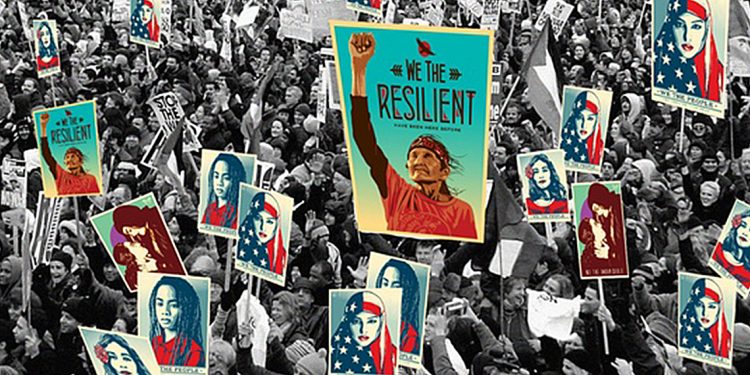
Following Donald Trump’s xenophobic and racist electoral campaign, and in the wake of his election to become 45th President of the United States, in November of 2016, the artist Ernesto Yerena Montajana teamed up with fellow artists Jessica Sabogal and Shepard Fairey, and the non-profit Amplifier Foundation, a self-described ‘art machine for social change’ to produce works for the Foundation’s We the People campaign. The campaign’s objective was to flood Washington D.C. with symbols of hope on January 20th of this year, the date of Trump’s inauguration. And indeed, pictures of the demonstrations that took place that day indicate the efficacy of the campaign. Looking at those pictures we see people marching in their numbers carrying the images created by Fairey, one of an African-American woman, another of a Muslim woman, and one of a Latino woman, each titled, “We the People”. We also see Sabogal’s image being displayed, depicting two women, looking at each other tenderly, one above the other, whose neck she holds, and whose hat reads ‘Women are perfect’. The image itself is titled underneath, “We the Indivisible”.

image1

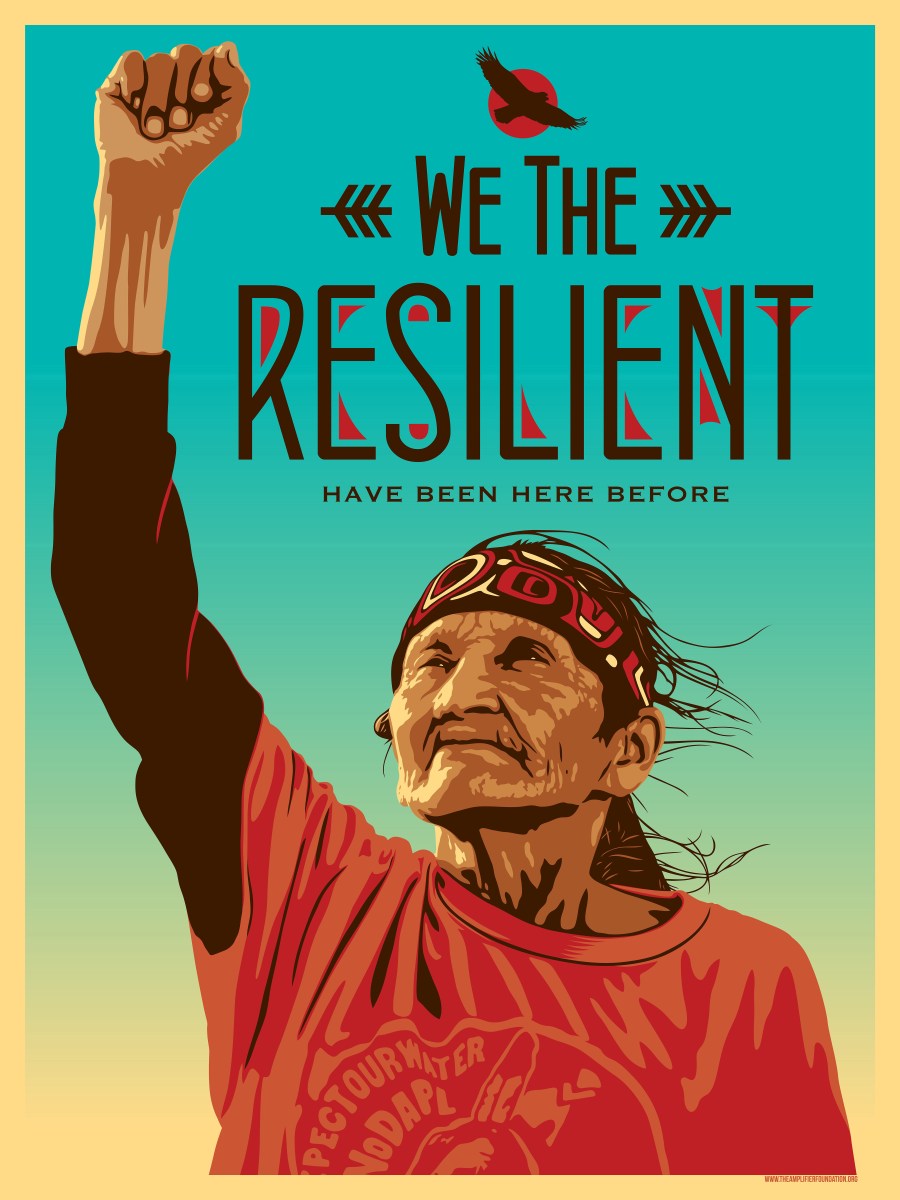
Yerena’s contribution was a stenciled image, featuring Lakota elder Helen “Granny” Redfeather, a protestor fighting against the Dakota Access Pipeline at Standing Rock, where Yerena himself also spent time in the November of Trump’s election. Yerena’s work situates the Lakota elder underneath its title “We the Resilient: Have Been Here Before”.

WE THE RESILIENT FINAL WITH TYPE !!!

Contextualizing his work, Yerena explains

“My relationship with the U.S. is very complicated…I was born here, I live here, but the government is like an occupying force on this land. The colonization process was so violent. It outlawed people from being able to practice Indigenous traditions and languages. How, through all that, have people been able to survive? Considering how hostile the attempted erasure was toward everything to do with our people, Indigenous people, it’s incredible. That’s resilience.”[1]

[1] ‘Meet Ernesto Yerena Montejano: Artist Behind Ubiquitous We Are Resilient Poster’ https://www.colorlines.com/content/meet-ernesto-yerena-montejano-artist-behind-ubiquitous-we-resilient-protest-poster (accessed 2/9/17).

The image Yerena created soon became ubiquitous, a symbol of hope and defiance for peoples protesting the white supremacism of Trump’s election. On January 21 Yerena could be seen distributing his ‘We are Resilient’ posters at the Women’s March in Los Angeles. Yerena himself was born in California, close to the Mexican border.[2] Although identifying as Chicano, he expresses solidarity with the indigenous.[3] His work is dedicated to exposing ‘the weight of colonization and the effects of Westernization of Indigenous cultures’.[4] ‘Trump is the Chernobyl of colonialism’, he explains, ‘but I don’t want to make artwork that’s against him; it gets too dark. I want to make artwork that’s for something. I’m for dignity. I’m for resilience. I’m for Mother Earth. I’m for honoring elders. I’m for working with my friends. I’m for making positive messages’.[5]


Yerena’s positive message can be seen to have already spread. Inspired by the image and Yerena’s message, Sarah Bunin Benor, an Associate Professor of Contemporary Jewish Studies at the Hebrew Union College Institute of Religion in Los Angeles, set to work on a book, now already published, titled We the Resilient: Wisdom for America from Women Born Before Suffrage. The book began life as a website set up in October of last year, designed to give voice to hopeful women voters who had been born in the years preceding the ratification of the 19th amendment in 1920, and who were in the lead up to the election of November 2017, not only able to cast a vote in ways that women not long ago were denied, but vote for what could have been the first female president of the United States, Hillary Clinton.[6] The book, We the Resilient, features interviews with fifty-five of the women who appeared on the website, and who respond to Benor’s questions. Questions that included: when in your life have you experienced personal disappointment, tragedy or unexpected loss? How were you able to overcome those setbacks? Though coming from a variety of different backgrounds, the women tell of similar experiences of disappointment, tragedy, and loss, such as losing parents, spouses, siblings and children, and contemplate how it was they were able to bounce back from those difficult experiences.[7]


Within the health sciences resilience is identified as the ‘trait that enables an individual to recover from stress and to face the next stressor with optimism. Resilient people are considered to have a better mental and physical health’.[8] The analysis of resilience invariably involves examining how people cope with disappointment, tragedy and loss. What divides the resilient self who bounces back from life tragedies from the failed selves who never recover?  Where does resilience come from? What are its sources? Who has it and why? How to build resilience where it is lacking? These are the questions health practitioners of resilience routinely ask. But its growth as a concept within the health sciences can be traced in correspondence to its development in a range of other fields, including the social sciences concerned with the attributes of human groups, as well as the non-human sciences concerned with the study of non-human living systems. Across these different fields resilience is defined as the capacity of any living system, including human systems, both individual and social, to absorb the shocks generated by disastrous events, and respond by either maintaining or changing form, evolving with them, and growing stronger from their occurrence.


The word resilience has existed for centuries. It comes from the Latin word resilire – to rebound or recoil. In the 17th century it described the ability of physical materials to return to their original shape after suffering deformation. Its contemporary use developed significantly in Ecology during the 1970s to describe how living systems recover and evolve following disasters. Gradually it mutated into social science as a way to understand how humans absorb shocks and withstand disasters of multiple kinds. In the era of Sustainable Development it became identified especially with the Global Poor, given their excessive exposure to shocks of a disastrous nature.[9] And more recently it has become a capacity especially attributed to indigenous peoples.[10] This is evidenced not just by Ernesto Yerena’s representation of indigenous resilience in the protest posters, but also by the anthropological literature on indigenous resilience. For indigenous peoples are perceived by western anthropologists to be particularly exemplary subjects of resilience.


Indeed not just anthropologists but policy makers the world over, concerned as they currently are with attempting to formulate policies to help people cope with the coming era of disasters portended by climate change, are attracted to indigenous peoples on account of their perceived abilities to live in a state of permanent crisis. Within the Academy, anthropologists are currently being mobilized to provide ethnographic studies of the practices and forms of knowledge that enable indigenous peoples to do so. For example the Oxford-based anthropologist, Laura Rival, has detailed the ways in which the Makushi, an indigenous people living in the borderlands of northern Brazil and southern Guyana, live with severe drought and flooding as normal conditions of life.[11] This is a people as well adapted to a world of floods as much as it is to extreme drought, Rival argues, and able to cope with whatever the climate throws at them.[12] As such she holds them up as a model for the rest of humanity, faced as it is with a coming era of climate disasters and global ecological catastrophe.


Anthropology has, from its origins, ‘existed in a state of complex symbiotic dependency on government, in so far as anthropologists have been materially and practically dependent on state support to fund research, and the direction anthropological work has taken in any particular period has been influenced by state needs for certain kinds of information with which to govern its Indigenous populace.[13] This is as true today in the context of the mobilization of anthropologists to produce knowledge about indigenous resilience. The arguments and conclusions of academic anthropologists are mirrored in policy reports such as that published by UNESCO, titled Weathering Uncertainty, and which likewise describes how indigenous peoples, on account of their high-exposure sensitivity to extreme weather events, are thought to be especially resilient to climate change.[14] The indigenous are of interest and value to policy-makers because they have a proven track record of what the report describes as ‘resourcefulness and response capacity in the face of global climate change’.[15]


Many are those who interpret this development as a step forwards in the decolonization of relations between indigenous and non-indigenous peoples. For it seems to challenge the west’s teleological sense of its own superiority, debunks it even, and places the indigenous on a pedestal once reserved for the western subject of modernist tradition.[16] What such enthusiasts don’t recognize is the problematic nature of the entanglement of this reversal with white western strategies of power. The ascription of resilience to indigenous people is not something being achieved simply by anthropologists working to the left of western states or other colonial institutions. It is a mantra being repeated by colonial states and deeply powerful western actors worldwide. Such that the representation of the indigenous as possessing exceptional capacities to care for their natural environments, to adapt to climate change, and deal with extreme weather events has become a governing cliché of white western neoliberal governance.


Resilience is advancing throughout the west as a major discourse for the implementation of neoliberal governance. Indigenous peoples are but one target population of strategies for the making of resilient subjects. Nevertheless they are a crucial one, given the arguments beings made for their exemplary status. For this reason anyone concerned with indigenous politics must be circumspect when confronting claims about the inherent resilience of indigenous peoples. For the risks in accepting such clichéd representations of the indigenous are vast, and ultimately complicit with colonial power and neoliberal exploitation. We know much by now about the long history of colonial violence that arose from the western desire to destroy indigenous peoples on account of their perceived inferiority. We recognize much less of the violence which arises from the apparent desire to protect indigenous peoples and the ontological alterity they supposedly embody.[17] Yet that is a form which colonial violence now takes. From South to North, indigenous peoples must resist the violence embedded in neoliberal strategies of resilience, while the anthropologists who study them must beware being drawn into the latest ideologically driven project to govern the lives of indigenous peoples.


What then to make of the artwork of Ernesto Yerena Montajana with which this essay began? And what of the people carrying the ‘We The Resilient’ banners on the protests against Trump? Are they also to be condemned, along with the concept of resilience itself, as part of the problem of colonialism today? Is resilience a univocal concept, or is it open to different usages? I recognize the salience of critiques of the critique of resilience that have appeared recently. I read with interest works arguing we must avoid the cynicism of a blanket dismissal of resilience, distinguish between its positive and negative aspects, and recognize its potential to constitute more open and inclusive democratic political orders.[18] The geographer Ben Anderson has made similar kinds of points when asking ‘what kind of thing is resilience?’ and by imploring that we make the connections between resilience and neoliberalism into a question to be explored rather than a presumption from which analysis begins.[19] These are useful interventions the basis for which echoes throughout this problem of discourses on indigenous resilience. The resilience at stake in strategy documents of international organizations is not the same as that enunciated on the streets of American cities as indigenous people and their allies took to those streets to fight the election of Trump. There are differences between claims concerning resilience. For one, the resilience indigenous peoples lay claim to refers to their having survived a project of colonial extermination, while the resilience which colonial states now identify with indigenous peoples refers to their abilities to survive environmental disasters and pays little heed to their own histories of colonial violence.


Nevertheless, there are relations between these different usages of resilience, and while their points of articulation are indeed different and to some extent opposed, they are nevertheless tied by the concept itself. In each case the indigenous subject which resilience refers to is defined by its capacity to survive. Is there anything problematic in that?


Ernesto Yerena Montajana, like everybody else, has also to survive. An artist has to make a living, and art, for the most part pays badly. In Yerena’s case survival requires once in a while a relative sacrifice of principle. Which is why he sold his work to the manufacturer of the energy drink, Red Bull. Some of their cans are decorated with his signature rose symbolizing dignity and a calavera (Mexican sugar skull).

image3

As he explains, ‘sometimes corporations hire me because they want to tap into the “Latino” market. I take some of the jobs because I need to keep paying rent, but it’s a fine line. What I really want is to make critical, challenging work. A lot of times I have to self-fund or work with a small stipend. Unfortunately, the people with the best ideas don’t have a lot of money’.[20]


Many of us know this conflict between good intention and its sacrifice for survival’s sake. Images, concepts and arguments are all open to appropriation by agencies whose intentions are self-interested, as is the case with the profit-maximizing Red Bull, an Austrian company with the highest market share of any energy drink in the world, selling five billion cans a year; a market share that owes in no small part to the distinctiveness of the blue silver design of the cans in which its drink is sold and on which Yerena’s designs appear.


There is no direct connection between Yerena’s work for Red Bull and the ‘We Are Resilient’ poster that he made for the campaign against Trump. In effect the former served the latter. Selling to Red Bull meant Yerena could pay the rent and paying the rent meant Yerena could design for the Amplifier Foundation and its political campaign against the particular formation of white racist neoliberal capital that Trump’s presidency represents. We have no reason to believe Red Bull saw any capital in hiring an artist with his politics or with his links to indigenous peoples and political struggles. As Yerena states, Red Bull were interested in tapping into the Latino market and it is the resonance of his designs with Chicano culture that attracted them. But there is some faint sense of a connection, in this collaboration between Yerena and Red Bull on the one hand, and the collaborations taking place between resilience and neoliberalism on the other. Red Bull, as the most iconic energy drink of its generation, epitomizes resilience culture. It is what you drink when you are struggling to cope, stay awake, or persevere amid stress, physical or psychic. If you need resilience in a liquid form you drink Red Bull. It is also the drink that besides giving you resilience, gives you stereotypes. On the website, Native Appropriations, a forum for discussing representations of native peoples, including stereotypes and cultural appropriation, a commercial campaign of Red Bull is described as reading like a ‘check list of native stereotypes.’[21] Amid tipis, smoke signals, war whoops, and “tom-tom” drumming, two natives, Brown Bear and White Dove, express in third person broken English their frustrated sexual desire for each other.


‘Greetings White Dove, my heart is heavy’, says Brown Bear. ‘Mine too, Brown Bear’, replies White Dove. ‘The end of the year is near, and we still can’t get together. Brown bear can’t jump that far!’ complains Brown Bear. ‘And White Dove can’t fly! We are only united in mind’ concludes White Dove. ‘Yes, but my body longs for you too’, confirms Brown Bear. White Dove sighs. ‘No Red Bull, no happy ending’, warns the narrator. Yes, Red Bull is not only the drink that gives you resilience. It’s the drink that gets you laid. Or it’s the drink that gives you the necessary resilience to get laid. And, which in sexualizing resilience, also sexualizes indigeneity, making a commercial stereotype out of indigenous perseverance, and stoking colonial myths.


Red Bull is responsible for mythic representations of indigenous peoples, but what about resilience itself? In March this year the Journal of Multidisciplinary Healthcare published an article titled ‘Mental Resilience, Perceived Immune Functioning, and Health’. The article is a classic of its kind, describing resilience as the ‘trait that enables an individual to recover from stress and to face the next stressor with optimism’.[22] People with resilience, it argues, ‘have a better mental and physical health’.[23] People with reduced immune functioning tend to be those who are less resilient, while people with resilience tend to have better functioning immune systems, is the conclusion it draws on the basis of a large empirical study.[24] Like a lot of medical research the article had as many as eight authors, among who is named a Dr. Joris Verster from the University of Utrecht. In the Disclosure section of the article the authors list the sources of financial support that have funded their research. Verster, a proponent of resilience lists among the many different funders he is in the patronage of, Red Bull. Which is interesting. In fact Verster is also the author of a another study, published last year, in the Journal of Human Psychopharmacology, titled ‘Mixing Alcohol With Energy Drink: A Systematic Review and Meta-Analysis’. The article addresses the belief that people who mix energy drinks such as Red Bull with alcohol end up drinking more alcohol than they ordinarily would. Reassuringly, Verster and his colleagues conclude that their research proves that mixing energy drinks with alcohol does not increase the total amount of alcohol consumed.[25]  Which is interesting. What to make of these connections between the science of resilience, so assured in its conclusions concerning the reality of resilience as property of healthy people everywhere, and an energy drink manufacturer which funds the science of resilience, and which employs the same science to defend itself from mythic representations of the properties of the product as a source of alcoholism and ill health? A corporation, and icon of the neoliberal economy, furthermore, which sells its products on the basis of colonial representations of indigenous people, as well as by decorating its cans with the designs of an artist who, unwittingly no doubt, is himself a proponent of indigenous resilience, and the creator of what is the most iconic image of indigenous resilience, the picture of Lakota elder Helen “Granny” Redfeather, carried on banners by the many people who showed up to protest the election of Donald Trump, in Washington DC and other American cities in January of this year.


There is a lot at stake in this nexus of relations between colonialism, capitalism, neoliberalism, the fight against fascism, and the science of resilience, both in the forms it is attributed to indigenous peoples, as well as people everywhere struggling to recover from stress and to face the next stressor with optimism.


Resilience, I agree, is not a univocal concept, and like all concepts in fact, is open to different usages. We should never condemn, or at least be content with condemning concepts. But wherever it is used, and however it is used, resilience is a dangerous concept. Beneath the surface of the seeming positivity with which it has been invoked this year as a defining characteristic of indigenous people everywhere, fighting their dispossession by colonial powers, and struggling to persevere against the racism of colonial states, there lurks a great deal of danger and malign investments. It’s not my place in the world to tell indigenous people who they are or what they are. All I have to say to them is this; be careful. And when you listen to the next anthropologist, the next statesman, the next well-meaning activist, or corporate brand manager, who talks about indigenous resilience, treat the term with the circumspection it deserves.

[2] Ibid (accessed 2/9/17).

[3] http://www.hechoconganas.com/bio/ (accessed 2/9/17).

[4] ‘Meet Ernesto Yerena Montajano’.

[5] Ibid.

[6] ‘Wisdom of the Aged Offers Hope to Clinton Voters’ http://jewishjournal.com/culture/lifestyle/50_plus/219159/echoes-election-2016-women-resilient/ (accessed 2/9/17).

[7] Ibid.

[8] Van Schrojenstein Lantman M, Mackus M, Otten LS, et al. ‘Mental resilience, perceived immune functioning, and health’, Journal of Multidisciplinary Healthcare (10, 2017),107-112.

[9] Julian Reid, ‘The Disastrous and Politically Debased Subject of Resilience’, Development Dialogue 58 (2012), 67-79.

[10] Marjo Lindroth and Heidi Sinevaara-Niskanen, ‘The Biopolitics of Resilient Indigeneity and the Radical Gamble of Resistance’, Resilience (4:2, 2016).

[11] Laura Rival, ‘The Resilience of Indigenous Intelligence’ in K. Hastrup (ed.) The Question of Resilience: Social Responses to Climate Change (Copenhagen: The Royal Danish Academy of Sciences and Letters), 293-313.

[12] Ibid, 302

[13] Melinda Hinkson, ‘Introduction: Anthropology and the Culture Wars’ in Jon Altman and Melinda Hinkson (eds.), Culture Crisis: Anthropology and Politics in Aboriginal Australia (Sydney: University of New South Wales Press, 2010), 5.

[14] Douglas Nakashima et al, Weathering Uncertainty: Traditional Knowledge for Climate Change Assessment and Adaptation (Paris: UNESCO, 2012).

[15] Ibid

[16] Tess Lea, “Contemporary Anthropologies of Indigenous Australia,” Annual Review of Anthropology (41, 2012), 196.

[17] Luc Bessire, Behold the Black Caiman: A Chronicle of Ayoreo Life (Chicago and London: University of Chicago Press, 2014).

[18] Peter Rogers, ‘Researching resilience: An agenda for change’, Resilience: International Policies, Practices and Discourses (3:1, 2015), 66.

[19] Ben Anderson, ‘What Kind of Thing is Resilience?’, Politics (35:1, 2015), 60.

[20] Meet Ernesto Yerena Montajana’.

[21] ‘Red Bull Gives You Stereotypes’, http://nativeappropriations.com/2010/07/red-bull-gives-you-stereotypes.html

[22] Marith Van Schrojenstein Lantman et al, ‘Mental resilience, perceived immune functioning, and health’, Journal of Multidisciplinary Healthcare (10: 2017), 107.

[23] Ibid.

[24] Ibid, 112.

[25] Joris Verster et al, ‘Mixing alcohol with energy drink (AMED) and total alcohol consumption: a systematic review and meta-analysis’, Human Psychopharmacology (31: 1: 2016).

Education for ecological democracy

Michael A. Peters

We have every reason to think that whatever changes may take place in existing democratic machinery, they will be of a sort to make the interest of the public a more supreme guide and criterion of governmental activity, and to enable the public to form and manifest its purposes still more authoritatively. In this sense the cure for the ailments of democracy is more democracy. –John Dewey (1927), The Public and Its Problems.

Environmental ecology, as it exists today, has barely begun to prefigure the generalised ecology that I advocate here, the aim of which will be to radically decentre social struggles and ways of coming into one’s own psyche … Ecology must stop being associated with the image of a small nature-loving minority. Ecology in my sense questions the whole of subjectivity and capitalistic power formations. –Felix Guattari (2000), The Three Ecologies.

Democracy, yet again

Donald Trump’s decision to quit the Paris agreement, a contemptible decision that does the US no good in term of moral leadership and one almost universally condemned by world leaders, raises the question about the structural capacity of democracy at the extra-state level to reach consensus or indeed to action decisions at a global level. Under the circumstances one wonders whether democracy is able to deliver ecological outcomes or whether in the stand-off between democracy and oil and gas capitalism that it has the power to harness and transform the energy sector. The fact is that modern representative democracy was never designed to handle environmental challenges and many scholars now seek the establishment of new global institutions that carries the mantle for intergenerational environmental problems based on evidence-based sustainability science. One set of anxieties revolve around whether democratic institutions based on deliberative forms of government have the power to set new environmental norms, to curb the transnational energy multinationals or to institute change quickly enough in order to avert environmental collapse.

There is some evidence that democratic values increasingly operate now at the global level and multi-stakeholder dialogues between civil society, NGOs, governments and world agencies are now more common, yet some critics doubt whether concepts of world democracy will ever be strong enough to reconcile either radical participatory politics and the world’s energy multinationals, or the climate deniers and the scientific mainstream consensus. Some scientists despair that green diplomacy perhaps best represented in the Paris agreement, where the French hosts acting in concert with many agencies engineered an agreement with 195 countries, can ever protect itself and its environmental policy decisions against the actions of authoritarian thumb-nosing and outright grand-standing on the basis of flimsy ‘America first’ sloganising.

Yet others talk of the longer term transformation of democratic culture aimed at producing green citizens committed to the principles of bioregionalism on the one hand and to principles of discursive democracy on the other, steadfast in their belief that deliberation is the appropriate space in which to change peoples’ habits, beliefs and actions.

Ecological democracy

The term ‘ecological democracy’ (ED) has been established in the literature for a couple of decades (Dryzek, 1992, 1997; Faber, 1998; Morrison, 1995; Ungaro, 2005), if not always in an explicit conceptual formulation. It is slowly evolving as a liberal notion that presupposes a link between democracy and ecology, sometimes cashed out in terms of ‘sustainable development’ or ‘green capitalism’ (‘green consumerism’) while emphasising that ED requires a form of grass-roots participation by citizens both individually and collectively. The exact nature of the link and the success and results of ED have been up for ongoing scrutiny and political scepticism. Both ‘ecology’ and ‘democracy’ are expansive concepts that have been refined and developed over the last couple of decades so it is not surprising that the links between these and cognate concepts are hard to pin down.

There has been a peak in the use of the concept with applications in a variety of settings. For example, an online journal based in India established in 2013 has adopted the name (http://ecologicaldemocracy.net) which it introduces in the following way:

The last century has seen many national movements successfully liberating countries from colonial rule. But since the last quarter of the twentieth century, we have witnessed world-wide schizophrenia in our ‘development’ policies. Global players like the US and European Union and arms of their economic hegemonies such as the World Bank and I.M.F. have forced governments to adopt policies which are resulted in a serious all round crisis, including an ecological crisis. On the other hand there is a multitude of UN Conferences on various dimensions of the ecological crisis. To understand this schizophrenia and to evolve policy frameworks to respond to this crisis from the ecological swaraaj perspective is the need of the hour. Our online journal http://www.ecologicaldemocracy.net is an effort to bring cohesion to the efforts of all who believe in the idea of ecological swaraaj [‘self-governance’ in Hindi].

The term ‘radical’ ecological democracy (RED) stands for degrowth policies, grassroots participation and has been used to demonstrate problems for existing democratic structures (Kothari, 2014; Mitchell, 2006). RED contributes to the search ‘for sustainable and equitable alternatives to the dominant economic development model’ that pursues the ‘goals of direct democracy, local and bioregional economies, cultural diversity, human well-being, and ecological resilience at the core of its vision’ (Kothari, 2014, p. 57). RED also maps on to the concept of ‘radical democracy’ developed by post-Marxist thinkers Ernesto Laclau and Chantal Mouffe starting in the early 1990s (Laclau, 1990; Laclau & Mouffe, 2001). One line of thought, which I support, has begun to map notions of ‘radical’ and ‘open’ on to overlapping concepts of democracy and environment through notions of collective subjectivity (Peters, 2002, 2013).

Hester (2010), in another example, outlines new principles for urban design that he calls Design for Ecological Democracy emphasising how ‘responsible freedom’ rests on respect and acknowledgement of an interconnectivity with all living things. Finally, an example- based on a workshop entitled ‘Ecological Democracy’ that was held at the University of Sydney 20–21 February 2017 that advertises itself in the following terms:

The role of democracy in the face of global environmental threats has been subject to intense scholarly debate over the past four decades. At times, ecological democracy has had a bright future ahead of it. Yet the ideal of ecological democracy continually faces challenges both to its conceptual foundations and to its practical realisation on national and global scales. This workshop will seek to focus on new considerations and directions for ecological democracy, while looking back to examine the impact and viability of its founding texts as well as empirical studies of the relationship between democracy and sustainability.

The wide-ranging workshop included sessions on: Foundations of Ecological Democracy; Rights, Institutions, and Deliberation; Democracy and the Nonhuman; Culture & Ecological Citizenship; Diversity, Culture and Democracy; Ecological Democracy and Indigenous Peoples; Resources, Democracy and the Local. A panel discussion ‘Ecological Democracy – Looking Back, Looking Forward’ chaired by David Schlosberg with Robyn Eckersley, Karin Bäckstrand and John Dryzek as discussants, examine the attempts at reconciliation between democracy and sustainability within environmental political thought including problems of “the representation of the nonhuman, the relationship between democracy and ecological ‘limits,’ and the design of ‘green’ states.” The note continues:

Since this first wave of scholarship [in 1980s and ‘90s] on ecological democracy, there have been numerous crucial developments that pose a range of challenges. On the environmental side, we have seen the acceleration of climate change, arguments for setting planetary boundaries around humanity’s environmental impacts, and widespread acknowledgement that the Earth has entered a new epoch: the Anthropocene. On the political side, we have had the growth of environmental and climate justice movements, the proliferation of institutions for global environmental governance, and the anti-environmental and post-truth era.

In short, the second wave of ED concerns the growth of political movements broadly embracing the concept of environmental justice in an attempt to counteract and address backsliding anti-environmentalism. The third wave of ED takes place in relation to President Trump’s anti-environmentalism, his withdrawal from the Paris agreement, his championing of world oil and gas, and cuts to the jurisdiction and budget of the Environmental Protection Agency. In this political environment, the future of environmental sustainability depends upon more radical forms of ED tied to notions of citizen science and forms of learning as activism.

Origins and possibilities

The concept and practices of ED have developed as part of a broader theoretical re-examination and conceptual development of ‘participatory,’ ‘strong,’ ‘discursive,’ ‘inclusive,’ ‘deliberative’ and ‘radical’ democracy (Barber, 1984; Dryzek, 2010; Ester, 1998; Gutmann & Thompson, 2002; Laclau & Mouffe, 1985; Young, 2000, 2001). These diverse threads spring in part from attempts to revisit democracy after the rise of neoliberalism in the age of globalisation that hastened the decline of social democracy. Social democracy as part of the Keynesian post-war consensus developed an ideology based on the compromise between market and the State that supported the mixed economy and capitalism as the means of wealth generation and distribution that necessitated State intervention based on rights and equality of opportunity to correct the defective tendencies of the market towards increasing poverty and growing inequalities.

In effect, it was largely this attempted compromise that led to the first green social democracies and red–green coalitions in Germany under Gerhard Schroder (1998–2005), the ‘plural Left’ coalition in France (2012–2014), Lipponen’s first and second cabinet in Finland that included socialist and green members (1995–2002), Norway’s red–green coalition (2003–2013), with similar developments in Iceland, Italy, Denmark, Sweden and Portugal. Radical red–green alliances formed in the Netherlands (GreenLeft), Denmark (Unity List), Norway (Green Left Alliance), Italy (Left Ecology Freedom) and Greece (SYRIZA). There are also red/green political alliances and/or electoral agreements between social–democratic or liberal parties with green parties such as the Red–Green Alliance in Canada, Sweden and Italy.

After the demise of the Keynesian-based and the empirically discredited neoliberal variant of capitalism, the goal of transcending global capitalism seems far-fetched and Left parties—Far-Left and centrist socialist—began to question the basis for renewed social democratic appeal. Under the Third Way, social democracy capitulated to neoliberalism and thus compromised the green market solution and no growth policies. Under the rise of authoritarian populism in its first phase with Thatcher–Reagan and then most recently under Trump, working-class voters have been easily captured by anti-immigration far-right parties that promise to bring back industrial jobs at home.

The origins of green parties begin in the 1970s first in Australia and then Germany. By the 1980s and especially after Green Politics: The Global Promise (Spretnak & Capra, 1984), green agendas became more progressively tied to policy issues outside immediate ecological considerations.1 As Mendes (2015) notes the West German Green Party ‘founded in opposition to the guiding principles of the West German post-war consensus’ and their entrance into the Bundestag in 1983 marked a turning point in German parliamentary history but soon also reverted to traditions of political liberalisation with a mixture of classical elements of conservativism over conservation of resources. Jackson (2012, p. 593) suggests the Australian Greens, as a political organisation, are possibly following the transformation of European green parties moving from ‘a movement based party to a pragmatic parliamentary party.’ The question is where do green parties go after the Trump retrenchment of global oil & gas? Is there any legitimate resistance against neoliberalism and authoritarian populism that draws off the working-class vote?

Education for ED

Education has the possibility of bringing together two powerful concepts and international movements of ecology and local democracy that are needed to bring about the transformation of grass-roots civil society. This combination of ‘ecological democracy’ that rests on two fundamental principles—the freedom to participate in local society and our growing awareness of the interconnectedness of all living things. It also draws and encourages the development of new forms of green identity and citizenship.

Peters and González-Gaudiano (2008) observed the evolution of environmental education over three decades towards a new relation to identity struggle, new social movements and green citizenship.

During its thirty years of existence, despite having faced problems and diverse challenges from country to country, environmental education (EE) has acquired a certain influence over the design of educational and environmental public policies on an international level. Throughout these three decades, environmental education has contributed to the configuration of new ontological and epistemological proposals, as well as introducing practices that have become well-established and have made significant contributions to the strengthening of not only the environmental education field but educational processes in general. However, as EE became established a great variety of viewpoints were taken into account and elements incorporated not only from the widest variety of theoretical approaches and philosophical currents, but also from very different schools of thought and action, which established important articulations with complex social movements such as feminism, multiculturalism, peace, democracy, health, consumerism and human rights to mention but a few.

One definition of ED emphasises sustainability in action by emphasising a relationship between biological processes and political subjectivities of participatory democracy considered as a co-evolutionary strategy. Education for Ecological Democracy is based an alternative democratic model that strives to educate students about the norms and values of democracy-in-action and eventually incorporate them as interested citizens into environmental decision-making and collective action. ‘Ecological democracy’ is still a concept in the formative stage. In its radical form ‘it places the goals of direct democracy, local and bioregional economies, cultural diversity, human well-being, and ecological resilience at the core of its vision’ (Kothari, 2014). In educational theory and practice it is closely associated with the notion of deliberation that is considered central to consensus decision-making and majority rule. The principles of deliberative democracy are embraced for their educative power and pedagogical force in teaching secondary school students to reason in democratic for a about ecological issues. The deliberative nature of ED has a strong base in grassroots participation within civil society. In philosophical terms, it is indebted to Dewey’s (1916) Education and Democracy and more recently to Habermas (1984) theory of communicative rationality that proposes the ideal of a self-organising community of free and equal citizens, coordinating their collective affairs through their common reason. Free and open debate is a necessary condition for the legitimacy of democratic political decisions based on the exercise of ‘public reason’ rather than simply the aggregation of citizen preferences as with representative or direct democracy.

From its development in the 1980s and 1990s Green Political Theory or ecopolitics founded on the work of John Dryzek (1987), Robyn Eckersley (1992), Val Plumwood (1993) and Andrew Dobson (1980), participatory democracy has been viewed as a central pillar and key value, often associated with descriptions of decentralisation, grass-roots political decision-making and citizen participation, ‘strong democracy’ (Barber, 1984) and increasingly with conceptions of deliberative democracy. The value of participatory or grassroots democracy also seemed to gel with a new ecological awareness, non-violence and the concern for social justice. Green politics favoured participatory and more recently deliberative democracy because it provided a model for open debate, direct citizen involvement and emphasised grass-roots action over electoral politics.

Local government is often more democratic than any other level of government. At the same time it provides education for the practice of political education instructing children and others people in the art if decision-making that is sensitive to opinions based on local knowledge and on the representation of diverse political groupings and sub-state actors. It is especially appropriate in mobilising community to gain local support for ecological projects ensuring that power is widely dispersed while also encouraging people to rebuild democracy at the local level moving towards forms of self-organisation that can collect, analyse and monitor ecological data on the local environment while hooking up to larger global concerns.

In an era of authoritarian populism based on the echo-chamber of Twitter politics the only sure answer to Trump’s arrogance and world selfishness is to organise, to educate and to motivate the younger generation to take matters into their own hands, combining forms of learning with activism.

Note

  1. The Origins of Green Parties In Global Perspective, at http://www.ghi-dc.org/fileadmin/user_upload/GHI_ Washington/Publications/Bulletin35/35.179.pdf.

References

Barber, B. (1984). Strong democracy: Participatory politics for a new age. University of California Press, 1984.

Dewey, J. (1916). Democracy and education: An introduction to the philosophy of education. New York, NY: Macmillan.

Dewey, J. (1927). The public and its problems: An essay in political inquiry. Penn State Press, 2012.

Dobson, A. (1980). Green politicial thought (4th ed. 2007). London & New York: Routledge.

Dryzek, J. S. (1987). Rational ecology: environment and political economy. Oxford: Blackwell.

Dryzek, J. S. (1992). Ecology and discursive democracy: Beyond liberal capitalism and the administrative state. Capitalism, Nature, Socialism, 3, 18–42.

Dryzek, J. S. (1997). The politics of the earth. Oxford: Oxford University Press.

Dryzek, J. (2010). Foundations and frontiers of deliberative governance. Oxford: Oxford University Press.

Eckersley, R. (1992). Environmentalism and political theory: Toward an ecocentric approach. State University of New York Press.

Ester, J. (Ed.). (1998). Deliberative democracy. Cambridge: Cambridge University Press.

Faber, D. (1998). The struggle for ecological democracy: Environmental justice movements in the United States. New York, NY: Guilford.

Guattari, F. (2000). The three ecologies. Translated by Ian Pindar & Paul Sutton. London: The Athlone Press. Retrieved from https://monoskop.org/images/4/44/Guattari_Felix_The_Three_Ecologies.pdf

Gutmann, A., & Thompson, D. (2002). Why deliberative democracy? Princeton, NJ: Princeton University Press.

Habermas, J. (1984). The theory of communicative action, vol. 1: Reason and the rationalization of society. Boston, MA: Beacon Press.

Hester, R. (2010). Design for ecological democracy. Retrieved from http://www.radicaldemocracy.org/

Jackson, S. (2012). Thinking activists: Australian greens party activists and their responses to leadership. Australian Journal of Political Science, 47, 593–607.

Kothari, A. (2014). Radical ecological democracy: A path forward for India and beyond. Development, 57, 36–45. doi:10.1057/ dev.2014.43

Laclau, E. (1990). New reflections on the revolution of our times. London: Verso.

Laclau, E., & Mouffe, C. (1985). Hegemony and socialist strategy: Towards a radical democratic politics. London: Verso.

Laclau, E., & Mouffe, C. (2001). Hegemony and socialist strategy: Towards a radical democratic politics (2nd ed.). London: Verso.

Mendes, S. (2015, Winter). “Enemies At The Gate” The West German – Between old ideals and new challenges. German Politics and Society, 33, 66–79.

Mitchell, R. (2006). Building an empirical case for ecological democracy. Nature and Culture, 1, 149–156.

Morrison, R. (1995). Ecological democracy. Boston, MA: South End Press.

Peters, M. A. (2002). Anti-globalization and Guattari’s The Three Ecologies. In M. A. Peters, M. Olssen, & C. Lankshear (Eds.), Futures of critical theory: Dreams of difference, 275–288. Lanham, CO: Rowman & Littlefield.

Peters, M. A. (2013). Institutions, semiotics and the politics of subjectivity. In B. Dillet, R. Porter, & I. Mackenzie (Eds.), The Edinburgh companion to poststructuralism (pp. 368–383). Edinburgh: University of Edinburgh Press.

Peters, M. A., & González-Gaudiano, E. (2008). Introduction. In E. González-Gaudiano & M. A. Peters (Eds.), Environmental education: Identity, politics and citizenship. Rotterdam: Sense Publications.

Plumwood, V. (1993). Feminism and the mastery of nature. London: Routledge.

Spretnak, C., & Capra, F. (1984). Green politics: The global promise. E.P. Dutton. New York, NY: Paladin, 1990.

Ungaro, D. (2005). Ecological democracy: The environment and the crisis of the liberal institutions. International Review of Sociology, 15, 293–303.

Young, I. M. (2000). Inclusion and democracy. Oxford: Oxford University Press.

Young, I. M. (2001). Activist challenges to deliberative democracy. Political Theory, 29, 670–690.

Michael A. Peters, University of Waikato michael.peters@waikato.ac.nz

Originally published at: http://www.tandfonline.com/doi/full/10.1080/00131857.2017.1339408