Achieving a climate justice pathway to 1.5 °C

Mary Robinson & Tara Shine 

Nature Climate Change volume 8, pages 564 –569 (2018) Cite this article

Abstract

It is vital for climate justice to pursue a pathway to zero carbon emissions by 2050 to limit global temperature rise to 1.5 °C above pre-industrial levels and to minimize the adverse impacts of climate change on people and their human rights. But can such a pathway be achieved without undermining human rights and restricting the right to development? This Perspective discusses the risks of action and inaction to identify a fair and just transition. It compares the risks posed to human rights from climate impacts with the risks posed by climate action and suggests that rights-informed climate action can maximize benefits for people and the planet.

Main

Climate justice is a concept that views climate change and efforts to combat it as having ethical implications and considers how these relate to wider justice concerns1. Climate justice links human rights and development to achieve a human-centred approach, safeguarding the rights of the most vulnerable people and sharing the burdens and benefits of climate change and its impacts equitably and fairly2. It is informed by science and responds to science. As a result, climate justice strives to achieve the 1.5 °C temperature goal and avoid dangerous climate change. This approach is underpinned by a desire to respect and protect the human rights of all people, particularly those living in vulnerable situations, in the face of climate impacts and through climate actions.

Climate change is well established as an issue of ethics and justice3,4,5,6,7,8,9,10,11; in terms of climate impacts (including asymmetrical impacts12 and skewed vulnerabilities13), the international climate negotiations14, responsibility for climate responses15 and the role of climate policies in protecting and strengthening basic capabilities such as human rights16. So far considerations of ethics and justice have primarily focused on responsibility, distributive justice, burden sharing and equity, including intergenerational equity17. As the global temperature rises ethicists ask: if the international community accepts that climate change is happening, understands its causes and knows what needs to be done to change course — how can it justify its continued delays to act on the scale, and with the urgency, required14? Answering this question leads to many more ethical questions about the fact that the benefits of industrialization have been enjoyed primarily in developed countries, while the costs in terms of climate change are borne by the entire global community and future generations18. Linked to this is the question of the right to development. If developed countries became rich by burning fossil fuels that have consumed the majority of the Earth’s carbon budget, how can people in developing countries reap the same benefits of development without burning the fossil fuels that would surpass the remaining carbon budget and lead to global warming well in excess of 1.5 or 2 °C: an outcome that would be disastrous for people in all countries19,20. This challenge, to lift people out of poverty and achieve national development goals, without fossil fuels, is the very real and very daunting task facing developing countries today21. It is also at the centre of discussions on just pathways to 1.5 °C.

Until the Paris Agreement was adopted in 2015, unpacking of these ethical questions focused on what equity and justice meant in terms of the design of a new climate regime. Now, with the Paris Agreement and the 2030 Agenda in place, the focus moves to how justice and equity can inform implementation. The preamble to the Paris Agreement includes a commitment to respect human rights and gender equality in all climate action. This is a less explored and less well understood area of climate justice: how human rights can inform climate action — particularly the aggressive climate action needed to pursue a 1.5 °C pathway.

This Perspective investigates whether it is possible to make the rapid transition to low-carbon, climate-resilient development without undermining human rights, including the right to development. First the impacts of climate change on human rights are assessed, followed by an appraisal of the risks to human rights from climate action and international regulations on GHG emissions. Both sets of risks are then compared, and the implications for climate action consistent with a 1.5 °C pathway are discussed to identify the critical factors for a fair and just transition.

Climate risks to human rights

Human rights are the equal and inalienable rights of all members of the human family22 and human-induced climate change is putting these rights at risk. For example, the right to health is undermined by the impacts of climate change. The World Health Organization predicts that between 2030 and 2050, climate change will cause approximately 250,000 additional deaths per year, from malnutrition, malaria, diarrhoea and heat stress. The direct damage costs to health from climate change (that is, excluding costs in health-determining sectors such as agriculture and water and sanitation), is estimated to be between US$2–4 billion per year by 203023. Action on climate change is critical for the realization of the right to health24.

Table 1 demonstrates that climate change poses an immediate threat to people around the world and undermines the full range of human rights25. The Special Procedures of the UN Human Rights Council have concluded that the risks posed by climate change to human rights are considerable at 1 °C to 2 °C above pre-industrial levels. At 2 °C of warming, unique and threatened ecosystems such as the Arctic sea ice and coral reefs would be at risk, with impacts on the right to food and the right to an adequate standard of living. Consider, for example, the people directly reliant on coral reefs for their livelihood and diet; 2 °C or more of warming will be detrimental to coral reef ecosystems and as a result will undermine the right to an adequate standard of living for at least 30 million people and undermine the rights of up to 500 million people26. Extreme weather events pose a high risk for human health, urban infrastructure and resource-dependant livelihoods such as farming and fishing. At 2 °C of warming, sea-level rise could exceed 1 m and crop production would be at risk, with impacts on global food security and the right to food.

Table 1 Climate change impacts and affected human rights

Climate change ImpactsImpacts on human/social SystemsHuman rights affected
Temperature risksIncreased health risks/fatalities from diseases and natural disastersLife
Risk of extreme weather eventsIncreased water insecurityPoverty, adequate standard of living and means of subsistence
Threats to unique ecosystemsLoss of livelihoodsFood and hunger
Changes in precipitation and distribution of waterChanges in agricultural productivity and food productionHealth
Threats to biodiversityThreats to security/societal cohesionCulture
Sea-level rises, flooding and storm surgesEffects on human settlementsProperty
Large-scale ‘singularities’Land and property leading to migration and displacementAdequate and secure housing
 Impacts on political/public servicesEducation
Damage to vital infrastructure and public utilitiesWork
Loss of cultural integrityProperty
Decline in natural systems servicesWomen’s, children’s and indigenous people’s rights
Distribution of impacts (vulnerable, poor and marginalized people are hit first and hardest)Self-determination

Beyond 2 °C the climate moves into unchartered territory. The risk of triggering positive feedbacks such as the release of carbon from soil increases, as does the likelihood of passing climate tipping points, where greenhouse gas emissions change the climate so much that it is impossible (or extremely difficult and costly) to return it to its original state. The risks and uncertainty associated with such tipping points make it correspondingly more difficult for states to fulfil their obligations under international law to respect, protect and promote human rights.

A study by the UN Environment Programme (UNEP) published in 201527 reviewed the projected climate impacts associated with a global mean temperature increase of between 1.1 and 3.1 °C (under IPCC Representation Concentration Pathways (RCPs) 4.5 and 6.0) and noted the affected rights in each case. Neither this report nor the work of the Office of the High Commissioner for Human Rights (OHCHR) Special Procedures could assess the difference between 1.5 °C and 2 °C of warming with respect to outcomes for human rights. Nevertheless, both conclude that human rights are already being undermined by climate impacts and that the risk rises incrementally as temperatures increase.

The risks from climate action

The imperative for climate action at scale has increased with the commitment to keep global temperature increase well below 2 °C and to pursue 1.5 °C. The result is a drive for more climate action, at scale and in a more immediate timeframe. Despite the implications of climate impacts for human rights being well established (as discussed above), the potential risks to human rights from climate action have been less well documented.

Climate actions that do not respect human rights can have direct and indirect negative impacts on people and their rights (Table 2)28. In 2009 initial concerns were raised about the impacts of mitigation policies on human rights29. This included impacts on the right to food due to changes in land use or increasing food prices due to competition between crops for food and for biofuels. Since then further examples have come to light demonstrating that climate adaptation and mitigation projects that are designed without the participation of local people can lead to conflict or to the project being rejected by the community30,31. Climate action including reforestation and afforestation, hydroelectric dams, wind or solar energy installations and biofuel plantations pose risks to human rights. The rights affected include the right to housing and to a livelihood, the right to water and to food, and the right to take part in cultural life27.

Table 2 Potential direct and indirect risks to human rights from climate action

Direct impactsIndirect impacts
Inadequate consultation with citizens and communitiesIncreasing food prices and energy costs
Displacement (sometimes violently) of people and communitiesLoss of livelihoods for communities employed in fossil fuel sectors
Exclusion from, or diversion of, essential resourcesDiminished developmental progress reducing the overall ability of countries to provide conditions for the realization of rights

There are already examples from the UN Framework Convention on Climate Change’s Clean Development Mechanism and Reduced Emissions from Deforestation and Forest Degradation (REDD+) where climate action has resulted in human rights violations27,32. For instance, the construction of the Barro Blanco Dam — a Clean Development Mechanism project in Panama33. According to civil society organizations, the indigenous community has not been adequately consulted and their right to free, prior and informed consent has not been respected. The issues have been brought before the Inter American Human Rights Commission and in 2016 the Government of Panama withdrew its registration of the project under the Clean Development Mechanism34, demonstrating that formal compliance with CDM rules is not enough to avoid human rights infringements33.

There are also cases of renewable energy projects having negative impacts on human rights35. For example, the Baharini Electra Wind Farm in Kenya, operated by Electrawind and Kenwind and financed by the International Finance Corporation (IFC). Over 8,000 local Mpeketoni residents were allegedly not informed of the project’s intention to acquire their land, and were not offered any compensation or alternative settlement. The local residents filed a lawsuit at the Lamu County Assembly to stop compulsory acquisition of their land. The project was then approved with a number of conditions, such as the requirement to give priority to local people for employment, and provide land and monetary compensation to 259 families. Community consultation and hearing the concerns of the people who will be impacted by the project kept the project from suffering devastating economic and social losses.

There are also human rights aspects to adaptation to climate change36. Large-scale adaptation projects related to infrastructure such as dykes, coastal management systems and rerouting transport systems can pose risks to human rights. Take, for example, a planned relocation from a coastal village or small island that is no longer habitable. Without adequate consultation with the local community, consideration of socio-economic and cultural issues, as well as the choice of a suitable new site with adequate resources to re-establish the community, there is a risk of increasing, rather than decreasing, people’s vulnerability37, a concept known as maladaptation38. As many adaptation actions take place at the local level, the need to ensure adequate involvement of communities in decision-making has so far received more attention than in mitigation, and is often expressed as rights-based or community-based adaptation39,40,41,42.

The Paris Agreement (building on a decision adopted at the Sixteenth Conference of the Parties to the UNFCCC (COP 16) in Cancun and a series of Human Rights Council Resolutions spanning almost a decade) establishes the links between human rights and climate change in international law. This is an important signal to climate policymakers to integrate human rights into climate policies, plans and actions, but it does not assure legal certainty43,44. The question is whether these signals will be adequate to ensure a human rights informed transition.

Risks from impacts versus action

When determining whether or not climate action on the scale needed to phase out carbon emissions by 2050 is consistent with climate justice, it is important to compare the risks posed to human rights from climate impacts to the risks posed to human rights by climate action.

Warming of 2 °C or more leads to large, biophysical, unpredictable — and in many cases irreversible — risks that humanity is ill equipped to deal with, negatively undermining the rights of millions of people around the world. Limiting warming to 1.5 °C above pre-industrial levels would mean that climate-related extremes that are rare now would be part of the new climate normal, but the climate would remain within the upper end of present-day climate variability and would avoid entering a new climatic regime45. In turn, it is assumed that the climate-related risks to human rights would also be reduced and the extreme injustice of loss of livelihood, displacement or loss of life would be less than they would otherwise have been.

However, the climate actions required to achieve the 1.5 °C goal will be at an unprecedented scale and evidence shows that responses to climate change are already posing risks to human rights. This is particularly the case when climate actions do not take the rights of people living in the vicinity of renewable energy infrastructure or adaptation infrastructure into account.

Of particular note is the likelihood that a 1.5 °C pathway will require the deployment of new technologies, especially those needed to achieve negative emissions. This includes bioenergy with carbon capture and storage and carbon capture and storage from fossil fuel installations and solar radiation management46. There are concerns about the wide-scale deployment of these technologies and their ethical implications, including the realization of human rights47,48,49. There are questions about the biophysical and socially acceptable limits on the scale of land required for bioenergy, for example, and the potential negative impact on food security, soil nutrients and water availability50. Although the risks associated with warming above 1.5 °C are biophysical and unpredictable, the risks posed by climate action at scale can be managed by human institutions and are driven by processes that have a better chance of being predicted and controlled. Human society has centuries of experience in developing policies and plans, building infrastructure and investing in development. There is evidence of what works and what does not, and there is at least an imperfect knowledge of what needs to be done to protect human rights when taking action as an individual, a company or a country. Sectors ranging from mining and forestry to agriculture and energy have experience of how to avoid human rights infringements and deliver benefits from rights-based approaches51. Many of these are the same sectors that will be central to climate action — so in many ways it is a question of acting on the learning and good practice generated so far.

Human rights are legal guarantees that protect individuals and groups against actions that interfere with their fundamental freedoms and entitlements. Human rights obligations, standards and principles can shape policies for climate change mitigation and adaptation and ensure accountability for climate commitments24. Although the Paris Agreement does not create any new human rights obligations on member states, it does remind states that their existing human rights commitments apply to all aspects of climate decision-making and action.

There are guidelines to help policymakers and businesses to respect human rights; including the UN Guiding Principles on Business and Human Rights52, the OECD Guidelines for Multinational Enterprises relating to responsible business conduct in a global context53 and the African Commission on Human and Peoples’ Rights Guidelines and Principles on Economic, Social and Cultural Rights in the African Charter on Human and Peoples’ Rights54. Few of these guidelines address climate change specifically, but the norms and procedures they advocate are equally applicable to climate action. In addition, tools such as environment and social governance reporting can be used by companies to ensure their actions are good for both people and the environment55.

Procedural rights, such as the right to information and the right to participation, are increasingly being highlighted in the context of climate action56,57. Most states have several procedural obligations that apply to climate change decision-making, including duties to assess environmental impacts and make environmental information public; to facilitate public participation in environmental decision-making; and to provide access to remedies for harm57. Although ensuring rights of access to information and participation in climate decision-making are not a panacea (particularly if the quality of participation is poor58,59), meaningful participation that is informed by access to information can increase public support, promote sustainable development and improve the protection of rights60.

The significance of these procedural rights in ensuring that climate action does not lead to human rights violations cannot be overestimated61. Procedural rights have been interpreted as critical to the exercise of substantive human rights, such as the rights to life and health62. By respecting and fulfilling procedural rights in climate action, the risk of undermining a wider range of rights can be averted, and the contribution of climate action to sustainable development enhanced63.

The climate actions required to keep warming to 1.5 °C above pre-industrial levels will need to be informed by human rights to mitigate the risk of any negative impacts on people. While society has relevant experience, lessons have been learned and guidance is available to help states and businesses to protect human rights; the challenge lies in respecting the provisions of existing human rights treaties in the execution of climate policy and action64.

Climate just pathways to 1.5 °C

Climate justice recognizes that that the only way to limit warming to 1.5 °C above pre-industrial levels is for all countries to take appropriate climate action, in line with the universal nature (that is, it applies to all countries regardless of their level of development) of the Paris Agreement. Even with aggressive mitigation action in developed countries, mitigation in developing countries can be no less aggressive. Developed countries must accelerate their decline in emissions, and with equal effort must support climate action in developing countries21. Although the previous two sections highlighted the risks to human rights from climate responses involving infrastructure and technology, this section also considers how international regulations on carbon emissions could restrict the right to development in developing and emerging economies. This is illustrated in Fig. 1, which shows that developing countries face the greater challenge in the rapid transition to 1.5 °C as they have to develop and lift their people out of poverty while reducing emissions at the same time21. This means that the citizens of developing countries are doubly at risk — due to their vulnerability to the negative effects of climate change as well as the fact that their opportunity to reduce this vulnerability, increase adaptive capacity and achieve sustainable development could be limited by international climate regulations on GHG emissions65.
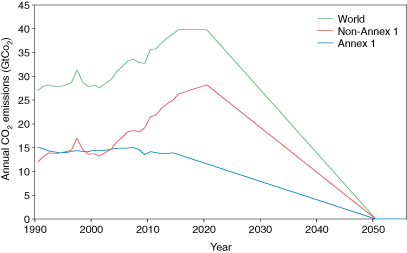
figure 1
Fig. 1: Carbon phase-out by 2050.

Figure 2 shows a set of developing countries, and their projected annual per capita incomes during the 2015 to 2025 time period21. There is a substantial range of incomes across countries, but most developing countries will be considerably less wealthy when their emissions need to peak than most developed countries were in 2010. For example, China is projected to have an income one-sixth to one-half of the income levels of the United States in 2010 at the time it needs to peak its emissions. Indonesia and India are projected to have per capita incomes corresponding to the income level of the United States in the 1890s at the time their emissions peak21. At that time, industrialization in the United States was based on the consumption of fossil fuels and its emissions were increasing incrementally. At this same level of development, countries such as Indonesia and India will need to be eliminating GHG emissions — and adopting green growth strategies — at an annual percentage rate similar to the rate at which the United States had been increasing its carbon emissions21.
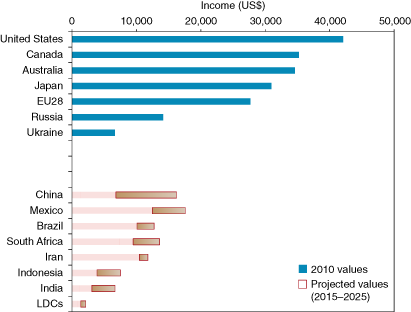
figure 2
Fig. 2: Annual per capita income of several developed and developing countries when emissions peak.

This transition away from fossil fuels will need to take place while most of the developing world’s citizens are preoccupied with maintaining or improving their livelihoods and raising their material living standards. Yet the only proven routes to development involve expanding access to energy services, which up until now has depended on the consumption of fossil fuels66. As a result, the challenge is to meet the demands to develop and to decarbonize simultaneously and to forge an alternative route to the rapid expansion of sustainable energy services for all67.

Although there is now plenty of evidence that it is possible to achieve growth without emissions68, the challenge facing developing countries, and in particular least developed countries, is unprecedented. No industrialized country has achieved its wealth without fossil fuels. The scale of this challenge has to be acknowledged and support provided for a just transition. If not, climate injustice will extend well beyond the adverse impacts of climate change to include restrictions on the right to development of people in developing countries.

Countries such as Ethiopia and Mongolia are adopting a green economy approach to their development that decouples economic growth from GHG emissions69,70. UN Environment (formerly UNEP) defines a green economy as one that results in improved human well-being and social equity, while significantly reducing environmental risks and ecological scarcities71. Countries pursuing a green economy are putting in place policies and plans that can contribute to 1.5 °C pathways while achieving the Sustainable Development Goals (SDGs) and enabling social development. In less developed economies the success of these strategies in practice depends to a great extent on access to investment, including climate finance72.

A just transition to zero carbon by 2050 is possible, but only with the necessary scale of international cooperation, comprising both financial and technological support. The commitment made by developed countries in Copenhagen at COP15 and reiterated at COP 21 in Paris, to mobilize US$100 billion per year of public and private finance by 2020 for climate action in developing countries, lies at the lower end of the estimates of the finance needed to enable developing countries to adopt 1.5 °C-compatible development pathways73,74.

Developing countries, including those most vulnerable to climate change, have shown that they are ready to lead on climate action75,76. However, to put the pledges they have made through their Nationally Determined Contributions into action they will require financial and technical support from the international community (these commitments consist of unconditional and conditional elements. The conditional elements require support from the international community). This should not be seen as charity; it is an investment in our common future; because if the countries of the world don’t make the transition to zero carbon together: (1) the 1.5 and 2 °C goals will be surpassed and everyone will suffer the consequences, but the most vulnerable people in society will suffer most; and (2) there is a risk of exacerbating inequality by creating a world where those who can afford green energy and clean air leave behind a poorer majority who have no option but to use fossil fuels and live with the pollution they produce.

Developing countries need to be supported to realize the right to development in the context of climate action. This is often expressed as the right to sustainable development; that is the right to develop in the context of global policies to reduce GHG emissions and achieve sustainable development. The right to sustainable development is captured in the UNFCCC (Article 3.4) and is reflected in the Paris Agreement, which emphasizes the intrinsic relationship that climate change actions have with equitable access to sustainable development. An equitable transition to a zero-carbon society depends on all countries being enabled and empowered to play their part in global climate action and in achieving the SDGs. In fact, ending poverty, achieving sustainable development and stabilizing climate change are mutually reinforcing objectives77.

Conclusions

In all countries, at all stages of development, the key to making these pathways to 1.5 °C just extends beyond equity and access to finance to include attention to human rights. As climate action increases in scale and in urgency, it will be critical to ensure respect for human rights in the design and implementation of these actions. If not, there is a risk of undermining individual rights in pursuit of climate action to protect the climate system as a global good. Respecting human rights in climate action will also strengthen the 1.5 °C pathways as promoting procedural rights such as the rights to information and participation help to engage more people in climate action78,79, whereas attention to substantive rights can help to identify actions with co-benefits in terms of development, the SDGs, resilience and mitigation. For example, mainstreaming gender equality into climate action leads to benefits in terms of sustainable development, women’s empowerment, increased resilience and low carbon-development80. A just climate pathway to 1.5 °C has people at the centre — it never loses sight of people, and their rights — while pursuing ambitious and climate resilient actions towards the goal of sustainable development.

The transition to zero carbon by 2050, with global emissions peaking in 2020, is by far the best way to achieve the 1.5 °C temperature goal that is a prerequisite for climate justice. Without it, the impacts of climate change associated with 2 °C or more of warming would undermine the full range of human rights, in many cases irreversibly (for example, the right to food, right to water, right to self-determination for Small Island Developing States). For this transition to be just, all aspects of climate action have to be informed by human rights. Much of what is required to respect human rights in climate action is already established as good practice, if not universally implemented — access to information, the right to participation, gender equality, respect for indigenous peoples’ rights — and will have to become the norm in planning and implementing climate action.

As a result, we find that the risks to human rights of climate inaction and of climate impacts far outweigh the risks to human rights posed by climate action consistent with meeting the 1.5 °C goal set in the Paris Agreement. This is a new challenge for humankind, requiring that the reserves of empathy and humanity are found to meet it.

All states need to be enabled to take part in the transition to zero carbon so that they can reap the benefits of clean air, green jobs and food security — all of which are critical to achieving the SDGs. All countries and all people need to be enabled through access to financial investment and technology to be part of this global effort, by respecting their rights and investing in their agency to drive change. Climate justice puts these human factors at the centre of decision-making on climate change, to inform policies that are good for people and good for the planet.

References
  1. Achieving Justice and Human Rights in an Era of Climate Disruption (Climate Change Justice and Human Rights Task Force, International Bar Association, 2014). Identifies problems and gaps in existing legal, human rights, trade and other institutional arrangements for advancing climate justice and makes recommendations to achieve climate justice.
  2. Principles of Climate Justice (Mary Robinson Foundation – Climate Justice, 2018); http://www.mrfcj.org/principles-of-climate-justice
  3. Understanding Human Rights and Climate Change (Office of the High Commissioner for Human Rights, 2015); https://www.ohchr.org/Documents/Issues/ClimateChange/COP21.pdf
  4. Shue, H. Climate Justice: Vulnerability and Protection. (Oxford Univ. Press, Oxford, 2014). The ethical case for climate action, grounded in science and covering theory and practice.
  5. Caney, S. in Human Rights and Climate Change (ed. Humfreys, S.) 69–90 (Cambridge Univ. Press, Cambridge, 2010).
  6. Gardiner, A. M. et al. Climate Ethics: Essential Readings (Oxford Univ. Press, Oxford, 2010).Google Scholar 
  7. McKinnon, C. Climate justice in a carbon budget. Climatic Change 133, 375–384 (2015).Article CAS Google Scholar 
  8. Heyward, C. & Roser, D. in Climate Justice in a Non-Ideal World (eds Heyward, C. & Rosner, D) (Oxford Univ. Press, Oxford, 2016).
  9. Gardiner, S. M. in The Oxford Handbook of Climate Change and Society (eds Dryzek, J. S., Norgaard, R. B. & Schlosberg, D.) Ch. 1 (Oxford Univ. Press, Oxford, 2011).
  10. Okereke, C. & Coventry, P. Climate justice and the international regime: before, during and after Paris. WIREs Clim. Change 7, 834–851 (2016). Explores the links between climate change and justice, establishes why climate change is an issue of justice, and discusses climate justice narratives.Article Google Scholar 
  11. Moss, J. (ed.) Climate Change and Climate Justice (Cambridge Univ. Press, Cambridge, 2015).Google Scholar 
  12. Byravan, S. & Chella Rajan, S. The ethical implications of sea level rise due to climate change. Ethics Int. Aff. 24, 239–60 (2010).Article Google Scholar 
  13. Gardiner, S. M. & Hartzell-Nichols, L. Ethics and global climate change. Nat. Educ. Knowl. 3, 5 (2012).Google Scholar 
  14. Cameron, E., Shine, T. & Bevins, W. Climate Justice: Equity and Justice Informing a New Climate Agreement (WRI & Mary Robinson Foundation – Climate Justice, 2013). Explores the links between climate change and justice, establishes why climate change is an issue of justice and discusses climate justice narratives.
  15. Caney, S. Cosmopolitan justice, responsibility and global climate change. Leiden J. Int. Law 18, 747–775 (2005).Article Google Scholar 
  16. Sen, A. Development as Freedom (Oxford Univ. Press, Oxford, 1999).
  17. Baxi, U. Towards a climate change justice theory? J. Hum. Rights Environ. 7, 7–31 (2016).Article Google Scholar 
  18. Shue, H. Technical Briefing for Ad Hoc Working Group on Long-term Cooperative Action under the Convention [AWG-LCA], Subsidiary Body on Scientific and Technical Advice (SBSTA) (UNFCC, 2009); https://go.nature.com/2HlKfNq
  19. Shue, H. in Climate Justice: Vulnerability and Protection 27–46 (Oxford Univ. Press, Oxford, 2014).
  20. Mollendorf, D. The Moral Challenge of Dangerous Climate Change: Values, Poverty and Policy (Cambridge Univ. Press, New York, 2013).
  21. Zero Carbon Zero Poverty the Climate Justice Way (Mary Robinson Foundation: Climate Justice, 2014); https://go.nature.com/2JfWZqBMakes the case for people-centred rights informed climate action on a pathway to zero carbon emissions.
  22. Universal Declaration of Human Rights (United Nations, 1948).
  23. Climate Change and Health Fact Sheet July 2017 (World Health Organization, 2017); http://www.who.int/mediacentre/factsheets/fs266/en
  24. Analytical Study on the Relationship Between Climate Change and the Human Right of Everyone to the Enjoyment of the Highest Attainable Standard of Physical and Mental Health A/HRC/32/23 (UN Human Rights Council, Office of the High Commissioner for Human Rights, 2016); https://go.nature.com/2JwO2N9Sets out framework principles for States to ensure the enjoyment of a safe, clean, healthy and sustainable environment within the context of human rights.
  25. Report of the Office of the United Nations High Commissioner for Human Rights on the Relationship Between Climate Change and Human Rights A/HRC/10/61 (OHCHR, 2009). Sets out the links between human rights and climate change and demonstrates how climate change directly and indirectly affects the enjoyment of human rights.
  26. Wilkinson, C. Status of the Coral Reefs of the World: 2008 (Global Coral Reef Monitoring Network & Reef and Rainforest Research Centre, 2008).
  27. Climate Change and Human Rights (UNEP & Sabin Centre for Climate Change Law at Columbia Law School, 2015). A comprehensive study of the links between human rights law and climate change.
  28. Rights for Action: Putting People at the Centre of Action on Climate Change (Mary Robinson Foundation – Climate Justice, 2015); https://go.nature.com/2LkU4hc
  29. Orellana, M. in Conservation with Justice: A Rights Based Approach (ed. Greiber, T.) Ch. 3 (IUCN, Gland, 2009).
  30. Hunsberger, C. et al. Climate Change mitigation, land grabbing and conflict: towards a landscape-based and collaborative action research agenda. Can. J. Dev. Stud. 38, 305–324 (2017).Article Google Scholar 
  31. Penz, P., Drydyk, J. & Bose, P. S. Displacement by Development: Ethics, Rights and Responsibilities. (Cambridge Univ. Press, Cambridge, 2011).Book Google Scholar 
  32. Schade, J. & Obergassel, W. Human rights and the Clean Development Mechanism. Camb. Rev. Int. Aff. 27, 717–735 (2014).Article Google Scholar 
  33. Obergassel, W. et al. Human rights and the clean development mechanism: lessons learned from three case studies. J. Environ. Hum. Rights 8, 51–71 (2017).Article Google Scholar 
  34. Letter from the Government of Panama to the Executive Board of the Clean Development Mechanism (Government of Panama, 2016); https://go.nature.com/2M1gcOO
  35. Database of Case Studies on Renewable Energy & Human Rights (Centre for Human Rights and Business, accessed 29 January 2018); https://business-humanrights.org/en/case-studies-renewable-energyThe approaches taken by renewable energy companies to human rights, with a focus on community engagement.
  36. Adger, W. N. et al. Fairness in Adaptation to Climate Change. (MIT Press, Cambridge, 2006).
  37. Mangan, A. Avoiding maladaptation to climate change: towards guiding principles. SAPIENS 7https://sapiens.revues.org/1680 (2014).
  38. Noble, I. R. et al. in Climate Change 2014: Impacts, Adaptation, and Vulnerability (eds Field, C. B. et al.) 833–868 (IPCC, Cambridge Univ. Press, 2014).
  39. Girot, P. Integrating Community-Based Adaptation and DRR Approaches into Ecosystem-Based Approaches to Adaptation (CARE, United Nations Office for Disaster Risk Reduction, 2015); https://go.nature.com/2xJRn6P
  40. Bee, B. et al. in Research, Action and Policy: Addressing the Gendered Impacts of Climate Change (eds Alston, M. & Whittenbury, K.) 95–108 (Springer, Berlin, 2012).
  41. Orellana, M. The Human Rights-Based Approach: A Field of Action for Human Rights Education 53–63 (Cifedhop, 2012); http://www.ciel.org/Publications/HR_Approach_Climate_2012.pdf
  42. Draper, J. & McKinnon, C. The ethics of climate induced displacement and resettlement. WIRES Climate Change 9, e519 (2018).Article Google Scholar 
  43. Mayer, B. Human rights in the Paris Agreement. Clim. Law 6, 109–117 (2016).Google Scholar 
  44. Rajamani, L. The 2015 Paris Agreement: interplay between hard, soft and non-obligations. J. Environ. Law 28, 337–358 (2016).Article Google Scholar 
  45. Hare, B. et al. Implications of the 1.5 °C Limit in the Paris Agreement for Climate Policy and Decarbonisation (Climate Analytics, 2016); http://climateanalytics.org/files/1p5_australia_report_ci.pdf
  46. Keith, D. W. & MacMartin, D. G. A temporary, moderate and responsive scenario for solar geoengineering. Nat. Clim. Change 5, 201–206 (2015).Article Google Scholar 
  47. Kolstad C. et al. in Climate Change 2014: Mitigation of Climate Change (eds Edenhofer, O. et al.) 173–248 (IPCC, Cambridge Univ. Press, 2014).
  48. Shue, H. Climate dreaming: negative emissions, risk transfer, and irreversibility. J. Hum. Rights Environ. 8, 203–216 (2017).Article Google Scholar 
  49. Preston, C. J. Ethics and geoengineering: reviewing the moral issues raised by solar radiation management and carbon dioxide removal. WIREs Clim. Change 4, 23–37 (2013).Article Google Scholar 
  50. Fairhead, J., Leach, M. & Scoones, I. Green grabbing: a new appropriation of nature? J. Peasant Stud. 39, 237–261 (2012).Article Google Scholar 
  51. Cotula, L. & Berger, T. Legal Empowerment in Agribusiness Investments: Harnessing Political Economy Analysis (International Institute for Environment and Development, 2017).
  52. Guiding Principles on Business and Human Rights (Office of the High Commissioner for Human Rights, 2011); https://go.nature.com/2LYlVFb
  53. OECD Guidelines for Multinational Enterprises: Responsible Business Conduct Matters (OECD, 2011); https://mneguidelines.oecd.org/mneguidelines_rbcmatters.pdf
  54. Principles and Guidelines on the Implementation of Economic, Social and Cultural Rights in the African Charter on Human and Peoples’ Rights (African Commission on Human and Peoples’ Rights, 2010); https://go.nature.com/2sGB30V
  55. Pursuing Climate Justice within Environmental, Social and Governance Investment Frameworks (Mary Robinson Foundation: Climate Justice, 2017); https://go.nature.com/2Jh9JgG
  56. Report of the Special Rapporteur on the Issue of Human Rights Obligations Relating to the Enjoyment of a Safe, Clean, Healthy and Sustainable Environment A/HRC/31/52 (UN Human Rights Council, 2016).
  57. Incorporating Human Rights into Climate Action (Mary Robinson Foundation: Climate Justice, 2016); https://go.nature.com/2JactAx
  58. Bernauer, T. & Betzold, C. Civil society in global environmental governance. J. Environ. Dev. 21, 62–66 (2012).Article Google Scholar 
  59. Kramarz, T. & Park, S. Accountability in global environmental governance: a meaningful tool for action? Glob. Environ. Politics 16, 1–21 (2016).Article Google Scholar 
  60. Report of the Special Rapporteur on the Issue of Human Rights Obligations Relating to the Enjoyment of a Safe, Clean, Healthy and Sustainable Environment A/HRC/37/59 (United Nations Human Rights Council, 2018).
  61. Kravchenko, S. Procedural rights as a crucial tool to combat climate change. Georgia J. Int. Comp. Law 38, 613 (2015). http://digitalcommons.law.uga.edu/gjicl/vol38/iss3/7/
  62. Human Rights and Climate Change (UNEP, 2015).
  63. Report of the Independent Expert on the Issue of Human Rights Obligations Relating to the Enjoyment of a Safe, Clean, Healthy and Sustainable Environment, John H. Knox: Compilation of Good Practices A/HRC/28/61 (United Nations Human Rights Council, 2015).
  64. Human Rights and Climate Change UN Human Rights Council Resolution 10/4 (United Nations, Geneva, 2009).
  65. Shue, H. Climate hope: implementing the exit strategy. Chicago J. Int. Law 30, 6 (2013).Google Scholar 
  66. Shue, H. Climate Justice: Vulnerability and Protection Ch. 5 (Oxford Univ. Press, Oxford, 2014).
  67. Shue, H. in Oxford Handbook of Global Justice (ed. Brooks, T.) (Oxford Univ. Press, Oxford, in the press).
  68. World Energy Outlook 2016 (International Energy Agency, 2016).
  69. Ethiopia’s Climate Resilient Green Economy Strategy (Federal Democratic Republic of Ethiopia, 2011); http://www.ethcrge.info/crge.php
  70. Mongolia’s Transition to a Green Economy: A Stocktaking Report (UN-PAGE & Ministry of Environment and Green Development, Government of Mongolia, 2014).
  71. Towards a Green Economy: Pathways to Sustainable Development and Poverty Eradication (UNEP, 2011); www.unep.org/greeneconomy
  72. Delivering the Green Economy Through Financial Policy (Frankfurt School of Finance & Management — UNEP Collaborating Centre for Climate & Sustainable Energy Finance, 2014).
  73. The Adaptation Finance Gap Report 2016 (UNEP, 2016).
  74. Hof, A. F. et al. Global and regional abatement costs of Nationally Determined Contributions (NDCs) and of enhanced action to levels well below 2 °C and 1.5 °C. Environ. Sci. Policy. 71, 30–40 (2017).Article Google Scholar 
  75. Stern, N. Why Are We Waiting? The Logic, Urgency, and Promise of Tackling Climate Change (MIT, 2016).
  76. The Marrakech Communique (Climate Vulnerable Forum, 2016); https://go.nature.com/2kNIDmR
  77. Hallegatte, S. et al. Shock Waves: Managing the Impacts of Climate Change on Poverty. Climate Change and Development (World Bank, Washington DC, 2016).
  78. Jodoin, S., Duyck, S. & Lofts, K. A. Public participation and climate governance: an introduction. Rev. Euro. Comp. Int. Environ. Law 24, 117–122 (2015).Article Google Scholar 
  79. Report of the Special Rapporteur on the Issue of Human Rights Obligations Relating to the Enjoyment of a Safe, Clean, Healthy and Sustainable Environment A/HRC/37/59 (Human Rights Council, United Nations General Assembly, 2018).
  80. Leveraging Co-benefits Between Gender Equality and Climate Action for Sustainable Development: Mainstreaming Gender Considerations in Climate Change Projects (UN Women, 2016); https://go.nature.com/2JucEGo

Download references

Acknowledgements

We thank C. Clarke for reviewing the early drafts of this Perspective. We also acknowledge P. Baer and S. Kartha, who prepared a paper for the Mary Robinson Foundation – Climate Justice on Zero Carbon Zero Poverty in 2015 that informed this Perspective. P. Baer is missed by all who work on climate justice and we dedicate this article to his memory.

Author information
Authors and Affiliations
  1. Mary Robinson Foundation – Climate Justice, Trinity College, Dublin, IrelandMary Robinson & Tara Shine
Contributions

M.R. and T.S. wrote the initial version of the paper. T.S. led on reviewing and analysing the literature, and on redrafting with inputs from M.R.

Corresponding author

Correspondence to Tara Shine.

Ethics declarations
Competing interests

The authors declare no competing interests.

Additional information

Publisher’s note: Springer Nature remains neutral with regard to jurisdictional claims in published maps and institutional affiliations.

Cite this article

Robinson, M., Shine, T. Achieving a climate justice pathway to 1.5 °C. Nature Clim Change 8, 564–569 (2018). https://doi.org/10.1038/s41558-018-0189-7
Subjects

The Walking Dead: The Anthropocene as a Ruined Earth

Nicholas Beuret &

Gareth Brown

Abstract

Much has been made of the claim that humanity has ascended to the status of a terrestrial force and inaugurated a new geological epoch, the Anthropocene. While attention has been paid to the contestable nature of the epoch and its disputed histories, insufficient attention has been paid to the significance of the Anthropocene for political praxis. Contrary to much Anthropocenic discourse that articulates a renewed sense of mastery over nature through assertions of humanity’s complete subsumption of the environment, recent work in both science and technology studies and human geography suggests an alternate reading of the Anthropocene as an epoch without mastery, one where humanity exists in a permanent state of vulnerability. The political significance of this state of vulnerability is explored through a reading of popular TV show The Walking Dead, a post-collapse narrative of a world in ruins and overrun by zombies. On a ruined earth, political praxis is orientated not towards a return of the earth to its previous productive state, but rather as an unending labour of survival and salvage. Survival is not a life reduced to bare life, but rather a state of tension between a life reduced to necessity, and the refusal to separate the question of how to live from the work of securing life itself. Left unresolved, this tension animates the politics of the Anthropocene, suggesting that in place of the teleology of progress social life is organised within it through unceasing care and repair time.

1. Introduction

Island nations are subject to the slow violence of rising seas. Drought and savage weather events drive cycles of migration and violence. Storms and heat waves batter Europe and North America. Slowly tales of the Anthropocene as an unending series of disasters gather pace (Waters et al., 2016). What is articulated in the idea of the Anthropocene is not a speculative future disaster (Adams et al., 2009) but a past event. Unlike other ‘images of doom’ (Buell, 1995), the Anthropocene names something that has already happened that ‘humanity’ must now adapt to rather than a future disaster that must be prevented. The Anthropocene, considered as a breakdown in the functioning of the Holocene (Winner, 1986; Star, 1999), marks a moment where maintenance and repair as practices are transformed from a labour of possible restoration (Jackson, 2014) to a ceaseless labour of salvage. The Holocene has ended and cannot be restored. The biosphere is caught up in a long thaw that will reshape the context of life for the next 10,000 years (Archer, 2009). There is no return to modernity, either as an epoch, environment or project.

How can we practice politics in the Anthropocene, a space of not only of an environmental breakdown but a ‘late industrial’ (Fortun, 2014) ecosystemic state of on-going disaster (Clark, 2014)? The uncertainty of the earth sciences and the urgency of ecological issues such as climate change compel us to reconsider what should count as a suitable object of research or political concern (Latour, 2015). Indeed this is perhaps the very point of the concept of the Anthropocene—to compel a planetary mode of politics adequate to issues such as climate change (Steffen et al., 2011). The Anthropocene as a concept has brought to light ‘material conditions that not only defy prediction, but reveal the precarious existence of those beings who are asking questions of it’ (Clark, 2010, p. 21), putting not only the process of research but the researchers themselves into question.

Since the concept of the Anthropocene was first proposed in 2000 it has been significantly developed and informally adopted by geologists and a broad range of scholars and has sparked much debate as to its import and significance (Szerszynski, 2012; Malm and Hornborg, 2014; Castree, 2014a; Latour, 2015). It also signals a transformation of these various fields of study, with boundaries between disciplines blurring if not collapsing in many instances. We therefore deliberately move away from the realm of stable truths in this article and into what may at first glance look like the opposite, the realm of speculative fiction.

A small band of survivors find an abandoned prison. They repair the fences, and set to work tilling the fields, building communal kitchens and living quarters. They organise bands to go out looking for food and things to salvage and bring back, as well as find more survivors. Another band of survivors find them, lay siege to their fortified home, the result being the destruction of them all.

The scene above is taken from the TV programme The Walking Dead. Based on the comic book series of the same name by Robert Kirkman, it centres on (former) deputy sheriff Rick Grimes who wakes from a coma to find the world overrun with zombies1 and in a state of total social collapse. The narrative of the show stutters and jumps: there is no singular narrative progression from one event to another, with a clear end or terminus. What we see is the emergence then collapse (both partial and total) of social forms and bonds as well as modes of government. Stability is only ever temporary, and there is no progression in either social or personal senses. Social and personal progress is undone continually by inhuman acts of violence, carried out by zombies.

The Walking Dead is an extended meditation on the reconstitution of community life under conditions of social collapse. Creator Kirkman explicitly suggests as much when he asks readers to consider how they would survive in a world without the infrastructure of modern consumer capitalism, and what sort of people they would become when confronted by a daily struggle over the necessities of life (Kirkman and Moore, 2008). Survival, and not a project of political renewal, is the objective of The Walking Dead. As such it offers a fictional meditation on the political conditions of the Anthropocene as a ruined earth.

The location of The Walking Dead within the southern states of the USA is suggestive of an answer to the (unasked) question ‘ruined for whom?’. Gendering and racialising the Anthropocene brings forth a series of questions as to the temporality of this particular ecological catastrophe (Gunaratnam and Clark, 2012; Crist, 2013; Haraway, 2014; Lewis and Maslin, 2015). As has been noted, the long dyings and slow violence of environmental injustice have provided the context for marginal, black and poor lives for decades (Ammons and Roy, 2015). Indeed, whatever ‘start date’ is officially chosen for the Anthropocene it will mark a legacy of expropriation, colonialism and dispossession as well as environmental injustice. The earth is already—and has long been—ruined for many.

The Anthropocene speaks to a specific ruining however: the ruining of modernity, bound to the centres of capitalist accumulation and the gendered and racialised orderings of the modern world-system. As such it speaks to not only the threat of climate change as that which undoes existing climatic (and with them biotic) regimes, but to the threats posed by the exhaustion of our current ecological regime (Moore, 2015): the loss of the ecological surplus (energy, food, raw materials) that maintains the global economic system. The exhaustion of these ecological frontiers provides the material grounds for the end of human history as distinct from natural history (Chakrabarty, 2009), the end of the notion of limitless socio-economic growth (Mitchell, 2013), and perhaps to the very notion of progressive time as a temporality organised around the accumulation of power and knowledge (Roitman, 2014). As Fortun (2014) suggests, the disasters of ‘late industrialism’ mark the collapse of the separations that maintain modernity. Within this context our task is not to contribute to the growing body of work critiquing the concept of the Anthropocene but to begin to map out the contours of political life on a ruined earth.

Taking up the challenge of the Anthropocene as an expression of the speculative turn within geology, we turn to the imaginary presented by the first five seasons of The Walking Dead as expressive of symptoms of the emerging politics of the Anthropocene. We concentrate on the television series The Walking Dead as a fictional rendition of life on a ruined earth, an imaginary that we see as central to the project of imagining social change in the Anthropocene. While we draw on the comics as additional materials, our focus is the specific imaginary of the TV series. We suggest that within this narrative political practice in the Anthropocene takes as its subject not the citizen or worker, but the survivor.

Through an exploration of The Walking Dead as an image of a ruined earth, the question of how the politics of organising human/more-than-human relations is brought into sharp relief. We contend that the Anthropocene brings the biospheric conditions of life to the forefront of political thought. This foregrounding of ‘nature’ does not signify a subsumption of nature into culture, nor does it denote the ascendency of humanity over nature as a masterful subject (Asafu-Adjaye et al., 2015). Rather it suggests an unending state of vulnerability in the world, where political practice is framed as the unceasing labour of survival. Survival here is a work of care and repair, of maintaining ourselves, our social relations and our worlds against the socio-ecological unravellings of a period of complex environmental disaster.

2. The Anthropocene as a Period of Ruin and Disaster

Since first proposed by Crutzen et al. in 2000, the concept of the Anthropocene has been significantly developed and expanded upon, most notably by geologist Zalasiewicz et al. (20082010). The concept designates a shift from the geological conditions of the past 10–12,000 years known as the Holocene to one irreversibly marked by human activity. The Anthropocene refers to the geological age defined by the aggregated species-impact of humanity—the point at which the activities of the human species became a crucially significant factor in shaping the dynamics of the Earth. It is argued that the impact of humanity is now so significant that it will be possible to be read in the geological record thousands of years from now. Humanity has altered not only the planet’s ecosystems, atmosphere and surface appearance, but also it’s chemistry and geology. As such, it has been argued that the ‘proper’ political response to the Anthropocene is to assume a stewarding role over the entirety of the earth, extending and consolidating a mastery over nature without limit (Steffen et al., 2011).

The prospect of human activity triggering irreversible change within the earth’s atmosphere is the principle driving force behind the adoption of the Anthropocene as a heuristic device (Clark, 2014). Szerszynski suggests that ‘the truth of the Anthropocene is less about what humanity is doing, than the traces that humanity will leave behind’ (2012, p. 169). Here we not only see the question of legacy, a question evocatively explored by Weisman in his best-selling book The World Without Us (2008), but, we would suggest, the question of our own extinction as a species.

To focus on our extinction is to re-centre history on humanity and in some senses void the troubles of the increasing human-non-human entanglements of the present (Latour, 2004). Clark (2014) suggests that there has been an over-emphasis on the human within the Anthropocene, with a concurrent sidelining of properly geological concerns. Turning to the more-than-human world, Crist (2013) argues that the focus on human mastery as a political response to the Anthropocene works to erase the threat to the Enlightenment ideal of mastery over nature that the debasement of humanity into a mere geological force enacts. She further suggests that we undo the reversal that takes place in Anthropocenic thinking in order to lower humanity into the muck of ‘merely-living life’ (2013, p. 131) and foreground the question of limits to human mastery, focusing on what are a series of unforeseen or undesired side-effects. Recent work in science and technology studies and infrastructural studies points towards a similar conclusion (Fortun, 2014; Denis et al., 2015; Howe et al., 2016). Fortun suggests that it is the failures to maintain industrial infrastructure that has led to the collapse of modernist separations keeping the ‘sludge’ out of our lives, noting the role waste plays in producing the ruined biosphere of the Anthropocene.

Agency here, as something that denotes a specific characteristic of particular relations and qualities (Braun and Whatmore, 2010; Castree, 2014b; Haraway, 2014), is framed as a relationship to the on-going disasters of our epoch and the failures to maintain the socio-technical infrastructures of the Holocene. We can contrast this approach to a resurgent Prometheanism that sets out to posit the ‘proper’ relationship to the Anthropocene as one of renewed human mastery (or stewardship) over nature (Steffen et al., 2011; Asafu-Adjaye et al., 2015). This latter position is, as noted by Crist, predominant within the Anthropocenic discourse of earth system scientists who often focus on the need to constitute a global human agent capable of planetary stewardship (i.e. Steffen et al., 2011).

3. The Walking Dead and Necromancy: On Reading Zombies

We contend that TV shows such as The Walking Dead offer a meditation upon the idea of foregoing mastery over nature in favour of an alternate political practice. In particular, we would suggest that the show explores the labour of maintaining a form of life (Winner, 1986; Papadopoulos, 2010) in a period without security on what Fortun calls ‘soiled ground’ (2014). That is, not only a period without social or political security, but of a fundamental biological and geological uncertainty (Clark, 20102014). As such the show depicts an alternative to contemporary accounts of the Anthropocene that posit a masterful human species-agency (Malm and Hornborg, 2014).

The primary narration of agency vis-à-vis disaster is as a response to the breakdown of socio-technical infrastructure. Disaster is theorised to either reveal hidden social processes (Wynne, 1988) or to weaken their grip (Solnit, 2010) in such a way as to enable other forms of life to emerge. In both instances what enables agency to function is the disaster itself. Disaster appears as an opportunity for the work of renewal or construction. Here we find the basic engine of modernist human history, the mechanism of crisis-renewal (Roitman, 2014). Crisis reveals itself to be a problem that must be rectified or corrected for progress to be made. With the breakdown of the world, space is made for us to set to work to resolve the problems that brought about the crisis in the first place, thus enabling the accumulation of knowledge and power (Roitman, 2014). Progress figures here as a kind of continual work of repair (Jackson, 2014; Denis and Pontille, 2015; Howe et al., 2016).

The Anthropocene as an unending disaster undoes this process of crisis-renewal. The extinctions are irreversible; the climatic and geo-chemical transformations will take thousands of years to undo, if they are undone at all (Archer, 2009). The disaster is, to all intents and purposes, permanent (at least as far as humanity is concerned). Repair as a practice of renewal cannot take place. Within the Anthropocene humanity’s agency is limited to the question of how to dwell within the ruins of the previous geological epoch. Neither mastery nor repair-as-renewal frame political agency. Rather, it is the question of survival that marks Anthropocenic politics out from the modernist politics of the Holocene. Survival as a situation or mode of politics stands in contrast to calls for a renewed mastery of nature as espoused though calls for geoengineering (Hamilton, 2014) or in texts such as the Ecomodernist Manifesto (Asafu-Adjaye et al., 2015).

How does survival trouble modernist distinctions between nature and culture? Survival speaks to an unsettling of the dyads upon which the discourse of the mastery of nature rests, particularly the pairing of active/passive as it maps onto culture/nature (Plumwood, 1993). The vulnerability that calls for practices of survival and care on a damaged Earth is suggestive of a state of biospheric exhaustion. Agamben (2002) suggests that a condition of exhaustion enables the rethinking of ethics. Extending this from the moment of exception found in the camp out to encompass the biosphere, we would argue that such a possibility extends to broader political concerns, insofar as the concept of the political still holds in such a state.

Such an ethico-political practice would contest not only the active/passive pairing, but also the notion that mastery (or survival) is ever finally achieved. Rather, a critical reading of Agamben as set out by Whyte (2013) suggests that survival is always contested within exhausted spaces, and that there is a lived contestation of the terms of survival. This is the question posed by Whyte in her reading of Giorgio Agamben’s Homo Sacer, critically interrogating his notion of bare life suggesting that rather than a historical tendency towards the complete realisation of biopolitics, bare life be considered as a continually contested political terrain. We set out from Whyte’s critical reading in part as an acknowledgement of the controversial nature of Agamben’s bare life thesis to argue that bare survival names bare life as a contested political category.

Such a contestation could be read against the dystopian brutality of The Walking Dead as an expression of a kind of care-time (de la Bellacasa, 2015). However, we would posit the politics of survival as found in The Walking Dead as a form of care, where not only is care ‘never done’ (de la Bellacasa, 2015) vis-à-vis human life, but the work of caring for the conditions of life, of the worlds we precariously make and the ecologies we inhabit, is constantly at the forefront of minds, as opposed to being a ‘naturalised’ backdrop to the ‘proper’ activity of life (Plumwood, 1993; de la Bellacasa, 20122015).

The survivor, as one who cares (Mol, 2008; de la Bellacasa, 20122015), offers an alternative approach to acting on the material conditions of life contrary to the renewal of a mastery over nature. With a renewal of mastery over the Earth, the planet is made once more to sink into the background, remade as an object of control and manipulation. However, what we find with survival and care is a never-ceasing emphasis on our dependency on the biosphere, and the need to continually work with its varied capacities and processes.

We are not arguing that The Walking Dead is consciously about the Anthropocene, nor suggesting the zombie itself is the political figure of the Anthropocene, as interesting as that suggestion is (Lauro and Embry, 2008). Rather we understand the environment of The Walking Dead to be representative of an increasingly utilised trope in contemporary fiction; that of survival in a post-catastrophic world. Russell (2014, p. 83) has noted that the core element of zombie narratives is the image of a ruined world, the old order overturned only for nothing to be posed in its place. This contrasts with the presentation of the zombie as either the paradigmatic figure of work under neoliberalism (Shaviro, 2002), the figure of post-crisis capitalism itself (Harman, 2010; Quiggin, 2012), or as the hordes that necessitate a racialised security regime (Canavan, 2010). We are interested in taking up Yuen’s (2012) suggestion that the figure of the zombie provokes us to ask what remains of political praxis after the world has ended.

We are not interrogating The Walking Dead in search of solutions. We do not expect to find ourselves having to deal with the zombie horde and we do not necessarily think the actions taken by Rick and his cohorts are the same ones we would take in their world, let alone the ones we shall take in ours. Instead we are interested in the nature of the problematic played out through the creation and the consumption of these films and television programmes. In particular we are interested in what we can take from fictional narratives of life at the end of the world in order to understand our current geological epoch.

4. The Work of Surviving

Throughout The Walking Dead’s first five seasons there are sporadic echoes of the previous lives of the characters. Occasionally this serves as a dramatic device to build a sense of hope in the viewers only to then dash those hopes shortly afterwards. It is really only in the first episode of the third season that we encounter the possibility that there will be no going back to life before the collapse. While the first five seasons are dominated by a seemingly downward spiral into mere survival, there is a reoccurring tension (most strongly articulated in season six) that survival can assume a less fragile state and can become about making something more than mere survival, thus preparing the grounds for a return of some form of hope, albeit not hope for a better future, but that a particular form of life will be made to endure.

The first episode of season three opens with the characters methodically and in grim silence clearing a house first of its undead residents and then of its food, a category that also includes an unfortunate owl who has taken up residence in an attic bedroom. They arrange blankets and sleeping bags in one of the rooms and set about opening tins of dog food. Rick picks up one of the tins, and throws it away with a look that is clearly intended to show that he is experiencing a brief revisitation of the question ‘what have we become?’ Before the gang even have time to pluck their owl, let alone settle in for the night, an approaching zombie horde necessitates a hasty exit, travelling in salvaged vehicles not towards a final destination where a better life might unfold but simply in the direction in which the characters hope that they might find food, shelter and fuel for the next day or so. The long hair, beards, torn clothes and general indicators of neglect tell us that this process has been repeated again and again since we left them at the end of season two (The Walking Dead, Ep. 3.1, 2012).

Survivors exist in a world without frontiers or new territories to expand into. It is a world saturated with waste and ruins—with objects severed from their previous use values. Abandoned factories, empty buildings, quiet roads. More than this, social roles no longer hold their value. It is not who we are that forms the basis of action, but what our bodies can do. In The Walking Dead we encounter ruination and wastelands. Progressive politics ceases to work in this world as there is nothing left to transform, overturn or overthrow. There is only the question of how to survive: will it be mere survival, survival as a bare biological fact, or will it be with others, collective survival, survival as the making of a life in the ruins?

At the start of season three it appears as though even collective survival constitutes little more than bare survival with others. In season two we see Rick and his band join a farming family, creating a collective life, only for this to break down through acts of human (patriarchal) violence and the arrival of a zombie horde. The unstable settlements of the opening of season three serve to mark how time works within The Walking Dead. Rather than the time of progress that accumulates and builds (Roitman, 2014), where the life takes place within an abstract space (Lefebvre, 1991), what we see is time bound to the labour of survival, what van Dooren (2014) calls knots of time, where rather than accumulation we see a contingent process where settlements and communities are made and unmade by both human and inhuman violence. This oscillation between fragile settlement and the flight into bare survival forms the basis of the first five seasons, giving way to a more extended meditation on the forms of collective life in season six, where, following the on-going storyline of the comics, we can expect further irruptions of human and inhuman violence to undo and threaten the existences of the nascent human communities.

Reading the Anthropocene through the lens of The Walking Dead suggests that we live in an on-going complex disaster and that the terrain of struggle is no longer capitalism per se but the inhumanity of a ruined world, of the un-natural excesses of nature (Clark, 2010). This on-going disaster is significantly different to the anticipated crises of modernity and signals an end without hope of renewal or repair (Williams, 2011), thus a period where works of maintenance, repair and care must be reconceived. We propose that this tension between bare survival and making a life, as an irresolvable tension, characterises politics in the Anthropocene. The question of survival as a condition of late modernity has been raised by a number of authors. Abeles (2010) has suggested that survival constitutes the basic condition of political life after the decline of the welfare state. This suggestion resonates with those of a number of other theorists who have suggested variously that we now dwell within an everyday atmosphere of fear (Massumi, 1993; Virilio, 2012), risk (Beck, 1992) or ‘after the future’ (Berardi, 2011). Abeles—like Franco Berardi—argues that the decline of the welfare state and current stuttering of neoliberal capitalism eviscerate the very notion of progress and thus the future. The Anthropocene figures a break with existing narrations of survival however, insofar as it suggests an ecological and not economic end to the future. As the name for an on-going ecological disaster that has already arrived, it is not something than can be repaired or transformed, only endured.

A sequence in the tenth episode of season five of The Walking Dead represents another point in the ongoing story where we see this seeming interminability played out. Here the situation is somewhat more dire due to an absence of residential or commercial sites from which to salvage and an absence of rain creating a serious risk of death from thirst. By this point in the story though, the reversal wherein these nomadic periods have become normality and the periods of temporary settlement have become exceptional is a well-established one. A group conversation takes place almost entirely through looks, gestures and brief verbal exchanges (‘Don’t think, just eat’) as the gang make their way slowly along a narrow road, occasionally veering off to investigate carrion or look for water. This eventually crystalises into more substantial reflection on the protagonists’ condition when they take shelter in a barn.

Rick [referring to those survivors who have not yet reached adulthood]:

Growing up’s getting used to the world. This is easier for them

Michonne:

This isn’t the world … This isn’t it.

Glen:

It might be

Michonne:

That’s giving up

Rick:

It’s reality until we see otherwise. This is what we have to live with

(The Walking Dead, Ep. 5.10, 2015)

Central to the figure of the survivor as a political agent is how time—and the future—is inhabited. In contrast to the figure of the revolutionary worker, the survivor does not overcome capitalism and begin history in a work of crisis-resolution (Roitman, 2014), but instead dwells within a collapsing world. Where the worker was an agent that sought to resolve the ‘final’ crisis of capitalism through a dialectical movement of internal overcoming, the survivor exists within a fracturing of modernity’s history. Time is no longer linear but fragmented, partial, bound to the life of the survivor. It is no longer abstract, but bound to specific activities and localities. That is to say, the survivor is not going anywhere. Nor does the survivor have a purpose beyond living unlike the revolutionary worker, be it bare life or collective life. What we see in The Walking Dead is a grappling with purposeful time without the discipline of the clock, without the 24/7 of work-time. What we see is the stumbling out of old work habits and routines into the tempos of reproductive labours shorn of their ‘productive’ counterparts.

In The Walking Dead we see specific tempos attached to the meeting of basic needs. There are specific tempos attached to the social life of the protagonists and the various other survivors that are encountered. All of these tempos are interspersed with inhuman zombie eruptions and novel events that set new courses and narratives in train. There is no over-riding time however. Time becomes a terrain within which to stumble and struggle. But importantly the struggle is not against anyone but our own habits; that is, with the habits of life before the catastrophe. Survival is an unending process of adaption to the world and the transformation of the self into one who can survive. Our own processes of becoming or unbecoming set the rhythm—as Rick says time and time again, ‘we’ve all done things’, and it is those ‘things’ that set the pace of life within the zombie-scape.

In the wastelands and ruins of The Walking Dead, time-discipline has broken down. Instead what emerges is a harsh kind of care-time (de la Bellacasa, 2015),2 that is focused on the maintenance of bodies and social relations that does not hold to a singular tempo. Care-time is focused on ‘living in the present in order to make it work well’ (de la Bellacasa, 2015). But not well—in The Walking Dead the focus is on desperately make it work at all. Or better still, it is repair time, time focused on ‘things’ and their maintenance in a world that is always-already falling apart (Jackson, 2014; Howe et al., 2016). The difference is perhaps that within the Anthropocene the ‘ordering work’ of maintenance and repair (Denis and Pontille, 2015) gives way to a disorderly and disordering practice of salvage, where ruins must be further broken down if they are to be made useful once more. Here then, to dwell in a world that is always-already falling apart is, to take up Jackson’s phrasing, to undertake ‘broken world thinking’ (2014, p. 222). To practice broken world thinking means to consider yourself as existing in the aftermath (2014, p. 237). That is, it is to posit that the disaster has already occurred and that we now dwell within it, a thesis Williams (2011) amongst others proposes as the basis for political practice today.

5. Fear the Living … 

Introducing the first paperback edition of the comic book version of The Walking Dead, Kirkman sets out that the comic is not a work of horror but is about ‘watching Rick survive’ (Kirkman & Moore, 2008). Survival in The Walking Dead is about dwelling in a ruined world littered with the dead who have become an atmosphere of inhuman violence, menacing and without end. Life within the ruins exists in a state of tension between two tendencies within survivalism: that of bare survival, the focused activities of merely fighting to survive, and that of making a life, of refusing to be reduced to bare survival and instead investing in a form of life that is at odds with the notion of unrelenting civil war that characterises bare survival (Tiqqun, 2010). It is this tension that we see played out without teleology in The Walking Dead. Here we turn to the pivotal events of season three of the TV series to draw out this tension and its significance.

During season three Rick and the band of survivors find an apparently abandoned prison, and decide to hide out there as it is easily defended once the existing zombie population is destroyed (The Walking Dead, Ep. 3.1, 2012). Inside the prison they encounter a small band of convicts with whom they try to negotiate a space-sharing arrangement, by putting the two groups into separate prison blocks. The deal brokered is that Rick and his group will help the convicts clear a wing of the prison that they will then live in, leaving another already cleared wing for Rick and his group. However, while clearing the new wing, the apparent leader of the convict group twice attempts to kill Rick, with Rick dispatching him to a grizzly end instead. One of the other convicts runs off to be chased by Rick, who locks him outside amidst a group of zombies (we do not see him die, but hear sounds of screaming and fighting from behind a closed door).

The episode continues, moving to a scene with the two remaining convicts, one where Rick and his group are poised to kill them, but decide to let them live in the newly cleared wing. Here we see the first act of the tension, where Rick oscillates between brutally slaying those people who appear as a threat to his group, and embracing a broader notion of life that is open to chance human encounters and new social bonds, a process often mediated through how the community of survivors is defined (‘us’ or ‘we’) (The Walking Dead, Ep. 3.2, 2012). These moments of The Walking Dead are always overshadowed by an atmosphere of fear born of a vulnerability of existing outside of a state of law. Will the group be betrayed? Are lives of those who are known to be ‘trustworthy’ being put at risk by the unknown (living) bodies? The opening up of the community of survivors suggests the need to trouble—but not eradicate—the necessarily violent work of making a world fit for some lives but not others (van Dooren, 2014). This moment in season three is put to the test in the next episode where the convict we thought dead, ravaged by zombies when locked outside after fleeing, returns to kill Rick. In the resulting carnage, Rick’s pregnant wife Lori dies during childbirth. Rick is distraught, and descends into madness (The Walking Dead, Ep. 3.16, 2012).

This moment of consequence—to kill or not to kill—plays out across the season via an extended encounter with a ‘gated community’ ruled by a sadistic individual known as ‘The Governor’. In the gated community we see a series of attempts to live life with others, letting go of the horror outside the community’s walls (even if those attempts do include scenes of barbarity and zombie blood-sports). It is a contrast to the prison, which is still the scene of a life in the making, one that while safe is nothing more than a space for bare survival. Ultimately the season ends, after a series of raids, kidnappings and reprisals, in The Governor launching an assault on the prison, intending on killing Rick and his group and taking their place inside the safety of the prison walls. The assault fails and The Governor is forced to chase after his ‘troops’ as they flee. Once he manages to arrest their flight, he turns on his own people, killing most of them before departing with a handful of others into the ruined world (The Walking Dead, Ep. 3.16, 2012). This interplay between survival and life takes place throughout the show on a series of ever-more detailed levels.

In one of the season finale’s final scenes, Rick’s son Carl (who is 13 years old) shoots a boy not much older than himself, who was one of The Governors troops. The boy had surrendered, but Carl told his father that he shot the surrendering boy because ‘he couldn’t take the chance’, telling his father that many of the group’s members who had recently died, including his mother (Rick’s wife Lori), had died because Rick failed to kill those responsible when he had the chance—that is, he was not brutal enough. As the show progresses we see Carl become ever-more hardened to the violence of survival, at one point graphically explaining to a surviving priest in season four exactly how to make sure you kill a zombie with a machete, a process that elicits deep concern from several of the characters including Rick (The Walking Dead, Ep. 3.16, 2012). This transformation, like that of his father, is not an even process implying a telos to survival. Carl—like Rick—swings between modes of survival, at turns focused on the brutality of life in the world of the walking dead, and at others on making more out of his life than mere survival. From parenthood and childhood through to love affairs, fraternal relations to friendship, the process of survival undoes them all, leaving them as a series of unresolved tensions—does one fight to survive, no matter what the cost, or is there something more to hold to, something more to live for?

Like other seasons, season three is a long exercise in brutality—in pitting the desires for community, either in a prison or in the gated community ruled by The Governor, against the savagery of a life outside the commune. The season concludes with Rick and his group victorious, but only at a high cost. The ending sees the remaining gated community survivors being bussed into the prison, to live in a now expanded community, in a moment that is expanded in the fourth season where we find a thriving community, replete with self-managed social roles, communal kitchens, makeshift schools and a farm. The prison community is ever-growing, as Rick and his band of survivors bring in more people that they find outside the walls. Rick has transformed himself—he has taken leave of the savagery of bare life and taken up farming (The Walking Dead, Ep. 4.1, 2013).

But again the season swings between savagery and community, as The Governor returns with another band of survivors and a tank, to once again try to take the prison and enact revenge. Rick pleads with The Governor at the fence, saying that they could leave all that had happened in the past, and that they could live in the prison together. But The Governor has no faith in communal bonds—he declares Rick a liar for uttering such a thing: there is only violence and savagery, and the kind of form of life Rick is proposing is, to The Governor, nothing but a lie masking the brutality of survival. There is a battle, the prison walls are torn down, The Governor dies, zombies invade the once-refuge, and the survivors are scattered. In a sense the story goes nowhere: there is, in the end, nowhere for it to go. There is only the pulsating narrative between bare survival and making a life, and the struggle to inhabit the process of living (The Walking Dead, Ep. 4.8, 2013).

6. Bare Survival

Much has already been written on the significance of zombie narratives vis-à-vis economic crisis: from crisis of capitalism (Harman, 2010) to those of the working class (Shaviro, 2002). There are also numerous accounts of the effects of late modernity as zombifying (Paik, 2012) or even of the zombie as a Bartelby-esque figure of revolt (Lauro and Embry, 2008). Here we want to suggest that a more provocative reading is one that takes the end of the world more seriously. After all, few economic crises actually end the world. There are however actual scientific narratives that describe the end of the world, beginning right now, or if not right now then within a few short years. And as we have noted above what defines the Anthropocene is its status as a factual description of an ending that has already arrived and manifests as an on-going disaster for us as a species. Indeed, as Hamilton has forcefully argued the Anthropocene could signal the end of the human species (2010):

even with the most optimistic set of assumptions … we have no chance of preventing emissions rising well above a number of critical tipping points that will spark uncontrollable climate change. The Earth’s climate would enter a chaotic era lasting thousands of years before natural processes eventually establish some sort of equilibrium. Whether human beings would still be a force on the planet, or even survive, is a moot point. One thing seems certain: there will be far fewer of us. (Hamilton, 2010, pp. 21–22)

The picture Hamilton paints here is one of a ruined world where humans fight to survive. If anything The Walking Dead paints a rosier picture of the future, where the only thing to be survived are zombies and brutal humans and not chaotic and monstrous weather, the inability to grow crops, rising seas and depleted resources. Reading The Walking Dead through this ecological lens suggests that the question of how we survive is central. As Paik notes, the principle ethical dilemma of The Walking Dead, and thus for the praxis of survival, is ‘how far one is willing to go in order to preserve one’s own life or the lives of those whom one loves’ (2012, p. 4). It is this ethical dilemma that animates the narrative oscillation in the Walking Dead between bare survival and making a life, but as an ethical dilemma it is grounded in necessity and not choice. Or rather, the choice is often posed as one over what constitutes necessity, thus making survival a contested state of life.

This dilemma could be said to speak to the tension surrounding the utilisation of ‘humanity’ as a universal agent within Anthropocenic discourse (Crist, 2013; Haraway, 2014; Todd, 2015). In both instances there is a common root to the criticisms: that of the historical construction of the universal subject ‘humanity’. In an effort to address this through the concept of the Anthropocene, Lewis and Maslin (2015) have suggested dating the Anthropocene from 1610, or the period of socio-demographic collapse in the Americas that followed from Spanish and Portuguese conquests. We would agree with the necessary entangling of legacies of violence and dispossession in any accounting for the emergence of the current geological epoch. But while noting this we also would suggest that the Anthropocene potentially marks a novel geo-historical terrain that must be addressed ethico-politically in its own right as the grounds of politics. That is, the planetary exhaustion of innumerable resources, the potentially catastrophic stress being placed on a number of biospheric processes, the ruination of late industrial infrastructure and the fact of climate change all suggest that the Anthropocenic earth as the terrain with and on which politics is to be made is fundamentally different to that of the Holocene. Furthermore, if as Mitchell (2013) suggests the notion of progress itself is an artefact of a particular confluence of human social organisation and energy resources, this would suggest that progress must either be radically reimagined for an earth no longer capable of sustaining boundless accumulation or give way to another political project that articulates an alternative approach to time and the more-than-human world.

Put simply, survival as a form of life brings out the ever-present tension between bare survival and making a life. While this tension is realised as a differentiated horizon insofar as the question of survival is organised through distinct colonial, racial, gendered and (crucially) geographical differences, differences that are radically compounded by the ecological unravelling that characterises the Anthropocene (Parenti, 2011), we contend that it is nonetheless a common horizon. Or, given the Anthropocene dates a past event, a common ground. We can explore the tensions that inhere in survival as a differentiated common ground by turning to Whyte’s critical reading of Agamben’s notion of bare life.

As Whyte (2013) outlines, bare life is a description of a life that has been excised from the protection of the law or community and exposed to sovereign power and the threat of death. Bare life, for Agamben, is not only a matter of exposure and expulsion. The mechanics of bare life function to divide political life from natural life (Whyte, 2013, p. 21)—natural life here meaning the basic animality of life, its biological functioning, in contrast to the social forms that human life takes. Agamben (2003) does not set out to naturalise such a distinction, only to suggest that this fabricated division is fundamental to European political thought. Agamben (1998, p. 11) claims that the originary distinction between life and politics taints all European political traditions, rendering them all problematic as means of liberation. This is because the expansion of the dominion of politics over life—the emergence and unfolding of biopolitics—eventually evacuates politics of substance (Agamben, 2003).

As life is progressively subjected to political practice, all of life becomes managed by the logic of politics, calculable and thus stripped bare of anything particular about it. The mere fact of living, and the necessities that govern that fact, become the basis of politics and thus politics becomes biopolitics. Agamben’s thought here is deeply indebted to Aristotle, in particular his distinction between life itself and the good life. Aristotle distinguishes between the biological necessities of life, necessities that push people to band together for the sake of biological life, and the good life which is a cultivation of social, ethical, artistic and political forms that can only take place once the bare necessities of life have been secured. Freedom, Aristotle believed, can only be secured once people are free from the work of survival.

Whyte’s reading troubles this distinction, or at least suggests how there is no one moment survival as bare life is overcome. Rather there is a constant movement or contestation around making a life that threatens the reduction of life to bare survival. Such a reading echoes suggestions that modernist forms of life are threatened with extinction within the Anthropocene (Hamilton, 2010). Reading such suggestions critically, we could posit that the erosion of social, environmental and infrastructural security (Dalby, 2009; Fortun, 2014; Howe et al., 2016) produces an unstable ground of social life, threatening specific forms of life with extinction (van Dooren, 2014).

Returning to The Walking Dead what we see are lives that have been plunged back into the daily work of survival, the freedoms of civilised life lying in ruins. Read alongside Chakrabarty’s (2009) historical theorisation that the Anthropocene marks the end of modernist conceptions of freedom, survival, not boundless progress, becomes the ground of human sociality. All of life thus appears as bare life. And yet this is not what we find detailed in The Walking Dead. Instead what we see is a process of survival that continually poses the question ‘what is necessary to live?’ At points in the narrative, merely living is not enough—people are willing to die for community, for friends and lovers, for transitory pleasures and for points of principle.

This question of survival vs. life is posed explicitly towards the middle of season five of the TV programme. During a brief moment of respite, Rick tells the story of his grandfather who survived the Second World War by thinking of himself as already dead, only returning to life after the war had ended. Rick says that is how their group will survive—by imagining themselves to be ‘the walking dead’. This is contested, both immediately and later on in the programme by several of the characters. One character, Daryl, reacts in horror, saying that ‘we ain’t them, … we ain’t them’. The idea that survival is a kind of living death fills Daryl with dread. A number say that survival is not enough, and that the world is never going to recover. Speaking specifically against notions that some place clear of zombies exists, or that a cure for the catastrophe will be found, another character Glenn argues that the ruined world filled with zombies is how the future will look forever, that there is no hope of return to the past. Without the hope of return or renewal, to live as though one were dead would be to give up all hope of making a life (The Walking Dead, Ep. 5.10, 2015).

Contra Agamben, what is suggested by The Walking Dead is that survival is always a struggle over what will constitute a necessity, and that life cannot ever be freed from such a labour. This corresponds with Whyte’s (2013, p. 42) reading against Agamben, where she poses a historical sense of the politicisation of life. Whyte suggests that at each moment we are confronted with the need to survive a question is posed: is merely surviving enough reason to live (2013, p. 42). That is, what should we consider to be the foundations of our survival, what will we count as necessities, and what forms of life we will endure. Will survival be mere survival, the reduction of politics to bare life, or will it be a new formulation, a refusal to separate how we live from what we need to live (Whyte, 2013, p. 42).

In The Walking Dead, this tension is never completely resolved. What we witness is a never-ceasing movement between the bare fact of survival—finding food, healing wounds, killing zombies, etc.—and those moment of having a life—love, social ritual, communal and fraternal bonds, etc. What we see in The Walking Dead is a continual work of trying to find the space that can be cleared just enough to make a life and not merely fight to survive. At while there are moments of hope to be found in the narrative, what we see more often than not is the failure to make a life, perhaps best captured by the un-civilising of Rick, who becomes increasingly savage and violent as the series progress, his hopes for a life having been continually dashed and frustrated.

7. To be for some Forms of Life … 

As both the show and comics continue, we see ever-more collective iterations of this tension between bare survival and making a life, as both progress into narrations of a permanent state of civil war between (precariously) settled communities. In season six the TV show takes up the Alexandria plot line from the comics where Rick and his gang join a fortified township. After a series of conflicts with the township residents (and a series of deaths and violent clashes), Rick and his gang embrace the township community. This takes place for Rick after an attack by human marauders (called ‘wolves’) is beaten back and a zombie horde that has breached the walls of Alexandria is cleared out. The actions of the residents of Alexandria, who take up arms and destroy those bodies that threaten the community, are understood by Rick as a demonstration that they have ‘what it takes’ to survive. Because they will fight and kill, Rick understands them to be able to be incorporated into his collective social body. They are now ‘us’.

In his embrace of a broader polity, Rick does not resolve the tension between bare survival and making a life. Rather he is making the capacity for violence central to the project of making a life. Without violence, without the ability and capacity to make a space within which to live, there can be no form of life beyond bare survival.

The world of The Walking Dead is one we have suggested mirrors the ruined earth of the Anthropocene. In both it could be suggested that there is an absence of un-occupied space, an absence that manifests as an exhaustion of frontiers. The creation or reproduction of any given form of life requires putting another form of life (human or more-than-human) into question. This is not just to say that to be for some forms of life is to necessarily be against others (Winner, 1986; van Dooren, 2014). The conflict between forms of life are intensified on a ruined earth insofar as the very possibility of accommodating conflicting or contradictory forms of life is undermined in a period without either progress or frontiers (Chakrabarty, 2009; Mitchell, 2013; Moore, 2015). In The Walking Dead we see conflicts over both the space in which to live and the resources necessary to live. Similarly, what we are already seeing in the Anthropocene is an era of environmentally driven conflicts and the preparations of environmental states of emergency (Parenti, 2011; Klare, 2012). More to the point, the capacity to sustain some forms of life, particularly those consumer lifestyles of the global North, are only possible through the destruction of other spaces of human and more-than-human life.

The Walking Dead presents us with an image of life amidst on-going eco-infrastructural disaster—things have not been maintained, infrastructure is breaking down, and an inhuman catastrophe walks the earth consuming the unwary. The Anthropocene is as much an expression of ruined socio-technical infrastructure and its concomitant accidents in the global North as it is an expression of the impact of human socio-economic activity. The disasters of late industrialism present as complex disasters that must be endured but threaten to never be resolved. Taking care of socio-technical infrastructure in such an epoch is as much a work of salvage as it is of repair and maintenance. Salvage, as the lack of ecological surplus and of frontier space combine with the on-going disasters of the Anthropocene to produce a soiled earth that functionally undermines any capacity to lay a stable foundation for the steady re-accumulation of wealth or mastery over nature (Clark, 20102014; Moore, 2015).

8. Salvage

It is often the visions of looting and salvage that form the secret joy of zombie films, from the characters of Dawn of the Dead (1978) freely looting a shopping mall to the idea that everything is now up for grabs, and that you can take whatever you can claim. In The Walking Dead this joyous vision of salvage quickly gives way to a slow work of salvage that has more in common with the reproductive time of care work (de la Bellacasa, 2015) than it does to the destruction of property-values found in other apocalyptic visions of the future.

Starting from within a period of breakdown and collapse without renewal, the continual and necessary work of repair appears as a labour of salvage, as a work of invention within the ruins (Jackson, 2014). This is the second way the figure of the survivor differs from that of other modernist political agents. Where the classical vision of the worker, for example, is of one who produces value, the survivor produces nothing. The survivor salvages.

Salvage presupposes (and follows from) breakage. It is to take something that has lost its value and find a way to make it work again. In the world of The Walking Dead, everything has broken down, and everything must be salvaged—from cars, to guns, to social roles and relations, to dreams and ideas of what constitutes community and living. This is salvage in its most total and expansive mode—in a utopian mode (Williams, 2011, p. 42). See for example the transformation of the rooms, artefacts and exercise yards of the prison in season three into the tools, equipment and land necessary for low-key farming and treatment of the sick. Perhaps even more poignantly the reappropriation of the pipes of a church organ for the purposes of building defensive structures in the early part of season five (The Walking Dead, Ep. 5.5, 2014).

In The Walking Dead, capitalism as a social form has come to an end. The excesses of plague-nature have undone it. We could suggest that the Anthropocene invokes a future end of capitalism through a similar process of excessive nature—storms, floods, sea-rises, etc. Or also by absences—no people, no workers, no clear ground in The Walking Dead; no oil, no soil, no room to expand in the Anthropocene. In both scenarios that which is terminated by disaster is capitalism.

This is a point that has been long made by many environmental and political thinkers, such as Heinberg (2007), Foster et al. (2010), Klein (2014) and Moore (2015). And despite the diversity of arguments presented by even this small sample of commentators, they all agree on two points. The first is that the cause of environmental crises is capitalism as an socio-economic system, and the second is that the endless growth required by capitalism in order to flourish not only cannot proceed indefinitely, but is in fact now at an end.

If we put political analysis and commentary to one side, we find much the same argument being increasingly made by the scientific community. From editorials in the usually staid journal Nature calling for direct action by scientists (Grantham, 2012, p. 303), to serious sessions at major international conferences, such as that of the American Geophysical Union, where one such session was entitled ‘Is Earth F**ked? Dynamical Futility of Global Environmental Management and Possibilities for Sustainability via Direct Action Activism’ (Mingle, 2012), to the work of Anderson (20122013) from the Tyndall climate change research centre, there is an increasing call from within the scientific community to recognise the unviability of our current economic system.

In The Walking Dead, exchange has broken down and new uses must be found for old things. Labour is focused not on productivity but reproduction, and reproduction is not reducible to utility. As Jackson argues, when repair and not production becomes central to our understanding, economics becomes a matter of sustainability and not growth. Extending this beyond a moment of breakdown that promises a return to functionality, salvage is more of a question of making things work long enough to enable a form of life to endure. In The Walking Dead we are presented with a partial or stalled trajectory however. The struggle to salvage enough, to fabricate the space to live forms the central narrative of The Walking Dead. To be free of desperate survival, to escape from a pitiful life eating pet food, as we find the characters at the start of season three, even if all that can be found to build that freedom is a re-purposed prison, this is the tension around making a life in the ruins of the world that The Walking Dead explores (The Walking Dead, Ep. 3.1, 2012). The struggle is to deepen the work of salvage and turn it into a process of invention, invention being that point where repair becomes something more, a process of ‘making new’ (Jackson, 2014).

9. Conclusion

The Anthropocene is an epoch marked by a pervasive ecological vulnerability, one that takes place at a planetary scale and produced by the progressive exhaustion of the environmental grounds of human social life. This is not to suggest, however, that there is a singular human subject that stands apart or indeed over a unitary ‘nature’. The articulation of the concept of the Anthropocene would appear to be a political attempt by earth scientists to bring a global political subject into being (Bonneuil and Fressoz, 2016), one capable of tackling ‘global’ issues such as climate change and biodiversity loss. Such an articulation would obscure the long history of not only environmental injustices and ecological violence (Bonneuil and Fressoz, 2016), but the disaggregated character of humanity itself (Malm and Hornborg, 2014), insofar as there is no singular ‘human’ subject. Nonetheless, the naming of the Anthropocene does mark a series of biospheric and geo-chemical transformations to the planet, changes that suggest a fundamental (uneven) transformation of the grounds of human life.

Contrary to attempts to renew a sense of human mastery over the earth and to subsume nature in its entirety under the rubric of human action (Crist, 2013), the Anthropocene signals the deepening of the uncertainties produced by the earth sciences (Stengers, 2000). Indeed, the geological science that underpins the naming of the Anthropocene undoes previous notions of terrestrial stability (Clark, 2014), and in doing so collapses human into non-human time (Chakrabarty, 2009). Moreover, such an unsettling brings the more-than-human world out from the background of social life, not as an object of concern but as a locus of unpredicatable actions and events (Clark, 2014). The combination of foregrounding the varied agencies of the biosphere and the production of a profound state of uncertainty and vulnerability vis-à-vis human life turns politics to questions of care, repair and reproduction (Jackson, 2014; de la Bellacasa, 2015). Or, returning to our focus on a ruined earth, to questions of survival and salvage.

We set out to explore the plausibilities of political life in the Anthropocene as an exhausted material ground of politics through a reading of The Walking Dead as an image of a ruined earth, paying particular attention to how the image of a ruined world brings the practices of organising human and more-than-human relations into sharp relief. The visual narrative of The Walking Dead sets out three questions relevant to the concept of the Anthropocene.

It presents viewers with an image of the lived environment as inhuman and unsettling. Infrastructure fails, social life revolves around everyday tasks and life is subject to unpredictable and frequent inhuman violence that erupts out of the refusal of the dead to die. It is not only an unpredictable world, but one that exceeds control. Rather than mastery their environments, the protagonists of The Walking Dead fight to endure within it.

The problem of endurance is a question of the character of survival. Survival is not constituted as a past event that has been overcome in order to pursue more ‘properly human’ tasks, in the Aristotelian sense. Nor is survival a condition to be overcome; it is the character of life itself. It is a form of life in tension, where struggle is constituted as an every-present conflict to make a life and refuse the reduction of survival to bare life. Survival in this register is an acknowledgement that the inhuman and more-than-human will never return to the background, will never become something to be assumed or denied (Plumwood, 1993). As such, survival is an act of unceasing reproduction—of care, maintenance and repair. The time of survival is not that of modernist notions of progress. It is not a singular historical continuum framing the accumulation of wealth, power and knowledge, but rather a complex ecology of tempos, where time is bound to specific practices, events and places. It is a kind of care-time entangled with ruined environments and infrastructures, where the narrative focus is not on making things better but making things work.

The need to focus on survival and making things work is suggestive of the inability to finally resolve the tension between bare life and making a life within survival. And as explored in the trajectories of the characters in The Walking Dead it is also suggestive of the inability to put violence into the past of social life. At no point does the violence foundational to forming social orders, from the fictional creations of community in The Walking Dead to the historical violences that mark the European legacies of colonialism and fossil fuel capitalism, ever cease. At no point does it become a matter that can be incorporated into a history of founding or forgotten within an origin story. Rather the question of violence—how violent to be, what violence is justified and what to care for or abandon—is continually posed.

Exploring the question of violence and the practice of survival through the attempts to constitute community in The Walking Dead, we have suggested that the work of the survivor in the Anthropocene be considered as a labour of salvage. As a particular mode of the practices of care and repair, salvage is grounded in what can be done with what remains. It is a practice that is limited to making do, to improvisation rather than invention.

As such, salvage sets out the limits of the politics of survival. Salvage starts with the world as it is found: it works with the ruins of the Anthropocene, the toxic drifts and broken infrastructures. The existing inequities of material wealth and distribution, the ruins of the present world, form the differentiated grounds of survival. In The Walking Dead this plays out between small bands of human survivors. In the real world we can see this difference geographically striated between those still-wealthy cities of the global North and the slums and informal settlements of the global South. In The Walking Dead the conflict over the material resources needed to make a life takes place in small armed conflicts, ambushes and fraught negotiations undertaken face to face. In the real world it is a matter of drone strikes, boarder police and military occupations (Parenti, 2011).

This formulation indicates the limit of the survivor as political figure. While within the histories of working class struggles, it was always the agency of the worker that was figured to be capitalism’s catastrophe (the real state of emergency), in catastrophic fantasies like The Walking Dead, the survivor changes nothing. It is catastrophe itself—the zombie plague—that appears as the historical agent. This is the significance of vulnerability. With the return of the inhuman as a force that shapes human social life, struggle ceases to be one for progression and instead one over the character of survival. But will survival be mere survival, the reduction of politics to bare life, or will it be a new formulation, a refusal to separate how we live from what we need to live (Whyte, 2013, p. 42). In The Walking Dead, this tension is never completely resolved. Rather it, and not progress becomes the horizon towards which the political is played out. The question raised for we who dwell within the Anthropocene is thus what kind of survival do we want, and how are we to inhabit our differentiated vulnerabilities.

Notes

1 Of course, in line with genre conventions, the ‘walkers’ in Kirkman’s work are never referred to as ‘zombies’.

2 Not that care-time in the work of de la Bellacasa necessarily takes up the implied positivity uncritically. Indeed, the preferred device for exploring the interrelation of care-time and soil is the practice of cultivating rot—composting.

References
  • Ables, M. (2010) The Politics of Survival (London: Duke University Press). [Google Scholar]
  • Adams, V., Murphy, M. and Clarke, A. E. (2009) Anticipation: Technoscience, life, affect, temporality, Subjectivity, 28(1), pp. 246–265. doi: 10.1057/sub.2009.18 [Crossref][Google Scholar]
  • Agamben, G. (1998) Homo Sacer: Sovereign Power and Bare Life (Stanford, CA: Stanford University Press). [Crossref][Google Scholar]
  • Agamben, G. (2002) Remnants of Auschwitz: The Witness and the Archive (New York: Zone Books). [Google Scholar]
  • Agamben, G. (2003) The Open: Man and Animal (Stanford, CA: Stanford University Press). [Google Scholar]
  • Ammons, E. and Roy, M. (Eds) (2015) Sharing the Earth: An International Environmental Justice Reader (Athens: University of Georgia Press). [Google Scholar]
  • Anderson, K. (2012) Climate Change Going Beyond Dangerous – Brutal Numbers and Tenuous Hope. Development Dialogue September 2012 (What Next Volume III – Climate, Development and Equity), pp. 16–40. [Google Scholar]
  • Anderson, K. (2013) Avoiding dangerous climate change demands de-growth strategies from wealthier nations. Available at http://kevinanderson.info/blog/avoiding-dangerous-climate-change-demands-de-growth-strategies-from-wealthier-nations/[Google Scholar]
  • Archer, D. (2009) The Long Thaw: How Humans are Changing the Next 100,000 Years of the Earth’s Climate (Princeton, NJ: Princeton University Press). [Google Scholar]
  • Asafu-Adjaye, J., Blomqvist, L., Brand, S., Brook, B. W., DeFries, R., Ellis, E., Foreman, C., Keith, D., Lewis, M., Lynas, M and Nordhaus, T. (2015). An Ecomodernist Manifesto. Available at http://www.ecomodernism.org/manifesto[Google Scholar]
  • Beck, U. (1992) Risk Society: Towards a New Modernity (London: Sage). [Crossref][Google Scholar]
  • de la Bellacasa, Maria Puig. (2012) ‘Nothing comes without its world’: Thinking with care, The Sociological Review, 60(2), pp. 197–216. doi: 10.1111/j.1467-954X.2012.02070.x [Crossref][Web of Science ®][Google Scholar]
  • de la Bellacasa, Maria Puig. (2015) Making time for soil: Technoscientific futurity and the pace of care, Social Studies of Science, 45(5), pp. 691–716. doi: 10.1177/0306312715599851 [Crossref][PubMed][Web of Science ®][Google Scholar]
  • Berardi, F. (2011) After the Future (Oakland: AK Press). [Google Scholar]
  • Bonneuil, C. and Fressoz, J.-B. (2016) The Shock of the Anthropocene: The Earth, History and Us (London: Verso). [Google Scholar]
  • Braun, B. and Whatmore, S. J. (Eds) (2010) Political Matter: Technoscience, Democracy, and Public Life (Minneapolis: University of Minnesota Press). [Google Scholar]
  • Buell, L. (1995) The Environmental Imagination: Thoreau, Nature Writing and the Formation of American Culture (London: Harvard University Press). [Google Scholar]
  • Canavan, G. (2010) We are the walking dead: Race, time, and survival in Zombie narrative, Extrapolation, 51(3), pp. 431–453. doi: 10.3828/extr.2010.51.3.7 [Crossref][Web of Science ®][Google Scholar]
  • Castree, N. (2014a) Geography and the Anthropocene II: Current contributions, Geography Compass, 8(7), pp. 450–463. doi: 10.1111/gec3.12140 [Crossref][Google Scholar]
  • Castree, N. (2014b) Making Sense of Nature: Representation, Politics and Democracy (New York: Routledge). [Google Scholar]
  • Chakrabarty, D. (2009) The climate of history: Four theses, Critical Inquiry, 35(2), pp. 197–222. doi: 10.1086/596640 [Crossref][Web of Science ®][Google Scholar]
  • Clark, N. (2010) Inhuman Nature: Sociable Life on a Dynamic Planet (London: Sage). [Google Scholar]
  • Clark, N. (2014) Geo-politics and the disaster of the Anthropocene, The Sociological Review, 62(Issue Supplement S1), pp. 19–37. doi: 10.1111/1467-954X.12122 [Crossref][Web of Science ®][Google Scholar]
  • Crist, E. (2013) On the poverty of our nomenclature, Environmental Humanities, 3, pp. 129–147. doi: 10.1215/22011919-3611266 [Crossref][Google Scholar]
  • Dalby, S. (2009) Security and Environmental Change (Cambridge: Polity). [Google Scholar]
  • Denis, J. and Pontille, D. (2015) Material ordering and the care of things, Science, Technology, & Human Values, 40(3), pp. 338–367. doi: 10.1177/0162243914553129 [Crossref][Web of Science ®][Google Scholar]
  • Denis, J., Mongili, A. and Pontille, D. (2015) Maintenance & repair in science and technology studies, TECNOSCIENZA: Italian Journal of Science & Technology Studies, 6(2), 5–15. [Web of Science ®][Google Scholar]
  • van Dooren, T. (2014) Flight Ways: Life and Loss at the Edge of Extinction (New York: Columbia University Press). [Crossref][Google Scholar]
  • Fortun, K. (2014) From Latour to late industrialism, Hau: Journal of Ethnographic Theory, 4(1), pp. 309–329. doi: 10.14318/hau4.1.017 [Crossref][Google Scholar]
  • Foster, J. B., Clark, B. and York, R. (2010) The Ecological Rift (New York: Monthly Review Press). [Google Scholar]
  • Grantham, J. (2012) Be persuasive. Be brave. Be arrested (if necessary), Nature, 491(7424), pp. 303. doi: 10.1038/491303a [Crossref][PubMed][Web of Science ®][Google Scholar]
  • Gunaratnam, Y. and Clark, N. (2012) Pre-race post-race: Climate change and planetary humanism, Darkmatter, 9(1). [Google Scholar]
  • Hamilton, C. (2010) Requiem for a Species: Why We Resist the Truth about Climate Change (Sydney: Allen & Unwin). [Google Scholar]
  • Hamilton, C. (2014) Earthmasters: The Dawn of the Age of Climate Engineering (Cornwell: Yale University Press). [Google Scholar]
  • Haraway, D. J. (2014) Anthropocene, capitalocene, chthulucene: Staying with the trouble, paper presented at the conference Arts of Living on a Damaged Planet, 8-10 May, Santa Cruz, USA. [Google Scholar]
  • Harman, C. (2010) Zombie Capitalism: Global Crisis and the Relevance of Marx (Chicago, IL: Haymarket Books). [Google Scholar]
  • Heinberg, R. (2007) Peak Everything. Waking up in a Century of Decline in Earth’s Resources (Forest Row: Clairview Books). [Google Scholar]
  • Howe, C., Lockrem, J., Appel, H., Hackett, E., Boyer, D., Hall, R., SchneiderMayerson, M., Pope, A., Gupta, A., Rodwell, E., Ballestero, A., Durbin, T., el-Dahdah, F., Long, E. and Mody, C. (2016) Paradoxical infrastructures: Ruins, retrofit, and risk, Science, Technology, & Human Values, 41(3), pp. 1–19. doi: 10.1177/0162243915620017 [Crossref][Web of Science ®][Google Scholar]
  • Jackson, S. J. (2014) Rethinking repair, in: T. Gillespie, P. Boczkowski and K. Foot (Eds) Media Technologies: Essays on Communication, Materiality and Society, pp. 221–239 (Cambridge: MIT Press). [Crossref][Google Scholar]
  • Kirkman, R. and Moore, T. (2008) The Walking Dead Volume 1: Days Gone By (Berkeley, CA: Image). [Google Scholar]
  • Klare, M. (2012) The Race for What’s Left: The Global Scramble for the World’s Last Resources (New York: Metropolitan Books). [Google Scholar]
  • Klein, N. (2014) This Changes Everything: Capitalism vs the Climate (New York: Simon & Schuster). [Google Scholar]
  • Latour, B. (2004) Politics of Nature: How to Bring the Sciences into Democracy (Cambridge, MA: Harvard University Press). [Crossref][Google Scholar]
  • Latour, B. (2015) Telling friends from foes in the time of the Anthropocene, in: C. Hamilton, C. Bonneuil and F. Gemenne (Eds) The Anthropocene and the Global Environment Crisis – Rethinking Modernity in a New Epoch, pp. 145–155 (London: Routledge). [Crossref][Google Scholar]
  • Lauro, S. J. and Embry, K. (2008) A zombie manifesto: The nonhuman condition in the era of advanced capitalism, Boundary 2, 35(1), pp. 85–108. doi: 10.1215/01903659-2007-027 [Crossref][Web of Science ®][Google Scholar]
  • Lefebvre, H. (1991) The Production of Space (Oxford: Blackwell Publishing). [Google Scholar]
  • Lewis, S. L. and Maslin, M. A. (2015) Defining the Anthropocene, Nature, 519(7542), pp. 171–180. doi: 10.1038/nature14258 [Crossref][PubMed][Web of Science ®][Google Scholar]
  • Malm, A. and Hornborg, A. (2014) The geology of mankind? A critique of the Anthropocene narrative, The Anthropocene Review, 1(1), pp. 62–69. doi: 10.1177/2053019613516291 [Crossref][Web of Science ®][Google Scholar]
  • Massumi, B. (ed.) (1993) The Politics of Everyday Fear (Minneapolis: University of Minnesota). [Google Scholar]
  • Mingle, J. (2012) Scientists ask blunt question on everyone’s mind, Slate Magazine[Google Scholar]
  • Mitchell, T. (2013) Carbon Democracy: Political Power in the Age of Oil (London: Verso). [Google Scholar]
  • Mol, A. (2008) The Logic of Care: Health and the Problem of Patient Choice (New York: Routledge). [Crossref][Google Scholar]
  • Moore, J. (2015) Capitalism in the Web of Life: Ecology and the Accumulation of Capital (London: Verso). [Google Scholar]
  • Paik, P. (2012) The gnostic zombie and the state of nature: On Robert Kirkman’s The Walking Dead. Available at SSRN: http://ssrn.com/abstract=1912203[Google Scholar]
  • Papadopoulos, D. (2010) Insurgent posthumanism, Ephemera: Theory & Organisation in Politics, 10(2), pp. 134–151. [Google Scholar]
  • Parenti, C. (2011) Tropic of Chaos. Climate Change and the New Geography of Violence (New York: Nation Books). [Google Scholar]
  • Plumwood, V. (1993) Feminism and the Mastery of Nature (London: Routledge). [Google Scholar]
  • Quiggin, J. (2012) Zombie Economics: How Dead Ideas Still Walk among Us (Princeton, NJ: Princeton University Press). [Crossref][Google Scholar]
  • Roitman, J. (2014) Anti-Crisis (London: Duke University Press). [Google Scholar]
  • Russell, J. (2014) Book of the Dead: The Complete History of Zombie Movies (London: Titan Books). [Google Scholar]
  • Shaviro, S. (2002) Capitalist monsters, Historical Materialism, 10(4), pp. 281–290. doi: 10.1163/15692060260474486 [Crossref][Google Scholar]
  • Solnit, R. (2010) A Paradise Built in Hell. The Extraordinary Communities that Arise in Disaster (New York: Pengiun Books). [Google Scholar]
  • Star, S. L. (1999) The ethnography of infrastructure, American Behavioural Scientist, 43(3), pp. 377–391. doi: 10.1177/00027649921955326 [Crossref][Web of Science ®][Google Scholar]
  • Steffen, W., Persson, Å., Deutsch, L., Zalasiewicz, J., Williams, M., Richardson, K., Crumley, C., Crutzen, P., Folke, C., Gordon, L., Molina, M., Ramanathan, V., Rockström, J., Scheffer, M., Schellnhuber, H. J. and Svedin, U. (2011) The anthropocene: From global change to planetary stewardship, Ambio, 40(7), pp. 739–761. doi: 10.1007/s13280-011-0185-x [Crossref][PubMed][Web of Science ®][Google Scholar]
  • Stengers, I. (2000) The Invention of Modern Science (London: University of Minnesota Press). [Google Scholar]
  • Szerszynski, B. (2012) The end of the end of nature: the Anthropocene and the fate of the human, The Oxford Literary Review, 34(2), pp. 165–184. doi: 10.3366/olr.2012.0040 [Crossref][Web of Science ®][Google Scholar]
  • Thrift, N. (2010) Halos: Making more room in the world for new political orders, in: B. Braun and S. J. Whatmore (Eds) Political Matter: Technoscience, Democracy, and Public Life, pp. 139–176 (Minneapolis: University of Minnesota Press). [Google Scholar]
  • Tiqqun. 2010. Introduction to Civil War (Los Angeles: Semiotext(e)). [Google Scholar]
  • Todd, Z. (2015) Indigenizing the Anthropocene, in: H. Davis and E. Turpin (Eds) Art in the Anthropocene: Encounters Among Aesthetics, Politics, Environments and Epistemologies, pp. 241–254 (London: Open Humanities Press). [Google Scholar]
  • Virilio, P. (2012) The Adminstration of Fear (Los Angeles: Semiotext(e)). [Google Scholar]
  • Waters, C. N, Zalasiewicz, J., Summerhayes, C., Barnosky, A. D., Poirier, C., Gałuszka, A., Cearreta, A., Edgeworth, M., Ellis, E. C. and Ellis, M. (2016) The Anthropocene is functionally and stratigraphically distinct from the Holocene, Science, 351(6269), pp. 137–153. doi: 10.1126/science.aad2622 [Crossref][Web of Science ®][Google Scholar]
  • Weisman, A. (2008) The World Without Us (Croydon: Virgin Books). [Google Scholar]
  • Whyte, J. (2013) Castastrophe and Redemption: The Political Thought of Giorgio Agamben (New York: State University of New York Press). [Google Scholar]
  • Williams, E. C. (2011). Combined and Uneven Apocalypse (Winchester: Zero Books). [Google Scholar]
  • Winner, L. (1986) The Whale and the Reactor (Chicago, IL: University of Chicago Press). [Google Scholar]
  • Wynne, B. (1988) Unruly technology: Practical rules, impractical discourses and public understanding’, Social Studies of Science, 18(1), pp. 147–167. doi: 10.1177/030631288018001006 [Crossref][Web of Science ®][Google Scholar]
  • Yuen, W. (ed.) (2012) The walking dead and philosophy: Zombie apocalypse now (Chicago, IL: Open Court). [Google Scholar]
  • Zalasiewicz, J., Williams, M., Smith, A., Barry, T. L., Coe, A. L., Bown, P. R., Brenchley, P., Cantrill, D., Gale, A., Gibbard, P., Gregory, F. J. (2008) Are we now living in the Anthropocene?, GSA Today, 18(2), pp. 4. doi: 10.1130/GSAT01802A.1 [Crossref][Google Scholar]
  • Zalasiewicz, J., Williams, M., Steffen, W. and Crutzen, P. (2010) The new world of the Anthropocene, Environment, Science & Technology Viewpoint, 44, pp. 2228–2231. doi: 10.1021/es903118j [Crossref][PubMed][Web of Science ®][Google Scholar]
  • Dawn of the Dead. 1978. [Film] George A. Romero. dir. USA: Laurel Group [Google Scholar]
  • The Walking Dead, Episode 3.1, Seed. 2012. AMC. 14 October. 22.00 [Google Scholar]
  • The Walking Dead, Episode 3.2, Sick. 2012. AMC. 21 October. 22.00 [Google Scholar]
  • The Walking Dead, Episode 3.16, Welcome to the Tombs. 2012. AMC. 31 March. 22.00 [Google Scholar]
  • The Walking Dead, Episode 4.1, 30 Days Without and Accident. 2013. AMC. 13 October. 22.00 [Google Scholar]
  • The Walking Dead, Episode 4.8, Too Far Gone. 2013. AMC. 1 December. 22.00 [Google Scholar]
  • The Walking Dead, Episode 5.5, Self Help. 2014. AMC. 9 November. 22.00 [Google Scholar]
  • The Walking Dead, Episode 5.10, Them. 2015. AMC. 15 February. 22.00 [Google Scholar]

Why the Anthropocene began with European colonisation, mass slavery and the ‘great dying’ of the 16th century

  1. Mark Maslin Professor of Earth System Science, UCL
  2. Simon Lewis Professor of Global Change Science at University of Leeds and, UCL

Original article in the Conversation

The toppling of statues at Black Lives Matter protests has powerfully articulated that the roots of modern racism lie in European colonisation and slavery. Racism will be more forcefully opposed once we acknowledge this history and learn from it. Geographers and geologists can help contribute to this new understanding of our past, by defining the new human-dominated period of Earth’s history as beginning with European colonialism.

Today our impacts on the environment are immense: humans move more soil, rock and sediment each year than is transported by all other natural processes combined. We may have kicked off the sixth “mass extinction” in Earth’s history, and the global climate is warming so fast we have delayed the next ice age.

We’ve made enough concrete to cover the entire surface of the Earth in a layer two millimetres thick. Enough plastic has been manufactured to clingfilm it as well. We annually produce 4.8 billion tonnes of our top five crops and 4.8 billion livestock animals. There are 1.4 billion motor vehicles, 2 billion personal computers, and more mobile phones than the 7.8 billion people on Earth.

All this suggests humans have become a geological superpower and evidence of our impact will be visible in rocks millions of years from now. This is a new geological epoch that scientists are calling the Anthropocene, combining the words for “human” and “recent-time”. But debate still continues as to when we should define the beginning of this period. When exactly did we leave behind the Holocene – the 10,000 years of stability that allowed farming and complex civilisations to develop – and move into the new epoch? Five years ago we published evidence that the start of capitalism and European colonisation meet the formal scientific criteria for the start of the Anthropocene.

Our planetary impacts have increased since our earliest ancestors stepped down from the trees, at first by hunting some animal species to extinction. Much later, following the development of farming and agricultural societies, we started to change the climate. Yet Earth only truly became a “human planet” with the emergence of something quite different. This was capitalism, which itself grew out of European expansion in the 15th and 16th century and the era of colonisation and subjugation of indigenous peoples all around the world.

Christopher Columbus takes a tumble. Ben Hovland / shutterstock

In the Americas, just 100 years after Christopher Columbus first set foot on the Bahamas in 1492, 56 million indigenous Americans were dead, mainly in South and Central America. This was 90% of the population. Most were killed by diseases brought across the Atlantic by Europeans, which had never been seen before in the Americas: measles, smallpox, influenza, the bubonic plague. War, slavery and wave after wave of disease combined to cause this “great dying”, something the world had never seen before, or since.

In North America the population decline was slower but no less dramatic due to slower colonisation by Europeans. US census data suggest the Native American population may have been as low as 250,000 people by 1900 from a pre-Columbus level of 5 million, a 95% decline.

This depopulation left the continents dominated by Europeans, who set up plantations and filled a labour shortage with enslaved workers. In total, more than 12 million people were forced to leave Africa and work for Europeans as slaves.

One further impact of the great dying was that there were at first very few farmers left to manage the fields and forests. Our image of the Native American hunting buffalo on horseback is false – those who adopted this new lifestyle only did so because they had been forced off their land by the European invaders, who also brought with them the horse. Most pre-Columbus indigenous Americans were farmers. In their absence, previously managed landscapes returned to their natural states, with new trees absorbing carbon from the atmosphere. So large was this carbon uptake that there is a drop in atmospheric carbon dioxide recorded in Antarctic ice cores, centred around the year 1610.

The deadly diseases hitched a ride on new shipping routes, as did many other plants and animals. This reconnecting of the continents and ocean basins for the first time in 200 million years has set Earth on a new developmental trajectory. The ongoing mixing and re-ordering of life on Earth will be seen in future rocks millions of years in the future. The drop in carbon dioxide at 1610 provides a first marker in a geological sediment associated with this new global, more homogeneous, ecology, and so provides a sensible start date for the new Anthropocene epoch.

In addition to the critical task of highlighting and tackling the racism within science, perhaps geologists and geographers can also make a small contribution to the Black Lives Matter movement by unflinchingly compiling the evidence showing that when humans started to exert a huge influence on the Earth’s environment was also the start of the brutal European colonisation of the world.

In her insightful book, A Billion Black Anthropocenes or None, the geography professor Kathryn Yusoff makes it very clear that predominantly white geologists and geographers need to acknowledge that Europeans decimated indigenous and minority populations whenever so-called progress occurred.

Defining the start of the human planet as the period of colonisation, the spread of deadly diseases and transatlantic slavery, means we can face the past and ensure we deal with its toxic legacy. If 1610 marks both a turning point in human relations with the Earth and our treatment of each other, then maybe, just maybe, 2020 could mark the start of a new chapter of equality, environmental justice and stewardship of the only planet in the universe known to harbour any life. It’s a struggle nobody can afford to lose.

The Anthropocene crisis and Higher Education: A fundamental shift


D. Carstens

Arts/Law Extended Curriculum Programme University of the Western Cape Cape Town, South Africa e-mail: carstensdelphi@gmail.com

ABSTRACT
This article seeks to address a fundamental shift that has occurred in reality; a displacement that requires us to critically account for the ways in which knowledge is both being produced and taught at universities. The recent re-naming of the current geological epoch after anthropos has some chilling implications for humans and the ecosystems on which their livelihoods depend. As pedagogues, the crisis of the Anthropocene demands that we make drastic interventions in the way we teach and in what we teach. My aim is to suggest ways in which Deleuzoguattarian schizoanalysis, intersecting as it does with critical posthumanism, the affective turn and the new materialisms, might assist us in this process of crafting socially and environmentally-just pedagogies that are relevant to the contemporary situation. In so doing, I will address some of the uncanny ethical, ontological, epistemological and affective configurations of these theoretical perspectives to show how these ideas may impact the curriculum of socially/environmentally just pedagogies and the practice of such pedagogies in higher education.


Keywords: Anthropocene, Capitalocene, Anthrobscene, Cthulucene, transversal thinking, the uncanny, schizoanalysis, critical posthumanism, machinic enslavement, capitalist realism, transdisciplinarity, onto-epistemology, 6th extinction, Deleuze and Guattari


INTRODUCTION

The Anthropocene could be described in terms of ‘learning to live in blasted landscapes’ and ‘coping with life in the aftermath of global anthropogenic disasters’ (Kirksey, Shapiro and Brodine 2013, 15). The uncanny spectre of life thrown out of balance by the actions of anthropos requires, as a matter of urgency, new approaches to both ontology and epistemology. This article will discuss ways in which we might foster ‘transversal thinking’ – a concept that is central to Deleuze and Guattari’s formulation of schizoanalysis. This ‘onto-epistemology’ (a way of being and thinking) favours inclusiveness, flexibility, mutability and multiplicity, acknowledging the entangled kinships between humans and a multitude of non-human others. Such an uncanny aesthetic formulation, moreover, requires coming to terms with uncomfortable knowledge about the unhinged world that humans have brought into existence.

Donna Haraway’s slogan ‘Cyborgs for Earthly Survival’ (2015, 161) gets to the core of my suggested schizoanalytical or transversal approach. To be a cyborg in Haraway’s sense does not mean to be a ‘man-machine’ but rather to be symbiotically alive to a multiplicity of nonhuman critters and things. As Karen Barad (2007, 136) explains, being a posthuman cyborg means fostering a type of transversal thinking that takes ‘issue with human exceptionalism while being accountable for the role we play in the differential constitution and differential positioning of the human among other creatures’. Such a perspective implies a keen sense of the uncanny because it requires a critical engagement with the unfamiliar, strange and uncomfortable. It requires us to untangle our familiar world of hierarchical and binary constructions and to consider the strange, intensive and entangled world of affects we share with animals and things. According to Isabelle Stengers (2015), the arrival of the Anthropocene, the so-called ‘age of man’, is in itself uncanny, requiring that we engage with difficult knowledge and ‘stay with the trouble’ as Haraway (2015b) would put it, taking cognisance of the damage we have already done and might yet do to the network of life we find ourselves inextricably embedded in. As Stengers (2015) writes, a fundamental ‘reality shift’ is taking place – and has been taking place for a long time already. A schizoanalytic approach, as I will argue, forms a useful navigational tool for mapping the stormy waters of this reality shift in the classroom.


THE ANTHOPOCENE CRISIS

We are no longer in the Holocene, a geological epoch that began 11 500 years ago with the ending of the cycle of Pleistocene ice-ages. Since the advent of industrial capitalism, we have been in the Anthropocene, a geological epoch wholly shaped and characterised by accelerated human impacts on the lithosphere, hydrosphere, atmosphere, and biosphere of planet Earth. As Haraway (2015, 160) explains, the Holocene named ‘a period when refugia, places of refuge, still existed, even abounded, to sustain reworlding in rich cultural and biological diversity’, whereas the Anthropocene ‘is about the destruction of places and times of refuge for people and other critters’. Human beings ‘have so altered the planet in just the past century or two that we’ve ushered in a new [geological] epoch’ writes Elizabeth Kolbert (2011, 70). Indicators of the Anthropocene include a spike of ‘bacterial’ proportion in human population and resource consumption, the chemical alteration of the world’s atmosphere and hydrosphere as well as massive losses of biodiversity and ecosystem degradation that are so profound that scientists now accept the reality of an ongoing 6th mass extinction of biological life (Kolbert 2011, 73). The situation is so dire that scientists believe that losses (of biodiversity and ecosystems) will surpass the voracity of the 5th major extinction event (the asteroid impact that killed-off the dinosaurs 65 million years ago) within the next few decades. Furthermore, as Stengers (2015) writes, we
are incontrovertibly at the end of ‘cheap nature’ and all that this implies for economies, societies and institutions. As Haraway bluntly explains, ‘cheapening nature cannot work much longer to sustain extraction and production … most of the reserves of the earth have been drained, burned, depleted, poisoned, exterminated, and otherwise exhausted’ (2015, 160).
In his science-fiction novel 2312 (2012), the author Kim Stanley Robinson refers to the current state of Anthropocene affairs as ‘the dithering’; a name that recalls the entrenchment of our current global economic system and our refusal to accept and deal with the realities of climate change, biosphere destruction and all the weighty implications of these destructive scenarios (see Beauchamp 2013; Haraway 2015a). This begs the question: how are we as academics coping with the capitalist system of unquestioned consumerism that is hastening extinction or engaging with the phenomenon of the Anthropocene (if in fact we are engaging with these issues at all?). More pertinently for this publication, how are we preparing students for collapsing worlds (societies, economies, environments, etc.) ‒ realities that do not lie in some distant future, but in the here and now.


Machinic enslavement

While many students, particularly first generation learners in South Africa, may lack access to nutritionally adequate meals or appropriate living and studying conditions (let alone post-university employment opportunities and viable economic futures), an increasingly large number have access to televisions, cellphones or smartphones and, of course, capitalism’s mediated dreams of consumer oblivion. As Deleuze and Guattari (1988, 457) would have it, new technological networks have both ‘deterritorialising’ and ‘reterritorialising’ effects; while freeing or deterritorialising us, they reterritorialise or embedd us more firmly in a culture of ‘machinic enslavement’ in which we effectively think and act as automatons. Manuel Castells (1996) describes how the networked communication media of late capitalism create the illusion of a seamless ‘ever present’ and a global culture of ‘real virtuality’. All, of course, is not well with our ‘seamless ever present’, which has, in fact, been hard-wired for constant socio-economic instability. While South Africa is currently experiencing a crippling drought (threatening both food security and, potentially hundreds of thousands of jobs) as a result of global warming-related El Nino effects, the spectre of globalisation-related socio-economic instability (such as a devalued currency, escalating costs of living and collapsing job-markets) looms large (and often unspoken) in our classrooms. While Paul Virilio (2009) writes about how technological networks numb consumers to the true scope of capitalism’s apocalyptic impact on nature, society and individuals, Jean Baudrillard (1994) theorises the noxious impact of ‘hyperreality’; a technological apathy or mediated ‘brain fog’ that spreads, virus-like, with communications media, smothering the globalised world in a haze of simulacra and consumer oblivion. Mark Fisher (2009) refers to the impact of this mediated hyperreality as ‘capitalist realism’ – a ‘mental disorder’, the symptoms of which manifest in higher education institutions in the form of apathy, cynicism and mental agitation. ‘The slogan which sums up the new conditions is “no long term”’, writes Fisher (2009, 32), warning that the biggest problem for contemporary students and pedagogues may be the pernicious impact of technological networks on critical faculties. ‘What we in the classroom are now facing is a generation born into ahistorical, anti-mnemonic blip culture’; a ‘dyslexic’, or rather a ‘postlexic’ generation ‘who process capital’s image dense data very effectively without the need to read’ or even think (2009, 25). Coupled with new post-Fordist modes of capital, production and labour, the complex connectivity engendered by the ‘networked space of flows’ (the globally interconnected system of electronically-based financial transactions, telecommunications networks, television, social media, the internet, etc.) has generated, as Castells (1996, 436) writes, an uncanny experience that is ‘globally connected but locally disconnected’.

The space of flows has engendered an uncanny temporarility; a radically unstable geopolitical situation in which anything can happen at any time, it can happen very rapidly, and its sequence will be independent of what goes on in the places where its effects are felt. As David Bell (2007, 77) notes, time as well as space have become ‘accelerated, randomised and desequenced’, upsetting the ‘former rhythms of life’. Today, in the minds of many theorists, economists, politicians and pedagogues, we have the situation of a state of wild ontological and epistemological disorientation, combined with a deadly sense of paralysis. In the background, which frequently morphs into the foreground, there is the uncanny spectre of immanent biospheric and socio-economic collapse. In short, the very fabric of life (both ecological and social) is under threat. These socio-economic, cultural and pedagogical issues foreground the arrival the Anthropocene, ‘a new epoch of the earth’, as James Proctor (2013, 83) writes, ‘in which nature [including human nature] is no longer as natural as it once was (or seemed)’. At the root of the problem are outdated and problematic ‘notions of nature’ and ‘what it means to be human’ that inform dominant paradigms of knowledge production, technoscientific innovation and cultural/economic practice (2013, 83). At stake are questionable (one might, in fact, say highly poisonous) conceptions of progress and human exceptionalism which are promulgated, often unquestioned, in subjects and disciplines that span the arts/humanities and the sciences. Welcome to the Anthropocene or, as Haraway (2015b), Stengers (2015) and many others would describe it, the ‘Capitalocene’.


SCHIZOANALYSIS AND THE UNCANNY

In Anti-Oedipus (1983), Deleuze and Guattari conceptualise ‘schizoanalysis’ as a critique of the normative models of industrial capitalist society and its flawed socio-political and eco-social engagements. Concerned with how learned patterns of behavior are inherited from and promulgated unquestioningly by educational institutions and socio-political regimes, they set out to discover new means of mapping cognitive and affective processes and configurations, both at the level of the individual and at that of the social. As they explain in Anti-Oedipus’ sequel, A thousand plateaus (1988), while capitalism erodes or deterritorialises traditional hierarchies, promising to give ever greater numbers of individuals access to self mastery and material comforts, its’ relentless decoding of social and eco-social relations gives way to a new set of reterritorialisations or rigorous and constraining contours, bringing into play a new ‘megamachine’ of cybernetic control, ‘machinic enslavement’ and environmental destructiveness. They ask readers to uproot themselves from social/institutional conditioning, tease out the ‘intangible’ and unconscious sets of poisoned affective disorders that govern their ‘enslavement’ and to use the insights gained from this process of conceptual deterritorialisation to engender radical social and pedagogical transformations. Guattari explains the schizoanalytical agenda thusly: ‘Without pretending to promote a didactic program, it is a matter of … escap[ing] the systems of modeling in which we are entangled and which are in the process of completely polluting us, head and heart’ (1996, 132).
In A thousand plateaus (1988) Deleuze and Guattari demonstrate how a multitude of insights and approaches from different disciplines and forms of knowledge may come unexpectedly together. Key to their suggested program of schizoanalysis or transversal thinking is an aesthetic perspective open to transports of affect and sudden flashes of insight; one that apprehends reality as a multileveled and polyphonic whole made from interlocking parts. Guattari (2002) emphasises that what is needed, above all, is to foster greater interactivity, participation, and spaces for cultural minorities as well as alternative models of thought and action. To think and teach transversally or schizoanalytically, he writes (2002), means having the courage to map the entangled, unspoken, uncanny and uncomfortable relations that characterise modern machine-mediated consumer society.
But what does it mean to be shizoanalytical and to engage with uncanny transdisciplinary entanglements? In A thousand plateaus, Deleuze and Guattari (1988, 69) ask that we ‘consider the strata’ of knowledge production (the hierarchical division of knowledge into subjects and disciplines) and realise that ‘there is no fixed order’:

… one stratum can serve directly as a substratum for another … or the apparent order can be reversed with cultural or technical phenomena providing a good soup for the development of insects, bacteria, germs, or even particles. … Furthermore, if one considers the plane of consistency we note that the most disparate of things and signs move upon it: a semiotic fragment rubs shoulders with a chemical reaction, an electron crashes into a language, a black hole captures a genetic message, a crystallisation produces a passion, the wasp and the orchid cross a letter. There is no ‘like’ here, we are not saying ‘like an electron’, ‘like an interaction’, etc. The plane of consistency is the abolition of all metaphor; all that consists is real. There are electrons in perversion, veritable black holes, actual organites, authentic sign sequences. It’s just that they have been uprooted from their strata, destratified, decoded, deterritorialised … and that is what makes their proximity in the plane of consistency possible. A silent dance.

Schizoanalysis is a Deleuzoguattarian term for the type of uncomfortably strange and unfamiliar onto-epistemological ‘mixing’ that lies at the core of the new materialist and critical posthumanist approaches to knowledge, some of which I will be discussing presently. Their ‘thousand plateaus’ are new diffractive languages with which to express the immanent, multiplex, schizophrenic, transversal and entangled ‘natures’ of human relations to the world. These entail crafting new onto-epistemological assemblages by ranging across multiple areas of learning and ways of perceiving; cross-pollinating the jargon of molecular biology with that of literature, philosophy, chemistry, physics, philosophy, economics, anthropology, psychology, etc. With this in mind, Joni Adamson, MeiMei Evans and Rachel Stein write that ‘education which aims to be environmentally just’ and in line with the new approaches to knowledge must ‘translate the mantra of ecology (all is connected) into a web of concrete relations that includes not only ecological but cultural, economic and political processes’ (in Adamson, Evans and Stein 2002, 11). There can be no socially-just pedagogy, for example, that does not take cognisance of environmental, historical, economic and scientific concerns. My own approach to teaching posthumanly encourages students to think shizoanalytically or transversally by foregrounding history, society and science as outcomes of attitudes toward and relationships with the environment in which individuals, cultures, animals and things are inextricably embedded. I present students with a series of interconnected readings that explore geology, biology, anthropology, history, science, sociology and economics in relation to the environment (and to ontological and epistemological constructions of familiar binary oppositions such as self/other, nature/culture and, of course human/world). Environmental justice is a core issue that lies at the heart of contemporary (post)humanities; one that permeates (albeit silently) all existing disciplines and facilitates connections to be made between them. It may, in fact, spore a raft of new disciplines in the near future (and it may emphatically need to if our species is to survive).

In The uncanny (2009), Nicolas Royle argues ‘for the importance of notions of the uncanny as a way of beginning to think about culture, philosophy, religion, literature, science, politics in the present’ (2009, 22). Like Deleuze and Guattari, Royle calls for a form of transversal thinking and doing that is able to navigate between multiple areas of knowledge and practice. Such an uncanny onto-epistemology, he writes (2009, 3), is necessary for coming to grips with the contemporary state of affairs; ‘a situation in which we appear to have mastered nature, yet are taking the world to pieces in ways and speeds beyond our control’. This is a difficult and entangled paradox that we need to schizoanalytically explore in the classroom by referring to interconnected examples from a broad array of fields and disciplines. We should stay with the trouble when we seek to engage students with the entangled question of ethical and environmental responsibility; in short, we should engage students by fostering an uncanny aesthetic approach to learning and knowledge. As Royle (2003, 2) explains, the uncanny has to do with the unfamiliar; a sense of creeping strangeness located in ontological and epistemological disturbance – ‘a crisis of the natural, touching upon everything that one might have thought was “part of nature”: one’s own nature, human nature, the nature of reality and the world’. Part of the uncanny, he writes (2003, 8) is realising that we, along with our students, are caught up and implicated in the very processes we are trying to comprehend. As posited most famously by Freud building on the work of Jentsch, the uncanny is to do with what Deleuze and Guattari would later describe as schizoanalytical deterritorialisation. It is about the unheimliche (literally, the ‘unhomely’); a sense of being ‘lost in the world’ that assaults us when the familiar is rendered unfamiliar, when the boundaries that separate nature from culture, animate from inanimate, individual from collective, living from dead, embodied from disembodied, or the future from present or past are suddenly agitated (2003, 2). More importantly, the uncanny is also about experiencing the sudden flashes of insight that accompany seeing the familiar in an unfamiliar light (2009, 3). These are all useful points of departure that should be considered when constructing Anthropocene-appropriate curricula. After all, these questions directly address the uncanny agency of anthropos, the ‘classically-framed’ (hu)man that finds himself suddenly embroiled in ‘a strangeness given to dissolving all assurances about [stable] identity’ (2003, 9). The uncanny as Royle explains, is when ‘one tries to keep oneself out [of the trouble], but one cannot … [when] the escape clause is confounded’ (2003, 10).

Ronald Barnett (2005) maintains that the notion of strangeness promises nothing less than a ‘new universal’ for the university in an age of supercomplexity. Teaching in this vision works in ‘strange spaces’, becoming focused on ‘the production of human capacities … for the personal assimilation and creation of strangeness’ (2005, 795). An uncanny climate of global uncertainty calls for an urgently-needed ontological turn in higher education; a greater concern with the nature of being in relation to teaching and learning, and a nurturing in students of the ability to live with precariousness. The Anthropocene, he writes (2007, 1) calls for a fluid and entangled schizoanalytical pedagogy ‘that opens up unfamiliar spaces and calls for a will to learn even amid uncertainty’; a pedagogy which encourages students ‘to come into new modes of being’. For Royle (2003, 52) too, ‘intellectual uncertainty’ – central to many understandings of the uncanny – is something generative, exhilarating and ‘a crucial dimension of any teaching worth of the name’. As Sian Bayne (2008, 197) writes, ‘volatile, unfamiliar spaces for learning perhaps materialise and to an extent literalise the idea of “awkward spaces” – when used well, they open to us vibrant new domains where generative intellectual uncertainties might be nurtured’.


Critical posthuman and new materialist pedagogical perspectives

Despite the entrenchment of anthropos in the mediated machineries of the Capitalocene, there are, in fact, numerous maps of new and exciting posthuman territories; science-fictional mazings that might lead us away from catastrophe. The well-defined and well-disciplined intellectual boundaries between humans, other lifeforms and matter itself have indeed been collapsing since the dawn of the information age and its networked space of flows. As feminist new materialist author (and practicing scientist) Karen Barad (2007, 27) reminds us, advances in physics, chemistry and molecular biology as well as ‘the recent convergence of biotechnologies, information technologies and nanotechnologies [are] reconfigur[ing] the human and its others so rapidly that it is already overloading the circuits of the human imagination’. Like Deleuze and Guattari, new materialists like Barad and Jussi Parikka as well as critical posthumanists like Rosi Braidotti, Iris van der Tuin and Haraway foreground entanglements and interdependencies between disciplines, histories, temporalities, bodies and things, natures and cultures.

As with Deleuzoguattarian schizoanalyis, critical posthumanist and new materialist perspectives ask us to consider the uncanny dimensions of uncomfortable knowledge and to be at ease with precariousness. Critical posthumanism as Barad (2007, 136) reminds us, should not be understood as some ‘postmodernist celebration’ of the ‘death of the human’ or ‘the next stage of Man’. Rather, as Haraway (2015a, 160) concurs, it asks us to consider the ‘dynamic ongoing sym-chthonic forces and powers of which people are a part, within which ongoingness is at stake’. Critical posthumanists or ‘compostists’ (a term implying a radical schizoanalytical ‘mixing together’ that Haraway substitutes for posthumanism) inhabit the ‘Cthulucene’ as opposed to the Anthropocene or Capitalocene. Cthulucene, as a term, not only recalls the dreaded ‘tentacled ones’ of pre-civilised myth, but also inheres in the wonderfully bizarre and radically entangled complex interspecies networks of our living present that contemporary studies in molecular biology are beginning to unravel. For Haraway (2015a, 160), the Cthulucene, describes the task of posthumanist pedagogy as a process of uncanny transversal engagement; an ‘intense commitment and collaborative work and play with other terrans, flourishing for rich multispecies assemblages that include people’. Clearly, there is a dire need to schizoanalytically explore the uncomfortably uncanny entanglements of nature and culture as well as the roles played by false cultural ‘dicho-tomies’ or ‘cuttings apart’ (Barad 2014, 168) that are central to the manufactured reality-constructs of the Anthropocene. We need to investigate how we got into this anthropocentric fix, writes Kim Stanley Robinson (in Beauchamp 2013, 1), suggesting ‘Raymond Williams’s idea of the residual and emergent’ as a useful thinking and pedagogical tool. Using this method in the classroom, we would trace aspects of the ‘present in the past and future’; detecting the present as emergent from the past, we would investigate ‘what is emerging now’, and speculate about what might persist and ‘be in the future a residual’ (Robinson in Beauchamp 2013, 1). Iris van der Tuin, referring Deleuze, urges pedagogues to develop a take on the past as active and ongoing. A ‘virtual past is a past considered ontologically’, she explains (2014, 232); a past that is ‘a condition of the passage into the living present’ where we might enact new epistemologies. She describes the forging of a critical posthuman and new materialist onto-epistemology by which we think and teach, ‘without presupposing dualist structures such as subject and object, word and world, nature and culture’ (2014, 233). Engaging with these kinds of speculative fabulations or ‘thought experiments’ via our prescribed materials, assessments and classroom debates is key to what Guattari (1995, 1996) refers to as ‘ecosophy’ or ‘chaosmosis’. The gist of chaosmosis is an approach that it at ease with uncertainty and radical otherness; it is what Robinson (in Beauchamp 2013) refers to as a transversal and schizoanalytical process of thinking about and fostering the formerly unthinkable; namely, ‘just, inclusive and sustainable human interactions with the biosphere and each other’.

Neither immaterial or infinite: the value of thinking post or beyond the human

New-materialist and critical posthumanism turns in theory have, as Sean Cubitt (2015, 1) writes, encouraged scholars and pedagogues to consider the entangled ‘materials and technical affordances’ of devices, desires and cultural productions. As Parikka explains (2014, 37), the ‘immaterial sphere of information’ (namely, the mediated space of flows, ‘cyberpsace’ or the ‘information super-highway’ of cellphone, internet, financial and televisual networks) is, of course, quite untidily embroiled with the social, the environmental and the deep-time of geology. The energy resources and materials that have made postmodern cyberspaces possible are gathered from exhaustible geological layerings that represent irreplaceably finite environmental ‘services’ (such as the mineral, metal and fossil fuel deposits on which our energy-intensive information economy depends) garnered over hundreds of millions of years of geological time. Parikka (2014, 37) asks pedagogues to consider and teach about how the dire socio-political fall-outs of the coltan (columbite–tantalite) mines in central Africa are inseparable from the global flow of information economies, and asks that the long-lasting toxic environmental (and social) residues of digital production and e-waste not be overlooked or glossed over in the classroom. As Cubitt (2015, 1) explains, new-materialist and critical posthuman perspectives frame the social, the political and the technoscientific in relation ‘to the central concerns of how things work, what they are made of, and how they mediate between non-human and human domains’. A critical posthuman or new-materialist pedagogical perspective would therefore take urgent cognisance of these transdisciplinary entanglements that implicate a multiplicity of species, ecosystems, societies and raw materials. The current affective turn in theory, of which Deleuze and Guattari are the primary engineers, would, in turn, ask us to consider the haecceities (the uncanny aesthetic relationalities) that these entanglements have conjured into being; i.e. the ‘crises of feeling’ that they have engendered. Here Jussi Parikka’s neologism ‘Anthrobscene’ (a combination of ‘Anthro’ and ‘obscene’ ‒ and also the title of an excellent essay by Parikka) is perhaps a useful affect-laden descriptor of the current situation. Haraway’s Cthulucene speaks affectively as well as cognitively (and, of course, more hopefully) of alternative technological and eco-social possibilities and assemblages yet to come.

The Earth’s resources are clearly not infinite, although contemporary consumer culture, as Parikka (2014) or Haraway (2015a) write, appears to be premised around this dangerous assumption. In the final chapter of his comparative environmental history Collapse (2004), Jared Diamond clearly outlines the 12 major environmental problems currently caused and experienced by humanity, 3 of which relate to ceilings on the availability of fossil fuels and other related natural resources (other problems relate to the destruction of ecosystems and species, industrial and e-waste pollution, as well as population growth and rising levels of consumption). As Diamond clearly argues in laymans terms, these problems are not only inextricably interrelated with how humans think and do, but they are also uncannily entangled with one another. Moreover, any one of them, if left untreated, could result in the catastrophic and immanent collapse of human society. This fascinating reading which, like Parikka’s Anthrobscene (2014) essay, highlights the dire socio-economic entanglements of the Anthropocene (and includes, as a bonus, compelling arguments for alternative uses to which social media could be put), has been a prescribed reading for my students for the last 10 years. It constitutes merely one example amongst a host of fascinating and informative transdisciplinary engagements that are surfacing today in the work of an array of critical posthuman and new materialist-inspired thinkers, scientists, historians, sociologists and pedagogues.

The ingression of the Anthropocene/Anthrobscene has become a rallying point for transdisciplinarity across the (post)humanities and the sciences. Yet it is a difficult conversation to implement in practice, especially because it poses significant challenges to how existing disciplines are conceptualised, funded and taught. How, for instance, can we theorize temporal and spatial scales that allow us to hold the planetary and the particular in the same frame? This might challenge us to think speculatively beyond the limits of the ‘human’, to engage both speculatively and critically with states, materials and lifeforms anterior, posterior or completely outside human ‘givenness’. To help my students engage with these decidedly uncanny and transversally-orientated issues, for example, I start the academic year with a chapter called ‘Evolution in perspective’ taken from Ian McCallum’s Ecological intelligence: Seeing ourselves in nature (2001). Covering the vast time-scales of cosmic, geological and biological evolution in laymans terms, McCallum not only bridges between religious and scientific perspectives, but shows how the cultural evolution of the human species is inextricably related to and embedded within these inhuman events and immensities. There are clear benefits to such a speculative approach that asks students to consider not only communalities between different cultural approaches, but also to ponder uncanny timescales and events that reach well beyond narrow human temporalities. More than this, McCallum concludes the chapter by asking readers to consider contemporary neurosciences and their revelations about the levels of cognition and ‘consciousness’ that we share with our animal kin. The Anthropocene, after all, is both a crisis of and possibility for epistemology and ontology; suggesting an onto-epistemology of being and thinking that is intimate with and immanent to the Earth, its materials, processes and multitudes of lifeforms. It requires us to regard the world, its critters and things as they exist in and for themselves (and not just ‘for us’) and to problematise our fictions of separation. These inquiries, with their implications for how we rethink our relations to (and embeddedness in) the world, require us to think schizoanalytically and transversally. They also form the core of critical posthuman and new materialist turns in theory, presenting, as van der Tuin (2014, 231) writes, new ‘avenues for productive scholarly engagement with the twenty-first-century ecological, energy and financial crises, including their (dis-)continuous processes of in- and exclusion’.


Challenges for Anthropocene-appropriate pedagogies

The convention of single-discipline knowledge and teaching is no longer adequate for making sense of the complex socio-ecological issues facing the denizens of Earth (which include humans and a multitude of ‘others’) in the 21st century. Relational, critical, anticipatory and complex forms of knowledge and learning need to be at the core of the ‘new education’ of the Anthropocene, both in South Africa and elsewhere. The ‘greening’ of education thus far has generally consisted of adding new bits of green content to existing courses or introducing a few new interdisciplinary degree programs. Such steps, while positive, ‘are unfortunately inadequate for meeting students’ needs today or in the future’, writes Heila Lotz-Sisitka (2014, 1). We are entering a world of rapid and unpredictable environmental change, which is ushering in unprecedented social, cultural, economic and political consequences. In a world of interconnected economies, ecosystems and weather patterns the local can no longer be productively seperated from the global; both are messily entangled. The real challenge of the Anthropocene, therefore, is that it has introduced elements of uncertainty into particular, regional, cultural and, indeed, all narrowly constructed areas of human knowledge. In higher education, we therefore need to rethink what constitutes appropriate ‘knowledge’, engage with uncertainty and foster new forms of transdisciplinary learning that are not just about ‘facts’, but which encourage anticipatory, uncanny and transveral forms of thinking. However, before we think about tossing the baby out with the bath-water, Lotz-Sisitka (2014, 1) cautions that curricula relevant to the twenty-first century will need to have a far stronger and more robust basis in disciplinary knowledge whilst ‘engaging this strength in inter- and transdisciplinary learning and practice’. The erosion of disciplinary knowledge and the watering down of critical inquiry may be where some of the trouble with academia is at today. As Fisher (2009, 23‒24) points out, not only are disciplines themselves are fatally out of touch with the times, but the basic critical skills necessary for fostering and engaging with disciplinary and transdisciplinary knowledges are fading too:

Ask students to read for more than a few sentences and many – and these are university students mind you – will protest that they can’t do it. The most frequent complaint is that it’s boring. It is not so much the written material that is at issue here; it is the act of reading itself that is deemed ‘boring’. What we are facing here is not just time-honored student torpor, but the mismatch between a post-literate ‘new flesh’ that is ‘too wired to concentrate’ and the confining, conventional logics of decaying disciplinary systems. To be bored simply means to be removed from the communicative sensation-stimulus matrix of texting, YouTube and fast food; to be denied for a moment, the constant flow of sugary gratification on demand. Some students want [knowledge] in the same way they want a hamburger; they fail to grasp – and the logic of the consumer system encourages this misapprehension – that the indigestibility, the difficulty is [knowledge].

Haraway (2015b, 1) has recently remarked that what’s at stake these days is ‘staying with the trouble’. In the light of Fisher and Lotz-Sisitka’s observations, we could interpret this to mean encouraging literacy and bringing reading back into the classroom. As Haraway (2015a, 161) humorously sloganises it elsewhere: ‘Shut up and train!’. Of course, Haraway (2015b) is primarily concerned with avoiding any kind of human exceptionalism and getting rid, once and for all, of the incapacity to think the world that is actually being lived. For Haraway and other critical posthumanists such as Braidotti and Barad, as well as for affective schizoanalysts such as Deleuze and Guattari, staying with the trouble means engaging with difficult, entangled and uncanny knowledge. This means that what is being read is as much at stake as the act of reading itself; we cannot shy away from the complex and uncomfortable issues of entanglement that are at stake in the Anthropocene/Anthrobscene. Our students are more aware of these issues than we might think; what they want from us is to teach them how to engage with these difficult entanglements that seem to imperil and annul their future. They might, in any event, enjoy the stimulation of difficult knowledge – as my own experience in challenging foundation-level students in the arts with world-changing debates in the sciences suggests. I am with Haraway when she emphasises (2015b) that we need to be both speculatively and transversally orientated in our approach to pedagogy.

As Braidotti (2014) points out, there are several challenges that face pedagogy today at universities; first and foremost being ‘how to we tackle the uncanny question of what it means to be (pos)thuman in the light of present Anthropocene developments’? Perhaps we need to begin by foregrounding, as Braidotti (2013, 144) suggests, the ‘hierarchical exclusion[s] and cultural hegemonies’ that have been used to construct standard ‘androcentric’ answers. In order to grapple with posthuman ontological and epistemological perspectives, we first need to engage with the historical, political, technoscientific, social, environmental and geological movements and forces that have produced this phenomenon. Ingredients in the Anthropocene soup include (but but are by no means restricted to) human migrations around the planet, the development of agriculture and civilisation, the advent of science, industrial capitalism, the revolution in molecular biology, the development of the space of flows, the onset of the 6th extinction and the theoretical ‘arrival’ of the posthuman. These are all topics of inclusion in Anthropocene curricula that might help us to cultivate ‘radical relationality’ and a sense of ‘multiple allegiances’ implied in ‘post-anthropocentric’ redefinitions of the human (Braidotti 2013, 144). Failing to give students a critical foothold in any of the key areas that are shaping the Anthropocene, writes Stengers (2015, 142), means fatally hamstringing their capacity to engage with the world that is actually being lived. Our task is to turn our students into ‘actants’ rather than passive consumers (or worse, victims) of late capitalist realities. Quite often, however, despite our best attempts, our students remain unwilling actants.

In her Cyborg manifesto (1991), Haraway chronicles the most uncanny notion of all: as machines grow increasingly more lively and animated, humans seem to be growing more and more shockingly inert. Instead of becoming more than human, our entanglements with media technologies and Capitalocene subjectivities seem to have turned us into something rather less than human (with no insult intended to non-human others). Many of our students, writes Fisher (2009, 21), have become ‘stranded between the old role of being the subject of a disciplinary institution’ and their new roles as the abject ‘consumers of services’. The pathologies of late capitalism (such as attention deficit hyperactivity disorder, depressive hedonia, etc.) have ensured that many students nowadays, although relentless in their pursuit of commodity pleasures, are simultaneously overwhelmed with an affective torpor. ‘A sense that something is missing’ and that there is ‘nothing to do about it’ besets them as they dream of being ‘plugged-in to television, PlayStation, social media and fast-food oblivion’ (Fisher 2009, 23). Of course, commodity distractions and amusements have existed in some form or another throughout the ages. Simarly, as Fisher (2009:24) writes, the task of pedagogues has always been to bring home to students that their mysterious ‘missing sense can only be accessed beyond the commodity pleasure principle’. As critical posthuman pedagogues today, however, our task has manifestly become more urgent than ever before. First and foremost, we may need to inculcate in students the ability to critically recognise the poisoned status quo in which they find themselves embedded and complicit. Here the work of Naomi Klein, Mike Davis and the Adbusters collective, for instance, may provide useful critical inroads for exploring with students the phenomenon of consumer addiction and passivity. Baudrillard’s concept of hyperreality and the simulacrum, the urban dystopias conjured into being by late-capitalism (explored, for instance, by Mike Davis in Evil paradises – 2007) are all sources of potentially gripping classroom materials. They also happen to engage with transdisciplinarity and unlock a keen sense of the uncanny. But are they apt? Shouldn’t we be white-washing the grim reality and hiding the awful truth from our students? My contention, along with that of Stengers (2015) and Haraway (2015a and b) is that Anthropocene appropriate curricula need to directly engage with the gritty history, philosophy and death-defying/life-denying science of industrialisation, capitalism, globalisation, as well as with local challenges such as xenophobia, domestic abuse, patriarchal structures, and HIV, etc. Most importantly, we need to supply students with a critical knowledge framework that enables them to appreciate how culture determines thoughts and actions in relation to self and others. We also need to teach about consumer passivity and the concept of ‘nature on demand’. We live in a world of dramatically escalating environmental changes where stability can no longer be taken for granted and the future is no longer guaranteed. Fisher (2009) warns that our students’ affective sensibility is entangled in this precariousness; it is a component of their contemporary ‘missing sense’.


A fundamental shift

A fundamental shift has occurred and no level of our reality construct ‒ from the pre-personal to the personal, the cultural, the economic, etc. ‒ is exempt from the onto-epistemological crisis induced by this displacement. Our students recognise or sense this ‘tectonic’ movement which has been called the Anthropocene; if not consciously then affectively. After all, as Fisher (2009, 53) notes, they are expected to cheerfully operate ‘amidst capitalism’s perpetual instability’. They find themselves in academic institutions and disciplines of knowledge that seem wholly complicit in the spectacle of ‘denial’ and ‘business as usual’; no wonder then that a lack of critical engagement is their default position (Fisher 2009, 54). Stengers (2015), as I have noted, writes that it would be both criminal and fatally unproductive to shelter those we teach from harsh realities. The Anthrobscene requires us to engage schizoanalytically and transversally with uncanny topics, to talk, without mincing our words, about ‘erosion, pollution, contamination, a monstrous accumulation of garbage, and of course a massive loss in biodiversity … [which] tell, and will go on telling [about humans] in a far away future measured in geological time’ (Stengers 2015, 134). Moreover, it requires us to accept and teach about the reality of ontological, epistemological and eco-social assemblages that we have thus far ignored, denied or taken for granted. Simply put, we can no longer afford to take the uncanny entanglements implied by critical posthuman and new materialist perspectives for granted when it’s become incontrovertible that the world (as we know it and have conceptualised it) is in extremis.

The overlapping of financial, ecological and social crises seem, in fact, to have coincided, as Sadie Plant (1992, 186) writes, with a postmodern spectacle of ‘petrifying circularity and stultification’ in higher-education pedagogy ‘from which there apparently seems to be no desirable recourse’. Our task as pedagogues is to address this pressing and fatal apathy by thinking and doing differently. As pedagogues we need to reaffirm and take seriously the goals of our profession; namely, to produce subjects who are critically aware and able to actively and creatively engage in the formulation of their own subjectivities. ‘The “long dark night at the end of history” has to be grasped as an enormous opportunity’, writes Fisher (2009, 80). As consumers of hyppereality and technological over-stimulation, our students (and ourselves) have an intimate understanding of schizophrenic mental states. Ironically, this proclivity for mental entanglements and dark technological pleasures has primed us for the ‘transversal contamination’ (or the entanglement of the disciplines) that Deleuze and Guattari and other critical posthuman and new materialist thinkers espouse. It has also primed us for a deep understanding of affect. The ‘affective disorders’ that we suffer from, writes Fisher, are forms of ‘captured discontent’, the symptoms of which ‘can and must be channeled outwards [and] directed’ towards building a knowledge of causes and conditions (2009, 80). As Stengers observes, we must do this ‘channeling’ by learning and teaching how ‘to pay due attention’ (2015, 137).

As I have already noted, it may be necessary to practice what Fisher (2009, 80) calls a ‘new ascesis’ by ‘force-feeding’ our students with literacy and academic rigour as necessary antidotes to the overstimulated mental torpor and critical disengagements of late capitalism. While exploiting their natural attraction for inter-connectivity via stimulating transversal topical materials, we need to encourage them to overcome their capitalist postlyxia by ensuring that they engage critically and intimately with prescribed materials (by debating, writing essays, reading texts, and through regular comprehension testing, etc.). In our courses and curricula we need to make schizoanalytical or transversal transdisciplinary connections, ‘to jump from one interval to another’, as Deleuze and Parnett (2007, 40) suggest. We should engage with challenging and entangled transdisciplinary topics (to venture examples from my course: ‘Where do we come from? What are we? Where are we going?’ and ‘Capitalism and extinction’, etc.). We also need to pay attention to Fisher’s argument (2009) that our students’ difficulties with reading and writing are not simply the result of inferior school education or problems with second/third language acquisition. Perhaps, as he suggests (2009, 60), their dys/postlexia is directly coupled with the postmodern problems of consumer mentality: the in-built conceptual laziness placed there by a capitalist desiring machine that has no need to produce critically thinking subjects.


CONCLUSION

Fostering a critical awareness of the confluence of the technoscientific, the cultural-historical and the environmental are the first necessary steps in realising the potentials of the posthuman and freeing ourselves from the Capitalocene state of bondage. Together these concepts can help us to create a stable anchor from which to engage more fully and pay closer attention to the affective relations that inform our changing human subjectivities. Knowledge and critical thinking skills are not, however, enough in themselves. We need to exorcise from ourselves and our students a poisoned and future-denying state of paralysis. ‘We know things are bad’, writes Fisher (2009, 21), ‘but feel helpless to do, say or think anything about it’. This is more than ‘a passive observation of an already existing state of affairs. It is a self-fulfilling prophecy’. Barad (2014, 168) might say that we find ourselves frozen in a state of ‘dicho-tomy’, unable to think or teach schizoanalytically/transversally, or, as she would put it, ‘diffractively’. We should therefore learn to pay due attention to the entanglements, uncanny symbioses and novel interconnections that mediate and intersperse between ourselves and the world. As speculative schizoanalytical explorers, we should find ourselves thawed from our complicit paralysis and enlivened by the radical promises of blurred boundaries. Posthumanism, new-materialism and the affective turn occupy an agitated edge (the boundary between ourselves and the world/cosmos) of entangled engagements. These science-fictional and speculative ways of looking and feeling offer exciting new possibilities of conceptualising and provide aesthetic antidotes to the affective and mental poisons of the Capitalocene/Anthrobscene. Along with other practitioners of shizoanalysis, we need to imagine and teach about the fantastic, the uncanny or the unimaginably alien as we recalibrate what it means to be human and how we might become and think differently. From a pedagogical perspective, fostering such posthuman manners of thinking and engaging are not mere idylls of fancy. They will become increasingly necessary if higher education is to keep abreast with the accelerated pace of Anthropocene developments and the reality of environmental (and possibly human) extinction.


REFERENCES
Adamson, J., M. Evans and R. Stein. 2002. Introduction. In The environmental justice reader: Politics, poetics, and pedagogy, ed. J. Adamson et al. Phoenix: The University of Arizona Press.Barad, K. 2007. Meeting the universe halfway: Quantum physics and the entanglement of matter and meaning. Durhum: Duke University Press.
Barad, K. 2014. Diffracting diffractions: Cutting together-apart. Parallax 20(3): 168‒187.
Bayne, S. 2008. Uncanny spaces for higher education: Teaching and learning in virtual worlds. ALT-J, Research in Learning Technology 16(3): 197‒205.
Barnett, R. 2005. Recapturing the universal in the university. Educational Philosphy and Theory 37(6): 785‒797.
Baudrillard, J. 1994. Simulacra and simulation. Translated by Sheila-Faria Glaser. New York. Semiotext[e].
Carstens The Anthropocene crisis and higher education
272
Beauchamp, S. 2013. In 300 years, Kim Stanley Robinson’s science fiction may not be fiction. The Atlantic. http://www.theatlantic.com/entertainment/archive/2013/04/in-300-years-kim-stanley-robinsons- science-fiction-may-not-be-fiction/274392/ (accessed 2 November 2015).
Bell, D. 2007. Cyberculture theorists. London: Routledge.
Braidotti, R. 2013. The posthuman. Cambridge, UK: Polity.
Castells, M. 1996. The rise of the network society – the information age: Economy, society and culture. V. I. Oxford: Blackwell.
Cubitt, S. 2014. A review of Jussi Parikka’s Geology of media. Theory, Culture and Society. http://theoryculturesociety.org/review-of-parikkas-geology-of-media-by-sean-cubitt/ (accessed 22 October 2015).
Deleuze, G. and F. Guattari. 1988. A thousand plateaus: Capitalism and schizophrenia. Translated by Brian Massumi. London: Continuum.
Deleuze, G. and C. Parnett. 2007. Dialogues II: Revised edition. Translated by Hugh Tomlinson and Barbera Habberjam. New York: Columbia University Press.
Diamond, D. 2004. Collapse. London: Viking.
Fisher, M. 2009. Capitalist realims: Is there no alternative? London: Zero Books.
Guattari, F. 1995. Chaosmosis: An ethico-aesthetic paradigm. Translated by Julian Pefanis. Paris: Power Institute.
Guattari, F. 1996. The Guattari reader. Gary Genosko, ed. Oxford: Blackwell.
Guattari, F. 2002. Toward an ethics of the media. Translated by Janell Watson. Polygraph: An International Journal of Culture and Politics 14: 17‒21.
Haraway, D. 1991. Cyborg manifesto. In Simians, cyborgs, and women: The teinvention of nature, 149‒181. London: Free Association Books.
Haraway, D. 1995. Cyborgs and symbionts: Living together in the new world order. In The cyborg handbook, ed. G. H. Gray et al., 1‒14. New York: Routledge.
Haraway, D. 2015a. Anthropocene, Capitalocene, Plantationocene, Chthulucene: Making kin. Environmental Humanities 6: 159‒165.
Haraway, D. 2015b. Staying with the trouble: Xenoecologies of home for companions in the contested zones. Cultural anthropology archives. http://www.culanth.org/fieldsights/289-staying-with-the-trouble-xenoecologies-of-home-for-companions-in-the-contested-zones (accessed 2 November 2015).
Jones, A. 2009. The next mass extinction. Journal of Cosmology 2: 316‒333.
Kirksey, S., N. Shapiro and M. Brodine. 2013. Hope in blasted landscapes. Social Science Information 0(0): 1–29.
Kolbert, E. 2011. The age of man. National Geographic March: 70‒76.
Lotz-Sisitka, L. 2014. Radically reshaping higher education for the future. SciDev.Net. http://www.scidev.net/global/education/opinion/radically-reshaping-higher-education-for-the-future.html (accessed 22 October 2015).
Parikka, J. 2015. The anthrobscene. Minneapolis. The University of Minnesota Press.
Plant, S. 1992. The most radical gesture: The Situationist International in a postmodern age. London: Routledge.
Proctor, J. D. 2013. Saving nature in the Anthropocene. Journal of Environmental Studies and Sciences 3(1): 83‒92.
Royle, N. 2003. The uncanny. Manchester: Manchester University Press.
Stengers, I. 2015. Accepting the reality of Gaia: A fundamental shift. In The Anthropocene and the global environmental crisis: Rethinking modernity in a new epoch, ed. Clive Hamilton et al., 134‒144. London: Routledge.
Carstens The Anthropocene crisis and higher education
273
Van der Tuin, Iris. 2014. Diffraction as a methodology for feminist onto-epistemology: On encountering Chantal Chawaf and posthuman interpellation. Parallax 20(3): 231‒44.
Virilio, P. 2009. The aesthetics of disappearance. Translated by Phillip Beitchman. Los Angeles: Semiotext(e).

GAIA 2048—A ‘Glocal Agency in Anthropocene’: Cognitive and Institutional Change as ‘Legal Science Fiction’

Rostam J. Neuwirth 

Abstract

To assess a future scenario of the world without a WTO, the present chapter projects the reader into the distant future of the year 2048 by which time the global community is aiming to establish GAIA, the so-called “Glocal Agency in Anthropocene”. GAIA is designed as the first truly integrated global institution with a universal character with the aim to tackle the complex and multiversal governance challenges of humanity and the planet as a whole. This chapter marks both a legally and a scientifically fictitious account of the years from 2020 until 2048, from a dystopian and a utopian perspective, with the aim of highlighting the importance of cognition for legal and institutional change. The need for cognitive change is driven by changes in the environment, and by the challenges resulting from a perceived acceleration of the pace of change and the unprecedented levels of technological complexity. Both change and complexity increase the relevance of cognition, as laws and policies adopted in one area are more likely to affect their success or failure and that of the global governance system as a whole. Thus, this chapter predicts that the foremost necessity for law in the future is to build on novel and enhanced modes of human cognition to deal better with complexity and rapid change.

Download chapter PDF

Introduction

Why do we remember the past and not the future?1

We are writing at the end of the year 2048, and marking a period of efforts towards the establishment of a new and comprehensive global governance mechanism, known, for short, as “GAIA 2048”. GAIA stands for “Glocal Agency in Anthropocene”, and describes a project for a novel institutional framework to be set up with the objective of tackling humanity’s most urgent problems and glocally governing and sustainably developing human affairs in the future.

The future is what matters the most right now, as the world is hoping to recover from the devastating effects of the time period known as the “Digital Dark Age”. This is the era from 2030 until 2045 when—as the result of an Internet blackout (outage)—all prior digital resources, including records and archives, became inaccessible and, because of the wide prevalence of the Internet of Things (IOT), the same happened to most related technical applications and utilities.2 In short, this dark period wiped out all digitally or electronically stored data. As a consequence, it not only paralysed all technical facilities and caused millions of casualties, but also led to a collective loss of humanity’s memory, which, furthermore, caused a loss of identity. Many still speculate about what triggered the meltdown of the former information society based on the Internet, with the suggested causes ranging from scientific, economic, and political to cognitive and, notably, legal reasons.

For instance, scientific explanations range from a cyberattack using malware to a nuclear blackout caused by the detonation of an atomic warhead in outer space, an accident at CERN creating a black hole in Geneva following a malfunction of the Large Hadron Collider II, or a failure of the 5G network in combination with a data overload on the World Wide Web caused by states’ geopolitical struggles and the monopolistic tendencies of various tech giants. Other people invoke politico-economic explanations, simply citing the second global financial crisis of 2029, which was caused by trade and currency wars that, inter alia, eroded the finances needed for the maintenance of the Internet’s sophisticated infrastructure. Environmental factors are also often named, such as floods and rising sea levels, increased volcanic activity and earthquakes, combined with heatwaves and global pandemics, which disrupted or paralysed the energy supply by damaging its essential facilities.

Politics also played a role, as populism and racism increased, further fragmenting society into ever smaller units, down to its most vulnerable minority, the individual. Constitutional democracies came under threat from changes that were, at first, undetectably small but that eventually combined and posed a serious threat. In legal circles, the fragmentation of international law, the rise of norm conflicts due to bad regulation, overregulation and the automation that took over several fields of law3 are mentioned as the prime causes of the inability of humanity to halt the dangers of the conditions it had created for itself. It again became obvious that the rule of law needed not just legal texts but also stable institutional guarantors at both the national and the global levels.4

It is more likely that the blackout was due to a combination of interrelated factors in an environment characterized by an increasing complexity and ever faster pace of change. Since time immemorial, humanity has struggled with change or, notably, with its perception of change, since this perception may itself have been subject to change.5 However, since the last millennium many observers have noted an apparent effect of an acceleration of change or so-called “time shrinking”.6 This trend for change to accelerate started to pose a major threat to lawmakers and policymakers and, in particular, to law, as it became more difficult to “preserve its integrity over time, while managing to address the newly emerging circumstances that continually arise throughout our history”.7 Another threat to law came from unprecedented levels of technological innovation, which culminated in a situation in which the regulation of specific industries and technologies, such as those of artificial intelligence, nanotechnology, big data and genetics, failed to find a successful balance between their unknown risks and their expected benefits. In short, excessive levels of specialization, not met by an adequate general understanding, led technological progress to spin out of control.8

Thus, by the year 2020 the international legal order had witnessed the disastrous effects of a gradual loss of control caused by decades of neglecting first subtle and later obvious signs of multiple law and policy failures. These policy failures culminated in the failed attempts to reform the most important international institutions, the United Nations (UN) and the World Trade Organization (WTO), in a holistic and comprehensive manner. There was a failure to bridge the rift that was caused when the International Trade Organization (ITO) did not materialize; the ITO would have complemented the institutional balance between the three Bretton Woods sisters, the ITO, the IMF and the World Bank. In other words, the institutional failure of the ITO to materialize also meant that greater coherence, or to integrate trade and non-trade concerns, was renounced as an ideal for global governance. The separation between the UN on the one hand and the GATT on the other, can also be regarded as a further strong manifestation of a dualistic mode of thinking based on binary logic. Most of all, it was the beginning of a failure of cognitive modes of thinking to keep pace with technological changes in the context so as to provide a stable and coherent global institutional framework for the governance of global affairs.

Historically, the GATT 1947 was characterised as having found “itself without an inadequate legal and constitutional base and required to fill a vacuum created by the failure of the ITO”.9 The situation also meant that attempts to reconcile trade and non-trade concerns in both substantive and institutional terms was postponed to a distant day. This delay later led to the emergence of the “trade linkage debate”, by which different pairs of “trade and …” problems were supposed to be reconciled. Lacking their reconciliation, criticism of the WTO also became louder and culminated in the protests accompanying the 1999 Seattle WTO Ministerial Conference.10 Since then, the failure to address non-trade concerns and to achieve greater policy coherence continued and provided further momentum to the procedural crisis affecting the WTO Dispute Settlement Body. In sum, a lack of political will as much as outdated cognitive modes framed by dualistic thinking led to the law being inadequate to meet the institutional and substantive challenges.

To exemplify the impact of cognition on whether the law meets the demands put upon it, the present chapter divides the time between the year 2020 and 2048 into two opposite scenarios. First, Sect. 1 traces the lost years by drawing up a dystopian scenario, in which cognition remained largely static and dualistic, such that changes did not keep pace with the speed of technological and scientific innovation. Section 2 is more utopian, in the sense that it relies on a newly acquired cognitive mode of thinking as exemplified by synaesthesia, which not only allows for the development of actions as causes of change but also includes a review and evaluation of the consequences. The conclusion finds that an entirely new mode of cognition, triggered by linguistic changes that are reflected in a recent rise of oxymora and paradoxes, opens a new perspective on how lawyers can help to both predict and shape the future.

Dystopian Scenario: Specialization and ‘Fragmented We Fail’

In the world of theory, there are many dichotomies. In the real world, there are many divisions and divides. In the world of power, all too often, these divisions, divides, and dichotomies serve to maintain and reinforce existing imbalanced and skewed power relations between individuals, communities, governments, and nation-states. In the world of power, it is indeed divide and rule.11

In attempts to describe the evolution of the multilateral trading regime from 1995 until 2048, so-called “digital historians” have argued that 11 December 2019 marked the decisive moment and unofficial date of the decline of the World Trade Organization. Although aggressive regionalism, unilateral measures and resulting trade wars as well as inertia in addressing the trade linkage debate and interinstitutional linkages between the WTO and the UN had been eroding the multilateral trading regime for some time before, it was on that day that the WTO’s dispute settlement system became dysfunctional following the expiration of the terms of two of the three remaining members of the Appellate Body (AB).12 This left the AB with fewer than the three members required by Art. 17.1 DSU to serve on appeal cases.

As with many international organizations, nation states and other legal constructs before it, the official decline of the WTO and the multilateral trading regime as a whole started slowly and then ended abruptly. The decline was probably the result of a chain of missed opportunities for the reform and adaptation of the relevant system to changes in the context, which notably saw a strong trend towards greater convergence of various industries, technologies and products.13 This convergence further increased the need for the consideration of non-trade concerns and greater policy coherence. For some time, the system lingered on and ministerial conferences were merely held without achieving tangible results, continuing the deplorable tradition that began with the launch of the Doha Development Round in 2001. Most WTO members engaged in either a relapse into unilateral measures adopted at the domestic level or a rat race to join numerous regional trade agreements. However, in both cases, the most important challenges faced at that time, in the form of institutional gaps, regulatory fragmentation and overregulation, were not tackled, either nationally or regionally, let alone globally. Numerous calls and suggestions for institutional reform to achieve greater policy coherence, under the aegis of the so-called “trade linkage debate” discussing various “trade and … problems” or how to better link trade with non-trade issues, were ignored.14 In this regard, more importantly, the cognitive and conceptual dimension of trade policy was not duly considered, as “transformational change in the institutions and politics of international trade” were found to go “hand in hand with cognitive change” as Andrew T. F. Lang wrote.15 He also found a nexus between cognitive change and institutional reform being linked to the criticism of the WTO and notably the failure to address the trade linkage debate.16

As a result, from this time on, the international system, or, more accurately, the remaining “international systemic chaos”,17 was described as having moved “away from an assembly of distinct, territorial, sovereign, legally equal states toward different, more hierarchical, and in many ways more complicated structures”.18 Even though an attempt was launched in 2006 to reform the United Nations Organization in order to streamline the coordination of its many specialized organizations and to enhance the coherence of global policymaking by “delivering as one”,19 the management of this reform eventually proved to be an oxymoron before it failed altogether.20 For a long time, the UN’s work in its core areas, from development to the environment, was described as fragmented, and its inefficient governance structure contributed to “policy incoherence, duplication and operational ineffectiveness across the system”.21

What could be framed as a “trade and technology” problem, the earlier US–China trade disputes (2017–2020), also caused frictions in the innovation of new technologies and especially in the realm of telecommunication and information technologies.22 These frictions led to a further fragmentation of the Internet and the market for information and communication technologies (ICT). Russia initiated the creation of an alternate web, which was later also used by the remaining BRICS countries, with other countries following suit. Moreover, it was common for the governance gaps and frequent legal inconsistencies between the various fragments of laws governing international trade and commerce to be abused by artificial intelligence and unregulated algorithms, those lacking a kind of lex algoritmica, meaning that global business generally operated in a “black box” inaccessible to consumers and lawmakers.23

From a commercial perspective, the “world wide web” (www), which was intended to become a “wireless world wide web” (wwww) by virtue of the transition to the 5G network, became further fragmented by national and regional firewalls as well as restrictive measures known as geolocation measures.24 Other conflicts, in the form of regulatory paradoxes framed as dichotomies, such as those of “goods versus services”,25 “free trade in data versus data localization”,26 or “regulatory fragmentation versus technological convergence”,27 were also ignored.

In the same way, in other sectors covered by the GATT, GATS and TRIPS agreements, the multilateral trading rules were further eroded by trade disputes in which different claims were met by defences made on the basis of national security concerns.28 Known as the “trade and security” problem, questions about the self-judging nature of the security exceptions widened the institutional gap opened by the split between the UN system and the GATT/WTO system caused by the failure of the International Trade Organization (ITO) to materialize. This institutional rift had, since 1948, left the world with a conflict of norms in the form of a “catch XXI” or “trade and security” dilemma.29 After the WTO ruling in Russia – Measures in Transit in 2019, in which the panel held that it had jurisdiction to determine whether the requirements of Article XXI of the GATT 1994 were satisfied,30 other countries simply refused to respond to requests for consultations and boycotted the relevant meetings.31 In the end, the invocation of the security exceptions further eroded belief in the WTO and accelerated its demise.

The broader conditions in the global economy also grew dimmer and were closely related to the “trade and energy” problem. From as early as 2005, the tipping point in the production of oil was reached, meaning that conventional crude oil production was not rising to match increasing demand.32 The “all-oil peak” meant that, after decades of controversy over its arrival, there was a drastic dampening in economic growth and, actually, the inauguration of an era of global depression.33 Notably, for oil-producing and other resource-rich countries, the so-called “paradox of plenty” aggravated, and the ensuing economic disaster also led to, the collapse of their constitutional system, and also triggered new waves of political violence. Since human civilization was a sensitive “complex adaptive system”, other countries too, and the globe as a whole, also were drawn into a downward spiral of economic recession and political instability.34 Institutionally, the proliferation and fragmentation of energy organizations and the failure to address the “global energy governance gap” by reforming existing energy agencies or creating a global energy agency, further contributed to the resulting disaster.35

The complexity of the global economy could also be seen in the connection between trade, the environment and energy. In parallel, numerous efforts towards achieving greater sustainability in economic development based on renewable energies were also unable to offset the devastating effects of the disruptive consequences of the “all-oil peak” and the ensuing global energy crisis on economies and societies around the world. The result was a global energy crisis in 2033 that disrupted most global trade in both goods and services and caused stock crashes through inflationary pressures, and later accelerated the eventual collapse of the international monetary system as it had done during the 1973 oil crisis. Renewable energies were also incapable of averting the crisis, even though the impact of the 2015 Paris Agreement, adopted with the objective of responding to the threat of climate change, had no negative effect on the global economy or on countries’ welfare gains. Because of the absence of a coherent global regulatory framework, renewable energies remained expensive and investments often did not materialize. In this context, it was also a failure when the WTO membership addressed the “trade and environment” problem by, inter alia, reforming the WTO subsidies agreement, which resulted in various trade disputes challenging green policies.36

The lack of global competition rules, as a result of the abandonment of a project in 2004 that was one of four “Singapore issues”,37 led to the emergence of various multinational tech giants, which widely abused their dominant positions, explored tax loopholes, and competed unfairly in courts, patent offices and markets. They were also crucial in meddling in elections and were accused of undermining democratic institutions.38 No efficient dispute settlement system under the multilateral trading regime, and a lack of legal standing for private parties, both natural and legal persons, in domestic or supranational courts caused further havoc and greater inequality among global citizens. As early as 2017, inequality was reported to be standing at unprecedented levels, and it was claimed that “just eight men own the same wealth as the poorest half of the world”.39 These inequalities, dividing societies around the world, not only perpetuated themselves but even increased, with devastating effects on the global economy and the environment.

Another aspect of inequality was found in the “trade and development” link, another complex and cross-cutting “trade and …” problem. Cutting a long story short, the development discourse continued along the “developing versus developed country” dichotomy, despite calls to the contrary and even its abandonment by the World Bank in 2016.40 Even though the definition of “official development assistance” (ODA) evolved, it continued to be understood as resource flows from developed to developing countries.41 With the mindset unchanged, the language use of “developed-developing countries” also remained the same. As a result, the US and the EU continued, on the one hand, to subsidize their agricultural producers and to reap excessive benefits from royalties on various patented and copyrighted products, while on the other, they kept granting support through official development assistance programs to a large number of developing countries. This practice continued to impede the development of local industries in the targeted countries.42 Moreover, the uncertainty surrounding the meaning of “development status” further eroded the WTO’s status after the US began to challenge it in 2019.43

At the same time, the trade and development problem was closely tied to the “trade and finance” problem.44 Generally, the trade and finance link suffered from the failure of the ITO mentioned above, and the absence of a coherent framework for both trade and finance became manifest in the problem of so-called “currency manipulation”, that is, the depreciation of a country’s currency relative to other currencies so as to develop a large global and bilateral trade surplus.45 Despite the three organizations, the WTO, the IMF and the World Bank, having pledged to enhance their policy coherence, their inter-institutional dialogues did not yield tangible results and the use of policy coherence was criticized instead as a way to introduce policy conformance.46

Put briefly, the “trade and finance issue” also remained unsolved, and the two respective regulatory regimes of trade and of finance continued to evolve side by side in dramatically different directions in spite of being mutually interdependent systems.47 This had a serious impact on the world as the regulatory gap between them grew even more intense while the technological reality saw them increasingly converge notably with the emergence of the blockchain technology that underlies cryptocurrencies. Cryptocurrencies, from Bitcoin to Altcoin, proliferated and gradually disrupted business and financial services as well as the global economy.48 This meant that, in parallel to the third currency war between the world currencies (the dollar, the euro and the yuan), which began in 2010,49 a digital currency war also began to be waged. In this digital currency war, the traditional world currencies fought against emerging digital currencies backed both by state and non-state actors. The ensuing chaos of currency wars brought about a loss of state control over financial markets and a rise of a global underground economy thriving on tax evasion and criminal activities.50 It all culminated in a collapse of global trade and finance and ended with the second global financial crisis of the twenty-first century, which began on “black Wednesday” of 24 October 2029.

Together with military conflicts, global health pandemics, like the large-scale outbreak of the novel coronavirus (nCoV) infectious disease, and various natural disasters, like large scales rainforest wildfires and bushfires, caused by climate change and other anthropogenic factors,51 the total disruption of the global economy created a dangerous dynamic, causing a severe migratory wave52 that increased the number of forcibly displaced people from about 70 million people in 2018 to 1.4 billion less than 15 years later.53 The crisis of migratory flows was aggravated by national governments and courts, who denied the affected persons the status of climate refugees.54 At the same time, after an erosion of the rule of law in the majority of countries around the world, ever more restrictive national policies regarding citizenship in general, and dual citizenship in particular, also increased the number of stateless persons, who were thus deprived of all fundamental rights within and across state borders.55

The European Union, paralysed by endless Brexit debates and the United Kingdom’s final exit from the EU on 31 January 2020, made little progress in reforming its institutions, the single market, the single currency or its taxation system. On the contrary, past achievements in the four freedoms were scaled down as the result of nationalist policies in many member states. The EU’s so-called “Luxembourg Treaty”, negotiated under the 2029 EU Presidency of Luxembourg, added nothing that substantively remedied the lost opportunity of creating a constitution for Europe in 2001. The EU’s failure to become the world’s most competitive market (the Lisbon Strategy) extended the lost decade of the EU, which began in 2000, when, to a lost near-half century.56

Many more regional integration projects worldwide also stagnated. For instance, the BRICS, representing 42% of the world’s population in 2014 and initially set up as a “cooperation and dialogue forum” between Brazil, Russia, India, China and South Africa in order to defy differences and make a difference in global governance, saw no progress, such as by seeking greater policy coherence based on more closely coordinating institutionalizing their cooperation.57 Similarly, the positive effects on infrastructure development based on the Belt and Road Initiative (BRI), initiated by the Chinese government in 2013, were largely neutralized by opposition from the US and several European countries. The African Union also failed to prevent the food security crisis that hit the African continent in 203058 and that pushed the achievement of the objectives enshrined in Agenda 2063 into an even more distant future.59

In sum, despite the emergence of a creative economy, which was initially fostered by the potential of new and innovative technologies, the 2015 Sustainable Development Goals were still not realized by 2030. Across the globe, political disagreements prevented action for greater regulatory harmonization, while centrifugal forces and fragmentation intensified. Legally, a patchwork of isolated areas of law continued to grow, as did the number of regional trade agreements, which were violated or withdrawn from faster than they were negotiated. Put simply, the so-called “global governance paradox”, or the logical loop that a global platform was needed in order to create a global platform, proved a problem that was too difficult to tackle in conceptual and cognitive terms. With no consistent global legal order, fragmentation prevailed and led to the aggravation of the negative effects of “trade and …” problems on global peace and welfare.

Utopian Scenario: Synaesthesia and ‘United We Sense’

The limits of my language mean the limits of my world.60

In 2048, historians are still pondering the reasons for the collapse of the WTO. Some attribute it to isolationist US trade policies and the political turmoil around Brexit, while others tend to focus on the rise of first Asian and subsequently African countries. However, a different view identifies this failure as the beginning of the end of “end of … stories”61 or a drastic paradigm shift in cognition. Cognition had reached a tipping point in human evolution following two centuries of rapid technological innovations, which “shaped consciousness directly”.62

Linguistic changes also confirmed this cognitive shift, mostly through the rise of essentially oxymoronic concepts.63 As a result of these external factors, epigeneticists found biological and cognitive changes occurring in parallel. New organs of cognition hence emerged, as humans were evolving biologically and consciously. As a visible result, even by 2025 97% of new-born children displayed conditions of synaesthesia, i.e. the ability to better connect stimuli received from different sensory organs, which improved the skills to foresee developments and solve complex problems as well as enhanced their abilities of abstract thought.64

Related changes in educational policies were implemented, with the goal of creating a “world brain”, or “an enhanced educational system through the whole body of mankind”, designed to “replace our multitude of uncoordinated ganglia, our powerless miscellany of universities, research institutions, literatures with a purpose, national educational systems and the like”.65 This goal was to be achieved by fostering oxymoronic learning methods and giving training in both bivalent and polyvalent logic, complemented by training in multilingualism and oxymoronic thinking.

For the trade and health link, the novel coronavirus (nCoV) pandemic underscored once more the strong links between international trade, public healthcare and the global economy. As a result, the global healthcare system was integrated with a future trading system and backed by a consistent set of global innovation rules consisting of competition rules, intellectual property laws and fiscal incentives, which prevented price discrimination in pharmaceutical products and secured global access to affordable medicines. Additionally, universal healthcare was provided freely by a combination of measures that combined both traditional and conventional medicines.66 Based on further changes in perception, such as through the development of technologies for the visualization of auras,67 medical diagnosis improved and conventional, traditional and alternative medicines as well as mental health strategies were all integrated into a coherent set of laws and policies. Further changes in healthcare were influenced by discoveries in so-called “life after life studies”, which transcended the life–death dichotomy as the result of a greater awareness of the missing link in a globally coherent health policy.68 Research on near-death experiences scientifically confirmed popular and religious beliefs about life after life.69

Overall, a new cognitive mindset emerged in parallel with technical tools, leading to a new conception of the areas of economics, politics and law. For instance, the global economy became more sustainable, based on the spirit of “degrowth”, which rejected the illusion of endless economic growth by advocating for a “democratically-led shrinking of production and consumption with the aim of achieving social justice and ecological sustainability”.70 At the same time, new and cleaner energy resources were derived from nuclear fusion developed by the ITER project, helping to decarbonize the world’s energy system.71 Various new and renewable energies complemented this.72

Since a G20 initiative formulated in 2019, the global community embraced an ambitious tax agenda to improve cooperation and transparency on the basis of a strategy for a global taxation system.73 This initiative originally included a global financial transaction tax to fund the new global governance system.74 It later included a digital tax on the world’s tech giants, which levied taxes in the places where the goods and services were sold rather than the places where the company was based. It also introduced a global minimum tax rate to prevent a company from shifting its sales to a country with lower taxes. Finally, a robotic tax, aided by the creation of a single global cryptocurrency (SGCC),75 covered all activities based on automation to compensate for the disruptive effects of automation on the global labour market.76 Together, these measures helped to contain the outbreak of currency wars and related trade/finance disputes.77 On the other hand, the changes in the taxation system also helped to reverse the former trend of higher income taxes as opposed to lower corporate taxes. The new system achieved an optimal balance, with around 5% income tax, 25% corporate tax (including on digital activities) and 35% robotic tax, as measures towards greater global tax justice.78 These and other fiscal policies were introduced in coherence with other incentives to end the poverty trap.79

The cognitive shift also remodelled the international multilevel governance system towards a “glocal” and holarchic system in which local, largely self-governing, entities were complemented by various regional regimes often organized into mega-regional blocks, with those of an inclusive global system enshrined in the GAIA Charter of 2048. Holarchy here means a system in which various self-regulating entities function as autonomous wholes in supra-ordination to their parts but, at the same time, also as dependent parts in subordination to controls on higher levels their local environment.80 The foundation is a polyvalent logic by which the links between stakeholders at different levels are supported by a dynamic system of subsidiarity and an open method of coordination.81 It is based on a set of different criteria that the best possible level of regulation is determined without any prior bias towards either the local or the global level of governance. The same method is also applied to territorial questions, such as national sovereignty is no longer fixed but where territorial boundaries are drawn based on a similar set of criteria. Thus, like in the quantum world, different political entities, and even national governments’ competences, can overlap and even be superimposed without being perceived in conflict.

Changes in cognition facilitated the adoption of the GAIA 2048 Charter, as the global community finally found the “common language”82 to tackle the “global governance paradox” successfully. The paradox was that, in order to create a global legal order, the world community needed a global governance platform that had not previously existed, confirming that linguistic and cognitive changes are quintessential to institutional change.

Structurally, the GAIA 2048 was based on an institutional setting in which every “trade and …” problem was coordinated by a “coherence committee”, with the competence to avoid conflict between different policy goals. The functioning of the institutional framework was aided by an e-governance system, which used intelligent algorithms to consolidate redundant norms and detect incoherent measures. However, artificial intelligence was considered not only to be hype but also to be an oxymoron, and, in relation to law and policy, artificial intelligence measures were strictly bound by the requirement inherited from the former EU General Data Protection Regulation that they could not be implemented and enforced “without any human intervention”.83

In substantive terms, existing sources of global law were codified into a single legal document, the GAIA Code, a global constitutional text that reduced the previous disarray of international laws. In this way, former conflicts between norms that arose because of dichotomies that were too simplistic to account for real complexity, be it between electronic and traditional modes of consumption of goods (GATT) and services (GATS), between IP law and competition law, or between international trade law and various subfields of general public international law in the name of “self-contained regimes”, were no longer unavoidable and irresolvable.84 In this context, global competition rules were integrated and enhanced so as to not only guarantee the sustainable economic development of the global market but also “solve social problems ranging from unemployment to income inequality and indeed to improve the functioning of democracy itself”.85

Other necessary changes simply came with changes in cognition and understanding, and did not require a change in language as they occurred earlier when a higher court reconsidered its established case law. For instance, in the field of global economic law, the national treatment provisions of GATT Article III, GATS Article XVII and Article 3 of TRIPS were now no longer merely interpreted as prohibiting discrimination between domestic and imported goods or services but also as encompassing “all measures having an equivalent effect on consumers in covered markets”.86 This became necessary to cover personalized price discrimination made possible by the data economy.87 These cognitive changes, plus a seamless global wireless web, also ended the western failure of the territorial national state.88 As a result, the “four freedoms” related to the free movement of goods, services, persons and capital, became recognized as ubiquitous civil right and a global reality.89

The various systemic changes resulting from cognitive changes were supported by, and helped to establish, an effective and inclusive global dispute settlement mechanism, which recognized the right to bring an action and to be heard in court (locus standi) of not only international organizations, states and multinational corporations but also natural persons.90 It effectively aligned the former WTO Dispute Settlement system with investor–state arbitration.91 Both systems were elevated to a “world trade court” embedded within a fully-fledged global judicial body, the GAIA Tribunal, that was vested with various constitutional powers to sanction and enforce the rulings it issued.92 Overall, the new institutional design based on these cognitive changes was said to have helped to “improve and eventually overcome the perceived lack of legitimacy of international courts and tribunals in the eyes of the governments, the legal community and civil society”.93

Conclusion: ‘Dystopian Utopia’ or Oxymora to Predict the Future by Creating It

My project was retarded by laws of nature. The world was not prepared for it. It was too far ahead of time. But the same laws will prevail in the end and make it a triumphal success.94

A dystopian or a utopian future, does it matter? After all, from the “perspective of the brain, there’s a thin line between a good decision and a bad decision”.95 It seems, though, that what matters to everyone is the future, because the future is “where we are all going to spend the rest of our lives”.96 However, perhaps this must also not be the case as, paradoxically, most (or all) dichotomies have a limitation in that they not only trade accuracy for simplicity,97 but also provide an invisible barrier to a vision of the bigger picture. This is where subtle linguistic changes may gradually trigger cognitive changes and eventually bring in legal and institutional changes, in the same way as dripping water hollows out stone, even though the cognitive habits of binary or dualistic thinking are said to die hard.98 Easy or difficult, it is a source of encouragement for everyone, as we may, à la longue, be able to bring about the change we desire, given that institutional change is possible once a cognitive change has occurred.99

The recent rise in the number of oxymora and paradoxes, however, seems to indicate this “creative” possibility. For instance, various concepts implicitly reflecting the tensions between prediction and destiny within the confines of past and present, such as science fiction100 or free will,101 have been qualified as oxymora. In their context (and possibly in the context of all paradoxes), time therefore appears as the clue, or the key we need to find to unlock the limitations inherent in our current linear perception of time. The fact is that the grammar of many modern languages, conjugating verbs in the “present,” “past,” and “future” tenses, was said to not be “well-adapted for speaking about the real temporal structure of reality, which is more complex”.102 Various “nostalgic visionaries”, like Herbert G. Wells or Jules Verne, however, transcended the past–future dichotomy in their writings, thereby anticipating many future inventions.103 Lawyers, too, can act in this way, as their work is often similar to that of science fiction authors, given that they can help in translating fiction into legal fact104 or turning dreams into reality by combining “the law as it is” (lex lata) with “the law as it should be” (de lege ferenda) perspectives.105

For lawyers to achieve this creative goal and to synthesize the two competing scenarios of the future beyond the WTO outlined in this chapter, it will be necessary, first, to work actively towards a cognitive change. Applied to legal reasoning, it means to transcend an exclusively dualistic mode of reasoning, which means to solely rely on the “law of the excluded middle” (i.e. “Everything must either be or not be.”).106 Applied to the regulation of global trade, this kind of “either/or thinking” or that something either belongs to the sphere of trade or is classified as a “non-trade concern” must be complemented by the law of the included middle. The law of the included middle can be achieved through oxymoronic thinking by way of which, for instance, trade and non-trade concerns are not opposed to each other but where their apparent contradiction can be resolved at a higher level of reality or complexity.107

More concretely, lawyers must be able cognitively to transcend the iron law of binary logic by also being versatile in reasoning based on polyvalent logic—a kind of multivalued logic in which there can be more than two truth values.108 A good way to remind ourselves of this is given in the following quote: “laws may differ but they do not conflict: the only possible conflict is in the mind of the judge”.109 In this regard, legal education seems the best place to begin.110 Thus, addressing problems by legally expressing them solely using dichotomies is no longer apt to deal with their underlying complexity. It also means that a purely static approach should be complemented with a more dynamic one to ensure that laws are adopted in a way that embraces change ex ante and makes them fit for the future. In institutional terms, a more dynamic approach is also needed, as otherwise we merely observe their initial rise and subsequent demise.111 In this respect, discursive institutionalism provides an excellent complement, as it regards norms as “dynamic, intersubjective constructs rather than static structures”.112 Ultimately, it is submitted here that, based on this cognitive change, novel models of global institutions, like GAIA 2048, can emerge.

Second, the cognitive changes of polyvalent or oxymoronic thinking, when combined with new organs of perception as symbolized by synaesthesia, will enable another important insight, which lies in the realization that the best way to predict the future is by creating (and regulating) it. This insight puts the theory of a self-fulfilling prophecy into a new light, one which proves that theory and practice are intimately linked and that sociological predictions are “products of an era, co-determinants of what they assert”.113

When applied to humanity as a whole, predicting the future by creating it (and regulating it accordingly) means that if we plan something and act upon it coherently and persistently, it is more likely to happen, eventually. This, however, first requires a cognitive change in the understanding of humanity as a divided amalgam of different peoples or nations instead of an organic whole united in its diversity. Only then can an adequate global governance mechanism capable of putting the necessary global legal order into place be expected to be brought forth. In short, the global governance paradox and other apparent contradictions can only be successfully addressed by expanding our reasoning from bivalent to polyvalent modes of thinking, as reflected in synaesthesia or in new optimized ways to receive and channel information through our different senses or, in legal terms, different institutions.

Applied to the dichotomy of the past versus the future, a new cognitive mode may one day enable humans to recall the fundamental importance of the present, that is, the magical power of the present to rewrite both the world of yesterday and the world of tomorrow. By the same token, humans can then eventually use the same magic to control the outcome between the two apparently opposite scenarios, the dystopian and the utopian one. For now, the two scenarios outlined in this chapter cannot answer the questions of whether or not, in our perception, linear time exists, or whether or not we have free will or all fate (including the fate of the WTO) is already written in a comprehensive book of destiny. This chapter is equally unable to say whether a post-WTO legal order will be able to avoid global disaster and humanity’s as well as nature’s demise. However, the hope is that the chapter shows that the many “scientifically fictitious” developments described in both the dystopian and the utopian scenarios concur in essence or are—if at all—divided by a very thin line, one merely drawn in our minds. Nevertheless, this thin line determines how we will deal with the most urgent challenges in the Anthropocene, or at any given point in time (when no longer understood as the linear process from the past to the future), because it clearly proves that today we humans cannot say that “we did not know (about the dangers and inherent consequences of our actions)”. On the contrary, we can only say “we knew but did not care”.

Notes
  1. Rovelli (2018), p. 3.
  2. Petersen (2014), p. 283.
  3. Ashley (2017).
  4. Bacchus (2003), pp. 533–550.
  5. Wittmann (2016), p. 124.
  6. Ten Hoopen (1995), p. 577.
  7. Johnson (2007), p. 845.
  8. Harari (2017), p. 51.
  9. Jackson (1969), p. 51.
  10. DiMatteo (2003), pp. 95 and 102.
  11. Dias (2007), p. 278.
  12. Lo et al. (2020).
  13. Neuwirth (2015), p. 31.
  14. Pauwelyn (2005), pp. 329–346.
  15. Lang (2007), p. 529.
  16. Lang (2007), p. 523.
  17. Hopkins and Wallerstein (1996), p. 226.
  18. Van Creveld (1999), p. vii.
  19. United Nations High Level Panel on Coherence (2006) Delivering as One. G.A. A/61/583 (9 November 2006).
  20. Baumann (2016), pp. 461–472.
  21. United Nations High Level Panel on Coherence (2006) Delivering as One. G.A. A/61/583 (9 November 2006), p. 10.
  22. Lawrence (2018), pp. 62–82.
  23. Pasquale (2015).
  24. Yu (2019), pp. 503–529.
  25. Smith and Woods (2005), pp. 463–510.
  26. Burri (2017), pp. 65–132.
  27. Neuwirth (2015), pp. 21–50.
  28. Request for the Establishment of a Panel by Qatar, United Arab Emirates – Measures Relating to Trade in Goods and Services, and Trade-Related Aspects of Intellectual Property Rights, para. 1, WT/DS526/2 (12 Oct. 2017).
  29. Neuwirth and Svetlicinii (2015b), p. 892.
  30. WTO Panel Report, Russia – Measures Concerning Traffic in Transit, WT/DS512/R (5 April 2019).
  31. Requests for consultations and establishment of a panel by Qatar, Saudi Arabia — Measures concerning the Protection of Intellectual Property Rights, WT/DS567/1 (4 October 2018) and WT/DS567/3 (19 November 2018).
  32. Murray and King (2012), pp. 433–435.
  33. Hall and Klitgaard (2018), p. 109.
  34. Ahmed (2017).
  35. Downie (2015), p. 475.
  36. Cosbey and Mavroidis (2014), pp. 11–47.
  37. Demedts (2015), pp. 415–416.
  38. Ginsburg and Huq (2018), p. 198.
  39. An Economy for the 99%. OXFAM Briefing Paper, January 2017. https://www-cdn.oxfam.org/s3fs-public/file_attachments/bp-economy-for-99-percent-160117-en.pdf.
  40. Neuwirth (2016), pp. 911–925.
  41. Hynes and Scott (2013).
  42. Moyo (2009), pp. 52–53.
  43. WTO General Council, An Undifferentiated WTO: Self-Declared Development Status Risks Institutional Irrelevance (Communication from the United States), WT/GC/W/757 (16 January 2019).
  44. Thomas (2000), pp. 1249–1278.
  45. Staiger and Sykes (2010), pp. 583–627.
  46. Grabel (2007), pp. 335–341.
  47. Gadbaw (2010), p. 552.
  48. Tapscott and Tapscott (2018).
  49. Rickards (2011), p. 98.
  50. Rogoff K (2019) The High Stakes of the Coming Digital Currency War. Project Syndicate. https://www.project-syndicate.org/commentary/global-battle-for-digital-currency-supremacy-by-kenneth-rogoff-2019-11.
  51. Reuveny (2007), pp. 656–673.
  52. Beets and Willekens (2009).
  53. UNHCR (2019).
  54. Berchin et al. (2017), pp. 147–150.
  55. Weissbrodt and Collins (2006), pp. 245–276.
  56. Neuwirth (2020), p. 51.
  57. Neuwirth et al. (2017) and Neuwirth and Svetlicinii (2019).
  58. Onyutha (2018), pp. 1203–1219.
  59. African Union (2017) Progress Report on the Implementation of Agenda 2063 First Ten-Year Implementation Plan. Available at: https://archives.au.int/handle/123456789/2618.
  60. Wittgenstein (1960), p. 149 (5.6).
  61. Neuwirth (2019b), p. 15.
  62. Kern (1983), p. 1.
  63. Neuwirth (2018a), pp. 23, 52 and 243.
  64. Deroy and Spence (2013), pp. 1240–1253.
  65. Wells (1938), p. xvi.
  66. Neuwirth and Svetlicinii (2015a), pp. 330–366.
  67. See also Milán et al. (2012), pp. 258–268.
  68. Neuwirth (2018b), pp. 3–26.
  69. Flannelly et al. (2012), pp. 651–662.
  70. D’Alisa et al. (2015).
  71. Fiore (2006), pp. 3334–3341.
  72. Ongena (2018), pp. 114–432.
  73. G20 (2019) Ministerial Statement on Trade and Digital Economy. http://trade.ec.europa.eu/doclib/docs/2019/june/tradoc_157920.pdf.
  74. Tobin (1978), pp. 153–159.
  75. Ahmed (2018), pp. 697–740.
  76. Abbott and Bogenschneider (2018), pp. 145–175.
  77. Yi-Lin-Forrest et al. (2018), p. 567.
  78. Brock and Pogge (2014), pp. 1–15.
  79. Thang Dao and Edenhofer (2018), pp. 253–273.
  80. Koestler (1967), pp. 102–103.
  81. Neuwirth (2020), p. 51.
  82. Halpin and Roeben (2009), p. 6.
  83. Art. 22 Regulation (EU) 2016/679, O.J. L 119/1 (4 May 2016).
  84. Jeutner (2017).
  85. Wright et al. (2019), p. 294.
  86. Neuwirth (2015), pp. 21–50.
  87. Townley et al. (2017), pp. 683–748.
  88. Strange (1999), p. 345.
  89. Nett (1971), pp. 212–227.
  90. Schwartmann (2005).
  91. Li (2018), pp. 189–232.
  92. Cottier (2015), pp. 12–14.
  93. Dimitropoulos (2018), p. 569.
  94. Tesla (2016), p. 46.
  95. Lehrer (2009), p. xiv.
  96. Rescher (1998), p. 1.
  97. Kosko (1993), p. 21.
  98. Segal (2008), p. 101.
  99. Lang (2007), p. 529.
  100. Csicsery-Ronay Jr. (2008), p. 8 (“As its name implies, science fiction is an oxymoron.”).
  101. Crewe (2008), p. 23.
  102. Rovelli (2018), p. 111.
  103. Unwin (2000), pp. 18 and 31.
  104. Fuller (1967), p. 1.
  105. Virally (1981), p. 519.
  106. Russell (1912), p. 113.
  107. Brenner (2008), p. 4; Neuwirth (2018a), pp. 180–181.
  108. Jeutner (2017), p. 151; Neuwirth (2018a), pp. 234 and 255.
  109. Glenn (2017), p. 162.
  110. Neuwirth (2019a), p. 45.
  111. Chase-Dunn and Hall (1997).
  112. Schmidt (2008), p. 303.
  113. Neurath (1973), pp. 405–406.
References
  • Abbott R, Bogenschneider B (2018) Should robots pay taxes? Tax policy in the age of automation. Harv Law Policy Rev 12(1):145–175Google Scholar 
  • Ahmed NM (2017) Failing states, collapsing systems: biophysical triggers of political violence. Springer, ChamCrossRef Google Scholar 
  • Ahmed S (2018) Cryptocurreny & robots: how to tax and pay tax on them. S C Law Rev 69:697–740Google Scholar 
  • Ashley KD (2017) Artificial intelligence and legal analytics: new tools for law practice in the digital age. Cambridge University Press, CambridgeCrossRef Google Scholar 
  • Bacchus J (2003) Groping toward Grotius: the WTO and the international rule of law. Harv Int Law J 44(2):533–550Google Scholar 
  • Baumann F (2016) United Nations management – an oxymoron? Glob Gov 22(4):461–472CrossRef Google Scholar 
  • Beets G, Willekens F (2009) The global economic crisis and international migration: an uncertain outlook. Netherlands Interdisciplinary Demographic Institute, The HagueGoogle Scholar 
  • Berchin II et al (2017) Climate change and forced migrations: an effort towards recognizing climate refugees. Geoforum 84:147–150CrossRef Google Scholar 
  • Brenner JE (2008) Logic in reality. Springer Science+Business Media, New York, p 4CrossRef Google Scholar 
  • Brock G, Pogge T (2014) Global tax justice and global justice. Moral Philos Polit 1(1):1–15CrossRef Google Scholar 
  • Burri M (2017) The governance of data and data flows in trade agreements: the pitfalls of legal adaptation. Univ Calif Davis Law Rev 51(1):65–132Google Scholar 
  • Chase-Dunn C, Hall TD (1997) Rise and demise: comparing world-systems. Westview Press, BoulderGoogle Scholar 
  • Cosbey A, Mavroidis PC (2014) A turquoise mess: green subsidies, blue industrial policy and renewable energy: the case for redrafting the subsidies agreement of the WTO. J Int Econ Law 17(1):11–47CrossRef Google Scholar 
  • Cottier T (2015) The Common Law of International Trade and the future of the World Trade Organization. J Int Econ Law 18(1):3–20CrossRef Google Scholar 
  • Crewe D (2008) Will to self-consummation, and will to crime: a study in criminal motivation. In: Lippens R, Crewe D (eds) Existentialist criminology. Routledge-Cavendish, London, p 23Google Scholar 
  • Csicsery-Ronay I Jr (2008) The seven beauties of science fiction. Wesleyan University Press, Middletown, p 8Google Scholar 
  • D’Alisa G, Demaria F, Kallis G (eds) (2015) Degrowth: a vocabulary for a new era. Routledge, OxonGoogle Scholar 
  • Demedts V (2015) Which future for competition in the global trade system: competition chapters in FTAs. J World Trade 49(3):407–436Google Scholar 
  • Deroy O, Spence C (2013) Are we all born synaesthetic? Examining the neonatal synaesthesia hypothesis. Neurosci Biobehav Rev 37:1240–1253CrossRef Google Scholar 
  • Dias CJ (2007) International relations and international law: from competition to complementarity. In: Biersteker TJ et al (eds) International relations and international law: bridging theory and practice. Routledge, Oxon, p 278Google Scholar 
  • DiMatteo LA et al (2003) The Doha Declaration and Beyond: giving a voice to non-trade concerns within the WTO trade regime. Vanderbilt J Transnatl Law 36(1):95–160Google Scholar 
  • Dimitropoulos G (2018) Investor–state dispute settlement reform and theory of institutional design. J Int Dispute Settlement 9(4):535–569CrossRef Google Scholar 
  • Downie C (2015) Global energy governance in the G-20: states, coalitions, and crises. Glob Gov 21(3):475–492Google Scholar 
  • Fiore K (2006) Nuclear energy and sustainability: understanding ITER. Energy Policy 34:3334–3341CrossRef Google Scholar 
  • Flannelly KJ et al (2012) Belief in life-after-death, beliefs about the world, and psychiatric symptoms. J Relig Health 51(3):651–662CrossRef Google Scholar 
  • Fuller LL (1967) Legal fictions. Stanford University Press, Stanford, p 1Google Scholar 
  • Gadbaw RM (2010) Systemic regulation of global trade and finance: a tale of two systems. J Int Econ Law 13(3):551–574CrossRef Google Scholar 
  • Ginsburg T, Huq AZ (2018) How to save a constitutional democracy. The University of Chicago Press, Chicago, p 198Google Scholar 
  • Glenn HP (2017) Choice of logic and choice of law. In: Glenn HP, Smith LD (eds) Law and the new logics. Cambridge University Press, Cambridge, p 162CrossRef Google Scholar 
  • Grabel I (2007) Policy coherence or conformance? The New World Bank–International Monetary Fund–World Trade Organization Rhetoric on trade and investment in developing countries. Rev Radic Polit Econ 39(3):335–341CrossRef Google Scholar 
  • Hall CAS, Klitgaard K (2018) Energy and the wealth of nations: an introduction to biophysical economics, 2nd edn. Springer, Cham, p 109CrossRef Google Scholar 
  • Halpin A, Roeben V (eds) (2009) Theorising the global legal order. Hart, Oxford, p 6Google Scholar 
  • Harari YN (2017) Homo Deus: a brief history of tomorrow. Harper, New York, p 51CrossRef Google Scholar 
  • Hopkins TK, Wallerstein I (1996) The age of transition: trajectory of the world-system, 1945–2025. Pluto Press, Leichhardt, p 226Google Scholar 
  • Hynes W, Scott S (2013) The evolution of official development assistance: achievements, criticisms and a way forward. OECD Development Co-operation Working Papers, No. 12. OECD Publishing, Paris. https://doi.org/10.1787/5k3v1dv3f024-en
  • Jackson JH (1969) World trade and the law of GATT. The Bobbs Merril Company, Indianapolis, p 51Google Scholar 
  • Jeutner V (2017) Irresolvable norm conflicts in international law: the concept of a legal dilemma. Oxford University Press, OxfordCrossRef Google Scholar 
  • Johnson ML (2007) Mind, metaphor, law. Mercer Law Rev 58(3):845–868Google Scholar 
  • Kern S (1983) The culture of time and space 1880–1918. Harvard University Press, Cambridge, p 1Google Scholar 
  • Koestler A (1967) The ghost in the machine. Arkana, London, pp 102–103Google Scholar 
  • Kosko B (1993) Fuzzy thinking: the new science of fuzzy logic. Hyperion, New York, p 21Google Scholar 
  • Lang ATF (2007) Reflecting on ‘linkage’: cognitive and institutional change in the international trading system. Mod Law Rev 70(4):523–549CrossRef Google Scholar 
  • Lawrence RZ (2018) Can the trading system survive US–China trade friction? China World Econ 26(5):62–82CrossRef Google Scholar 
  • Lehrer J (2009) How we decide. Houghton Mifflin Harcourt, Boston, p xivGoogle Scholar 
  • Li S (2018) Convergence of WTO dispute settlement and investor-state arbitration: a closer look at umbrella clauses. Chic J Int Law 19(1):189–232Google Scholar 
  • Lo C-F, Nakagawa J, Chen T-F (eds) (2020) The appellate body of the WTO and its reform. Springer, SingaporeGoogle Scholar 
  • Milán EG et al (2012) Auras in mysticism and synaesthesia: a comparison. Conscious Cogn 21:258–268CrossRef Google Scholar 
  • Moyo D (2009) Dead aid: why aid is not working and how there is another way for Africa. Allen Lane, London, pp 52–53Google Scholar 
  • Murray J, King D (2012) Oil’s tipping point has passed. Nature 481:433–435CrossRef Google Scholar 
  • Nett R (1971) The civil right we are not ready for: the right of free movement of people on the face of the earth. Ethics 81(3):212–227CrossRef Google Scholar 
  • Neurath O (1973) Empiricism and sociology. D. Reidel, Dordrecht, pp 405–406CrossRef Google Scholar 
  • Neuwirth RJ (2015) Global market integration and the creative economy: the paradox of industry convergence and regulatory divergence. J Int Econ Law 18(1):21–50CrossRef Google Scholar 
  • Neuwirth RJ (2016) Global law and sustainable development: change and the “developing-developed country” terminology. Eur J Dev Res 29(4):911–925CrossRef Google Scholar 
  • Neuwirth RJ (2018a) Law in the time of oxymora: a synaesthesia of language, logic and law. Routledge, New YorkCrossRef Google Scholar 
  • Neuwirth RJ (2018b) The quest for the “missing link” in a coherent global health policy. Med Law 37(1):3–26Google Scholar 
  • Neuwirth RJ (2019a) On the origin of legal diversity by means of comparative law, or the role of legal education in the solution of legal conflicts. In: Singh MP, Kumar N (eds) Indian yearbook of comparative law. Springer, Berlin, p 45Google Scholar 
  • Neuwirth RJ (2019b) The end of ‘development assistance’ and the BRICS. In: Puppim de Oliveira JA, Jing Y (eds) International development assistance, China and the BRICS. Palgrave, New York, p 15Google Scholar 
  • Neuwirth RJ (2020) The European Union as an oxymoron: from contest via contradiction to constitution? In: Chaisse J (ed) 60 years of European Integration: perceptions, interactions and lessons. Hart, Oxford, p 51Google Scholar 
  • Neuwirth RJ, Svetlicinii A (2015a) Law as a social medicine: enhancing international inter-regime regulatory coopetition as a means for the establishment of a global health governance framework. J Leg Med 36(3–4):330–366CrossRef Google Scholar 
  • Neuwirth RJ, Svetlicinii A (2015b) The economic sanctions over the Ukraine conflict and the WTO: “Catch XXI” and the revival of the debate on security exceptions. J World Trade 49(5):891–914Google Scholar 
  • Neuwirth RJ, Svetlicinii A (2019) The BRICS-Lawyers’ guide to BRICS texts and materials. The BRICS-Lawyer, MacauGoogle Scholar 
  • Neuwirth RJ, Svetlicinii A, De Castro Halis D (eds) (2017) The BRICS-Lawyers’ guide to global cooperation. Cambridge University Press, CambridgeGoogle Scholar 
  • Ongena J (2018) Nuclear fusion and its large potential for the future world energy supply. Comput Nanotechnol 2018(1):114–432Google Scholar 
  • Onyutha C (2018) African crop production trends are insufficient to guarantee food security in the sub-Saharan region by 2050 owing to persistent poverty. Food Sec 10:1203–1219CrossRef Google Scholar 
  • Pasquale F (2015) The black box society: the secret algorithms that control money and information. Harvard University Press, CambridgeCrossRef Google Scholar 
  • Pauwelyn J (2005) The Sutherland Report: a missed opportunity for genuine debate on trade, globalization and reforming the WTO. J Int Econ Law 8(2):329–346CrossRef Google Scholar 
  • Petersen H et al (2014) The role of the internet of things in network resilience. In: Giaffreda R et al (eds) Internet of things. IoT infrastructures. Springer, Cham, p 283Google Scholar 
  • Rescher N (1998) Predicting the future: an introduction to the theory of forecasting. State University of New York Press, Albany, p 1Google Scholar 
  • Reuveny R (2007) Climate change-induced migration and violent conflict. Polit Geogr 26:656–673CrossRef Google Scholar 
  • Rickards J (2011) Currency wars: the making of the next global crisis. Penguin, London, p 98Google Scholar 
  • Rovelli C (2018) The order of time. Riverhead Books, New YorkGoogle Scholar 
  • Russell B (1912) The problems of philosophy. Williams & Norgate, London, p 113Google Scholar 
  • Schmidt VA (2008) Discursive institutionalism: the explanatory power of ideas and discourse. Annu Rev Polit Sci 11:303–326CrossRef Google Scholar 
  • Schwartmann R (2005) Private im Wirtschaftsvölkerrecht. Mohr Siebeck, TübingenGoogle Scholar 
  • Segal G (2008) Poverty of stimulus arguments concerning language and folk psychology. In: Carruthers P, Laurence S, Stich S (eds) The innate mind: foundations and the future, vol 3. Oxford University Press, Oxford, p 101Google Scholar 
  • Smith F, Woods L (2005) A distinction without a difference: exploring the boundary between goods and services in the World Trade Organization and the European Union. Yearb Eur Law 24(1):463–510CrossRef Google Scholar 
  • Staiger RW, Sykes AO (2010) Currency manipulation’ and world trade. World Trade Rev 9(4):583–627CrossRef Google Scholar 
  • Strange S (1999) The westfailure system. Rev Int Stud 25(3):345–354CrossRef Google Scholar 
  • Tapscott D, Tapscott A (2018) Blockchain revolution: how the technology behind bitcoin and other cryptocurrencies is changing the world. Penguin, New YorkGoogle Scholar 
  • Ten Hoopen G et al (1995) Auditory isochrony: time shrinking and temporal patterns. Perception 24:577–593CrossRef Google Scholar 
  • Tesla N (2016) My inventions and other writings. Dover, Mineola, p 46Google Scholar 
  • Thang Dao N, Edenhofer O (2018) On the fiscal strategies of escaping poverty-environment traps towards sustainable growth. J Macroecon 55:253–273CrossRef Google Scholar 
  • Thomas C (2000) Balance-of-payments crises in the developing world: balancing trade, finance and development in the new economic order. Am Univ Int Law Rev 15(6):1249–1278Google Scholar 
  • Tobin J (1978) A proposal for international monetary reform. East Econ J 4(3–4):153–159Google Scholar 
  • Townley C, Morrison E, Yeung K (2017) Big data and personalized price discrimination in EU competition law. Yearb Eur Law 36(1):683–748CrossRef Google Scholar 
  • UNHCR (2019) Global trends: forced displacement 2018. UNHCR, GenevaGoogle Scholar 
  • Unwin T (2000) Technology and progress in Jules Verne, or anticipation in reverse. J Australas Univ Lang Lit Assoc 93(1):17–35CrossRef Google Scholar 
  • Van Creveld M (1999) The rise and decline of the state. Cambridge University Press, Cambridge, p viiCrossRef Google Scholar 
  • Virally M (1981) A propos de la lex ferenda. In: Reuter P (ed) Mélanges offerts à Paul Reuter: le droit international, unité et diversité. A. Pedone, Paris, p 519Google Scholar 
  • Weissbrodt D, Collins C (2006) The human rights of stateless persons. Hum Rights Q 28(1):245–276CrossRef Google Scholar 
  • Wells HG (1938) World brain. Doubleday, Doran & Co., Garden City, p xviGoogle Scholar 
  • Wittgenstein L (1960) Tractatus Logico-Philosophicus. Routledge, London, p 149Google Scholar 
  • Wittmann M (2016) Felt time: the psychology of how we perceive time. The MIT Press, Cambridge, p 124Google Scholar 
  • Wright JD et al (2019) Requiem for a paradox: the dubious rise and inevitable fall of hipster antitrust. Ariz State Law J 51(1):293–369Google Scholar 
  • Yi-Lin-Forrest J, Ying Y, Gong Z (2018) Currency wars: offense and defense through systemic thinking. Springer, Cham, p 567CrossRef Google Scholar 
  • Yu PK (2019) A Hater’s guide to geoblocking. Boston Univ J Sci Technol Law 25(2):503–529Google Scholar 

Download references

Author information
Affiliations
  1. University of Macau, Taipa, Macau, ChinaRostam J. Neuwirth
Corresponding author

Correspondence to Rostam J. Neuwirth .

Reprints and Permissions

Cite this chapter

Neuwirth, R.J. (2020). GAIA 2048—A ‘Glocal Agency in Anthropocene’: Cognitive and Institutional Change as ‘Legal Science Fiction’. In: Lewis, M.K., Nakagawa, J., Neuwirth, R.J., Picker, C.B., Stoll, PT. (eds) A Post-WTO International Legal Order. Springer, Cham. https://doi.org/10.1007/978-3-030-45428-9_5