The sustainable development index: Measuring the ecological efficiency of human development in the anthropocene

JasonHickel

https://doi.org/10.1016/j.ecolecon.2019.05.011

Abstract

When the Human Development Index (HDI) was introduced in the 1990s, it was an important step toward a more sensible measure of progress, one defined less by GDP growth and more by social goals. But the limitations of HDI have become clear in the 21st century, given a growing crisis of climate change and ecological breakdown. HDI pays no attention to ecology, and retains an emphasis on high levels of income that – given strong correlations between income and ecological impact – violates sustainability principles. The countries that score highest on the HDI also contribute most, in per capita terms, to climate change and other forms of ecological breakdown. In this sense, HDI promotes a model of development that is empirically incompatible with ecological stability, and impossible to universalize. In this paper I propose an alternative index that corrects for these problems: the Sustainable Development Index (SDI). The SDI retains the base formula of the HDI but places a sufficiency threshold on per capita income, and divides by two key indicators of ecological impact: CO2 emissions and material footprint, both calculated in per capita consumption-based terms and rendered vis-à-vis planetary boundaries. The SDI is an indicator of strong sustainability that measures nations’ ecological efficiency in delivering human development.

1. Introduction: the quest to overcome the ecological limitations of HDI

The Human Development Index (HDI) was invented by Pakistani economist Mahbub ul Haq and introduced in 1990 (UNDP, 1990). At the time, there was a growing realization among development economists that national income, or Gross Domestic Product (GDP), does not adequately account for the social or human dimensions of development (Kelly, 1991Anand and Sen, 1994). The goal of HDI was to shift the focus of development economics from national income accounting to people-centered policies with a measure that could be used to assess countries’ progress not only in terms of economic expansion, but also in terms of key social outcomes. HDI is presently calculated as the geometric mean of three indicators: life expectancy at birth; education (the average of mean years of schooling and expected years of schooling); and income (GNI per capita, PPP), which is placed on a natural logarithmic scale.

HDI is an objective metric of human development in that it relies on indicators that can be observed and compared meaningfully across contexts. This distinguishes it from other human development metrics that include indicators of subjective well-being (such as happiness or life satisfaction). The longevity and education components of HDI have substantial theoretical underpinning in Amartya Sen’s notion of basic functionings and capabilities, and have been buttressed in more recent theories of human need (Gough, 2015). HDI has been promoted through the United Nations Development Program’s annual reports, and has become the single most widely-used indicator of human development. The principles behind HDI informed the Millennium Development Goals, which were launched in 2000.

The HDI has come under critique from a variety of angles. It has been to some extent adjusted accordingly (see UNDP, 2011 for a review of critiques and changes), but key limitations remain – most notably the absence of any indicator of ecological sustainability. This limitation is becoming acutely evident given a growing crisis of climate change and ecological breakdown.

In recent high-profile studies, Rockström et al. (2009) and Steffen et al. (2015) conclude that human economic activity has transgressed four critical planetary boundaries: climate change, biodiversity loss, chemical loading (nitrogen and phosphorous) and land-system change. Ocean acidification and freshwater use are two-thirds of the way toward the planetary boundaries, relative to pre-industrial levels. Human consumption of material resources has reached 91 billion tons per year, overshooting the sustainable level by 82% (Dittrich et al., 2012Hoekstra and Wiedmann, 2014Bringezu et al., 2015). In light of this, Raworth (20122017) has argued that any vision for development needs to “fit within” planetary boundaries: in other words, resources should be mobilized to improve human well-being, but without violating sustainability parameters. Raworth termed this the “safe and just space”. The objective is to accomplish both human development and ecological sustainability – an aim that is now widely accepted and officially reflected in the Sustainable Development Goals.

The ecological limitations of HDI have been explored by a number of scholars (Desai, 1995; Dahme et al., 1998; Sagar and Najam, 1998Ramathan, 1999de la Vega and Urratia, 2001Neumayer, 2001Morse, 2003Togtokh, 2011Pelenc et al., 2013). Several attempts have been made to integrate environmental dimensions into HDI (Hirai, 2017). The most notable is that developed by Togtokh and Gaffney (2010) and improved by Bravo (2014), which includes an index of per capita CO2 emissions in a geometric mean alongside the three original HDI indicators. Kai et al. (1998) developed an alternative that incorporates “material footprint” (the total weight of material extraction and consumption, including biomass, minerals, fossil fuels and construction materials) into the mean alongside the three original indicators. Türe (2013) takes a different approach and divides HDI by “ecological footprint”, which accounts for not only carbon emissions but also the biocapacity of cropland, grazing land, forests and fisheries. Most recently, Biggeri and Mauro (2018) have developed an alternative index that incorporates not only an ecological indicator (CO2 emissions) but also an additional social indicator, freedom (defined as political rights and civil liberties).

All of these alternatives build on the underlying logic and structure of the HDI. Many others do not. The Happy Planet Index (HPI), developed by the New Economics Foundation (see Jeffrey et al., 2016), abandons income and education altogether and incorporates happiness and equality instead, alongside life expectancy, and then divides the result by ecological footprint. More recently, attempts have been made to dispense with a single index altogether in favor of disaggregated metrics that cover a range of key ecological indicators (such as those captured by the planetary boundary framework) as well as a range of social indicators (such as those covered by the Sustainable Development Goals), allowing us to see important information that is otherwise hidden in single indexes. The method developed by O’Neill et al. (2018) is perhaps the most comprehensive attempt at this to date, building directly on the “safe and just space” approach articulated by Raworth. Finally, there are a number of national accounting metrics that have been developed specifically in order to correct or complement GDP, such as the Index of Sustainable Economic Welfare (ISEW) and the Genuine Progress Indicator (GPI), both of which start with personal consumption expenditure (also the starting point for GDP) and then adjust for ecological and social costs not captured by GDP (while including the benefits of non-market activity and accounting for inequality).

It is important to acknowledge the virtues of these approaches for their own purposes. ISEW and GPI are valuable as socially and ecologically-minded alternatives to national accounting, but they are not designed to address the question of human development, which is what concerns us here. The disaggregated dashboard developed by O’Neill et al. (2018) is a comprehensive approach to assessing human development and ecological impact, but does not set out to correct HDI or to provide a direct alternative. By contrast, the approach I take in this paper is very specific: to correct HDI for ecological impact and to provide a simple alternative that retains the basic logic and structure of the original. HDI enjoys widespread use and is deeply entrenched in policy discourse. By developing a direct modification we can hope to maximize its accessibility and uptake to an extent that more complex alternatives – like the disaggregated dashboard approach – may not be able to achieve. While a single index might obscure the more detailed information that is revealed by a dashboard approach, it is nonetheless useful for direct comparisons, and can in any case be presented alongside its constitutive elements in order to render them visible (as I do here, and as is common practice with HDI).

This paper seeks to advance the longstanding quest to modify HDI for ecological impact. The attempts that have been made thus far all suffer from notable weaknesses that render them ultimately unsuitable. First, most of the alternatives described above (except for Ture) are indicators of weak sustainability, in that they permit trade-offs between development and ecology. Strong performance on development compensates for high ecological impact, and vice versa. This is inconsistent with the principles of ecology, and inconsistent with the planetary boundary framework. O’Neill et al. (2018) reject this approach and insist on strong sustainability, with ecological impact measured against planetary boundaries, and no trade-offs permitted. Any attempt to correct HDI for ecological impact must therefore take this into account. Second, existing alternatives do not adequately account for the full extent of ecological impact. While including CO2 emissions (as Togtokh/Gaffney, Biggeria/Mauro and Bravo have done) is a sensible move, this represents only one dimension of ecological impact, leaving other crucial dimensions unexamined. Eliminating CO2 emissions would still leave critical overshoot on biodiversity loss, nitrogen loading, phosphorous loading, and land-use change, according to the planetary boundary framework. One can imagine a global civilization powered entirely by solar and wind and yet nonetheless unsustainable in terms of its extraction from and impact on terrestrial and marine ecosystems.

Using material footprint is one way of incorporating other ecological dimensions, as material extraction from terrestrial and marine ecosystems has an impact on land-use change, chemical loading, biodiversity loss and other key processes represented in the planetary boundary framework. While material footprint is not a direct indicator of ecological impact, it is a well-established and widely-used proxy in the policy literature and enjoys robust empirical grounding for this purpose (Krausmann et al., 2009, p. 2703). Van der Voet et al. (2004) find that while the mass flows of individual materials are not indicative of their ecological impacts, and while impacts vary as technologies change, at an aggregate level there is a high degree of correlation (0.73) between material throughput and ecological impacts. But while material footprint does include the weight of fossil fuel extraction, it does not directly measure emissions. Given that climate change is among the most urgent ecological crises we face, it makes little sense to incorporate material footprint into a modified HDI (as Kai et al. have done) without also incorporating emissions.

It might seem that using ecological footprint (as Ture has done, and as the Happy Planet Index does) would provide a sensible omnibus measure, transcending the limitations of using only CO2 emissions or material footprint, as it promises to incorporate a broad range of ecological impacts into a single unit (“global hectares”). In reality, however, ecological footprint is disproportionately reliant on CO2 emissions. Its accounting of biological resource use – cropland, grazing land, forests and fisheries – is measured not in terms of specific ecological impacts, but rather in terms of the capacity of different ecosystems to absorb CO2. As a result, if CO2 emissions were reduced to zero, the ecological footprint metric would show no indication of ecological crisis even if terrestrial and marine ecosystems continue collapsing, at least as long as their capacity to absorb CO2 is in excess of emissions. It is therefore not clear that ecological footprint is an adequate indicator of ecological impact (Van den Bergh and Grazi, 2014). Indeed, the concept of ecological footprint is rapidly being replaced by the concept of planetary boundaries, which is more scientifically robust.

Given the limitations of relying on either of these ecological indicators alone, the modification I propose here – which I call the Sustainable Development Index (SDI) – divides human development by a composite metric of ecological impact that incorporates both key indicators: CO2 emissions per capita and material footprint per capita. This is the first development index to take this dual approach. I render both indicators in consumption-based terms; in other words, they account for international trade by adding the emissions and materials embodied in imports (including the upstream emissions and resources involved in producing and shipping imported goods) and subtracting that of exports (see Wiedmann et al., 2015Gutowski et al., 2017). This allows us to account for the fact that, in an era of globalization, high-income countries have shifted much of the extraction and production side of their consumption abroad, effectively outsourcing their ecological impact.

One concern about combining material footprint and CO2 emissions is that because material footprint includes fossil fuels there is some overlap between the two. To address this, we might opt to subtract fossil fuels from material footprint. I have chosen not to do so, however, reasoning that the extraction of fossil fuels (measured by weight) has an ecological impact aside from the emissions that come from combustion. For example, strip-mining for coal has a similar impact to strip-mining for gold. Subtracting fossil fuels from material footprint would be tantamount to ignoring this impact, which is not acceptable. In short, the two ecological indicators must be seen here as measuring different things: one is about the impact of material throughput and the other is about emissions. In the SDI, these two indicators are rendered in terms of per capita planetary boundaries.

In addition, the SDI includes a second key modification. It introduces a sufficiency threshold on the income indicator, at a point above which additional income becomes unnecessary to achieve high levels of human development. This allows us to resolve a longstanding problem with the Human Development Index. Because there is a tight coupling between income and both emissions and material footprint, to achieve the levels of income necessary for “very high” HDI locks in very high levels of ecological impact. While we know that it is possible to decouple income from CO2 emissions, extant empirical evidence indicates that it is infeasible for high-income nations to decouple income from material footprint at a rate sufficient to meaningfully reduce ecological impact (Hickel and Kallis, 2019). Instead of promoting very high levels of income (and therefore consumption), the SDI promotes income sufficiency, while celebrating countries that achieve high levels of human development with minimal ecological impact. I further explain the rationale for this approach in what follows, before laying out the SDI formula and country results.

2. HDI and the income problem

The problem with the HDI is that all of the top performers are notable for high and unsustainable levels of ecological impact. Table 1 lists the 10 top-ranked nations alongside their CO2 emissions and material footprint. For reference, a sustainable level of CO2 emissions is about 1.74 t per person, and a sustainable material footprint is about 6.8 t per person, if we divide the material use and emissions permissible within global planetary boundaries by world population in 2015.1 The final row shows the extent to which the average emissions and material use of the top 10 overshoot these boundaries.

Table 1. Top 10 performers on the Human Development Index (2015).a

HDI RankCountryHDIGNI PPP (2011$/cap)Life expect. (years)Material Footprint (tns/cap)CO2 emissions (tns/cap)
1Norway0.94867,02882.037.7114.38
2Switzerland0.94258,28083.131.7311.83
3Australia0.93643,13882.742.7019.08
4Germany0.93344,76680.822.3110.02
5Sweden0.92946,38082.331.728.97
6Ireland0.92948,55181.321.089.91
7Singapore0.92978,74282.874.1928.78
8Iceland0.92742,42582.633.9412.97
9Netherlands0.92646,23981.726.7311.41
10Denmark0.92647,00080.624.2710.39
Average of top 1052,25582.034.6413.77
Overshoot (multiple of boundary)5.097.91

Material footprint data is derived from materialflows.net, and CO2 emissions data are derived from the Eora MRIO database.

We can see this relationship more broadly by plotting the whole HDI series against the CO2 emissions and material footprint for each nation (Fig. 1Fig. 2).2

Fig. 1
Fig. 2

Fig. 1Fig. 23 show that as HDI rises, so too do CO2 emissions and material footprint. The indicators are correlated on an exponential curve (the R-squared value is 76% for material footprint and 85% for CO2 emissions). There are a few nations that achieve “high” HDI (which the UN defines as between 0.70 and 0.79) while maintaining sustainable CO2 emissions (below 1.74 t per capita) and sustainable material footprint (below 7.2 tonnes per capita). But there are no nations that achieve “very high” HDI (0.8 and above) while remaining within these ecological boundaries. As HDI increases above 0.8, CO2 emissions and material footprint rise steeply.

One of the reasons for this disappointing result has to do with the composition of HDI itself. As mentioned above, the HDI is calculated as the geometric mean of three indicators: life expectancy at birth; education (the average of mean years of schooling and expected years of schooling); and income (GNI per capita, PPP) on a natural logarithmic scale. Each of these indicators is indexed within a range defined by maximum and minimum values.

The maximum value is $75,000 per capita and the minimum value is $100.-

The result is 1 when income is $75,000 and 0 when income is $100.

Each of the component indexes correlates with ecological impact on an exponential curve; in other words, as life expectancy, education and income improve, ecological impact rises exponentially. Improvements in these social indicators from very low levels can be accomplished with little additional impact, while gains at the higher end entail a rapidly rising ecological cost. But this relationship is strongest for the income index, which has a R-squared value of 88% for CO2 emissions and 74% for material footprint. High levels of income drives rising ecological impact much more aggressively than education and life expectancy do. In order to achieve a score of “very high” on the income index (0.8 or above), a nation must have a GNI of at least $20,000 per capita (2011 PPP). The average material footprint of nations with income between $20,000 and $25,000 per capita is 17 t per capita, while the average CO2 emissions of nations in this range is 7 t per capita, both many times in excess of sustainable levels. A score of 1 on the income index requires $75,000 per capita. The average material footprint of nations with income over $60,000 is 40 t per capita, with CO2 emissions of 22 t per capita – levels of ecological impact that are highly destabilizing. In other words, the income index effectively precludes nations from achieving very high HDI while at the same time being ecologically sustainable, at least given the existing dominant economic model.

There are two problems to consider here. First, HDI celebrates the very nations that are contributing most to climate change and other forms of ecological breakdown, in terms of their per capita rates of emissions and material use (e.g., the USA, Australia, Germany). In doing so, it promotes a model of development that is empirically incompatible with ecology. The average material footprint of nations with “very high” HDI scores is 26 t per capita, (four times over the sustainable boundary), while their average CO2 emissions is 11 tonnes per capita (six times over the boundary). It is not ecologically possible for all nations to consume at this level. In other words, the pursuit of development according to HDI – the objective that the UN and virtually every international development agency promotes – requires that the world “develops” to the point of ecological collapse. This is not a tenable approach for the 21st century.

The second problem is related to the first. We know that the countries of the global South suffer disproportionately from the negative impact of climate change and ecological breakdown on economic and human development, in terms of loss of life, financial cost, and lost potential income; indeed, climate change is now beginning to reverse key human development indicators in some regions, as agricultural yields decline and hunger rates rise (Hickel, 2017). In this sense, HDI embodies a contradiction whereby the process of maintaining high levels of development in high-income nations constrains development – and even drives de-development – in poorer nations. For a development indicator that purports to be universal, such a contradiction is indefensible.

3. Prospects for improving the ecological efficiency of income

The tight coupling between income and ecological impact is due to the fact that the income indicator (GNI) is a measurement of economic production and exchange, which has an intrinsic relationship to material use and (in a fossil fuel energy system) emissions. The only way to resolve the problems with the HDI identified above is to break this relationship – to somehow achieve absolute decoupling of income from material use and emissions, such that high-income nations can maintain income per capita at very high levels while ecological impact falls to sustainable thresholds, and low-income nations can rise to high income per capita without overshooting sustainability thresholds.

We know that it is technically possible to absolutely decouple income from CO2 emissions, by switching from fossil fuels to clean energy (e.g., Jacobson and Delucchi, 2011). Indeed, a number of high-income nations have already achieved some reductions in annual CO2 emissions, even in consumption-based terms. A more difficult question is whether it is possible to accomplish this transition quickly enough to reduce emissions in time to stay within the carbon budget for 1.5 or 2C, as per the Paris Agreement, while at the same time growing GDP at normal rates. Holz et al. (2018) find that the required rate of decarbonization for the Paris targets is “well outside what is currently deemed achievable, based on historical evidence and standard modelling” (see also Anderson and Bows, 2011Schroder and Storm, 2018). Grubler et al. (2018) and Van Vuuren et al. (2018) conclude that achieving these targets will require high-income nations to adopt what scholars call “degrowth” strategies, i.e., reducing aggregate economic activity in order to reduce energy demand, therefore making a rapid transition to clean energy easier to accomplish. Indeed, this approach is highlighted by the IPCC (2018) as the most feasible pathway to sufficient emissions reductions.

The evidence on decoupling income from material footprint is perhaps even more concerning. There are no historical or contemporary examples of nations reducing their material footprint while at the same time increasing GDP at normal rates. Some hope that a policy-driven shift to more efficient technologies might make economies more materially-efficient, so that fewer materials are required per unit of GDP. Three recent studies (Dittrich et al., 2012Schandl et al., 2016UNEP, 2017a) have explored this question, looking at whether aggressive policy measures can drive decoupling of GDP from material footprint on a global level, with normal rates of GDP growth (2–3% per year). All of them conclude that relative decoupling can be achieved, but not absolute decoupling – even under highly optimistic assumptions. In other words, while an economy can become more materially efficient, efficiency gains are not adequate to reduce aggregate material use. Models that incorporate the “rebound effect” yield particularly discouraging results, suggesting that relative decoupling can be achieved at only about 1% per year (UNEP, 2017b:106ff).

The same conclusion holds for high-income nations specifically. While one well-known model (Hatfield-Dodds et al., 2015) suggests absolute decoupling of GDP from material footprint may be possible (in Australia), it assumes an unrealistic rate of efficiency improvement (Alexander et al., 2018). Moreover, Ward et al. (2016) demonstrate that the result holds only in the short term. As efficiency improvements approach physical limits, the scale effect of growth drives material use back up. Ward et al. conclude that this implies a “robust rebuttal to the claim of absolute decoupling”: “decoupling of GDP growth from resource use, whether relative or absolute, is at best only temporary. Permanent decoupling (absolute or relative) is impossible for essential, non-substitutable resources because the efficiency gains are ultimately governed by physical limits. Growth in GDP ultimately cannot plausibly be decoupled from growth in material and energy use, demonstrating categorically that GDP growth cannot be sustained indefinitely.”

The conclusions of the literature reviewed above hold that it is not empirically feasible to reduce material footprint while at the same time growing GDP at normal rates, and that it is not empirically feasible to reduce emissions in line with the Paris targets while at the same time growing GDP at normal rates. What implications does this literature hold for the question of how we might reconsider the income component of the Human Development Index?

First, it is reasonable to expect that low-income nations can grow their incomes significantly without breaching ecological boundaries. But it is not reasonable to expect that they can do so indefinitely, i.e., to the point of reaching the levels of income that presently characterize high-income countries, given existing empirical evidence and modelling. As of 2015, $8600 GNI per capita (PPP) is the average level of income that nations achieve at the ecological boundaries of material footprint and CO2 emissions; the highest is about $17,000. This can be improved upon, but – given the tight coupling between income and material footprint – only with relatively low rates of income growth (i.e., no more than 1% per year, as per UNEP, 2017b), and this trajectory may not be sustainable in the long-term (as per Ward et al., 2016).

Second, for middle-income nations that have material footprint and CO2 emissions only modestly in excess of ecological boundaries, it is reasonable to expect that they would be able to reduce their emissions and material footprint down to sustainable levels while maintaining their per capita income, and perhaps while growing income at a slow rate, but not while growing income at a rate adequate to reach “very-high” levels within any meaningful timeframe, particularly given the patterns identified by Ward et al. (2016) regarding prospects for absolute decoupling of income from material footprint over the long term.

Finally, for high-income nations, it is empirically feasible for them to reduce their material footprint at a rate of 1% per year while maintaining their existing levels of income (albeit not over the long-term), and it is technically feasible for them to gradually reduce their CO2 emissions while maintaining their existing levels of income. But it is not feasible for them to reduce their material footprint down to sustainable levels, and not feasible for them to reduce emissions rapidly enough to meet the Paris climate targets, without also reducing aggregate economic activity (Hickel and Kallis, 2019). Importantly, reducing aggregate economic activity need not entail any reductions to human development indicators. Research indicates that it is possible for high-income countries to maintain or even improve their levels of human development while reducing throughput and output (i.e., Alier, 2009Jackson, 2019Kallis, 2011Victor, 2019), for example by distributing income more fairly, investing in public services, shortening the working week and improving wages.

4. Reformulating the income index

In light of the two preceding sections, it seems reasonable to reconsider the extent to which high income serves as a useful indicator of human development. While nations with high income generally perform better on key social indicators than nations with lower income, the relationship is not determinate; indeed, ul Haq himself was intent on highlighting this point. There are a number of countries with relatively low income that nonetheless achieve high levels of human development. Greece, Chile, and Portugal have higher life expectancy than the US with less than half the income per capita. Costa Rica has a life expectancy that exceeds that of the US with one-fourth of the income per capita. Similarly, there are a number of countries that score highly on the education index with relatively low levels of income. Kazakhstan’s education levels rival Austria’s, with half of the income per capita. Belarus exceeds Austria with one-third of the income per capita. Georgia and Ukraine rival Austria with less than one-fifth of the income per capita.

These are the results that should be highlighted within any framework of sustainable development: middle-income nations that perform well on key social indicators while staying close to or within the boundaries of ecological sustainability. Given that income is so tightly coupled with ecological impact, it would make sense to look at nations that achieve high levels of human development with relatively low levels of income as models to emulate in the process of designing more sustainable approaches to development, rather than punishing them for not having high income, as the HDI does.

One way to correct for this problem is to simply remove the income component from HDI. There are a number of composite human development indicators that have made this move, eschewing income in favor of subjective measures such as happiness, life satisfaction and well-being (e.g., the Happy Planet Index, Gross National Happiness Index, Gross National Wellbeing Index, etc). This approach departs significantly from the objective approach of the HDI that I seek to retain, and is in any case not without its problems, which I will discuss in a later section. Moreover, we must allow that income might contribute meaningfully to human development in ways that education and life expectancy cannot capture; for instance, in terms of choice, economic agency, empowerment and security, which is what the designers of HDI had in mind when they chose to include income as a key component. Rather than jettison the income index from HDI altogether, then, I propose to modify it with a sufficiency threshold.

Toward this end, there are a few considerations to bear in mind. According to the 2015 dataset for HDI, some nations achieve very high levels (0.8 or above) on the life expectancy index with as little as $3,300 per capita (or 0.9 with as little as $11,000), and very high levels on the education index with as little as $8,700 per capita, while keeping ecological impact at sustainable levels. According to the O’Neill et al. (2018) database of social and ecological indicators, a number of nations achieve impressive levels of sustainable development with as little as $10,000 to $14,000 per capita (Hickel, 2018). Finally, we know that as GNI exceeds this level it begins to cause net negative social and ecological consequences (Kubiszewski et al., 2013Lamb et al., 2014Max-Neef, 1995Deaton, 2008Inglehart, 1997).

With this range of figures in mind, we might set $20,000 per capita (PPP) as the maximum value on the income index scale, thus introducing a sufficiency threshold at a point above which additional income becomes socially unnecessary. This function creates a curve that crosses 0.8 on the income index at about $7,000, crosses 0.9 at about $12,000, and crosses 0.95 at about $15,000, all of which is possible to achieve without excessive ecological impact. The sufficiency threshold brings the income index in line with the other human development indices, in terms of what we know of the relationship between income and social outcomes, while ensuring that countries need not pursue ecologically destructive levels of economic growth in order to score well. It is important to note that countries are of course not punished for exceeding $20,000; rather, it is simply that any additional income over this level does not boost a country’s score or improve its ranking.

5. The sustainable development index

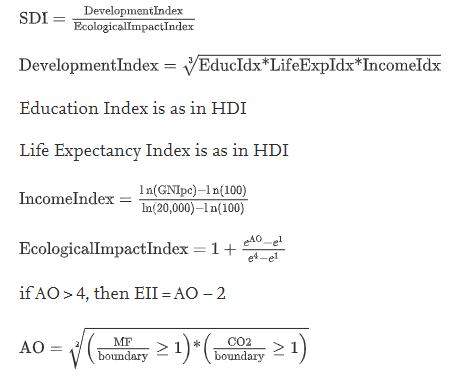
The Sustainable Development Index proposed here includes five indicators, then: education, life expectancy, income, CO2 emissions and material footprint. The SDI is calculated as the quotient of two figures: (1) a “development index” calculated as the geometric mean of the education index, the life expectancy index, and the modified income index; and (2) an “ecological impact index” calculated as the average overshoot of CO2 emissions and material footprint vis-à-vis their per capita planetary boundaries, indexed on a natural exponential scale. The formula can be described as follows:

Average overshoot (AO) is calculated as follows. Material footprint and emissions values are each divided by their respective per capita planetary boundary (which varies by year depending on population size) to determine the extent of boundary overshoot (or undershoot). This also standardizes the units. If the result of either division is less than 1 (undershoot) it is rendered as 1. Then the results are averaged using the geometric mean. This method ensures that a country cannot compensate for overshooting one boundary by undershooting the other. Overshoot of either boundary will yield average overshoot of greater than 1.

In the ecological impact index, AO is indexed on a natural exponential scale. Given the uncertainties around the precise definition of the planetary boundaries, this allows some leeway for small amounts of overshoot. Adding 1 ensures that the minimum result is 1 (no overshoot). For countries that have no overshoot, their development index is therefore unaffected. Once overshoot reaches four times the planetary boundary the ecological impact index registers 2, thus cutting the development index in half. Thereafter a linear function applies. This method ensures that the SDI is an indicator of strong sustainability. Countries cannot use low ecological impact to compensate for poor performance in human development. And strong performance in development cannot compensate for high ecological impact.

There are 163 countries that have data points for all five of the metrics included in the SDI for 2015. The top ten performers on the SDI are listed in Table 2Table 3 presents a selection of countries from across the range, for comparison. The overshoot calculation here assumes a boundary of 6.8 t per person per year for material footprint (Bringezu et al., 2015), and a boundary of 1.74 t per person per year for CO2 emissions (IPCC, 2018).

Table 2. Top 10 performers on the Sustainable Development Index (2015).a

SDI RankCountrySDILife Expect. (years)Education IndexGNI per capita (PPP)Material Footprint (tns/cap)CO2 emissions (tns/cap)
1Cuba0.85979.60.76821,0008.043.42
2Costa Rica0.83079.60.71314,0868.082.66
3Sri Lanka0.82575.10.75110,7913.881.03
4Albania0.81178.20.73311,08310.922.32
5Panama0.80877.80.68118,1677.853.77
6Algeria0.80575.90.66213,3383.031.96
7Georgia0.80173.10.8318,7669.123.07
8Armenia0.80074.40.7468,5177.631.99
9Azerbaijan0.79871.90.70916,3345.913.24
10Peru0.78874.70.68611,4209.382.14
Average of top 1076.030.72813,3507.382.56
Overshoot (multiple of boundary)1.091.47

Life expectancy, Education Index, and GNI are derived from the UNDP dataset for HDI 2015. Material footprint data is derived from materialflows.net, and CO2 emissions data is derived from the Eora MRIO database.

Table 3. Selection of countries from the Sustainable Development Index (2015).

SDI RankCountrySDILife Expect. (years)Education IndexGNI per capita (PPP)Material Footprint (tns/cap)CO2 emissions (tns/cap)
16Jordan0.77574.20.7068,3926.782.99
27Belize0.74570.20.7047,6667.952.84
55India0.67568.30.5425,6914.461.68
95France0.54982.40.84038,36721.207.47
100China0.53276.10.64113,51920.016.68
131United Kingdom0.39981.40.91138,14622.5710.08
136Niger0.37459.70.2088893.270.55
152Qatar0.25178.00.698117,89613.3525.91
157Norway0.20082.00.90867,02837.7114.38
159USA0.18479.20.90053,74132.3618.35

The best performers are Cuba, Costa Rica, Sri Lanka and Albania, which achieve high levels of social performance with low levels of ecological impact. The degree of overshoot on material footprint and CO2 emissions of the top 10 is significantly lower than under the HDI (compare with Table 1). The nations that dominate HDI (Norway, etc.) fall toward the bottom of the SDI range, dragged down by their high ecological impact. The bottom of the SDI range is populated by very poor countries (like Niger) as well as countries with very high ecological impact (like Qatar).

Of course, what the SDI ranking reveals is that no countries truly succeed at sustainable development, with scores over 0.9. There are no countries that achieve top scores for human development (with life expectancy and education at the level of Switzerland, for example) while at the same time remaining within or even remotely near ecological boundaries. In contrast to the HDI, wherein more than 20 countries score over 0.9, the SDI ranking reveals that all countries are still “developing”: countries with the highest levels of human development still need to significantly reduce their ecological impact, while countries with the lowest levels of ecological impact still need to significantly improve their performance on social indicators.

6. Additional considerations

My goal in designing the Sustainable Development Index is to retain the base logic of the HDI, which I have done. Nonetheless, I considered a number of possible alternative formulations. I review them here along with the reasons I chose to reject them.

First, it might seem reasonable to consider including additional indicators of human development in the SDI, alongside life expectancy and education, such as literacy and infant mortality (which are included in the SDGs). But infant mortality overlaps substantially with life expectancy, and therefore cannot be granted equal weight as a third term (the Physical Quality of Life Index has been criticized for doing so). Moreover, infant mortality is a “weaker” or lower-order measure, in that it is easier to accomplish a reduction in infant mortality than to accomplish an improvement in the life expectancy of non-infants. Countries that have achieved higher levels of life expectancy have generally also already succeeded at reducing infant mortality, but the opposite does not generally hold. In the same way, literacy is weaker than and overlaps substantially with the education index. In short, then, infant mortality and literacy are trumped by life expectancy and education, respectively, and do not warrant inclusion in the SDI.

Another option might be to incorporate indicators related to basic physical needs, such as access to food, electricity, improved sanitation facilities and housing, all of which are targeted by the SDGs. The problem here is that high levels of access to these basic goods is “easy” to deliver, and at this point most of the world’s nations have done so: for instance, of the 100 best-performing countries in each indicator, the average electricity provision is 100%, and the average proportion of the population that achieves the nutrition threshold set by the Food and Agricultural Organization is 98%. All of the nations that perform well (or even modestly) in terms of life expectancy and education have universal coverage of these basic needs. For this reason, we can assume that provision of basic needs is already “covered” by the higher-order (or more difficult to achieve) social indicators included in the SDI.

Apart from basic physical needs, there are a number of qualitative indicators that we might consider for inclusion in the SDI: social support, democratic quality and employment – all of which are aspirations represented in the SDGs. These are covered by the Better Life Index, an alternative measure of progress devised for the OECD. The problem here is that all of these indicators have a weak relationship with ecological impact (O’Neill et al., 2018). While improving indicators like education and life expectancy clearly requires some additional ecological impact (since schools and hospitals, for instance, require materials to construct and energy to run), improving social support, democratic quality and employment does not (Hickel, 2018). Social support is largely a cultural phenomenon; the indicator measures whether or not people have someone to count on in times of need, which can be improved without additional ecological impact. Similarly, one can imagine a government delivering dramatic improvements in democratic quality without any additional ecological impact (for instance, South Africa’s transition to democracy in 1994 caused no increase in impact). Moreover, there is no necessary relationship between democracy and ecological impact: low-impact nations like India as well as high-impact nations like Norway can have robust democracies, while dictatorships can be present in low-impact nations like Swaziland as well as high-impact nations like Saudi Arabia. As for employment, O’Neill et al. (2018) show that there is no statistical relationship between employment and impact at all. Once again, both poor nations and rich nations can have either high or low employment. And all nations can improve their employment levels simply and without any additional ecological impact by introducing specific policy settings (for example, by reducing the length of the working week and sharing necessary labour). There is therefore little reason to measure these indicators against ecological impact.

Moreover, it is possible for poor countries to have high levels of social support, democratic quality and employment while at the same time performing poorly in terms of life expectancy and education. It seems reasonable, then, to exclude these from the SDI on the grounds that, because they can and often do move in the opposite direction to life expectancy and education, they would muddy the results (see Streeten, 1994), a problem to which all composite indexes are vulnerable. For these reasons I depart from Biggeri and Mauro (2018), whose alternative formulation of the HDI (mentioned in the opening section of the paper) incorporates an indicator for “freedom”.

It might seem reasonable to consider including subjective indicators of happiness or well-being, as the Happy Planet Index has done. I chose not to do so because it would depart from the objective approach that the SDI seeks to retain, but also because the data (which is derived from the World Happiness Report) presents a number of problems. (1) The question asks about people’s feelings of well-being “at the present time”, which leaves it vulnerable to being skewed downward by temporary events such as natural disaster, military conflict, or change of government. Including such a measure in the SDI would risk obscuring countries that otherwise perform well at the core objective of delivering ecologically efficient human development. (2) The question asks people to place themselves on a ladder, where “the top of the ladder represents the best possible life for you; and the bottom of the ladder represents the worst possible life for you”, but such a scale is not comparable across contexts. The best possible life imaginable by someone in the UK is not comparable to the best possible life imaginable by someone in Bangladesh. Indeed, the happiness indicator risks rewarding people in poor countries for low expectations. By the same token, people in rich countries who should be satisfied with their prospects compared to the rest of the world may feel that they nonetheless need more. (3) Finally, the ladder metaphor embodies a particularly Eurocentric conception of progress: unilineal, unidirectional, hierarchical, individualistic, etc. It is possible that this metaphor is less meaningful to people who do not subscribe to these underlying principles. If that is the case, then it may not be suitable for use in cross-country comparisons (see Mathews and Izquierdo, 2009Mathews, 2012). Indeed, cultures that value modesty (such as in East Asia) tend to report lower levels of well-being, because to do otherwise would seem impertinent, and might risk inviting misfortune (see Gough, 2017: 40). There are more general formulations of the evaluative question, and evidence to suggest that responses are more comparable across contexts, but the data remains subjective and therefore incompatible with the objective approach I have selected.

A final consideration has to do with inequality. Greater equality is associated with a variety of positive social outcomes (greater happiness, better health, less anxiety, less depression, etc.; see Wilkinson and Picket, 2009). Recognizing this, the UNDP has designed an inequality-adjusted HDI (IHDI). According to the 2016 Human Development Report, “The IHDI can be interpreted as the level of human development when inequality is accounted for,” whereas the normal HDI is “an index of potential human development (or the maximum IHDI that could be achieved if there were no inequality).” The concept of development potential is interesting here. I have chosen to render the SDI without adjusting for inequality because, when it comes to the question of sustainable development, what is important is the potential of nations to achieve high levels of human development at a given level of ecological impact. Inequitable countries that have relatively low levels of impact are theoretically capable of improving their human development outcomes considerably by distributing existing domestic resources more fairly, without any additional ecological impact. By not adjusting for inequality, the SDI highlights these countries as models of efficiency in human development potential.

A brief note about the education index is in order here. The inclusion of the education index in HDI has come under criticism for a variety of reasons. First, it is an input metric that does not guarantee consistent outcomes. In other words, it is possible that a country could achieve maximum years of schooling, but if the schooling is of a poor standard it will do little to improve the actual education of the population. Moreover, it is potentially problematic to combine an input-based metric like the education index together with an outcomes-based metric like life expectancy, given the dissimilarities between the two. Second, the education index measures education in terms of an institutional model, and therefore effectively discriminates against cultures that may have historically valued different approaches. For instance, indigenous people living in Bolivia may have few years of formal schooling but nonetheless have mastery of botany and ecology and other fields crucial to their context, acquired through rigorous training and mentorship – a kind of education that would be difficult to gain through institutional schooling. These are important critiques that need to be addressed, but I have chosen to put them aside here for the sake retaining the underlying logic of the HDI, and because there is no readily available alternative metric.

Finally, what can we say about the relationship between the SDI and the SDGs? Clearly the two draw on the same underlying conception of sustainable development, but the SDI incorporates a narrower range of indicators than are represented among the SDG targets. O’Neill et al. (2018) have proposed a broad dashboard of indicators of human development that derives from the SDGs, alongside indicators of ecological impact that derive from the planetary boundary framework. This is a robust and informative approach, but if we wish to use a single index, the SDI – as I have argued above – provides the most reasonable formulation, as it includes the three well-established indicators of human development derived from the HDI and the two keystone indicators of ecological impact (which are represented in Goals 12 and 13 of the SDGs), while retaining the principles of strong sustainability. Just as the HDI served us for the era of the Millennium Development Goals (which focused on human development to the exclusion of ecological considerations) without incorporating all of the MDG targets, so the SDI can serve us in the era of the SDGs. But it should not be used to the exclusion of disaggregated approaches.

7. Conclusion and discussion

The ecological limitations of the Human Development Index have long been apparent. For more than twenty years, scholars have attempted to modify HDI in order to overcome these limitations. These attempts suffer from significant flaws, which the Sustainable Development Index I have proposed here seeks to transcend. By correcting for both CO2 emissions and material footprint (rendered in per capita consumption-based terms), by placing a sufficiency threshold on income, and by dividing human development by ecological impact, the SDI offers an alternative index that is robust in terms of both ecology and social science, while upholding the principles of strong sustainability.

The SDI also makes an important contribution to development theory, inasmuch as it disrupts dominant development hierarchies. Arturo Escobar (2011) famously pointed out that conventional development indicators construct conceptual ladders of progress that place Western countries at the top and represent the rest of the world as lagging behind. Such representations have significant discursive power, and shape the way that people think about the world. This is clear in the case of HDI. Given HDI’s reliance on income, it represents the countries of the global North as automatically superior to the countries of the South, erasing and indeed even legitimizing the violence that the former have deployed in order to accumulate their surplus, through for example colonization, the slave trade, structural adjustment, land grabs, labour exploitation, resource extraction and other methods by which nations at the core of the world system have sabotaged the periphery for the sake of their own development (Hickel, 2017). The SDI challenges this narrative (and the troubling racial overtones of the HDI hierarchy) by introducing ecological indicators that reflect the negative effects of the excess extraction, consumption and accumulation practiced by rich countries, and demoting them accordingly.

The SDI does however raise a number of practical issues. For one, there is an interesting question to be asked about the purpose of an index that mixes both human development and ecological impact. A critic might note that with human development indicators, the countries that rise to the top (like Switzerland and Denmark) do so because of intentional policies, like investment in public healthcare and education. These are policies that other countries can aspire to imitate. It is not quite so straightforward with the ecological indicators, however. Some of the nations that have low ecological impact use intentional policies to get there, such as Costa Rica’s investment in renewable energy infrastructure and Cuba’s focus on material reuse. But many others (like Sri Lanka) have low impact not because of intentional policies but rather because they have less intensive economies. So in what sense can Sri Lanka be held up as a model that should be imitated? What do they do better? What would it mean for a country to seek to be more like Sri Lanka, if there are no clear policies to follow?

In other words, one might say there is a deficit of success at the top of the SDI. This is in keeping with what I noted above, namely, that the SDI reveals that no nations are yet sustainably developed (with world-leading performance on social indicators and safe levels of ecological impact), and therefore none yet stand as an obvious champion for others to follow. This will begin to change, however, as middle and high-income countries implement ecological policy in order to reduce their emissions and material footprint, which they will have to do if they want to adhere to Paris Agreement targets and the Sustainable Development Goals. So for instance as countries like Switzerland and Chile (which have high levels of human development) invest in renewable energy, circular economy principles and post-growth policies, they will rise to the top of the SDI, and one could point to them as models. In this sense, the SDI is a metric that stands ready to measure progress toward the ecological transition that needs to happen, but which is not yet underway.

In the meantime, it is important to note that while the countries that rise to the top of the SDI may not provide a model for richer countries to follow, they do provide a model for poorer countries. All of the SDI leaders have succeeded in achieving high levels of human development with minimal GNI per capita and minimal ecological pressure. This is a remarkable accomplishment. In this sense, there is a great deal that a country like Bangladesh can imitate about Sri Lanka. Sri Lanka, which has invested heavily in public healthcare and education, illustrates that it is possible for poorer countries to dramatically improve their social outcomes without needing ecologically destructive levels of economic activity to do so.

What might appear at first glance as a flaw, then, is in fact a key strength of the SDI. The SDI charts out a conception of progress that allows for and indeed promotes different development trajectories depending on each nation’s position. Under HDI, the objective is univocal and unidirectional. Those at the bottom of the ranking are enjoined to progress by growing GDP, without concern for ecological externalities, while investing in healthcare and education. Under the SDI, by contrast, the objective is more complicated. The bottom of the ranking is populated by both poor countries with low levels of human development as well as by rich countries with high levels of ecological impact. The United States, for instance, is ranked 159th, as a result of having very high levels of ecological impact. For rich countries at the bottom of the SDI, the path to progress requires reducing emissions and material footprint. For poor countries at the bottom of the SDI, the path to progress requires social policy, imitating countries like Costa Rica and Sri Lanka in order to deliver strong social outcomes with little additional ecological impact.

The SDI therefore implies heterogeneous prescriptions for progress, disrupting unilineal normative trajectories and usefully speaking to the varied predicaments of countries in the real world. And yet the goal that the SDI promotes is nonetheless singular: to achieve ecologically sustainable human development.

Seeing the world through the lens of the Sustainable Development Index illustrates how, when it comes to development in the 21st century, poor nations are the “easy” part. We know, from already-existing examples (such as those at the top of the SDI ranking), that it is possible for poor nations to achieve high levels of human development with sustainable levels of ecological impact, for instance by investing in universal social goods like public health and education (Martínez Franzoni and Sánchez Ancochea, 2016). It is rich nations that are the hard part, as reducing their emissions and material footprint down to sustainable levels will require not only aggressive efficiency improvements, but also a shift toward alternative economic models that allow aggregate economic activity to be scaled down (in order to dramatically reduce material and energy throughput) in a manner that maintains and even improves their performance on social indicators (Hickel, 2019). The SDI highlights this challenge.

Acknowledgements

This paper benefited significantly from input from Daniel O’Neill, Gary Stevenson, Huzaifa Zoomkawala, and anonymous reviewers, although they bear no responsibility for any weaknesses that may remain.

References

Alexander et al., 2018S. Alexander, J. Rutherford, J. Floyd A critique of the Australian National Outlook decoupling strategy: a limits to growth perspective Ecol. Econ., 145 (2018), pp. 10-17ArticleDownload PDFView Record in ScopusGoogle Scholar

Alier, 2009J.M. Alier Socially sustainable economic de-growthDev. Change, 40 (6) (2009), pp. 1099-1119CrossRefView Record in ScopusGoogle Scholar

Anand and Sen, 1994 S. Anand, Amartya Sen Human Development Index: Methodology and Measurement, HDR Occasional Papers(1994)Google Scholar

Anderson and Bows, 2011Kevin Anderson, Alice BowsBeyond ‘dangerous’ climate change: emission scenarios for a new world PhilosTrans. R. Soc. Lond. A, 369 (1934) (2011), pp. 20-44CrossRefView Record in ScopusGoogle Scholar

Biggeri and Mauro, 2018M. Biggeri, V. MauroTowards a more ‘sustainable’ human development index: integrating the environment and freedomEcol. Indic., 91 (2018), pp. 220-231ArticleDownload PDFView Record in ScopusGoogle Scholar

Bravo, 2014G. BravoThe human sustainable development index: new calculations and a first critical analysisEcol. Indic., 37 (2014), pp. 145-150ArticleDownload PDFView Record in ScopusGoogle Scholar

Bringezu et al., 2015S. Bringezu, et al.Possible target corridor for sustainable use of global material resourcesResources, 4 (2015), pp. 25-54CrossRefView Record in ScopusGoogle Scholar

de La Vega and Urrutia, 2001M.L. de La Vega, A.M. UrrutiaHDPI: a framework for pollution-sensitive human development indicatorsEnviron. Dev. Sustain., 3 (3) (2001), pp. 199-215View Record in ScopusGoogle Scholar

Deaton, 2008A. DeatonIncome, health, and well-being around the worldJ. Econ. Perspect., 22 (2) (2008), pp. 53-72CrossRefView Record in ScopusGoogle Scholar

Desai, 1995M. DesaiGreening the HDI?. Accounting for ChangeThe New Economics Foundation, London (1995), pp. 21-36View Record in ScopusGoogle Scholar

Dittrich et al., 2012M. Dittrich, S. Giljum, S. Lutter, C. PolzinGreen economies around the worldImplications of Resource Use for Development and the Environment, SERI, Vienna (2012)Google Scholar

Escobar, 2011A. EscobarEncountering Development: The Making and Unmaking of the Third WorldPrinceton University Press (2011)Google Scholar

Gough, 2015I. GoughClimate change and sustainable welfare: the centrality of human needsCamb. J. Econ., 39 (5) (2015), pp. 1191-1214CrossRefView Record in ScopusGoogle Scholar

Gough, 2017I. GoughHeat, Greed and Human Need: Climate Change, Capitalism and Sustainable WellbeingEdward Elgar Publishing (2017)Google Scholar

Grubler et al., 2018A. Grubler, et al.A low energy demand scenario for meeting the 1.5C target and sustainable development goals without negative emissions technologiesNat. Energy, 3 (2018), pp. 515-527CrossRefView Record in ScopusGoogle Scholar

Gutowski et al., 2017T. Gutowski, D. Cooper, S. SahniWhy we use more materialsPhilos. Trans. R. Soc. A, 375 (2017) (2017)Google Scholar

Hatfield-Dodds et al., 2015S. Hatfield-Dodds, et al.Australia is ‘free to choose’ economic growth and falling environmental pressuresNature, 527 (7576) (2015), pp. 49-53CrossRefView Record in ScopusGoogle Scholar

Hickel, 2018J. HickelIs it possible to achieve a good life for all within planetary boundaries?Third World Q. (2018), pp. 1-17View Record in ScopusGoogle Scholar

Hickel, 2017J. HickelThe Divide: A Brief Guide to Global Inequality and Its SolutionsPenguin Random House, UK; London (2017)Google Scholar

Hickel, 2019J. HickelDegrowth: a theory of radical abundanceReal World Econ. Rev., 87 (2019)Google Scholar

Hickel and Kallis, 2019J. Hickel, G. KallisIs green growth possible?New Polit. Econ. (2019)Google Scholar

Hirai, 2017T. HiraiThe Creation of the Human Development ApproachSpringer (2017)Google Scholar

Hoekstra and Wiedmann, 2014A.Y. Hoekstra, T.O. WiedmannHumanity’s unsustainable environmental footprintScience, 344 (2014), pp. 1114-1117CrossRefView Record in ScopusGoogle Scholar

Holz et al., 2018C. Holz, L.S. Siegel, E. Johnston, A.P. Jones, J. StermanRatcheting ambition to limit warming to 1.5 C–trade-offs between emission reductions and carbon dioxide removalEnviron. Res. Lett., 13 (6) (2018), Article 064028CrossRefView Record in ScopusGoogle Scholar

Inglehart, 1997R. InglehartModernization and Postmodernization: Cultural, Political and Economic Change in 43 SocietiesPrinceton University Press, Princeton (1997)Google Scholar

IPCC, 2018IPCCGlobal Warming of 1.5C – Summary for PolicymakersIPCC, Switzerland (2018)Google Scholar

Jackson, 2019T. JacksonProsperity Without Growth: Economics for a Finite PlanetRoutledge (2019)Google Scholar

Jacobson and Delucchi, 2011M.Z. Jacobson, M.A. DelucchiProviding all global energy with wind, water, and solar power, Part I: technologies, energy resources, quantities and areas of infrastructure, and materialsEnergy Policy, 39 (3) (2011), pp. 1154-1169ArticleDownload PDFView Record in ScopusGoogle Scholar

Jeffrey et al., 2016K. Jeffrey, H. Wheatley, S. AbdallahThe Happy Planet Index 2016: A Global Index of Sustainable WellbeingNew Economics Foundation, London (2016)Google Scholar

Kai et al., 1998Kai et al. 1998.Google Scholar

Kallis, 2011G. KallisIn defence of degrowthEcol. Econ., 70 (5) (2011), pp. 873-880ArticleDownload PDFView Record in ScopusGoogle Scholar

Kelly, 1991I. KellyThe human development index: handle with carePopul. Dev. Rev., 17 (2) (1991), pp. 315-324Google Scholar

Krausmann et al., 2009F. Krausmann, et al.Growth in global materials use, GDP and population during the 20th centuryEcol. Econ., 68 (10) (2009), pp. 2696-2705ArticleDownload PDFView Record in ScopusGoogle Scholar

Kubiszewski et al., 2013I. Kubiszewski, et al.Beyond GDP: measuring and achieving global genuine progressEcol. Econ., 93 (2013), pp. 57-68ArticleDownload PDFView Record in ScopusGoogle Scholar

Lamb et al., 2014W.F. Lamb, J.K. Steinberger, A. Bows-Larkin, G.P. Peters, J.T. Roberts, F.R. WoodTransitions in pathways of human development and carbon emissionsEnviron. Res. Letts, 9 (1) (2014), Article 014011CrossRefView Record in ScopusGoogle Scholar

Martínez Franzoni and Sánchez Ancochea, 2016J. Martínez Franzoni, D. Sánchez AncocheaThe Quest for Universal Social Policy in the South: Actors, Ideas and Architectures(2016)Google Scholar

Mathews, 2012G. MathewsHappiness, culture and contextInt. J. Wellbeing, 2 (4) (2012), pp. 299-312CrossRefView Record in ScopusGoogle Scholar

Mathews and Izquierdo, 2009G. Mathews, C. IzquierdoPursuits of Happiness: Wellbeing in Anthropological PerspectiveBerghahn Books, New York, Oxford (2009)Google Scholar

Max-Neef, 1995M. Max-NeefEconomic growth and quality of life: a threshold hypothesisEcol. Econ., 15 (2) (1995), pp. 115-118ArticleDownload PDFView Record in ScopusGoogle Scholar

Morse, 2003S. MorseGreening the United Nations’ human development index?Sustain. Dev., 11 (4) (2003), pp. 183-198View Record in ScopusGoogle Scholar

Neumayer, 2001E. NeumayerThe human development index and sustainability—a constructive proposalEcol. Econ., 39 (1) (2001), pp. 101-114ArticleDownload PDFView Record in ScopusGoogle Scholar

O’Neill Daniel et al., 2018W. O’Neill Daniel, L. Fanning Andrew, F. Lamb William, K. Steinberger JuliaA good life for all within planetary boundariesNat. Sustain., 1 (2) (2018)Google Scholar

Pelenc et al., 2013J. Pelenc, M.K. Lompo, J. Ballet, J.L. DuboisSustainable human development and the capability approach: integrating environment, responsibility and collective agencyJ. Human Dev. Capabil., 14 (1) (2013), pp. 77-94CrossRefView Record in ScopusGoogle Scholar

Ramathan, 1999B. RamathanEnvironment sensitive human development index: issues and alternativesIndian Sociol. Rev., 1 (1999), pp. 193-201View Record in ScopusGoogle Scholar

Raworth, 2012Kate RaworthA safe and just space for humanity: can we live within the doughnutOxfam Policy and Practice: Climate Change and Resilience, vol. 8 (2012), pp. 1-26View Record in ScopusGoogle Scholar

Raworth, 2017Kate RaworthDoughnut Economics: Seven Ways to Think Like a 21st-Century EconomistChelsea Green Publishing (2017)Google Scholar

Rockström et al., 2009Johan Rockström, Steffen Will, Noone Kevin, Persson Åsa, F. Stuart Chapin, Lambin Eric, M. Lenton Timothy, et al.Planetary boundaries: exploring the safe operating space for humanityEcol. Soc., 14 (2) (2009)Google Scholar

Sagar and Najam, 1998A. Sagar, A. NajamThe human development index: a critical reviewEcol. Econ., 25 (1998), pp. 249-264ArticleDownload PDFView Record in ScopusGoogle Scholar

Schandl et al., 2016Heinz Schandl, et al.Decoupling global environmental pressure and economic growthJ. Clean. Prod., 132 (2016), pp. 45-56ArticleDownload PDFView Record in ScopusGoogle Scholar

Schroder and Storm, 2018E. Schroder, S. StormEconomic Growth and Carbon Emissions: the Road to ‘Hothouse Earth’ Is Paved With Good IntentionsInstitute for New Economic Thinking (2018)(Working Paper 84)Google Scholar

Steffen et al., 2015Will Steffen, Richardson Katherine, Rockström Johan, E. Cornell Sarah, Fetzer Ingo, M. Bennett Elena, Biggs Reinette, et al.Planetary boundaries: guiding human development on a changing planetScience, 347 (6223) (2015)Google Scholar

Streeten, 1994Paul StreetenHuman development: means and endsAm. Econ. Rev., 84 (2) (1994), pp. 232-237View Record in ScopusGoogle Scholar

Togtokh, 2011C. TogtokhTime to stop celebrating the pollutersNat. News, 479 (7373) (2011), p. 269CrossRefView Record in ScopusGoogle Scholar

Togtokh and Gaffney, 2010C. Togtokh, O. GaffneyHuman sustainable development indexOur World, 2 (2010)Google Scholar

Türe, 2013C. TüreA methodology to analyse the relations of ecological footprint corresponding with human development index: eco-sustainable human development indexInt. J. Sustain. Dev. World Ecol., 20 (1) (2013), pp. 9-19CrossRefView Record in ScopusGoogle Scholar

UNDP, 1990UNDPHuman Development Report 1990(1990)Google Scholar

UNDP, 2011UNDPReview of HDI Critiques and Potential Improvements, HDR Research Paper(2011)Google Scholar

United Nations Environment Programme (UNEP), 2017aUnited Nations Environment Programme (UNEP)Assessing Global Resource Use(2017)Google Scholar

United Nations Environment Programme (UNEP), 2017bUnited Nations Environment Programme (UNEP)Resource Efficiency: Potential and Economic Implications. A Report From the International Resource Panel(2017)Google Scholar

Van den Bergh and Grazi, 2014J.C. Van den Bergh, F. GraziEcological footprint policy? Land use as an environmental indicatorJ. Ind. Ecol., 18 (1) (2014), pp. 10-19CrossRefView Record in ScopusGoogle Scholar

Van Vuuren et al., 2018D.P. Van Vuuren, et al.Alternative Pathways to the 1.5C target reduce the need for negative emission technologiesNat. Clim. Change, 8 (2018), pp. 391-397CrossRefView Record in ScopusGoogle Scholar

Victor, 2019P. VictorManaging without Growth: Slower by Design, Not Disaster(2nd edition), Edward Elgar Publishing (2019)Google Scholar

Voet et al., 2004E. Voet, L. Oers, I. NikolicDematerialization: not just a matter of weightJ. Ind. Ecol., 8 (4) (2004), pp. 121-137CrossRefGoogle Scholar

Ward et al., 2016James Ward, et al.Is decoupling GDP growth from environmental impact possible?PLoS One, 11 (10) (2016)Google Scholar

Wiedmann et al., 2015Thomas Wiedmann, et al.The material footprint of nationsProc. Natl. Acad. Sci., 112 (20) (2015), pp. 6271-6276CrossRefView Record in ScopusGoogle Scholar

Wilkinson and Picket, 2009Richard Wilkinson, Kate PicketThe Spirit LevelAllen Lane (2009)Google Scholar1

For material footprint, Bringezu et al. use a planetary boundary of 50 billion tonnes per year. Dividing this by 7.358 billion people in 2015 gives us 6.8t per person per year. For CO2 emissions, we can use the IPCC’s 2018 report to estimate what the remaining carbon budget for the century was in 2015 if we are to have a 67% chance of staying between 1.5C and 2C, averaging the two budgets for 2018, subtracting emissions since 2015, and dividing by the remaining years of the century. Dividing the result by 7.358 billion people gives us 1.74 billion tonnes per person per year until 2100. This assumes no population growth, however. Furthermore, we must note that applying the same boundary to each country brackets the principle of climate fair shares, whereby richer countries must observe a smaller carbon budget in order to leave more space to poorer countries.2

HDI data is derived from the UNDP. Material footprint data is derived from materialflows.net.3

HDI data is derived from the UNDP. CO2 emissions data is derived from the Eora MRIO database.

Who is responsible for the climate crisis?

It’s not the failure of a species, it’s the failure of a system.

BY Jason Moore

November 04, 2019 ENVIRONMENT & SUSTAINABILITY

Reposted from Maize magazine

Who is responsible for the climate crisis? For everyone who isn’t a climate denialist, there’s an easy answer to the question: humanity. Who, in their right mind, would challenge the idea that climate change is anthropogenic (made by humans)? Are we not living in the Anthropocene: the Age of Man as geological force? 

Well, yes and no. It turns out that saying “Humans did it!” may obscure as much as it clarifies. A world of political difference lies between saying “Humans did it!” – and saying “Some humans did it!” Radical thinkers and climate justice activists have begun to question a starkly egalitarian distribution of historical responsibility for climate change in a system committed to a sharply unequal distribution of wealth and power. From this standpoint, the phrase anthropogenic climate change is a special brand of blaming the victims of exploitation, violence, and poverty. A more nearly accurate alternative? Ours is an era of capitalogenic climate crisis.

Capitalogenic: “made by capital.” Like its sibling, Capitalocene, it can sound awkward when spoken. That doesn’t have much to do with the word, however – it’s because under bourgeois hegemony we are taught to view with suspicion any language that names the system. But naming the system, the form of oppression, and logic of exploitation is what emancipatory social movements always do. Justice movements unfold through new ideas and new languages. The power to name an injustice channels thought and strategy, something dramatically underscored by labor, anti-colonial, and feminist movements across the long twentieth century. In this respect, mainstream environmentalism since 1968 – the “environmentalism of the rich” (Peter Dauvergne) – has been a complete disaster. The “ecological footprint” directs our attention to individual, market-oriented consumption. The Anthropocene (and before that, Spaceship Earth) tells us that planetary crisis is more or less a natural consequence of human nature – as if today’s climate crisis is a matter of humans being humans, just as snakes will be snakes and zebras will be zebras. The truth is more nuanced, identifiable, and actionable: we are living in the Capitalocene, the Age of Capital. We know – historically and in the present crisis – who is responsible for the climate crisis. They have names and addresses, starting with the eight richest men in the world with more wealth than the bottom 3.6 billion humans.

What is the Capitalocene? Let me begin by saying what the Capitalocene is not. It is not a substitute for geology. And it is not an argument that says an economic system drives planetary crisis – although economics are crucial. It is a way of understanding capitalism as a connective geographical and patterned historical system. In this view, the Capitalocene is a geopoetics for making sense of capitalism as a world-ecology of power and re/production in the web of life. 

We’ll dig into the Capitalocene in just a moment. First, let’s get clear on the Anthropocene, of which there are two. One is the Geological Anthropocene. This is the concern of geologists and earth system scientists. Their primary concern is golden spikes: key markers in the stratigraphic layer that identify geological eras. In the case of the Anthropocene, these spikes are generally recognized as plastics, chicken bones and nuclear waste. (Such is the contribution of capitalism to geological history!) Alternatively, and perceptively, the biogeographers Simon Lewis and Mark Maslin argue that 1610 marks the dawn of the Geological Anthropocene. Deemed the “Orbis Spike”, the period between 1492 and 1610 witnessed not only the Columbian Invasion. The ensuing genocide in the Americas led to forest regrowth and a rapid CO2 drawdown by 1550, contributing to some of the Little Ice Age’s coldest decades (c. 1300-1850). The Geological Anthropocene is therefore a deliberate abstraction of historical relations in order to clarify the biogeographical relations of humans (as species) and the biosphere. That’s entirely reasonable. The Capitalocene thesis is not an argument about geological history. 

It’s an argument about geohistory – something that includes biogeological changes as fundamental to human histories of power and production. Here, the Capitalocene confronts a second Anthropocene: the Popular Anthropocene. This second Anthropocene encompasses a much wider discussion in the humanities and social sciences. It’s a conversation about the historical development, and contemporary realities, of planetary crisis. There’s no neat and tidy separation, and many earth system scientists have been happy to shift from the Geological to the Popular Anthropocene, and then back again!

For the Popular Anthropocene, the problem is Man and Nature – a problem that contains more than a little gender bias, as Kate Raworth makes clear when she quips that we’re living the Manthropocene. This Anthropocene presents a model of planetary crisis that is anything but new. It reincarnates a cosmology of Humanity and Nature that goes back in some ways to 1492 – and in others to Thomas Malthus in the eighteenth century. This is the narrative of Humanity doing terrible things to Nature. And driving those terrible things is, as ever, the spectre of overpopulation – an idea that has consistently justified the violent oppression of women and peoples of color.

 You might notice that I’ve capitalized those words Humanity and Nature. That’s because these are not mere words, but abstractions that have been taken as real by empires, modernizing states, and capitalists in order to cheapen human and extra-human natures of every kind. Historically, most human beings have been practically excluded from membership in Humanity. In the history of capitalism, there has been little room in the Anthropos for anyone not white, male, and bourgeois. From 1492, the super-rich and their imperial allies dispossessed peoples of color, Indigenous Peoples, and virtually all women of their Humanity, and assigned to Nature – the better they could be transformed into profit-making opportunities. The upshot is that the cosmology of Man and Nature in the Popular Anthropocene is not only a faulty analytic, but implicated in practical histories of domination. When the Popular Anthropocene refuses name capitalogenic climate change, it fails to see that the problem is not Man and Nature, but certain men committed to the profitable domination and destruction of most humans and the rest of nature.

Courtesy of Rebecca Hastings.

The Popular Anthropocene’s insinuation that all humans did it, then, is clearly not the case. The American and western European share of CO2 emissions between 1850 and 2012 is three times greater than China’s. Even this doesn’t go far enough. Such national accounting is akin to individualizing responsibility for the climate crisis. It doesn’t consider the centrality of American and western European capital in global industrialization since 1945. Since the 1990s, for example, China’s emissions have overwhelmingly served European and American export markets, and for decades were underwritten by massive foreign investment. There’s a global system of power and capital that’s always hungry for more Cheap Nature, which since the 1970s has meant sharply widening class inequality. Consider the United States, the world-historical leader in carbonizing the atmosphere. To allocate equal responsibility for global warming to all Americans is a grand erasure. The U.S. was, from the beginning, an apartheid-style republic based on genocide and dispossession and slavery. Certain Americans are responsible for US emissions: the owners of capital, plantations and slaves (or today’s private prisons), factories and banks. 

The Capitalocene argument therefore rejects anthropocentric flattening – “We have met the enemy and he is us” (as in Walt Kelly’s iconic 1970 Earth Day poster) – along with economic reductionism. To be sure, capitalism is a system of endless capital accumulation. But the Capitalocene thesis says that to understand planetary crisis today, we need to look at capitalism as a world-ecology of power, production, and reproduction. In this perspective, the “social” moments of modern class rule, white supremacy, and patriarchy are intimately connected with environmental projects aimed at endless capital accumulation. Essentially, the great innovation of capitalism, from its origins after 1492, was to invent the practice of appropriating Nature. That Nature was not just an idea but a territorial and cultural reality that encaged and policed women, colonized peoples, and extra-human webs of life. Because webs of life resist the standardization, acceleration, and homogenization of capitalist profit-maximization, capitalism has never been narrowly economic; cultural domination and political force have made possible the capitalogenic devastation of human and extra-human natures at every turn. 

Why 1492 and not 1850 or 1945? There’s no question that the Anthropocene’s famous “hockey stick” charts indicate major inflection points for carbonization and other movements at these points, especially the latter. These are representations of consequences, however, not the causes of planetary crisis. The Capitalocene thesis pursues analyses that link such consequences to the longer histories of class rule, racism and sexism, all of which form, in the modern sense, after 1492.

By the sixteenth century, we see a rupture in how scientists, capitalists, and imperial strategists understood planetary reality. In medieval Europe, humans and the rest of nature were understood in hierarchical terms, like the Great Chain of Being. But there was no strict separation between human relations and the rest of nature. Words such as nature, civilization, savagery and society only realized their modern meaning in the English language between 1550 and 1650. This was, not coincidentally, the era of England’s capitalist agricultural revolution, the modern coal mining revolution, the invasion of Ireland (1541). This cultural shift didn’t happen in isolation in the Anglosphere – there were cognate movements underway in other western European languages at around the same time too, as the Atlantic world underwent a capitalist shift. This radical break with the old ways of knowing reality, previously holistic (but still hierarchical) gave way to the dualism of Civilization and Savagery. 

Wherever and whenever European ships disembarked soldiers, priests, and merchants, they immediately encountered “savages.” In the Middle Ages, the word meant strong and fierce; now it signified the antonym of civilization. Savages inhabited something called wilderness, and it was the task of the civilized conquers to Christianize and to Improve. Wilderness in these years was often known as “waste” – and in the colonies, it justified laying waste so that such lands and its savage inhabitants might be put to work cheaply. The binary code of Civilization and Savagery constitutes a pivotal operating system for modernity, one premised on dispossessing human beings of their humanity. Such dispossession – which occurred not once but many times over – was the fate meted out to indigenous peoples, to the Irish, to virtually all women, to African slaves, to colonial peoples around the world. It’s this capitalist geoculture that reproduces an extraordinary cheapening of life and work, essential to every great world economic boom but also violent, degrading, and self-exhausting. 

The language of Society and Nature is therefore not just the language of the bourgeois-colonial revolution in its widest sense, but also a praxis of alienation, every bit as fundamental to capitalism hegemony as the alienation of modern labor relations. Society and Nature fetishize the essential alienated relations of violence and domination under capitalism. Marx’s account of commodity fetishism, through which workers come to perceive the fruits of their labor as an alien power looming over them is obviously central. There’s another form of alienation that goes along with this commodity fetishism. This is civilizational fetishism. That alienation isn’t between “humans and nature.” It’s a project of some humans – white, bourgeois, male during the rise of capitalism – to cheapen most humans and our fellow life-forms. If commodity fetishism is a fundamental antagonism of capital and the proletariat, civilizational fetishism is the world-historical antagonism between capital and the biotariat (Stephen Collis) – the forms of life, living and dead, that provide the unpaid work/energy that makes capitalism possible. Civilizational fetishism teaches us to think the relation between capitalism and the web of life as a relation between objects, rather than an internalizing and externalizing relation of environment-making. Everything that Marx says about commodity fetishism was prefigured – both logically and historically – by a series of civilizational fetishes, with the line between Civilization and Savagery its geocultural pivot. The rise of capitalism did not invent wage-work; it invented the modern proletariat within an ever more audacious project of putting natures of every kind to work for free or low cost: the biotariart. Like commodity fetishism, civilization fetishism was — and remains — not just an idea but a praxis and a rationality of world domination. Since 1492, this line – between Civilized and the Savage – has shaped modern life and power, production and reproduction. Reinvented in every era of capitalism, it is now being reasserted in a powerful way – as resurgent authorian populists militarize and secure borders against the “infestations” of refugees driven by the late Capitalocene’s trinity of endless war, racialized dispossession, and climate crises. 

1492 marked not only a geocultural shift, but also a biogeographical transition unprecedented in human history. The Columbian Invasion began a geohistorical reunification of Pangea, the supercontinent that drifted apart 175 million years earlier. This modern Pangea would, in the eyes of Europe’s bankers, kings, and nobles, serve as a virtually limitless storehouse of Cheap labor, food, energy, and raw materials. It’s here, in the Atlantic zone of modern Pangea, that capitalism and today’s planetary crisis originated. In the three centuries that followed, capitalism’s triple helix of empire, capital, and science made possible the greatest and most rapid land/labor transformation in human history. Only the genesis of settled agriculture at the dawn of the Holocene, some 12,000 years ago, rivals early capitalism’s ecological revolution. Centuries before Newcomen and Watt’s steam engines, European bankers, planters, industrialists, merchants, and empires transformed planetary labor/life/land relations on a scale and at a speed an order of magnitude greater than anything seen before. From Brazil to the Andes to the Baltic, forests were mowed down, coercive labor systems imposed on Africans, indigenous peoples and Slavs, and indispensable supplies of Cheap food, timber, and silver shipped to the centers of wealth and power. Meanwhile, women in Europe – not to mention in the colonies! – were subjected to a coercive labor regime more ruthless than anything known under feudalism. Women were ejected from Civilization, their lives and labor tightly policed and redefined as “non-work” (Silvia Federici): precisely because “women’s work” belonged to the sphere of Nature. 

Courtesy of Rebecca Hastings.

The story of planetary crisis is typically told through the lens of “the” Industrial Revolution. No one questions that successive industrializations have coincided with major inflection points of resource use and toxification. (But industrialization long predates the nineteenth century!) To explain the origins of planetary crisis to technological transformations, however, is a powerful reductionism. Britain’s Industrial Revolution, for example, owed everything to Cheap cotton, to the unpaid work of generations of indigenous peoples who co-produced a variety of cotton suitable for machine production (G. hirsutum), to the genocides and dispossessions of the Cherokees and others in the American South, to the cotton gin which magnified labor productivity fifty-fold, to the enslaved Africans who worked in the cotton fields. Nor was English industrialization possible without the previous century’s oppressive gender-fertility revolution that subjected women’s care and reproductive capacities to capital’s demographic imperatives. 

These snapshots of capitalism’s history tell us that this peculiar system has always depended on frontiers of Cheap Natures – uncommodified natures whose work can be appropriated for free or low cost through violence, cultural domination, and markets. Such frontiers have been crucial because capitalism is the most prodigiously wasteful system ever created. This explains capitalism’s extraordinary extroversion. To survive, it has had to enclose the planet simultaneously as a source of Cheap Nature, and as a planetary waste dump. Both frontiers, which allow for radical cost-reduction and therefore profit-maximization, are now closing. On the one hand, Cheapness is a relationship subject to exhaustion – workers and peasants revolt and resist, mines are depleted, soil fertility eroded. On the other hand, capitalism’s enclosure of the planetary atmosphere and other commons for its wastes has crossed a critical threshold. Epochal climate change is the most dramatic expression of this tipping point, where we find global toxification increasingly destabilizing capitalism’s epochal achievements, its Cheap Food regime above all. These two strategies, Cheap Nature and Cheap Waste, are increasingly exhausted, as the geography of life-making and profit-taking enter a morbid phase. The climate crisis is – as Naomi Klein reminds us – changing everything. Capitalism’s world-ecology is undergoing an epochal inversion – or better, implosion – as natures stop being cheap and starting mounting ever-more effective resistance. Webs of life everywhere are challenging capital’s cost-reduction strategies, and become a cost-maximizing reality for capital. Climate change (but not only climate change) makes everything more expensive for capital – and more dangerous for the rest of us. 

This is the end of Cheap Nature. That’s a huge problem for capitalism, built on the praxis of cheapening: cheapening in the sense of price, but also cheapening in the sense of cultural domination. The first is a form of political economy, whilst the other is the cultural domination that revolves around imperial hegemony, racism and sexism. Among the most central problems of planetary justice today is to forge a strategy that links justice across and through these two moments. Consider that the most violent and deadly biophysical results of this toxification and economic stagnation are now visited upon those populations most consistently designated as Nature since 1492: women, neo-colonial populations, peoples of color. 

This is a dire situation for everyone on planet Earth. But there are grounds for hope. A key lesson I’ve drawn from studying climate history over the past 2,000 years is this: ruling classes have rarely survived climate shifts. The collapse of Roman power in the West coincided with the Dark Ages Cold Period (c. 400-750). The crisis of feudalism occurred in century or so after the arrival of the Little Ice Age (c. 1300-1850). Early capitalism’s most serious political crises – until the mid-twentieth century – coincided with the most severe decades of the Little Ice Age in the seventeenth century. Climate determines nothing, but climate changes are woven into the fabric of production, reproduction, governance, culture… in short, everything! To be sure, the climate changes that are now unfolding will be bigger than anything we’ve seen over past 12,000 years. “Business as usual” – systems of class rule and production and the all rest – never survive major climate shifts. The end of the Holocene and dawn of the Geological Anthropocene may therefore be welcomed as a moment of epochal political possibility – the end of the Capitalocene.

To be sure, capitalism continues. But it’s a dead man walking. What needs to happen now is radical change that links decarburization, democratization, decommodification. This will have to turn the logic of the Green New Deal inside-out. Such a radical vision will take the GND’s crucial linkage of economic justice, social provision, and environmental sustainability in the direction of de-commodifying housing, transportation, care, and education – and ensuring food and climate justice by de-linking agriculture from the tyranny of capitalist monocultures. 

It’s precisely this radical impulse that is at the heart of the world-ecology conversation. That conversation is defined by a fundamental openness to rethinking the old intellectual models – not least but not only Society and Nature – and to encouraging a new dialogue of scholars, artists, activists, and scientists that explores capitalism as an ecology of power, production, and reproduction in the web of life. It’s a conversation that insists: No politics of labor without nature, no politics of nature without labor; that emphasizes Climate Justice is Reproductive Justice; that challenges Climate Apartheid with Climate Abolitionism. 

The Capitalocene is therefore not some new word to mock the Anthropocene. It is an invitation to a conversation around how we might dismantle, analytically and practically, the tyranny of Man and Nature. It’s a way of making sense of the planetary inferno, emphasizing that the climate crisis is a geohistorical shift that includes greenhouse gas molecules but can’t be reduced to matters of parts per million. The climate crisis is a geohistorical moment that systemically combines greenhouse gas pollution with the climate class divide, class patriarchy, and climate apartheid. The history of justice in the twenty-first century will turn on how well we can identify these antagonisms and mutual interdependencies, and how adeptly we can build political coalitions that transcend these planetary contradictions.

Imagining the Anthropocene: Evoking an Ecological Occult

Rachel Edelman 

In 2000, atmospheric chemist Paul Crutzen coined the term “Anthropocene” to describe the geologic epoch during which human activity (primarily, the burning of fossil fuels) has significantly altered the earth. Geologists formally adopted the term in 2016. And yet, resistance to the fact of human-caused climate change remains rampant. If we are to preserve our species by reversing humans’ catastrophic impact on earth systems, we must facilitate a deeper cultural understanding of our relationship with the planet. The Imagining the Anthropocene series presents books of poetry that imagine humans’ impact on a geologic scale.

Human society is built on superficial impositions of order: government, religion, science, and language attempt to enervate chaos. But for Jane Mead, a poet entrusted with her family’s California vineyard in the midst of a historic drought, there’s no hiding from earth’s mists and windstorms. In Money Money Money | Water Water Water (Alice James, 2014), Mead’s musical polyvocality evokes the hidden worlds beyond humans’ limited paradigms.

Money Money Money | Water Water Water begins with a section devoted to the language of the Magna Carta, investigating the first English-language document of popular government. In the third poem, “Lassitude and Independence,” Mead writes:

The green world enters, introduces its yellows—

(no false reckoning, no plan, no artifice)—

the light as landscape (the specter as shore):


this is the way to know what you know:

the mind gives over its small grave of secrets—.

Color’s crossings begin a catalog of conflict: land against water, intention against “reckoning,” knowledge against what can never be known. Mead’s punctuation exerts the immense control required to present such compressed oppositions. Parentheses enable the quick shifts in tone between attention and deflection, bounding each item like commas wearing armor, while em dashes and commas govern the suspense with which the reader ends a line. I once heard poet Robyn Schiff refer to the end of the line as “the abyss”—the reader’s plunge through white space to the next line. Above, Mead’s em dashes propel and colons delay the emotional cascade from invitation to revulsion to surrender.

Mead’s symphony of voices pursues the dangers and pleasures of dispelling our false security. The book welcomes the occult and the unknowable to every opening of its spine. At the bottom of each of its left-facing pages sits a fragment. Each italicized tercet and monostich looks orderly: they remind me of tanka. In that Japanese form, an upper, three-line stanza often focuses on an image or condition; a lower stanza then turns inward or elsewhere, questioning, responding to, or opposing what’s come before. The result is a tension distilled to its essence:

+

Now as animal bodies

As the glistening fur

Fur in the rain smells


Let us smell

Mead’s ghostly fragments appear on every spread, even between sections of long sequences. Unpunctuated, they undercut the formal structures relied upon just across the spine. The plus signs that precede these fragments create a sense of multiplicity, suggesting their provenance in other voices or worlds:

+

The world full of tractors

Is the mystery world

The other world


Is the seasons

Seasons are made “other” and perhaps unknowable, while the tractor holds mystery’s romance. In this case, the fragment begins in a machine-driven setting, then bursts outward into “the seasons,” over which humans have a small amount of influence (as we’ve recently learned), but no chance of control. Through insistent rhymes and haunting refrains, Mead braids techniques from incantation, prayer, and Greek drama to question industry and capitalism’s veneers:

+

The creation of want

The creation of debt

The creation of the toxic ponds


If they wave wave back

Here, each made thing serves as a warning. The upper stanza lists creations by name, while the lower instructs as if in prophecy. Can the waves see each other and meet in passing? Throughout Money Money Money | Water Water Water, repeated references to waves double as gesture and fluid motion. Mead uses money and water as lines of inquiry; water’s unceasing motion chips away at currency’s notions of control.

From within this network of formal, design, and prosodic structures, Mead’s spare lines pivot between metaphorical and discursive ways of knowing. In “The Length of Life,” she writes:

Mist on the pond where a scene is missing.

This is the forward-marching of history?

Moving from scene to meditation, these lines follow a previously established logic. However, when a version of these words repeats at the end of the poem, its order is inverted, lines slightly changed:

The way may be found to be myth, or be history, —.

(Mist on the pond, where the scene is missing.)

Adapted to account for further unknowing of myth, these lines juxtapose the search for rhetorical resolution against the entirely parenthetical last line. The train of punctuation at the end of the first line asks the reader to pause, then move forward, then stop. After a stumbling journey away from “history,” the final line’s hush is Mead’s ultimate achievement: an empathic connection with earthly loss. Her reversal asks the reader to create, then destroy, an image: “The scene is missing.” With such capacity for simultaneous imagination and destruction, perhaps the speaker, the audience, and others of our species might remake the ways we exist on earth.

From ploughshares blog

The morendo of the Anthropocene

Foundations of Science (2021

The Original Article was published on 31 May 2021

Abstract

This essay engages with Bernard Stiegler’s discussion with Martin Heidegger in The ordeal of Truth, published in Foundations of Science 2020 (this volume). It appreciates Stiegler’s progressive reading of Heidegger’s work but critically reflects on several elements in his work. A first element is the methodological aspect of Heidegger’s being historical thinking, which is missed by Stiegler and confirms the indifference towards philosophical method that can be found in the work of many contemporary philosophers. A second element concerns Heidegger’s and Stiegler’s remaining humanism and the necessity to move beyond humanism and post-humanism in the era of global warming. A third element of reflection concerns Stiegler’s idea of the obligation of making our being-in-default come true, which shows a hidden metaphysical orientation in his work.

The starting point of The ordeal of Truth is found in Stiegler’s initial discomfort with Heidegger’s opposition between Sorge and Besorgen, Eigentlichkeit and Uneigentlichkeit, Wahrheit and Richtigkeit, which degrades the initial positive notion of the existential technicity of human Dasein in Being and Time to a negative notion of technology as Gestell in his later being historical thinking. He is now critical about his own initial assessment of Heidegger’s notion of Gestell from this oppositional perspective, because it misses the point that according to Heidegger, the essence of technology is ambiguous; this ambiguity of Gestell does not involve its danger within which the saving power grows, which may be read as a prefiguration of Stiegler’s pharmacology, but the experience of the inaccessibility of Ereignis.

This ambiguity can already be found in Being and Time. While—especially French—readers of Being and Time didn’t cease to read his efforts as a call to move from Uneigentlichkeit to Eigentlichkeit, the ambiguity of Eigentlichkeit consists in its inaccessibility. Only in our experience of Uneigenlichkeit, a negative experience of Eigentlichkeit is possible. On the one hand, because human Dasein is included in the tendency to fall (Abfall), Eigentlichkeit can only be achieved within the tendency of Uneigentlichkeit. On the other hand, to the extent that the experience of Eigentlichkeit is dependent on Uneigenlichkeit as its condition, Eigentlichkeit is never achieved and remains inaccessible.

With this, it becomes clear why Heidegger is primarily a methodological thinker, as I have argued in Heidegger’s concept of philosophical method. He does not presuppose the a priori accessibility of notions like Sorge, Eigentlichkeit and Wahrheit and renders the question concerning access the central philosophical problem. Considering the methodological aspects of Heidegger’s being historical thinking is important if Stiegler in his article wants to move beyond his initial oppositional perspective in order to ask for Ereignis as the hidden and wants to engage in an ordeal of truth. But he nowhere in the article discusses the methodological problem of the inaccessibility of Ereignis, and how he as a philosopher is able to have access to this inaccessible phenomenon. Instead of addressing the methodological question of how we can make any legitimate claim about Ereignis as the hidden, he uncritically subscribes to a position that it is “only with the introduction into modern physics … that it becomes possible to think (that is, to take care of [panser]) Ereignis as the destiny of Gestell” (5). This is not a personal omission of Stiegler’s work, but confirms the indifference towards philosophical method that can be found in the work of many contemporary philosophers, ranging from Morton to Harman. It indicates the crisis of contemporary philosophy (Blok 2020a).

Instead of uncritically subscribing to scientism, or to a position that understands itself in terms of taking care (panser), the in-accessibility of Ereignis indicates that it is a phenomenon that we can never take care of, always withdraws from our efforts to take care, and calls for a consideration of the philosophical method before we engage in any ordeal of truth.

II

Stiegler argues that Heidegger’s notion of Gestell enables us to think the Anthropocene. What Heidegger ignores in his proto-philosophy of the Anthropocene, according to Stiegler, is the question of entropy and negentropy. Stiegler’s connection between the Anthropocene and the notions of entropy and negentropy enables us to reflect on Earth and World in the Anthropocene. We can argue that entropy and negentropy emerge already in Heidegger’s concept of the truth of being as double movement of concealing-unconcealing, namely as the coming forth or rising up of a World in which we are at home, its endurance, and finally its decay in its inclination towards the concealment and self-closedness of Earth from which the World arose. Earth and World are essentially different and at the same time not separated from each other, that is, they are performatively constituted in the strive between negentropy or unconcealing (World) and entropy or concealing (Earth) of the truth of being. Although we have to nuance Stiegler’s criticism therefore, because Heidegger provides in fact a proto-conceptualization of entropy and negentropy, we may argue that Stiegler is also right in a way. The entropic movement of concealing remains in the end unthought in Heidegger’s work because he conceptualizes Earth from the perspective of the World. This is however not a personal omission of Heidegger. Philosophers never thought about the Earth as the extra-ordinary and always thought Earth out of World, matter out of form etc. (Blok 2019).

Be it as it may, Stiegler’s criticism enables us to ask for the role of negentropy or unconcealing of World in the Anthropocene. While post-humanists like Timothy Morton reject any notion of World in the Anthropocene in favour of the enmeshment of human technicity in the natural environment, we argued elsewhere that only the notion of World enables us to understand the meaning of our being-in-the-Anthropocene in contrast with our being-in-the-Holocene (Blok 2020b). We can read Stiegler’s “process of the exosomatization of the functions and faculties of noesis” as a process of World-constitution, in which the World that articulates our being-in-the-Anthropocene is both constitutive and destitutive for contemporary noesis. What is constituted in this exosomatic process is however not only the world of global warming in the third phase of the Anthropocene, which is indicated by Heidegger’s Gestell, but the neganthropy of Earth beyond humanism and post-humanism, which is indeed absent in Heidegger’s thought.

The singularity of the experience of global warming that we face today is that it draws our attention to Earth as ontic-ontological condition of our being-in-the-Anthropocene. The emergence of planet Earth in Earth’s history is a prerequisite not only for the emergence of human being on Earth at an ontic level, but more important, also for humans’ responsiveness to the world around us, that is, for our being-in-the-world at an ontological level. In the Earth’s history, Earth was long before humans emerged on the planet and, in this respect, our being-in-the-world emerges, unfolds, and expands out of Earth in the era of humanity and threatens to go back into Earth again at the end of this era in which humanity is threatened by global warming (Blok 2019). It is the experience of Earth as ontic-ontological condition of the possibility of our being-in-the-world in the era of global warming that confronts us with the Anthropocene on the one hand, and raises questions regarding the ordeal of truth on the other. My hypothesis is that a post-Heideggerian conception of the strive between negentropy or unconcealing (World) and entropy or concealing (Earth) can inform such an ordeal beyond scientism.

III

Although this ordeal of truth cannot consist in any form of taking care as we have seen, Stiegler’s conceptualization of being-in-the-world as being-in-default, which I would frame as being-in-the-world as being-on-Earth, may be of help here. But in order to make sense, we have to criticize the remainder of the humanistic orientation of Stiegler’s example of Joë Bousquet, and to reframe the human wound beyond humanism and post-humanism. The wound that we bear today is not a personal wound that we bear deep within our body in its eternal truth as a pure event, but the environmental crisis that we as Earthbound creatures bear deep within us. The signal of this ‘wound’ provides us with the experience that the Earth existed long before us, both at an ontic or ‘rock’ level and ontological or pre-individual level, and that I was born to embody it in my being-on-Earth. I embody this pre-individual Earth as morendo in my being-in-the-Anthropocene as operationalization of Gestell, that calls for the constitution of a World as crescendo of a being-in-the-Anthropocene beyond Gestell.

Only from a scientistic perspective, this morendo and crescendo is understood in terms of quasi-causality however. While causality—including quasi-causality and also conditions for the possibility (Möglichkeitsbedingung)—concerns beings, the morendo-crescendo from the pre-individual to the individual concerns being, i.e., our being-in-the-Anthropocene. Morendo is not concealing as dying away, but being as dying away, living a dying life.

I agree with Stiegler that this crescendo does no longer belong to endosomatic phusis but is exosomatically constituted as our being-in-the-Anthropocene, in which noetic tekhnè is at the same time Earthbound tekhnè (Zwier and Blok 2017). It remains open for future exchanges whether an eco-centric concept of being-in-default, substantiated by biomimetic technologies, can be of help in the conceptualization of noetic tekhnè (Blok 2017).

IV

I am hesitant to accept Stiegler’s further argument that the assignment of the being-in-default of noetic tekhnè obligates to “make their (de-)fault come true … as the absence of epoch, as the ‘post-truth era’, as the presence of Nothingness, as the ordeal of what remains hidden, of what does nothing but conceal” (10). On the one hand, why should we feel any obligation to make the default true, to re-present our being-in-default, except in case one adheres to the metaphysical truth as Rectitudo and Richtigkeit for which the ordeal of truth remains closed. On the other hand, we have to accept our human limits in the ordeal of what does nothing but conceal. The ordeal of what does nothing but conceal would lead to a philosophical variety of Cotard’s syndrome. In a strange way, there seems to be a connection between the metaphysical focus on the eye and perception of the present (idein, eidos), Stiegler’s obligation to make default true as re-presentation, and the being of an eye that sees and reflects but is disconnected from the one who sees in case of people who suffer from Cotard’s syndrome and experience they are dead or do not exist. One can argue that being-in-default requires the Cotard syndrome in order to have access to the presence of the truth as “presence of Nothingness” (10). But the price Stiegler has to pay for this experience is death and despair, i.e. the end of his being-in-default. In this respect, the process of exosomatisation of World is a more fruitful way forward, as World provides the meaningful order in which any being-in-default remains connected to his or her being-in-default, and enables us to experience our being-in-default as being-on-Earth, in which each and every being-in-the-World, also our current being-in-the-Anthropocene, remains embedded. But this requires us to accept the limit of human experience. But then it is no longer possible to experience the inaccessibility of Ereignis as the hidden. This is the price we have to pay for the Ordeal of Truth.

References

  1. Blok, V. (2017). Earthing technology: Towards an eco-centric concept of biomimetic technologies in the anthropocene. Techne: Research in Philosophy and Technology, 21(2-3), 127–149. https://doi.org/10.5840/techne201752363.Article Google Scholar 
  2. Blok, V. (2019). Nothing else matters: Towards an ontological concept of the materiality of the earth in the age of global warming. Research in Phenomenology, 49, 65–87.Article Google Scholar 
  3. Blok, V. (2020a). Heidegger’s concept of philosophical method. Innovating philosophy in the age of global warming. New York: Routledge.Google Scholar 
  4. Blok, V. (2020b). Beyond enmeshment: Critical reflections on the post-humanist position in the Anthropocene”, Working paper.
  5. Zwier, J., & Blok, V. (2017). Saving earth encountering Heidegger’s philosophy of technology in the anthropocene. Techne: Research in Philosophy and Technology, 21(2), 222–242.Google Scholar 

Download references

Author information
Affiliations
  1. Philosophy Group, Wageningen University, Wageningen, The NetherlandsVincent Blok
Corresponding author

Correspondence to Vincent Blok.

Additional information
Publisher’s Note

Springer Nature remains neutral with regard to jurisdictional claims in published maps and institutional affiliations.

Open Access This article is licensed under a Creative Commons Attribution 4.0 International License, which permits use, sharing, adaptation, distribution and reproduction in any medium or format, as long as you give appropriate credit to the original author(s) and the source, provide a link to the Creative Commons licence, and indicate if changes were made. The images or other third party material in this article are included in the article’s Creative Commons licence, unless indicated otherwise in a credit line to the material. If material is not included in the article’s Creative Commons licence and your intended use is not permitted by statutory regulation or exceeds the permitted use, you will need to obtain permission directly from the copyright holder. To view a copy of this licence, visit http://creativecommons.org/licenses/by/4.0/.

Reprints and Permissions

Cite this article

Blok, V. The morendo of the Anthropocene. Found Sci (2021). https://doi.org/10.1007/s10699-020-09763-0

Download citation

A date with destiny: Racial capitalism and the beginnings of the Anthropocene

Arun Saldanha

First Published September 5, 2019 

Research Article https://doi.org/10.1177/0263775819871964

Volume: 38 issue: 1,  page(s): 12-34

Article first published online: September 5, 2019; Issue published: February 1, 2020

Arun Saldanha, Department of Geography, Environment, and Society, University of Minnesota-Twin Cities, Minneapolis, MN 55455, USA. Email: saldanha@umn.edu

  • Abstract

The Anthropocene names the epoch wherein humans have become the main geological agent on the planet’s surface. But which humans, and since when? Dating the onset of the Anthropocene is a political and ontological as much as a scientific act. This essay argues the Anthropocene is inexorably racial because it flows out of a capitalist system which requires racializing populations and environments from early modernity to the present and into the future. The essay contends that racial capitalism should be a central category in explaining the onset of the Anthropocene. The focus will be on investigating whether it makes sense to take the European discovery of the Americas and the genocide against its original inhabitants as threshold of a new geological epoch. Following the radicalization of Marx in the philosophy of Deleuze and Guattari, it will be suggested that though colonization and slavery were essential for modern globalization to emerge, capital embarked on its self-perpetuating destructive trajectory through industrialization. Structural racism was transmuted and continues to characterize the global ecological crisis.

Keywords Anthropoceneracial capitalismcapitalOrbis hypothesisgenocide of Indigenous Americansindustrialization

Introduction

The Anthropocene names the epoch wherein humans have become the main geological agent on the planet’s surface. The impact of human activity on the planet is such that a hundred millions years from now, hypothetical geologists will be able to notice the earth went through changes that will still be measurable. But which changes do we select as definite, and when did they happen? Which humans? Dating the onset of the Anthropocene is a political and ontological as much as a scientific act, as scientists realize very well, though seldom admit. Defining the Anthropocene intrinsically carries with it a laying of culpability for the past and a responsibility for the future, while the research on how geological agency is distributed across time and across species cannot but involve the deepest of moral conundrums. Since the processes gathered under the Anthropocene umbrella are almost all self-reinforcing and nefarious for ecosystems, hence possibly jeopardizing the viability of our species itself, the question is properly existential: who or what is to take care of humanity’s survival?

Some social science scholars and political activists have sought to debunk the Anthropocene concept altogether, pointing out that only a small proportion of the human population has in the last few centuries caused the discussed immense environmental changes, from the annihilation of Indigenous ecologies and the ever more desperate mining of fossil fuels and rare earths, to overfishing and agribusiness. As Oxfam (2015) pointed out during the Paris climate negotiations, the carbon footprint of the world’s richest 1% could be as much as 175 times that of the poorest 10%. With that 1% owning half the world’s wealth, decisions on how the economy runs are obscenely skewed. Poverty and vulnerability are just like in colonial times concentrated in Africa, South America, and Asia. On a deeper level, the Promethean subjugation of ecosystems and the exploitative division of labor has from ancient times been premised on patriarchy, that is, the usurpation of social power and discourse itself by adult men. Rather than humanity as such, which has been around for hundreds of thousands of years, these critics (e.g. Mirzoeff, 2016) point out that it is the white captains of the capitalist system who have created a new geological epoch.

With help from renegade Marxists Gilles Deleuze and Félix Guattari, this essay agrees the key agent behind environmental destruction is the capitalist system as fed by European colonization and patriarchy, yet emphasizes the power of those captains depends on the inhuman self-replication of capital, that is, on the most deterritorialized and deterritorializing force of modernity. For sure, in certain corners of critical geography, “capital” accrued such an expansive explanatory force that it became taken-for-granted and perhaps quasi-theological. Even if Marx first formulated a systematic concept of capital, this essay attempts to rediscover this category after the critiques of the sclerotic tendencies of Marxism by poststructuralist, feminist, black, postcolonial, Indigenous, environmentalist, and other left theorists. To offer a starting date for the Anthropocene and explaining capitalism, one cannot but inhabit the productive tensions between Marxism and these cognate critical discourses.

In this essay, I will keep the term Anthropocene, then, precisely in order to wrest it from the mainstream mystifications of how the planet came to this situation. Following the recent suggestion of Françoise Vergès (2017), we can call the Anthropocene an inexorably racial regime because modern society has at crucial junctures had to discriminate populations in order to expand itself. We will see one crucial debate involves the proposition of Simon Lewis and Mark Maslin (2018) that the Anthropocene is based on the decimation of Indigenous Americans. The emergence of capitalism in Europe was built on the displacement and exploitation of others elsewhere, especially but not only across the Atlantic Ocean, a process we will see is captured well by the Marxian concept of primitive accumulation. But I will argue a framework is required to explain racial capitalism’s more recent developments as well, after it abandoned displacement and slave-trade as central features. That the new planetary phase is intrinsically a “racial” phenomenon means that contingently distinguishable human bodies are differentially positioned in relation to not just the state and the city, but the profound geological and ecological transformations which were required for “modern” society to emerge at all. The racializing effects of capital have been intrinsic, though they continually shift.

Hence anthropos as a site of (r)evolutionary thresholds is always already subdivided into subsets which are interpellated in sharply different ways by the earth and by world-history. As Indigenous, feminist, black, and critical race theorists have long since demonstrated, the discursive figure of “man” belies structural injustices so entrenched that upending them requires redefining the basic terms for talking about the social at all (Mbembe, 2017Mirzoeff, 2016Sharpe, 2016Wynter, 2013). Anthropos is fundamentally at odds with itself, and this is what makes it thoroughly political (see also Clark and Gunaratnam, 2017). When the extreme geographic disparities highlighted by the umbrella term “Anthropocene”—of footprints, consumption levels, vulnerability—are explained, the concept of “the human species” loses its humanist innocence. Geographers have long pointed out that what is called development in one place happens within the same global ecosystem making life tougher or impossible elsewhere (Harvey, 2010Yusoff, 2018). The prospect of hundreds of millions of so-called climate refugees follows from the fact that the distribution of mobility and war technologies is already highly racialized, and it has been for centuries (Baldwin and Bettini, 2017). To retrieve a radical potential of the Anthropocene concept is to alert publics of the possibility that imminent catastrophes are to be appreciated on the scale of millions of years, requiring concomitantly epochal forms of responsibility, solidarity, and upheaval. While the left has long pointed out the status quo’s hidden destructiveness, now even the most cautious mainstream science is understanding intergenerational injustices are built into the economic megamachine itself.

When the Anthropocene was first proposed as new geological epoch or era in earth science, it was suggested it started with the initial Industrial Revolution as fuelled by coal-powered steam engines (Crutzen and Stoermer, 2000). The search has since then been for a so-called golden spike or Global boundary Stratotype Section and Point (GSSP), a location and date at which planet-wide signals are sufficiently measurable that a qualitative shift from the Holocene can be inferred. On this criterion of detectability, radioactive fallout from nuclear testing is a clearer marker than changes in the carbon, nitrogen, and other cycles (or presumed future fossils for that matter). As reported by Jan Zalasiewicz et al. (2015), earth science is now leaning towards determining a GSSP in the 1950s or 1960s, but the decision is still to be made. This essay agrees with the initial intuition that the onset of the Anthropocene lies in the later 18th century, not on empirical grounds, however, which are beyond my expertise, but explicitly starting from theoretical principles in the humanities insofar as they are coterminous with understanding the particularity of modern times. Alongside the quantitative empiricism of science, we should remember debates about human–environment relations ineluctably involve concepts which have been discussed for centuries and have recently been given new political salience in various left (feminist, black, Marxist, decolonial, etc.) discourses: market society, oppression, universality, the “New World,” “nature,” technology, and so on. Here, the focus will be on the concept of racial capitalism as elaborated through the nonhuman aspect of capital, and we devote a section to other prevalent approaches to racial capitalism. After introducing the politics of the dating debate, we will consider the analysis of the trans-Atlantic contact event in greater detail. Though appreciative of Lewis and Maslin’s suggestion the mass death of native Americans be taken as indicative of the Anthropocene, and though recent developments in the theorization of slavery and blackness are sharpening our views of the profundity of racist violences, I will suggest industrialization has been, in retrospect, more consequential for the planet, even if mass death and slave labor had prepared for it, and will continue to characterize it into the future.

One or several Anthropocenes?

As an intrinsically temporal concept, the Anthropocene cannot but be dated. Moreover, as it pertains to a geological series, it must abide by or at least engage the methodological rules of that series for its coherence. That is, it must be based on a signal (fossil, sedimentary, chemical, radiometric, geomagnetic, etc.), a condensation in a certain location on Earth representing the planetary average and detectible millions of years from now. In August 2016, the International Congress of the Geological Sciences voted in Cape Town that the Anthropocene is real, but when it followed the Holocene is yet to be decided. Amongst scientists, the debate about the start date, technically called the GSSP, continues to rage (Zalasiewicz et al., 2015). The propositions that an “early Anthropocene” began with the human use of fire between two and one million years ago, which incrementally changed the distribution of vegetation and animals and levels of atmospheric carbon, and the more influential theory that irreversible anthropogenic planetary changes commenced 10,000–8000 BCE, the period of the Neolithic Revolution in agriculture and settlement, are clearly defended by more conservative earth scientists, archeologists, and paleontologists. When we analyze earth science’s premises and methods, it quickly becomes clear it inevitably comprises an ideological struggle, insofar as evidence is interpreted and conceptualized in conflicting ways (see Angus, 2016). For both science and the humanities, it does not make sense to locate the cusp of the new epoch thousands of years ago if the recent changes associated with “modern times” are more consequential. But by asking when the Anthropocene commenced after the medieval period, we are forced to confront some productive tensions.

While there might be broad agreement amongst many in activist circles and the critical humanities and social science literature that a confluence of oppressive social relations lies at the heart of the global environmental crisis, there are many ways of understanding “racism” and “capitalism” and how they relate to colonial settlement, heteropatriarchy, science and technology, and nonhuman entities. Indigenous and decolonial critiques in the Americas have emphasized the arrival of Columbus and the subsequent and ongoing process of eliminating the socioecological arrangements of the original inhabitants (Davis and Todd, 2017). Black and critical race theorists have unearthed the basis of globalization in the trans-Atlantic slave trade and plantation slavery (Wynter, 2013Yusoff, 2018). Postcolonial and subaltern studies focus more on the question how peoples in Asia and Africa could acquiesce to Europeans transforming their economies and ecologies for the profit of the metropoles, a question less of extermination or enslavement than of subordination (Chakrabarty, 2012). Pacifists point out the world’s nuclear arsenal is capable of destroying the entire terrestrial habitat several times over (Schell, 1982), while futurists, both utopian and dystopian, argue the profound dependency of human life on computers should be central to how our common future is to be thought (compare Bastani, 2019 and Berry, 2018). Some radical environmentalists lay the blame with civilization or even humanity itself (Jensen, 2016). Finally, Marxist discourse seeks to provide these relatively newer progressive positions the crucial concept of capitalism, demonstrating how conquest, enslavement, and cultural and technological domination have been intrinsic to Europe’s ascendance into industrial hegemony (Foster et al., 2010). So different thematic foci can correspond to different starting dates for our planetary emergency: the dawn of Homo sapiens, the Neolithic Revolution, 1492, the centuries over which trans-Atlantic slavery was institutionalized, the Industrial Revolution from about 1750, the age of empires and nationalisms, the atom bomb and Cold War, the birth of mass consumption in the 1950s, or the advent of the internet.

Could we not be content with a pluralist approach in which there are multiple Anthropocenes without one exact start date, which would have always in some way accompanied the human species and which have merely intensified with each of these thresholds? If stratigraphy itself requires strict periodization, could “Anthropocene” not mean different things in different discourses, for different political aims? It is true periodization is often a teleological exercise, its Eurocentric totalizing tendencies on a par with those of cartography and Linnaean taxonomy. Just like with the related concepts civilization, progress, evolution, modernity, and globalization, the debate about the Anthropocene’s starting date is ridden with the problem of how to locate places as “further” on a trajectory of change which is then taken to be desirable or inevitable. But the most important argument against the skepticism about the term amongst social scientists (Bonneil and Fressoz, 2016Malm, 2015) is that in sharp contrast to the discourses of modernization and progress, almost all uses of the term are tinged with deep worry about the future. Certainly, the alarmism has a tendency towards ethnocentrism and is increasingly hijacked by racist nationalism and Malthusian pseudo-solutions. But simultaneously, it cannot be favorable to those in power if they can be shown to be maintaining a trajectory possibly leading, if not to the extinction of humans, at least to massive deprivation and uncertainty. As climate activists across the world from a wide range of backgrounds show, the deep worry intrinsic to the Anthropocene concept can be politicized.

Joining the dating debate therefore does not necessarily erect the new geological epoch as monolithic or transcendent, a grand end-point which European men as privileged bearers of history (or even of evolution) led the rest of the world to. It is precisely to demonstrate how the processes that led to the new earthly reality are highly uneven and fiercely contested. Far from allowing the Anthropocene concept to once again reinforce hegemonic sentiments about societal maturation, deciding on a start date could underline the utterly contingent nature of all life if it can be shown to follow from assemblages (of capital, patriarchy, and racism) that could well not have existed at all. Another epistemico-political aim here, however, is to urge critical human geography to engage Western physical science so that they can urge it to become politicized (see also Clark and Gunaratnam, 2017). Even if it turns out the humanities suggest a different start date than scientists do, it will be because the former can lay claim to a more rigorous understanding of what exactly is anthropogenic about the new epoch—what makes the world of anthropos go around.

Primitive accumulation and racial capitalism

The tendency towards orthodoxy in the Marxist legacy has often blocked it from enriching itself with other critical or left discourses. The concept of “racial capitalism” as propounded by Cedric Robinson (1983), for example, is first of all meant to correct Marx’s and socialism’s relative neglect of the physical violence and ideological processes of slavery, racism, and nationalism, which modernity is constructed from. Eric Williams’ classic Capitalism and Slavery (Williams, 1944) had already demonstrated how the wealth amassed from the plantation economies in the Caribbean and the southern United States was directly fed into the burgeoning landscapes of factories and rapid urbanization of Northern England, and then the rest of Europe. We can conclude from Robinson’s wide-ranging historical analysis that capitalism is from the beginning not just transcontinental and transoceanic but a runaway process intrinsically geared to expand itself by exploiting populations deemed less worthy of life, without concern for long-term ramifications. While Marx downplays the role of race in the development of capitalism, his overall framework allows for correcting his own oversight. Something Robinson lays less stress on but what is crucial for my argument here is that once capital was established as feedback loop by the factories of Northern England after some two centuries of slavery, it insinuated itself into one social formation after another. No guild, ethnic prejudice, border, or sultan could hold back the new magic formula of making profits through industrial technologies and wage-labor.

Though manufacturing, credit/debt, and reinvestment had existed for many centuries, the abstract as well as violent force of money could only come into its own with luxury commodities, especially spices and sugar, and textiles, first wool then cotton (Beckert, 2014Eichen, 2019). In the last chapters of Volume 1 of CapitalMarx (1992) famously writes of what the bourgeois political economists before him called “primitive” (a better translation is original or primary) accumulation, the concentration of wealth before and necessary for industrialization. From the later Middle Ages, as trade increased amongst market towns, landowners in Europe gradually consolidated land by both legal and violent means, causing mass impoverishment amongst peasants, whose labor was henceforth available at very low wages and whose itinerancy was often made illegal (cf. Federici, 2004).

The spoliation of the church’s property, the fraudulent alienation of the State domains, the robbery of the common lands, the usurpation of feudal and clan property, and its transformation into modern private property under circumstances of reckless terrorism, were just so many idyllic methods of primitive accumulation. They conquered the field for capitalistic agriculture, made the soil part and parcel of capital, and created for the town industries the necessary supply of a “free” and outlawed proletariat. (Marx, 1992: 895)

In the British Isles especially, the policy of so-called enclosure was often difficult to distinguish from legalized theft. It displaced thousands of small farmers and over some three centuries (14th to 18th) created the propertyless masses which the factories would put to work at new, more efficient machinery. Some Marxist historians like Ellen Meiksins Wood (1999) argue England’s strong economic position was chiefly thanks to these enclosures, a large domestic market, and durable infrastructure. However, the theory of primitive accumulation (even in its mainstream versions) holds that there was already a world-system of transoceanic interactions which industrialization could tap into. The profits amassed in the Italian city-states from maritime trade, and then in the Iberian peninsula from its ruthless plunder of the Americas, especially of their precious metals, was a necessary buildup for the rise of Northwestern Europe, as the latter could benefit from the credit and the geographical connections forged by the former (Arrighi, 2009). Furthermore, as the Dutch, British, French, then Belgians and Germans started colonizing as well, it would become clear how primitive accumulation in the colonies became a sort of enclosure policy continued by other means, a general process of soft and hard coercion David Harvey renamed accumulation by dispossession (see Harvey, 2010). To understand why the capitalist state is intrinsically expansionist and racialized, the concept of primitive accumulation is crucial.

The discovery of gold and silver in America, the extirpation, enslavement and entombment in mines of the indigenous population of that continent, the beginnings of the conquest and plunder of India, and the conversion of Africa into a preserve for the commercial hunting of black-skins, are all things which characterize the dawn of the era of capitalist production. These idyllic proceedings are the chief moments of primitive accumulation. (Marx, 1992: 1147)

Updating these illustrious remarks about modernity’s “idyllic” origins, Silvia Federici (2004) theorizes early-modern misogynous violence like witch-hunting, the origins of the nuclear family, and subordination of women’s labor as entirely implicated in the establishment of the capitalist system. Jason Moore (2015) has added that primitive accumulation also encompasses a belligerent exploitation of slaves both Indigenous and imported as well as nonhuman forces like minerals, energy sources, and fertilizers (what Moore calls “cheap nature”). Racialization can be considered a requirement, seen in hindsight, for capitalism to take hold as intercontinental economic system (Eichen, 2019). Following Robinson and Moore, Vergès (2017) argues for defining the Anthropocene/Capitalocene as deeply racialized, against the natural scientists and environmental historians who often erase systemic violence from their narratives of ecological change. Echoing environmental justice advocates, Vergès points out the adverse effects of global warming and pollution (think of plastics, e-waste, and noise) are felt more intensely by brown and black populations. Just like early-modern Europeans claimed entire continents and oceans and grew powerful from coerced labor, the vulnerability to environmental disaster of some groups today systematically follows from the actions of still mostly white elites.

While the first defenders of the Anthropocene idea in earth science noted a threshold of the earth’s environmental systems was crossed in Britain in the latter 18th century (Crutzen and Stoermer, 2000), they refrain from unpacking why this event occurred at all. In science, capital’s violent logic is obscured just as it is elsewhere. Following the liberal canon, Crutzen takes steam-power to be the driving force of industrialization and 1784, the year James Watt patented his second steam engine, as symbolic of the threshold between Holocene and Anthropocene, even if it cannot be a GSSP because nothing geologically discernible occurred that year. But Andreas Malm (2016) argues the liberal canon is historically inaccurate: the coal-powered steam engine became central to industry only later, and British factories were during their initial boom mostly powered by water. Retrieving Marx’s classic argument, Malm argues it is not steam but the increasing availability of capital and cheap labor which triggered the Industrial Revolution in Britain. Technology is given shape only within the matrix of socioeconomic difference, as are its disastrous effects. Capitalism’s love affair with fossil fuels and the resulting unprecedented changes to atmospheric chemistry were not inaugurated with Watt’s engines, but by capital amassed through primitive accumulation.

It is important to understand how racial capitalism reproduces itself ideologically by masking its systematic violences while providing benefits to those in power. Even if capital is itself an unintentional process, its relentless logic of self-enrichment makes individual capitalists, politicians, and bureaucrats make decisions with increasingly adverse effects on others and the environment. Malm writes in the beginning of his book:

Global warming is the unintended by-product par excellence. A cotton manufacturer of early nineteenth-century Lancashire who decided to forgo his old waterwheel and invest in a steam engine, erect a chimney and order coal from a nearby pit did not, in all likelihood, entertain the possibility that his act could have any kind of relationship to the extent of the Artic sea ice […] Whether one chooses to ignore, suppress, deny or agonise over the knowledge of what is happening, it is there, in the air, heavier by the year. And yet the descendants of the Lancashire manufacturers, whose dominion now span the globe, are taking decisions on a daily basis to invest in new oil wells, new coal-fired power plants, new airports, new highways, new liquified natural gas facilities, new machines to replace human workers, so that emissions are not only continuing to grow but are doing so at a higher speed. […] How did we get caught up in this mess? (2016: 1–3, my italics)

These kinds of observations need to be read with an attention to embodied difference traditionally underplayed in the Marxist literature. Against the hegemonic liberal idea that racism is mostly about interpersonal prejudice, the question whether a cotton manufacturer is “a racist” is moot. What is incontrovertible is that he profits from an overall circuit involving the displacement of Indigenous Americans, the capture of slaves within Africa, brutal labor practices in the plantations, corrupt monopolies in Asia, surplus-labor in his factory, cut-throat competition in London, geopoliticking across European capital cities, warfare everywhere between, and millennia of patriarchy (Beckert, 2014Dunbar-Ortiz, 2014; Williams, 1944). Similarly, in the 20th century, the infrastructures around oil and automobility are steeped in institutional racism, from the demolishment of black neighborhoods for the highways facilitating white flight in the US to Bangladeshi construction workers in the Qatari desert and Chinese-led mineral extraction in central Africa. And it is essential to note the “yet” in Malm’s quote: what motivates humans to continue on the path of obvious destruction of other people, other species? Which tiny groups benefit from a disastrous system? Why do millions vote liars and sociopaths into office? And how long can the facts of geophysics be ignored? Addressing today’s planetary “mess” will require a concept of racial and gender ideology lacking in most accounts of it.

Capital as axiomatic

In order to understand the seeming inexorability of the Anthropocene and its devastating racializing effects, the traditional Marxist focus of class and political-economic analysis seems insufficient. Deleuze and Guattari (1987) nevertheless strictly follow Marx when they conceptualize capital as an abstract, altogether inhuman form of exchange. For the “mature” Marx of Capital, the irrational nature of capital is exactly what makes it capable of reorganizing the earth in its own image, regardless of ideology and tradition. At the time of The Communist ManifestoMarx and Engels (2005) still identified the bourgeoisie as the revolutionary subject of modernity, but we should reread its famous passages as conceptualizations of capital instead:

The bourgeoisie [capital] cannot exist without constantly revolutionising the instruments of production, and thereby the relations of production, and with them the whole relations of society. Conservation of the old modes of production in unaltered form, was, on the contrary, the first condition of existence for all earlier industrial classes. Constant revolutionising of production, uninterrupted disturbance of all social conditions, everlasting uncertainty and agitation distinguish the bourgeois [capitalist] epoch from all earlier ones. All fixed, fast-frozen relations, with their train of ancient and venerable prejudices and opinions, are swept away, all new-formed ones become antiquated before they can ossify. All that is solid melts into air, all that is holy is profaned, and man is at last compelled to face with sober senses his real conditions of life, and his relations with his kind.

The need of a constantly expanding market for its products chases the bourgeoisie [capital] over the entire surface of the globe. It must nestle everywhere, settle everywhere, establish connexions everywhere. (Marx and Engels, 2005: 44)

Capital’s essence is to penetrate, scoop up, and render exchangeable all bodies, things, and landscapes, and meanwhile obfuscate its own workings. Deleuze and Guattari put emphasis on the mysterious power of money to put a value on absolutely anything. But they also follow Marx in insisting that capital requires barriers in order to renew itself, an argument well-known in geography through Harvey’s work (see Harvey, 2010). Capital became the determining factor only because it is hindered by political and traditional as well as geophysical and physiological obstacles. There is no space here to fully elaborate a Deleuze–Guattarian critical-geographical framework, but it starts by radicalizing the Marxian concept of capital and critique of state power (Alliez and Lazzarato, 2018; Sibertin-Blanc, 2016). Against both their faddish reputation in the humanities and a suspicion amongst Marxists, Deleuze and Guattari are far from vitalist mystics unencumbered with geographical injustices. In fact, the attention in their work, especially A Thousand Plateaus (1987), to the unsurpassable fluidity of capital in conjunction with sexual desires, racist imagery (or “faciality”), and mechanization, as well as their idea of “the earth” as factor in world-history, can entwine fruitfully with feminist and decolonial discourses and potentially overcome the tendencies towards philosophical dualism and reductionism which continue to plague the more traditional Marxist critiques (Saldanha, 2017).

The central concept Deleuze and Guattari (1987) propose to highlight the inhuman explosiveness of capital is the “axiomatic.” The capitalist economy continually invents quasi-automatic mechanisms for profit-making they call “axioms.” Far from being in essence linked to liberal democracy, capitalism takes many forms, with authoritarian, criminal, and even state-socialist regimes all procuring ever-new ways of feeding the feedback loop of money. Following world-systems theory (see also Arrighi, 2009), Deleuze and Guattari contend this continual reinvention of capital as it spreads explains the geographic unevenness of the system in which even noncapitalism (economies without banking, cross-border trade, or reinvestment of profits) continues to exist:

the international capitalist axiomatic effectively assures the isomorphy of the diverse formations only where the domestic market is developing and expanding, in other words, in ‘the center’. But it tolerates, in fact it requires, a certain peripheral polymorphy, to the extent that it is not saturated, to the extent that it actively repels its own limits; this explains the existence, at the periphery, of heteromorphic social formations, which certainly do not constitute vestiges or transitional forms since they realize an ultramodern capitalist production (oil, mines, plantations, industrial equipment, steel, chemistry), but which are nonetheless precapitalist, or extracapitalist, owing to other aspects of their production and to the forced inadequacy of their domestic market in relation to the world market. When international organization becomes the capitalist axiomatic, it continues to imply a heterogeneity of social formations, it gives rise to and organizes its ‘Third World’. (1987: 436–437)

Capital’s paradox is that it is both immensely productive and immensely destructive of social formations and ecologies, and that it homogenizes the world by encouraging heterogeneity. But with feminist and decolonial critiques in mind, we should add the renown “creative destruction” neoliberal economists elevate to quasi-divine principle has an intrinsic racial and gender bias insofar as bosses and politicians of the core countries make decisions that cause unemployment, war, famine, pollution, extreme weather, and stressed households in the peripheries, continuing the callousness of colonial days. Men in suits make decisions about arms and mining or food and fuel prices on Wall Street and in the City of London, but also in Hong Kong and Riyadh, driving farmers to suicide in India and refugees to flee Yemen or East Congo. But the men in suits must continually reinvest their profits or they risk being outcompeted: nobody masters capital’s fluidity. The institutional racism inheres in the fact that in the process of fiercely competing with one another, these capitalists can lay entire societies and ecosystems to waste and justify it as bringing “development” or simply “doing business.”

Empires and wealthy merchants have been aggressively expanding their reach for millennia. However, thanks to its enigmatic and singularly effective axiomatic, only capital could have pursued a truly “planetary” agenda. This diffusedness and proliferating reliance on other forces is exactly what amounts to its capacity to create a new phase in the evolution of the earth. Analyses of the role of capital in global environmental destruction show the disaster-prone nature of capital is part of its normal functioning (Angus, 2016Foster et al., 2010Kovel, 2007). The child soldiers, toxic sludge, detention camps, sex tourism, ocean garbage patches, smog, and unfinished ghost cities are the logical result of the self-augmentation of capital as much as the glitzier spaces of airports and cyberspace. All the famous hockey-stick graphs associated with the Anthropocene are ultimately materializations of the exponential spirality of capital, and even mainstream commentators are anxious about where these compound processes are heading. Qua axiomatic capital has no conscience, because it is not conscious. It is a very simple algorithmic process capitalists themselves are caught up in. The Anthropocene could only emerge because of such a runaway process, whereas previous transformations brought to the planet by humans, from fire to polders, all had their geographic limitations built into them. Though Deleuze and Guattari (1987) are in broad agreement with Harvey’s (2010) characterization of capital as the quintessential productive principle of globalization, especially in the form of finance, their concept of axiomatic places more emphasis on capital’s uncontrollable and inhuman aspects while never losing sight of how money enlists consumers’, bankers’, and politician’s desires.

It makes philosophical sense, then, to date the Anthropocene’s beginning to late-18th-century Lancashire and its new wage-labor-powered industrial regime. Certainly, this emergence was no simple “point” because it was made possible by financial inputs from London and the East India Company as well as the Atlantic slave economy set up much earlier by the Iberians and Italians. But what is important to note for understanding our global predicament is that the techno-economic magic which happened there would become planet-wide over the following two centuries. This becoming-global of the capitalist formula only happened because it could not have been invented and commanded by any one state or group in any one ecosystem, yet could overtake them all. But the way in which money pits populations against each other is all too human. That capital is a quasi-automatic process tending toward ubiquity does not mean that it has not been profusely contested at every moment it conjured another commodity-chain and marketplace.

Given the fundamental driver of the Anthropocene is capital, calling our epoch the “Capitalocene” with Jason Moore (2015: chapter 7) could seem attractive. He dates its onset in “the long sixteenth century” because the twin forces of genocide and slavery were then consolidated in conjunction with banking. But aiming to critique geology from the outside, Moore’s term betrays its political color without being able to do much about the spread of the term it deprecates. By emphasizing only capital, it has to underestimate the profundity of the earth processes occurring under and before capitalism, thereby missing the extreme contingency of the capture of flows of matter, energy, and labor-power which capital must continually attempt. The axiomatic comes into existence precisely because this capture is often fraught with tensions and setbacks. Similarly, when Jake Kovel (2007) calls capital the “enemy of nature,” he cancels the possibility of a geohistorical understanding of capitalism as emergent from socioecological assemblages which have to align to create value. In the Deleuze–Guattarian framework, capital is instead fully part of the biophysical world, uniquely able to bend nonhuman forces to its wishes, very friendly indeed to human desire and the generativity of life forms and minerals. Naming capital the sovereign force over and against “nature” swings us back into the kind of determinism in which technology or the bourgeoisie is in control of life, when what is needed is a paradigm shift acknowledging that capital entirely depends on and is ever vulnerable to earthly exigencies. For that, I would suggest the Enlightenment concept of “nature” which Marxism inherited be replaced with Deleuze and Guattri’s ontology of multiplicity and flow.

To conclude, while Marxists are correct to call out the technocratic and teleological biases in mainstream stories about industrialization, Malm (2015) is wrong to call the Anthropocene but a bourgeois “myth.” No doubt the Anthropocene concept potentially reinforces the most Promethean and Eurocentric mythologies ever, but that shows just how important it is to redefine it. There needs to be a modicum of agreement that Earth has indeed gone through a qualitative shift in order for the debate about what caused it to be held convincingly, even if mainstream science habitually ignores racism, capital, and patriarchy as explanatory factors. When the name “Anthropocene” is decried in advance because of its sensationalism or partiality, the opportunity is missed for partaking in what may prove to be the most important naming debate of our lifetime.

Ontologies of blackness and indigeneity

A growing number of theorists are elaborating on racial capitalism, though not always using the term, working broadly in the Fanonian tradition but pushing the ontological envelope on how race pries open the consistency of the notion of humanity as such (from Chakrabarty, 2012 in postcolonial theory to Yusoff, 2018 in new-materialist feminism via Mirzoeff, 2016 in critical race studies). It can be said there is an “ontological turn” in the theorization of race in that long-standing philosophical questions of “man,” being, life, death, temporality, historicity, embodiment, the thing, the earth, language as such, and the limits of knowledge have come to the fore (Wynter, 2013). In black studies, the ontological turn often has implicit and explicit echoes of Heidegger, ethically assuming an “Afropessimist” or even black-nihilist stance in that the hopefulness associated with African American political aspirations is shown to itself perpetuate the structural erasure of the possibility of black human-being as inaugurated in the Middle Passage and the commodification of African bodies, which are continued directly in the present (Sexton, 2016; Sharpe, 2016; Warren, 2018). Antiblackness is in this literature a fundamental feature of both modernity and scholarly thought itself. The erasure of Indigenous peoples has a similar and related profundity, and the category of settler-colonialism has in recent years allowed Indigenous scholars to radically question the legal, metaphysical, and political parameters of the socius (Byrd, 2011Coulthard, 2014Whyte, 2018Wolfe, 2016). While there is no space to do justice to the nuances and sophistication of this new effervescence in black, Indigenous, and decolonial theoretical discourse—in particular their varying relations to Marxism, feminism, ecological thought, and poststructuralism—their growing international influence warrants some brief comments to distinguish the approach sketched here.

First, while the social death imparted on Indigenous Americans and enslaved Africans are certainly two originary catastrophes forming the basis of global modernity and systematically repressed in discourse, the question is not only how they are entwined, but how they interact with later violent as well as ostensibly more benevolent racializing processes, from the European conquest of the Pacific to multiculturalism in Scandinavia and Singapore, from Soviet Union ethnic policies to the exploitation of South Asian workers in the Middle East and Palestinian workers in Israel. Insofar as capital intrinsically “aims” to become-planetary, we cannot limit ourselves to the Atlantic world, or even primitive accumulation, when explaining its racial implications. Following internationalist black feminists like Angela Davis and historians of global settler-colonialism like Patrick Wolfe (2016), racial capitalism can be seen to have from the beginning involved multiple continents at once, potentializing all of the human species and planet for marketization, with varying degrees of annihilatory biopower and differential inclusion.

Second, pointing out that coercion, warfare, and letting die are at the heart of the global system does not necessarily deny the forcefulness of more seductive ideological processes. To put it bluntly, there must be more benignness to the capitalist system or it would have been overthrown long ago. Deleuze and Guattari’s work insists on the immense functionality of consumerism in chaining populations to the very megamachine which oppresses them. When Glen Coulthard (2014) takes aim at Canada’s liberal politics of recognition which slots its Indigenous peoples into a capitalist state while leaving intact the property codes which have always benefited white settlers, he tells Marx(ists) primitive accumulation encompasses not only the violences of genocide but an inculcation of possessive individualism amongst Native populations which continues unabated today (cf. Hartman, 1997 on such individualism amongst legally emancipated African Americans). If Wolfe and Coulthard conceive settler-colonialism (and primitive accumulation) as a “structure” rather than an “event,” they are in effect saying it had to transform itself from a regime of outright elimination and dispossession into a more subtle one of legalistic recognition, exploitation, and sentimental exoticization. This is not to say physical violence against Indigenous peoples is no longer prevalent. Ontologically, however, following Deleuze and Guattari (1987), more than annihilation, it is life, flow, desire, and productivity that racial capitalism feeds off, and this makes it all the more insidious.

In Christina Sharpe’s influential theorization (2016), blackness is a hole in human “being” itself, the reduction of a part of humanity to thinghood. Like others in the Afropessimist idiom, Sharpe (2016: 11–14) challenges the hegemonic assumption that the Shoah embodies modernity’s most radical evil, noting the violences of trans-Atlantic slavery not only include the still-ongoing eradication of sociocultural rootedness but have been neglected and misrepresented. In a move parallel to Coulthard’s on settler-colonialism, Sharpe conceives slavery not as a past event but the anchor of the structure of (Euro-American) society, which is in itself “antiblack” in that it is premised on the total suppression of black subjecthood. She thereby formally emulates a line of European thinkers like Giorgio Agamben on the role that the absolute abjection of Auschwitz plays in constituting the humanist mythology of modernity: if the intrinsic link between modernity and the Shoah must be disavowed for humanity to continue conceiving itself in liberal-progressivist vein, the more unspeakable disaster for Sharpe is that of slavery. But while European Jewishness constituted itself successfully after its near eradication—controversially in the form of Zionism—black being is for Sharpe always already a structural impossibility (black being as written in Heideggerian typography by Warren, 2018).

Rethinking blackness by way of modernity’s effort to extirpate it, Afropessimism’s position is radical, and it is conscious of the risk of repeating the oft-noted exceptionalist manner in which Israel puts the Shoah to use towards settler-colonial ends (see Wolfe, 2016). Black activists including Angela Davis (in a YouTube video, 2018, with Gayatri Spivak agreeing) have taken issue with this exceptionalist tendency, as inscribed in the term antiblackness and the resurgence of a black nationalism (see also Olaloku-Teriba, 2018 amongst others). Notwithstanding Sharpe’s eloquence in tracing antiblackness from the Middle Passage to refugee drownings in the Mediterranean, a Deleuze–Guattarian approach to racial capitalism differs markedly in that it seeks to map the specific modalities, gradients, and absurdities of institutional racism. Comprehending police brutality, for example, requires concepts like gentrification, securitization, and masculinity, and cannot follow directly from a negativity of blackness at the metaphysical level. We thereby avoid the quasi-theological dispute about which group has historically endured the most suffering. And while the global archives of violence against black peoples must continue to be elaborated, is it the case that slavery and racism seek to absolutely evacuate humanity from the enslaved or incarcerated body? Is it not precisely as humans capable of resistance, farming, crime, and sex that slaves were savagely oppressed? While conceptualizing blackness as dehumanized “nonbeing” makes sense in a Heideggerian framework, for Deleuze and Guattari and (broadly internationalist) feminists like Davis and Spivak, there can be no such sweeping binary between black and everything else (another critique of Afropessimist binarization is found in Day, 2015).

Finally, the historical question is how genocide and slavery prepared for capitalism. The integration of the United States of America as a white-majority nation-state and superpower could only be achieved with rapid immigration, urbanization, and fossil-fuelled transport. During the time when “pioneer” families and farmers were moving in, there were still sizeable areas controlled by Native confederations. When we look at specific regions like William Cronon (1991) does with the Midwest, the eradication of Native ecosystems and the concomitant creation of new European-derived ones—what Alfred Crosby (1986) from a more conservative angle calls “Neo-Europes”—became possible with aggressive new urban assemblages and foodways. White farmers and Indigenous populations have lived in constant tension on the Great Plains. What environmental histories like Cronon show, complementing accounts like Coulthard’s, is that there was a decisive shift in the settling of the American interior when banks could supply loans for parceling land and establishing large infrastructure and industry projects. Tellingly, movies and museums fantasize about the fleeting symbiotic relationships which are supposed to have existed between Indigenous and white. In retrospect, however, such fantasies and the ensuing lamentations about the vanishing Indian were but ideological fig leaves hiding how industrialization in Britain, intra-European imperial wars, and mass consumerism conspired to continue genocide by other means (Dunbar-Ortiz, 2014). If Indigenous populations had somehow become resistant to Old World diseases and continued using guns and horses efficiently, it is conceivable a patchwork of white and Indigenous states might have persisted, if it were not for a giant wave of capital and migrants coming over from Europe (and later elsewhere). With Indigenous Americans contained and plantation slavery and its quasi-feudal and patriarchal ways outlawed, capital could wipe the continent clean for a new megamachinic arrangement.

Hence ontologizing racial capitalism as always already tethered to slavery and/or genocide avoids the question when exactly “modernity” and the Anthropocene started. For the perspective I am developing, industrialization and related transformations like wage-labor, urbanization, motorized transport, and mass communications are fundamental shifts. While the slave trade and the displacement of Indigenous peoples were essential to enriching Europe for global hegemony, it is manufacturing with its intrinsic relation to proletarianization and slums, accelerating technological innovation, and an irrepressible invitation to consume which spread around the planet, which meant that extermination and coerced labor became slower and more covert processes. Doubtless there are work and mobility conditions approaching chattel slavery in all continents, and there is plenty of biopolitical domination approaching genocide even during alleged peace times. But it is difficult to see how multinational corporations, megacities, and mass migration could have obtained were it not for industrial capitalism overcoming the severe limitations built into the mercantile, plantation, colonial, and eliminationist models.

In the US itself, as scholars from WEB Du Bois (1935) onwards have shown, slavery had to be formally abolished for manufacturing and cities to kick off, spurring processes like the Great Migration of African Americans and, more fortuitously, black music. Following Deleuze and Guattari (and Marx), however dire the extraction of surplus-value from the laboring body, racial capitalism involves some degree (and ideology) of “freedom.” Saidiya Hartman’s (1997) excavation of the terroristic, legal, and psychical aspects of slavery living on after legal Emancipation demonstrates there are strong but disavowed continuities in institutional racism and misogyny. But however violent the post-Emancipation United States has been, from lynching to the prison-industrial complex to the war on crack, there was also the slow rise of black subjectivity, as testified by the black radical tradition to which Hartman herself belongs. She presents one of the finest analyses of the libidinal economies and legal codifications precluding a real black liberation from racial capitalism and individualism, hence of the hypocrisy underneath the official nationalist ideology of “we the people.” Yet an overemphasis on abjection deters from appreciating the enduring plasticity of racism.1 Politically speaking, there must be room, as there is for Du Bois, Fanon, Angela Davis, and the Black Panthers, for theorizing how a black elite could possibly emerge against such backdrop of violence and despair, and why it does not dismantle the system of privilege it gains from itself (from Booker Washington to Jay Z). To wit, if blackness is modernity’s quintessential site of abjection, it becomes difficult to explain why the “most powerful man on Earth” has been black. Afropessimists have of course passionately critiqued the deep complicity with an antiblack system shaping Barack Obama and all liberal antiracism, but true to their pessimistic stance consistently eschew formulating where exactly hope for black people (and other minorities) could come from.

With the benefit of hindsight, we can understand why capital was compelled to expunge slavery and feudal territorialities, often pitting itself explicitly against older forms of racism and sexism, as well as colonialism and nationalism. After the Second World War, the system of United Nations and Bretton-Woods explicitly aimed to allow capital to flow planet-wide so as to transcend the genocidal nationalisms and imperialisms which had just led to such destruction, even though the world remained catastrophically divided between East and West. Formal decolonization was on the one hand an egalitarian antiracist project often inspired by Marxism-Leninism, but on the other, it turned out to be a new phase in capital’s expansion under the rubric of development, with China now occupying the strangest systemic role. However hypocritical the reproach of premodern brutalities by industrial capitalism, it has proven tremendously effective.

Following feminist, black, postcolonial/decolonial, Indigenous, and queer critiques, capital cannot be the only system of violence, even if it posits itself as the dominant one. For Deleuze and Guattari, capital is always reconfiguring the “despotic” or “barbarian” assemblages of patriarchy, religion, kinship, cruelty, extraction of resources, and domestication of plants and animals, all with their various racial dimensions (Saldanha and Adams, 2013). There can only be an extreme fluidity of money by virtue of the fixities of borders, commodification, and biopower. And these pseudo-archaic forces, these reterritorializations through the deterritorializing impetus of capital, have their own ecohistories which the multidisciplinary conversations around the Anthropocene are bringing to light. What is required is a nonreductionist ontology which grants that capital strives to bring all of life, in fact all of the thinkable universe, into its preternatural ambit, but it can do so only by virtue of the biophysical and sociocultural characteristics of what it captures. Capital is such a formidable genie precisely because it is conjured from deep within the earth.

The Orbis hypothesis

Two physical geographers, Simon Lewis and Mark Maslin, have recently suggested our new geological epoch be dated to the near-disappearance of the Indigenous societies of the Americas, that is, the beginning of the 17th instead of the end of the 18th century. The link between planetary transformation and the colonization of the Americas has made their 2015 article in Nature an instant classic (the thesis is taken up again in the general-audience book The Human PlanetLewis and Maslin, 2018). Ice core samples reveal that in 1610 a peak occurred in a temporary downward trend in global CO2 levels. The general trend is that CO2 has been increasing steadily since the Neolithic because of deforestation and combustion, and accelerating since the industrial and fossil fuel revolutions. For Lewis and Martin, changes in the composition of Earth’s atmosphere are the best indicators of the new geological epoch because unlike fossilized remains, ice sheets, or deposits, they can be easily averaged and are planet-wide. The greenhouse effect caused by accumulated carbon in the atmosphere has drastically changed biological regimes on Earth before and will do so again this very century, ensuring the Anthropocene’s detectability into the far future.

Looking at this 1610 pike, scientists are asking what massive change happened over the 16th century that could suck up 7–10 parts per million of atmospheric CO2 and buck the general trend. Apparently—an irony in world-history—this carbon sequestration happened a mere century before carbon levels would start increasing exponentially. The only reasonable conjecture, Lewis and Maslin argue, is that the dip is an effect of the reforestation that occurred after the quasi-annihilation of Indigenous ecologies by Europeans. Of a population of between 60 and 100 million, within a century, at least 50 million Indigenous Americans perished from enslavement, warfare, epidemics, displacement, and starvation, a formative event in racist violence which David Stannard (1992) calls the American Holocaust. While violence, environmental injustice, and health disparity continue to characterize the relationship between Native and settler from the Arctic to the Amazon, the genocidal and ecological scale of the disappearance of Native Americans in early modernity remains unparalleled (see Dunbar-Ortiz, 2014). With Indigenous agriculture, hunting, and use of fire abruptly declining across vast stretches of the coastal Americas, vegetation returned and CO2 levels decreased, lowering the greenhouse effect and cooling the planet, hence extending the so-called Little Ice Age (a cooler period following the Middle Ages with more complex causes). As Charles Mann (2005) has summarized, only recently have non-Indigenous historians and ecologists started accepting the extent to which the pre-Columbian landscape was shaped by burning, farming, cities, trade-networks, empires, and their attendant governance and cosmologies. Of course, the same argument from Indigenous activists and writers has for many decades been marginalized by the mainstream.

There is no scientific consensus yet on whether the planetary effects of the depopulation and reforestation of the Americans could have offset those of the increase in the European settler population with their own agriculture and timber needs, not to forget the growing populations in the rest of the world. But what is intriguing about Lewis and Maslin’s line of argument is that just like the extinction events for earlier geological epochs, the mass death of Indigenous Americans might be of measurable environmental significance. Though they obviously risk “naturalizing” the Columbian holocaust as unavoidable implication of the struggle of survival amongst populations, they also show just how profoundly consequential, indeed contemporary, the genocide is. Understanding there is a geochemistry to the American Holocaust and creation of a “New World” through primitive accumulation can be a powerful counterhistorical rejoinder to the hegemonic forgetting of how the current world-order came into existence. The sheer scale of the intoxicating greed and religious self-righteousness of the conquistadores long noted by Indigenous activists and psychoanalyzed by Stannard becomes all the more breathtaking: the newly systematized racism of early modernity will be legible in tree rings and ice cores thousands or millions of years into the future.

There is a lot to be said for taking 1610 as the golden spike for the Anthropocene, the official year it began. Lewis and Maslin’s “Orbis hypothesis” is the only one proposed which takes the interplay of political-economic and geochemical processes seriously as measurable at the global level (orbis, “world”). Their effort is commendable for appreciating that the decimation—literally, with some ninety percent eliminated—of Indigenous America was, in hindsight, a necessary condition for European global dominance and anthropogenic climate change. Even so, some seemingly naive questions alert us to the moral conundrum immediately presenting itself here: if the Columbian holocaust evidently sequestered carbon, were Native Americans not emitting CO2 into the atmosphere? Yes, but more so were Europe, China, and India, whose agriculture and trade were more intense (see Pomeranz, 2000). And is population decline the answer to excessive greenhouse effect? Obviously not, as it all depends on the unequal footprints of sectors of populations. It must be remembered the footprint of Indigenous fire and agricultural regimes pales in comparison to the onslaught on ecosystems unleashed by elites under colonialism and industrialization. What transpires from the Orbis hypothesis is not only that reforestation is indeed essential to climatic equilibrium, as conservative environmentalists have long maintained, but that an exceptionally violent episode of world-history defines our geological present. At the very least, its moral implications would be to shun the thirst for profit which has demonstrably turned genocidal in the past.

In their call to decolonize the Anthropocene concept, Heather Davis and Zoe Todd (2017) welcome the 1610 date above the other candidates. They appreciate Lewis and Maslin’s more-than-geological framework but take another step by critiquing science’s universalism and demanding a place in the Anthropocene dating debates for embodied and Indigenous ways of knowing. Notwithstanding the importance of analyzing the colonialist orientations of science and the role non-Western cosmologies and practices should play in building sustainable economies, however, this effort to pluralize the Anthropocene concept may dilute its epistemic force, which derives precisely from a stringent yet open scientificity heavily debated in the International Commission on Stratigraphy. If Indigenous and embodied ways of knowing, including art and religion, are critical for understanding the versatility and the violences of human–environment relations, the question is how they can enter the stratigraphic debate about which earth signals will be measurable in the far future. It is important to question the legitimacy of science and its intrinsic Eurocentrism and masculinism, but doing so without engaging it on its own terms leaves its hegemonic position intact, which could impede interdisciplinary and international solidarities in face of the problems both scientists and activists chart. The universality of science is its tremendous strength, but “universality” is universalizability, a potentiality not a given. Like cricket or punk rock, that stratigraphy or evolutionary biology has mostly been the business of white men does not mean others do not or should not participate in it. Furthermore, the scientific imagination certainly can and does learn from traditional cosmologies, just as environmental justice advocates use scientific methods. As geologists come to a decision on the Anthropocene’s GSSP, the “-cene” (kainos, “new”) part of the Anthropocene, the humanities, social sciences, and activists can interrogate anthropos as an embodied reality shaped by the ravages of colonization, industrialization, and patriarchy.

Deciding on a date

There is no doubt the post-Columbian genocide is a defining event in human evolution, partly because its still-existing causes and impacts are so systematically repressed. The question is whether it can satisfactorily explain not just trans-Atlantic mobilities but subsequent developments like the East India companies, the Scramble for Africa, two World Wars, decolonization, the ascendancy of the Arab emirates and China, and the revolution in electronics. The missing concept for understanding all these facets of globalization is capital. While it is encouraging to see “capitalism” mentioned repeatedly in Lewis and Maslin’s book (2018) and they show familiarity with world-systems theory, their take-home message is that the environmental consequences of the European settling of the Americas are a fundamental marker of modernity. As can be inferred even from non-Marxist environmental-historical perspectives on globalization’s unevennesses like that of Kenneth Pomeranz (2000), however important the conquest of the Americas was as condition for “the great divergence” between Europe and China, the take-off of industrialization required, in addition, a radically different way of appropriating minerals and labor-power. The genealogy (or stratigraphy) of the shift from mercantilist to monetary biopower offered in Deleuze and Guattari (1987) changes the importance of Columbus. Though epochal in many ways, and though settler-colonialism continues today, 1492 seems less consequential for the subsequent global order than the conjunction of deterritorialized labor-power and deterritorializing money in Britain from circa 1750. While scholars like Sharpe (2016) hypostatize the Middle Passage and its reach into (Atlantic) modernity, there is sometimes an overemphasis on the event of conquest in Indigenous and decolonial literature, which for both comes at the detriment of theorizing how industrial and postindustrial capitalism’s extreme elasticity, indeed seductiveness, perpetuates and exacerbates its racial regimes.

Most earth scientists have now abandoned Crutzen’s focus on the Industrial Revolution and are leaning towards the mid-20th century as golden spike of the Anthropocene. To many physicists, the epoch-defining feature of modernity is the mobilization of the stupendous energy deriving from the splitting of the atomic nucleus, a scientific as much as geopolitical and theological feat. July 16, 1945, when the first nuclear bomb was detonated with the suitably metaphysical name of the Trinity Test, could be considered the Anthropocene’s symbolic starting date, not a GSSP but a Global Standard Stratigraphic Age, a geological marker out of convenience (Zalasiewicz et al., 2015). The obliteration of Hiroshima and Nagasaki happened a few weeks later. (The citation from the Bhagavad Gita at the Trinity Test by theoretical physicist J. Robert Oppenheimer, the “father of the atom bomb,” is justifiably famous: “I am become death, the shatterer of worlds.”) This frightful arrival of the possibility of instant annihilation of cities and of human extinction by accident or evil intent has accompanied decades of frantic nuclear development, with no end in sight. For the humanities and social sciences, what makes 1945 compelling as contender for the Anthropocene’s start date is furthermore the monetary and postcolonial liberal-humanitarian order around the United Nations and the so-called Bretton Woods system instituted in the wake of massive casualties and the Holocaust, enabling what environmental historians call the Great Acceleration of baby boom, mass consumption, and mobility, with their attendant environmental impacts (McNeill and Engelke, 2016). Since the Trinity Test, over 2000 nuclear bombs have been exploded, and their fallout is planet-wide and easily measurable. Many earth scientists, including Lewis and Maslin, suggest 1964 is a very good candidate for GSSP because of a clearly legible peak in radioactive carbon-14 in sediments and trees that year. While Lewis and Maslin prefer 1610 because of the conceptual link with the colonization of the Americas, there is no doubt radioactive dust will be a clear-cut marker for thousands of years.

The discussion revolves around the practice of geological periodization itself. Either we choose the geosynchronous signal of radionuclides, or we grant that the multi-factor, uneven, protracted modifications by industrialization have been more consequential, even if no one geological signal can be agreed upon to capture those modifications. If it is not the mid-20th century or 1610 or 1492, we have seen why 1784 makes an inadequate Anthropocenic boundary as proposed by Crutzen and Stoermer (2000). From the Deleuzo-Marxist perspective, steam-power and the use of coal (and gas and oil) are secondary to the more fundamental event of capital encountering displaced peasants looking for work, while for stratigraphers that year is meaningless if there is no strong signal associated with it. If we pick “Lancashire in the late eighteenth century” as spatiotemporal threshold of the Anthropocene, this will not satisfy the requirements of a GSSP, but there seems to be no single geologically significant marker that can point to the beginnings of the capitalist system. It might appear this brings us to an impasse: I would like to identify the geological term “Anthropocene” with the planetary state of racializing industrial capitalism, but I cannot suggest how this epoch be measured as demanded by geological method. Interestingly, when Crutzen suggested 1784 as starting date, he too appears to have overlooked the GSSP requirements. It is conceivable earth science decides the Anthropocene, as “our” present geological epoch, is the only one defined by a more fuzzy symbolic starting date instead of a golden spike, but by now unlikely as some will speak of anthropocentrism and demand technical consistency.

Another option presents itself: simply continue using “Anthropocene” in an informal and capacious manner and accept there are many environmental and sociological markers which together point to North England at the end of the 18th century as its beginning. Between earth science and other practices, we can inhabit the impasse instead of ignoring it. If it turns out the Anthropocene officially starts in 1964, those outside earth science will have to accept that conclusion. But explaining the radioactive stratum will still require explaining Mutually Assured Destruction, industrial technology, and empire, and these have their roots in the racializing capitalisms of early modernity. What after all is the Great Acceleration an acceleration of? The destructive apparatuses of the World Wars and then the Cold War are culminations of geopolitical, technological, and legal processes which first took form much earlier (think of the papally backed Treaty of Tordesillas between Portugal and Spain of 1498 dividing the world for colonization). But this essay has argued it is the transition to an economy of perpetual speeding-up that is definitive, more than either the beginnings of colonial arrogance or the mad resort to nuclear arsenals. The military–industrial complex has been spectacularly wasteful and dangerous, but it is instigated by the growth imperative, by the “miracle” of the conjoining of primitive accumulation, gendered wage-labor, and commodification in little North English towns (compare Alliez and Lazzarato, 2018; Jones, 1981). The political upshot is that to avoid this system’s catastrophic exponentialities, it will not be possible to simply slow it down.

Concluding thoughts: Life through the Trumpocene

Since their inception in the Enlightenment, both the humanities and left politics have a lot to offer the science of nonhuman processes insofar as all three study the conditions of possibility of human life itself. The anthropos has always been an open question, a site of fundamental antagonism not a monolithic agent, defined by multi-layered and conflicting temporalities. The most promising premise of the Anthropocene concept is that it comes from such unlikely allies of the left, not just ecologists and epidemiologists but geochemists, paleontologists, oceanographers, astrobiologists, and complexity mathematicians. Few scientists, environmentalists, or diplomats follow a simplistic neo-Malthusian line for which it is overpopulation as such that is responsible for ecological devastation (Angus, 2016). Unwittingly, earth scientists in fact provide the Marxian, decolonial, and feminist critiques their most rigorous and affective impetus ever. Critical theorists have an opportunity for pushing scientists and laypeople further to acknowledging racial capitalism as what explains the Anthropocene and its stark inequalities and technologies of mass destruction. That can be done by co-claiming the term while respecting that the scientific rules governing its definitional procedure have their own consistency. It is true that as part of their habitus most physical scientists are unwilling to interrogate their ideological presumptions, but it also behooves the humanities and activists to be alert to the sharp and reasoned disagreements within science. In any case, stratigraphy can no longer proceed without intervention from the humanities, because the strata discussed can only be fully explained and responded to through the concepts the humanities have so long argued over. Just like with previous debates about human destiny, but unlike with most other geological periodizations, the Anthropocene debate has immediate political implications.

Let us recapitulate the argument about race and capital. This essay has argued globalization is based on racial capitalism as brought about by slavery and genocide, but partially overcoming them through the Industrial Revolution. If colonization was essential to the emergence of capitalism, today’s retrospection allows us to identify a “proto-racist” sense of privilege to others’ ecosystems and cultures that inflected the colonial projects (Saldanha, 2013). Liberal and conservative historians argue it was mutual competition, supposedly an inevitable fact amongst all human groups, that drove Western European powers to expand (Crosby, 1986Jones, 1981). The discords of early modernity are undeniable, of course, but the question is how Europeans could transpose their conflicts anywhere they wanted on the globe, starting with the Crusades and the Treaty of Tordesillas. One can only imagine if competition between China, Japan, and India were to be played out by carving out Europe as Europe did Africa. The aggressive usurpation of land, labor, and resources that colonial capitalism necessarily consists of corresponds with annihilating anthropogenic ecologies that had developed over generations. Following critical race scholars (Wynter, 2013), such annihilation cannot but be termed racist, as it was and is based on the certainty that some people, somehow, have a divine, legal, or rational “right” to appropriate other social formations and landscapes for the enrichment of their fatherland.

Public discourse is changing. Carbon inequality and climate justice are becoming mainstream progressive terms. Even lifestyle magazines like Essence now decry the structural racism inherent in the climate denialism of tycoons like Donald Trump (Sanders, 2017). Indeed, Trump embodies, in however contradictory a fashion, the coming-together of reactionary forces that had been accruing for decades, or rather centuries. As evinced by the spread of the word “Trumpocene,” the president’s cynical selfishness is likely to become more prevalent in the Anthropocene than humanitarian interventionism and the erstwhile calls for universal human rights and cooperation (see Kaplan, 2016Myer, 2016). When Trump designates countries in the Global South as “shitholes,” attacks brown and black Congresswomen, and refuses to criticize white fascists, he provides a lucid formulation of the logic of racial capitalism: the material positionality of a power elite obsessed with self-enrichment, a denial about the US’s own catastrophic levels of gun violence and plutocracy, and a paranoia about immigration from the areas of poverty this elite causes elsewhere, as a kind of excrement of the capitalist system. With the election of Jair Bolsonaro, Trumpism has been replicated in Brazil, its president openly imagining exterminating Indigenous Amazonians to make room for export beef. From Europe’s far-right parties to corrupt elites in the Global South, the global growth of Trumpism will no doubt deepen the racialized dimensions of capitalism.

One should not be blinded, however, by the abrasiveness of authoritarians like Trump and Bolsonaro: they are the condensation of a liberal-democratic order in crisis. An irony of Trump’s slogan “Make America Great Again” is that just when the most openly racist and sexist US president ever comes to lead the last white-supremacist empire—which, though crumbling, or perhaps because of that, has been most responsible for the world’s catastrophic state—he accelerates that empire’s decline and nefarious effects with as much bravado as ineptitude. The desperate anti-environmentalism and heteronormativity of the US Republicans and Bolsonaro must be seen as part and parcel of a fascist turn which, as history show, accompanies states of profound collective malaise. With the Industrial Revolution, the formal abolition of slavery, the welfare state, mass consumption, neoliberalism, and now a crypto-fascist turn, capital requires drastic axiomatic transformations for its own survival. Trump and Bolsonaro show that Nick Mirzoeff (2016) has a point in calling the Anthropocene “the White-Supremacy-Scene,” but racial capitalism operates through more than violence, and its start date is the late 18th century not the 16th.

The global system of race constantly has to restabilize itself across the centuries and across locations and scales. This article revisited processes whereby capital aggressively remade the earth in its own image and hence posited the white bourgeoisie as explicit standard for the entire species. But capital is a force uncontainable by any one racial or ruling class. If by the year 2120 on a viciously hot planet China turns out to be the dominant superpower, Arab city-states have successfully navigated peak oil, Europe is riven with separatist warfare, and US cities are burnt-out and flooded wastelands, inequalities in life expectancy will most probably still be indexed on phenotypical differences. Sinocentric or Arab-centric versions of structural racism and ecological destruction might be less genocidal than the white-supremacist ones—indeed, the truculent policies of the “emerging economies” often justify themselves as different from Europe’s arrogance even while they import the same methods—but that could render them more effective. Even if in this scenario white supremacy is superseded, it is certain the inhuman vortex of capital would continue to wreak havoc on racialized others, animals, and ecosystems. As a broadening coalition of activists, theorists, and scientists is showing, the time is now for conceiving and struggling for an Anthropocene freed from capital’s axiomatic of growth. Whenever the Anthropocene started, whether it engenders collapse, slow degradation, or a different system altogether is a political question of unprecedented magnitude.

Acknowledgements

Thanks to the perceptive criticisms of the three anonymous reviewers, special issue editors Bruce Erickson and Andrew Baldwin, and the journal editors, this essay has gone through an extraordinary amount of rewriting. Even while I am sure there remains plenty to argue about, I am immensely grateful for their engagements.

I revised this paper while I was Visiting Fellow at the Alfred Deakin Institute for Globalisation and Citizenship, Deakin University, Melbourne, Visiting Professor at the School of Geography, Queen Mary University of London, and Visiting Scholar at the Institute for Cultural Inquiry, Utrecht University. Many thanks to Nigel Clark and Kathryn Yusoff for ongoing conversations about all this.

Declaration of conflicting interests

The author(s) declared no potential conflicts of interest with respect to the research, authorship, and/or publication of this article.

Funding

The author(s) received no financial support for the research, authorship, and/or publication of this article.

Notes

1“It is not my intention to argue that the differences between slavery and freedom were negligible; certainly such an assertion would be ridiculous. Rather, it is to examine the shifting and transformed relations of power that brought about the resubordination of the emancipated, the control and domination of the free black population, and the persistent production of blackness as abject, threatening, servile, dangerous, dependent, irrational, and infectious” (Hartman, 1997: 116).

This essay argues the differences between slavery and “freedom” must be theorized. With the emergence of black working and middle-classes and the struggle for civil rights, there were profound shifts in racial capitalism. Recent protest movements have correctly flagged the continuity in the racist tropes Hartman identifies here, but this very gesture sustains the possibility of politics and disproves the identification of blackness with abjection.

References
Alliez, E, Lazzarato, M (2016) Wars and Capital, Trans. A Hodges. New York, NY: Semiotext(e).
Google Scholar
Angus, I (2016) Facing the Anthropocene: Fossil Capitalism and the Crisis of the Earth System. New York, NY: Monthly Review Press.
Google Scholar
Arrighi, G (2009) The Long Twentieth Century: Money, Power, and the Origins of Our Time. Second edition. London, UK: Verso.
Google Scholar
Baldwin, A, Bettini, G (eds) (2017) Life Adrift: Climate Change, Migration, Critique. London, UK: Rowman and Littlefield.
Google Scholar
Bastani, A (2019) Fully Automated Luxury Communism: A Manifesto. London, UK: Verso.
Google Scholar
Beckert, S (2014) Empire of Cotton: A New History of Global Capitalism. London, UK: Allen Lane.
Google Scholar
Berry, W (2018) Why I Am Not Going to Buy a Computer. London, UK: Penguin.
Google Scholar
Bonneil, C, Fressoz, J-P (2016) The Shock of the Anthropocene: The Earth, History, and Us, Trans. D Fernbach. London, UK: Verso.
Google Scholar
Byrd, J (2011) The Transit of Empire: Indigenous Critiques of Colonialism. Minneapolis, MN: University of Minnesota Press.
Google Scholar | Crossref
Chakrabarty, D (2012) Postcolonial studies and the challenge of climate change. New Literary History 43(1): 1–18.
Google Scholar | Crossref | ISI
Clark, N, Gunaratnam, Y (2017) Earthing the anthropos? From ‘socializing the Anthropocene’ to geologizing the social. European Journal of Social Theory 20(1): 146–163.
Google Scholar | SAGE Journals | ISI
Coulthard, GS (2014) Red Skin, White Masks: Rejecting the Colonial Politics of Recognition. Minneapolis, MN: University of Minnesota Press.
Google Scholar | Crossref
Cronon, W (1991) Nature’s Metropolis: Chicago and the Great West. New York, NY: Norton.
Google Scholar
Crosby, AW (1986) Ecological Imperialism: The Biological Expansion of Europe, 900–1900. Cambridge, UK: Cambridge University Press.
Google Scholar
Crutzen, P, Stoermer, EF (2000) The ‘Anthropocene’. Global Change: Newsletter of the International Geosphere-Biosphere Program 41(May): 17–18.
Google Scholar
Davis, A (2018) Angela Davis on anti-blackness, Afro-pessimism, and black nationalism. YouTube video. Available at: https://www.youtube.com/watch?v=DVjg6l-4LS8 (accessed 17 August 2019).
Google Scholar
Davis, H, Todd, Z (2017) On the importance of a date, or decolonizing the Anthropocene. ACME: An International Journal for Critical Geographies 16(4): 761–780.
Google Scholar
Day, I (2015) Being or nothingness: Indigeneity, antiblackness, and settler-colonial critique. Critical Ethnic Studies 1(2): 102–121.
Google Scholar | Crossref
Deleuze, G, Guattari, F (1987) A Thousand Plateaus: Capitalism and Schizophrenia, Trans. B Massumi. Minneapolis, MN: University of Minnesota Press.
Google Scholar
Du Bois, WEB (1935) Black Reconstruction in America 1860–1880. New York, NY: Harcourt, Brace, and Co.
Google Scholar
Dunbar-Ortiz, R (2014) An Indigenous Peoples’ History of the United States. Boston, MA: Beacon Press.
Google Scholar
Eichen J (2019) Cheapness and (labor-)power: the role of early modern Brazilian sugar plantations in the racializing Capitalocene. Environment and Planning D: Society and Space. DOI: 10.1177/0263775818798035.
Google Scholar
Federici, S (2004) Caliban and the Witch: Women, the Body, and Primitive Accumulation. Brooklyn, NY: Autonomedia.
Google Scholar
Foster, JF, Clark, B, York, R (2010) The Ecological Rift: Capitalism’s War on the Earth. New York, NY: Monthly Review Press.
Google Scholar
Jensen, D (2016) The Myth of Human Supremacy. New York, NY: Seven Stories.
Google Scholar
Jones, E (1981) The European Miracle: Environments, Economies, and Geopolitics in the History of Europe and Asia. Cambridge, UK: Cambridge University Press.
Google Scholar
Hartman, S (1997) Scenes of Subjection: Terror, Slavery, and Self-Making in Nineteenth-Century America. New York, NY: Oxford University Press.
Google Scholar
Harvey, D (2010) The Enigma of Capital and the Crises of Capitalism. Oxford, UK: Oxford University Press.
Google Scholar
Kaplan, S (2016) Scientists prepare to fight for their work during ‘the Trumpocene’. The Washington Post, December 15.
Google Scholar
Kovel, J (2007) The Enemy of Nature: The End of Capitalism or the End of the World? Second edition. London, UK: Zed.
Google Scholar
Lewis, S, Maslin, M (2018) The Human Planet: How We Created the Anthropocene. London, UK: Penguin.
Google Scholar
Malm, A (2015) The Anthropocene myth. Jacobin Magazine, 30 March.
Google Scholar
Malm, A (2016) Fossil Capital: The Rise of Steam Power and the Roots of Global Warming. London, UK: Verso.
Google Scholar
Mann, C (2005) 1491: New Revelations of the Americas before Columbus. New York, NY: Vintage.
Google Scholar
Marx, K (1992) Capital, Volume 1: A Critique of Political Economy, trans. B. Fowkes. London, UK: Penguin.
Google Scholar
Marx, K, Engels, F (2005) The Communist Manifesto, Gasper P (ed.). Chicago, IL, Haymarket.
Google Scholar
Mbembe, A (2017) Critique of Black Reason, Trans. Dubois L. Durham, NC: Duke University Press.
Google Scholar | Crossref
McNeill, JR, Engelke, P (2016) The Great Acceleration: An Environmental History of the Anthropocene since 1945. New Haven, CT: Belknap.
Google Scholar | Crossref
Mirzoeff, N (2016) It’s not the Anthropocene, it’s the white supremacy scene, or, the geological color line. In: Grusin, R (ed.) After Extinction. Minneapolis, MN: University of Minnesota Press.
Google Scholar
Moore, J (2015) Capitalism in the Web of Life: Ecology and the Accumulation of Capital. London, UK: Verso.
Google Scholar
Myer, R (2016) Donald Trump is the first demagogue of the Anthropocene. The Atlantic, October 19.
Google Scholar
Olaloku-Teriba A (2018) Afro-pessimism and the logic of anti-blackness. Historical Materialism 26(2): 96–122.
Google Scholar
Oxfam (2015) Extreme carbon inequality: Why the Paris climate deal must put the poorest, lowest emitting and most vulnerable people first. Media briefing, December 2. Available at: https://d1tn3vj7xz9fdh.cloudfront.net/s3fs-public/file_attachments/mb-extreme-carbon-inequality-021215-en.pdf (accessed 19 August 2019).
Google Scholar
Pomeranz, K (2000) The Great Divergence: China, Europe, and the Making of the Modern World Economy. Princeton, NJ: Princeton University Press.
Google Scholar | Crossref
Robinson, C (1983) Black Marxism: The Making of the Black Radical Tradition. London, UK: Zed.
Google Scholar
Saldanha, A (2013) Monopoly’s violence: Georges Bataille explains the early Dutch spice trade. In: Slocum, R, Saldanha, A (eds) Geographies of Race and Food: Fields, Bodies, Markets. Farnham, UK: Ashgate, pp. 313–330.
Google Scholar
Saldanha, A (2017) Space after Deleuze. London, UK: Bloomsbury Academic.
Google Scholar
Saldanha, A, Adams, JM (2013) Deleuze and Race. Edinburgh, UK: Edinburgh University Press.
Google Scholar
Sanders, SD (2017) Examining environmental racism: How Trump’s blatant disregard for climate change affects people of color. Essence magazine, 2 June.
Google Scholar
Schell, J (1982) The Fate of the Earth. New York, NY: Knopf.
Google Scholar
Sexton, J (2016) Afro-pessimism: The unclear word. Rhizomes: Cultural Studies in Emerging Knowledge 29. Available at: http://www.rhizomes.net/issue29/sexton.html (accessed 19 August 2019).
Google Scholar
Sharpe, C (2016) In the Wake: On Blackness and Being. Durham, NC: Duke University Press.
Google Scholar | Crossref
Sibertin-Blanc, G (2016) State and Politics: Deleuze and Guattari on Marx, trans. A Hodges. New York, NY: Semiotext(e).
Google Scholar
Stannard, D (1992) American Holocaust: The Conquest of the New World. Oxford, UK: Oxford University Press.
Google Scholar
Vergès, F (2017) Racial capitalocene. In: Johnson, GT, Lubin, A (eds) Futures of Black Radicalism. London, UK: Verso.
Google Scholar
Williams, E (1944) Capitalism and Slavery. Chapel Hill, NC: University of North Carolina Press.
Google Scholar
Wood, EM (1999) The Origin of Capitalism: A Longer View. London, UK: Verso.
Google Scholar
Yusoff, K (2018) A Billion Black Anthropocenes or None. Minneapolis, MN: University of Minnesota Press.
Google Scholar | Crossref
Warren, CL (2018) Ontological Terror: Blackness, Nihilism, and Emancipation. Durham, NC: Duke University Press.
Google Scholar | Crossref
Whyte, KP (2018) Indigenous science (fiction) for the Anthropocene: Ancestral dystopias and fantasies of climate crises. Environment and Planning E: Nature and Space 1(1–2): 224–242.
Google Scholar | SAGE Journals
Wolfe P (2016) Traces of History: Elementary Structures of Race. London: Verso.
Google Scholar
Wynter, S (2013) Unsettling the coloniality of being/power/truth/freedom: Towards the human, after man, its overrepresentation – An argument. CR: The New Centennial Review 3(3): 257–337.
Google Scholar | Crossref
Zalasiewicz, J, Waters, CN, Williams, M, et al. (2015) When did the Anthropocene being? A mid-twentieth century boundary level is stratigraphically optimal. Quaternary International 383: 196–203.
Google Scholar | Crossref | ISI

Arun Saldanha is Professor in the Department of Geography, Environment, and Society at the University of Minnesota-Twin Cities, USA. Saldanha is the author of Psychedelic White: Goa Trance and the Viscosity of Race (University of Minnesota Press, 2007) and Space After Deleuze (Bloomsbury, 2017), and coeditor with Hoon Song of Sexual Difference Between Psychoanalysis and Vitalism (Routledge, 2013), with Rachel Slocum of Geographies of Race and Food: Fields Bodies Markets (Ashgate, 2013), and with Jason Michael Adams of Deleuze and Race (Edinburgh University Press, 2013).