“We The Resilient”: Colonizing Indigeneity in the Era of Trump

Julian Reid


Following Donald Trump’s xenophobic and racist electoral campaign, and in the wake of his election to become 45th President of the United States, in November of 2016, the artist Ernesto Yerena Montajana teamed up with fellow artists Jessica Sabogal and Shepard Fairey, and the non-profit Amplifier Foundation, a self-described ‘art machine for social change’ to produce works for the Foundation’s We the People campaign. The campaign’s objective was to flood Washington D.C. with symbols of hope on January 20th of this year, the date of Trump’s inauguration. And indeed, pictures of the demonstrations that took place that day indicate the efficacy of the campaign. Looking at those pictures we see people marching in their numbers carrying the images created by Fairey, one of an African-American woman, another of a Muslim woman, and one of a Latino woman, each titled, “We the People”. We also see Sabogal’s image being displayed, depicting two women, looking at each other tenderly, one above the other, whose neck she holds, and whose hat reads ‘Women are perfect’. The image itself is titled underneath, “We the Indivisible”.
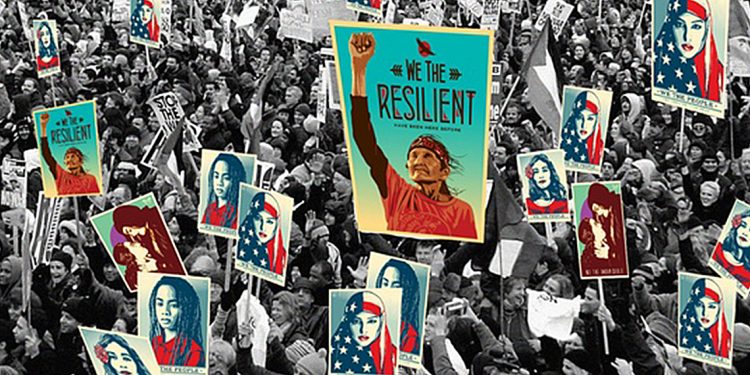
image1

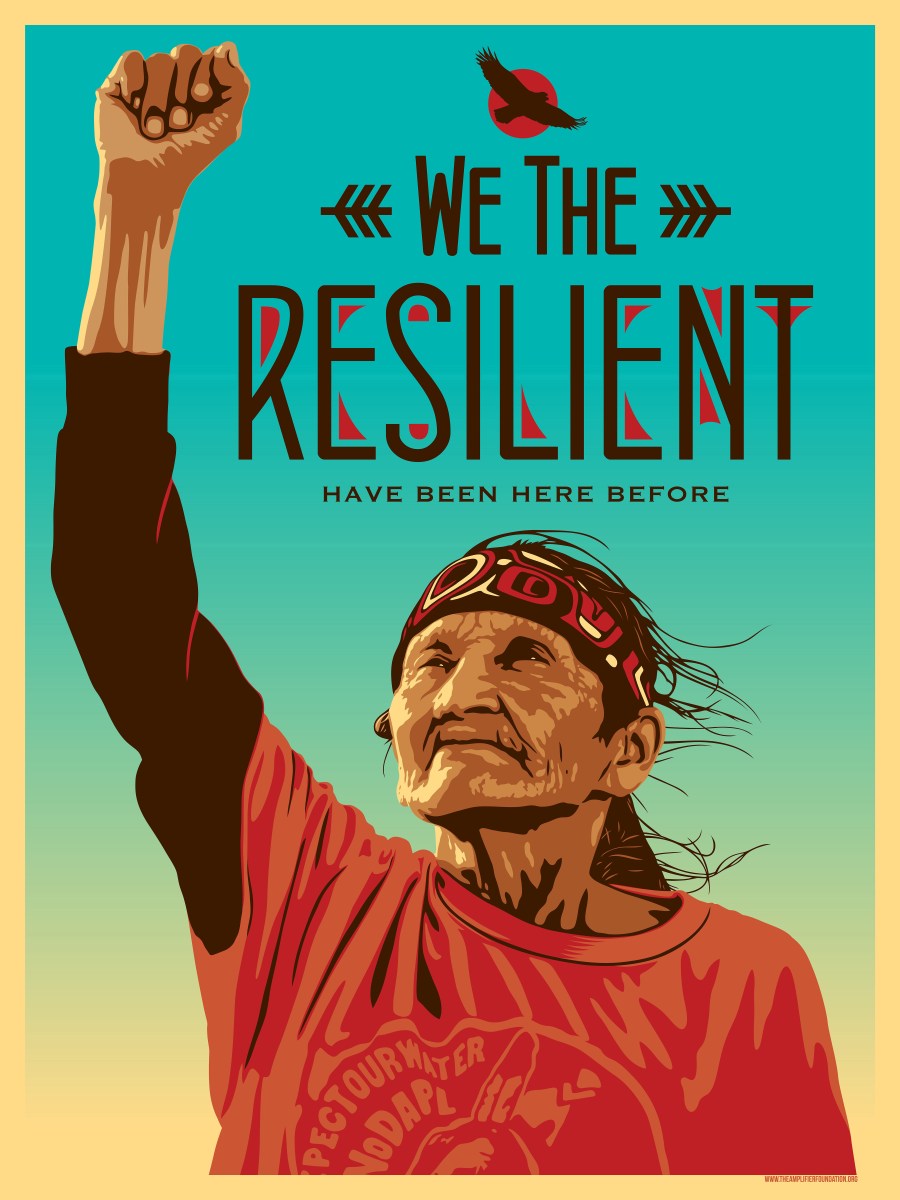
Yerena’s contribution was a stenciled image, featuring Lakota elder Helen “Granny” Redfeather, a protestor fighting against the Dakota Access Pipeline at Standing Rock, where Yerena himself also spent time in the November of Trump’s election. Yerena’s work situates the Lakota elder underneath its title “We the Resilient: Have Been Here Before”.
WE THE RESILIENT FINAL WITH TYPE !!!

Contextualizing his work, Yerena explains

“My relationship with the U.S. is very complicated…I was born here, I live here, but the government is like an occupying force on this land. The colonization process was so violent. It outlawed people from being able to practice Indigenous traditions and languages. How, through all that, have people been able to survive? Considering how hostile the attempted erasure was toward everything to do with our people, Indigenous people, it’s incredible. That’s resilience.”[1]

[1] ‘Meet Ernesto Yerena Montejano: Artist Behind Ubiquitous We Are Resilient Poster’ https://www.colorlines.com/content/meet-ernesto-yerena-montejano-artist-behind-ubiquitous-we-resilient-protest-poster (accessed 2/9/17).

The image Yerena created soon became ubiquitous, a symbol of hope and defiance for peoples protesting the white supremacism of Trump’s election. On January 21 Yerena could be seen distributing his ‘We are Resilient’ posters at the Women’s March in Los Angeles. Yerena himself was born in California, close to the Mexican border.[2] Although identifying as Chicano, he expresses solidarity with the indigenous.[3] His work is dedicated to exposing ‘the weight of colonization and the effects of Westernization of Indigenous cultures’.[4] ‘Trump is the Chernobyl of colonialism’, he explains, ‘but I don’t want to make artwork that’s against him; it gets too dark. I want to make artwork that’s for something. I’m for dignity. I’m for resilience. I’m for Mother Earth. I’m for honoring elders. I’m for working with my friends. I’m for making positive messages’.[5]


Yerena’s positive message can be seen to have already spread. Inspired by the image and Yerena’s message, Sarah Bunin Benor, an Associate Professor of Contemporary Jewish Studies at the Hebrew Union College Institute of Religion in Los Angeles, set to work on a book, now already published, titled We the Resilient: Wisdom for America from Women Born Before Suffrage. The book began life as a website set up in October of last year, designed to give voice to hopeful women voters who had been born in the years preceding the ratification of the 19th amendment in 1920, and who were in the lead up to the election of November 2017, not only able to cast a vote in ways that women not long ago were denied, but vote for what could have been the first female president of the United States, Hillary Clinton.[6] The book, We the Resilient, features interviews with fifty-five of the women who appeared on the website, and who respond to Benor’s questions. Questions that included: when in your life have you experienced personal disappointment, tragedy or unexpected loss? How were you able to overcome those setbacks? Though coming from a variety of different backgrounds, the women tell of similar experiences of disappointment, tragedy, and loss, such as losing parents, spouses, siblings and children, and contemplate how it was they were able to bounce back from those difficult experiences.[7]


Within the health sciences resilience is identified as the ‘trait that enables an individual to recover from stress and to face the next stressor with optimism. Resilient people are considered to have a better mental and physical health’.[8] The analysis of resilience invariably involves examining how people cope with disappointment, tragedy and loss. What divides the resilient self who bounces back from life tragedies from the failed selves who never recover?  Where does resilience come from? What are its sources? Who has it and why? How to build resilience where it is lacking? These are the questions health practitioners of resilience routinely ask. But its growth as a concept within the health sciences can be traced in correspondence to its development in a range of other fields, including the social sciences concerned with the attributes of human groups, as well as the non-human sciences concerned with the study of non-human living systems. Across these different fields resilience is defined as the capacity of any living system, including human systems, both individual and social, to absorb the shocks generated by disastrous events, and respond by either maintaining or changing form, evolving with them, and growing stronger from their occurrence.


The word resilience has existed for centuries. It comes from the Latin word resilire – to rebound or recoil. In the 17th century it described the ability of physical materials to return to their original shape after suffering deformation. Its contemporary use developed significantly in Ecology during the 1970s to describe how living systems recover and evolve following disasters. Gradually it mutated into social science as a way to understand how humans absorb shocks and withstand disasters of multiple kinds. In the era of Sustainable Development it became identified especially with the Global Poor, given their excessive exposure to shocks of a disastrous nature.[9] And more recently it has become a capacity especially attributed to indigenous peoples.[10] This is evidenced not just by Ernesto Yerena’s representation of indigenous resilience in the protest posters, but also by the anthropological literature on indigenous resilience. For indigenous peoples are perceived by western anthropologists to be particularly exemplary subjects of resilience.


Indeed not just anthropologists but policy makers the world over, concerned as they currently are with attempting to formulate policies to help people cope with the coming era of disasters portended by climate change, are attracted to indigenous peoples on account of their perceived abilities to live in a state of permanent crisis. Within the Academy, anthropologists are currently being mobilized to provide ethnographic studies of the practices and forms of knowledge that enable indigenous peoples to do so. For example the Oxford-based anthropologist, Laura Rival, has detailed the ways in which the Makushi, an indigenous people living in the borderlands of northern Brazil and southern Guyana, live with severe drought and flooding as normal conditions of life.[11] This is a people as well adapted to a world of floods as much as it is to extreme drought, Rival argues, and able to cope with whatever the climate throws at them.[12] As such she holds them up as a model for the rest of humanity, faced as it is with a coming era of climate disasters and global ecological catastrophe.


Anthropology has, from its origins, ‘existed in a state of complex symbiotic dependency on government, in so far as anthropologists have been materially and practically dependent on state support to fund research, and the direction anthropological work has taken in any particular period has been influenced by state needs for certain kinds of information with which to govern its Indigenous populace.[13] This is as true today in the context of the mobilization of anthropologists to produce knowledge about indigenous resilience. The arguments and conclusions of academic anthropologists are mirrored in policy reports such as that published by UNESCO, titled Weathering Uncertainty, and which likewise describes how indigenous peoples, on account of their high-exposure sensitivity to extreme weather events, are thought to be especially resilient to climate change.[14] The indigenous are of interest and value to policy-makers because they have a proven track record of what the report describes as ‘resourcefulness and response capacity in the face of global climate change’.[15]


Many are those who interpret this development as a step forwards in the decolonization of relations between indigenous and non-indigenous peoples. For it seems to challenge the west’s teleological sense of its own superiority, debunks it even, and places the indigenous on a pedestal once reserved for the western subject of modernist tradition.[16] What such enthusiasts don’t recognize is the problematic nature of the entanglement of this reversal with white western strategies of power. The ascription of resilience to indigenous people is not something being achieved simply by anthropologists working to the left of western states or other colonial institutions. It is a mantra being repeated by colonial states and deeply powerful western actors worldwide. Such that the representation of the indigenous as possessing exceptional capacities to care for their natural environments, to adapt to climate change, and deal with extreme weather events has become a governing cliché of white western neoliberal governance.


Resilience is advancing throughout the west as a major discourse for the implementation of neoliberal governance. Indigenous peoples are but one target population of strategies for the making of resilient subjects. Nevertheless they are a crucial one, given the arguments beings made for their exemplary status. For this reason anyone concerned with indigenous politics must be circumspect when confronting claims about the inherent resilience of indigenous peoples. For the risks in accepting such clichéd representations of the indigenous are vast, and ultimately complicit with colonial power and neoliberal exploitation. We know much by now about the long history of colonial violence that arose from the western desire to destroy indigenous peoples on account of their perceived inferiority. We recognize much less of the violence which arises from the apparent desire to protect indigenous peoples and the ontological alterity they supposedly embody.[17] Yet that is a form which colonial violence now takes. From South to North, indigenous peoples must resist the violence embedded in neoliberal strategies of resilience, while the anthropologists who study them must beware being drawn into the latest ideologically driven project to govern the lives of indigenous peoples.


What then to make of the artwork of Ernesto Yerena Montajana with which this essay began? And what of the people carrying the ‘We The Resilient’ banners on the protests against Trump? Are they also to be condemned, along with the concept of resilience itself, as part of the problem of colonialism today? Is resilience a univocal concept, or is it open to different usages? I recognize the salience of critiques of the critique of resilience that have appeared recently. I read with interest works arguing we must avoid the cynicism of a blanket dismissal of resilience, distinguish between its positive and negative aspects, and recognize its potential to constitute more open and inclusive democratic political orders.[18] The geographer Ben Anderson has made similar kinds of points when asking ‘what kind of thing is resilience?’ and by imploring that we make the connections between resilience and neoliberalism into a question to be explored rather than a presumption from which analysis begins.[19] These are useful interventions the basis for which echoes throughout this problem of discourses on indigenous resilience. The resilience at stake in strategy documents of international organizations is not the same as that enunciated on the streets of American cities as indigenous people and their allies took to those streets to fight the election of Trump. There are differences between claims concerning resilience. For one, the resilience indigenous peoples lay claim to refers to their having survived a project of colonial extermination, while the resilience which colonial states now identify with indigenous peoples refers to their abilities to survive environmental disasters and pays little heed to their own histories of colonial violence.


Nevertheless, there are relations between these different usages of resilience, and while their points of articulation are indeed different and to some extent opposed, they are nevertheless tied by the concept itself. In each case the indigenous subject which resilience refers to is defined by its capacity to survive. Is there anything problematic in that?


Ernesto Yerena Montajana, like everybody else, has also to survive. An artist has to make a living, and art, for the most part pays badly. In Yerena’s case survival requires once in a while a relative sacrifice of principle. Which is why he sold his work to the manufacturer of the energy drink, Red Bull. Some of their cans are decorated with his signature rose symbolizing dignity and a calavera (Mexican sugar skull).

image3

As he explains, ‘sometimes corporations hire me because they want to tap into the “Latino” market. I take some of the jobs because I need to keep paying rent, but it’s a fine line. What I really want is to make critical, challenging work. A lot of times I have to self-fund or work with a small stipend. Unfortunately, the people with the best ideas don’t have a lot of money’.[20]


Many of us know this conflict between good intention and its sacrifice for survival’s sake. Images, concepts and arguments are all open to appropriation by agencies whose intentions are self-interested, as is the case with the profit-maximizing Red Bull, an Austrian company with the highest market share of any energy drink in the world, selling five billion cans a year; a market share that owes in no small part to the distinctiveness of the blue silver design of the cans in which its drink is sold and on which Yerena’s designs appear.


There is no direct connection between Yerena’s work for Red Bull and the ‘We Are Resilient’ poster that he made for the campaign against Trump. In effect the former served the latter. Selling to Red Bull meant Yerena could pay the rent and paying the rent meant Yerena could design for the Amplifier Foundation and its political campaign against the particular formation of white racist neoliberal capital that Trump’s presidency represents. We have no reason to believe Red Bull saw any capital in hiring an artist with his politics or with his links to indigenous peoples and political struggles. As Yerena states, Red Bull were interested in tapping into the Latino market and it is the resonance of his designs with Chicano culture that attracted them. But there is some faint sense of a connection, in this collaboration between Yerena and Red Bull on the one hand, and the collaborations taking place between resilience and neoliberalism on the other. Red Bull, as the most iconic energy drink of its generation, epitomizes resilience culture. It is what you drink when you are struggling to cope, stay awake, or persevere amid stress, physical or psychic. If you need resilience in a liquid form you drink Red Bull. It is also the drink that besides giving you resilience, gives you stereotypes. On the website, Native Appropriations, a forum for discussing representations of native peoples, including stereotypes and cultural appropriation, a commercial campaign of Red Bull is described as reading like a ‘check list of native stereotypes.’[21] Amid tipis, smoke signals, war whoops, and “tom-tom” drumming, two natives, Brown Bear and White Dove, express in third person broken English their frustrated sexual desire for each other.


‘Greetings White Dove, my heart is heavy’, says Brown Bear. ‘Mine too, Brown Bear’, replies White Dove. ‘The end of the year is near, and we still can’t get together. Brown bear can’t jump that far!’ complains Brown Bear. ‘And White Dove can’t fly! We are only united in mind’ concludes White Dove. ‘Yes, but my body longs for you too’, confirms Brown Bear. White Dove sighs. ‘No Red Bull, no happy ending’, warns the narrator. Yes, Red Bull is not only the drink that gives you resilience. It’s the drink that gets you laid. Or it’s the drink that gives you the necessary resilience to get laid. And, which in sexualizing resilience, also sexualizes indigeneity, making a commercial stereotype out of indigenous perseverance, and stoking colonial myths.


Red Bull is responsible for mythic representations of indigenous peoples, but what about resilience itself? In March this year the Journal of Multidisciplinary Healthcare published an article titled ‘Mental Resilience, Perceived Immune Functioning, and Health’. The article is a classic of its kind, describing resilience as the ‘trait that enables an individual to recover from stress and to face the next stressor with optimism’.[22] People with resilience, it argues, ‘have a better mental and physical health’.[23] People with reduced immune functioning tend to be those who are less resilient, while people with resilience tend to have better functioning immune systems, is the conclusion it draws on the basis of a large empirical study.[24] Like a lot of medical research the article had as many as eight authors, among who is named a Dr. Joris Verster from the University of Utrecht. In the Disclosure section of the article the authors list the sources of financial support that have funded their research. Verster, a proponent of resilience lists among the many different funders he is in the patronage of, Red Bull. Which is interesting. In fact Verster is also the author of a another study, published last year, in the Journal of Human Psychopharmacology, titled ‘Mixing Alcohol With Energy Drink: A Systematic Review and Meta-Analysis’. The article addresses the belief that people who mix energy drinks such as Red Bull with alcohol end up drinking more alcohol than they ordinarily would. Reassuringly, Verster and his colleagues conclude that their research proves that mixing energy drinks with alcohol does not increase the total amount of alcohol consumed.[25]  Which is interesting. What to make of these connections between the science of resilience, so assured in its conclusions concerning the reality of resilience as property of healthy people everywhere, and an energy drink manufacturer which funds the science of resilience, and which employs the same science to defend itself from mythic representations of the properties of the product as a source of alcoholism and ill health? A corporation, and icon of the neoliberal economy, furthermore, which sells its products on the basis of colonial representations of indigenous people, as well as by decorating its cans with the designs of an artist who, unwittingly no doubt, is himself a proponent of indigenous resilience, and the creator of what is the most iconic image of indigenous resilience, the picture of Lakota elder Helen “Granny” Redfeather, carried on banners by the many people who showed up to protest the election of Donald Trump, in Washington DC and other American cities in January of this year.


There is a lot at stake in this nexus of relations between colonialism, capitalism, neoliberalism, the fight against fascism, and the science of resilience, both in the forms it is attributed to indigenous peoples, as well as people everywhere struggling to recover from stress and to face the next stressor with optimism.


Resilience, I agree, is not a univocal concept, and like all concepts in fact, is open to different usages. We should never condemn, or at least be content with condemning concepts. But wherever it is used, and however it is used, resilience is a dangerous concept. Beneath the surface of the seeming positivity with which it has been invoked this year as a defining characteristic of indigenous people everywhere, fighting their dispossession by colonial powers, and struggling to persevere against the racism of colonial states, there lurks a great deal of danger and malign investments. It’s not my place in the world to tell indigenous people who they are or what they are. All I have to say to them is this; be careful. And when you listen to the next anthropologist, the next statesman, the next well-meaning activist, or corporate brand manager, who talks about indigenous resilience, treat the term with the circumspection it deserves.

[2] Ibid (accessed 2/9/17).

[3] http://www.hechoconganas.com/bio/ (accessed 2/9/17).

[4] ‘Meet Ernesto Yerena Montajano’.

[5] Ibid.

[6] ‘Wisdom of the Aged Offers Hope to Clinton Voters’ http://jewishjournal.com/culture/lifestyle/50_plus/219159/echoes-election-2016-women-resilient/ (accessed 2/9/17).

[7] Ibid.

[8] Van Schrojenstein Lantman M, Mackus M, Otten LS, et al. ‘Mental resilience, perceived immune functioning, and health’, Journal of Multidisciplinary Healthcare (10, 2017),107-112.

[9] Julian Reid, ‘The Disastrous and Politically Debased Subject of Resilience’, Development Dialogue 58 (2012), 67-79.

[10] Marjo Lindroth and Heidi Sinevaara-Niskanen, ‘The Biopolitics of Resilient Indigeneity and the Radical Gamble of Resistance’, Resilience (4:2, 2016).

[11] Laura Rival, ‘The Resilience of Indigenous Intelligence’ in K. Hastrup (ed.) The Question of Resilience: Social Responses to Climate Change (Copenhagen: The Royal Danish Academy of Sciences and Letters), 293-313.

[12] Ibid, 302

[13] Melinda Hinkson, ‘Introduction: Anthropology and the Culture Wars’ in Jon Altman and Melinda Hinkson (eds.), Culture Crisis: Anthropology and Politics in Aboriginal Australia (Sydney: University of New South Wales Press, 2010), 5.

[14] Douglas Nakashima et al, Weathering Uncertainty: Traditional Knowledge for Climate Change Assessment and Adaptation (Paris: UNESCO, 2012).

[15] Ibid

[16] Tess Lea, “Contemporary Anthropologies of Indigenous Australia,” Annual Review of Anthropology (41, 2012), 196.

[17] Luc Bessire, Behold the Black Caiman: A Chronicle of Ayoreo Life (Chicago and London: University of Chicago Press, 2014).

[18] Peter Rogers, ‘Researching resilience: An agenda for change’, Resilience: International Policies, Practices and Discourses (3:1, 2015), 66.

[19] Ben Anderson, ‘What Kind of Thing is Resilience?’, Politics (35:1, 2015), 60.

[20] Meet Ernesto Yerena Montajana’.

[21] ‘Red Bull Gives You Stereotypes’, http://nativeappropriations.com/2010/07/red-bull-gives-you-stereotypes.html

[22] Marith Van Schrojenstein Lantman et al, ‘Mental resilience, perceived immune functioning, and health’, Journal of Multidisciplinary Healthcare (10: 2017), 107.

[23] Ibid.

[24] Ibid, 112.

[25] Joris Verster et al, ‘Mixing alcohol with energy drink (AMED) and total alcohol consumption: a systematic review and meta-analysis’, Human Psychopharmacology (31: 1: 2016).

Education for ecological democracy

Michael A. Peters

We have every reason to think that whatever changes may take place in existing democratic machinery, they will be of a sort to make the interest of the public a more supreme guide and criterion of governmental activity, and to enable the public to form and manifest its purposes still more authoritatively. In this sense the cure for the ailments of democracy is more democracy. –John Dewey (1927), The Public and Its Problems.

Environmental ecology, as it exists today, has barely begun to prefigure the generalised ecology that I advocate here, the aim of which will be to radically decentre social struggles and ways of coming into one’s own psyche … Ecology must stop being associated with the image of a small nature-loving minority. Ecology in my sense questions the whole of subjectivity and capitalistic power formations. –Felix Guattari (2000), The Three Ecologies.

Democracy, yet again

Donald Trump’s decision to quit the Paris agreement, a contemptible decision that does the US no good in term of moral leadership and one almost universally condemned by world leaders, raises the question about the structural capacity of democracy at the extra-state level to reach consensus or indeed to action decisions at a global level. Under the circumstances one wonders whether democracy is able to deliver ecological outcomes or whether in the stand-off between democracy and oil and gas capitalism that it has the power to harness and transform the energy sector. The fact is that modern representative democracy was never designed to handle environmental challenges and many scholars now seek the establishment of new global institutions that carries the mantle for intergenerational environmental problems based on evidence-based sustainability science. One set of anxieties revolve around whether democratic institutions based on deliberative forms of government have the power to set new environmental norms, to curb the transnational energy multinationals or to institute change quickly enough in order to avert environmental collapse.

There is some evidence that democratic values increasingly operate now at the global level and multi-stakeholder dialogues between civil society, NGOs, governments and world agencies are now more common, yet some critics doubt whether concepts of world democracy will ever be strong enough to reconcile either radical participatory politics and the world’s energy multinationals, or the climate deniers and the scientific mainstream consensus. Some scientists despair that green diplomacy perhaps best represented in the Paris agreement, where the French hosts acting in concert with many agencies engineered an agreement with 195 countries, can ever protect itself and its environmental policy decisions against the actions of authoritarian thumb-nosing and outright grand-standing on the basis of flimsy ‘America first’ sloganising.

Yet others talk of the longer term transformation of democratic culture aimed at producing green citizens committed to the principles of bioregionalism on the one hand and to principles of discursive democracy on the other, steadfast in their belief that deliberation is the appropriate space in which to change peoples’ habits, beliefs and actions.

Ecological democracy

The term ‘ecological democracy’ (ED) has been established in the literature for a couple of decades (Dryzek, 1992, 1997; Faber, 1998; Morrison, 1995; Ungaro, 2005), if not always in an explicit conceptual formulation. It is slowly evolving as a liberal notion that presupposes a link between democracy and ecology, sometimes cashed out in terms of ‘sustainable development’ or ‘green capitalism’ (‘green consumerism’) while emphasising that ED requires a form of grass-roots participation by citizens both individually and collectively. The exact nature of the link and the success and results of ED have been up for ongoing scrutiny and political scepticism. Both ‘ecology’ and ‘democracy’ are expansive concepts that have been refined and developed over the last couple of decades so it is not surprising that the links between these and cognate concepts are hard to pin down.

There has been a peak in the use of the concept with applications in a variety of settings. For example, an online journal based in India established in 2013 has adopted the name (http://ecologicaldemocracy.net) which it introduces in the following way:

The last century has seen many national movements successfully liberating countries from colonial rule. But since the last quarter of the twentieth century, we have witnessed world-wide schizophrenia in our ‘development’ policies. Global players like the US and European Union and arms of their economic hegemonies such as the World Bank and I.M.F. have forced governments to adopt policies which are resulted in a serious all round crisis, including an ecological crisis. On the other hand there is a multitude of UN Conferences on various dimensions of the ecological crisis. To understand this schizophrenia and to evolve policy frameworks to respond to this crisis from the ecological swaraaj perspective is the need of the hour. Our online journal http://www.ecologicaldemocracy.net is an effort to bring cohesion to the efforts of all who believe in the idea of ecological swaraaj [‘self-governance’ in Hindi].

The term ‘radical’ ecological democracy (RED) stands for degrowth policies, grassroots participation and has been used to demonstrate problems for existing democratic structures (Kothari, 2014; Mitchell, 2006). RED contributes to the search ‘for sustainable and equitable alternatives to the dominant economic development model’ that pursues the ‘goals of direct democracy, local and bioregional economies, cultural diversity, human well-being, and ecological resilience at the core of its vision’ (Kothari, 2014, p. 57). RED also maps on to the concept of ‘radical democracy’ developed by post-Marxist thinkers Ernesto Laclau and Chantal Mouffe starting in the early 1990s (Laclau, 1990; Laclau & Mouffe, 2001). One line of thought, which I support, has begun to map notions of ‘radical’ and ‘open’ on to overlapping concepts of democracy and environment through notions of collective subjectivity (Peters, 2002, 2013).

Hester (2010), in another example, outlines new principles for urban design that he calls Design for Ecological Democracy emphasising how ‘responsible freedom’ rests on respect and acknowledgement of an interconnectivity with all living things. Finally, an example- based on a workshop entitled ‘Ecological Democracy’ that was held at the University of Sydney 20–21 February 2017 that advertises itself in the following terms:

The role of democracy in the face of global environmental threats has been subject to intense scholarly debate over the past four decades. At times, ecological democracy has had a bright future ahead of it. Yet the ideal of ecological democracy continually faces challenges both to its conceptual foundations and to its practical realisation on national and global scales. This workshop will seek to focus on new considerations and directions for ecological democracy, while looking back to examine the impact and viability of its founding texts as well as empirical studies of the relationship between democracy and sustainability.

The wide-ranging workshop included sessions on: Foundations of Ecological Democracy; Rights, Institutions, and Deliberation; Democracy and the Nonhuman; Culture & Ecological Citizenship; Diversity, Culture and Democracy; Ecological Democracy and Indigenous Peoples; Resources, Democracy and the Local. A panel discussion ‘Ecological Democracy – Looking Back, Looking Forward’ chaired by David Schlosberg with Robyn Eckersley, Karin Bäckstrand and John Dryzek as discussants, examine the attempts at reconciliation between democracy and sustainability within environmental political thought including problems of “the representation of the nonhuman, the relationship between democracy and ecological ‘limits,’ and the design of ‘green’ states.” The note continues:

Since this first wave of scholarship [in 1980s and ‘90s] on ecological democracy, there have been numerous crucial developments that pose a range of challenges. On the environmental side, we have seen the acceleration of climate change, arguments for setting planetary boundaries around humanity’s environmental impacts, and widespread acknowledgement that the Earth has entered a new epoch: the Anthropocene. On the political side, we have had the growth of environmental and climate justice movements, the proliferation of institutions for global environmental governance, and the anti-environmental and post-truth era.

In short, the second wave of ED concerns the growth of political movements broadly embracing the concept of environmental justice in an attempt to counteract and address backsliding anti-environmentalism. The third wave of ED takes place in relation to President Trump’s anti-environmentalism, his withdrawal from the Paris agreement, his championing of world oil and gas, and cuts to the jurisdiction and budget of the Environmental Protection Agency. In this political environment, the future of environmental sustainability depends upon more radical forms of ED tied to notions of citizen science and forms of learning as activism.

Origins and possibilities

The concept and practices of ED have developed as part of a broader theoretical re-examination and conceptual development of ‘participatory,’ ‘strong,’ ‘discursive,’ ‘inclusive,’ ‘deliberative’ and ‘radical’ democracy (Barber, 1984; Dryzek, 2010; Ester, 1998; Gutmann & Thompson, 2002; Laclau & Mouffe, 1985; Young, 2000, 2001). These diverse threads spring in part from attempts to revisit democracy after the rise of neoliberalism in the age of globalisation that hastened the decline of social democracy. Social democracy as part of the Keynesian post-war consensus developed an ideology based on the compromise between market and the State that supported the mixed economy and capitalism as the means of wealth generation and distribution that necessitated State intervention based on rights and equality of opportunity to correct the defective tendencies of the market towards increasing poverty and growing inequalities.

In effect, it was largely this attempted compromise that led to the first green social democracies and red–green coalitions in Germany under Gerhard Schroder (1998–2005), the ‘plural Left’ coalition in France (2012–2014), Lipponen’s first and second cabinet in Finland that included socialist and green members (1995–2002), Norway’s red–green coalition (2003–2013), with similar developments in Iceland, Italy, Denmark, Sweden and Portugal. Radical red–green alliances formed in the Netherlands (GreenLeft), Denmark (Unity List), Norway (Green Left Alliance), Italy (Left Ecology Freedom) and Greece (SYRIZA). There are also red/green political alliances and/or electoral agreements between social–democratic or liberal parties with green parties such as the Red–Green Alliance in Canada, Sweden and Italy.

After the demise of the Keynesian-based and the empirically discredited neoliberal variant of capitalism, the goal of transcending global capitalism seems far-fetched and Left parties—Far-Left and centrist socialist—began to question the basis for renewed social democratic appeal. Under the Third Way, social democracy capitulated to neoliberalism and thus compromised the green market solution and no growth policies. Under the rise of authoritarian populism in its first phase with Thatcher–Reagan and then most recently under Trump, working-class voters have been easily captured by anti-immigration far-right parties that promise to bring back industrial jobs at home.

The origins of green parties begin in the 1970s first in Australia and then Germany. By the 1980s and especially after Green Politics: The Global Promise (Spretnak & Capra, 1984), green agendas became more progressively tied to policy issues outside immediate ecological considerations.1 As Mendes (2015) notes the West German Green Party ‘founded in opposition to the guiding principles of the West German post-war consensus’ and their entrance into the Bundestag in 1983 marked a turning point in German parliamentary history but soon also reverted to traditions of political liberalisation with a mixture of classical elements of conservativism over conservation of resources. Jackson (2012, p. 593) suggests the Australian Greens, as a political organisation, are possibly following the transformation of European green parties moving from ‘a movement based party to a pragmatic parliamentary party.’ The question is where do green parties go after the Trump retrenchment of global oil & gas? Is there any legitimate resistance against neoliberalism and authoritarian populism that draws off the working-class vote?

Education for ED

Education has the possibility of bringing together two powerful concepts and international movements of ecology and local democracy that are needed to bring about the transformation of grass-roots civil society. This combination of ‘ecological democracy’ that rests on two fundamental principles—the freedom to participate in local society and our growing awareness of the interconnectedness of all living things. It also draws and encourages the development of new forms of green identity and citizenship.

Peters and González-Gaudiano (2008) observed the evolution of environmental education over three decades towards a new relation to identity struggle, new social movements and green citizenship.

During its thirty years of existence, despite having faced problems and diverse challenges from country to country, environmental education (EE) has acquired a certain influence over the design of educational and environmental public policies on an international level. Throughout these three decades, environmental education has contributed to the configuration of new ontological and epistemological proposals, as well as introducing practices that have become well-established and have made significant contributions to the strengthening of not only the environmental education field but educational processes in general. However, as EE became established a great variety of viewpoints were taken into account and elements incorporated not only from the widest variety of theoretical approaches and philosophical currents, but also from very different schools of thought and action, which established important articulations with complex social movements such as feminism, multiculturalism, peace, democracy, health, consumerism and human rights to mention but a few.

One definition of ED emphasises sustainability in action by emphasising a relationship between biological processes and political subjectivities of participatory democracy considered as a co-evolutionary strategy. Education for Ecological Democracy is based an alternative democratic model that strives to educate students about the norms and values of democracy-in-action and eventually incorporate them as interested citizens into environmental decision-making and collective action. ‘Ecological democracy’ is still a concept in the formative stage. In its radical form ‘it places the goals of direct democracy, local and bioregional economies, cultural diversity, human well-being, and ecological resilience at the core of its vision’ (Kothari, 2014). In educational theory and practice it is closely associated with the notion of deliberation that is considered central to consensus decision-making and majority rule. The principles of deliberative democracy are embraced for their educative power and pedagogical force in teaching secondary school students to reason in democratic for a about ecological issues. The deliberative nature of ED has a strong base in grassroots participation within civil society. In philosophical terms, it is indebted to Dewey’s (1916) Education and Democracy and more recently to Habermas (1984) theory of communicative rationality that proposes the ideal of a self-organising community of free and equal citizens, coordinating their collective affairs through their common reason. Free and open debate is a necessary condition for the legitimacy of democratic political decisions based on the exercise of ‘public reason’ rather than simply the aggregation of citizen preferences as with representative or direct democracy.

From its development in the 1980s and 1990s Green Political Theory or ecopolitics founded on the work of John Dryzek (1987), Robyn Eckersley (1992), Val Plumwood (1993) and Andrew Dobson (1980), participatory democracy has been viewed as a central pillar and key value, often associated with descriptions of decentralisation, grass-roots political decision-making and citizen participation, ‘strong democracy’ (Barber, 1984) and increasingly with conceptions of deliberative democracy. The value of participatory or grassroots democracy also seemed to gel with a new ecological awareness, non-violence and the concern for social justice. Green politics favoured participatory and more recently deliberative democracy because it provided a model for open debate, direct citizen involvement and emphasised grass-roots action over electoral politics.

Local government is often more democratic than any other level of government. At the same time it provides education for the practice of political education instructing children and others people in the art if decision-making that is sensitive to opinions based on local knowledge and on the representation of diverse political groupings and sub-state actors. It is especially appropriate in mobilising community to gain local support for ecological projects ensuring that power is widely dispersed while also encouraging people to rebuild democracy at the local level moving towards forms of self-organisation that can collect, analyse and monitor ecological data on the local environment while hooking up to larger global concerns.

In an era of authoritarian populism based on the echo-chamber of Twitter politics the only sure answer to Trump’s arrogance and world selfishness is to organise, to educate and to motivate the younger generation to take matters into their own hands, combining forms of learning with activism.

Note

  1. The Origins of Green Parties In Global Perspective, at http://www.ghi-dc.org/fileadmin/user_upload/GHI_ Washington/Publications/Bulletin35/35.179.pdf.

References

Barber, B. (1984). Strong democracy: Participatory politics for a new age. University of California Press, 1984.

Dewey, J. (1916). Democracy and education: An introduction to the philosophy of education. New York, NY: Macmillan.

Dewey, J. (1927). The public and its problems: An essay in political inquiry. Penn State Press, 2012.

Dobson, A. (1980). Green politicial thought (4th ed. 2007). London & New York: Routledge.

Dryzek, J. S. (1987). Rational ecology: environment and political economy. Oxford: Blackwell.

Dryzek, J. S. (1992). Ecology and discursive democracy: Beyond liberal capitalism and the administrative state. Capitalism, Nature, Socialism, 3, 18–42.

Dryzek, J. S. (1997). The politics of the earth. Oxford: Oxford University Press.

Dryzek, J. (2010). Foundations and frontiers of deliberative governance. Oxford: Oxford University Press.

Eckersley, R. (1992). Environmentalism and political theory: Toward an ecocentric approach. State University of New York Press.

Ester, J. (Ed.). (1998). Deliberative democracy. Cambridge: Cambridge University Press.

Faber, D. (1998). The struggle for ecological democracy: Environmental justice movements in the United States. New York, NY: Guilford.

Guattari, F. (2000). The three ecologies. Translated by Ian Pindar & Paul Sutton. London: The Athlone Press. Retrieved from https://monoskop.org/images/4/44/Guattari_Felix_The_Three_Ecologies.pdf

Gutmann, A., & Thompson, D. (2002). Why deliberative democracy? Princeton, NJ: Princeton University Press.

Habermas, J. (1984). The theory of communicative action, vol. 1: Reason and the rationalization of society. Boston, MA: Beacon Press.

Hester, R. (2010). Design for ecological democracy. Retrieved from http://www.radicaldemocracy.org/

Jackson, S. (2012). Thinking activists: Australian greens party activists and their responses to leadership. Australian Journal of Political Science, 47, 593–607.

Kothari, A. (2014). Radical ecological democracy: A path forward for India and beyond. Development, 57, 36–45. doi:10.1057/ dev.2014.43

Laclau, E. (1990). New reflections on the revolution of our times. London: Verso.

Laclau, E., & Mouffe, C. (1985). Hegemony and socialist strategy: Towards a radical democratic politics. London: Verso.

Laclau, E., & Mouffe, C. (2001). Hegemony and socialist strategy: Towards a radical democratic politics (2nd ed.). London: Verso.

Mendes, S. (2015, Winter). “Enemies At The Gate” The West German – Between old ideals and new challenges. German Politics and Society, 33, 66–79.

Mitchell, R. (2006). Building an empirical case for ecological democracy. Nature and Culture, 1, 149–156.

Morrison, R. (1995). Ecological democracy. Boston, MA: South End Press.

Peters, M. A. (2002). Anti-globalization and Guattari’s The Three Ecologies. In M. A. Peters, M. Olssen, & C. Lankshear (Eds.), Futures of critical theory: Dreams of difference, 275–288. Lanham, CO: Rowman & Littlefield.

Peters, M. A. (2013). Institutions, semiotics and the politics of subjectivity. In B. Dillet, R. Porter, & I. Mackenzie (Eds.), The Edinburgh companion to poststructuralism (pp. 368–383). Edinburgh: University of Edinburgh Press.

Peters, M. A., & González-Gaudiano, E. (2008). Introduction. In E. González-Gaudiano & M. A. Peters (Eds.), Environmental education: Identity, politics and citizenship. Rotterdam: Sense Publications.

Plumwood, V. (1993). Feminism and the mastery of nature. London: Routledge.

Spretnak, C., & Capra, F. (1984). Green politics: The global promise. E.P. Dutton. New York, NY: Paladin, 1990.

Ungaro, D. (2005). Ecological democracy: The environment and the crisis of the liberal institutions. International Review of Sociology, 15, 293–303.

Young, I. M. (2000). Inclusion and democracy. Oxford: Oxford University Press.

Young, I. M. (2001). Activist challenges to deliberative democracy. Political Theory, 29, 670–690.

Michael A. Peters, University of Waikato michael.peters@waikato.ac.nz

Originally published at: http://www.tandfonline.com/doi/full/10.1080/00131857.2017.1339408


Fukushima: The geo-trauma of a futural wave

David R. COLE

Rick DOLPHIJN

Joff P.N. BRADLEY

Introduction

The authors of this article have constructed an abstract machine, dated and signed, ‘geophilosophy-futural wave-geo-trauma-Fukushima’. In this article, the authors are committed to the view that they have put geophilosophy to work, and thus have performed an inaugural and creative act of thinking, which is entirely consistent with the spirit of the philosophy of Gilles Deleuze and Félix Guattari. Moreover, this abstract machine is an application of Deleuze’s (1994) transcendental empiricism (which can be read as the search for the conditions of singular, creative production) and invents a new mode of thought that encompasses the Fukushima nuclear disaster in 2011. From this perspective, and in developing an unprecedented thought-experiment, the authors have consequently worked with Deleuze and Guattari’s concept of geophilosophy to explore the 2011 Fukushima-Daiichi disaster in the time of the Anthropocene as a singularity of absolute deterritorialization, as a moment when life escapes formations of categorical or territorial capture. The article engages with the pressing ecosophical matters at hand, engineering a compelling set of concepts and questions, in order to think the outside and beyond human finitude. Here geophilosophy is employed to consider the sense of immanence in nature which operates through interactive material processes and between boundaries and bodies of differentiation. The article concludes that the geo-trauma of the nuclear disaster acts as a spur away from the black hole of entropic capitalism, and toward an irradiated homelessness which holds the promise of a new utopos, a site of world-formation and a people yet-to-come. This is both the Zerrissenheit or torn-to-pieces-hood of Fukushima and a time of crisis, a moment fecund with new possibilities. This is the movement of philosophy to a third reterritorialization as set out in What is Philosophy? – from Greek polis, to modern democratic state to the absolute deterritorialization of a future revolution and earth: – in other words, philosophy as infinite movement, as the “utopia of immanence”. This is a movement from third reterritorialization to the possibility of eco-planetary-revolution. In sum, geophilosophy finds its milieu in the time of the Anthropocene.

Geophilosophy: Fukushima and the Anthropocene

Deleuze and Guattari (1988, 1994) anticipate many of the ongoing debates regarding the notion of the Anthropocene (Crutzen 2002). The Anthropocene is a vital consideration at this juncture, as the geological time of man’s intervention on Earth is exactly what this article is about through the example of Fukushima. Deleuze and Guattari predicted the rise of the Anthropocene and the resultant crises such as the 2011 nuclear meltdown in Japan: For example, in A Thousand Plateaus, the plateau “The Geology of Morals (Who does the Earth think he is?)” is precisely dated 10,000 Years B.C., a period before the rise of human civilization in the Holocene, a time in which “the Earth – the Deterritorialized, the Glacial, the giant Molecule – is a body without organs” (Deleuze and Guattari 1988: 40): that is to say, Deleuze and Guattari give voice to the Earth as a response to the Anthropocene. Moreover, in September 1988, in an interview with the Magazine Littéraire, Gilles Deleuze (1995) announced his plans for the near future: “I want to write a book on ‘What is Philosophy?’ Also, Guattari and I want to get back to our joint work, and produce a sort of philosophy of Nature, now that any distinction between nature and artifice is becoming blurred” (155). Although the joint philosophy of Nature was never realized, Qu’est-ce que la philosophie? [What is Philosophy? 1994] was published in 1992. In Chapter 4, “Geophilosophy” of the work, the philosophy of Nature (and the Earth, which might be seen as their translation of Spinoza’s Nature) becomes apparent. Revitalising the sections on Nature and the Earth that can be found in their previous collaborations, their philosophy of Nature focuses on the destabilising of dualisms that separates nature and culture, man and environment, matter and thought; in other words, on attacking exactly those dualisms that are at the heart of critical thinking in the Anthropocene. Their alternative is already found in their opening statement of the “Geophilosophy” chapter, which says: “thinking takes place in the relationship of territory and the Earth” (85). Thinking thus happens in a double movement or “entrenchment”; in a deterritorialization (from territory to the Earth) and a reterritorialization (from the Earth to territory): it is a passage to a third reterritorialization or new Earth and people. As territory and the Earth are inseparable from the moment that thinking (as a mode) begins according to this schema, it is impossible (for us) to take them apart ― in other words, all thought removes itself from a territory, towards the Earth, while it is at the same time installs a territory, removing itself from the Earth. “Thought” itself, moving parallel to the matters from which it breaks free, then necessarily involves both the Earth and territory, while it is deterritorialized and reterritorialized in perpetuum.

This article focuses on the event generated by “Fukushima” in the time of the Anthropocene, an event where the planet, as Deleuze and Guattari say in their own terms in Anti-Oedipus (1983), “becomes so artificial that the movement of deterritorialization creates of necessity and by itself a new Earth” (353). Working from a deep Spinozism, and radically breaking from Eurocentric Cartesianism, that still largely dominates the image of thought in philosophy, Deleuze and Guattari’s geophilosophy emphasises the “situatedness” of thinking principally in two ways: 1) Descartes’ cogito functioned “independent from anything else” (Gaukroger 50), forming both “the starting point for knowledge and the paradigm for knowledge” (50). Consequently, the origin of Cartesian thought and knowledge had nothing to do with the Earth. Cartesian thought reflected upon the Earth, but always already remained fully independent of it. 2) Descartes considered the cogito a distinctly human enterprise: our thinking (all the operations of our soul) is completely in our power and it is only according to our ideas that we envision the outer world (which makes Fukushima in light of the Anthropocene a radical break with this tradition). For Descartes, and in contrast to Spinoza and Deleuze and Guattari in What is Philosophy?, the human mind thinks about something―an animal, a thing, a disaster, or simply: “the Earth.”

By situating thinking between territory and the Earth as ‘entrenchment’, geophilosophy breaks with Cartesianism, because it turns thinking into an immanent activity and refuses to make thinking a solely human enterprise. Situating thinking “in the midst of things” as they occur, Deleuze and Guattari stress that the act of thinking is produced in the zigzagging relation between territory and the Earth. Thinking thus does not wait for man to begin, and necessarily happens when territory and the Earth meet. Spinoza (1955), in response to Descartes, notably offered the situated conceptualisation of thinking in his “Letter to Schaller” (390) in which he goes as far as to say that even the material assemblage called a stone holds the ability to think:

… that a stone, while continuing in motion, should be capable of thinking and knowing, that it is ‘endeavouring’, as far as it can, to continue to move. Such a stone, being conscious merely of its own endeavour and not at all indifferent, would believe itself to be completely free, and would think that it continued in motion solely because of its own wish. This is that human freedom, which all boast that they possess, and which consists solely in the fact, that men are conscious of their own desire, but are ignorant of the causes whereby that desire has been determined. Thus an infant believes that it desires milk freely.

Thinking, for Spinoza, is not a product of the human mind; it isn’t even located “inside” a body. Rather, thinking is what immanently causes the body to function as one, (since in the end its oneness is an illusion of the mind), and to act as one. Spinoza already noted that a body is “always already” a composite―he tells us that every individual is always a series of individuals ad infinitum (see Deleuze’s lecture on Spinoza, 1981; also Dolphijn 2014). The functioning together of these individuals, and, most importantly, expressing the desire to keep working as one (to maintain this particular being) forces the stone, the child or any possible individuality, to action. Therefore, thinking, in turn, is not so much “caused by” its body because this would lead us to the wrong kind of essentialism (there are an infinite amount of causes, unknown to the body in casu). Rather, thinking has its body as its object of thought (it is the idea of the body).

For Deleuze and Guattari (1988, 1994) in both A Thousand Plateaus (The Geology of Morals) and What is Philosophy? (geophilosophy) thinking decisively breaks the Cartesian mind/body distinction and rests on the capacity for entrenchment between territory and the Earth, or between culture (which is not necessarily human) and nature; thought is being actualized immanently, offering new life-forms (Cole 2011) and new images of thinking hitherto unknown or unforeseen. Hence, can we make sense of the event of Fukushima through the ‘geological-geophilosophical’ thought of the Anthropocene, the mixing of territories and the Earth, and the type of thinking that the nuclear meltdown has initiated?

The article is about Fukushima, that moment when a singularity ended the world as we know it and made in its wake both an un-world (immonde) as well as the possibility of a new Earth. Of course, the event of Fukushima was anticipated by dystopic Manga comics (think of Tokyo Magnitude 8.0 or Astro Boy/Mighty Atom), by the historical precedents of Hiroshima and Chernobyl, and by capitalism itself, through the economic imperatives that drove nuclear technology, including the construction of the Fukushima site. This last point is explored by Shirō Yabu (2012) in 3.12 No Shisō, in which he describes the thirst for nuclear energy as being primarily driven by what he terms as ‘nuclear capitalism’.

The concept of geophilosophy in the work of Deleuze and Guattari and in the light of Fukushima and the Anthropocene, pivots on two aspects of how, and in what sense, the singularity of the man-made nuclear meltdown is immanent:

  1. What is the (new) Earth in the context of Fukushima and the Anthropocene, and how does it relate to territory and land?
  2. How is the nuclear disaster and contamination of Fukushima not only in the Earth, but in the end, a mode of geo-trauma of human/non-human subjectivity (see, section IV) that prevents thinking altogether?

By means of rethinking Deleuze and Guattari’s geophilosophy, we note how Fukushima is an excrescent component in the logic of Japan’s post-war development, that its body (in space) and the ideas with which it causes its endurance (in time, see, section II) are situated in Japan. However, such logic does not properly take into account the location of the power plant, the likelihood of future strong earthquakes and fierce tsunamis, and the dangers of nuclear contamination. The schizophrenic “full Earth” as described in Anti-Oedipus (1983), where “the body without organs is the deterritorialized socius, the wilderness where the decoded flows run free, the end of the world, the apocalypse” (176) was unthinkable in terms of Fukushima as a staged event in the realisation of post-War Japanese capitalism. Even if (or when) human beings become extinct because of looming global climate catastrophe, Fukushima remains a lasting monument to the ways in which the insatiable desire or jouissance for constant energy has led to unsustainable invention. Following Geoffroy Saint Hilaire, the pre-Darwinist naturalist, who was more interested in the homologies in life than in genus and species, we read the Anthropocene as a layering of strata (his concept), a thickening of the Earth, with all sorts of sediments (from nuclear waste to socio-economic policy). Not starting from the human being, or from any privileged form of life, the focus on strata allows us to see the power differentials or levels involved with thinking the Earth in the context of the Anthropocene, and today, these differentials tend towards extenuating and obfuscating the intent of human activity. For example, the reasons for Fukushima’s placement are prefaced on the capitalist need for cheap energy to supply Japan’s industry― and this fact sets up a double articulation in terms of why Fukushima was built in such a precarious situation, in terms of modelling a new capitalist Japan after World War II, and in the frame of an obliviousness to global environmental effects that the push to a new Japan has created. The Anthropocene as an over-arching concept or designation for our ‘all-too-human’ times has inter-linked streams, flows or vectors working through it. Especially within the geosciences (e.g., the atmospheric sciences), the results of the Anthropocene indicate the interconnected layerings and feedback loops that define the ways in which human activity is changing the world irreversibly (Steffen et al. 2011). These changes are akin to the point made by Heidegger in Being and Time (1962) who claims that it is when our circumspection confronts the breakdown of equipment as ready-at-hand, that the environment is itself revealed afresh. Similarly, we can say that it is not until there is a traumatic rupture or bifurcation in our thinking vis-à-vis this layering, that what is happening becomes truly apparent.

Fukushima is one such bifurcation point or singularity; it is at once an event of creation and destruction, which has, for example, radically altered environmental thinking about nuclear power as a possible solution to global warming through fossil fuel usage (Chu and Majumdar 2012). In contrast, the mainstream political and conservative mollification of what has happened in Fukushima can divert and stall the asking of questions about possible action or activism as a result of the accident. The political forces that have set Fukushima in place and have justified its funding and construction, work to suggest the implications of nuclear meltdown are not as they in fact are. Fukushima is a singularity that shows how the strata of the Anthropocene work, on all levels of life and in all spheres, and it demonstrates how the various spheres fit together in the context of Japan and in time (sections III & IV). Fukushima realizes the Anthropocene, forming a singular territory of fluid materiality and geo-ideas that continue to create new cancerous webs of truth and lies between its territory and the Earth.

The futural wave and the irradiating plane

If Fukushima acts as a realization of the Anthropocene, as promoted in this article, one way to speculate upon the (end) times to come is through Alvin Toffler’s (1980) idea of the Third Wave. From the perspective of the geophilosophy of Deleuze and Guattari (1988, 1984), the strategic use of Toffler is important because of the ways in which Fukushima in the Anthropocene operates as a fully evolved concept that is at work on every social level from the micro to the macro, and also eats itself into the dimension of time. Toffler’s predictions were based on developments in the information society in the 1970s, and how, for example, democracy could change for the better under pressure from the new information society and increased transparency. Whilst some of Toffler’s predictions have come true, for example, the ways in which the internet has reinvented the limits of socialisation, learning and knowledge, the wholesale refashioning of society due to the information age has not taken place, principally because of the ways in which capitalism has resisted and co-opted such changes (Harvey 2000). Capitalism has been able to deal with Toffler’s utopian ideas, such as changes in and improvements to democracy, through the increased reach of credit and debt forms of financialization and in their very fluctuations (Lazzarato 2012), which have seeped into all aspects of life through learning, and which have been largely facilitated through the combination of electronic mediation and cybernetics. Toffler’s wave notion, figured here as a “futural-wave”, works in parallel to the entrenchment of the geo-idea of Fukushima (as (an)other plane), and captures the ways in which the socius is changing: the futural wave is a time-based, posthuman means to understand the geothought of the Anthropocene – or non-anthropocentric, nonhuman ‘Nature’ in the wake of Fukushima.

If we take the very instance of the singularity of Fukushima: March 11th, 2011, it could be figured as a “shock of the new.” Suddenly, the (conscious and unconscious) mistakes of the past and possible ways forward become apparent as planes collide. Instead of relying on the nuclear power solutions of the previous generation, new modes of energy creation can begin to take precedence, as ideas and in practice, as the dangers of nuclear energy are fully understood and this knowledge is gradually disseminated. However, these changes in thinking and societal organization are not instantaneous, but take concerted pressure, imagination and activism/work on all levels, as the stalling mechanisms in capitalism (anti-production) hinder progress to a better (uncontaminated) life. The unfortunate reality of living in the Anthropocene is that it takes deep ruptures, crises, moments of Zerrissenheit or torn-to-pieces-hood, here figured as societal futural-waves, as adapted from Toffler, combined with the geo-thinking of the strata, to refigure the modes through which society has been organised in the past, and to alter the continuums for society and thinking. Or as Michel Serres (1995) puts it: “Global history enters nature; global nature enters history: this is something utterly new in philosophy” (4). The continued growth and strengthening of global capitalism makes “cost benefit analysis” a matter of life and death in terms of society’s choices around building and maintaining nuclear power stations in vulnerable areas such as Fukushima. As Ronald Bogue (2011) has argued, Deleuze and Guattari’s “people-yet-to-come” (after Nietzsche) is not simply a utopian project, but posits “collectivity as change” that makes a difference in “the now,” involving, in the context of this article, those who have fully realised the folly of Fukushima, and those who would do everything in their power to ensure that a nuclear disaster never happens again.

The futural-wave discussed here is therefore about disruptions in social strata, and, the time-based thinking that can happen because of and in relation to Fukushima and the Anthropocene. Toffler underestimated the power of capitalism to undermine and infiltrate such processes as those that might think Fukushima with the Anthropocene, perhaps because of his Marxist-influenced notion that the capitalist mode of production will be overcome. In contrast, the futural-wave takes on inter-related scientific, political, artistic and strategic meanings, depending on how it is positioned, and pragmatically what work it is set to do in the world. Such an argument about the futural-wave leads to the genesis and question of time in relation to the future in Deleuze. Significantly, the third passive synthesis in Deleuze’s Difference & Repetition (1994) is of the future. The third synthesis is a peculiar force in time that dislocates time and divides the subject or “I.” Williams (2011) and Bogue (2011) have remarked that the third synthesis cannot be understood simply through dislocation, but it is a deliberate reordering and playing with time (or a science fiction of the temporal order).

In the context of Fukushima and the situatedness of this article, Japanese art has concerned itself with time since Hiroshima. For example, in its aftermath, Kurosawa’s classic film I live in fear (1955) works with Fukushima as its extreme limit or next plane of collision. Furthermore, Manga comics such as Astro Boy/Mighty Atom (from 1952 to 1968) and Barefoot Gen (1945 onwards) have incorporated the irradiated playing with time of the third synthesis in the context of Fukushima as a limit thought. At the heart of Fukushima, one could place the writings of noir author Haruki Murakami, whose Kafka on the Shore and 1Q84 meticulously show us how, as Deleuze puts it in Difference and Repetition (1994), “time itself unfolds instead of things unfolding within it” (88). In other words, the third synthesis is a form of novelty or action that produces lesions in time, a “before and after” that, in our case, has been realized with the futural-wave of Fukushima and in the geothought of the Anthropocene. One could say, following Bergson, that the third synthesis or futural-wave constructs time internally as duration, but also tears such duration asunder. Once the violence and loop in time have been achieved, a new sequencing will occur: in the context of this article, around how exactly to deal with Fukushima in the Anthropocene, the consequent geo-trauma that Fukushima has produced, and the new forms of subjectivity that the plateau based around March 11th, 2011 tolerates. A territory, an Earth, an idea has emerged that is so radically different from hitherto notions that a rupture in time, a “crack in the world,” as Murakami puts it, is noticed, producing a non-equilibrium division in which the before (nuclear power in the Anthropocene) and after (alternate power in the Anthropocene) are incommensurable. Put differently, an absolute silence, an absolute nothingness is realising itself as time unfolds post-Fukushima. As non-equal elements pre and post Fukushima, the continuum is thus divided not only as a sequence, but also as a series (Williams 2011).

In the 22nd series of The Logic of Sense, entitled “Porcelain and Volcano,” Deleuze discusses how self-destruction comes out of left field. Something happens that shatters the image and sanctuary of a perfect life – “looks, charm, riches, superficiality and lots of talent” – like “an old plate or glass” (154). This is what he describes as the “terrible tête-à-tête of the schizophrenic and the alcoholic” (154). Indeed, in Transpositions: On Nomadic Ethics, regarding a discussion on the nomadic processes of transformation, Braidotti (2006a), following Deleuze, maintains that the point is to learn how to refuse the sad passions which one feasts upon on “the crest of the wave of cracking-up” (208). If one toils in “the long deep crack” of life, the question is how to learn to ward off the sad affects “of orchestrated demolition of the self” (Braidotti 2006a 213). In Braidotti’s essay “Affirmation versus Vulnerability: On Contemporary Ethical Debates,” she suggests that from the experience and recovery from the crack up, what returns is a new force of health, resistance, adaptability, even ethical transformation, which is productive of difference. As she says, “[p]aradoxically, it is those who have already cracked up a bit, those who have suffered pain and injury, who are better placed to take the lead in the process of ethical transformation …. They know about endurance, adequate forces, and the importance of Relations” (Braidotti 2006b 156). Deleuze takes the line that art itself is a path between the cracks. As he says: “There is no work of art that does not indicate an opening for life, a path between the cracks” (Bogue 2004 9). For Deleuze, and indeed Nietzsche, the question is how to live in and on the surface of the crack, to traverse it, delicately, like the tightrope walker, balancing as ever over the precipice, yet learning all the while how to avoid headlong, hell-for-leather suicidal collapse and thus to resist the perilous descent into nihilism, decadence and despair. In this article we argue that this is precisely the type of sensitive balancing required to live on in the time after Fukushima, as the futural wave constantly extends, mutates and plays with time, as the Anthropocene become even weirder.

One could suggest that, with respect to the futural-wave that unfolds from the caesura that we have called the singularity of Fukushima in the Anthropocene; there are three forms or planes of the future, that is to say, the 1) present, 2) past and 3) future. These forms of the future “groove the Earth” for the people-yet-to-come, as they carry with them and work with forms (material and immaterial) of the future. Such modes of time set conditions and act as contingency in terms of the non-linearity of what happens next. In the context of Fukushima, the force of the Fukushima-Anthropocene geo-idea, for example, which includes the ability to rally against nuclear power and compellingly dispute its continued use in exposed and vulnerable positions, will live or die depending on the ruptures and feedback loops in time that are possible, and the outcomes associated with such rupturing and subsequent assemblage. Deleuze’s third synthesis promotes the thinking through of the absolute complexities of time, which adds another dimension of thought to the gathering of forces necessary to change society with respect to Fukushima. Ultimately, Deleuze and Guattari’s geophilosophy lends itself to avoiding the mistakes of the past (e.g. those involved with nuclear capitalism), but this avoidance cannot be left to gradual changes in society, especially in the context of an irradiating Fukushima in the Anthropocene; it has to do with creating difference and planes on all levels, including the natural world (rethinking the Earth), the unconscious (reimagining and feeling a new world), and the hyper-rational (making a new world). In the next section, the challenge of the futural wave is taken up in the context of the temporal and traumatised dimensions at work in post-Fukushima Japanese society and is read through the trope of “geo-trauma.”

Geo-trauma from within Japan

How does the application of Deleuze and Guattari in A Thousand Plateaus (1988) and What is Philosophy? (1994) make sense of post-Fukushima Japan? Firstly, one can now name a Fukushima-Japanese thinking-praxis that disseminates the rhythm of the irradiated, singular milieu (March 11th, 2011), hence opening up new (possible) worlds. This is a wholly new conception of thought in and for Japan, redefining what it means to think of and according to an infected and traumatised non-place such as Fukushima. In this context, the Japanese Earth, the cherry blossoms, seas, mountains all give rise to geo-ideas, marking the Anthropocentric nuclear age as infected by/in Fukushima. However, one cannot overlook the power and “affect” of the geo-trauma produced on March 11th, 2011, and the social and psychic maladies which have ensued – which are bound up in memory, image, contamination and a frozen temporality where one “works to forget” to the point of karoshi or death from overwork. The geo-trauma of Fukushima functions in a new sense based on the posthuman thinking that the nuclear meltdown has precipitated and constantly gives rise to as a futural wave (see, Figure 1 below).

The anthropologist Chihiro Minato, who appears in Melitopoulos and Lazzarato’s documentary, “Life of Particles” (2012, 82 min), speaks of the adaptation to the environment in terms of interior and exterior “psychosis,” which he argues is a territory or psycho-geography that the Japanese must now negotiate. Minato suggests that “the absolute evil” of the atom bomb is inextricably tied to Japanese desire. Similarly, the adoption of nuclear power is wedded to desire for economic development in post-war Japan. Because of this desire, Minato says that the Japanese are compelled to respond to Fukushima. Geo-trauma, in the context of the Anthropocene and Fukushima, is defined as a form of ecological thinking that takes as its object not Nature per se but the unnaturalisable as such. Drawing on the concept of geo-traumatics, as suggested by Nick Land (2011) and as elaborated on by Reza Negarestani in Cyclonopedia (2008), we can say: “it is not a question of being “open to” something, some object or other, but, rather, of being opened, with all the necessary force that this suggests” (200-1). Geo-trauma helps us to rethink the relation between the human and non-human post-Fukushima, by embracing a notion of violence irreducible to either side of the human/non-human relation and through the very irruption of Fukushima. As Land points out in Fanged Noumena (2011), for Freud, the notion of trauma corresponds to a breach or invasion, the emergence of something alien from the outside that the conscious system struggles to assimilate (333).

Prior to March the 11th, 2011, Koichiro Kokubun writes in his newspaper article, “Beyond Boredom” (2012) that even though the post-Pacific war generation in Japan believed that politics could not change anything in principle, they nevertheless engaged in politics to “pass the time” (taikutsu shinogi). One could say that given the historical structure of Japanese democratic politics and sovereignty, before 3.11, no new image of thought or vision of the future could have been imagined – because Japan had enjoyed its prosperity, while living schizophrenically under the shadow of American imperial will. As such, there is no way to actively engage in politics, except by merely passing the time. However, following the nuclear meltdown, and in the resultant horror and danger to their life, the Japanese people are forced to become “animals” (doubutsu ni naru koto) – compelled to think a new image of thought that fully embraces the ramifications of Fukushima. In an interesting way, this move by Kokubun is a reworking of Deleuze and Guattari’s (1994) geo-conception of thought. Why? Because, as they say, in facing the “ignominy of the possibilities of life” and the shameful compromises of our non-thinking present, Deleuze and Guattari contend that: “[T]here is no way to escape the ignoble, but to play the part of the animal (to growl, burrow, snigger, distort ourselves)” (108).

Amidst the ongoing and complex geo-trauma of the shock of 3.11, Japanese society is confronted with a demand to think a new image of thought, to begin thinking again, especially with respect to an engaged democracy. Kokubun makes the point that there is a pressing need to connect the everyday lives of people with representative bodies in singularly new ways. In this respect, 3.11 is a trigger for people to think fundamentally, in order not to fall back on received opinion, or what Kokubun terms passive democracy (omakase minshushugi). In a similarly critical manner, Shirô Yabu (2012), author of 3/12 no Shisô [The Philosophy of 3/12], writes that Japan remains bound to the logic of a “nuclear state” (a concept borrowed from Robert Jungk). What the 3.11 shock demonstrates, qua simulacrum of the real, is how the dystopia of “nuclear capitalism” (genshiryoku shihonshugi) was pre-existent before the catastrophic accident. Meanwhile, Sabu Kohso (2015) claims that Fukushima remains implicated in a capitalism-driven “totalisation of the world” (52) and, as such, its “apocalyptic symptom” is part of an “unending process toward a radioactive planet” (52). The fissures of Fukushima are, he says, “running everywhere on our existential territories” and because of this, the people of Japan face a crossroads, one towards conservatism and collusion with the nuclear industry, the other to “pry open the fissures” (52) ̶ to destinations unknown. Through the fissures, there is the remote hope to “decompose capitalism” (53), to “turn people’s sufferings into political projects and the different ways we can interact with the planet” (53). So it is this crack or rupture, a break in the clouds, a rend in the protective walls which govern the everyday, which offers the possibility to view something other, not-yet or unforeseen, a new utopos: an emergent island or volcano amidst the chaos.

Congruously, one could argue that post-Fukushima meltdown and the new geophilosophy from, in and about Japan on the singularity of the plateau of March 11th, 2011, is bound and grooved on a course of the autonomous technology of radiation (Winner). The geo-idea/wave of Fukushima forges an irradiated territory with the Earth that pushes the real “out to sea” to envelop the entire Japanese archipelago, and its conception of itself through contamination.

After Fukushima, the abstract movement from “land of hope” to “hope of land” – a relay to and fro, from deterritorialization to reterritorialization – is a question of terra incognita (unknown land) or, in Deleuze and Guattari’s terms absolute deterritorialization, nomadism, drift and utopia. Absolute deterritorialization connects with both the present relative milieu (of irradiated land) and the forces which are curtailed by this milieu (Deleuze and Guattari, 1994 99-100). “The land of hope” metamorphoses into “the hope of land,” as it is a passing from collapse of structure to ungrounded ground, or terra infirma. The absolute deterritorialization of the Anthropocene in light of Fukushima is, pivotally and simultaneously, the search for a new escape fantasy, an off-world sanctuary, enclave, haven or (an)other Atlantis ― sited in the sea of geo-trauma, indifference, separation and mutation – mare incognitum (unknown sea). The futural wave sweeps away the present, as well as assumptions about the past in Japan, made in and for the expansion of a post-war capitalist state as the “miracle economy.” The futural wave could be aligned with an impersonal K-wave or extended cycle of economic activity in Japan, because the course of inexorable inhuman economic logic, or expansion for any purpose ― is tellingly a line of pure madness, destruction, abolition in and for itself. As a consequence, a dramatic interplay between Fukushima as geo-idea/wave and the continuing economic miracle of the new Japan is emerging.

Post-Fukushima Japan is on a journey motivated by the “hope of virgin land” (risōkyō, utopia) as mutated object. The “idea” of Fukushima/Japan ― contaminated and irradiating ― thinks flows of time, images, abstract matter and machines in the context of geo-trauma. Terra firma ebbs in and out of being: irradiated being is a processual, futural ebbing machine of trauma. The future of Fukushima ungrounds the Earth and territory; its pollution remains “groundless,” nomadic. The breakthrough of the ground “ungrounds” the Earth from its moorings and sets it on a course for posthuman and futural becomings ― in other words, “processual virtual immanence.” Fukushima signals a universal breakdown or collapse (effondrement) alongside a universal ungrounding (effondement) – an ‘absence of fondement’ or ground, more cracked spaces than smooth spaces, but more than this, it is also a reversal of grounding and in effect, it is undoubtedly an “absence of ground” in the new Japan (Sauvagnargues 2009 97-98). However, one significant problem for the universal ungrounding of Fukushima is that there appears to be no immediate prospect for a Japanese diaspora, or the possible discovery of a new Promised Land. There is no escape from the viscous hyperobjects of the Anthropocene (Morton 2013 29). Fukushima now reconfigures “the Zeitgeist of precarity” according to Maria Grajdian (Rosenbaum & Iwata-Weickgenannt 2014 119), and is the new threshold of cataclysm and mutation. For example, filmmaker Sion Sono’s “The Land of Hope” in 2012 ― made soon after Fukushima ― represents this new sense of terra-formation as Fukushima. Inhabitants of a made up prefecture are uprooted and ordered to evacuate, never to return. They leave without destination. They flee with neither weapons nor hope. This harsh reality brings home the radical destratification of the Earth in the present epoch (see Figure 1) which is to say post-Fukushima as a fundamental condition of the Anthropocene.

Despite the aforementioned relationless and precarious aspects of the Anthropocene, Slavoj Žižek, in the documentary, “The possibility of hope” (2007), which was made for the film “Children of Men,” speaks affirmatively of the state of being adrift. Discussing the concept of the boat and reflecting on the geo-traumatic ecological crisis facing mankind, Žižek (2007) suggests: “We must really accept how we are rootless. This is, for me, the meaning of this wonderful metaphor, boat. Boat is the solution; ‘boat’in the sense of, you accept rootless, free floating. You cannot rely on anything. You know, it’s not a return to land. Renewal means you cut your roots.” This philosophical sense of cutting of roots and the acceptance of drifting at sea – rendered imperative in post-Fukushima geo-traumatised Japan – functions with the intensification in horror-Manga that we have seen in the last few years, in, for example, the cartoons of Junji Ito (Figure 1). The recent emergence of horror manga as a major genre in the Japanese expressive psyche, coheres with the schizophrenic downgrading of nuclear capitalism, after Fukushima. Put another way, the decoded schizo flows of Fukushima haemorrhage hyperobjects, a traumatic chaos from which ‘we’ – deliriously – pass into thinking the inhuman and the increasingly inhospitable Gaia. Irradiated Japan is posthuman and nothing posthuman is alien to it. And we are thus always already populated by this strange matter, overcoded by an abstract machine which emerges from the futural wave:

eye

Figure 1. Junji Ito. Horror-Manga image, “the irradiating eye”

Conclusion ― After Fukushima and the kizuna to come

Although the Anthropocene may well be part of what Deleuze and Guattari designate the “landscapification” of all milieus in A Thousand Plateaus (1988 181), propelled, as Arun Saldanha claims,  by “the crazy greedy feedback loop that is capital” (Stark and Roffe 2015 201), there is also embedded in Fukushima-Anthropocene, equally, simultaneously and pivotally, a land (e)scapification of all current worlds, milieus, territories and (ir)rationalities of the human – a course of posthuman terra-formation for the people-yet-to-come.

Indeed, as Jean-Luc Nancy insists (2015), nature has reached a threshold; it is nature no more. The earthquake and tsunami render Fukushima not only a technological catastrophe, but also a social, economic, political, and philosophical earthquake. He writes: “We have, in fact, transformed nature, and we can no longer speak of it. We must attempt to think of a totality in which the distinction between nature and technology is no longer valid and in which, at the same time, a relationship of ‘this world’ to any ‘other world’ is also no longer valid” (34). Faced with the enduring geo-traumatic effects mentioned in this paper, we may ask the following questions: How does the philosopher, the friend of the concept, become a friend of the Earth in the time of the Anthropocene and in light of Fukushima? How does one become a friend of territory, a friend of terror-formation or “terra-formation” in Japan, when one is already caked in radiation? How does the philosopher form a provisional friendship with polluted territory and affirm the becoming of mutation? How does the philosopher think the Zerrissenheit of Fukushima and the third reterritorialization to come (eco-planetary-revolution)? How does the philosopher open up to the taking over of the unthinkable? More succinctly, these questions pertain to the question of friendship with the nonhuman. And it is this focus which crystallises the form of thinking in this article. Indeed, this article works in a parallel manner to Hiroki Azuma (2011), who discusses the notion of kizuna or bonds (of friendship), and claims that what 3/11 demonstrates is the conspicuous lack of solidarity and homogeneity in pre- and post-Fukushima Japanese society. He argues that the reality of post-Fukushima is that people remain atomized and alienated from each other in terms of income, location and age. Therefore, in this immonde or un-world the question is: How does one become a friend of radiation and embrace the kizuna, or friendship of the irradiated territory? Moreover, the question “How does one embrace kizuna in terms of the irradiated, impossible Earth?” coincides with Heidegger’s pessimistic view of the Earthrise photograph: “This is no longer the Earth on which man lives” (Wolin 105-106). In response, and faced with a kind of liminal eco-schizophrenia, geo-trauma or Zerrissenheit — so described because Japan’s nuclear capitalism appears hell-bent on more catastrophe, tearing the World away from Nature in its wake — we state that thought is destined for absolute deterritorialization, for all manner of strange becomings: Thought is no longer bound to the Earth on which man lives. How does one de/re-territorialize when one is terra-forming, searching for an island of renewal amidst irradiated seas? How does one embrace one’s “corporeal facticity” in the cosmic-making times of the Anthropocene? How does one embrace the absolute deterritorialization or utopia of a milieu in which and through which one calls, following (Nietzsche and) Deleuze and Guattari (1994) for “a new Earth, a new people” (101)? How is it possible to produce a mode of thinking capable of engineering futural becomings, to produce the thought of a third reterritorialization of the Earth. Post-Fukushima geophilosophy must respond to its current milieu, however traumatically, and contra the unworld or the immonde of Integrated World Capitalism, “create worlds of thought, a whole new conception of thought”, of “what it means to think” in that infected milieu (Deleuze 2004 138). So to ask the most Unheimlich of questions: How to become what one is, in the crack of time, outside of time, for a time yet to come?

Works Cited

Azuma, Hiroki. “For a Change, Proud to Be Japanese.” New York Times. March 17, 2011. Internet resource.

Bogue, Ronald. Deleuze’s Wake: Tributes and Tributaries. Albany: State University of New York Press, 2004. Print.

______. “Deleuze and Guattari and the Future of Politics: Science Fiction, Protocols and the People to Come.” Deleuze Studies 5, (2011): 77-97. Print.

Braidotti, Rosi. Transpositions: On Nomadic Ethics. Cambridge: Polity Press, 2006a. Print.

______. “Affirmation Versus Vulnerability.” Symposium. 10.1 (2006b): 235-254. Print.

Chu, Steven, and Arun Majumdar. “Opportunities and Challenges for a Sustainable Energy Future.” Nature. 488.7411 (2012): 294-303. Print.

Cole, David R. Educational Life-Forms: Deleuzian Teaching and Learning Practice. Rotterdam: Sense Publishers, 2011. Print.

Crutzen, Paul. “Geology of Mankind.” Nature 415: 23, 2002. Print.

Deleuze, Gilles. “Spinoza: The actual infinite-eternal, the logic of relations.” trans. S. Duffy. Les Cours de Gilles Deleuze. 1981. Internet resource.

______. The Logic of Sense. New York: Columbia University Press, 1990. Print.

______. Difference and Repetition. New York: Columbia University Press, 1994. Print.

______. Desert Islands and Other Texts, 1953-1974. Los Angeles, CA: Semiotext(e, 2004. Print.

Deleuze, Gilles, and Martin Joughin. Negotiations: 1972-1990. New York: Columbia University Press, 1995. Print.

Deleuze, Gilles, and Félix Guattari. Anti-oedipus: Capitalism and Schizophrenia. Minneapolis: University of Minnesota Press, 1983. Print.

______. A Thousand Plateaus: Capitalism and Schizophrenia. London: Athlone Press, 1988. Print.

______. What Is Philosophy? New York: Columbia University Press, 1994. Print.

Dolphijn, Rick. “The Revelation of a World That Was Always Already There: the Creative Act As an Occupation.” (2014): 185-205. Print.

Gaukroger, Stephen. Cartesian Logic: An Essay on Descartes’s Conception of Inference. Oxford [England: Clarendon Press, 1989. Print.

Harvey, David. Spaces of Hope. Berkeley: University of California Press, 2000. Print.

Heidegger, Martin. Being and Time. New York: Harper, 1962. Print.

Kohso, Sabu. “Constellations of the Fukushima Problematic: Socialization, Capitalism, and Struggle.” Boundary 2, 42, (3), pp. 37-54. 2015.

Kokubun, Koichiro. “Beyond Boredom.” Asahi Shimbun. February 10, 2012.

Melitopoulos, Angela and Maurizio Lazzarato. The Life of Particles: A 3-Channel Video Installation. 82 mins. 2012.

Nancy, Jean-Luc, and Charlotte Mandell. After Fukushima: The Equivalence of Catastrophes. New York: Fordham University Press, 2015. Print.

Land, Nick, Robin Mackay, and Ray Brassier. Fanged Noumena: Collected Writings 1987-2007. Falmouth: Urbanomic, 2011. Print.

Lazzarato, M, and Joshua D. Jordan. The Making of the Indebted Man: An Essay on the Neoliberal Condition. Los Angeles, CA : Semiotext(e). 2012. Print.

Morton, Timothy. Hyperobjects: Philosophy and Ecology After the End of the World. Minneapolis: University of Minnesota Press, 2013. Print.

Negarestani, Reza. Cyclonopedia: Complicity with Anonymous Materials. Melbourne: Re.press, 2008. Internet resource.

Rosenbaum, Roman, and Kristina Iwata-Weickgenannt. Visions of Precarity in Japanese Popular Culture and Literature. London: Taylor & Francis Ltd, 2014. Print.

Stark, Hannah, and Jon Roffe. Deleuze and the Non/human. Basingstoke: Palgrave Macmillan, 2015. Print.

Sauvagnargues, Anne. Deleuze: L’empirisme Transcendantal. Paris: Presses universitaires de France, 2009. Print.

Steffen, W, J Grinevald, P Crutzen, and J McNeill. “The Anthropocene: Conceptual and Historical Perspectives.” Philosophical Transactions. Series A, Mathematical, Physical, and    Engineering     Sciences. 369. 1938 (2011): 842-67. Print.

Williams, James. Gilles Deleuze’s Philosophy of Time: A Critical Introduction and Guide. Edinburgh: Edinburgh University Press, 2011. Print.

Winner, Langdon. Autonomous Technology: Technics-out-of-control As a Theme in Political Thought. Cambridge, Mass: MIT Press, 1977. Print.

Wolin, Richard (ed). “Only a God Can Save Us.” The Heidegger Controversy: A Critical Reader, Cambridge, Mass.: MIT Press, 1993. Print.

Yabu, Shirō. 3.12 No Shisō. Tōkyō: Ibunsha, 2012. Print.

Žižek, Slavoj. Monologue in film ‘Children of Men’. Alfonso Cuarón, United Kingdom: Universal Pictures, UK. 2007.

Sustainability as ecological potential: Environment, sociology and the posthuman

Nick J Fox and Pam Alldred

Introduction

Our aim in this paper is bring to bear a materialist and monist perspective on how sociology has considered environment, and to develop an understanding of environmental sustainability as a maximisation of ecological potential (Fox and Alldred, 2017). Drawing on the work of Donna Haraway, Rosi Braidotti and Gilles Deleuze, we will promote a ‘posthuman’ and ecological sociological perspective that cuts across dualisms of nature and culture, and sees humans as fully integral to the ‘environment’, with the latter re-thought as the world of physical and social relations that is both productive of – and produced by – the on-going flow of events that comprise the history of the Earth and the universe.

Sociology, humans and the environment

Social sciences such as sociology, economics and political science treat ‘the environment’ as the broad social context for human action, and differentiate between the physical and biological environment and the social and cultural environment (Dunlap and Catton, 1979: 245). We can discern three distinct engagements between sociology and environment.

The first applied a view of ‘the environment’ as basically everything that is not part of a human body, a product of human agency, or a human construction. This perspective has been called by Catton and Dunlap (1978) a ‘human exemptionalist (or exceptionalist) paradigm’. Stevens (2012) describes this as

a fundamental separation between humans and the rest of the animal world, culture being a uniquely human quality that is more variable and able to change more rapidly than purely biological traits; that humans have freedom of choice, subject only to social and cultural factors; … and that human ingenuity and problem-solving shows a cumulative progression that can continue to expand ad infinitum.

Second, social scientists have sought understanding of how the physical environment has shaped human existence. Examples include John Urry’s work on how environmental events such as frequent flooding and longer-term climatic changes affect human endeavour, and Halpern’s assessment of the psychological and social effects of the built environment.  This thread also offers critical insights into public understanding and construction of environmental hazards (Dunlap, 1998).

Third, sociologists have since the 1990s addressed concerns that ‘the environment’ is progressively being damaged by human social and economic activity, and must be protected from the ravages of an ‘anthropocene’ era. Social theorists explore the problems and challenges scientists face when recommending cultural or behavioural changes to address environmental threats, and how society and individuals assess these threats.  Dunlap and Catton (1979) designated this as a ‘new ecological paradigm’, in which humans – though still distinct from the rest of nature – are part of the global ecosystem, and are governed by the same ‘ecological laws’ as other species, which they may not flout with impunity (Stevens, 2012: 580).

A critique of these perspectives

All these environmental sociological angles depended upon sustaining a distinction or an opposition between humans and environment, with the environment ‘conceptually subordinate to society’ (Walker, 2005: 80). Despite environmental sociology’s shift from the exceptionalist to the ecological paradigm, it has remained fundamentally anthropocentric.  Arguably this anthropocentric distinction is ingrained in sociology, with ‘nature’ treated as culture’s ‘Other’ (Haraway).  We can see this in Durkheim’s separation of the social as a causal agency independent of biological processes, Weber’s anti-naturalism, and Marx’s view of humans’ uniqueness in terms of an ability to produce the means of subsistence – for instance, by farming or industrialization.  In wider society, this dualism has also been used as a justification for colonialism, racism, sexism and class domination.

Some sociologists have offered resolutions to the anthropocentrism and nature/culture dualism, including Ted Benton, Gavin Walker and Paul Stevens. But none of these has adopted the radical ontological solution of cutting across the very dualism that sets the social and the natural in opposition.  We shall consequently set out a monist ontology that does not differentiate between environment and humans, and that cuts across nature/culture dualism based on post-anthropocentric and posthuman, materialist theory.

Towards environmental monism: two voices

To address this, we draw on the work of Donna Haraway and Rosi Braidotti.

The feminist biologist turned social theorist Donna Haraway’s analysis of the cyborg, a creature of both flesh and technology, was the hook for her critique of a nature/culture division that underpinned a supremacist politics of sexualisation, racialisation and naturalisation of the West’s Others. She argued that in the contemporary world, we are more and more a mix of nature and culture, as scientific and medical innovations – from prostheses and false teeth to gene therapies and test-tube babies – link bodies to inorganic matter.  However, entities labelled as ‘apes’ and ‘women’ have also – in their different ways – unsettled this dualism.  Cyborgs, simians and women all transgress the leaky boundary between these domains (1991), and consequently provide the means to reveal the continuities between humans and the rest of the material universe, and the means to overturn many other dualisms including those that oppress specific individuals, groups, classes, genders and species.

For philosopher Rosi Braidotti, the justification for overturning a nature/culture dualism lies in the recognition that the interests of humans are not divorced from the interests of other living things and of the physical Earth. Braidotti is critical of both humanism (which elevates humans above all else, and make man the measure of all things) and anti-humanism that (while acknowledging that humanity is not an intrinsically progressive force) risks throwing out the progressive achievements of humanism concerning solidarity, social justice and equality. Braidotti advocates an alternative ‘posthuman’ project that cuts across the humanist/anti-humanist opposition, emphasizing the vital capacities of all matter – animate and inanimate – for self-organization and ‘becoming’.  This is the basis for an eco-philosophy that establishes a continuum between human and non-human matter (2013: 104), and between human subjectivity and planetary ecology, and a posthuman ethics for engagement with the environment, based on a new sense of inter-connectedness between human and non-human.

The monism of new materialism

Materialist ontology starts from the view that there are not pre-existent, fixed entities such as humans, animals, oil and coal, atmospheric conditions, climates, coastlines, economic and political systems, and all the other things that might be part of an environmental event. Rather, all these myriad materialities are relational, gaining form and continuity through their engagements with the other material relations with which they assemble, and through their ‘becomings’.  To this list of materialities we must add the expressive relations deriving from human minds, cultures and societies, such as beliefs, desires and values, ideas and feelings, political movements and institutions, ideologies and discourses, and so forth, all of which can materially affect other constituents of an assemblage.

These disparate relations accrete around specific events. Consider, for example, a policy initiative by public health staff in a city council to improve child health by reducing the number of vehicles using the roads during peak times, thus cutting pollution and road traffic accidents, and encouraging people to walk more or use bicycles (Fox and Alldred, 2016).  This policy is quite complex, and the relations involved may be represented (in no particular order) by the following assemblage.

cars – public transport – bicycles – roads – fossil fuels – renewable fuels – pollution – schools – work places – shops – services – housing – workers – transport infrastructure – local employers – environmental campaigners – council leaders – urban planners –obesity – climate change – etc.

No doubt many other relations are also involved, but this is sufficient for the example. We might explore this event though some general questions:

  • What relations are assembled?
  • What are the affects (and the affect economy) between these relations that assemble them and thereby produce the event?
  • What are the capacities produced in the different relations by this affect economy – what can the human and non-human relations do?
  • What are the micropolitics of the event assemblage – what does the event reveal about which relations in an assemblage are powerful?

Analysis of this assemblage in terms of these questions reveals a multiplicity of affective flows; for instance, an ‘employment’ flow that connects employers, workers, workplaces, houses and economics; an ‘education’ flow between children, schools, houses and so on; a ‘transport’ flow of roads, modes of travel, fuel, pollution, housing, schools, workplaces and so forth; and a ‘climate’ flow of fossil fuels, industry and transport, the atmosphere, the sun etc. The capacities of these affective flows produce the events associated with the assemblage, including economic production, education, traffic congestion, poor air quality, climate change and deleterious health outcomes.  The micropolitics of the assemblage reflect the disparate ways power flows through it, including the development of a city environment that bring workplaces and current and future generations of workers into proximity; the economics and physical logistics of managing daily transport; the economics and politics of cheap energy; and the democratic and technocratic processes of planning a city to achieve a range of sometimes contradictory objectives such as economic prosperity and human health/well-being.

This monist analysis suggests that an issue such as improving child health by tacking air pollution is caught up in a highly complex assemblage, with multiple affective flows and contradictory micropolitics. Traditionally, public health interventions and social science analysis of such complex assemblages have sought to isolate a specific cause/effect flow of affect in the assemblage and intervene accordingly (for instance, banning all ‘school run’ journeys by parents transporting children to and from school, and providing an alternative public transport system).  The materialist analysis that we are developing here suggests another approach which would aim for a more holistic engagement with the assemblage.  Significantly, this would not make a foundational distinction between humans and ‘the rest’, instead adopting a posthuman sensibility that neither privileges nor denies human aspirations, values and desires.  The stages in this process would be:

  • Seek a comprehensive understanding of the affects and the micropolitics that surround the interactions between children and transport.
  • Critically evaluate how the assemblage sustains particular patterns of social, economic and political power.
  • Address the contradictions that emerge between the different affective flows between relations (for example, between the needs of industry and the health of citizens).

To these, we suggest a fourth stage:

  • Explore multiple ways to engineer sustainability into the assemblage.
Materialist sociology and ‘sustainability’

This last point leads us to the second issue we want to address today. Sustainability is a contested concept (Braidotti et al, 1994; Lockie, 2016; Ratner, 2004), which draws into assemblage a range of natural science, ecological, economic, political, social justice and other perspectives on the interactions and conflicts between nature and culture.  Too often however, sustainability is assessed in terms of human needs and desires, albeit those of future human generations (see for example, the Brundtland Report, that defines sustainable development as ‘development that meets the needs of the present without compromising the ability of future generations to meet their own needs’).

More significantly, the monist ontology we have developed in this paper (and its rejection of nature/culture dualism) questions the concept of environmental sustainability or continuity itself. The materialist model suggests that most assemblages are not sustainable and have within them contradictory affects that will lead them to fall apart or transmogrify into something else in a day or an hour or a minute (Deleuze and Guattari, 1984: 5).  After all, the universe, we are told, is not sustainable, some time in the future it will either expand to infinity and slowly chill to near absolute zero, or collapse into a singularity; one day the Earth will fall into the sun and be utterly transformed materially.

An alternative view of sustainability more in line with a materialist ontology of affects and becomings needs to focus upon potentials and capacities (Braidotti, 2011: 312-3; Parr, 2009: 161), and be marked by a posthuman ethics that moves beyond the usual narrow focus on human potential, to instead encompass the capacity of all matter within an inclusive ‘environment’ (that includes humans) to become other (Guattari, 2000: 20). The posthuman ethics that underpins this becoming counters forces and affective flows constrain the environment’s potentialities – be that by exhausting natural resources, filling the atmosphere with greenhouse gases, or limiting human possibilities through poverty, inequity or threats to health – fostering in their place affects that enhance human and environmental potentiality.

This re-formulation provides the basis for a materialist perspective on environment that is not only theoretically grounded in the monist perspective on the world that we have presented, but also provides a means to establish a post-anthropocentric and posthuman research agenda for the sociological study of environment. This agenda, we would suggest, is energized first by the monistic ontology that draws humans fully into the environment from which they have been ontologically differentiated in contemporary sociology, and second, by the assemblage/affect approach that focuses not upon single entities, but upon the affectivities and micropolitics of assemblages. Practically speaking, this means designing and undertaking research that is capable of exploring the constellations of relations that assemble around events, and of unpicking the affects, the capacities and the micropolitics that produce these assemblages.

The challenge for sociology of the perspective on environment that we have set out here is to recognize that human endeavours are far less independent of the non-human world than is sometimes supposed. There is an inclination when undertaking sociological research to focus on the cultural at the expense of the natural (for instance, by adopting an interview-based design and develop an interview guide that addresses human interactions, values, beliefs, feelings and desires, without taking account of the broader ‘environment’ around the participants).  If, as we have argued here, this nature/culture dualism should be dissolved, then it behoves sociological researchers to ensure that their designs can take account of the ecological breadth of affects that are involved in what might at first glance seem entirely ‘cultural’ (or ‘micro-sociological’) activities and events.

Conclusion

We have sought to develop an alternative, monist ontology of environment in which humans are not separate from, but part of an ecology of the natural and the social. This provides not only the basis for a materialist environmental sociology and approach to sustainability, but also the basis for a post-anthropocentric and post-human project.

References

Braidotti, R. (2011) Nomadic Theory, New York: Columbia University Press.
Braidotti, R. (2013) The Posthuman, Cambridge: Polity.
Braidotti, R., Charkiewicz, E., Hausler, S. and Wieringa, S. (1994). Women, the Environment and Sustainable Development: Towards a Theoretical Synthesis. London: Zed Books.
Catton W.R. and Dunlap R.E. (1978) ‘Environmental sociology: a new paradigm’, American Sociologist 13: 41–9.
Deleuze, G. and Guattari, F. (1984) Anti-Oedipus. Capitalism and Schizophrenia, London: Athlone.
Dunlap, R.E. (1998) ‘Lay perceptions of global risk public views of global warming in cross-national context’, International Sociology, 13(4): 473-498.
Dunlap, R.E. and Catton, W.R. (1979) ‘Environmental sociology’, Annual Review of Sociology 5: 243–73.
Fox, N. J. and Alldred, P. (2016) ‘Sociology, environment and health: a materialist approach’. Public Health, 141: 287-293.
Fox, N.J. and Alldred, P. (2017) Sociology and the New Materialism. London: Sage.
Guattari, F. (2000) The Three Ecologies, London: Athlone.
Haraway, D. (1991) Cyborgs, Simians and Women, London: Free Association Books.
Lockie, S. (2016) ‘Sustainability and the future of environmental sociology’, Environmental Sociology 2(1): 1-4.  DOI: 10.1080/23251042.2016.1142692
Parr, A. (2009) Hijacking Sustainability, Cambridge MA: MIT Press.
Ratner, B.D. (2004) ‘Sustainability’ as a dialogue of values: challenges to the sociology of development’, Sociological Inquiry 74(1): 50–69.
Stevens, P. (2012) ‘Towards an ecosociology’, Sociology 46(4): 579-595
Walker, G. (2005) ‘Sociological theory and the natural environment’, History of the Human Sciences 18(1): 77–106.

Acknowledgement

This paper was presented to the British Sociological Association annual conference, Birmingham, April 2016.