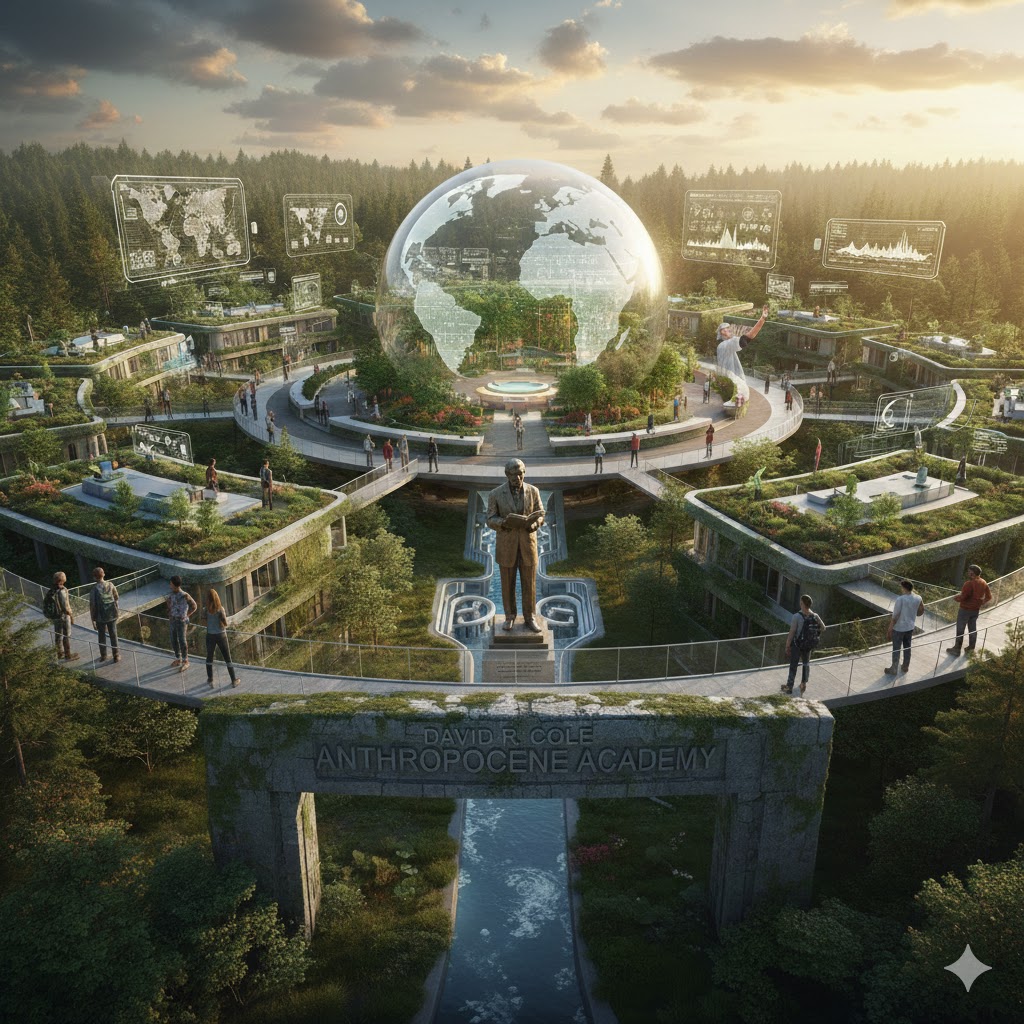
The Anthropocene marks an epoch of unprecedented planetary disruption, driven by human activity. Traditional schooling systems, rooted in disciplinary silos, industrial logic, and anthropocentric assumptions, are ill-equipped to prepare learners for uncertain, interdependent futures. This program brings together academic researchers, teachers, policy influencers, and community members to co-design new models of education grounded in sustainability, critical and creative thinking, systems thinking, and relational pedagogies. Hence, the focus of the program, anchored in the unique local context of NSW, while drawing on international theory and practice, is to develop cutting edge educational innovation for future-inspired planetary wellbeing.
The term, Anthropocene, was introduced to a global audience by Paul Crutzen in 2000 by his publication in the journal Nature. Crutzen was an atmospheric chemist, who won the Nobel prize for his work, and was one of the first to go beyond the chemistry and physics of the release of greenhouse gases, to recognise that the transformative nature of the contemporary industrial situation could mean naming a new geological age after human activity (the Anthropos). Since that time interest in the term, Anthropocene, has exponentially grown. A database search on current publications including the Anthropocene in their titles rendered 474,000 results. However, education has been slow to act and incorporate the findings of the many studies into the nature of the Anthropocene into its practises, including journals dedicated exclusively to its explanation such as: The Anthropocene Review. Hence, the national/international significance of the program lies in following the publications of researchers such as Annette Gough, Marie Brennan, Delphi Carstens, Jane Gilbert and Lesley Le Grange, and critically examining how findings from Anthropocene research can be implemented in learning practices.
In 2025, the ‘Education in the Anthropocene’ program has organized an international colloquium with the University of Shiraz, Iran, and invited Professor Claire Colebrook to speak about Art as Education in the Anthropocene (A Pedagogy of Chaos).
Team members
Associate Professor David R. Cole (Program Leader)
Dr Eva Vass (Program Deputy Leader)
Dr Susan Germein
Ms Jen Dollin (Director, Sustainability Education and Partnerships, WSU)
Dr Sarah Crinall (SCU)
Research Program: Education in the Anthropocene
Provocation (1): What if it’s the idea of the human that’s the problem?
This stakeholder event will focus on the idea of ‘the human’ as enacted through education, community organizations, and industry partners such as those represented by the arts. The idea of the human lies at the base of communication, values, and modes of operation that sets up chains of repetition and continuing to act as if we are still in the past. We are now in the Anthropocene, a new epoch defined by unprecedented human action on planetary and environmental systems, that precisely requires humans to change their habits, beliefs, and actions to maintain liveable conditions for humans on planet Earth. This stakeholder meeting asks participants to:
- Debate the dominant idea of the human that is represented by and through their organizations, how it functions, and how it acts.
- Come up with a new notion of the human, more aligned with the needs and changing conditions of the Anthropocene.
Beneath notions of the human that we must live by in the new conditions of the Anthropocene, are further considerations, such as: How can we change in the Anthropocene? Every individual and organization has specific constraints that define and limit change in their contexts. Hence, further debate is required once a new and relevant notion of the human has been redesigned for the Anthropocene, and the varying positions in which we find ourselves. Constraints such as predefined curriculum, pedagogic frameworks (standards), funding allocations, outreach capacities, mission statements, normative expectations, and externally imposed beliefs (e.g., neoliberal, reactionary) can stymie creativity and make transformation given new conditions untenable. It is the stated aim of this session that we have the collective ability to critically analyse these constraints and come up with viable pathways for a future of flourishing and life.
Video recoding of this provocation:
What if its the human that’s the problem?
Professor Claire Colebrook
Pedagogy of Chaos: Art as Education in the Anthropocene
What value might art have at the end of the world? One answer would be to claim that art ought to make sense of the present, either providing an understanding that would enable activism or an expansion of perceptual horizons that would provide solace in end times. Against this seemingly necessary figurative conception of art Gilles Deleuze tied art to chaos and the destruction of sense, and did so through a practical and pedagogical conception of art. This anti-figurative and highly formal conception of art might seem to be all too typical of the late twentieth-century French valorization of modernism. I will argue that a modified version of a pedagogy of chaos is necessary in an age of brutal literalism
Pedagogy of Chaos: Art as Education in the Anthropocene
Stakeholder Session 2
Provocation 2: The problematic nature of Science in Education in the Anthropocene
Led by Dr Felicity Picken and Dr Sarah M Crinall
In responding to the Anthropocene two divergent paths are often put forward. The first calls for a return or at least slowing down of our current trajectory and a restoration or reinvigoration of pre-modern values, ways of living and knowledges. The second calls for accelerating our movements along our current trajectory in a race to acquire better, more fitting, technological solutions. One characteristic that describes the nature of this divergence is a difference regarding science. Put simply, the former advocates for less science in prescribing a discourse of living well, and the latter advocates for more. As the ideological battle lines are drawn, one path is criticised as regressive, nostalgic, and naïve and the other is criticised as dehumanising, one-dimensional and superficial, yet the pathways we traverse in our day-to-day lives are entangled with elements of both. To misappropriate the metaphor of Robert Frost, this entangled path is the one less travelled in educational settings.
We live in a world that is shot through with science so is it possible or desirable to erase this? Science located the evidence, churned the data, and projected the estimates that forced a global awakening to ecological crises. At the same time, science is a significant actor in creating the very conditions that have dealt these ecological blows. It is both problem maker and problem solver, a factor in as well as solution to the circumstances we find ourselves in (Resttvo1988). These simultaneous truths become particularly stark in educational settings, many of which are the natural home of science, scientific progress, and the procurement of scientifically evidence-based solutions. When every discipline and educational programme is underpinned by some form of scientific reason, if not wholly furnished with scientific content, science becomes somewhat invisible. Yet, if we take account of the Anthropocene, as illustrative of the contemporary world, there is an obligation to factor this problematic and dual nature of science into our teaching practice and curricula. This session which will draw upon our own experiences as educators across of range of educational settings to reflect upon questions like:
- Is there room in educational settings for a fundamental critique of science?
- How would such a critique be delivered?
- How would this re-shape educational settings?
- What benefits would it deliver to students?
- What kinds of resistance or obstacles might this bring?
The session will range across explorations of deep, philosophical implications through to practicalities of educational spaces, content, and practice.
Resttvo, S. (1988). Modern science as a Social Problem. Social Problems, 35(3), 206-225.
What if it’s science that is the problem?
Stakeholder 3 session
Lead: Dr Karin Louise
Provocation (3) What radical acts of being and becoming can we dare to undertake to reimagine our collective future in a dangerous world?
Considering the enormity of the challenge that is living well in the Anthropocene, we face the compounding struggles of fighting off despair, apathy, exhaustion, and deep disempowerment. Cole suggests we seek escape routes from the circular systems that keep us trapped. How then do we create pathways out of this capture in ways that sustain life and possibility?
One of our greatest challenges in a post truth world is to find new ways to speak, to create, and to truly be heard, that pierce through the cacophony of voices so we do not remain isolated in timid silos. If we do not find our voices now, if we do not speak up while we still can, our capacity to dissent may vanish altogether.
This stakeholder event will encourage us to question our own and others power in our lives and what we can do where we are standing right now to effect life sustaining change in our local spaces. What everyday individual and collective creative acts of expression like art making, storytelling, gardening, gathering, wondering, can we call on to be our radical spaces of being and becoming.
This session invites participants to explore three urgent questions:
- How can we, as educators, creatives, community members, and industry partners, start from where we are right now to push back against the great silencing and build cohesive, life-sustaining communities?
- What small but significant radical acts of creativity and solidarity can we undertake to keep hoping, keep going, and carve out spaces for authentic expression and collective transformation, even when it feels safer to stay small?
- Being alive is itself the most creative act, yet does our drive for creativity and discovery also stretch the bounds of planetary resources?
Our individual and collective creative acts have the power to become more than art. They become forces that articulate truths too dangerous or too complex for ordinary speech. They become vehicles for solidarity, clandestine mementos of shared meaning that offer light in the dark. Whether through storytelling, ritual, painting, dance, or community gatherings, creative cultural practices can be radical interventions that defy oppressive narratives and open space for new ways of knowing, feeling, and being. Like artistic creation itself, fluid, porous, alive, the university was once a site for radical thinking and freedom of thought. How might we begin again, together, to reimagine education as a place for exploring what is possible?
What radical acts of being and becoming can we dare to undertake to reimagine our collective future in a dangerous world?
 Institute for Interdisciplinary Research into the Anthropocene