The Anthropocene’s animal? Coywolves as feral cotravelers

Stephanie Rutherford

First Published March 19, 2018 

https://doi-org.ezproxy.uws.edu.au/10.1177/2514848618763250

Abstract

This article considers the irreducible indeterminacy of the coywolf and how this shapes human perceptions of the animal, as well as attempts to manage it. The hybridity of the coywolf matters very much to its interactions with humans, as well as the panic that has ensued over its evolutionary success. They are genetic and morphological intermediaries, an admixture of western coyote, eastern wolf, and dog. They hunt in packs like wolves but demonstrate a fearlessness to humans more common of coyotes. They thrive in urban or semiurban environs, moving along our highway, transit, and green space systems in search of food and shelter. I suggest it is the putative ferality of the coywolf—its margin—dwelling between urban and wild, between wolf and coyote—that disrupts our prevailing narratives about how, and on whose terms, animals can occupy the world. But it is also an animal that offers an opening to think about mutual flourishing. I contend this is a fruitful place to start tackling the questions raised by the Anthropocene, and reimagining all creatures as cotravelers.

Keywords Anthropocenecoywolvesmore-than-human geographiesurban wildlifeferality

Introduction

In 2014, PBS ran a documentary entitled Meet the Coywolf, which introduced its viewers to a new urban predator. But it was an animal with which many were already familiar as it was the lead in a series of stories—from Toronto to Chicago—about dog-snatching wolves. Most startlingly, coywolves hit the national media in Canada in 2009, when a 19-year-old hiker in Cape Breton Highlands National Park was attacked by two canids at the time thought to be coyotes. Other hikers came upon the scene and had to scare the animals away from the hiker’s body in what clearly appeared to be a predatory event. The woman later succumbed to her injuries. In response, park wardens set traps for coyotes in the attack area and eventually killed one that appeared to be acting aggressively. Genetic analysis done on the animal’s body indicated that it was not a coyote, or at least not straightforwardly so. Instead, the hiker was taken down by a critter named at turns the “eastern coyote,” “northeastern coyote,” or “coywolf,” a hybrid of eastern wolf and western coyote, with some dog genes thrown in the mix (Way and Lynn, 2016Way et al., 2010).

This story might have remained a somewhat shocking footnote in the history of Canadian national parks, a stark reminder that wildness still remains. Beyond the Canadian context, it might also have served as an instructive example of what can happen to nonhumans when they transgress human boundaries. But the problem with consigning this story in such a way is that coywolves have not stayed in the wilderness. Instead, like coyotes, raccoons, fox, and sometimes bears and cougars, they have become part of the multispecies assemblages that comprises some of the biggest cities in southeastern Canada and the northeastern United States.

This article contends that notions of indeterminacy that are sometimes embedded in human perceptions of the animal can make it seem unnerving and most certainly out of place. In all respects, the coywolf is an “unsettled mixture” (Tsing, 2012), crossing the supposed species lines between wolf, coyote, and dog; the spatial assignments of wild, rural, and urban; and the categorizations of valued species and vermin. Its indeterminate classification—its resistance to taxa—make the coywolf an indistinct and troublesome creature, and one that works to reveal the instability not just of the boundaries which it exceeds, but the project of boundary making in the first place. As a result, some see it is a form of biological pollution, one that deserves extermination rather than conservation. However, I suggest that the coywolf might also offer an opening that those who care about the more-than-human world would be wise to seize. As Waterton and Yusoff (2017) point out, indeterminacy can work both ways, eliciting all manner of affective responses. Talking about “indeterminacy as a site of political possibility” (p. 6), Waterton and Yusoff show the potential in attending to the unpredictable, unfixed, and incoherent, which requires an acknowledgment not only of the porous relations between animal species, but also between human and nonhuman.

To make these arguments, this article proceeds as follows. First, I situate the case of the coywolf in the broader literature around posthumanism, both within and beyond geography. I also consider the ways that the notion of the Anthropocene has both deepened some of the insights of more-than-human geographies, while presenting new hazards in terms of how we respond to its complexities. Then, I offer an account of the coywolf itself, exploring, as much as possible, the ways in which this creature has come to be in the world, as well as the taxonomic firestorm it generates in its wake. I document the ambivalent reactions these canids engender, where discursive signals often hinge on notions of invasion and impurity, if not toxicity, comparing and contrasting perceptions of the coywolf with historical understandings of wolves. The article ends on the more theoretical question of what the coywolf might teach us about living well in the Anthropocene. It is here that I gesture to notion of ferality (Tsing, 2005; Van Dooren, 2015) as generative, opening up space to rethink multispecies connection.

More-than-human geographies in the Anthropocene

“The animal” has had its moment in the academic sun over the last two decades in (inter)disciplines as varied as political science, anthropology and sociology, English literature, philosophy, psychology, and history. But geography has, in some ways, offered the most sustained engagement with this question. Beginning with early efforts at zoogeography, geographers have been preoccupied with animals since at least the early part of the 20th century. However, the ways that animals have been apprehended in geography have changed through time. As Julie Urbanik (2012: 21–47) notes, there have been three phases in animal geography, with the last taking a posthumanist turn, focusing on the themes of decentering the human while emphasizing animal agency, entanglement, and hybridity (see also Buller, 2014). This has produced what Henry Buller (2014: 310) has called “an emergent scholarly community” where “animals matter individually and collectively, materially and semiotically, metaphorically and politically, rationally and affectively.” As a result of this scholarly community, acknowledging that animals are individuals with lifeworlds of their own, existing in networks with other animals, including humans, no longer represents a theoretical risk. This is thanks to the labors of geographers like Barua (201420162017), Collard (20122014), and Lorimer (200720142015)1 who have demonstrated the ways that all our practices are formed through interspecies relationality; put another way, and to quote Claude Lévi-Strauss (1970), “animals are good to think with,” allowing for the fact that species other than humans shape the places, landscapes, and practices we encounter on a daily basis.

In recent years, the notion of the Anthropocene has become central to many of these analyses of human–animal relations. Now famously defined by Paul Crutzen and Eugene F. Stoermer in 2000 as the proposed geological epoch defined by human intrusion into the biosphere, the concept has taken root across the traditional solitudes in academia, spreading like wildfire in the sciences, humanities, and social sciences. This is no surprise; as Jenny Turner (2017) notes, “it has a luscious mouth-feel, and seems just the thing to bring new urgency and direction to all the tired old arguments about climate change, resource depletion, the future of the planet.” As a scholar of environmental studies, I take for granted the salience of the Anthropocene concept, acknowledging as it does that my species (or at least parts of it) have reshaped the world in ways which are sometimes irreparable. But the trouble with depicting humans as a geological force, of course, is that it is at once awfully self-centered and totalizing. It abstracts up both differential cause and effect, rendering the racialized, classed, gendered, and imperial forms of violence that have, in part, created and perpetuated this human defined moment occluded from view. Instead, an undifferentiated Anthropos has ravaged the wild. It might also be taken to mean that to remedy the worst excesses of the Anthropocene, we need a different yet still totalizing new story to tell. By contrast, Donna Haraway (2016) suggests we should talk about the Chthulucene, which rejects both the boastfulness of the Anthropocene as well as the end of the world-ishness of the Capitalocene, proposed by Jason W. Moore as an alternative. Here Haraway (2016: 55) is at pains to emphasize the chthonic: that which is of the Earth. In so doing, she suggests that the “Chthulucene is made up of ongoing multispecies stories and practices of becoming with in times that remain at stake, in precarious times, in which the world is not finished and the sky has not fallen—yet.” So, Haraway points to what is beneath notions of the Anthropocene, hewn as it is to a fiction of separation, is an exaltation of human mastery even as it decries its impacts. Following Bruno Latour, she provides reinforcements here for the broader sweep of her work; the Chthulucene hinges on the notion that we have never been just human, but are always and inevitably an assemblage, a “tentacular” composition constituting and constituted by the more-than-human world. While I take her critique of the Anthropocene seriously and have long accepted the kind of ontology that Haraway has spent a lifetime so brilliantly espousing, I also think the notion of an epoch defined by human-induced change can be generative, implying both acknowledgment of asymmetrical harm and a responsibility to act. The notion gestures toward an ethical thrust. There are political stakes for accountability to both humans and nonhumans which the Anthropocene implies. Following Collard et al. (2015: 323), the idea of the Anthropocene opens up the possibility of thinking through “abundant futures” while recognizing that we live among “capitalist ruins.”

It bears mentioning, however, that neither posthumanism nor the Anthropocene are innocent descriptors of the world; these can be too-slippery shorthands which simultaneously reveal and obscure. Nor were geographers the first or the only people to think about the ontological relationality that characterizes the more-than-human world. As Kim TallBear (2011) writes of the “interspecies communities” so venerated by posthumanism, “It sounds to me like ‘we are all related’,” a long-held truth of Indigenous knowledge. Indeed, she contends that the recent turn to animal studies leaves out much of the nonhuman that is included in Indigenous relational ontologies—for example, glaciers (Cruikshank, 2005)—which may also be considered lively parts of creation. Zoe Todd concurs in a paper which ties the much heralded “ontological turn” directly to colonialism. She writes of the long wait—in vain—for Western scholars to “credit Indigenous thinkers for their millennia of engagement with sentient environments, with cosmologies that enmesh people into complex relationships between themselves and all relations” (2016: 6). In geography Juanita Sundberg (2014), like both TallBear and Todd, has cautioned those who sometimes wield posthumanism as a shibboleth to recall that what they are saying is not precisely new, and often reasserts colonial dividing practices as it seeks to destabilize them. By claiming, as much of the literature in more-than-human geographies does, that the divide between nature and culture has been universal, posthumanist thought can erase ways of knowing not structured in this way while also reifying the very Euro-American dualism being critiqued. TallBear, Todd, and Sundberg remind scholars, then, to be cautious not only of totalizing narratives, but of those that seek to upend them. Thom van Dooren argues for a humbler view, one which acknowledges both the politics and stakes involved in multispecies assemblages. Van Dooren (2016) writes, “There are worlds in which lives are lived in zones of inescapable overlap. My house, my body, are always already others’ territories too; often without our really ever knowing about the others’ existence.” For the remainder of this paper I contend that the coywolf might encourage this openness to the many creatures that make up our daily lives.

Becomings

Coywolves are recent entrants into the biological record, only emerging in the last 100 years or so. Yet in this time they have displayed a remarkable degree of evolutionary plasticity and adaptability, seizing on the areas “dewolfed” by the bounty across Canada and the United States. The bounty system in both countries served as a technology of colonization, one tentacle in an all-out assault that replaced a complex web of Indigenous nationhoods, lifeways, knowledges, and practices with European ones. The aim of extermination is rendered legible in the context of the anxieties that wolves induced, both similar and different to anxieties generated by coywolves. For white settlers, the transformation of appropriated lands to “productive” use—forestry, trapping, ranching, farming, and fishing—was the mainstay of their lives. Wilderness—and the people and animals that inhabited these spatial imaginaries—needed to be eliminated: one landscape replaced by another. As Jones (2002: 104) attests, “The abundance of wolves in the Canadian West symbolized the primitive state of the region, a condition that had to fall before the advance of civilization.” Put differently, wolves (among others, both nonhuman and human) resisted the sweep of colonial transformation, both actually and by what their bodies represented. With relation to the wolf, anxiety was generated on two registers: the fear of becoming a food source (through wolf attack) and the fear of losing their food sources (by way of wolf predation on livestock) (Coleman, 2006). For instance, the howl of the wolf, so often heard across the early frontier, signaled its failure to submit to colonial will. Many of the stories about wolves in Rod and Gun in Canada, the Canadian equivalent to Field and Stream, recount the panic at the howl of a wolf, in part at the fear of becoming an animal’s dinner (Rutherford, 2016). And their adaptation to the changes wrought by colonialism—for example, prey switching to domesticated ungulates like cows and sheep once elk and deer were less abundant—sealed wolves’ fate. Settler relationships with wolves were dominated by fear.

I would contend, along with Coleman (2006) and Wise (2016) that the root of this fear is that wolves were seen as boundary crossers, upending the natural order which placed white European humans at the top of every hierarchy of which they could conceive. Accordingly, wolves were anachronistic animals; their time had passed. Even those who professed love for the wolf—like Ernest Thompson Seton (2009 [1898]), noted nature writer—saw their fate as inevitable. Indeed, the actual and imagined threats posed by wolves were often read as similar to those presented by the Indigenous peoples they sought to displace; both hinged on notions of moral corruption. This was so much the case that wolves were often conflated with Indigenous peoples. Of course, the efforts to put animals and Indigenous peoples in the same discursive space have long been a strategy of colonialism in North America and elsewhere, serving as a mechanism to legitimize the stealing of land (Braun, 2002Thorpe, 2012). For settlers, wolves and Indigenous peoples were reminders that the colonial project remained unfinished. Nowhere is this made clearer than in the invocation of wolves as part of the “civilizing mission” at Canadian residential schools. For instance, a 1935 letter written by the Acting Secretary of the Department of Indian Affairs to the Principal of the Anglican Indian Residential School in Aklavik, Northwest Territories, asked that nuns embark on a “campaign of education” to convince students they should “destroy wolves” and end the Indigenous “superstition” against wolf extermination. The Principal replied that the school would “make every effort to eradicate the superstition from the native mind” (Correspondence between Parker & Mack, 1935 – 1936). In the kind of nation imagined by the Department of Indian Affairs, neither the wolf, nor Indigenous understandings of it as more than a beast to be eliminated, could survive. A similar conflation can also be seen in the US, where Michael Wise (2016) contends that wolves and Indigenous people (specifically the Niitsitapi) became central to defining a difference between predatory and productive labor. Wolves and the Niitsitapi were put in the same discursive space, both understood as predators in a nation that sought to redefine work as only productive. Wise suggests that one of the key tasks of colonization was boundary making, and both wolves as Indigenous people found themselves on the wrong side of this line of demarcation. Bounties, which spread to each province, territory, and state in Canada and US from the 1700s to the mid-1900s, worked to make the killing of those animals that threatened colonial progress profitable.

Bounties served a variety of aims (in Canada, see Loo, 2006; in the US, see Coleman, 2006), but perhaps chief among them were boundary maintenance and the reinscription of order on a landscape in transition, to ease the anxious settlers’ mind. Wolves were seen by colonial settlers as rapacious beasts and ambassadors of the uncontained wilderness the imperial project sought to subdue (Rutherford, 2013). As vestiges of a supposed uncivilized time, their destruction became imperative. And the bounties in both Canada and the US achieved much of their aim, such that wolves were eliminated from much of their range in both countries at the turn of the 20th century. As a result, by the early 1900s in Ontario, Canada, eastern wolves (Canis lycaon)—something of a hybrid itself, or at least subject to taxonomic debate (Grewal et al., 2004)—were hunted for bounty or killed by government predator control units until near extinction. As keystone predators, wolves limited coyote range extension, which were found in the southwestern US since the Pleistocene (Pennsylvania Game Commission, n.d.). However, the gap created by the bounty meant that coyotes could move east, expanding their population and extending their range. According to Kays et al. (2010: 89), “coyote colonization was fivefold faster via the northern route through Ontario, which exposed them to wolf populations, compared with the southern route through Ohio, where wolves were extirpated prior to coyote expansion.” The speed of this colonization was amplified by the landscape change that coyotes encountered, one in transition to large-scale industrial agriculture. Because wolf numbers had been so decimated, they began to look upon coyotes—animals that wolves would normally drive from their territories—as potential mates (Way, 2013Way et al., 2010). In this way, human persecution of wolves made the coywolf an evolutionary possibility; we created a window for a new species to emerge, one which thrives in wilderness and disturbed ecosystems equally well (White, personal communication, 2013) and by some estimates, now number in the millions in northeastern US and Canada (—, 2015). In the course of less than 100 years, they have become the largest predator in the region and have taken their place at the top of the food chain (Kays et al., 2010). But this would not have been possible without the enactment of settler anxieties about wolves and the colonial imperative to reshape the land. As Brad White, a geneticist at the forefront of canid research suggests, “this animal is a creation of human impact on the planet” (White in Vyhnak (2009)). Put another way, the coywolf is an animal of the Anthropocene.

Yet, there remains much debate in the scientific literature and amid conservation circles as to whether the coywolf is an actual “thing.” By way of example, one might take a quick look at a recent debate that played out in The Conversation, an online platform meant to deliver academic research and opinion on a range of issues in an accessible and interesting way. In November 2015, zoologist Roland Kays (2015) wrote a piece for the website contesting the use of the term coywolf. The author takes issue with the word because it imputes, in his view, equal gene contribution from wolves and coyotes. Kays asserts that the coywolf remains mostly coyote (somewhere between 60 and 84%) and in some cases there are animals with almost no wolf genes. As such, “there is no single new genetic entity that should be considered a unique species” (Kays, 2015) and hence, no coywolf. He concludes the article with the somewhat testy exhortation, “Call it a distinct ‘subspecies’, call it an ‘ecomorph’, or call it by its scientific name, Canis latrans var. But don’t call it a new species, and please don’t call it the coywolf” (Kays, 2015). In May of 2016, the other side answered. Jonathan Way, who has written extensively on coywolves, including the book Suburban Howls: Tracking the Eastern Coyote in Urban Massachusetts (2007), entered the fray. Way (2016) argues, contra Kays, that the coywolf is in fact a distinct species and should be hailed not as a coyote variant, but as Canis oriensWay (2016) contends that the animal is “significantly different—genetically and physically—from their parental species since the coywolf is about 60 percent coyote, 30 percent wolf, and 10 percent dog; thus, nearly 40 percent of this animal is not coyote.” He ends his intervention with the suggestion that coywolves might act as something of conservation role model, demonstrating the importance of not only protecting species that live in wilderness, but also those with whom we are more likely to share space.

Whereas Kays’ argument hinges on similarity—coywolves are too much like coyotes—Way’s functions on difference—they are dissimilar enough to be considered their own species. The language seems to matter quite a bit here, working as it does to enforce taxonomic boundaries that reify species divides. These arguments also suggest that the divisions between species are more calcified than they may actually be. For my purposes, this debate is less interesting as a means to determine the truth of species-hood, and more because of its insistence that defining the animal as either a distinct species, or not, is central to understanding it. And so, I use the term coywolf precise to stick with its indeterminacy, for its inability to be contained either by the geographical imaginaries that are imposed upon it, or the species boundaries which its body actively resists.

Dwelling in between

What is interesting about coywolves is the blend of morphological and behavioral traits they display from their progenitors. For example, they fall between wolves and coyotes in size, somewhere between 30 and 55 pounds. They hunt in packs, like wolves, but demonstrate a degree of fearlessness, or at least curiosity, toward humans—more of a coyote trait. They thrive in urban environs, moving along our highway systems, abandoned rail lines, and segmented green space in search of food (Cortorneo, 2013). They are opportunistic omnivores, with the ability to eat deer (because of their larger jaws) or urban compost (cbc.ca, n.d.). There have also been reports that suggest that the animals are “bolder and smarter than regular coyotes” (Vyhnak, 2009). And it appears it is their very hybridity that has ensured their evolutionary success; rather than genetic pollution, interbreeding has led to species strength in the form of adaptability (—, 2015; Velasquez-Manoff, 2014). Coywolves, like Rosemary-Claire Collard’s (2012: 24) cougars, are “hard to pin down.”

The unsettledness of the coywolf has in some cases provoked a fearful response that has been part of the media narrative around the coywolf expansion across southern Canada and the northeastern US. This disquiet follows, at least to some degree, the well-worn grooves laid down by settler interactions with wolves. Like wolves, coywolves are seen as out of place. They occupy places that wild animals should not. For wolves, there very presence marked them for extermination. In the case of coywolves, it is their presence at the margins of city life which generate affective responses in the humans that encounter them. This is especially true because of their ubiquity. Since their first sighting in central Ontario in 1919, coywolves have in recent years become something of a shadowy fixture in urban and suburban areas. As a result, the interactions between coywolves and humans have grown. While they might be difficult to categorize, for many, especially those who have lost a beloved family pet to their predations, coywolves fit the definition of “urban terrorist” assigned to other “trash animals” (Nagy and Johnson, 2013: 2). Predatory wildlife in the city presents challenges to our normative spatial understandings of what belongs where, generating registers of fear and anxiety around wildness radically out of place. As Jennifer Wolch (19962002) suggests, the urban setting offers an illusory sense of separateness from nature, where the ordering and segmentation of space proceeds almost entirely on human terms. But, of course, animals and other nonhumans have always been integral to cities not only in the form of urban wildlife but also pets, livestock, disease vectors like cholera, cockroaches and bedbugs, and so on. Moreover, rather than eschewing contact with humans, some animals may choose to live in close proximity for a number of reason, like access to food or safety from hunters (Thompson, 2007). Despite this evidence, the idea the cities are somehow antinatural is prevalent, causing Jerolmack (2008: 88) to suggest that urban wildlife “signals a cityscape that is not subdued.” As a result, intrusion upon this fiction is often vigorously policed, particularly if the multispecies encounter leads to human loss (property damage, missing pets), or perceived loss (“aesthetic insults”) (Wolch, 1996: 35). For example, the flying fox, a large fruit bat native to Australia, has been purged from its chosen home in Melbourne’s Royal Botanical Gardens (Thompson, 2007). So too have Van Dooren’s (2016) “unwelcome crows” in Hoek van Holland. Along the same lines, the coywolf, with its less predatory cotravelers, like raccoons, rats, weasels, feral cats, and fox, disrupts our narratives about how and on whose terms animals can occupy the world.

It is in part because of the very indeterminacy of the coywolf that how humans encounter its presence in (sub)urban settings is amplified. Writing about coyotes in Toronto, Blue and Alexander (2015: 155) contend they “refuse to remain within such tidy geographical orderings and imaginaries. In transgressing these categories, coyotes can be viewed as out of place and risk inciting potentially dangerous reactions for the human community.” The coywolves’ success in using urban infrastructure—of moving along remnant greenspaces designed for recreation, of using highway off-ramps for dens, of howling at the sound of fire truck sirens—suggests a sense that they can navigate urban terrain capably and without human awareness. They are synanthropes that have adapted to urban environments and “are able to adjust their behavior to habitat fragmentation and human activities” (Birnie-Gauvin et al., 2016: 417). Put differently, coywolves are novel animals for novel ecosystems that show a kind of phenotypic plasticity that some find so troubling.

To determine popular perceptions of the coywolf, I took aim at the proliferation of news sources which have turned their attention to this creature in the northeastern US and southeastern Canada, conducting a systematic search of news aggregator Factiva, spanning the first mention of the coywolf in this source in 1994 to October 2017 (with mentions peaking in 2015). This yielded 193 publications dealing with the coywolf. However, this approach to accessing public opinion has its own hazards. As numerous animal geographers have pointed out, animal subjectivity is lost when a scholar only looks at narrative sources about animals (cf. Hodgetts and Lorimer, 2015Van Patter and Hovorka, 2017). I agree wholeheartedly with this admonition to pay attention to the lives of animals. However, my goal here is less to understand coywolves’ lived experience (which is better left for another article), than to get at the way their indeterminacy has generated affective responses, often concentrated (though not entirely) around fear and panic.

Some of these articles were reflective think pieces on the emergence of coywolves and their remarkable capacity to live in some of the biggest cities in Canada and the US (cf. Matheny, 2015; Richardson, 2015). Others were more focused on the taxonomic classifications that such critters resist (cf. Miller, 2015). However, a good number displayed angst at a new predatory force that seems capable of moving among our spatial and genetic categories with east. Take, for example, some of the more overwrought headlines:

Victoria Beach under siege by a vicious new predator—Winnipeg Free Press (Owen, 2015)

The super coyote is here…They are here, maybe right in your own backyard, and they’re bred to hunt.—Windsor Star (City Desk, 2013)

Coyotes taking over East Haven backyards—WTNH Connecticut (Simoni, 2014)

This is our town’s Jaws—Motherboard (Knafo, 2015)

Coywolves have taken over the Northeast—Business Insider (Welsh, 2014)

Coywolves, coyote-wolf hybrids, are prowling Rock Creek Park and D.C. Suburbs—(Dingfelder, 2014)

Of course, as mentioned above, these are not the only stories to tell about human–coywolf encounters. Some media outlets have been far more admiring in their depiction of these canid hybrids. But I would suggest that these stories—the ones that dwell on the affective registers of panic, fear, and horror—are the ones freighted with the most potential to impact the lives of coywolves. While, each of these news reports might be read as a hyperbolic lead to attract viewers in a media-saturated market where “click-bait” is prevalent, the degree of fear and disdain is palpable as one delves further into these news reports. For example, in the case of Chappaqua, New York, an affluent suburb in Westchester that is home to Bill and Hillary Clinton, the presence of coywolves has torn community ties precisely along the lines of those who believe the coywolves should be trapped and killed because of an impending “coyote jihad” (sporting freshly made coyote gloves at town meetings to emphasize the point), and others who suggest that maybe we need to find better ways to live together (Knafo, 2015). In the case of Victoria Beach, Manitoba—and in the absence of any documented cases of coywolves—the description given is of a pack of roving (and ravening) canids, completely unafraid of humans (Owen, 2015). Indeed, members of the suburban community indicated they preferred the long-reviled wolf to the coywolf, because it stayed away from humans; wolves it seems, unlike their kin, know their place. Members of Victoria Beach asserted they felt “under siege” from having to keep their pets inside (Owen, 2015). Similarly, in a central Ontario town called Gravenhurst, resident Lori Kennedy recounts being attacked by a coywolf as she attempted to rescue her pet cat. She remarks that since the attack “the neighbours have all been living in fear” (Kenny, 2014). Bette Jean Crew of the Ontario Federation of Agriculture echoes this sentiment: “From what I know talking to farmers, the animals are getting bigger and bolder” (Winsa, 2011). The article goes on to suggest that “in recent years, stories have spread about the hybrid eastern coyote, a once solitary animal that now hunts in packs like a wolf and lures off expensive guard dogs so other pack members can move in for the kill” (Winsa, 2011). Carol Kaesuk Yoon’s (2010) coyotes are wily too, charged with four attacks on children in one summer and leaving the community on alert from this new suburban predator.

Most articles also deal head-on with the indeterminacy of the coywolf, remarking on wolf–coyote hybridity in the US and Canada in sometimes less overstated but no less important terms. For instance, as far back as the early 1990s, the Toronto Star (1990) suggests that “[w]olves are threatened by a lust for coyotes” in ways that “threaten their genetic integrity.” Ron Nowak (1995: 1), a former United States Fish and Wildlife Service zoologist, amplified this concern in a 1995 article for Canid News, where he outlined the taxonomic peril with recognizing hybridization.

The wolves of North America are under a severe new threat from an influential group; not the lumber companies, fur trappers, or stockman, but the zoologists, or at least some among them who are keen to publish claims that wolf populations have hybridized with other species.

A more recent article about wolves in a national park in western Quebec echoes this lack of distinction, suggesting that in the six packs found in Gatineau Park, the lines between wolf, dog, and coyote are blurred (Spears, 2015). Indeed, almost all of the articles I looked at referenced the “canid soup,” the futility in separating out species lines among canid populations as exemplified by the fight about whether coywolves are a distinct species or not. The presence of the coywolf alerts us to the invention of species boundaries in the first place.

The discursive signals in these articles work through fear of a new predatory species or the biological risks it poses, and often hinge on the notion of invasion and intrusion—that coywolves represent some kind of biorisk that needs to be eliminated from the urban landscape. This terrain has been expertly covered both with reference to predatory wildlife (cf. Collard, 2012) and with the broad literature on so-called invasive alien species (cf. Larson, 2008). Invasion carries its own lexicon of political prescriptions, but the vast majority dictate extermination of one species for the conservation of another (Ritvo, 2017)—the one which is “in place” rather than exceeding its spatial or species boundaries. Similar to wolves, those species deemed out of place, either by virtue of geography or taxonomy, unsettle the certitude with which humans navigate the world. And yet, in my estimation, it is not just that the coywolf is wild but that it occupies a space in between that gnaws at the edges of normalcy in urban life. The coywolves’ success in using urban infrastructure—of moving along remnant greenspaces designed for recreation, of using highway off-ramps or overturned canoes for dens, of howling at the sound of fire truck sirens (Meet the Coywolf, 2014; Way, 2009)—suggests a sense that they can navigate the urban terrain capably, making use of the novel ecosystems we have provided for them. Rather than wild, I would suggest it is the instability of coywolves that has induced the kind of moral panic we see elaborated in these news reports. At the root of this is the notion that the coywolf is an abject animal. For Kristeva, the abject has to do with “what disturbs identity, system, order. What does not respect borders, positions, rules” (Kristeva, 1982: 4; see also Van Dooren, 2015). The coywolf represents the loss of distinction, of secure moorings with which to define not only the human-dominated landscape of the urban, but even the supposed impermeable divisions between species themselves. Not only does the coywolf resist our spatial categories, it refuses our notions of genetic purity. Its biggest violation is that it insists on being in the first place. It is, as Donna Haraway would suggest, a string figure, emphasizing the knottiness of enmeshed living. This I think, if nothing else, is what is fruitful in the idea of the Anthropocene. For all of its conceits around the importance of humans to the stories of the earth, it does invite a recognition that the world only operates via entanglement. Coywolves, then, can be thought of as an embodiment of the Anthropocene’s most interesting conceptual elements. They call into question what Fiona Probyn-Rapsey (2017) has called the “purifying logic” we apply to the nonhuman world, pointing instead to the evolutionary possibilities of hybridity, of unsettled mixtures, of indeterminacy.

Historicizing hybridity

As mentioned above, some of the responses to coywolves follow a longer lineage of both fascination and revulsion around hybridity. Hybridity, as Homi Bhabha (1995) so famously remarked, is a site of ambivalence. One can see this ambivalence at work when looking at animals like the coywolf that unsettle our taxonomic practices. As Caccavale and Reise (2011) suggest, monsters captivate. Those creatures that do not fit within our classificatory practices are at once bewitching and abhorrent, titillating yet disquieting (see also Ritvo, 1998). This ambivalence is often sutured through a reestablishment of the categories that such creatures unsettle. This is very clear in the insistence that the lines between species are distinct and bounded. However, the emphasis on species boundaries is as much an imaginative act as a biological one, yet one which is “deeply rooted in our culture” (Caccavale and Reise, 2011). Since Ernst Mayr’s elaboration of the biological species concept, based on the notion that species boundaries are calcified through the (im)possibility of breeding, this understanding has become normative way of conceptualizing species distinction (Mitchell, 2016). But, as Mitchell (2016: 34) points out, this move to abstraction can only be maintained by disregarding “the creative promiscuity and proliferation of life forms.”

As Mitchell, Latour (1993) and others have signaled, beneath the boundary policing between species, hybridization thrives. Perhaps because of this, efforts at purification may be redoubled. In revealing the historical contingency of species divides, animals like coywolves are rendered unworthy of conservation (Stronen and Paquet, 2013) in language that often echoes eugenic desires to purge the body of impure elements (Pêgas, 2013). Referring to the instability of these notions, as shown by genetic modification, recombinant DNA and animal hybridization, Caccavale and Reise (2011) go on to suggest “This has provoked a deep anxiety among many people, an anxiety that has been variously described as a rejection of the ‘unnatural’ or a fear of the ‘alien’ or the ‘dangerous’.” Conservation biology is not immune to these views, where, as Rodrigo Vargas Pêgas (2013: 1) attests, hybridization has an “unnatural image.” We see this in Nowak’s panic around an acknowledgment of hybridization, as well as Geise’s (2005: 865) more recent work on coywolves, which asserts “the wolf now faces a new and unlikely threat. Molecular genetics research suggests that gray wolves have hybridized with coyotes in the northeastern United States.” Underpinning this contention is a biopolitical move that carries the resonance of the wolf bounty, but instead of killing wolves, they are saved from genetic swamping. What is interesting, of course, is that this discourse and practice assumes that wolves are somehow pure species, whereas coywolves are not. This essentialism falls apart once we recognize that the eastern wolf, with whom coyotes bred in the first place, is part of the canid soup that makes up the northeastern US and southeastern Canada. The politics of purity has no place in the canine world.

Even so, animals like the coywolf—genetically, spatially, and discursively indeterminate—are remade into threats in need of management. For Mitchell (2016: 30), these are the “unloved” creatures of conservation practice, in this case rendered so because they thrive where they should not. This unlovability is present in both conservationist and popular discourses of the animal. For instance, it is hard to miss the underlying racial logic at play, most obviously in the language of jihad above, but also present through an elaboration of the perils of genetic swamping, or “extinction by introgression” that is pinned on this animal. The coywolf is talked about as an agent of invasion. As Probyn-Rapsey (2016) suggests, “The categories into which animals are made to fit are both cultural and scientific… We have ferals because we have a stubborn insistence on categorical thinking.” Livingston and Puar (2011: 7) stick with the implications of the genetic transgression offered by creatures like the coywolf, arguing that attention must be paid to the “social and affective processes when barriers are breached” and “the hierarchical classificatory system is subverted or reworked.” In this way, the kind of horror expressed by the residents of some of the towns featured in the news makes a little more sense. In many of the accounts presented in the media and some scientific understandings, the coywolf’s eradication is necessary: it inverts some of the certainties through which we order our lives and throws into relief the futility of these attempts at demarcating the world.

Love your monsters

Perhaps the most interesting aspect of this story from the perspective of multispecies encounter is that we made the coywolf possible. By attempting to exterminate one species, we allowed another to emerge, one which is highly adapted to human socioecological relations. The critical question, then, is if we made it, what is our responsibility to it? The more predictable reaction charted above does not have to be—and indeed is not—the only one. Just as often as people want to trap and kill the coywolves (and make them into silky mittens!), others want to ensure their continued ability to live in the places that they choose. If the coywolf is an animal of the Anthropocene, then, as Collard et al. (2015: 322) suggest, it invites “the question of how humans ought to intervene in the environment; how to live in a multispecies world.” French philosopher and scholar of science and technology studies, Bruno Latour, tells us to love our monsters. He contends that “Dr. Frankenstein’s crime was not that he invented a creature through some combination of hubris and high technology, but rather that he abandoned the creature to itself” (Latour, 2012). What if we take this seriously, accepting both responsibility for and the humility to learn with more-than-human critters, like the coywolf?

The wolf, the coywolf’s cotraveller and kin, has played an active role in the lives of humans for millennia, even as we spent centuries trying to eradicate them. Indeed, there is evidence of the domestication of wolves since at least the Neolithic period. But what is perhaps interesting about this story is that new research contends that wolves domesticated us, rather than the other way around. The notion that wolves approach us first, perhaps hanging around the edges of a cooking fire in 10,000BCE, suggests a kind of “survival of the friendliest” which is marked by our relationship with dogs today (O’Callaghan, 2013). In the end, we have coevolved. Throughout much of the history of our relationship with and to wolves, we have attempted to deny this coevolution, this multispecies assemblage. Some wolves became dogs, and others remained resolutely part of the wilderness that needed taming. But coywolves show us yet another layer of this coevolution. Fugitives from a feral landscape, their presence jars us into thinking about the stakes of decisions about livability, and how we might rework them—both discursively and materially—if our goal is coflourishing.

So, I think the coywolf is good to think with precisely because it disconcerts. Put differently, it asks how we learn to love our monsters, beings that upset the neatness of our conceptual boundaries, that function as examples of Kirksey’s emergent ecologies (2015). In what ways can we foster intimacy by way of new forms of attentiveness, while at the same time making room for autonomy? What do cohabitation and livability look like for the coywolf? It is here that I think a return to the notion of ferality leads in interesting directions, not to reify a discourse of genetic purity but to deny the political value that an attachment to a fictive purity offers. I contend that the coywolf is feral, but not in the putative sense of a domesticated animal returning to the wild. I would invite a broader interpretation. Ferality points to the ways that some (all?) animals are made possible through human interaction and disturbance and that encounter shapes all those doing the relating. In the case of the coywolf, its relationships to humans, to particular kinds of landscapes, and to wolves brought it into being. In the way I am deploying the notion here, ferality might be a synonym for symbiosis, always entangling multiple actors in a messy and unending negotiation of difference. So, ferality is risky. It shreds certainty and violates limits. Yoon (2017: 136) asserts that the feral “evokes liminal, excessive, inappropriate, and transgressively abject connotations, marking the need to correct, neuter, or even exterminate ecological and political outcasts.” It is the unruliness here which I think it might be important to hang on to, for in my view, it offers a way forward in the politics (and poetics) of ecological revivification and repair. As Haraway and Tsing (2015) tell us, “resurgence is always a multispecies affair.” And it is necessarily relational, often occurring at the “neglected margins or the seams of empire” (Tsing, 2012: 155). The coywolf is an animal of the edge, full of the potential that ferality implies.

And yet, there is much to be critiqued in the flat ontologies that often accompany an unambiguous celebration of resilience in nature. This emphasis on enmeshment, on resilience, on the capacity of the more-than-human world to respond to and shape our shared environment can also work to evacuate politics out of questions of human–animal relations. If we acknowledge that humans are not always, as Steve Hinchliffe and Nick Bingham (2008) suggest, the most interesting place to start, then there is the attendant possibility that an emphasis on agency obscures asymmetry, coercion, and domination. As Rosemary Collard, Jessica Dempsey, and Juanita Sundberg have so insightfully shown, mainstream conservation is becoming more both “neoliberal and postnatural” in its embrace of the Anthropocene, emphasizing ecosystem services over biodiversity protection, where the more-than-human world becomes instrumentalized through new forms of green governmentality. A potential hazard, then, of this posthumanist celebration of entanglement, coconstitution, assemblage, and biopolitical collectivities, is that it actually perpetuates the very circumstances that require nonhuman resilience in the first place. Because, while these creatures have survived the legacy of human-induced environmental change, they may not survive their continued interaction with humans on human-only defined terms. There are better ways of relating to the fact that we are necessarily and inevitably entangled with the nonhuman and that have everything to do with reciprocity, exchange, improvisation, and liveliness than doubling down on the kind of technological utopianism espoused by the folks at the Breakthrough Institute through their Ecomodernist Manifesto (Asafu-Adjaye et al., 2015). Conservation triage or deextinction is not, in my view, options. So, I would suggest we need to find another way.

Put differently, when I say we need to love our monsters, I am gesturing to the ways that rejecting humanism is a political project, and one with real stakes not only for nonhumans but those people who, through the epistemic violence of the nature–culture divide, have found themselves on the wrong end of that boundary. How do we open space for all parts of creation—human, nonhuman, biotic, abiotic, person, polar bear, and lichen? How do Western subjects invite a curiosity and attentiveness to the world outside of the human, a world which fundamentally makes us up even as we have sought to deny this material reality? How do we make life liveable for each other? In this context, the coywolf may offer an example of the degree to which some humans have intruded on and shaped the biosphere, but our reaction to it does not need to continue along this thread. The coywolf is illustrative of the precarity that the Anthropocene implies, but also of the ways that that there is life in the midst of death. Said differently, the coywolf could be considered an agent of “genetic rescue” (Stronen and Paquet, 2013: 391) in the context of the rate of extinction we have wrought. While the Anthropocene presents us with dire indictment of violences against the nonhuman world, it also may not be the end of this story. For J.B MacKinnon, “a story of loss is not always and only a lament; it can also be a measure of possibility” (cited in Collard et al. (2015: 327)). This does not provide an alibi for the destruction of the natural world; rather if gives a place to go that sidesteps the politics of purity. Instead of balking at the environmental change the coywolf represents or denying our role in producing it, those whose lives are enmeshed with coywolves might seek a productive and generative attention to difference and livability in the context of that difference. Rather than panic and issue exhortations around genetic pollution or animals out of place, instead there could be embrace the kind of resilience the coywolf exemplifies, while also recognizing that we need to do more for those animals that cannot live in such close proximity to humans. In cities, what this might look like, at a minimum, is the acknowledgment the urban is a space constituted by multispecies encounters, which cries out for a “transspecies urban theory” (Hovorka, 2008). At a concrete level and at the very least, planners could extend spaces for the coywolf and other predators to survive, establishing nodes, buffers, and corridors, where wildness is a characteristic not defined by proximity, but the chance for autonomy and self-determination (Collard et al., 2015). Or, instead of embarking on ecological restoration projects which deny the value of novel ecosystems, there might be an acknowledgment that sometimes humans increase rather than decrease biodiversity, or at the very least allow for different kinds of biodiversity to emerge and thrive. Some of us may be required to accept the potential for loss—particularly of beloved pets—if we allow them to roam outdoors, negotiating the knotty entanglements of sharing space. Further still, the possibilities for urban wildlife to thrive might be made manifest if we see them not simply as pests or wildlife out of place, or even as victims displaced through the Anthropocene, but as individuals that may have chosen to occupy the city on their own terms. More broadly, Stronen and Paquet (2013: 394) offer an option that is at once common sense and challenging at the same time:

Where hybrids have filled the ecological niche (or parts thereof) of one or more extirpated parent taxa, such as the eastern coyote in the northeastern United States and parts of southeastern Canada, the focus should be on preserving the ecological role currently held by these hybrids.

One wonders about the possibilities for interspecies exchange that are opened up when we allow for the fact all animals, human and otherwise, make choices to pursue their own lifeways. In this context, the existence of the coywolf gives us some reason for hope; they might be our accomplices in dwelling well in the Anthropocene. Either way, it seems, the coywolf invites us to unfix our conceptual rigidity, opening up what Livingstone and Puar (2011: 11) call a “politics of curiosity and vulnerability,” where risky and contingent attachments maybe be formed and reformed in a continuous negotiation of mutual responsibility. Working out how this might make these choices less asymmetrical and more about flourishing is, in my view, the critical task of our time. This curiosity and vulnerability can be put into practice through the politics of encounter where we come to relationality bereft of assumption. Maan Barua (2015: 266) sketches eloquently what this could mean:

Encounters point to taxa being occurrents, inseparable from the heterogeneous bodies, technologies and practices through which they are articulated. Multiple modes of knowledge are fused in classificatory schemes, evident when plicated histories of encounters between colonizer and colonized are unraveled. Encounters scramble genealogical trees: introgression and horizontal gene transfer happen across phyla and scales. They herald involutions, organismic filiations based on contagion and symbiosis.

The choice to encounter requires something of us; apathy becomes an unacceptable response. There is hope here, but not the kind that is blind to the perils we face or the enormity of the task at hand. As historian Tina Loo (2017) has recently suggested, “perfection is the enemy of hope.” Learning to love our monsters is an iterative process, one which we will almost certainly get wrong again and again. Paying attention to one another in ways that are both intimate but also allow for autonomy will be difficult. The likely result will be an inevitably flawed effort to come to know another animal in a way that grants it has lifeways that we may not understand, but are worth attending to. So then, it is important to deploy hope as a verb, as an ethical obligation, and, for my purposes, a way of doing research. If, as Haraway (2016) contends, “it has become literally unthinkable to do good work in any interesting field with the premises of individualism, methodologically individualism, and human exceptionalism,” then political hope must be a relational multispecies affair.

Acknowledgements

Many thanks are due to the research assistants who have aided this project: Adam Marques, James McBride, and Brook Schryer. Thanks also to the editor and three anonymous reviewers whose careful reading and suggestions for revision greatly improved the paper.

Declaration of conflicting interests

The author(s) declared no potential conflicts of interest with respect to the research, authorship, and/or publication of this article.

Funding

The author(s) disclosed receipt of the following financial support for the research, authorship, and/or publication of this article: The research was supported by the Social Sciences and Humanities Research Council of Canada.

Notes

1This list is obviously not exhaustive but rather is meant to be representative of some of the recent and cutting-edge working taking place in animal geographies, and that which has been most influential for me. Other, very accomplished posthuman/animal geographers are also cited throughout the text.

References

(2015) Greater than the sum of its parts. Available at: http://www.economist.com/news/science-andtechnology/21677188-it-rare-new animal-species-emerge-front-scientists-eyes (accessed 15 June 2017).
(1990) Wolves threatened by a lust for coyotes. Toronto Star, 30 September. Asafu-Adjaye J, Blomqvist L, Brand S, et al. (2015) An ecomodernist manifesto. Available at: https:// static1.squarespace.com/static/5515d9f9e4b04d5c3198b7bb/t/552d37bbe4b07a7dd 9fcdbb/1429026747046/AnþEcomodernistþManifesto.pdf (accessed 19 December 2017).
Barua M (2014) Circulating elephants: Unpacking the geographies of a cosmopolitan animal. Transactions of the Institute of British Geographers 39(4): 559–573.
Barua M (2015) Encounter. Environmental Humanities 7: 265–270.
Barua M (2016) Lively commodities and encounter value. Environment and Planning D: Society and Space 34(4): 725–744.
Barua M (2017) Nonhuman labour, encounter value, spectacular accumulation: The geographies of a lively commodity. Transactions of the Institute of British Geographers 42(2): 274–288.
Bhabha H (1995) Location of Culture. London: Routledge.
Birnie-Gauvin K, Peiman K, Gallagher A, et al. (2016) Sublethal consequences of urban life for wild vertebrates. Environmental Reviews 24: 416–425.
Blue G and Alexander S (2015) Coyotes in the city: Gastro-ethical encounters in a more-than human world. In: Gillespie K and Collard R-C (eds) Critical Animal Geographies: Politics, Intersections and Hierarchies in a Multispecies World. London and New York: Routledge, pp. 149–163.
Braun B (2002) The Intemperate Rainforest: Nature, Culture, and Power on Canada’s West Coast. Minneapolis: University of Minnesota Press.
Buller H (2014) Animal geographies I. Progress in Human Geography 38(2): 308–318.
Caccavale E and Reise R (2011). Miracles, monsters and disturbances. V2_, lab for the unstable media. Available at: http://v2.nl/archive/articles/miracles-monsters-and-disturbances (accessed 19 December 2017). cbc.ca, n.d. Wolf/coyote/coywolf: a comparison. Available at: http://www.cbc.ca/natureofthings/features/wolf-coyote (accessed 15 June 2017).
Coleman J (2006) Vicious: Wolves and Men in America. New Haven, CT: Yale University Press.
Collard R-C (2012) Cougar-human entanglements and the biopolitical un/making of safe space. Environment and Planning D: Society and Space 30(1): 23–42.
Collard R-C (2014) Putting animals back together, taking commodities apart. Annals of the Association of American Geographers 104(1): 151–165. 220 Environment and Planning E: Nature and Space 1(1–2)
Collard R, Dempsey J and Sundberg J (2015) A manifesto for abundant futures. Annals of the Association of American Geographers 105(2): 322–330.
Cortorneo C (2013) Meet the coywolf: Susan Fleming looks at the hybrid in our midst. Available at: http://www.huffingtonpost.ca/2013/02/08/coywolf-susan-fleming-film_n_2567531.html (accessed 15 June 2017).
Correspondence between Parker CC and Mack Sr. (1935–1936). BC Archives, File No B01860 420-1-5.
Cruikshank J (2005) Do Glaciers Listen? Local Knowledge, Colonial Encounter, and Social Imagination. Vancouver: UBC Press.
Desk C (2013) The super-coyote is here. Available at: http://windsorstar.com/arts-2/the-super-coyoteis-here (accessed 15 June 2017).
Dingfelder S (2014) Coywolves, coyote-wolf hydrids, are prowling Rock Creek and D.C. suburbs. The Washington Post, July 1. Available at: https://www.washingtonpost.com/express/wp/2014/07/01/
coywolves-coyote-wolf-hybrids-are-prowling-rock-creek-park-and-d-c-suburbs/?utm_term=.bca7a6092702
Giese CLA (2005) The big bad wolf hybrid: How molecular genetics research may undermine protection for wolves under the Endangered Species Act. Minnesota Journal of Law, Science & Technology 6(2): 865–872.
Grewal SK, Wilson P, Kung T, et al. (2004) A genetic assessment of the eastern wolf (Canis lycaon) in Algonquin Provincial Park. Journal of Mammology 85(4): 625–632.
Haraway D (2016) Staying with the Trouble: Making Kin in the Chthulucene. Durham, NC: Duke University Press.
Haraway D and Tsing A (2015) Tunnelling in the Chthulucene: Resurgence on a damaged planet. In: Paper presented at the American society for literature and environment biennial conference, Moscow, ID, 23–27 June, Available at: https://www.youtube.com/watch?v=FkZSh8Wb-t8
Hinchliffe S and Bingham N (2008) Securing life: The emerging practices of biosecurity. Environment and Planning A 40: 1534–1551.
Hodgetts T and Lorimer J (2015) Methodologies for animals’ geographies: Cultures, communication and genomics. Cultural Geographies 2: 285–295.
Hovorka A (2008) Transspecies urban theory: Chickens in an African city. Cultural Geographies 15: 95–117.
Jerolmack C (2008) How pigeons became rats: The cultural-spatial logic of problem animals. Social Problems 55(1): 92–94.
Jones KR (2002) Wolf Mountains: A History of Wolves Along the Great Divide. Calgary: University of Calgary Press.
Kays R (2015) Yes, eastern coyotes are hybrids, but the ‘coywolf’ is not a thing. Available at: https://theconversation.com/yes-eastern-coyotes-are-hybrids-but-the-coywolf-is-not-a-thing-50368 (accessed 15 June 2017).
Kays R, Curtis A and Kirchman JJ (2010) Rapid adaptive evolution of northeastern coyotes via hybridization with wolves. Biology Letters 6: 89–93.
Kenny K (2014) Woman survives coyote attack in front of her home. Gravenhurst Banner, 3 September. Available at: https://www.muskokaregion.com/news-story/4821031-woman-survivescoyote-attack-in-front-of-her-home/ (accessed 20 October 2017).
Kirksey E (2015) Emergent Ecologies. Durham, NC: Duke University Press.
Knafo S (2015) Predator politics. Available at: http://motherboard.vice.com/read/predator-politicscoywolves (accessed 15 June 2017).
Kristeva J (1982) Powers of Horror: An Essay on Abjection. New York: Columbia University Press.
Larson BM (2008) Friend, foe, wonder, peril. Available at: http://www.alternativesjournal.ca/energyand-resources/friend-foe-wonder-peril (accessed 15 June 2017).
Latour B (1993) We Have Never Been Modern. Cambridge, MA: Harvard University Press.
Latour B (2012) Love your monsters. Available at: https://thebreakthrough.org/index.php/journal/past-issues/issue-2/love-your-monsters (accessed 15 June 2017).
Le´vi-Strauss C (1970) The Savage Mind. Chicago, IL: University of Chicago Press.
Livingston J and Puar JK (2011) Interspecies. Social Text 29(1–106): 3–14. Rutherford 221
Loo T (2006) States of Nature: Conserving Canada’s Wildlife. Vancouver: UBC Press.
Loo T (2017) A field guide to hope. Network in Canadian history & environment. Available at: http://niche-canada.org/2017/06/07/a-field-guide-to-hope/ (accessed 26 October 2017).
Lorimer J (2007) Nonhuman charisma. Environment and Planning D: Society and Space 25(5): 911–932.
Lorimer J (2014) On awks and awkwardness. Environmental Humanities 4: 195–205.
Lorimer J (2015) Wildlife in the Anthropocene: Conservation After Nature. Minneapolis: University of Minnesota Press.
Matheny K (2015) Michigan’s mysterious, misundertood coywolves. Detroit Free Press, 28 February.
Available at: https://www.freep.com/story/news/local/michigan/2015/02/28/coywolf-coyote-wolfhybrid/24186739/ (accessed 19 December 2017).
Meet the Coywolf (2014) [Film] Directed by Susan Fleming. USA, Thirteen Productions LLC.
Miller M (2015) Wolf? Coyote? Coywolf? Understanding wolf hybrids just got a bit easier. Available at: https://blog.nature.org/science/2015/08/03/wolf-coyote-coywolf-understanding-wolf-hybridsjust-got-a-bit-easier/ (accessed 6 June 2017).
Mitchell A (2016) Beyond biodiversity and species: Problematizing extinction. Theory, Culture & Society 33(5): 23–42.
Nagy K and Johnson II PD (2013) Introduction. In: Nagy K and Johnson PD II (eds) Trash Animals: How We Live with Nature’s Filthy, Feral, Invasive and Unwanted Species. Minneapolis: University of Minnesota Press, pp. 1–27.
Nowak R (1995) Hybridization: The double-edged threat. Canid News 3: 1–7. Available at: https:// redwolves.com/wp/wp-content/uploads/2016/01/12-Nowak-1995.pdf (accessed 26 October 2017).
O’Callaghan T (2013) Survival of the friendliest. Available at: http://www.slate.com/articles/health_and_science/new_scientist/2013/03/the_genius_of_dogs_brian_hare_on_friendliness_intelligence_and_inference.html (accessed 15 June 2017).
Owen B (2015) Victoria Beach under siege by a vicious new predator. Available at: http://www.winnipegfreepress.com/local/under-siege-328744901.html (accessed 15 June 2017).
Peˆgas RV (2013) A review on animal hybridization’s role in evolution and conservation: Canis Rufus (Audubon and Bachman) 1851 – A case study. ISRN Zoology 2013: 1–6. Pennsylvania Game Commission (n.d.) Eastern coyote wildlife note. Available at: http://www.pgc.pa.gov/Education/WildlifeNotesIndex/Pages/ECoyote.aspx (accessed 18 December 2017).
Probyn-Rapsey F (2017) Eating dingoes. Australian Zoologist 39(1): 39–42.
Probyn-Rapsey F (2016) Five propositions on ferals. Feral Feminisms 6: 18–21.
Richardson L (2015) New York needs coyotes. Slate, 31 July. Available at: http://www.slate.com/articles/health_and_science/science/2015/07/coyotes_in_new_york_and_chicago_urban_ecology_of_rats_geese_deer_feral_cats.html (accessed 23 February 2016).
Ritvo H (1998) The Platypus and the Mermaid: And Other Figments of the Classifying Imagination. Cambridge, MA: Harvard University Press.
Ritvo H (2017) Invasion/invasive. Environmental Humanities 9(1): 171–174.
Rutherford S (2013) The biopolitical animal in Canadian and environmental studies. Journal of Canadian Studies 47(3): 123–144.
Rutherford S (2016) A resounding success: Howling as a source of environmental history. In: Thorpe J, Rutherford S and Sandberg LA (eds) Methodological Challenges in Nature-Culture and Environmental History Research. New York: Routledge, pp. 43–54.
Seton ET (2009 [1898]) Wild Animals I Have Known. Champaign, IL: bookjungle.com.
Simoni S (2014) Coyotes taking over East Haven backyards. East Haven, CT: News 8 WTNH.com.
Spears T (2015) Packs of Gatineau Park: Not quite wolves, not quite coyotes. The Ottawa Citizen, 22 October. Available at: http://ottawacitizen.com/news/local-news/packs-of-gatineau-park-not-quitewolves-not-quite-coyotes (accessed 19 December 2017).
Stronen AV and Paquet PC (2013) Perspectives on wild hybrids. Biological Conservation 167: 390–395.
Sundberg J (2014) Decolonizing posthumanist geographies. Cultural Geographies 21(1): 33–47.
TallBear K (2011) Why interspecies thinking needs Indigenous standpoints. Available at: https://culanth.org/fieldsights/260-why-interspecies-thinking-needs-indigenous-standpoints (accessed 14 June 2017). 222 Environment and Planning E: Nature and Space 1(1–2)
Thompson MS (2007) Placing the wild in the city: ‘Thinking with’ Melbourne’s bats. Society and Animals 15: 79–95.
Thorpe J (2012) Temagami’s Tangled Wild: Race, Gender, and the Making of Canadian Nature. Vancouver: UBC Press.
Todd Z (2016) An indigenous feminist’s take on the ontological turn: ‘Ontology’ is just another word for colonialism. Journal of Historical Sociology 29(1): 4–22.
Tsing A (2012) Unruly edges: Mushrooms as companion species. Environmental Humanities 1: 141–154.
Tsing AL (2005) Friction: An Ethnography of Global Connection. Princeton, NJ: Princeton University Press.
Turner J (2017) My life with Ms. Cayenne Pepper. London Review of Books. London: s.n. Urbanik J (2012) Placing Animals: An Introduction to the Geography of Human-Animal Relations. Lanham, MD: Rowman & Littlefield Publishers Inc.
van Dooren T (2015) On ferals. Available at: http://thomvandooren.org/2015/12/05/on-ferals/
(accessed 12 June 2017).
van Dooren T (2016) The unwelcome crows. Angelaki: Journal of the Theoretical Humanities 21(2): 193–212.
Van Patter LE and Hovorka AJ (2017) ‘Of place’ or ‘of people’: Exploring the animal spaces and beastly places of feral cats in southern Ontario. Social & Cultural Geography 19(2): 275–295.
Velasquez-Manoff M (2014) Should you fear the pizzly bear? Available at: https://www.nytimes.com/ 2014/08/17/magazine/should-you-fear-the-pizzly-bear.html?r¼0 (accessed 15 June 2017). Vyhnak C (2009) Meet the coywolf. Available at: http://www.thestar.com/news/gta/2009/08/15/meet the_coywolf.html (accessed 15 June 2017).
Waterton C and Yusoff K (2017) Indeterminate bodies: Introduction. Body & Society 23(3): 3–22.
Way JG (2007) Suburban Howls: Tracking the Eastern Coyote in Urban Massachusetts. Indianapolis, IN: Dog Ear Publishing.
Way JG (2009) Observations of coywolves, Canis latrans x lycaon, crossing bridges and using human structures on Cape Cod, Massachusetts. The Canadian Field Naturalist 123(3): 206–209.
Way JG (2013) Taxonomic implications of morphological and genetic differences in northeastern coyotes (coywolves) (Canis latrans C. lycaon), western coyotes (C. latrans), and eastern wolves (C. lycaon or C. lupus lycaon). The Canadian Field Naturalist 127(1): 1–16.
Way JG (2016) Why the eastern coyote should be a separate species: The ‘coywolf’. Available at: https://theconversation.com/why-the-eastern-coyote-should-be-a-separate-species-the-coywolf59214 (accessed 15 June 2017).
Way JG and Lynn WS (2016) Northeastern coyote/coywolf taxonomy and admixture: A metaanalysis. Canid Biology & Conservation 19(1): 1–7.
Way JG, Rutledge L, Wheeldon T, et al. (2010) Genetic characteristics of eastern ‘‘coyotes’’ in eastern Massachusetts. Northeastern Naturalist 17(2): 189–204.
Welsh J (2014) Humans have created a top predator that is taking over the Northeast. Available at: http://www.businessinsider.com/coywolves-have-taken-over-the northeast-2014-8 (accessed 15 June 2017).
Winsa P (2011) Coyote attacks spark rise in farmer compensation. Toronto Star, 18 July.
Wise MD (2016) Producing Predators: Wolves, Work, and Conquest in the Northern Rockies. Lincoln: University of Nebraska Press.
Wolch J (1996) Zoo¨polis. Capitalism, Nature, Socialism 7(2): 21–47.
Wolch J (2002) Anima Urbis. Progress in Human Geography 26(6): 721–742.
Yoon CK (2010) Mysteries that howl and hunt. The New York Times, 28 September. Available at: http://www.nytimes.com/2010/09/28/science/28coyotes.html (accessed 23 October 2017).
Yoon H (2017) Feral biopolitics. Angelaki: Journal of the Theoretical Humanities 22(2): 135–150.

The sustainable development index: Measuring the ecological efficiency of human development in the anthropocene

JasonHickel

https://doi.org/10.1016/j.ecolecon.2019.05.011

Abstract

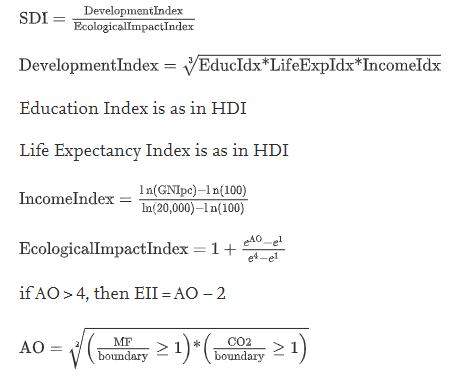
When the Human Development Index (HDI) was introduced in the 1990s, it was an important step toward a more sensible measure of progress, one defined less by GDP growth and more by social goals. But the limitations of HDI have become clear in the 21st century, given a growing crisis of climate change and ecological breakdown. HDI pays no attention to ecology, and retains an emphasis on high levels of income that – given strong correlations between income and ecological impact – violates sustainability principles. The countries that score highest on the HDI also contribute most, in per capita terms, to climate change and other forms of ecological breakdown. In this sense, HDI promotes a model of development that is empirically incompatible with ecological stability, and impossible to universalize. In this paper I propose an alternative index that corrects for these problems: the Sustainable Development Index (SDI). The SDI retains the base formula of the HDI but places a sufficiency threshold on per capita income, and divides by two key indicators of ecological impact: CO2 emissions and material footprint, both calculated in per capita consumption-based terms and rendered vis-à-vis planetary boundaries. The SDI is an indicator of strong sustainability that measures nations’ ecological efficiency in delivering human development.

1. Introduction: the quest to overcome the ecological limitations of HDI

The Human Development Index (HDI) was invented by Pakistani economist Mahbub ul Haq and introduced in 1990 (UNDP, 1990). At the time, there was a growing realization among development economists that national income, or Gross Domestic Product (GDP), does not adequately account for the social or human dimensions of development (Kelly, 1991Anand and Sen, 1994). The goal of HDI was to shift the focus of development economics from national income accounting to people-centered policies with a measure that could be used to assess countries’ progress not only in terms of economic expansion, but also in terms of key social outcomes. HDI is presently calculated as the geometric mean of three indicators: life expectancy at birth; education (the average of mean years of schooling and expected years of schooling); and income (GNI per capita, PPP), which is placed on a natural logarithmic scale.

HDI is an objective metric of human development in that it relies on indicators that can be observed and compared meaningfully across contexts. This distinguishes it from other human development metrics that include indicators of subjective well-being (such as happiness or life satisfaction). The longevity and education components of HDI have substantial theoretical underpinning in Amartya Sen’s notion of basic functionings and capabilities, and have been buttressed in more recent theories of human need (Gough, 2015). HDI has been promoted through the United Nations Development Program’s annual reports, and has become the single most widely-used indicator of human development. The principles behind HDI informed the Millennium Development Goals, which were launched in 2000.

The HDI has come under critique from a variety of angles. It has been to some extent adjusted accordingly (see UNDP, 2011 for a review of critiques and changes), but key limitations remain – most notably the absence of any indicator of ecological sustainability. This limitation is becoming acutely evident given a growing crisis of climate change and ecological breakdown.

In recent high-profile studies, Rockström et al. (2009) and Steffen et al. (2015) conclude that human economic activity has transgressed four critical planetary boundaries: climate change, biodiversity loss, chemical loading (nitrogen and phosphorous) and land-system change. Ocean acidification and freshwater use are two-thirds of the way toward the planetary boundaries, relative to pre-industrial levels. Human consumption of material resources has reached 91 billion tons per year, overshooting the sustainable level by 82% (Dittrich et al., 2012Hoekstra and Wiedmann, 2014Bringezu et al., 2015). In light of this, Raworth (20122017) has argued that any vision for development needs to “fit within” planetary boundaries: in other words, resources should be mobilized to improve human well-being, but without violating sustainability parameters. Raworth termed this the “safe and just space”. The objective is to accomplish both human development and ecological sustainability – an aim that is now widely accepted and officially reflected in the Sustainable Development Goals.

The ecological limitations of HDI have been explored by a number of scholars (Desai, 1995; Dahme et al., 1998; Sagar and Najam, 1998Ramathan, 1999de la Vega and Urratia, 2001Neumayer, 2001Morse, 2003Togtokh, 2011Pelenc et al., 2013). Several attempts have been made to integrate environmental dimensions into HDI (Hirai, 2017). The most notable is that developed by Togtokh and Gaffney (2010) and improved by Bravo (2014), which includes an index of per capita CO2 emissions in a geometric mean alongside the three original HDI indicators. Kai et al. (1998) developed an alternative that incorporates “material footprint” (the total weight of material extraction and consumption, including biomass, minerals, fossil fuels and construction materials) into the mean alongside the three original indicators. Türe (2013) takes a different approach and divides HDI by “ecological footprint”, which accounts for not only carbon emissions but also the biocapacity of cropland, grazing land, forests and fisheries. Most recently, Biggeri and Mauro (2018) have developed an alternative index that incorporates not only an ecological indicator (CO2 emissions) but also an additional social indicator, freedom (defined as political rights and civil liberties).

All of these alternatives build on the underlying logic and structure of the HDI. Many others do not. The Happy Planet Index (HPI), developed by the New Economics Foundation (see Jeffrey et al., 2016), abandons income and education altogether and incorporates happiness and equality instead, alongside life expectancy, and then divides the result by ecological footprint. More recently, attempts have been made to dispense with a single index altogether in favor of disaggregated metrics that cover a range of key ecological indicators (such as those captured by the planetary boundary framework) as well as a range of social indicators (such as those covered by the Sustainable Development Goals), allowing us to see important information that is otherwise hidden in single indexes. The method developed by O’Neill et al. (2018) is perhaps the most comprehensive attempt at this to date, building directly on the “safe and just space” approach articulated by Raworth. Finally, there are a number of national accounting metrics that have been developed specifically in order to correct or complement GDP, such as the Index of Sustainable Economic Welfare (ISEW) and the Genuine Progress Indicator (GPI), both of which start with personal consumption expenditure (also the starting point for GDP) and then adjust for ecological and social costs not captured by GDP (while including the benefits of non-market activity and accounting for inequality).

It is important to acknowledge the virtues of these approaches for their own purposes. ISEW and GPI are valuable as socially and ecologically-minded alternatives to national accounting, but they are not designed to address the question of human development, which is what concerns us here. The disaggregated dashboard developed by O’Neill et al. (2018) is a comprehensive approach to assessing human development and ecological impact, but does not set out to correct HDI or to provide a direct alternative. By contrast, the approach I take in this paper is very specific: to correct HDI for ecological impact and to provide a simple alternative that retains the basic logic and structure of the original. HDI enjoys widespread use and is deeply entrenched in policy discourse. By developing a direct modification we can hope to maximize its accessibility and uptake to an extent that more complex alternatives – like the disaggregated dashboard approach – may not be able to achieve. While a single index might obscure the more detailed information that is revealed by a dashboard approach, it is nonetheless useful for direct comparisons, and can in any case be presented alongside its constitutive elements in order to render them visible (as I do here, and as is common practice with HDI).

This paper seeks to advance the longstanding quest to modify HDI for ecological impact. The attempts that have been made thus far all suffer from notable weaknesses that render them ultimately unsuitable. First, most of the alternatives described above (except for Ture) are indicators of weak sustainability, in that they permit trade-offs between development and ecology. Strong performance on development compensates for high ecological impact, and vice versa. This is inconsistent with the principles of ecology, and inconsistent with the planetary boundary framework. O’Neill et al. (2018) reject this approach and insist on strong sustainability, with ecological impact measured against planetary boundaries, and no trade-offs permitted. Any attempt to correct HDI for ecological impact must therefore take this into account. Second, existing alternatives do not adequately account for the full extent of ecological impact. While including CO2 emissions (as Togtokh/Gaffney, Biggeria/Mauro and Bravo have done) is a sensible move, this represents only one dimension of ecological impact, leaving other crucial dimensions unexamined. Eliminating CO2 emissions would still leave critical overshoot on biodiversity loss, nitrogen loading, phosphorous loading, and land-use change, according to the planetary boundary framework. One can imagine a global civilization powered entirely by solar and wind and yet nonetheless unsustainable in terms of its extraction from and impact on terrestrial and marine ecosystems.

Using material footprint is one way of incorporating other ecological dimensions, as material extraction from terrestrial and marine ecosystems has an impact on land-use change, chemical loading, biodiversity loss and other key processes represented in the planetary boundary framework. While material footprint is not a direct indicator of ecological impact, it is a well-established and widely-used proxy in the policy literature and enjoys robust empirical grounding for this purpose (Krausmann et al., 2009, p. 2703). Van der Voet et al. (2004) find that while the mass flows of individual materials are not indicative of their ecological impacts, and while impacts vary as technologies change, at an aggregate level there is a high degree of correlation (0.73) between material throughput and ecological impacts. But while material footprint does include the weight of fossil fuel extraction, it does not directly measure emissions. Given that climate change is among the most urgent ecological crises we face, it makes little sense to incorporate material footprint into a modified HDI (as Kai et al. have done) without also incorporating emissions.

It might seem that using ecological footprint (as Ture has done, and as the Happy Planet Index does) would provide a sensible omnibus measure, transcending the limitations of using only CO2 emissions or material footprint, as it promises to incorporate a broad range of ecological impacts into a single unit (“global hectares”). In reality, however, ecological footprint is disproportionately reliant on CO2 emissions. Its accounting of biological resource use – cropland, grazing land, forests and fisheries – is measured not in terms of specific ecological impacts, but rather in terms of the capacity of different ecosystems to absorb CO2. As a result, if CO2 emissions were reduced to zero, the ecological footprint metric would show no indication of ecological crisis even if terrestrial and marine ecosystems continue collapsing, at least as long as their capacity to absorb CO2 is in excess of emissions. It is therefore not clear that ecological footprint is an adequate indicator of ecological impact (Van den Bergh and Grazi, 2014). Indeed, the concept of ecological footprint is rapidly being replaced by the concept of planetary boundaries, which is more scientifically robust.

Given the limitations of relying on either of these ecological indicators alone, the modification I propose here – which I call the Sustainable Development Index (SDI) – divides human development by a composite metric of ecological impact that incorporates both key indicators: CO2 emissions per capita and material footprint per capita. This is the first development index to take this dual approach. I render both indicators in consumption-based terms; in other words, they account for international trade by adding the emissions and materials embodied in imports (including the upstream emissions and resources involved in producing and shipping imported goods) and subtracting that of exports (see Wiedmann et al., 2015Gutowski et al., 2017). This allows us to account for the fact that, in an era of globalization, high-income countries have shifted much of the extraction and production side of their consumption abroad, effectively outsourcing their ecological impact.

One concern about combining material footprint and CO2 emissions is that because material footprint includes fossil fuels there is some overlap between the two. To address this, we might opt to subtract fossil fuels from material footprint. I have chosen not to do so, however, reasoning that the extraction of fossil fuels (measured by weight) has an ecological impact aside from the emissions that come from combustion. For example, strip-mining for coal has a similar impact to strip-mining for gold. Subtracting fossil fuels from material footprint would be tantamount to ignoring this impact, which is not acceptable. In short, the two ecological indicators must be seen here as measuring different things: one is about the impact of material throughput and the other is about emissions. In the SDI, these two indicators are rendered in terms of per capita planetary boundaries.

In addition, the SDI includes a second key modification. It introduces a sufficiency threshold on the income indicator, at a point above which additional income becomes unnecessary to achieve high levels of human development. This allows us to resolve a longstanding problem with the Human Development Index. Because there is a tight coupling between income and both emissions and material footprint, to achieve the levels of income necessary for “very high” HDI locks in very high levels of ecological impact. While we know that it is possible to decouple income from CO2 emissions, extant empirical evidence indicates that it is infeasible for high-income nations to decouple income from material footprint at a rate sufficient to meaningfully reduce ecological impact (Hickel and Kallis, 2019). Instead of promoting very high levels of income (and therefore consumption), the SDI promotes income sufficiency, while celebrating countries that achieve high levels of human development with minimal ecological impact. I further explain the rationale for this approach in what follows, before laying out the SDI formula and country results.

2. HDI and the income problem

The problem with the HDI is that all of the top performers are notable for high and unsustainable levels of ecological impact. Table 1 lists the 10 top-ranked nations alongside their CO2 emissions and material footprint. For reference, a sustainable level of CO2 emissions is about 1.74 t per person, and a sustainable material footprint is about 6.8 t per person, if we divide the material use and emissions permissible within global planetary boundaries by world population in 2015.1 The final row shows the extent to which the average emissions and material use of the top 10 overshoot these boundaries.

Table 1. Top 10 performers on the Human Development Index (2015).a

HDI RankCountryHDIGNI PPP (2011$/cap)Life expect. (years)Material Footprint (tns/cap)CO2 emissions (tns/cap)
1Norway0.94867,02882.037.7114.38
2Switzerland0.94258,28083.131.7311.83
3Australia0.93643,13882.742.7019.08
4Germany0.93344,76680.822.3110.02
5Sweden0.92946,38082.331.728.97
6Ireland0.92948,55181.321.089.91
7Singapore0.92978,74282.874.1928.78
8Iceland0.92742,42582.633.9412.97
9Netherlands0.92646,23981.726.7311.41
10Denmark0.92647,00080.624.2710.39
Average of top 1052,25582.034.6413.77
Overshoot (multiple of boundary)5.097.91

Material footprint data is derived from materialflows.net, and CO2 emissions data are derived from the Eora MRIO database.

We can see this relationship more broadly by plotting the whole HDI series against the CO2 emissions and material footprint for each nation (Fig. 1Fig. 2).2

Fig. 1
Fig. 2

Fig. 1Fig. 23 show that as HDI rises, so too do CO2 emissions and material footprint. The indicators are correlated on an exponential curve (the R-squared value is 76% for material footprint and 85% for CO2 emissions). There are a few nations that achieve “high” HDI (which the UN defines as between 0.70 and 0.79) while maintaining sustainable CO2 emissions (below 1.74 t per capita) and sustainable material footprint (below 7.2 tonnes per capita). But there are no nations that achieve “very high” HDI (0.8 and above) while remaining within these ecological boundaries. As HDI increases above 0.8, CO2 emissions and material footprint rise steeply.

One of the reasons for this disappointing result has to do with the composition of HDI itself. As mentioned above, the HDI is calculated as the geometric mean of three indicators: life expectancy at birth; education (the average of mean years of schooling and expected years of schooling); and income (GNI per capita, PPP) on a natural logarithmic scale. Each of these indicators is indexed within a range defined by maximum and minimum values.

The maximum value is $75,000 per capita and the minimum value is $100.-

The result is 1 when income is $75,000 and 0 when income is $100.

Each of the component indexes correlates with ecological impact on an exponential curve; in other words, as life expectancy, education and income improve, ecological impact rises exponentially. Improvements in these social indicators from very low levels can be accomplished with little additional impact, while gains at the higher end entail a rapidly rising ecological cost. But this relationship is strongest for the income index, which has a R-squared value of 88% for CO2 emissions and 74% for material footprint. High levels of income drives rising ecological impact much more aggressively than education and life expectancy do. In order to achieve a score of “very high” on the income index (0.8 or above), a nation must have a GNI of at least $20,000 per capita (2011 PPP). The average material footprint of nations with income between $20,000 and $25,000 per capita is 17 t per capita, while the average CO2 emissions of nations in this range is 7 t per capita, both many times in excess of sustainable levels. A score of 1 on the income index requires $75,000 per capita. The average material footprint of nations with income over $60,000 is 40 t per capita, with CO2 emissions of 22 t per capita – levels of ecological impact that are highly destabilizing. In other words, the income index effectively precludes nations from achieving very high HDI while at the same time being ecologically sustainable, at least given the existing dominant economic model.

There are two problems to consider here. First, HDI celebrates the very nations that are contributing most to climate change and other forms of ecological breakdown, in terms of their per capita rates of emissions and material use (e.g., the USA, Australia, Germany). In doing so, it promotes a model of development that is empirically incompatible with ecology. The average material footprint of nations with “very high” HDI scores is 26 t per capita, (four times over the sustainable boundary), while their average CO2 emissions is 11 tonnes per capita (six times over the boundary). It is not ecologically possible for all nations to consume at this level. In other words, the pursuit of development according to HDI – the objective that the UN and virtually every international development agency promotes – requires that the world “develops” to the point of ecological collapse. This is not a tenable approach for the 21st century.

The second problem is related to the first. We know that the countries of the global South suffer disproportionately from the negative impact of climate change and ecological breakdown on economic and human development, in terms of loss of life, financial cost, and lost potential income; indeed, climate change is now beginning to reverse key human development indicators in some regions, as agricultural yields decline and hunger rates rise (Hickel, 2017). In this sense, HDI embodies a contradiction whereby the process of maintaining high levels of development in high-income nations constrains development – and even drives de-development – in poorer nations. For a development indicator that purports to be universal, such a contradiction is indefensible.

3. Prospects for improving the ecological efficiency of income

The tight coupling between income and ecological impact is due to the fact that the income indicator (GNI) is a measurement of economic production and exchange, which has an intrinsic relationship to material use and (in a fossil fuel energy system) emissions. The only way to resolve the problems with the HDI identified above is to break this relationship – to somehow achieve absolute decoupling of income from material use and emissions, such that high-income nations can maintain income per capita at very high levels while ecological impact falls to sustainable thresholds, and low-income nations can rise to high income per capita without overshooting sustainability thresholds.

We know that it is technically possible to absolutely decouple income from CO2 emissions, by switching from fossil fuels to clean energy (e.g., Jacobson and Delucchi, 2011). Indeed, a number of high-income nations have already achieved some reductions in annual CO2 emissions, even in consumption-based terms. A more difficult question is whether it is possible to accomplish this transition quickly enough to reduce emissions in time to stay within the carbon budget for 1.5 or 2C, as per the Paris Agreement, while at the same time growing GDP at normal rates. Holz et al. (2018) find that the required rate of decarbonization for the Paris targets is “well outside what is currently deemed achievable, based on historical evidence and standard modelling” (see also Anderson and Bows, 2011Schroder and Storm, 2018). Grubler et al. (2018) and Van Vuuren et al. (2018) conclude that achieving these targets will require high-income nations to adopt what scholars call “degrowth” strategies, i.e., reducing aggregate economic activity in order to reduce energy demand, therefore making a rapid transition to clean energy easier to accomplish. Indeed, this approach is highlighted by the IPCC (2018) as the most feasible pathway to sufficient emissions reductions.

The evidence on decoupling income from material footprint is perhaps even more concerning. There are no historical or contemporary examples of nations reducing their material footprint while at the same time increasing GDP at normal rates. Some hope that a policy-driven shift to more efficient technologies might make economies more materially-efficient, so that fewer materials are required per unit of GDP. Three recent studies (Dittrich et al., 2012Schandl et al., 2016UNEP, 2017a) have explored this question, looking at whether aggressive policy measures can drive decoupling of GDP from material footprint on a global level, with normal rates of GDP growth (2–3% per year). All of them conclude that relative decoupling can be achieved, but not absolute decoupling – even under highly optimistic assumptions. In other words, while an economy can become more materially efficient, efficiency gains are not adequate to reduce aggregate material use. Models that incorporate the “rebound effect” yield particularly discouraging results, suggesting that relative decoupling can be achieved at only about 1% per year (UNEP, 2017b:106ff).

The same conclusion holds for high-income nations specifically. While one well-known model (Hatfield-Dodds et al., 2015) suggests absolute decoupling of GDP from material footprint may be possible (in Australia), it assumes an unrealistic rate of efficiency improvement (Alexander et al., 2018). Moreover, Ward et al. (2016) demonstrate that the result holds only in the short term. As efficiency improvements approach physical limits, the scale effect of growth drives material use back up. Ward et al. conclude that this implies a “robust rebuttal to the claim of absolute decoupling”: “decoupling of GDP growth from resource use, whether relative or absolute, is at best only temporary. Permanent decoupling (absolute or relative) is impossible for essential, non-substitutable resources because the efficiency gains are ultimately governed by physical limits. Growth in GDP ultimately cannot plausibly be decoupled from growth in material and energy use, demonstrating categorically that GDP growth cannot be sustained indefinitely.”

The conclusions of the literature reviewed above hold that it is not empirically feasible to reduce material footprint while at the same time growing GDP at normal rates, and that it is not empirically feasible to reduce emissions in line with the Paris targets while at the same time growing GDP at normal rates. What implications does this literature hold for the question of how we might reconsider the income component of the Human Development Index?

First, it is reasonable to expect that low-income nations can grow their incomes significantly without breaching ecological boundaries. But it is not reasonable to expect that they can do so indefinitely, i.e., to the point of reaching the levels of income that presently characterize high-income countries, given existing empirical evidence and modelling. As of 2015, $8600 GNI per capita (PPP) is the average level of income that nations achieve at the ecological boundaries of material footprint and CO2 emissions; the highest is about $17,000. This can be improved upon, but – given the tight coupling between income and material footprint – only with relatively low rates of income growth (i.e., no more than 1% per year, as per UNEP, 2017b), and this trajectory may not be sustainable in the long-term (as per Ward et al., 2016).

Second, for middle-income nations that have material footprint and CO2 emissions only modestly in excess of ecological boundaries, it is reasonable to expect that they would be able to reduce their emissions and material footprint down to sustainable levels while maintaining their per capita income, and perhaps while growing income at a slow rate, but not while growing income at a rate adequate to reach “very-high” levels within any meaningful timeframe, particularly given the patterns identified by Ward et al. (2016) regarding prospects for absolute decoupling of income from material footprint over the long term.

Finally, for high-income nations, it is empirically feasible for them to reduce their material footprint at a rate of 1% per year while maintaining their existing levels of income (albeit not over the long-term), and it is technically feasible for them to gradually reduce their CO2 emissions while maintaining their existing levels of income. But it is not feasible for them to reduce their material footprint down to sustainable levels, and not feasible for them to reduce emissions rapidly enough to meet the Paris climate targets, without also reducing aggregate economic activity (Hickel and Kallis, 2019). Importantly, reducing aggregate economic activity need not entail any reductions to human development indicators. Research indicates that it is possible for high-income countries to maintain or even improve their levels of human development while reducing throughput and output (i.e., Alier, 2009Jackson, 2019Kallis, 2011Victor, 2019), for example by distributing income more fairly, investing in public services, shortening the working week and improving wages.

4. Reformulating the income index

In light of the two preceding sections, it seems reasonable to reconsider the extent to which high income serves as a useful indicator of human development. While nations with high income generally perform better on key social indicators than nations with lower income, the relationship is not determinate; indeed, ul Haq himself was intent on highlighting this point. There are a number of countries with relatively low income that nonetheless achieve high levels of human development. Greece, Chile, and Portugal have higher life expectancy than the US with less than half the income per capita. Costa Rica has a life expectancy that exceeds that of the US with one-fourth of the income per capita. Similarly, there are a number of countries that score highly on the education index with relatively low levels of income. Kazakhstan’s education levels rival Austria’s, with half of the income per capita. Belarus exceeds Austria with one-third of the income per capita. Georgia and Ukraine rival Austria with less than one-fifth of the income per capita.

These are the results that should be highlighted within any framework of sustainable development: middle-income nations that perform well on key social indicators while staying close to or within the boundaries of ecological sustainability. Given that income is so tightly coupled with ecological impact, it would make sense to look at nations that achieve high levels of human development with relatively low levels of income as models to emulate in the process of designing more sustainable approaches to development, rather than punishing them for not having high income, as the HDI does.

One way to correct for this problem is to simply remove the income component from HDI. There are a number of composite human development indicators that have made this move, eschewing income in favor of subjective measures such as happiness, life satisfaction and well-being (e.g., the Happy Planet Index, Gross National Happiness Index, Gross National Wellbeing Index, etc). This approach departs significantly from the objective approach of the HDI that I seek to retain, and is in any case not without its problems, which I will discuss in a later section. Moreover, we must allow that income might contribute meaningfully to human development in ways that education and life expectancy cannot capture; for instance, in terms of choice, economic agency, empowerment and security, which is what the designers of HDI had in mind when they chose to include income as a key component. Rather than jettison the income index from HDI altogether, then, I propose to modify it with a sufficiency threshold.

Toward this end, there are a few considerations to bear in mind. According to the 2015 dataset for HDI, some nations achieve very high levels (0.8 or above) on the life expectancy index with as little as $3,300 per capita (or 0.9 with as little as $11,000), and very high levels on the education index with as little as $8,700 per capita, while keeping ecological impact at sustainable levels. According to the O’Neill et al. (2018) database of social and ecological indicators, a number of nations achieve impressive levels of sustainable development with as little as $10,000 to $14,000 per capita (Hickel, 2018). Finally, we know that as GNI exceeds this level it begins to cause net negative social and ecological consequences (Kubiszewski et al., 2013Lamb et al., 2014Max-Neef, 1995Deaton, 2008Inglehart, 1997).

With this range of figures in mind, we might set $20,000 per capita (PPP) as the maximum value on the income index scale, thus introducing a sufficiency threshold at a point above which additional income becomes socially unnecessary. This function creates a curve that crosses 0.8 on the income index at about $7,000, crosses 0.9 at about $12,000, and crosses 0.95 at about $15,000, all of which is possible to achieve without excessive ecological impact. The sufficiency threshold brings the income index in line with the other human development indices, in terms of what we know of the relationship between income and social outcomes, while ensuring that countries need not pursue ecologically destructive levels of economic growth in order to score well. It is important to note that countries are of course not punished for exceeding $20,000; rather, it is simply that any additional income over this level does not boost a country’s score or improve its ranking.

5. The sustainable development index

The Sustainable Development Index proposed here includes five indicators, then: education, life expectancy, income, CO2 emissions and material footprint. The SDI is calculated as the quotient of two figures: (1) a “development index” calculated as the geometric mean of the education index, the life expectancy index, and the modified income index; and (2) an “ecological impact index” calculated as the average overshoot of CO2 emissions and material footprint vis-à-vis their per capita planetary boundaries, indexed on a natural exponential scale. The formula can be described as follows:

Average overshoot (AO) is calculated as follows. Material footprint and emissions values are each divided by their respective per capita planetary boundary (which varies by year depending on population size) to determine the extent of boundary overshoot (or undershoot). This also standardizes the units. If the result of either division is less than 1 (undershoot) it is rendered as 1. Then the results are averaged using the geometric mean. This method ensures that a country cannot compensate for overshooting one boundary by undershooting the other. Overshoot of either boundary will yield average overshoot of greater than 1.

In the ecological impact index, AO is indexed on a natural exponential scale. Given the uncertainties around the precise definition of the planetary boundaries, this allows some leeway for small amounts of overshoot. Adding 1 ensures that the minimum result is 1 (no overshoot). For countries that have no overshoot, their development index is therefore unaffected. Once overshoot reaches four times the planetary boundary the ecological impact index registers 2, thus cutting the development index in half. Thereafter a linear function applies. This method ensures that the SDI is an indicator of strong sustainability. Countries cannot use low ecological impact to compensate for poor performance in human development. And strong performance in development cannot compensate for high ecological impact.

There are 163 countries that have data points for all five of the metrics included in the SDI for 2015. The top ten performers on the SDI are listed in Table 2Table 3 presents a selection of countries from across the range, for comparison. The overshoot calculation here assumes a boundary of 6.8 t per person per year for material footprint (Bringezu et al., 2015), and a boundary of 1.74 t per person per year for CO2 emissions (IPCC, 2018).

Table 2. Top 10 performers on the Sustainable Development Index (2015).a

SDI RankCountrySDILife Expect. (years)Education IndexGNI per capita (PPP)Material Footprint (tns/cap)CO2 emissions (tns/cap)
1Cuba0.85979.60.76821,0008.043.42
2Costa Rica0.83079.60.71314,0868.082.66
3Sri Lanka0.82575.10.75110,7913.881.03
4Albania0.81178.20.73311,08310.922.32
5Panama0.80877.80.68118,1677.853.77
6Algeria0.80575.90.66213,3383.031.96
7Georgia0.80173.10.8318,7669.123.07
8Armenia0.80074.40.7468,5177.631.99
9Azerbaijan0.79871.90.70916,3345.913.24
10Peru0.78874.70.68611,4209.382.14
Average of top 1076.030.72813,3507.382.56
Overshoot (multiple of boundary)1.091.47

Life expectancy, Education Index, and GNI are derived from the UNDP dataset for HDI 2015. Material footprint data is derived from materialflows.net, and CO2 emissions data is derived from the Eora MRIO database.

Table 3. Selection of countries from the Sustainable Development Index (2015).

SDI RankCountrySDILife Expect. (years)Education IndexGNI per capita (PPP)Material Footprint (tns/cap)CO2 emissions (tns/cap)
16Jordan0.77574.20.7068,3926.782.99
27Belize0.74570.20.7047,6667.952.84
55India0.67568.30.5425,6914.461.68
95France0.54982.40.84038,36721.207.47
100China0.53276.10.64113,51920.016.68
131United Kingdom0.39981.40.91138,14622.5710.08
136Niger0.37459.70.2088893.270.55
152Qatar0.25178.00.698117,89613.3525.91
157Norway0.20082.00.90867,02837.7114.38
159USA0.18479.20.90053,74132.3618.35

The best performers are Cuba, Costa Rica, Sri Lanka and Albania, which achieve high levels of social performance with low levels of ecological impact. The degree of overshoot on material footprint and CO2 emissions of the top 10 is significantly lower than under the HDI (compare with Table 1). The nations that dominate HDI (Norway, etc.) fall toward the bottom of the SDI range, dragged down by their high ecological impact. The bottom of the SDI range is populated by very poor countries (like Niger) as well as countries with very high ecological impact (like Qatar).

Of course, what the SDI ranking reveals is that no countries truly succeed at sustainable development, with scores over 0.9. There are no countries that achieve top scores for human development (with life expectancy and education at the level of Switzerland, for example) while at the same time remaining within or even remotely near ecological boundaries. In contrast to the HDI, wherein more than 20 countries score over 0.9, the SDI ranking reveals that all countries are still “developing”: countries with the highest levels of human development still need to significantly reduce their ecological impact, while countries with the lowest levels of ecological impact still need to significantly improve their performance on social indicators.

6. Additional considerations

My goal in designing the Sustainable Development Index is to retain the base logic of the HDI, which I have done. Nonetheless, I considered a number of possible alternative formulations. I review them here along with the reasons I chose to reject them.

First, it might seem reasonable to consider including additional indicators of human development in the SDI, alongside life expectancy and education, such as literacy and infant mortality (which are included in the SDGs). But infant mortality overlaps substantially with life expectancy, and therefore cannot be granted equal weight as a third term (the Physical Quality of Life Index has been criticized for doing so). Moreover, infant mortality is a “weaker” or lower-order measure, in that it is easier to accomplish a reduction in infant mortality than to accomplish an improvement in the life expectancy of non-infants. Countries that have achieved higher levels of life expectancy have generally also already succeeded at reducing infant mortality, but the opposite does not generally hold. In the same way, literacy is weaker than and overlaps substantially with the education index. In short, then, infant mortality and literacy are trumped by life expectancy and education, respectively, and do not warrant inclusion in the SDI.

Another option might be to incorporate indicators related to basic physical needs, such as access to food, electricity, improved sanitation facilities and housing, all of which are targeted by the SDGs. The problem here is that high levels of access to these basic goods is “easy” to deliver, and at this point most of the world’s nations have done so: for instance, of the 100 best-performing countries in each indicator, the average electricity provision is 100%, and the average proportion of the population that achieves the nutrition threshold set by the Food and Agricultural Organization is 98%. All of the nations that perform well (or even modestly) in terms of life expectancy and education have universal coverage of these basic needs. For this reason, we can assume that provision of basic needs is already “covered” by the higher-order (or more difficult to achieve) social indicators included in the SDI.

Apart from basic physical needs, there are a number of qualitative indicators that we might consider for inclusion in the SDI: social support, democratic quality and employment – all of which are aspirations represented in the SDGs. These are covered by the Better Life Index, an alternative measure of progress devised for the OECD. The problem here is that all of these indicators have a weak relationship with ecological impact (O’Neill et al., 2018). While improving indicators like education and life expectancy clearly requires some additional ecological impact (since schools and hospitals, for instance, require materials to construct and energy to run), improving social support, democratic quality and employment does not (Hickel, 2018). Social support is largely a cultural phenomenon; the indicator measures whether or not people have someone to count on in times of need, which can be improved without additional ecological impact. Similarly, one can imagine a government delivering dramatic improvements in democratic quality without any additional ecological impact (for instance, South Africa’s transition to democracy in 1994 caused no increase in impact). Moreover, there is no necessary relationship between democracy and ecological impact: low-impact nations like India as well as high-impact nations like Norway can have robust democracies, while dictatorships can be present in low-impact nations like Swaziland as well as high-impact nations like Saudi Arabia. As for employment, O’Neill et al. (2018) show that there is no statistical relationship between employment and impact at all. Once again, both poor nations and rich nations can have either high or low employment. And all nations can improve their employment levels simply and without any additional ecological impact by introducing specific policy settings (for example, by reducing the length of the working week and sharing necessary labour). There is therefore little reason to measure these indicators against ecological impact.

Moreover, it is possible for poor countries to have high levels of social support, democratic quality and employment while at the same time performing poorly in terms of life expectancy and education. It seems reasonable, then, to exclude these from the SDI on the grounds that, because they can and often do move in the opposite direction to life expectancy and education, they would muddy the results (see Streeten, 1994), a problem to which all composite indexes are vulnerable. For these reasons I depart from Biggeri and Mauro (2018), whose alternative formulation of the HDI (mentioned in the opening section of the paper) incorporates an indicator for “freedom”.

It might seem reasonable to consider including subjective indicators of happiness or well-being, as the Happy Planet Index has done. I chose not to do so because it would depart from the objective approach that the SDI seeks to retain, but also because the data (which is derived from the World Happiness Report) presents a number of problems. (1) The question asks about people’s feelings of well-being “at the present time”, which leaves it vulnerable to being skewed downward by temporary events such as natural disaster, military conflict, or change of government. Including such a measure in the SDI would risk obscuring countries that otherwise perform well at the core objective of delivering ecologically efficient human development. (2) The question asks people to place themselves on a ladder, where “the top of the ladder represents the best possible life for you; and the bottom of the ladder represents the worst possible life for you”, but such a scale is not comparable across contexts. The best possible life imaginable by someone in the UK is not comparable to the best possible life imaginable by someone in Bangladesh. Indeed, the happiness indicator risks rewarding people in poor countries for low expectations. By the same token, people in rich countries who should be satisfied with their prospects compared to the rest of the world may feel that they nonetheless need more. (3) Finally, the ladder metaphor embodies a particularly Eurocentric conception of progress: unilineal, unidirectional, hierarchical, individualistic, etc. It is possible that this metaphor is less meaningful to people who do not subscribe to these underlying principles. If that is the case, then it may not be suitable for use in cross-country comparisons (see Mathews and Izquierdo, 2009Mathews, 2012). Indeed, cultures that value modesty (such as in East Asia) tend to report lower levels of well-being, because to do otherwise would seem impertinent, and might risk inviting misfortune (see Gough, 2017: 40). There are more general formulations of the evaluative question, and evidence to suggest that responses are more comparable across contexts, but the data remains subjective and therefore incompatible with the objective approach I have selected.

A final consideration has to do with inequality. Greater equality is associated with a variety of positive social outcomes (greater happiness, better health, less anxiety, less depression, etc.; see Wilkinson and Picket, 2009). Recognizing this, the UNDP has designed an inequality-adjusted HDI (IHDI). According to the 2016 Human Development Report, “The IHDI can be interpreted as the level of human development when inequality is accounted for,” whereas the normal HDI is “an index of potential human development (or the maximum IHDI that could be achieved if there were no inequality).” The concept of development potential is interesting here. I have chosen to render the SDI without adjusting for inequality because, when it comes to the question of sustainable development, what is important is the potential of nations to achieve high levels of human development at a given level of ecological impact. Inequitable countries that have relatively low levels of impact are theoretically capable of improving their human development outcomes considerably by distributing existing domestic resources more fairly, without any additional ecological impact. By not adjusting for inequality, the SDI highlights these countries as models of efficiency in human development potential.

A brief note about the education index is in order here. The inclusion of the education index in HDI has come under criticism for a variety of reasons. First, it is an input metric that does not guarantee consistent outcomes. In other words, it is possible that a country could achieve maximum years of schooling, but if the schooling is of a poor standard it will do little to improve the actual education of the population. Moreover, it is potentially problematic to combine an input-based metric like the education index together with an outcomes-based metric like life expectancy, given the dissimilarities between the two. Second, the education index measures education in terms of an institutional model, and therefore effectively discriminates against cultures that may have historically valued different approaches. For instance, indigenous people living in Bolivia may have few years of formal schooling but nonetheless have mastery of botany and ecology and other fields crucial to their context, acquired through rigorous training and mentorship – a kind of education that would be difficult to gain through institutional schooling. These are important critiques that need to be addressed, but I have chosen to put them aside here for the sake retaining the underlying logic of the HDI, and because there is no readily available alternative metric.

Finally, what can we say about the relationship between the SDI and the SDGs? Clearly the two draw on the same underlying conception of sustainable development, but the SDI incorporates a narrower range of indicators than are represented among the SDG targets. O’Neill et al. (2018) have proposed a broad dashboard of indicators of human development that derives from the SDGs, alongside indicators of ecological impact that derive from the planetary boundary framework. This is a robust and informative approach, but if we wish to use a single index, the SDI – as I have argued above – provides the most reasonable formulation, as it includes the three well-established indicators of human development derived from the HDI and the two keystone indicators of ecological impact (which are represented in Goals 12 and 13 of the SDGs), while retaining the principles of strong sustainability. Just as the HDI served us for the era of the Millennium Development Goals (which focused on human development to the exclusion of ecological considerations) without incorporating all of the MDG targets, so the SDI can serve us in the era of the SDGs. But it should not be used to the exclusion of disaggregated approaches.

7. Conclusion and discussion

The ecological limitations of the Human Development Index have long been apparent. For more than twenty years, scholars have attempted to modify HDI in order to overcome these limitations. These attempts suffer from significant flaws, which the Sustainable Development Index I have proposed here seeks to transcend. By correcting for both CO2 emissions and material footprint (rendered in per capita consumption-based terms), by placing a sufficiency threshold on income, and by dividing human development by ecological impact, the SDI offers an alternative index that is robust in terms of both ecology and social science, while upholding the principles of strong sustainability.

The SDI also makes an important contribution to development theory, inasmuch as it disrupts dominant development hierarchies. Arturo Escobar (2011) famously pointed out that conventional development indicators construct conceptual ladders of progress that place Western countries at the top and represent the rest of the world as lagging behind. Such representations have significant discursive power, and shape the way that people think about the world. This is clear in the case of HDI. Given HDI’s reliance on income, it represents the countries of the global North as automatically superior to the countries of the South, erasing and indeed even legitimizing the violence that the former have deployed in order to accumulate their surplus, through for example colonization, the slave trade, structural adjustment, land grabs, labour exploitation, resource extraction and other methods by which nations at the core of the world system have sabotaged the periphery for the sake of their own development (Hickel, 2017). The SDI challenges this narrative (and the troubling racial overtones of the HDI hierarchy) by introducing ecological indicators that reflect the negative effects of the excess extraction, consumption and accumulation practiced by rich countries, and demoting them accordingly.

The SDI does however raise a number of practical issues. For one, there is an interesting question to be asked about the purpose of an index that mixes both human development and ecological impact. A critic might note that with human development indicators, the countries that rise to the top (like Switzerland and Denmark) do so because of intentional policies, like investment in public healthcare and education. These are policies that other countries can aspire to imitate. It is not quite so straightforward with the ecological indicators, however. Some of the nations that have low ecological impact use intentional policies to get there, such as Costa Rica’s investment in renewable energy infrastructure and Cuba’s focus on material reuse. But many others (like Sri Lanka) have low impact not because of intentional policies but rather because they have less intensive economies. So in what sense can Sri Lanka be held up as a model that should be imitated? What do they do better? What would it mean for a country to seek to be more like Sri Lanka, if there are no clear policies to follow?

In other words, one might say there is a deficit of success at the top of the SDI. This is in keeping with what I noted above, namely, that the SDI reveals that no nations are yet sustainably developed (with world-leading performance on social indicators and safe levels of ecological impact), and therefore none yet stand as an obvious champion for others to follow. This will begin to change, however, as middle and high-income countries implement ecological policy in order to reduce their emissions and material footprint, which they will have to do if they want to adhere to Paris Agreement targets and the Sustainable Development Goals. So for instance as countries like Switzerland and Chile (which have high levels of human development) invest in renewable energy, circular economy principles and post-growth policies, they will rise to the top of the SDI, and one could point to them as models. In this sense, the SDI is a metric that stands ready to measure progress toward the ecological transition that needs to happen, but which is not yet underway.

In the meantime, it is important to note that while the countries that rise to the top of the SDI may not provide a model for richer countries to follow, they do provide a model for poorer countries. All of the SDI leaders have succeeded in achieving high levels of human development with minimal GNI per capita and minimal ecological pressure. This is a remarkable accomplishment. In this sense, there is a great deal that a country like Bangladesh can imitate about Sri Lanka. Sri Lanka, which has invested heavily in public healthcare and education, illustrates that it is possible for poorer countries to dramatically improve their social outcomes without needing ecologically destructive levels of economic activity to do so.

What might appear at first glance as a flaw, then, is in fact a key strength of the SDI. The SDI charts out a conception of progress that allows for and indeed promotes different development trajectories depending on each nation’s position. Under HDI, the objective is univocal and unidirectional. Those at the bottom of the ranking are enjoined to progress by growing GDP, without concern for ecological externalities, while investing in healthcare and education. Under the SDI, by contrast, the objective is more complicated. The bottom of the ranking is populated by both poor countries with low levels of human development as well as by rich countries with high levels of ecological impact. The United States, for instance, is ranked 159th, as a result of having very high levels of ecological impact. For rich countries at the bottom of the SDI, the path to progress requires reducing emissions and material footprint. For poor countries at the bottom of the SDI, the path to progress requires social policy, imitating countries like Costa Rica and Sri Lanka in order to deliver strong social outcomes with little additional ecological impact.

The SDI therefore implies heterogeneous prescriptions for progress, disrupting unilineal normative trajectories and usefully speaking to the varied predicaments of countries in the real world. And yet the goal that the SDI promotes is nonetheless singular: to achieve ecologically sustainable human development.

Seeing the world through the lens of the Sustainable Development Index illustrates how, when it comes to development in the 21st century, poor nations are the “easy” part. We know, from already-existing examples (such as those at the top of the SDI ranking), that it is possible for poor nations to achieve high levels of human development with sustainable levels of ecological impact, for instance by investing in universal social goods like public health and education (Martínez Franzoni and Sánchez Ancochea, 2016). It is rich nations that are the hard part, as reducing their emissions and material footprint down to sustainable levels will require not only aggressive efficiency improvements, but also a shift toward alternative economic models that allow aggregate economic activity to be scaled down (in order to dramatically reduce material and energy throughput) in a manner that maintains and even improves their performance on social indicators (Hickel, 2019). The SDI highlights this challenge.

Acknowledgements

This paper benefited significantly from input from Daniel O’Neill, Gary Stevenson, Huzaifa Zoomkawala, and anonymous reviewers, although they bear no responsibility for any weaknesses that may remain.

References

Alexander et al., 2018S. Alexander, J. Rutherford, J. Floyd A critique of the Australian National Outlook decoupling strategy: a limits to growth perspective Ecol. Econ., 145 (2018), pp. 10-17ArticleDownload PDFView Record in ScopusGoogle Scholar

Alier, 2009J.M. Alier Socially sustainable economic de-growthDev. Change, 40 (6) (2009), pp. 1099-1119CrossRefView Record in ScopusGoogle Scholar

Anand and Sen, 1994 S. Anand, Amartya Sen Human Development Index: Methodology and Measurement, HDR Occasional Papers(1994)Google Scholar

Anderson and Bows, 2011Kevin Anderson, Alice BowsBeyond ‘dangerous’ climate change: emission scenarios for a new world PhilosTrans. R. Soc. Lond. A, 369 (1934) (2011), pp. 20-44CrossRefView Record in ScopusGoogle Scholar

Biggeri and Mauro, 2018M. Biggeri, V. MauroTowards a more ‘sustainable’ human development index: integrating the environment and freedomEcol. Indic., 91 (2018), pp. 220-231ArticleDownload PDFView Record in ScopusGoogle Scholar

Bravo, 2014G. BravoThe human sustainable development index: new calculations and a first critical analysisEcol. Indic., 37 (2014), pp. 145-150ArticleDownload PDFView Record in ScopusGoogle Scholar

Bringezu et al., 2015S. Bringezu, et al.Possible target corridor for sustainable use of global material resourcesResources, 4 (2015), pp. 25-54CrossRefView Record in ScopusGoogle Scholar

de La Vega and Urrutia, 2001M.L. de La Vega, A.M. UrrutiaHDPI: a framework for pollution-sensitive human development indicatorsEnviron. Dev. Sustain., 3 (3) (2001), pp. 199-215View Record in ScopusGoogle Scholar

Deaton, 2008A. DeatonIncome, health, and well-being around the worldJ. Econ. Perspect., 22 (2) (2008), pp. 53-72CrossRefView Record in ScopusGoogle Scholar

Desai, 1995M. DesaiGreening the HDI?. Accounting for ChangeThe New Economics Foundation, London (1995), pp. 21-36View Record in ScopusGoogle Scholar

Dittrich et al., 2012M. Dittrich, S. Giljum, S. Lutter, C. PolzinGreen economies around the worldImplications of Resource Use for Development and the Environment, SERI, Vienna (2012)Google Scholar

Escobar, 2011A. EscobarEncountering Development: The Making and Unmaking of the Third WorldPrinceton University Press (2011)Google Scholar

Gough, 2015I. GoughClimate change and sustainable welfare: the centrality of human needsCamb. J. Econ., 39 (5) (2015), pp. 1191-1214CrossRefView Record in ScopusGoogle Scholar

Gough, 2017I. GoughHeat, Greed and Human Need: Climate Change, Capitalism and Sustainable WellbeingEdward Elgar Publishing (2017)Google Scholar

Grubler et al., 2018A. Grubler, et al.A low energy demand scenario for meeting the 1.5C target and sustainable development goals without negative emissions technologiesNat. Energy, 3 (2018), pp. 515-527CrossRefView Record in ScopusGoogle Scholar

Gutowski et al., 2017T. Gutowski, D. Cooper, S. SahniWhy we use more materialsPhilos. Trans. R. Soc. A, 375 (2017) (2017)Google Scholar

Hatfield-Dodds et al., 2015S. Hatfield-Dodds, et al.Australia is ‘free to choose’ economic growth and falling environmental pressuresNature, 527 (7576) (2015), pp. 49-53CrossRefView Record in ScopusGoogle Scholar

Hickel, 2018J. HickelIs it possible to achieve a good life for all within planetary boundaries?Third World Q. (2018), pp. 1-17View Record in ScopusGoogle Scholar

Hickel, 2017J. HickelThe Divide: A Brief Guide to Global Inequality and Its SolutionsPenguin Random House, UK; London (2017)Google Scholar

Hickel, 2019J. HickelDegrowth: a theory of radical abundanceReal World Econ. Rev., 87 (2019)Google Scholar

Hickel and Kallis, 2019J. Hickel, G. KallisIs green growth possible?New Polit. Econ. (2019)Google Scholar

Hirai, 2017T. HiraiThe Creation of the Human Development ApproachSpringer (2017)Google Scholar

Hoekstra and Wiedmann, 2014A.Y. Hoekstra, T.O. WiedmannHumanity’s unsustainable environmental footprintScience, 344 (2014), pp. 1114-1117CrossRefView Record in ScopusGoogle Scholar

Holz et al., 2018C. Holz, L.S. Siegel, E. Johnston, A.P. Jones, J. StermanRatcheting ambition to limit warming to 1.5 C–trade-offs between emission reductions and carbon dioxide removalEnviron. Res. Lett., 13 (6) (2018), Article 064028CrossRefView Record in ScopusGoogle Scholar

Inglehart, 1997R. InglehartModernization and Postmodernization: Cultural, Political and Economic Change in 43 SocietiesPrinceton University Press, Princeton (1997)Google Scholar

IPCC, 2018IPCCGlobal Warming of 1.5C – Summary for PolicymakersIPCC, Switzerland (2018)Google Scholar

Jackson, 2019T. JacksonProsperity Without Growth: Economics for a Finite PlanetRoutledge (2019)Google Scholar

Jacobson and Delucchi, 2011M.Z. Jacobson, M.A. DelucchiProviding all global energy with wind, water, and solar power, Part I: technologies, energy resources, quantities and areas of infrastructure, and materialsEnergy Policy, 39 (3) (2011), pp. 1154-1169ArticleDownload PDFView Record in ScopusGoogle Scholar

Jeffrey et al., 2016K. Jeffrey, H. Wheatley, S. AbdallahThe Happy Planet Index 2016: A Global Index of Sustainable WellbeingNew Economics Foundation, London (2016)Google Scholar

Kai et al., 1998Kai et al. 1998.Google Scholar

Kallis, 2011G. KallisIn defence of degrowthEcol. Econ., 70 (5) (2011), pp. 873-880ArticleDownload PDFView Record in ScopusGoogle Scholar

Kelly, 1991I. KellyThe human development index: handle with carePopul. Dev. Rev., 17 (2) (1991), pp. 315-324Google Scholar

Krausmann et al., 2009F. Krausmann, et al.Growth in global materials use, GDP and population during the 20th centuryEcol. Econ., 68 (10) (2009), pp. 2696-2705ArticleDownload PDFView Record in ScopusGoogle Scholar

Kubiszewski et al., 2013I. Kubiszewski, et al.Beyond GDP: measuring and achieving global genuine progressEcol. Econ., 93 (2013), pp. 57-68ArticleDownload PDFView Record in ScopusGoogle Scholar

Lamb et al., 2014W.F. Lamb, J.K. Steinberger, A. Bows-Larkin, G.P. Peters, J.T. Roberts, F.R. WoodTransitions in pathways of human development and carbon emissionsEnviron. Res. Letts, 9 (1) (2014), Article 014011CrossRefView Record in ScopusGoogle Scholar

Martínez Franzoni and Sánchez Ancochea, 2016J. Martínez Franzoni, D. Sánchez AncocheaThe Quest for Universal Social Policy in the South: Actors, Ideas and Architectures(2016)Google Scholar

Mathews, 2012G. MathewsHappiness, culture and contextInt. J. Wellbeing, 2 (4) (2012), pp. 299-312CrossRefView Record in ScopusGoogle Scholar

Mathews and Izquierdo, 2009G. Mathews, C. IzquierdoPursuits of Happiness: Wellbeing in Anthropological PerspectiveBerghahn Books, New York, Oxford (2009)Google Scholar

Max-Neef, 1995M. Max-NeefEconomic growth and quality of life: a threshold hypothesisEcol. Econ., 15 (2) (1995), pp. 115-118ArticleDownload PDFView Record in ScopusGoogle Scholar

Morse, 2003S. MorseGreening the United Nations’ human development index?Sustain. Dev., 11 (4) (2003), pp. 183-198View Record in ScopusGoogle Scholar

Neumayer, 2001E. NeumayerThe human development index and sustainability—a constructive proposalEcol. Econ., 39 (1) (2001), pp. 101-114ArticleDownload PDFView Record in ScopusGoogle Scholar

O’Neill Daniel et al., 2018W. O’Neill Daniel, L. Fanning Andrew, F. Lamb William, K. Steinberger JuliaA good life for all within planetary boundariesNat. Sustain., 1 (2) (2018)Google Scholar

Pelenc et al., 2013J. Pelenc, M.K. Lompo, J. Ballet, J.L. DuboisSustainable human development and the capability approach: integrating environment, responsibility and collective agencyJ. Human Dev. Capabil., 14 (1) (2013), pp. 77-94CrossRefView Record in ScopusGoogle Scholar

Ramathan, 1999B. RamathanEnvironment sensitive human development index: issues and alternativesIndian Sociol. Rev., 1 (1999), pp. 193-201View Record in ScopusGoogle Scholar

Raworth, 2012Kate RaworthA safe and just space for humanity: can we live within the doughnutOxfam Policy and Practice: Climate Change and Resilience, vol. 8 (2012), pp. 1-26View Record in ScopusGoogle Scholar

Raworth, 2017Kate RaworthDoughnut Economics: Seven Ways to Think Like a 21st-Century EconomistChelsea Green Publishing (2017)Google Scholar

Rockström et al., 2009Johan Rockström, Steffen Will, Noone Kevin, Persson Åsa, F. Stuart Chapin, Lambin Eric, M. Lenton Timothy, et al.Planetary boundaries: exploring the safe operating space for humanityEcol. Soc., 14 (2) (2009)Google Scholar

Sagar and Najam, 1998A. Sagar, A. NajamThe human development index: a critical reviewEcol. Econ., 25 (1998), pp. 249-264ArticleDownload PDFView Record in ScopusGoogle Scholar

Schandl et al., 2016Heinz Schandl, et al.Decoupling global environmental pressure and economic growthJ. Clean. Prod., 132 (2016), pp. 45-56ArticleDownload PDFView Record in ScopusGoogle Scholar

Schroder and Storm, 2018E. Schroder, S. StormEconomic Growth and Carbon Emissions: the Road to ‘Hothouse Earth’ Is Paved With Good IntentionsInstitute for New Economic Thinking (2018)(Working Paper 84)Google Scholar

Steffen et al., 2015Will Steffen, Richardson Katherine, Rockström Johan, E. Cornell Sarah, Fetzer Ingo, M. Bennett Elena, Biggs Reinette, et al.Planetary boundaries: guiding human development on a changing planetScience, 347 (6223) (2015)Google Scholar

Streeten, 1994Paul StreetenHuman development: means and endsAm. Econ. Rev., 84 (2) (1994), pp. 232-237View Record in ScopusGoogle Scholar

Togtokh, 2011C. TogtokhTime to stop celebrating the pollutersNat. News, 479 (7373) (2011), p. 269CrossRefView Record in ScopusGoogle Scholar

Togtokh and Gaffney, 2010C. Togtokh, O. GaffneyHuman sustainable development indexOur World, 2 (2010)Google Scholar

Türe, 2013C. TüreA methodology to analyse the relations of ecological footprint corresponding with human development index: eco-sustainable human development indexInt. J. Sustain. Dev. World Ecol., 20 (1) (2013), pp. 9-19CrossRefView Record in ScopusGoogle Scholar

UNDP, 1990UNDPHuman Development Report 1990(1990)Google Scholar

UNDP, 2011UNDPReview of HDI Critiques and Potential Improvements, HDR Research Paper(2011)Google Scholar

United Nations Environment Programme (UNEP), 2017aUnited Nations Environment Programme (UNEP)Assessing Global Resource Use(2017)Google Scholar

United Nations Environment Programme (UNEP), 2017bUnited Nations Environment Programme (UNEP)Resource Efficiency: Potential and Economic Implications. A Report From the International Resource Panel(2017)Google Scholar

Van den Bergh and Grazi, 2014J.C. Van den Bergh, F. GraziEcological footprint policy? Land use as an environmental indicatorJ. Ind. Ecol., 18 (1) (2014), pp. 10-19CrossRefView Record in ScopusGoogle Scholar

Van Vuuren et al., 2018D.P. Van Vuuren, et al.Alternative Pathways to the 1.5C target reduce the need for negative emission technologiesNat. Clim. Change, 8 (2018), pp. 391-397CrossRefView Record in ScopusGoogle Scholar

Victor, 2019P. VictorManaging without Growth: Slower by Design, Not Disaster(2nd edition), Edward Elgar Publishing (2019)Google Scholar

Voet et al., 2004E. Voet, L. Oers, I. NikolicDematerialization: not just a matter of weightJ. Ind. Ecol., 8 (4) (2004), pp. 121-137CrossRefGoogle Scholar

Ward et al., 2016James Ward, et al.Is decoupling GDP growth from environmental impact possible?PLoS One, 11 (10) (2016)Google Scholar

Wiedmann et al., 2015Thomas Wiedmann, et al.The material footprint of nationsProc. Natl. Acad. Sci., 112 (20) (2015), pp. 6271-6276CrossRefView Record in ScopusGoogle Scholar

Wilkinson and Picket, 2009Richard Wilkinson, Kate PicketThe Spirit LevelAllen Lane (2009)Google Scholar1

For material footprint, Bringezu et al. use a planetary boundary of 50 billion tonnes per year. Dividing this by 7.358 billion people in 2015 gives us 6.8t per person per year. For CO2 emissions, we can use the IPCC’s 2018 report to estimate what the remaining carbon budget for the century was in 2015 if we are to have a 67% chance of staying between 1.5C and 2C, averaging the two budgets for 2018, subtracting emissions since 2015, and dividing by the remaining years of the century. Dividing the result by 7.358 billion people gives us 1.74 billion tonnes per person per year until 2100. This assumes no population growth, however. Furthermore, we must note that applying the same boundary to each country brackets the principle of climate fair shares, whereby richer countries must observe a smaller carbon budget in order to leave more space to poorer countries.2

HDI data is derived from the UNDP. Material footprint data is derived from materialflows.net.3

HDI data is derived from the UNDP. CO2 emissions data is derived from the Eora MRIO database.

Who is responsible for the climate crisis?

It’s not the failure of a species, it’s the failure of a system.

BY Jason Moore

November 04, 2019 ENVIRONMENT & SUSTAINABILITY

Reposted from Maize magazine

Who is responsible for the climate crisis? For everyone who isn’t a climate denialist, there’s an easy answer to the question: humanity. Who, in their right mind, would challenge the idea that climate change is anthropogenic (made by humans)? Are we not living in the Anthropocene: the Age of Man as geological force? 

Well, yes and no. It turns out that saying “Humans did it!” may obscure as much as it clarifies. A world of political difference lies between saying “Humans did it!” – and saying “Some humans did it!” Radical thinkers and climate justice activists have begun to question a starkly egalitarian distribution of historical responsibility for climate change in a system committed to a sharply unequal distribution of wealth and power. From this standpoint, the phrase anthropogenic climate change is a special brand of blaming the victims of exploitation, violence, and poverty. A more nearly accurate alternative? Ours is an era of capitalogenic climate crisis.

Capitalogenic: “made by capital.” Like its sibling, Capitalocene, it can sound awkward when spoken. That doesn’t have much to do with the word, however – it’s because under bourgeois hegemony we are taught to view with suspicion any language that names the system. But naming the system, the form of oppression, and logic of exploitation is what emancipatory social movements always do. Justice movements unfold through new ideas and new languages. The power to name an injustice channels thought and strategy, something dramatically underscored by labor, anti-colonial, and feminist movements across the long twentieth century. In this respect, mainstream environmentalism since 1968 – the “environmentalism of the rich” (Peter Dauvergne) – has been a complete disaster. The “ecological footprint” directs our attention to individual, market-oriented consumption. The Anthropocene (and before that, Spaceship Earth) tells us that planetary crisis is more or less a natural consequence of human nature – as if today’s climate crisis is a matter of humans being humans, just as snakes will be snakes and zebras will be zebras. The truth is more nuanced, identifiable, and actionable: we are living in the Capitalocene, the Age of Capital. We know – historically and in the present crisis – who is responsible for the climate crisis. They have names and addresses, starting with the eight richest men in the world with more wealth than the bottom 3.6 billion humans.

What is the Capitalocene? Let me begin by saying what the Capitalocene is not. It is not a substitute for geology. And it is not an argument that says an economic system drives planetary crisis – although economics are crucial. It is a way of understanding capitalism as a connective geographical and patterned historical system. In this view, the Capitalocene is a geopoetics for making sense of capitalism as a world-ecology of power and re/production in the web of life. 

We’ll dig into the Capitalocene in just a moment. First, let’s get clear on the Anthropocene, of which there are two. One is the Geological Anthropocene. This is the concern of geologists and earth system scientists. Their primary concern is golden spikes: key markers in the stratigraphic layer that identify geological eras. In the case of the Anthropocene, these spikes are generally recognized as plastics, chicken bones and nuclear waste. (Such is the contribution of capitalism to geological history!) Alternatively, and perceptively, the biogeographers Simon Lewis and Mark Maslin argue that 1610 marks the dawn of the Geological Anthropocene. Deemed the “Orbis Spike”, the period between 1492 and 1610 witnessed not only the Columbian Invasion. The ensuing genocide in the Americas led to forest regrowth and a rapid CO2 drawdown by 1550, contributing to some of the Little Ice Age’s coldest decades (c. 1300-1850). The Geological Anthropocene is therefore a deliberate abstraction of historical relations in order to clarify the biogeographical relations of humans (as species) and the biosphere. That’s entirely reasonable. The Capitalocene thesis is not an argument about geological history. 

It’s an argument about geohistory – something that includes biogeological changes as fundamental to human histories of power and production. Here, the Capitalocene confronts a second Anthropocene: the Popular Anthropocene. This second Anthropocene encompasses a much wider discussion in the humanities and social sciences. It’s a conversation about the historical development, and contemporary realities, of planetary crisis. There’s no neat and tidy separation, and many earth system scientists have been happy to shift from the Geological to the Popular Anthropocene, and then back again!

For the Popular Anthropocene, the problem is Man and Nature – a problem that contains more than a little gender bias, as Kate Raworth makes clear when she quips that we’re living the Manthropocene. This Anthropocene presents a model of planetary crisis that is anything but new. It reincarnates a cosmology of Humanity and Nature that goes back in some ways to 1492 – and in others to Thomas Malthus in the eighteenth century. This is the narrative of Humanity doing terrible things to Nature. And driving those terrible things is, as ever, the spectre of overpopulation – an idea that has consistently justified the violent oppression of women and peoples of color.

 You might notice that I’ve capitalized those words Humanity and Nature. That’s because these are not mere words, but abstractions that have been taken as real by empires, modernizing states, and capitalists in order to cheapen human and extra-human natures of every kind. Historically, most human beings have been practically excluded from membership in Humanity. In the history of capitalism, there has been little room in the Anthropos for anyone not white, male, and bourgeois. From 1492, the super-rich and their imperial allies dispossessed peoples of color, Indigenous Peoples, and virtually all women of their Humanity, and assigned to Nature – the better they could be transformed into profit-making opportunities. The upshot is that the cosmology of Man and Nature in the Popular Anthropocene is not only a faulty analytic, but implicated in practical histories of domination. When the Popular Anthropocene refuses name capitalogenic climate change, it fails to see that the problem is not Man and Nature, but certain men committed to the profitable domination and destruction of most humans and the rest of nature.

Courtesy of Rebecca Hastings.

The Popular Anthropocene’s insinuation that all humans did it, then, is clearly not the case. The American and western European share of CO2 emissions between 1850 and 2012 is three times greater than China’s. Even this doesn’t go far enough. Such national accounting is akin to individualizing responsibility for the climate crisis. It doesn’t consider the centrality of American and western European capital in global industrialization since 1945. Since the 1990s, for example, China’s emissions have overwhelmingly served European and American export markets, and for decades were underwritten by massive foreign investment. There’s a global system of power and capital that’s always hungry for more Cheap Nature, which since the 1970s has meant sharply widening class inequality. Consider the United States, the world-historical leader in carbonizing the atmosphere. To allocate equal responsibility for global warming to all Americans is a grand erasure. The U.S. was, from the beginning, an apartheid-style republic based on genocide and dispossession and slavery. Certain Americans are responsible for US emissions: the owners of capital, plantations and slaves (or today’s private prisons), factories and banks. 

The Capitalocene argument therefore rejects anthropocentric flattening – “We have met the enemy and he is us” (as in Walt Kelly’s iconic 1970 Earth Day poster) – along with economic reductionism. To be sure, capitalism is a system of endless capital accumulation. But the Capitalocene thesis says that to understand planetary crisis today, we need to look at capitalism as a world-ecology of power, production, and reproduction. In this perspective, the “social” moments of modern class rule, white supremacy, and patriarchy are intimately connected with environmental projects aimed at endless capital accumulation. Essentially, the great innovation of capitalism, from its origins after 1492, was to invent the practice of appropriating Nature. That Nature was not just an idea but a territorial and cultural reality that encaged and policed women, colonized peoples, and extra-human webs of life. Because webs of life resist the standardization, acceleration, and homogenization of capitalist profit-maximization, capitalism has never been narrowly economic; cultural domination and political force have made possible the capitalogenic devastation of human and extra-human natures at every turn. 

Why 1492 and not 1850 or 1945? There’s no question that the Anthropocene’s famous “hockey stick” charts indicate major inflection points for carbonization and other movements at these points, especially the latter. These are representations of consequences, however, not the causes of planetary crisis. The Capitalocene thesis pursues analyses that link such consequences to the longer histories of class rule, racism and sexism, all of which form, in the modern sense, after 1492.

By the sixteenth century, we see a rupture in how scientists, capitalists, and imperial strategists understood planetary reality. In medieval Europe, humans and the rest of nature were understood in hierarchical terms, like the Great Chain of Being. But there was no strict separation between human relations and the rest of nature. Words such as nature, civilization, savagery and society only realized their modern meaning in the English language between 1550 and 1650. This was, not coincidentally, the era of England’s capitalist agricultural revolution, the modern coal mining revolution, the invasion of Ireland (1541). This cultural shift didn’t happen in isolation in the Anglosphere – there were cognate movements underway in other western European languages at around the same time too, as the Atlantic world underwent a capitalist shift. This radical break with the old ways of knowing reality, previously holistic (but still hierarchical) gave way to the dualism of Civilization and Savagery. 

Wherever and whenever European ships disembarked soldiers, priests, and merchants, they immediately encountered “savages.” In the Middle Ages, the word meant strong and fierce; now it signified the antonym of civilization. Savages inhabited something called wilderness, and it was the task of the civilized conquers to Christianize and to Improve. Wilderness in these years was often known as “waste” – and in the colonies, it justified laying waste so that such lands and its savage inhabitants might be put to work cheaply. The binary code of Civilization and Savagery constitutes a pivotal operating system for modernity, one premised on dispossessing human beings of their humanity. Such dispossession – which occurred not once but many times over – was the fate meted out to indigenous peoples, to the Irish, to virtually all women, to African slaves, to colonial peoples around the world. It’s this capitalist geoculture that reproduces an extraordinary cheapening of life and work, essential to every great world economic boom but also violent, degrading, and self-exhausting. 

The language of Society and Nature is therefore not just the language of the bourgeois-colonial revolution in its widest sense, but also a praxis of alienation, every bit as fundamental to capitalism hegemony as the alienation of modern labor relations. Society and Nature fetishize the essential alienated relations of violence and domination under capitalism. Marx’s account of commodity fetishism, through which workers come to perceive the fruits of their labor as an alien power looming over them is obviously central. There’s another form of alienation that goes along with this commodity fetishism. This is civilizational fetishism. That alienation isn’t between “humans and nature.” It’s a project of some humans – white, bourgeois, male during the rise of capitalism – to cheapen most humans and our fellow life-forms. If commodity fetishism is a fundamental antagonism of capital and the proletariat, civilizational fetishism is the world-historical antagonism between capital and the biotariat (Stephen Collis) – the forms of life, living and dead, that provide the unpaid work/energy that makes capitalism possible. Civilizational fetishism teaches us to think the relation between capitalism and the web of life as a relation between objects, rather than an internalizing and externalizing relation of environment-making. Everything that Marx says about commodity fetishism was prefigured – both logically and historically – by a series of civilizational fetishes, with the line between Civilization and Savagery its geocultural pivot. The rise of capitalism did not invent wage-work; it invented the modern proletariat within an ever more audacious project of putting natures of every kind to work for free or low cost: the biotariart. Like commodity fetishism, civilization fetishism was — and remains — not just an idea but a praxis and a rationality of world domination. Since 1492, this line – between Civilized and the Savage – has shaped modern life and power, production and reproduction. Reinvented in every era of capitalism, it is now being reasserted in a powerful way – as resurgent authorian populists militarize and secure borders against the “infestations” of refugees driven by the late Capitalocene’s trinity of endless war, racialized dispossession, and climate crises. 

1492 marked not only a geocultural shift, but also a biogeographical transition unprecedented in human history. The Columbian Invasion began a geohistorical reunification of Pangea, the supercontinent that drifted apart 175 million years earlier. This modern Pangea would, in the eyes of Europe’s bankers, kings, and nobles, serve as a virtually limitless storehouse of Cheap labor, food, energy, and raw materials. It’s here, in the Atlantic zone of modern Pangea, that capitalism and today’s planetary crisis originated. In the three centuries that followed, capitalism’s triple helix of empire, capital, and science made possible the greatest and most rapid land/labor transformation in human history. Only the genesis of settled agriculture at the dawn of the Holocene, some 12,000 years ago, rivals early capitalism’s ecological revolution. Centuries before Newcomen and Watt’s steam engines, European bankers, planters, industrialists, merchants, and empires transformed planetary labor/life/land relations on a scale and at a speed an order of magnitude greater than anything seen before. From Brazil to the Andes to the Baltic, forests were mowed down, coercive labor systems imposed on Africans, indigenous peoples and Slavs, and indispensable supplies of Cheap food, timber, and silver shipped to the centers of wealth and power. Meanwhile, women in Europe – not to mention in the colonies! – were subjected to a coercive labor regime more ruthless than anything known under feudalism. Women were ejected from Civilization, their lives and labor tightly policed and redefined as “non-work” (Silvia Federici): precisely because “women’s work” belonged to the sphere of Nature. 

Courtesy of Rebecca Hastings.

The story of planetary crisis is typically told through the lens of “the” Industrial Revolution. No one questions that successive industrializations have coincided with major inflection points of resource use and toxification. (But industrialization long predates the nineteenth century!) To explain the origins of planetary crisis to technological transformations, however, is a powerful reductionism. Britain’s Industrial Revolution, for example, owed everything to Cheap cotton, to the unpaid work of generations of indigenous peoples who co-produced a variety of cotton suitable for machine production (G. hirsutum), to the genocides and dispossessions of the Cherokees and others in the American South, to the cotton gin which magnified labor productivity fifty-fold, to the enslaved Africans who worked in the cotton fields. Nor was English industrialization possible without the previous century’s oppressive gender-fertility revolution that subjected women’s care and reproductive capacities to capital’s demographic imperatives. 

These snapshots of capitalism’s history tell us that this peculiar system has always depended on frontiers of Cheap Natures – uncommodified natures whose work can be appropriated for free or low cost through violence, cultural domination, and markets. Such frontiers have been crucial because capitalism is the most prodigiously wasteful system ever created. This explains capitalism’s extraordinary extroversion. To survive, it has had to enclose the planet simultaneously as a source of Cheap Nature, and as a planetary waste dump. Both frontiers, which allow for radical cost-reduction and therefore profit-maximization, are now closing. On the one hand, Cheapness is a relationship subject to exhaustion – workers and peasants revolt and resist, mines are depleted, soil fertility eroded. On the other hand, capitalism’s enclosure of the planetary atmosphere and other commons for its wastes has crossed a critical threshold. Epochal climate change is the most dramatic expression of this tipping point, where we find global toxification increasingly destabilizing capitalism’s epochal achievements, its Cheap Food regime above all. These two strategies, Cheap Nature and Cheap Waste, are increasingly exhausted, as the geography of life-making and profit-taking enter a morbid phase. The climate crisis is – as Naomi Klein reminds us – changing everything. Capitalism’s world-ecology is undergoing an epochal inversion – or better, implosion – as natures stop being cheap and starting mounting ever-more effective resistance. Webs of life everywhere are challenging capital’s cost-reduction strategies, and become a cost-maximizing reality for capital. Climate change (but not only climate change) makes everything more expensive for capital – and more dangerous for the rest of us. 

This is the end of Cheap Nature. That’s a huge problem for capitalism, built on the praxis of cheapening: cheapening in the sense of price, but also cheapening in the sense of cultural domination. The first is a form of political economy, whilst the other is the cultural domination that revolves around imperial hegemony, racism and sexism. Among the most central problems of planetary justice today is to forge a strategy that links justice across and through these two moments. Consider that the most violent and deadly biophysical results of this toxification and economic stagnation are now visited upon those populations most consistently designated as Nature since 1492: women, neo-colonial populations, peoples of color. 

This is a dire situation for everyone on planet Earth. But there are grounds for hope. A key lesson I’ve drawn from studying climate history over the past 2,000 years is this: ruling classes have rarely survived climate shifts. The collapse of Roman power in the West coincided with the Dark Ages Cold Period (c. 400-750). The crisis of feudalism occurred in century or so after the arrival of the Little Ice Age (c. 1300-1850). Early capitalism’s most serious political crises – until the mid-twentieth century – coincided with the most severe decades of the Little Ice Age in the seventeenth century. Climate determines nothing, but climate changes are woven into the fabric of production, reproduction, governance, culture… in short, everything! To be sure, the climate changes that are now unfolding will be bigger than anything we’ve seen over past 12,000 years. “Business as usual” – systems of class rule and production and the all rest – never survive major climate shifts. The end of the Holocene and dawn of the Geological Anthropocene may therefore be welcomed as a moment of epochal political possibility – the end of the Capitalocene.

To be sure, capitalism continues. But it’s a dead man walking. What needs to happen now is radical change that links decarburization, democratization, decommodification. This will have to turn the logic of the Green New Deal inside-out. Such a radical vision will take the GND’s crucial linkage of economic justice, social provision, and environmental sustainability in the direction of de-commodifying housing, transportation, care, and education – and ensuring food and climate justice by de-linking agriculture from the tyranny of capitalist monocultures. 

It’s precisely this radical impulse that is at the heart of the world-ecology conversation. That conversation is defined by a fundamental openness to rethinking the old intellectual models – not least but not only Society and Nature – and to encouraging a new dialogue of scholars, artists, activists, and scientists that explores capitalism as an ecology of power, production, and reproduction in the web of life. It’s a conversation that insists: No politics of labor without nature, no politics of nature without labor; that emphasizes Climate Justice is Reproductive Justice; that challenges Climate Apartheid with Climate Abolitionism. 

The Capitalocene is therefore not some new word to mock the Anthropocene. It is an invitation to a conversation around how we might dismantle, analytically and practically, the tyranny of Man and Nature. It’s a way of making sense of the planetary inferno, emphasizing that the climate crisis is a geohistorical shift that includes greenhouse gas molecules but can’t be reduced to matters of parts per million. The climate crisis is a geohistorical moment that systemically combines greenhouse gas pollution with the climate class divide, class patriarchy, and climate apartheid. The history of justice in the twenty-first century will turn on how well we can identify these antagonisms and mutual interdependencies, and how adeptly we can build political coalitions that transcend these planetary contradictions.

Imagining the Anthropocene: Evoking an Ecological Occult

Rachel Edelman 

In 2000, atmospheric chemist Paul Crutzen coined the term “Anthropocene” to describe the geologic epoch during which human activity (primarily, the burning of fossil fuels) has significantly altered the earth. Geologists formally adopted the term in 2016. And yet, resistance to the fact of human-caused climate change remains rampant. If we are to preserve our species by reversing humans’ catastrophic impact on earth systems, we must facilitate a deeper cultural understanding of our relationship with the planet. The Imagining the Anthropocene series presents books of poetry that imagine humans’ impact on a geologic scale.

Human society is built on superficial impositions of order: government, religion, science, and language attempt to enervate chaos. But for Jane Mead, a poet entrusted with her family’s California vineyard in the midst of a historic drought, there’s no hiding from earth’s mists and windstorms. In Money Money Money | Water Water Water (Alice James, 2014), Mead’s musical polyvocality evokes the hidden worlds beyond humans’ limited paradigms.

Money Money Money | Water Water Water begins with a section devoted to the language of the Magna Carta, investigating the first English-language document of popular government. In the third poem, “Lassitude and Independence,” Mead writes:

The green world enters, introduces its yellows—

(no false reckoning, no plan, no artifice)—

the light as landscape (the specter as shore):


this is the way to know what you know:

the mind gives over its small grave of secrets—.

Color’s crossings begin a catalog of conflict: land against water, intention against “reckoning,” knowledge against what can never be known. Mead’s punctuation exerts the immense control required to present such compressed oppositions. Parentheses enable the quick shifts in tone between attention and deflection, bounding each item like commas wearing armor, while em dashes and commas govern the suspense with which the reader ends a line. I once heard poet Robyn Schiff refer to the end of the line as “the abyss”—the reader’s plunge through white space to the next line. Above, Mead’s em dashes propel and colons delay the emotional cascade from invitation to revulsion to surrender.

Mead’s symphony of voices pursues the dangers and pleasures of dispelling our false security. The book welcomes the occult and the unknowable to every opening of its spine. At the bottom of each of its left-facing pages sits a fragment. Each italicized tercet and monostich looks orderly: they remind me of tanka. In that Japanese form, an upper, three-line stanza often focuses on an image or condition; a lower stanza then turns inward or elsewhere, questioning, responding to, or opposing what’s come before. The result is a tension distilled to its essence:

+

Now as animal bodies

As the glistening fur

Fur in the rain smells


Let us smell

Mead’s ghostly fragments appear on every spread, even between sections of long sequences. Unpunctuated, they undercut the formal structures relied upon just across the spine. The plus signs that precede these fragments create a sense of multiplicity, suggesting their provenance in other voices or worlds:

+

The world full of tractors

Is the mystery world

The other world


Is the seasons

Seasons are made “other” and perhaps unknowable, while the tractor holds mystery’s romance. In this case, the fragment begins in a machine-driven setting, then bursts outward into “the seasons,” over which humans have a small amount of influence (as we’ve recently learned), but no chance of control. Through insistent rhymes and haunting refrains, Mead braids techniques from incantation, prayer, and Greek drama to question industry and capitalism’s veneers:

+

The creation of want

The creation of debt

The creation of the toxic ponds


If they wave wave back

Here, each made thing serves as a warning. The upper stanza lists creations by name, while the lower instructs as if in prophecy. Can the waves see each other and meet in passing? Throughout Money Money Money | Water Water Water, repeated references to waves double as gesture and fluid motion. Mead uses money and water as lines of inquiry; water’s unceasing motion chips away at currency’s notions of control.

From within this network of formal, design, and prosodic structures, Mead’s spare lines pivot between metaphorical and discursive ways of knowing. In “The Length of Life,” she writes:

Mist on the pond where a scene is missing.

This is the forward-marching of history?

Moving from scene to meditation, these lines follow a previously established logic. However, when a version of these words repeats at the end of the poem, its order is inverted, lines slightly changed:

The way may be found to be myth, or be history, —.

(Mist on the pond, where the scene is missing.)

Adapted to account for further unknowing of myth, these lines juxtapose the search for rhetorical resolution against the entirely parenthetical last line. The train of punctuation at the end of the first line asks the reader to pause, then move forward, then stop. After a stumbling journey away from “history,” the final line’s hush is Mead’s ultimate achievement: an empathic connection with earthly loss. Her reversal asks the reader to create, then destroy, an image: “The scene is missing.” With such capacity for simultaneous imagination and destruction, perhaps the speaker, the audience, and others of our species might remake the ways we exist on earth.

From ploughshares blog

The morendo of the Anthropocene

Foundations of Science (2021

The Original Article was published on 31 May 2021

Abstract

This essay engages with Bernard Stiegler’s discussion with Martin Heidegger in The ordeal of Truth, published in Foundations of Science 2020 (this volume). It appreciates Stiegler’s progressive reading of Heidegger’s work but critically reflects on several elements in his work. A first element is the methodological aspect of Heidegger’s being historical thinking, which is missed by Stiegler and confirms the indifference towards philosophical method that can be found in the work of many contemporary philosophers. A second element concerns Heidegger’s and Stiegler’s remaining humanism and the necessity to move beyond humanism and post-humanism in the era of global warming. A third element of reflection concerns Stiegler’s idea of the obligation of making our being-in-default come true, which shows a hidden metaphysical orientation in his work.

The starting point of The ordeal of Truth is found in Stiegler’s initial discomfort with Heidegger’s opposition between Sorge and Besorgen, Eigentlichkeit and Uneigentlichkeit, Wahrheit and Richtigkeit, which degrades the initial positive notion of the existential technicity of human Dasein in Being and Time to a negative notion of technology as Gestell in his later being historical thinking. He is now critical about his own initial assessment of Heidegger’s notion of Gestell from this oppositional perspective, because it misses the point that according to Heidegger, the essence of technology is ambiguous; this ambiguity of Gestell does not involve its danger within which the saving power grows, which may be read as a prefiguration of Stiegler’s pharmacology, but the experience of the inaccessibility of Ereignis.

This ambiguity can already be found in Being and Time. While—especially French—readers of Being and Time didn’t cease to read his efforts as a call to move from Uneigentlichkeit to Eigentlichkeit, the ambiguity of Eigentlichkeit consists in its inaccessibility. Only in our experience of Uneigenlichkeit, a negative experience of Eigentlichkeit is possible. On the one hand, because human Dasein is included in the tendency to fall (Abfall), Eigentlichkeit can only be achieved within the tendency of Uneigentlichkeit. On the other hand, to the extent that the experience of Eigentlichkeit is dependent on Uneigenlichkeit as its condition, Eigentlichkeit is never achieved and remains inaccessible.

With this, it becomes clear why Heidegger is primarily a methodological thinker, as I have argued in Heidegger’s concept of philosophical method. He does not presuppose the a priori accessibility of notions like Sorge, Eigentlichkeit and Wahrheit and renders the question concerning access the central philosophical problem. Considering the methodological aspects of Heidegger’s being historical thinking is important if Stiegler in his article wants to move beyond his initial oppositional perspective in order to ask for Ereignis as the hidden and wants to engage in an ordeal of truth. But he nowhere in the article discusses the methodological problem of the inaccessibility of Ereignis, and how he as a philosopher is able to have access to this inaccessible phenomenon. Instead of addressing the methodological question of how we can make any legitimate claim about Ereignis as the hidden, he uncritically subscribes to a position that it is “only with the introduction into modern physics … that it becomes possible to think (that is, to take care of [panser]) Ereignis as the destiny of Gestell” (5). This is not a personal omission of Stiegler’s work, but confirms the indifference towards philosophical method that can be found in the work of many contemporary philosophers, ranging from Morton to Harman. It indicates the crisis of contemporary philosophy (Blok 2020a).

Instead of uncritically subscribing to scientism, or to a position that understands itself in terms of taking care (panser), the in-accessibility of Ereignis indicates that it is a phenomenon that we can never take care of, always withdraws from our efforts to take care, and calls for a consideration of the philosophical method before we engage in any ordeal of truth.

II

Stiegler argues that Heidegger’s notion of Gestell enables us to think the Anthropocene. What Heidegger ignores in his proto-philosophy of the Anthropocene, according to Stiegler, is the question of entropy and negentropy. Stiegler’s connection between the Anthropocene and the notions of entropy and negentropy enables us to reflect on Earth and World in the Anthropocene. We can argue that entropy and negentropy emerge already in Heidegger’s concept of the truth of being as double movement of concealing-unconcealing, namely as the coming forth or rising up of a World in which we are at home, its endurance, and finally its decay in its inclination towards the concealment and self-closedness of Earth from which the World arose. Earth and World are essentially different and at the same time not separated from each other, that is, they are performatively constituted in the strive between negentropy or unconcealing (World) and entropy or concealing (Earth) of the truth of being. Although we have to nuance Stiegler’s criticism therefore, because Heidegger provides in fact a proto-conceptualization of entropy and negentropy, we may argue that Stiegler is also right in a way. The entropic movement of concealing remains in the end unthought in Heidegger’s work because he conceptualizes Earth from the perspective of the World. This is however not a personal omission of Heidegger. Philosophers never thought about the Earth as the extra-ordinary and always thought Earth out of World, matter out of form etc. (Blok 2019).

Be it as it may, Stiegler’s criticism enables us to ask for the role of negentropy or unconcealing of World in the Anthropocene. While post-humanists like Timothy Morton reject any notion of World in the Anthropocene in favour of the enmeshment of human technicity in the natural environment, we argued elsewhere that only the notion of World enables us to understand the meaning of our being-in-the-Anthropocene in contrast with our being-in-the-Holocene (Blok 2020b). We can read Stiegler’s “process of the exosomatization of the functions and faculties of noesis” as a process of World-constitution, in which the World that articulates our being-in-the-Anthropocene is both constitutive and destitutive for contemporary noesis. What is constituted in this exosomatic process is however not only the world of global warming in the third phase of the Anthropocene, which is indicated by Heidegger’s Gestell, but the neganthropy of Earth beyond humanism and post-humanism, which is indeed absent in Heidegger’s thought.

The singularity of the experience of global warming that we face today is that it draws our attention to Earth as ontic-ontological condition of our being-in-the-Anthropocene. The emergence of planet Earth in Earth’s history is a prerequisite not only for the emergence of human being on Earth at an ontic level, but more important, also for humans’ responsiveness to the world around us, that is, for our being-in-the-world at an ontological level. In the Earth’s history, Earth was long before humans emerged on the planet and, in this respect, our being-in-the-world emerges, unfolds, and expands out of Earth in the era of humanity and threatens to go back into Earth again at the end of this era in which humanity is threatened by global warming (Blok 2019). It is the experience of Earth as ontic-ontological condition of the possibility of our being-in-the-world in the era of global warming that confronts us with the Anthropocene on the one hand, and raises questions regarding the ordeal of truth on the other. My hypothesis is that a post-Heideggerian conception of the strive between negentropy or unconcealing (World) and entropy or concealing (Earth) can inform such an ordeal beyond scientism.

III

Although this ordeal of truth cannot consist in any form of taking care as we have seen, Stiegler’s conceptualization of being-in-the-world as being-in-default, which I would frame as being-in-the-world as being-on-Earth, may be of help here. But in order to make sense, we have to criticize the remainder of the humanistic orientation of Stiegler’s example of Joë Bousquet, and to reframe the human wound beyond humanism and post-humanism. The wound that we bear today is not a personal wound that we bear deep within our body in its eternal truth as a pure event, but the environmental crisis that we as Earthbound creatures bear deep within us. The signal of this ‘wound’ provides us with the experience that the Earth existed long before us, both at an ontic or ‘rock’ level and ontological or pre-individual level, and that I was born to embody it in my being-on-Earth. I embody this pre-individual Earth as morendo in my being-in-the-Anthropocene as operationalization of Gestell, that calls for the constitution of a World as crescendo of a being-in-the-Anthropocene beyond Gestell.

Only from a scientistic perspective, this morendo and crescendo is understood in terms of quasi-causality however. While causality—including quasi-causality and also conditions for the possibility (Möglichkeitsbedingung)—concerns beings, the morendo-crescendo from the pre-individual to the individual concerns being, i.e., our being-in-the-Anthropocene. Morendo is not concealing as dying away, but being as dying away, living a dying life.

I agree with Stiegler that this crescendo does no longer belong to endosomatic phusis but is exosomatically constituted as our being-in-the-Anthropocene, in which noetic tekhnè is at the same time Earthbound tekhnè (Zwier and Blok 2017). It remains open for future exchanges whether an eco-centric concept of being-in-default, substantiated by biomimetic technologies, can be of help in the conceptualization of noetic tekhnè (Blok 2017).

IV

I am hesitant to accept Stiegler’s further argument that the assignment of the being-in-default of noetic tekhnè obligates to “make their (de-)fault come true … as the absence of epoch, as the ‘post-truth era’, as the presence of Nothingness, as the ordeal of what remains hidden, of what does nothing but conceal” (10). On the one hand, why should we feel any obligation to make the default true, to re-present our being-in-default, except in case one adheres to the metaphysical truth as Rectitudo and Richtigkeit for which the ordeal of truth remains closed. On the other hand, we have to accept our human limits in the ordeal of what does nothing but conceal. The ordeal of what does nothing but conceal would lead to a philosophical variety of Cotard’s syndrome. In a strange way, there seems to be a connection between the metaphysical focus on the eye and perception of the present (idein, eidos), Stiegler’s obligation to make default true as re-presentation, and the being of an eye that sees and reflects but is disconnected from the one who sees in case of people who suffer from Cotard’s syndrome and experience they are dead or do not exist. One can argue that being-in-default requires the Cotard syndrome in order to have access to the presence of the truth as “presence of Nothingness” (10). But the price Stiegler has to pay for this experience is death and despair, i.e. the end of his being-in-default. In this respect, the process of exosomatisation of World is a more fruitful way forward, as World provides the meaningful order in which any being-in-default remains connected to his or her being-in-default, and enables us to experience our being-in-default as being-on-Earth, in which each and every being-in-the-World, also our current being-in-the-Anthropocene, remains embedded. But this requires us to accept the limit of human experience. But then it is no longer possible to experience the inaccessibility of Ereignis as the hidden. This is the price we have to pay for the Ordeal of Truth.

References

  1. Blok, V. (2017). Earthing technology: Towards an eco-centric concept of biomimetic technologies in the anthropocene. Techne: Research in Philosophy and Technology, 21(2-3), 127–149. https://doi.org/10.5840/techne201752363.Article Google Scholar 
  2. Blok, V. (2019). Nothing else matters: Towards an ontological concept of the materiality of the earth in the age of global warming. Research in Phenomenology, 49, 65–87.Article Google Scholar 
  3. Blok, V. (2020a). Heidegger’s concept of philosophical method. Innovating philosophy in the age of global warming. New York: Routledge.Google Scholar 
  4. Blok, V. (2020b). Beyond enmeshment: Critical reflections on the post-humanist position in the Anthropocene”, Working paper.
  5. Zwier, J., & Blok, V. (2017). Saving earth encountering Heidegger’s philosophy of technology in the anthropocene. Techne: Research in Philosophy and Technology, 21(2), 222–242.Google Scholar 

Download references

Author information
Affiliations
  1. Philosophy Group, Wageningen University, Wageningen, The NetherlandsVincent Blok
Corresponding author

Correspondence to Vincent Blok.

Additional information
Publisher’s Note

Springer Nature remains neutral with regard to jurisdictional claims in published maps and institutional affiliations.

Open Access This article is licensed under a Creative Commons Attribution 4.0 International License, which permits use, sharing, adaptation, distribution and reproduction in any medium or format, as long as you give appropriate credit to the original author(s) and the source, provide a link to the Creative Commons licence, and indicate if changes were made. The images or other third party material in this article are included in the article’s Creative Commons licence, unless indicated otherwise in a credit line to the material. If material is not included in the article’s Creative Commons licence and your intended use is not permitted by statutory regulation or exceeds the permitted use, you will need to obtain permission directly from the copyright holder. To view a copy of this licence, visit http://creativecommons.org/licenses/by/4.0/.

Reprints and Permissions

Cite this article

Blok, V. The morendo of the Anthropocene. Found Sci (2021). https://doi.org/10.1007/s10699-020-09763-0

Download citation