What is the role of creative industries in the Anthropocene? An argument for planetary cultural policy

Miikka Pyykkönen a, Christiaan De Beukelaer bc

https://doi.org/10.1016/j.poetic.2025.101971

Under a Creative Commons license

Open access

Highlights

•International policy discourses on culture and sustainability are anthropocentric, economic growth-oriented and methodologically nationalist, and international cultural policy organisations and documents, such as United Nations resolution on the International Year of Creative Economy for Sustainable Development 2021, have been impotent in intertwining culture with ecological sustainability.

Economy for Sustainable Development 2021 is analyzed as an examplar of this anthropocentric and economist discourse.

•The ideological underpinnings of cultural policy are the primary reason why culture has not been seriously recognized in international sustainability policies. A profound shift away from anthropocentric worldviews, growth-oriented ideologies, and methodologically nationalist frameworks is needed.

•This ‘new’ understanding of culture in international cultural policies have to cover nature and ecology and see humans and their culture as part of larger ecosystemic framework. Incorporating such a view in public policy requires a new kind of “planetary cultural policy”.

Abstract

Many artistic expressions call for cultural, social and political change. Though the policy environments in which they emerge remain predominantly wedded to a consumption-driven creative economy. In doing so, they tacitly endorse a methodologically nationalist perspective on artistic expression, trade in creative goods and services, and cultural identity. By using the United Nations resolution on the International Year of Creative Economy for Sustainable Development 2021 as a case in point, we argue that the language of this document, which reflects the current hegemonic discourse of creative economy, misses its target when claiming to promote sustainability because it is (1) anthropocentric, (2) growth-focused and (3) methodologically nationalist. Through a discourse analysis of this particular UN resolution, we demonstrate the multiple and conflicting connections between culture and sustainability through the perspective of planetary well-being. The main target of our criticism is the anthropocentric nature of sustainability discourses, but also their unreserved promotion of perpetual economic growth. In response, we articulate the need for a profound cultural shift from anthropocentric worldviews, growth-oriented ideologies, and methodologically nationalist frameworks to enable environmentally engaged cultural policies and citizens.

Keywords

Creative economy; Climate crisis; Anthropocentrism; Methodological nationalism; Cosmopolitanism; Planetary well-being

1. Introduction: the tension between planet, people and culture

In November 2019, the 74th session of the United Nations General Assembly declared that 2021 would be the International Year of Creative Economy for Sustainable Development. The idea of the theme year was formulated in discussions between United Nations (UN) agencies, including UN-Habitat, UNESCO and UNCTAD (United Nations Conference on Trade and Development; recently rebranded as UN Trade & Development), which also consulted representatives of pro-creative economy organisations such as the OECD and the Asia-Europe Foundation. Indonesia drafted the resolution text, which was then presented to a group of representatives of 27 countries from all inhabited continents. The final and published version of the resolution is a consensus of these multi-layered discussions. Rather than being a final result that every involved state can fully rally behind, in practice a “consensus” text is precisely one containing conflicts. It is through the subtleties of phrasing that consenting parties ensure that all other parties can recognise their red lines, pet peeves, and concerns in the text, without (seemingly) ceding too much ground. A consensus is therefore not a strong joint position, but merely a position that no one strongly objects to.

Much like other United Nations documents, the resolution commits loyalty to the background organisations and their policies and programmes, as well as the international organisations and their branches that work on the topics of the resolution:

Recalling the Constitution of the United Nations Educational, Scientific and Cultural Organization, which states that the organization, as part of its purposes and functions, will maintain, increase and diffuse knowledge by encouraging cooperation among the nations in all branches of intellectual activity, and noting the report of the United Nations Educational, Scientific and Cultural Organization on culture and sustainable development, in which it is stated that cultural and creative industries should be part of economic growth strategies […] Welcoming the efforts of the United Nations Conference on Trade and Development, the United Nations Educational, Scientific and Cultural Organization, the United Nations Development Programme, the International Labour Organization, the United Nations Office for South-South Cooperation, the World Intellectual Property Organization, the Food and Agriculture Organization of the United Nations and other entities of the United Nations system to promote the creative economy for sustainable development. (United Nations, 2019, 2, emphasis added)

The resolution is, therefore, not so much a visionary document but largely a reflection of past initiatives and interventions. The document is thus a palimpsest through which decades of ideas and initiatives filter through.

The key argument of the resolution is that the creative industries can, should and do promote sustainable and innovation-based economic growth. The resolution mainstreams culture in and for sustainability by defining culture above all through its economic significance and national scope: “[The resolution] encourages all to observe the year in accordance with national priorities to raise awareness, promote cooperation and networking, encourage sharing best practices and experiences, enhance human resource capacity, promote an enabling environment at all levels as well as tackle the challenges of the creative economy” (UNCTAD, 2021). UNCTAD led the implementation of the theme year policies and activities in consultation with UNESCO and other relevant UN agencies.

Despite the triumphant tone of the resolution, culture plays a minor role in policies for sustainable development (Duxbury et al., 2017). If anything, it plays a contradictory role: art and culture can certainly play a positive part, but the creative industries have an enormous environmental impact that needs to be addressed (Miller, 2018). This is partly because of how the sector operates, but also because of the sponsorship connections many arts institutions maintain with fossil fuel producers, airlines and car manufacturers (Evans, 2015).

Our article builds on the following streams and debates in cultural policy: the dominant discourses and trends in international cultural policies, the economisation of cultural policies, the position of creative economies and industries in national economies, and, most of all, the meaning and position of culture in policies and politics for an ecologically sustainable world, that is, the rethinking of the human/culture and nature relationship. Brkldly, and eventually, the focus of our article is on the relation between cultural policy and cosmopolitan citizenship and identity, we posit that a new kind of human actorship in the era of climate crisis, one that includes the idea of human beings as members of the planetary community/entity. This is because we think we need more critical use of comprehensive research and policy concepts cultural policies. Such concepts still remain disconnected from the commonplace understandings of sustainability in cultural policy, as we explain in this paper. We use concepts such as the planetary well-being approach (Kortetmäki et al., 2021Brundtland Commission, 1987down-to-earth approach, which combine ecological, social, cultural and economic perspectives, allowing us to transcend the afore-mentioned tensions and dualisms. (A) They allow us to move towards a more robust and permanent approach when it comes to human and cultural actions – be they economic, anthropocentric or related to identity/citizenship – within natural ecosystems. (B) They enable us to rethink what culture should mean to become a key concept in the manifold efforts for sustainable futures. (C) We can use them to break the local/national-global dualism and reconstruct cosmopolitan or cosmopolitical (Beck, 2016) approaches.

This article thus explores how international policy documents frame culture, creative economy and culture’s role in sustainability. We look, in particular, at the documents and narratives proposed by United Nations Agencies, because they and their sub-actors pursue trendsetting in terms of what national, regional and local cultural policies focus on, and how culture should or could be approached (Pirnes, 2008). We are aware that there are local cultural policies and practices, which include critical and eco-sensitive features (see e.g. Bell et al., 2011Gross & Wilson, 2020Perry & Symons, 2019) and which potentially could be scaled at least to national level policies and practices, but to study them and their potential impacts is a topic for another article. Nevertheless, one of the key issues in international cultural policies on sustainability in the near-future is to change the orientation radically from one-sided economism towards discursive formulation and facilitation of ecological and non-anthropocentric ‘sustainable culture’. Part of this should be the rebuilding these policies more bottom-up than before in the sense that local ecological, planetary and non-capitalist forms of cultural production would get more attention in them.

The overall question this article sets out to answer is thus: Do the hegemonic creative economy and climate change discourses of international cultural and sustainability policies recognise the urgent need to rethink the human/nature and culture/nature relations? This is particularly relevant as climate change itself is a tricky concept that can be characterised as a “hyperobject” (Morton, 2013) or as an “event” (Tavory & Wagner-Pacifici, 2022). The main target of our criticism is the anthropocentric nature of the resolution and its unreserved promotion of perpetual economic growth, which are fundamentally incompatible with ecological sustainability (Hickel & Kallis, 2020Jackson, 2021Raworth, 2017) and “organismal needs”, as we explain below (Kortetmäki et al., 2021). By using the above concepts, we try to articulate the need for a profound cultural shift from anthropocentric, growth-oriented ideologies and methodologically nationalist frameworks to enable environmentally engaged cultural policies.

2. Data, methods and theory

Through a discourse analysis of the resolution, we demonstrate the multiple and conflicting connections between culture and sustainability through the perspective of planetary well-being and other relevant current social scientific theories.

Our primary data consists of a single document: the resolution on the International Year of Creative Economy for Sustainable Development (United Nations, 2019), which declared 2021 to be that year, to be led and implemented by UNCTAD and Indonesia. This decision – together with the more general policy discursive and organisational history – has influenced the way the relation of creativity and sustainability is understood in the Resolution as UNCTAD unexceptionally defines it with the strong economy association (see e.g. UNCTAD, 2022) and Indonesian creative policies have also a long tradition of linking it to economic growth (De Beukelaer, 2021).

The resolution is exemplary of how a cultural policy commonly connects culture and creativity to sustainable development. As we explore in section “The context of the resolution” the document under scrutiny is a political culmination of two decades of UN inter-agency work on the issue. It is an apt summary of the issues addressed, and given its limited length it exposes the discursive shortcuts inherent to the discourse – which often remain buried in verbose reports. The document is exemplary in its message and useful in its brevity, even if it offers a simplified conceptualisation of the creative economy. However, the resolution is not norm-setting. It rather reflects existing norms and concerns. Like many such United Nations documents, it offers (almost by definition) a consensus text of how states see a certain issue.

Due to the importance of this history and context, we have also looked beyond this single document by engaging with other recent documents of international organisations to describe more comprehensively the current hegemonic discourse on cultural sustainability and its construction over time in the field of international cultural policies (see below).

We use rhetorical discourse analysis as our method for analysing the resolution. It means that we concentrate on “textual practices” (Fairclough, 1995, 185): how certain kinds of words and expressions are used to construct certain kinds of definitions of culture and sustainability and to convince the reader of their validity (cf. Johnstone & Eisenhart, 2008). We also pay attention to other levels of discursive formation by shedding light on the organisational roles and practices that influence the messages of the resolution and their value in international and national cultural policies (cf. Pyykkönen, 2012). Before the actual discourse analysis, we provide a theoretically-driven content analysis of the resolution to initially clarify its key ways of speaking about culture and sustainability in the light of our theoretical framework.

We use multiple theories and theoretical perspectives to interpret the results and further discuss our findings. The first theoretical perspective focuses on the cultural economy (e.g., Throsby, 2010) and the idea of a so-called value-based economy (Klamer, 2017), which aim to emphasise the role of culture in orthodox economic thinking. The second theoretical perspective concentrates on recent social scientific and anthropological theories that attempt to rethink and reformulate the human/culture/nature relations. Here our aim is to show how the definitions of culture and sustainability – under the umbrella of the creative economy discourse – tend to be growth-centred, anthropocentric and methodologically nationalistic (Beck, 20062016Latour, 2018Malm, 2018). The third theoretical perspective focuses on planetary well-being, which to our understanding further directs the criticism at the conventional culture and sustainability nexus by suggesting orientations and practices that intertwine culture – and policies concerning it – with our planetary existence and identity in a novel way (Kortetmäki et al., 2021). Besides planetary well-being, we rely on Tim Jackson’s (20092021) ideas on prosperity and post-growth to put practical flesh on the theoretical bones of the necessary change.

Building on these theoretical and conceptual foundations, we strive for a new conceptualisation of “planetary cultural policy”, which consists of such policy discourses and practices on heritage, arts, creative work and identity in which nature and culture are seen as part of the same systemic totality, and the intrinsic and other values of cultural activities are determined based on how they promote ecological sustainability.

3. The hegemonic discourses of culture and sustainability

Sustainability and culture have been discussed in the national and international cultural policy contexts for over 20 years from various perspectives: What does “culture” stand for in culture and sustainability? What is the role of culture among the pillars of social, economic, and ecological sustainability? What is cultural sustainability? And, above all, how should cultural policies tackle sustainability issues? Due to the diversity of interests, intentions, expectations, discourses and related practices, sustainability does not have any single form in cultural policies. Similarly, researchers argue that culture has remained too vague to be a pragmatic policy issue, confined to the margins of national and international policies for sustainability (e.g., Sabatini, 2019Soini & Dessein, 2016). Others claim that proponents of cultural sustainability have not managed to intertwine culture with the other pillars of sustainability, especially ecological sustainability, which has diluted the significance of culture in sustainability policies (e.g., Kagan, 2011). For instance, culture is not explicitly mentioned in any of the titles of the UN’s Sustainable Development Goals (SDGs) (United Nations, 2018Vlassis, 2015).

As a reaction – less openly expressed – to this vagueness and marginalisation of culture in global sustainability policies, key international cultural policy agencies such as UNESCO and UNCTAD have embraced the economisation of culture (De Beukelaer & Spence, 2019Garner & O’Connor, 2019Pyykkönen, 2012).Despite some voices that have tried to expand the hegemonic economic reductionism of value (‘economism’) in more or less liberal societies by emphasising the social and educational values of cultural expressions (e.g., Klamer, 2017; Throsby, 2010), the research on this move has been ontologically uncritical the “economy”. The issue of how culture should contribute to sustainability – especially to its ecological dimension, which we consider the most critical and significant one – in this intertwinement has also remained almost unstudied in realpolitik.

This economism in the culture and sustainability discourse – and the general understanding of culture’s value – is underpinned by widely shared and ideologised significations of the capitalist market economy. In particular, the neoclassical theories of economic growth (Solow, 1999), Schumpeterian ideas on innovation, creativity and entrepreneurialism (Schumpeter, 1942; see also Potts, 2009) and related political ideas and trends (e.g., Hautamäki, 2010) have had a tremendous but thus far under-researched impact on cultural policies. These ideologies have created and strengthened a global discourse according to which the wealth and well-being of the world, nations and people are dependent on increasing productivity and economic growth. Through education, consumerism and national financial and economic policies, for instance, and through being entwined with the globalising knowledges and practices of capitalist production, these principles and their logics have become naturalised presumptions in our societies and cultures (Jackson, 20092021). According to some current researchers of philosophy, environmental sociology and politics, capitalist market economism has intertwined with two cornerstones of our Western culture: anthropocentrism and methodological nationalism (Beck, 2006Malm, 2018). Latour (2018) argues that the cultural mindset stemming from this hinders us from thinking of ourselves and our actions – practical, discursive, political etc. – as “terrestrial”, as being part of the earth and its ecosystems when acting both locally and globally.

Over time, the principles of capitalist production and market economy have also become normalised in cultural policies that guide the creative and cultural industries (McGuigan, 2015), particularly after key international players such as UNESCO and UNCTAD have adopted them as norms (De Beukelaer & Spence, 2019Pyykkönen, 2012). In the case of UNESCO, it has meant the culmination of its long “struggle” to justify the significance of culture and cultural diversity by creating such a numerical and measurable framework discourse for them. This framework resonates positively with both the dominant rationalities of global politics and the interests of nation states and their “methodological nationalism”. UNCTAD has helped popularise the “creative economy” discourse since 2004. UNCTAD’s ostensible goal is to enhance the prosperity and wealth of the poorest countries by facilitating access to global markets for their products. Both UNCESCO and UNCTAD implicitly ground their work on anthropocentrism: the ideas and the actions they support are from humans, for humans. Nature is an instrument of their creative expressions and economic efforts.

One might argue that this particular resolution – and the work of the United Nations in general – is already “planetary” or “universal”. We disagree, because United Nations agencies are intergovernmental forums that serve to find a common ground among nations through multilateral processes (De Beukelaer & Vlassis, 2019), not to foster an overarching set of principles that serve humanity or the planet – let alone the “universe” – as a whole. Hence, the discourse we criticise is inter-national at best, whereas what we call for is a fundamental shift in the normative foundations of global governance, by prioritising the planetary above the (inter)national. In our approach and in the context of this analysis, planetarism means that in global cultural policy, in addition to human values and well-being – and against the dominant emphasis on economic value – the values ​​and well-being of the environment has to be seriously and thoroughly considered, and to reconsider the concept of culture and to rescale it so that it intertwines with the nature and not detaches from it, as has been mostly typical for the hegemonic narrative of modernism (Koistinen et al., 2024Kortetmäki et al., 2021; see also Latour, 2017). Alasuutari (2016) argues that policy discourses across most domains have become “synchronised”, not through coercion, but through the voluntary creation of epistemic communities. In this discourse making and identicalisation the supranational organisations, such as UN and EU, are significant players due to their legal and legitimate grounds to determine the dissemination of ideas and discourses to international and intranational policymaking. These kinds of organisations take a clear step forward on putting the ecological sustainability as the first and main goal of the cultural policies. They thus actually, though not inherently, act as an ‘obligatory passage point’ for planetarisation of cultural policies. Signs of this can be already found from the documents such as New European Bauhaus (European Commission, 2021) and Pact for the Future (United Nations, 2024), and some related policy initiatives. How these changes take place in practice, is always an empirical question and a topic of deep discussion and observation beyond the scope of this article, where our focus is on global cultural policymaking discourses.

Research debates have been more diverse than the policy discussions, especially the dominant policy discourses. Among the best-known research publications on culture and sustainability are those originating in the research network “Investigating Cultural Sustainability” (which was active 2011–2015), which brought together more than 50 European researchers. One of the key findings of this collaborative research is that culture can function for, in and as sustainable development (Dessein et al., 2015Soini & Birkeland, 2014). Consequently, if cultural policy wants to broaden its scope of influence, it should opt to focus on the “for” sustainable development perspective because it allows the development of the sustainability of cultural expressions as well as the use of the cultural sphere and policies to enhance other aspects of sustainability, especially the ecological one (Duxbury et al., 2017). One of the key perspectives in policy reports and research papers on culture and sustainability is that they strive for “mainstreaming culture” by explaining it and its meanings next to the other pillars of sustainability. In our view, this, however, involves the “risk” that analyses merely concentrate on explaining the value of different kinds of cultural expressions and thus usually justify the economic determination of culture (e.g., Sabatini, 2019).

While some of the above-mentioned studies briefly suggest that the interrelatedness of biological and cultural forms of diversity should be enhanced in the culture and sustainability discourse/praxis (see, e.g., Dessein et al., 2015), we try to critically renew and complement them. We argue that the “mainstreaming of culture” should not be realised on an “anything goes” or economic basis, but rather by binding culture strongly and explicitly to the planetary and ecological aspects of sustainability. This does not only concern economism, but applies to anthropocentrism and methodological nationalism as well: the “planetary mainstreaming of culture” should consider principles, solutions and identities/citizen-subjectivities broader than national and human ones – ones that are both cosmopolitical and ecosystemic (see also Beck, 2006Malm, 2018).

4. The context of the resolution

The concept of sustainable development was introduced in 1987 by the “Brundtland Commission”, formally known as the World Commission on Environment and Development (Brundtland Commission, 1987). It first defined “sustainable development” in its report Our Common Future. This document aimed to respond to the environmental threat of global warming and the need to raise the living standards of those in so-called developing countries as well as to ensure a focus on economic growth, which was seen as one of the key indicators of economically sustainable development. Culture was not an explicit topic in the report, although many of its themes were related to it. When culture was first explicated as an issue of sustainability in international cultural policy during the UNESCO Decade of Culture and Development (1988–1997), it was connected to socioeconomic dimensions. Culture was seen as a root and a driving force of economic development and social improvement in so-called developing countries (WCCD, 1995). As we already referred, this stance has been predominant in UNCTAD’s and UNESCO’s recent approaches on culture and sustainability.

UNCTAD has been instrumental in framing culture in and for sustainability, especially in so-called developing countries. UNCTAD has been greatly involved in the international creative economy policy discourses since 2004, which also marked their beginning globally. Its programmes and documents have framed culture and sustainability to describe the broader discursive practice that is indelibly linked to the resolution and its overwhelmingly economic tone. UNCTAD uses programmes and reports to turn its rich datasets on trade in creative goods and services into analyses and trends. The best known is the Creative Economy Programme, dating back to 2004 (see, e.g., UNCTAD, 2022). The programme’s main purpose is to generate “economic information through a trade lens, to understand past trends and project into the future and to promote data-led understanding of trade in creative goods and services, intellectual property, ideas and imagination” (ibid.). At its core are the so-called Creative Economy Mandates (see ibid.), one of which is the resolution we are studying here. The mandates are based on the research and policy analyses that UNCTAD produces with its partners. The central ones for UNCTAD’s meaning making are creative industry reports such as Creative Industry 4.0: Towards a New Globalized Creative Economy (UNCTAD, 2022), which aims to argue not only that the creative economy is crucial for national and global economies, but also that the creative industries can actually be key drivers of the technological change and, thus, the large-scale economic and livelihood changes of the near future.

UNESCO, whose mandate explicitly covers culture, is another key actor in defining culture in, for and as sustainability. Since the afore-mentioned Brundtland Commission (1987) report, it has explicitly discussed sustainability as a key issue to enhance through its policies. UNESCO’s declarations and conventions – such as Our Creative Diversity (WCCD, 1995), Convention for the Safeguarding of the Intangible Heritage (UNESCO, 2001) and the Convention on the Protection and Promotion of Diversity of Cultural Expressions (UNESCO, 2005) – have outlined UNESCO’s arguments on the need to secure a sustainable future and apply culture in it. One might even say that UNESCO has been the prima driver of novel significations and contexts for culture within the framework of sustainability (cf. Dessein et al., 2015, 45, 51). The 2005 UNESCO Convention is a useful starting point for analysing the organisation’s rationale on culture and sustainability as it stresses the economic significance of cultural expressions and the construction of strong cultural industries (De Beukelaer et al., 2015Garner & O’Connor, 2019Pyykkönen, 2012).

UNESCO’s work is not only about making meanings, but also consists of collecting and analysing worldwide data on culture and sustainability. On the basis of this knowledge, it launches and participates in projects that promote culture in and for sustainability, such as the International Year of Creative Economy for Sustainable Development. UNESCO worked hard to get culture included in the Sustainable Development Goals (Soini & Birkeland, 2014) but was not successful as none of the original 17 SDGs focus exclusively on culture (United Nations, 2018). However, there are official post-SDG explanations about how culture nonetheless is “at the heart of SDGs” (Hosagrahar, 2017), and what nations and local advocates should do to pay attention to culture when trying to follow the SDGs (UCLG, 2021). After a few years of active campaigning, culture was finally explicitly noted in four of what are called SDG targets in the revised version of the goals (United Nations, 2019).

It is not only the UN or its agencies that have intertwined culture and sustainability with the economy in recent international policies. Both the OECD and the G20 have recently published reports that are very much in line with the principles and objectives of UNCTAD and the resolution we analyse here. Although the OECD pays attention to the creative economy’s potential in enhancing environmental sustainability in its note for Italy’s 2021 G20 presidency (OECD, 2021), the paper includes parts that openly favour culture’s role for economic growth (e.g., ibid., 12). The text-level discursive similarity between the G20’s (2021) Creative Economy 2030 policy brief and UNCTAD’s recent statements is striking: “Before COVID-19 hit, the global creative economy was growing rapidly in many regions. This momentum should not be lost in the wake of the pandemic; rather, greater investment needs to flow to the creative industries that have the potential to make localised and high impact, and help us shift to a new sustainable economy” (ibid., 9–10). This is not surprising as representatives of UNCTAD and other pro-creative economy organisations (e.g., the Creative Industries Policy and Evidence Centre and the Global Project Culture and Creative Industries) have participated in writing the G20’s policy brief. The World Bank & UNESCO (2021), too, greatly participates in the economist discourse making through its publication Cities, Culture, Creativity: Leveraging Culture and Creativity for Sustainable Urban Development and Inclusive Growth, jointly produced with UNESCO: “Cultural and creative industries are key drivers of the creative economy and represent important sources of employment, economic growth, and innovation, thus contributing to city competitiveness and sustainability” (ibid., 2).

5. The resolution

The resolution is an exemplary and nearly caricatural account of the discourse surrounding the “creative economy”. Ecological sustainability is almost completely absent from the resolution, and when it is mentioned, it is subordinated to capitalist economic objectives. In our analysis of the resolution, we found three interlinked categories through/in which the significations of culture are constituted: (i) Anthropocentrism; (ii) Economic Determinism; and (iii) Methodological Nationalism. Through our analysis, we argue that these discourses are problematic in terms of ecological sustainability, post-Anthropocene subjectivities, and notions of planetary well-being and prosperity (cf. Jackson, 2009Kortetmäki et al., 2021Latour, 2018).

5.1. Anthropocentrism

In general, anthropocentrism refers to a human-centred worldview and morality: humans are the only rational and truly meaning-making species and hence the key agents of the world; they are the ones who can, through work and reuse, dominate objects that originally belonged to nature; they can own and assume control over nature due to their supreme capabilities; and the value of nature is determined by its value for humans so that nature does not have an intrinsic value (Barry & Frankland, 2002). Though this raises questions of what the Anthropocene means. Commonly, it’s a shorthand for the idea “that modern human activity is large relative to the basic processes of planetary functioning, and therefore that human social, economic, and political decisions have become entangled in a web of planetary feedbacks (Malhi, 2016). Though it risks masking the deeply unequal and inequitable distribution of human influences and consequences on this way of looking at “our” era (Malm & Hornborg, 2014).

What is emblematic of anthropocentrism is that humans are either consciously or unconsciously defined and valued against nature and its actors such as animals. This is a typical text-level ‘regularity’ (see Foucault, 1972) and order in the whole centrism discourse. On the other hand, in ecocentrism and biocentrism, for instance, nature and its well-being are observed against humans. This discursive order derives from the nature/culture division, one of the major narratives in Western thought. This binarism is indeed one of the most problematic aspects of the “centrisms” in terms of ecological sustainability because it separates humans and nature from each other per se (Boddice, 2011).

As we have already claimed, conventional cultural policy understands culture as a merely human issue and makes the human the subject of and subject to cultural policy and its share of rights, actorships, beneficiaries and, in the end, the bios itself. Most studies and documents on cultural sustainability do not really pay attention to the position and role of nature or natural agents. We can take a key UN text as an example: although the UN Sustainable Development Goals address the sustainability of the environment in multiple ways and dimensions, they mostly focus on the human perspective, and the non-human aspects of sustainability are considered only if they instrumentally contribute to the human aspects (see also Dryzek, 2005, 157). The resolution also highlights the centrality of humans within its proposed approach to linking culture and sustainability:

Recognizing the role of the creative economy in creating full and productive employment and decent work, supporting entrepreneurship, creativity and innovation, encouraging the formalization and growth of micro-, small- and medium-sized enterprises, stimulating innovation, empowering people, promoting social inclusion, and reducing poverty […]

Highlighting that the creative economy encourages creativity and innovation in attaining inclusive, equitable and sustainable growth and development, while facilitating life transitions and supporting women, youth, migrants and older persons, as well as empowering people in vulnerable situations […]

Stressing that the creative economy can contribute to the three dimensions of sustainable development and the achievement of the 2030 Agenda, including by fostering economic growth and innovation, eradicating poverty, creating full and productive employment and decent work for all, improving the quality of life and empowerment of women and young people. (United Nations, 2019, 3)

As illustrated by these excerpts, anthropocentrism stands in a logical relation to economic goals. Creative economic practices serve humans and human development without reflecting the ecological limits of these actions. Superficially, it seems that everything is in order: if the functioning of the creative economy is secured and supported, it will improve the well-being and actorship of all humans. However, we argue that this thinly veiled anthropocentrism undermines the ultimate aims of the resolution itself as well as all the other major cultural policy documents that deal with sustainability. If we want to strive for true sustainability – at the pace necessary to prevent the massive environmental crisis we are facing at the moment – we should “focus on the systems and processes that support life, well-being, and biodiversity at different spatial scales” (Kortetmäki et al., 2021, 2).

Most commonly, anthropocentrism is not an explicit point of departure or a goal. However, policy documents and research have been criticised for their “human-centred sustainability” (e.g., Lepeley, 2019): despite their good intentions, they are too much oriented to human agents and undermine the role of humans as part of broader systems and networks that also include non-human actors; all cultural and human actions have ecological and ecosystemic impacts on the planetary future (Kortetmäki et al., 2021Latour, 2018Malm, 2018).

The resolution is a model example of this human-centred sustainability. Although it does not explicitly mention anthropocentrism, its discussion of sustainability is limited to human needs and well-being, especially from the perspective of prosperity and economic growth. The more moral and principled sections are also human-centred: when important values and goals (human rights, human creativity and ideas, gender equality, peace) are listed, no reference is made to environmental issues, except for a loose mentioning of sustainable lifestyle. However, what overemphasises the resolution’s anthropocentrism above all is that there is no explicit recognition of planetary wellbeing, not even the term “ecological sustainability”.

5.2. Economic determinism

As the title of the resolution already indicates, the economy is its main theme. The resolution lists ways in which the cultural and creative industries (CCIs) can enhance economic growth – without, however, specifying whether it means the growth of national economies or that of private businesses – and in which the economic growth brought by the CCIs fosters social values and goals such as “empowerment for all”, “eradicating poverty”, “decent work for all” and “empowerment of women and young people”, as the following excerpts illustrate:

Recognizing the need to promote sustained and inclusive economic growth, foster innovation and provide opportunities, benefits and empowerment for all and respect for all human rights […]

[N]oting the report of the United Nations Educational, Scientific and Cultural Organization on culture and sustainable development, in which it is stated that cultural and creative industries should be part of economic growth strategies […]

Recognizing the ongoing need to support developing countries and countries with economies in transition in diversifying production and exports, including in new sustainable growth areas, including creative industries. Emphasizing the resilient growth in international trade in creative industries, including the trade of creative goods and services, and its contribution to the global economy, and recognizing the economic and cultural values of the creative economy. (United Nations, 2019, 1–2)

Economic significance is a relatively new perspective in international cultural policy discourses: while the focus on the economic value of culture was mainly criticised until the 1980s due to the instrumentality, recuperation and alienation of arts, culture, creativity and passion (Adorno & Horkheimer, 2002, 94–136; Boltanski & Chiapello, 2007McGuigan, 2015). Bilton (2007), among others, argues that in the 1990s, experts, consultants and researchers started to speak positively about the economic value and meanings of arts and culture. Gradually, this perspective was taken up in cultural policies and by their key spokespersons such as administrators, educators and consultants, and finally by cultural actors and professionals as well. The current discourse on the economic side of culture is neutral or even downright positive about and in favour of the commodification of cultural products. This view on the cultural industries has spread in recent years together with the increasingly prevalent talk about the “creative industries”. Bilton describes the conceptual evolution from cultural industries to creative industries as follows:

The term “cultural industries” indicates that creativity grows out of a specific cultural context and emphasizes the cultural content of ideas, values and traditions. The term “creative industries” emphasizes the novelty of ideas and products and places creativity in a context of individual talent, innovation and productivity. (Bilton, 2007, 164)

This shift resonates with larger structural developments: the discursive transition from cultural industries to creative industries started in the 1990s along with the shifts in the capitalist market economy and its business structures and economic, labour and social policies. Whereas the traditional material industries weakened in so-called Western countries, the developing immaterial and digital information economy needed concepts like creativity, innovation and information and related practices to an extensive extent. Cultural policies and cultural policy researchers seized the moment and boldly defined arts and culture as the core of the emerging creative economy and designated it as a key economic growth sector. Creative industry/economy is a vaguer concept than cultural industry/economy, but its benefit is its broader scope and association with other – economically more important – industries and sectors. Through “creative industry” or “cultural and creative industries”, it is possible to raise the broad economic importance of arts and culture – at least rhetorically (Garnham, 2005).

The “economy” in creative economy refers to the organisation and the work of structures, institutions, groups and individuals concerning the production, distribution, exchange and consumption of goods and services that are defined creative and cultural. In this context, a product is therefore one that results from creativity – whether individually, collectively or industrially contributed – and is meant to be sold in the market, and its market value is at least partially based on the creativity used in its production (Throsby, 2010).

This economism is criticised because of its instrumental character, and because it endangers the intrinsic value of culture (e.g., Adorno & Horkheimer, 2002, 94–136; McGuigan, 2015). Recently, critical attention has focused more on the factors of precarious working conditions and the exploitation of the passion and creativity of creative workers (e.g., Gielen, 2015McRobbie, 2016). Less thought has been given to the fact that whether material or immaterial, the production of creative goods for economic growth is indelibly against the fundamentals of ecological sustainability (De Beukelaer, 2019a). However, there is a growing body of research literature theorising alternative forms of cultural economy (e.g. Clammer, 2016, 65–90; Conill et al., 2012Maurer, 2008Vanolo, 2012; see more about his later in this section). These studies share a justification of non-capitalist values for the cultural production and work and the exploration of post-capitalist practices of cultural sector and production (e.g. commoning). While many of them take a critical stance towards the capitalist economic growth, very few of them observe the issue from the point of view of ecological values or practices, the radically different relation of culture and nature (i.e. ecologically sustainable culture and non-antropocentric cultural subjectivity), and how these alternative paradigms are – or should be – considered in cultural policies. Increasingly, research includes perspectives on how culture and nature can be merged on the conceptual level of the cultural policies, and how culture can be approached foundational in the de- and post-growth economies and their national and local practical applications (Banks & Oakley, 2024McCartney et al., 2023Pyykkönen, 2024).

In this context, we neither buy into the doxa of economic growth, nor do we dogmatically defend degrowth: we remain growth-agnostic. Our key objective is to stop using economic turnover as a proxy for other goals, such as those concerning creativity, culture and environment, because they cannot be captured by this proxy (cf. van den Bergh, 2010). The obvious alternative would be to set policy objectives that do not explicitly build on growth. The macro-economic outcome could be growth or degrowth, but this ought to be secondary to stated objectives, which in our case relate to both formulating non-econocentric and non-anthropocentric international cultural policies (especially when speaking about culture and sustainability) and – through national and local policies – paving way for the ecologically sustainable cultural productions instead of capitalist cultural industries. These are important goals both for changing the mentalities and practices (i.e. immaterial and material “consumer cultures”) of our societies and recognizing the crucial place of labour-intensive jobs in post-growth economies (cf. Jackson, 2021).

The growth and intensification of creative production – and even the maintenance of the current level – will require unsustainable amounts of resources such as raw materials, energy, transportation and devices (Jackson, 2009; see also De Beukelaer, 2019). Meanwhile, research shows that it is possible for all humans to live within planetary boundaries and above social thresholds – that is, within the “doughnut” or the “safe operating space for humanity” – though not without radically rebalancing consumption patterns between rich and poor people (Hickel, 2019O’Neill et al., 2018; see also Gibson-Graham et al., 2013Gupta et al., 2024) while also addressing the colonial root causes of planetary plunder (Agyeman et al., 2003Jackson, 2009Kortetmäki et al., 2021Malm, 2018Rockström et al., 2009). The change requires the broad and effective adoption of post-growth thinking, attitudes and their implementation in economic and social practices, which in addition to greener production and massively less consumption of material goods has to include practices of equal and inclusive social work and health-care, and democratisation of decision-making processes and citizen-involvement in governance (Gibson-Graham et al., 2013Gupta et al., 2024Kortetmäki et al., 2021Raworth, 2017).

If we approach cultural production mainly from the perspective of profit making and economic growth, it is most certainly connected – at least indirectly – to such forms of capitalist production that are anti-ecological per se. As the citations at the beginning of this section suggest, two main discursive lines can be distinguished here: the resolution tries to prove again and again (a) how the creative and cultural industries serve the economic growth of nations, and (b) how cultural and economic values (incl. technological and industrial innovations) are intertwined without any challenges. As mentioned, economic determinism and anthropocentrism converge in the resolution: a greater and well-functioning creative economy – and economic growth in general – is assumed to serve the interests of all humans. The ecological and environmental consequences of the creative economy are secondary concerns at best. In addition to being linked to the other aspects, the economy also determines them in the resolution; humans and their relations and subjectivities are valued, signified, and represented within the economic frame.

5.3. Methodological nationalism

While the climate crisis is a quintessentially global issue, cultural policy still relies on and strengthens the idea of nation states at the centre of politics. This is to be expected as the United Nations framework generally doesn’t address the tensions between global challenges and national interests head-on. The resolution reaffirms this state of affairs and, as mentioned above, blends it seamlessly with the capitalist market economisation of culture:

Recommitting to sustaining and supporting developing countries’ economies to transition progressively to higher productivity through high-value-added sectors, by promoting diversification, technological upgrading, research and innovation, including the creation of quality, decent and productive jobs, including through the promotion of cultural and creative industries, sustainable tourism, performing arts and heritage conservation activities, among others […]

Acknowledging that innovation is essential for harnessing the economic potential of each nation and the importance of supporting mass entrepreneurship, creativity and innovation, which create new momentum for economic growth and job creation and expand opportunities for all, including women and youth […]

Stressing the importance of appropriate national policies aimed at promoting the diversity of cultural expression and advancing creativity for sustainable development. (United Nations, 2019, 2–3)

This kind of approach can be called “methodological nationalism”. It means the tendency of actors to assume that “the nation-state is the natural social and political form of the modern world” (Wimmer & Schiller, 2002, emphasis in original). In other words, it is a historically constructed post-Westphalian notion according to which nations and nation states are sovereign actors in solving political challenges and problems. Beck (2016) has criticised the concept in the context of current international politics concerning global problems. He claims that acute “cosmopoliticised” risks such as the climate crisis could give rise to “emancipatory catastrophism” – new normative horizons of common goods and a cosmopolitan outlook – if only we would be politically able to move beyond methodological nationalism. In the 21st century, not only the major challenges but also the “spaces of action” have become cosmopolitised. Beck’s view is that we can tackle these risks only with global political structures and policies, and by rethinking political agency from the level of the state to that of citizen-subjects. Emancipatory catastrophism could at best lead us to a new political approach of “methodological cosmopolitanism”. Latour (2018) makes a similar claim: we need to create political approaches and policies that are not grounded in national or global interests, but instead the earth. We globally need to learn new ways to live on and with the earth, and this is what cosmopolitan politics and agencies must be about.

How, then, does methodological nationalism appear in the resolution? As we can see from the citations at the beginning of this section, nation states are the ones that primarily benefit from the economic growth produced by the CCIs. They not only profit their economies, but also their nations in terms of prosperity, welfare and equality. Moreover, nation states and their national policies are the key actors of the resolution. It depends on them how all the economic and societal improvements generated by the creative economy will take place. The above contextualisation is not problematic only from the perspective of cultural sustainability and its basic values such as cultural diversity, but especially in terms of ecological sustainability, which is not national in its character.

6. Conclusions: towards a new planetary cultural policy

The United Nations promote the idea that the creative economy, through its constituent creative industries, will contribute to the transition towards sustainable development. However, the resolution on the International Year of Creative Economy for Sustainable Development 2021 we have examined as a key exemplar of these efforts fails to convince that the claims it makes will indeed materialise. Though it would not be useful to argue that if only United Nations agencies would change their tune, we’d be able to shift away from the kinds of ideas embedded in this Resolution. Indeed, if the document were more radical and progressive, it would not be representative of dominant international organisations’ and states’ views and interests, and it would likely not gain much traction because it would not align with dominant discourses in these organisations or responsible state ministries – and most importantly, among consultants (De Beukelaer & Vlassis, 2019). However, the “non-progressiveness” and lack of radical views might well exist also because of the politics behind the documents and the power imbalances between the contributing actors, which impact the outcomes of the political negotiations and disputes. As known, some parties – e.g. strong and powerful nation states or international organisations – do have more say than others in the resolution making processes..

While it is necessary to throw everything but the kitchen sink at the climate crisis, it can be counterproductive to make assertions without a shred of evidence. To make matters worse, the resolution makes gratuitous claims that fly in the face of empirical evidence, as we have illustrated above. The resolution stumbles over several pitfalls.

First, we have shown that the resolution fails to define a clear and realistic target (i.e., what should be “sustainable”). This may seem self-evident, but the term has become such a catch-all for anything from the grossest forms of corporate greenwashing to the most genuinely committed actions. For the term to have any meaning, it needs to be defined unambiguously. This should include an articulation of whether it means environmental, social and cultural sustainability – or merely one of them – and a clear dissociation from the hegemonic growth-oriented economist view. The definition also needs to be pragmatic in the sense that it recognizes existing and outlines new broader political projects and their tools to challenge the current capitalist and anthropocentric political order of culture. One solution would be to start seriously thinking about culture and sustainability in relation to the post-growth “safe operating space” and “doughnut economy” (Raworth, 2017; cf. Jackson, 2009), in that they offer more practical narratives and are clearer on what is needed and what can’t be exceeded.

Second, the resolution’s objectives and methods remain entirely captured within the doxa of “green growth”. This is not the, but merely a blueprint for climate action – and perhaps not the most credible one at that (Hickel & Kallis, 2019). As “green growth” remains the dominant framework for policies, explicitly recognising it as one among many competing visions of the future is all-important when working at the intersection between art, culture and creativity in relation to climate futures.

Third, both UNCTAD and UNESCO remain fixed on their respective raisons d’être, without addressing the systemic challenge we face. This results in an impoverished articulation of what the future should be, which remains tone-deaf to the real challenge that underpins the climate crisis: how to ensure life in dignity and prosperity without wrecking the planet. In sum, the resolution we have studied is fundamentally incompatible with ecological sustainability and the “organismal needs” (i.e. basic need that must be satisfied for an organism [human, animal, plant etc.] to realise its typical and special way and characteristics of life) of planetary well-being (Kortetmäki et al., 2021).

Notwithstanding our above criticisms of the resolution, the potential of art, culture and creativity to help confront the climate crisis is real. Its strength lies in a commitment to global environmental citizenship, which puts the planet before economic and anthropocentric or narrowly defined national, ethnic or religious group interests (Duxbury et al., 2017).1 It should help to address global issues with a cosmopolitan sensibility (De Beukelaer, 2019b). What we propose thus inherently challenges the normative foundations and horizons of public policy. Beyond shifting the normative ground on which policymaking builds, we would argue that it also requires a new political economy of creative work, which focuses on degrowth, revaluing craft and setting up a universal basic income. This should help lay the groundwork for a post-consumer society, in which the dignity and well-being of people and the planet take precedence over shareholder value.

Our suggestions might sound like wishful thinking. Which they are. Though so are the expected outcomes of the approaches suggested in the Resolution text. Policy texts inherently are wishful thinking. Contrary to this consensus-document, we believe that our suggested approach, “our” wishful thinking if you will, is more constructive. Which kind of “wishful thinking” one entertains is not just a mirage; it is helpful in offering both a semblance of a way out of this mess and a positive story that can garner public and political support. We are now at a point where the creative economy, as characterised in the Resolution, does neither.

In sum, our key argument is that the relation of culture and environment should be radically re-evaluated and re-defined when speaking and acting about sustainability and culture. Simply repackaging the creative industry policies of the past two decades as “sustainable” does little but further delay the much-needed rethinking of the future we want. To do that, we need a new kind of “planetary cultural policy” in which decision-making on culture always takes into account the environment, ecological sustainability and planetary boundaries per se. In addition, it must ideologically and conceptually understand culture as part of nature and vice versa. Finally, cultural policies should acknowledge that everything that human beings as cultural actors do has serious and true ecological implications, which also makes it a question of citizenship, identity and subjectivity. This would definitely confuse the already blurred boundaries of cultural policy as an administrative sector even more, but we think that it is an “obligatory passage point” (Callon, 1986) – i.e., the point of access to the irreversibly new understanding of relation between culture and sustainability that all key actors have to recognize and “go through”, if they want to participate in the process – if we really want to see culture as an important factor in sustainability policies and practices.

CRediT authorship contribution statement

Miikka Pyykkönen: Writing – original draft. Christiaan De Beukelaer: Writing – original draft.

Declaration of competing interest

The authors declare that they have no known competing financial interests or personal relationships that could have appeared to influence the work reported in this paper.

References

Cited by (0)

Dr. Miikka Pyykkönen is a Professor on Cultural Policy in the Department of Social Sciences and Philosophy, University of Jyväskylä, Finland. He teaches bachelor and master students in the study programme Cultures, Communities and Change, and doctoral students in Cultural Policy doctoral studies. He is also a docent in Sociology at the University of Helsinki. His current research areas are cultural policy, international cultural policy, culture and sustainability, economization of culture, entrepreneurship and history of ethnopolitics.

Dr. Christiaan De Beukelaer is a Senior Lecturer in Culture & Climate at the University of Melbourne and a Global Horizons Senior Fellow at the Swedish Collegium for Advanced Study. He was previously a Marie Skłodowska-Curie – FIAS-FP COFUND Fellow in Necessary Utopias at Iméra, the Institute for Advanced Study at Aix-Marseille Université. His primary research project is Shipping in the Oceanic Commons: Regulation and Prefiguration (ClimateWorks Foundation). His most recent book Trade Winds: A Voyage to a Sustainable Future for Shipping, published by Manchester University Press, is also available in French translation as Cargo à Voile: Une Aventure Militante pour un Transport Maritime Durable, published by Éditions Apogée. He is a fellow of the Royal Geographical Society.1

We do recognise that citizenship is always grounded in the lives of people, which are spatially and temporally bound. This offers up a further challenge of finding a space that connects the “planetary” and the individual, through multiple levels of social entanglement and political engagement.

© 2025 The Author(s). Published by Elsevier B.V.

Trump in the Anthropocene

The president’s pathologies point to why we got an “Anthropocene” in the first place

By Christopher Schaberg

Republished from here:

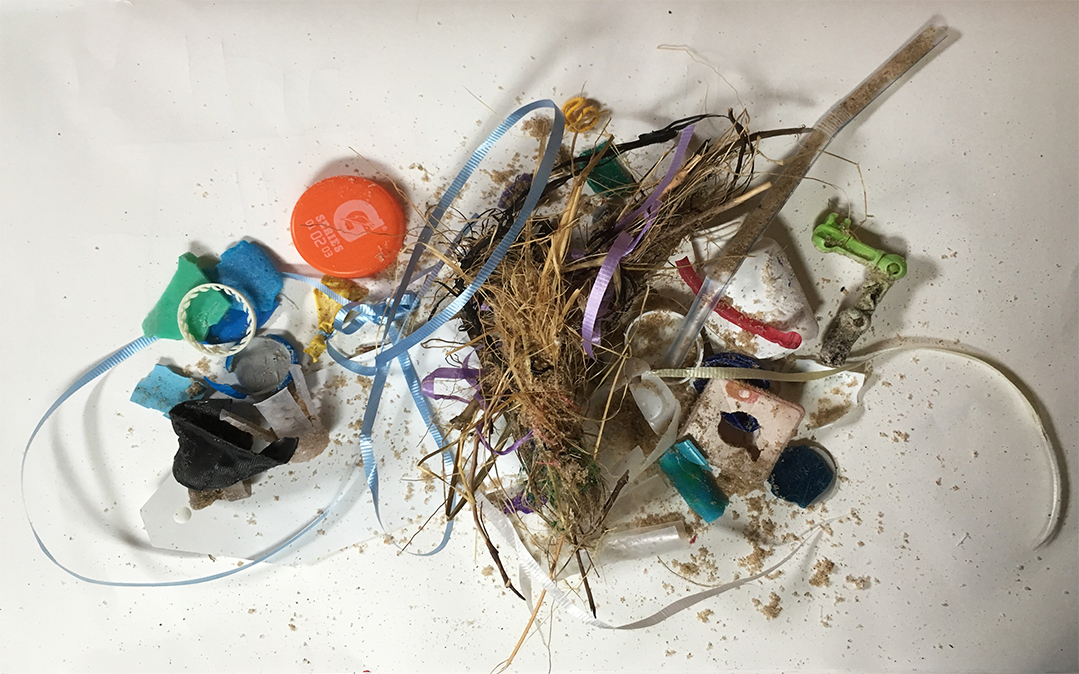
Beach trash

Photos by Christopher Schaberg

When I teach my Literature & Environment class at Loyola University New Orleans, one of the first lessons I try to get across is a tricky one: Nature with a capital N is an artificial construct. This doesn’t mean that there’s no such thing as nature, but rather, it’s not something over there, detached from human life. Nature is, if anything, everything. Writing about nature—and reading across the history of nature writing—can bring this into sharp relief, as we see how different authors use rhetorical strategies and narrative and poetic devices to make nature appear more like Nature. So-called environmental writers are often very good at defamiliarizing the very stuff of life, if then to make readers pay attention and care for it all the more. 

The day after the Women’s March on Washington, I took my children to the Smithsonian National Museum of Natural History. Amid the myriad exhibits, I was struck by one piece of signage nestled into a wall within the aquatic-life room. It was a sort of brief informative essay about the Anthropocene, a word that is used to describe human impact as having a geologic force on our planet. The sign diplomatically wondered whether or not this term should be used: Can we be so bold as to name an entire geological era after our arguably still young species? One way of answering this question is that we do it all the time, simply by rendering nature as something other than human in the first place. In other words, the Anthropocene has lurked as a cultural habit for a long time, before the word even emerged. It spilled out of smokestacks just as it infested 19th-century poems and essays named after “Nature.” 

It’s one thing to consider the Anthropocene when the incumbent political establishment acknowledges the significance of things like pollution, climate change, national parks, environmental protections, and so on. In such an atmosphere, we can have spirited debates about the implications of the concept of the Anthropocene, highlighting its different valences or offering alternative words. But this piece in the museum got me thinking: How are we to comprehend the Anthropocene in an age of a new president, a leader who seems utterly unmoved by ecological thought? Does the term become another disparaged “big word” that loses all traction given a regime of swift deregulations and defunding of scientific and precautionary research? In short, now that we are seeing the swift rolling back of so many careful measures put in place over the past several decades, how are we to understand Trump in relation to the Anthropocene? 

Beach trashI’ve been turning this over in my mind as I take walks along the Sleeping Bear Dunes National Lakeshore, picking up beach trash. This stuff washes up on shore and accumulates, especially after a big storm. It’s a mishmash usually consisting of balloon strings, plastic bottles, bottle caps, and tiny fragments of larger plastic containers. It’s a local snapshot of a global problem, one that we have come to know particularly well by the name Great Pacific Garbage Patch—that floating island in the Pacific Ocean the size of Texas, made of micro-plastics and other debris. These miniscule objects wreak havoc on certain bird species and other life forms, changing the planet demonstrably by threatening extinctions and upsetting the balances of ecosystems. Human waste has become such a vast thing, spread out across the globe, evident by traces and in glimpses but impossible to see as a totality—what environmental philosopher Timothy Morton would call a “hyperobject.” We’re responsible for it, and yet it seems completely elusive and beyond our grasp. Each day when I go back down to the beach, I fill another bag with these particulates of disposable fun, the detritus of so many summer vacations and freshwater boat rides. 

But how does Trump figure into this? 

For one, we cannot dismiss him or his policies as unnatural. Instead, as counterintuitive as this may sound, we have to acknowledge Trump as endemic to, and symptomatic of, the current state of our world. His bullying tweets and destructive executive orders; his prioritizing dirty fossil fuels over clean renewable energy; his “us versus them” and “America first” ethic all expose the very same pathologies that got us an “Anthropocene” in the first place. In a perverse way, then, Trump could end up making the Anthropocene a lot less controversial or debatable—he will make it chillingly obvious. His curiously ecological “swamp” metaphor appears quainter than ever. 

In the offing of his presidency, we can see individuals and collectives rallying around causes that we may have assumed a few months ago were settled matters. It was never just about a fabulist wetland that could or should be “drained”—what an odd idea—but rather a whole fragile, enmeshed planet with rising sea levels. And we’re here for the duration. 

If the downside of the Anthropocene is that we as a species have brought the planet to (or even beyond) the brink of mass extinction and environmental collapse, the upside might be that we can acknowledge this and become, to use a buzzword, proactive and conscious participants in this epoch. What would that look like? 

It wouldn’t look like the ultra-wealthy pursuing habitation on other planets, or fortifying nuclear-proof bunkers in Kansas. It would involve slower processes, such as community engagement, commitment to ecological education, and undoing our most wasteful and destructive habits. It would mean rethinking economic models and income gaps. It would mean trying, consciously and conscientiously, to bring about more balance rather than less, ecologically speaking. We have to work toward these things, even while knowing that there is no pure state of natural balance—flux is always the only game in town. We’re not trying for perfect harmony—we’re trying to survive, maybe even restore and better appreciate some of the biodiversity we have destroyed on our planet. And within these dynamic ecosystems, amid rampant threats and possible recoveries, how will we live out our time? What legacies will we leave, for our future generations and in the eventual fossil record, long after humans are gone? 

These are serious questions that demand serious answers—not impulsive reactions or the frantic shoring up of resources. If we truly wish to treat human life with dignity, we cannot detach humanity from the whole planet, in all its intricacies and ongoing pulsations. The hubris of Trump might end up revealing the humility of humans living in—and working with—the Anthropocene. It’s an endless project—at least while we’re here. But it’s the project we cannot help but be part of, whether we like it or not.   

The Anthropocene and the geo-political imagination: Re-writing Earth as political space

Eva Lövbrand a, Malin Mobjörk b, Rickard Söder b

https://doi.org/10.1016/j.esg.2020.100051

Abstract

The Anthropocene is described as a dangerous and unpredictable era in which fossil-fueled ways of life undermine the planetary systems on which human societies depend. It speaks of a new world of globalized and manufactured risks where neither security nor environment can be interpreted or acted upon in traditional ways. In this paper we examine how debates on the Anthropocene unfold in global politics and how they challenge core assumptions in International Relations. Through a structured analysis of 52 peer-reviewed journal articles, we identify three Anthropocene discourses that speak of new environmental realities for global politics. These are referred to as the endangered worldthe entangled world, and the extractivist world. While each discourse describes an increasingly interconnected and fragile world in which conventional binaries such as inside/outside, North/South and us/them can no longer be taken for granted, disagreement prevails over what needs to be secured and by whom.

1. Introduction

A new concept has entered the lexicon – the Anthropocene. The term was coined at the turn of the millennium to describe the profound and accelerating human imprint on the global environment (Crutzen and Stoermer, 2000). Rising global temperatures, melting glaciers, thawing permafrost, acidified oceans and irreversible species loss are some of the examples used to illustrate the dramatic shifts in the Earth’s biosphere caused by modern industrial civilization (IPCC, 2018). In contrast to the Holocene – the past 12 000 years of relative climate stability – the Anthropocene has been described as a dangerous and unpredictable era when fossil-fueled ways of life are undermining the planetary life-support systems upon which human societies depend (Rockström et al., 2009Steffen et al., 2018). It refers to a new phase in planetary history, we are told, when humanity has become a major force of nature that is changing the dynamics and functioning of Earth itself.

The proposition that we now live in a world entirely of our own making is uncomfortable and perplexing. It suggests a fundamental and dangerous rupture in the Earth’s trajectory that calls for new ways of thinking about humanity’s relationship to nature, ourselves and our collective existence (C. Hamilton, 2017Scranton, 2015). By tying the fate of humanity to the fate of our planet, the Anthropocene concept has invited intense interdisciplinary conversations across scholarly fields as varied as Earth system science, geology, history, philosophy, and sociology (Biermann and Lövbrand, 2019Hamilton et al., 2015Steffen et al., 2011). In recent years the Anthropocene has also arrived at the study of global politics and prompted critical debates about some of the core assumptions upon which International Relations (IR) rest (Simangan, 2020). Harrington (2016, p. 493) describes the Anthropocene as a watershed moment for a discipline that found its voice in the midst of the Cold War when apocalyptic visions of nuclear war were commonplace. It is a concept that speaks of a new world of globalized and manufactured risks in which neither security nor environment can be interpreted or acted upon in traditional ways (Dalby, 2009). In a time when modern technology, trade and consumerism is disrupting the planet’s life-upholding systems in unprecedented ways, a growing IR scholarship is searching for a new security language that brings our changing climate, melting glaciers and polluted oceans to the forefront of global affairs (Burke et al., 2016Harrington, 2016).

In this paper we trace how these Anthropocene debates are unfolding in the study of IR and ask how they may reconfigure Earth as political space. Just as geographical knowledge for long has been used by great powers to naturalize the exercise of power and control over distant places and people (Chaturvedi and Doyle, 2015), we examine how IR scholars now are drawing upon environmental knowledge to rethink nature as a stable ground for such global politics. While the profound material implications of a transformed global environment are central to this rethinking, we will in this paper primarily focus on the representational politics of contemporary Anthropocene debates. Informed by the critical geopolitics of scholars such as Gearoid O Tuathail (1996), John Agnew (1998) and Simon Dalby (2009), we approach the Anthropocene as a discursive event that is actively involved in the (re)writing of space for global politics. We thus ask how this new era in planetary history is staged as a geo-political drama. How is the Anthropocene written spatially and geographically? What risks and security concerns does it render visible? Who and what is endangered on this global scene? How are friends and enemies construed? What kinds of policy responses are deemed appropriate to meet the dangers of a transformed global environment?

Our study is based on a literature review of 52 peer-reviewed journal articles found in the database PROQUEST using the search words ‘Anthropocene’, ‘security’, ‘geopolitics’ and ‘politics’. The search was made in titles, abstracts and keywords of articles published during 2010–2018, and produced 143 results. As a first step, all articles were extracted into Excel and the abstracts were analyzed in view of how the Anthropocene is presented as a political problem. As a second step, we limited our sample to the articles that explicitly engage with the Anthropocene concept and its implications for global politics. These 52 articles were subject to thorough content analysis and sorted according to the analytical questions outlined above (for full list of articles, see appendix). From this analysis we identified reoccurring ontological claims, analytical themes and political concerns around which IR debates on the Anthropocene currently seem to circle. We used these categories to outline the contours of three discourses that we here call 1) the endangered world; 2) the entangled world and; 3) the extractivist world. In the following we present these discourses and compare how they stage our transforming Earth as political space. Although the Anthropocene debates drawn upon in this paper play out at the margins of mainstream IR,1 we find that they are actively confronting some of the spatial assumptions, meanings and orders upon which the latter rest. When engaging with the self-imposed dangers of a radically climate changed world, all three discourses project a world that is more interconnected and fragile than ever before and in which conventional binaries such as inside/outside, North/South, us/them no longer can be taken for granted. However, disagreement prevails over what needs to be secured and by whom in view of this new environmental reality.

2. The geopolitical imagination: imposing order and meaning on space

We live in confusing and troubled times. Three decades after the fall of the Berlin Wall and the peaceful end to Cold War rivalry, scholars and practitioners of global politics are again searching for a language that describes how the world works and what challenges global politics face. The 1990s often signify the triumph of liberal democracy and new political possibilities arising from multilateral cooperation and free trade (Hewson and Sinclair, 1999). In the aftermath of the Cold War, economic globalization and transnational flows of information, finance and people effectively unsettled the geopolitical map and challenged binary conceptions of political space such as East and West, modern and backward (Ó Tuathail, 1998). In the new world of global flows, networks and relations, the spellbinding ‘big picture’ of geopolitics seemed decidedly out of fashion and place (Ó Tuathail and Dalby, 1998). Instead global governance gained ground as a novel frame for understanding the character of global life (Latham, 1999). As outlined by James Rosenau in the first volume of the journal Global Governance, this new language signified an academic and political search for order, coherence and continuity in a time of disorder, contradiction and change. “To anticipate the prospects for global governance in the decades ahead”, Rosenau (1995, p. 13) suggested, “is to look for authorities that are obscure, boundaries that are in flux, and systems of rule that are emergent. And it is to experience hope embedded in despair.”

The rise of global environmental consciousness and governance belongs to this rethinking of global politics at the end of the 20th Century. Responding to a growing sense of ecological interdependence and urgency, state and non-state actors have since the mid-1990s engaged in a wide array of cooperative strategies and institutionalized forms of global governance. From the burgeoning field of global environmental governance studies, we have learned that these multilateral rule-systems today cut across traditional state-based jurisdictions and public-private divides and hereby link actors and places in ways that defy conventional understandings of IR (Biermann, 2014Bulkeley et al., 2014). In this new world of collaborative, networked and transnational forms of environmental governance, global politics no longer appears to be defined by international anarchy or the hierarchical authority of the state (Stripple and Bulkeley, 2013). As outlined by Biermann and Pattberg (2008) global life is instead characterized by new types of agency and actors, new mechanisms of governance that go beyond traditional forms of state led treaty-based regimes, and an increased segmentation and fragmentation of the overall governance system across levels and functional spheres.

While this largely liberal story of global politics has gained a powerful grip on the study of IR, we have recently experienced a revival of geopolitical thought and foreign policy practice. In response to the disorientation and identity crisis following the end of the Cold War, many foreign policy elites are again mobilizing allegedly objective geographical criteria to fix the role of the nation-state in world affairs and to keep ‘the Other’ out (Guzzini, 2012, p. 3). The new geographies of danger presented by melting glaciers, rising sea levels and more extreme weather feed into this re-territorialization of global affairs (Chaturvedi and Doyle, 2015) and have given rise to a new security language that accounts for the risks of climate-induced instability, conflict and displacement (Scheffran et al., 2012van Baalen and Mobjörk, 2018). While some work in this field draws upon the human security concept to examine how climate change may multiply existing vulnerabilities and threaten the livelihood of the poor (O’Brien et al., 2010), the scaling up of climate fear has also given new energy to realist scripts of international relations and state-centric security frames (Brzoska, 2012).

In the following we draw upon critical geopolitics to examine how the Anthropocene concept is mobilized in this struggle to (re)define global space in view of new environmental realities. Critical geopolitics is a sub-discipline to political geography that emerged during the 1980s to liberate geographical knowledge from the imperial geopolitics of domination (Chaturvedi and Doyle, 2015, p. 5). It is a scholarship that invites us to consider how certain “spatializations of identity, nationhood and danger manifest themselves across the landscape of states and how certain political, social and physical geographies in turn enframe and incite certain conceptual, moral and/or aesthetic understandings of self and other, security and danger, proximity and distance, indifference and responsibility” (Ó Tuathail and Dalby, 1998, p. 4). Hence, rather approaching the world as politically given, critical geopolitics critically interrogates the forms of knowledge and imaginations that underpin international politics and the cultural myths of the sovereign state (Agnew, 1998). A central assumption informing work in this field is that geographical representations of the world are far from innocent. As argued by Ó Tuathail (1996, p. 7), geographical knowledge constitutes a form of geo-power that is actively involved in the production, ordering and management of territorial space. Conscious and inspired by these insights, we here examine what forms of environmental knowledge that contemporary IR debates on the Anthropocene draw upon, and how they stage the future of world politics. In these unfolding debates we identify three discourses that we call the endangered world, the entangled world, and the extractivist world.

2.1. The endangered world: securing the future habitability of the planet

The endangered world is a discourse that draws energy from Earth system science and its proposition that humanity at the end of the 20th Century has become an Earth shaping agent that now rivals some of the great forces of nature (Brondizio et al., 2016Steffen et al., 2011). The Anthropocene here marks a shift from the stable Holocene era within which human civilizations have developed and thrived. As outlined by Steffen et al. (2011), the ‘great acceleration’ in human population, economic exchange, technological development, material consumption and international mobility following the end of World War II has left an unprecedented imprint on the global environment and fundamentally altered humanity’s relationship to Earth. By degrading the planet’s ecological systems and eroding its capacity to absorb our wastes, humanity has dangerously disrupted the Earth system and pushed the planet into a more hostile state from which we cannot easily return (Pereira and Freitas, 2017Steffen et al., 2011).

The endangered world presents a global scene where new environmental threats and dangers are causing socio-economic turbulence and gradually altering the geopolitical map. In the Arctic, for instance, Young (2012) finds that the interacting forces of climate change and globalization are transforming environments at unprecedented rates and opening up the region to outside forces. Non-linear shifts in sea ice and thawing permafrost have unleashed mounting interest in the region’s natural resources and invited Great Powers to enhance their commercial shipping, fossil fuel extraction and industrial fishing (Young, 2012). Similarly, Willcox (2016) outlines how climate change is posing a grave external threat to the self-determination of atoll island peoples in the Pacific region. As sea level rises and storms increase in frequency, states such as Tuvalu, Kiribati, and the Maldives are facing loss of habitable territory and relocation of entire populations (Willcox, 2016). In other parts of the world climate change is triggering vector-borne diseases, freshwater shortage, crop failure and food scarcity (Floyd, 2015). While these threats are most pressing in already fragile regions, they are multi-scalar, interconnected, and transboundary in nature and may therefore cause human insecurity and political instability in areas distant from their origin (Hommel and Murphy, 2013DeFries et al., 2012Pereira, 2015).

The endangered world is a discourse that challenges the modern spatialization of the world into a system of states with unquestionable political boundaries and mutually hostile armed camps (Agnew, 1998). As outlined by Pereira and Freitas (2017), many of the human-produced dangers of climate change have no parallel in history and work in complex, uncertain and unpredictable ways. The dangers are often diffuse, indirect and transnational and hereby make the world more interconnected and interdependent than ever imagined by IR. While this discourse recognizes that climate change may endanger the territories and populations of particular states, it is the global biosphere that is the primary referent object of security. The entire life-support system of the planet is under threat and the role of global politics is to regain control for the sake of human wellbeing and security (Floyd, 2015). As noted by Steffen at al. (2011, p. 749) the planetary nature of the challenge is unique and demands a global-scale response that transcends national boundaries and cultural divides. In order to avoid that large parts of the human population and modern society as a whole will collapse, humanity has to rise to the challenge and become a responsible steward of our own life-support system (Steffen et al., 2011). Geographical imbalances in human suffering and vulnerability form part of this new story for global politics (Biermann et al., 2016Da Costa Ferreira and Barbi, 2016O’Brien, 2011). However, in the endangered world it is the aggregated human effect on the Earth system that is the primary object of concern.

The endangered world draws energy from a long line of liberal institutionalist thinking to foster responsible Earth system stewardship. In order to gain control over the unfolding sustainability crisis and effectively govern the Anthropocene, this discourse insists that the world needs strong global institutions that can balance competing national interests and facilitate coordinated policy responses (Da Costa Ferreira and Barbi, 2016Young, 2012). Hence, the liberal democratic order organized around the United Nations and its various treaty-regimes remains central to the vision of global politics advanced here. However, given the complex and dispersed nature of 21st century challenges, international policy responses need to rest upon multi-level governance approaches that respond to the varied role of people and places in causation and effect of global environmental changes (Biermann et al., 2016Steffen et al., 2011). In order to build links across local, national and global scales, effective governance in the Anthropocene also hinges on integrated scientific assessments of critical Earth system processes and scenario planning that anticipates the systemic risks and security implications of ecosystem change (Hommel and Murphy, 2013Steffen et al., 2011). As outlined by Dumaine and Mintzer (2015) traditional security thinking makes little analytical sense in a world bound together by complex, non-linear and closely coupled environmental risks. In the Anthropocene security analysts must move beyond the assumption that the main purpose of defense is to secure the nation against external, state-based, mainly military threats. In order to respond to the dangers of a radically transformed global environment, states need to cultivate a shared view about common threats and improve collective capacities for early warning, rapid response, and disaster mitigation (Dumaine and Mintzer, 2015).

2.2. The entangled world: securing peaceful co-existence

In parallel to the science-driven and liberal institutionalist imagination informing the endangered world, the Anthropocene has also given energy to a post-humanist IR discourse that confronts the grand narratives of modernity and the forms of global politics they give rise to. Similar to the endangered world, this parallel discourse describes the Anthropocene as a complex and unpredictable era when human and natural processes have become deeply intertwined. However, the Anthropocene is here not approached as a problem that can be reversed, resolved or governed (Johnson and Morehouse, 2014). As outlined by Harrington (2016, p. 481) it instead reflects a new reality where humans, nonhumans, things, and materials co-exist in complex relations of life and non-life. In this entangled universe, the Cartesian separation between nature and culture has broken down and the world as conceived by modernity has ended. Dualistic understandings of the active, progressive and morally countable human (subject) and the passive and static externality of nature (object) are replaced by much more contingent, fragile and unpredictable networks of relations (Fagan, 2017). In a world marked by melting ice caps, thawing permafrost, acidified oceans, accelerating deforestation, degraded agricultural lands and dramatic species loss, human activity and nature are so enmeshed that they are existentially indistinguishable. A complex but singular “social nature” is now the new planetary real, claim Burke et al. (2016, p. 510).

The entangled world is a discourse that draws upon the Anthropocene to destabilize and radically rethink the conceptual frameworks that underpin contemporary global politics. It confronts a state-centric world obsessed with bargaining, power and interests with the monumental risks, threats, and physical effects of a transformed global environment (Burke et al., 2016Harrington, 2016). In a time when industrialized and profit-driven human societies are dangerously enmeshed with the biosphere, national security based on keeping ‘the Other’ out is failing the reality of the planet and portraying the wrong world picture. The magnitude and reach of contemporary environmental risks mean that “the Other is always already inside, so bound up with us in a common process that it no longer makes sense to speak of inside and outside” (Burke et al., 2016, p. 502). The dawning of the age of the human hereby challenges modern understandings of security at the most fundamental level. In the entangled world, the idea that we can secure humanity against external threats is precisely the problem that needs to be overcome (Chandler, 2018, p. 10). In the words of Hamilton (2017b, p. 586, italics in original), “(i)f humans are nature, and the Anthropocene demands the securing of humanity (and all life) from the unpredictable planetary conditions “we” are “making”, then the aim of security ultimately becomes that of securing oneself from oneself “.

The entangled world is as much a philosophical event as an environmental one that challenges modern conceptions of who we are as humans and how we relate to the world around us. Humans are conceived simultaneously as central and all-powerful, and fragmented and insignificant (Fagan, 2017). By reaching into deep geological time, the human-induced ecological crisis offers a new cosmological origin and ending story that alters today’s basic presuppositions of what the Earth and the ‘human condition’ are (Hamilton, 2018, p. 391). “Even in the study of deep time and geological shifts, we cannot escape ourselves” (Harrington, 2016, p. 479). Faced with humanity’s overwhelming Earth-shaping powers we appear adrift, claim Johnson and Morehouse (2014, p. 442), “alienated not only from a world that refuses to submit to long-held conceptual frameworks, but also alienated from ourselves in relation to this strange and allegedly destructive thing called ‘humanity’“. The entangled world hereby forces IR into an uncomfortable place where many of the discipline’s organizing categories break down: the logics of inclusion and exclusion; the idea of agency and a unified human subject; and the imagination of an intelligible world as a whole (Fagan, 2017, p. 294). In face of the ontological shift brought about by the Anthropocene, IR is called upon to rethink the narrow anthropocentric, state-led, economistic boundaries that solidify the bygone age of the Holocene (Harrington, 2016, p. 480).

The entangled world presents a global scene of complex interconnections and interdependencies that cut across conventional geographical and temporal scales and species boundaries. Security cannot be achieved by resolute actions grounded in expression of power targeting ‘external’ threats, but only by re-embedding modern humanity in the multi-species world that we now are remaking. As argued by Burke et al. (2016, p. 502) we cannot survive without accepting the cosmopolitan and enmeshed nature of this world. In a world of entangled relations security comes from being more connected, not less (ibid). Against this backdrop McClanahan and Brisman (2015) find proposals from the US security establishment to wage war on climate change deeply problematic. Militaristic assertions that we can win the fight against climate change reproduce the modern understanding of nature as exterior that we so desperately need to transcend. What the world needs is instead a new global political project that makes peace with Earth and hereby secures mutual co-existence (Burke et al., 2016McClanahan and Brisman, 2015). Such a project is by necessity post-human, claim Cudworth and Hobden (2013). In order to move beyond human centrism and domination we must recognize that social and political life always is bound up with non-human beings and things. In the Anthropocene the environment is not ‘out there’, but always ‘with’ and ‘in here’ (Cudworth and Hobden, 2013, p. 654). To end human-caused extinctions, prevent dangerous climate change, save the oceans, support vulnerable multi-species populations, and restore social justice, the entangled world therefore demands a ‘worldly politics’ that brings our multi-species interrelations to the foreground of global affairs (Burke et al., 2016).

2.3. The extractivist world: securing socio-ecological justice in capitalist ruins

The third IR discourse found in our sample pulls Anthropocene debates in a more neo-Marxist direction. Here we are also confronted with a world in radical transformation defined by unprecedented ecological destruction and insecurity. However, the Anthropocene is not primarily understood as geological marker of time or the symptom of anthropocentric modernity. In the extractivist world the center of concern is instead the global capitalist system and the monumental damage and injustice done by its ceaseless need for expansion, accumulation and extraction. As outlined by Sassen (2016, p. 90) the development of capitalism has, since its origins, been marked by violence, destruction, and appropriation. By digging up and burning large reserves of fossilized carbon, industrialized economies have long done damage to the biosphere and people living on the edges of the Western world. However, the past three decades of petroleum-powered economic globalization have reorganized human-nature relations on the largest possible scale. The extraordinary growth in industrial production, commodity markets, technological innovation and consumerism is now remaking the entire ecological context for humanity. The global ecological crisis must therefore be understood as a problem of production, claims Dalby (2014, p. 7). Making things now also means remaking ecologies and reconstructing the very geo of global politics.

The extractivist world presents a highly unstable, uncertain and risky political landscape in which the speed and scale of destruction has ruined the biosphere’s capacity to recover. As argued by Stubblefield (2018, p. 15) “capitalism does not merely produce commodities and (re)shape nature, but feasts upon and produces death—as it consumes the fossilized energy of the dead buried for millennia; as it inevitably kills cultures, ecosystems, humans, and non-human animals”. Degraded lands, polluted waters, destroyed livelihoods, and massive species extinction are therefore the dark signatures of the Anthropocene. The widespread production of devastated life spaces suggests that it is the process of expanding capital, and not humanity as such, that is at odds with nature (Stubblefield, 2018). As noted by Dalby (2017) human insecurity is now a matter relating to the global economy, its economic entitlements, and the technological systems in which those are enmeshed. While granting the rich unfettered access to resources and goods, the capitalist order increases the stress of those already at risk and hereby perpetuates landscapes of structural vulnerability and social injustice (Ribot, 2014). Waves of pain and suffering are now hitting people living on the edges of capitalist society and forcing vulnerable communities to give up their dead lands and join a growing urban precariat of “warehoused, displaced and trafficked laboring bodies” (Sassen, 2016, p. 90).

The extractivist world is a discourse that breaks with universalized stories of our contemporary ecological crisis. Although no one is immune to the terraforming effects of carboniferous capitalism, this discourse forefronts the diversity of human relations with nature and the political systems under which these relations emerge (Stubblefield, 2018). Rather than presenting the Anthropocene as the aggregated effect of an undifferentiated humanity, the extractivist world directs blame and liability and hereby links ecological damage to social organization and stratification (Ribot, 2014). In the extractivist world the climate stressors that arch through the sky are by no means natural. They are produced by a global political economy that requires an unending, cheap flow of fossil fuels for the concentration of wealth at the expense of vulnerable people and ecosystems (Daggett, 2018Ribot, 2014). While this fossil-fueled capitalist system is the real danger in the Anthropocene, it is forcefully protected by powerful economic and political elites. As proposed by Daggett (2018), fossil capitalism catalyzes the liberal democratic freedoms enjoyed by Western middle classes and fuels the energy-intensive and consumption-heavy lifestyles that extend across the planet. Concerns about climate change threaten these liberal consumer lifestyles and the white patriarchal orders that profit from them. This ‘catastrophic convergence’ between climate change, a threatened fossil fuel system, and an increasingly fragile liberal and patriarchal order, argues Daggett (2018), explains the rise of authoritarian movements marked by racism, misogyny, and climate denial in many Western states.

In the extractivist world the dangerous transformations of the global biosphere are symptoms of a political economy that commodifies and exploits environments and people. Serious efforts to come to terms with the damage done must therefore break with marketized solutions such as emissions trading or carbon offsetting and search for security beyond the circuits of capital. Everything else would be to accept, or even facilitate, the awaiting crises, claims Stubblefield (2018). As argued by Dalby (2013, p. 45), the rich industrial proportion of humanity has taken the fate of Earth into its own hands and is now determining what kinds of lives that get to be lived. Grasping the totality of material transformations is the pressing priority for anyone who thinks seriously about the future of humanity and our political arrangements. Rather than fiddling at the edges of carboniferous capitalism, security in the Anthropocene thus entails rapid social change that makes decarbonization of the global economy possible (Dalby, 2014). To break capital’s hold over life, argue Swyngedouw and Ernston (2018), we need to move beyond the depoliticized language of Earth system science and post-human philosophy and confront the contradictions of capitalist eco-modernization head on. In the extractivist world, technological fixes such as nuclear energy, carbon dioxide removal techniques or large-scale expansion of renewable energy technologies will not save us from the unfolding ecological crisis. Political renewal and security are instead sought in transformative social movements and local experimentation with less material-intensive and more just socio-ecological relations and ways of life (Roux-Rosier et al., 2018).

3. Rewriting Earth as political space

The Anthropocene is a troubling concept for troubled times. It speaks of a complex, interconnected and unstable world marked by globalized and manufactured risks that now are threatening the very life-upholding systems upon which human civilizations rest. In contrast to the hopeful and reassuring concept of sustainable development that has guided international environmental cooperation since the early 1990s, the Anthropocene is wedded into a language of fear and sorrow in view of irreparable loss of Arctic ice sheets, mass species extinction, acidified oceans and degraded lands. It confronts us with the dangers of a transformed global environment and the apparent failure of the modern state-system to offer effective and peaceful responses to the same. While this new vocabulary has gained widespread circulation in recent years, the Anthropocene remains a contested and ambiguous formulation that points in many different political directions (Biermann and Lövbrand, 2019). Since first introduced in Earth system science circles in the late 1990s, the concept has stirred heated interdisciplinary debate and been challenged, rejected and reworked by an expanding scholarship.

In this paper we have traced how the Anthropocene is interpreted and acted upon in the study of international relations. When navigating through our sample of 52 journal articles we found growing alarm in view of the self-imposed threats and security implications of a radically climate changed world, and mounting frustration with the failure of traditional IR theories and concepts to make analytical sense of the same. However, we also found important differences in the interpretations of the Anthropocene, with significant implications for the future of world politics. In the discourse that we call the endangered world the entire life-support system of the planet is under threat and the role of world politics is to regain control for the sake of human wellbeing and security. Rather than directing blame, this discourse is concerned with the aggregated human effects on the Earth system and the possibility of bringing the planet back to a safe Holocene-like state. In the endangered world, integrated scientific assessments and international policy coordination are the means for responsible Earth system stewardship and governance. In order to gain control over the unfolding sustainability crisis and hereby secure the future of modern civilization, this discourse insists that the world needs strong global institutions that can balance competing national interests and facilitate coordinated policy responses.

In the entangled world, by contrast, the idea that we can effectively govern the Anthropocene and hereby secure humanity against external threats is precisely the problem that needs to be overcome. In this discourse the modern spatializations of the world into nature and culture, subject and object, inside and outside are replaced by much more contingent, fragile and unpredictable networks of interrelations. In order to secure peaceful co-existence in the multi-species world that we now are re-making, the entangled world insists that we recognize modern civilization as a philosophical and political dead-end and search for a worldly politics that extends beyond human centrism and domination. The Anthropocene here becomes an invitation to rethink our institutions, commitments and rules and to forge new forms of cooperation built upon participation, solidarity and justice beyond the state and indeed the human (Burke et al., 2016, 507). While the entangled world is a discourse that seeks to break free from state-centric forms of global governance, the search for political alternatives remains unfinished and includes liberal institutionalist ideas of cosmopolitan democracy as well as bottom-up politics of subversion and resistance (Chandler et al., 2018).

The final Anthropocene discourse presented in this paper centers around the global capitalist system and the monumental damage and injustice done by its ceaseless need for expansion, accumulation and extraction. In the extractivist world degraded lands, polluted waters, destroyed livelihoods, and massive species extinction are the dark signatures of a fossil-fueled political economy that grants the rich unfettered access to resources and goods at the expense of vulnerable people and environments. In order to address the damage done and hereby secure socio-ecological justice, this discourse calls for transformative politics that breaks with technical fixes and marketized solutions and searches for political renewal in grassroots experiments and social movements operating beyond the circuits of capital.

The results from this discursive cartography are by no means ubiquitous. The geopolitical discourses emerging from our material are heterogeneous, partly overlapping and thus difficult to neatly separate. The articles analyzed here draw inspiration from a long heritage of liberal institutionalist, post-humanist and neo-Marxist thinking, and often combine these intellectual resources in intricate ways to make sense of our problem-ridden Earth. While the articles included in our study offer competing stories of Anthropocene endangerment and security, they all present a new scene for global politics. The damage done to the global biosphere is of such magnitude, we are told, that nature no longer functions as a stable and passive ground for the human drama that we can rely on. By digging up and burning large reserves of fossilized carbon, modern industrial society has pushed many ecosystems beyond their Holocene comfort zones and hereby altered the material context or the very geo of global politics. This new world of humanity’s own making effectively unsettles the geographical assumptions and ‘rules of the game’ that underpin familiar scripts of international relations (both realist and liberal). In the articles reviewed here we learn about non-linear, transboundary and closely coupled risks that now are travelling across the planet and linking states, people and environments in complex, unexpected and potentially dangerous ways. In this highly interconnected and risky world, neither state-centric representations of global space nor traditional security thinking make analytical or political sense. The traditional geopolitical categories of inside and outside, domestic and foreign, friends and foe are deeply questioned, along with conceptions of state, security and sovereignty. In the Anthropocene the political boundaries that constituted the Holocene world are eroding, we are told, and our transformed global environment now plays an integral and active part of the global drama.

Where this rethinking of global politics will lead us is too early to tell. IR debates on the Anthropocene are still unfolding and contain a broad mix of dystopian scenarios, social critique, novel ethical claims and challenging ontological propositions. So far, the discourses outlined here are found at the margins of the IR literature, and primarily seem to involve a Northern environmental scholarship. While the grand philosophical gestures and structural critique found in these debates may frustrate those who are interested in developing policy solutions to the environmental challenges of our times, we note that the Anthropocene is a travelling concept that already is beginning to shape policy thinking and practice. In Angela Merkel’s speech to the Munich security conference in 2019, the profound traces of humankind on Earth’s biological systems was staged as a major threat that requires new security responses (Merkel, 2019). Merkel’s speech was not the first time the Anthropocene concept entered policy debates, but likely the most recognized. Two additional policy sites where the Anthropocene concept now circulates include the Planetary Security Conference in the Hague, hosted by the Dutch Ministry of Foreign Affairs to develop knowledge and policies on climate-induced security risks (Chin and Kingham, 2016, p. 3), and the Centre for Climate and Security, a non-partisan security institute based in Washington DC (Werrell and Femia, 2017). Exactly how the Anthropocene vocabulary will influence direct frameworks, policies and decisions is of course difficult to tell, and given that the concept is debated, it will probably take time before its practical implications become clear. However, by challenging existing frameworks of thinking, we expect that the discursive scene of the Anthropocene will leave important marks on the study and practice of international relations in the years to come.

References

Appendix: Full list of reviewed journal articles

  1. Alcaraz et al., 2016Jose M. Alcaraz, Katherine Sugars, Katerina Nicolopoulou, Francisco TiradoCosmopolitanism or globalization: the anthropocene turnSoc. Bus. Rev. (2016), 10.1108/SBR-10-2015-0061OctoberView at publisher Google Scholar
  2. Baxi, 2016Upendra BaxiSome newly emergent geographies of injustice: boundaries and borders in international lawIndiana J. Global Leg. Stud., 23 (1) (2016), pp. 15-37View at publisher CrossrefView in ScopusGoogle Scholar
  3. Benedikter and Siepmann, 2015Roland Benedikter, Katja SiepmannGlobal Systemic Shift Redux: The State of the ArtNew Global Stud, 9 (2) (2015), pp. 167-198, 10.1515/ngs-2015-0014View at publisher View in ScopusGoogle Scholar
  4. Biermann et al., 2016Frank Biermann, Xuemei Bai, Ninad Bondre, Wendy Broadgate, Chen-Tung Arthur Chen, Opha Pauline Dube, Jan Willem Erisman, et al.Down to Earth: contextualizing the anthropoceneGlobal Environ. Change, 39 (July) (2016), pp. 341-350, 10.1016/j.gloenvcha.2015.11.004View PDFView articleView in ScopusGoogle Scholar
  5. Brondizio et al., 2016Eduardo S. Brondizio, Karen O’Brien, Xuemei Bai, Frank Biermann, Will Steffen, Frans Berkhout, Christophe Cudennec, et al.Re-conceptualizing the anthropocene: a call for collaborationGlobal Environ. Change, 39 (July) (2016), pp. 318-327, 10.1016/j.gloenvcha.2016.02.006View PDFView articleView in ScopusGoogle Scholar
  6. Burke, 2013Anthony BurkeThe good state, from a cosmic point of viewInt. Pol. Basingstoke, 50 (1) (2013), pp. 57-76, 10.1057/ip.2012.28View at publisher View in ScopusGoogle Scholar
  7. Burke et al., 2016Anthony Burke, Stefanie Fishel, Audra Mitchell, Simon Dalby, J. Daniel, LevinePlanet politics: a manifesto from the end of IRMillennium, 44 (3) (2016), pp. 499-523, 10.1177/0305829816636674View at publisher View in ScopusGoogle Scholar
  8. Cudworth and Hobden, 2013Erika Cudworth, Stephen HobdenComplexity, ecologism, and posthuman politicsRev. Int. Stud., 39 (3) (2013), pp. 643-664View in ScopusGoogle Scholar
  9. Da Costa Ferreira and Barbi, 2016Leila Da Costa Ferreira, Fabiana BarbiThe challenge of global environmental change in the anthropocene: an analysis of Brazil and ChinaChin. Pol. Sci. Rev. Singapore, 1 (4) (2016), pp. 685-697, 10.1007/s41111-016-0028-9 View at publisher This article is free to access.View in ScopusGoogle Scholar
  10. Daggett, 2018Cara DaggettPetro-Masculinity: fossil fuels and authoritarian desireMillenn. J. Int. Stud., 47 (1) (2018), pp. 25-44, 10.1177/0305829818775817 View at publisher This article is free to access.View in ScopusGoogle Scholar
  11. Dalby, 2013aSimon DalbyBiopolitics and climate security in the anthropoceneGeoforum, 49 (October) (2013), pp. 184-192, 10.1016/j.geoforum.2013.06.013View PDFView articleView in ScopusGoogle Scholar
  12. Dalby, 2013bSimon DalbyThe geopolitics of climate changePolit. Geogr., 37 (November) (2013), pp. 38-47, 10.1016/j.polgeo.2013.09.004View PDFView articleView in ScopusGoogle Scholar
  13. Dalby, 2014aSimon DalbyEnvironmental geopolitics in the twenty-first centuryAlternatives, 39 (1) (2014), p. 3View at publisher CrossrefView in ScopusGoogle Scholar
  14. Dalby, 2014bSimon DalbyRethinking geopolitics: climate security in the anthropoceneGlob. Pol., 5 (1) (2014), pp. 1-9, 10.1111/1758-5899.12074View at publisher View in ScopusGoogle Scholar
  15. Dalby, 2017Simon Dalby“Anthropocene formations: environmental security, geopolitics and disaster.” theoryCult. Soc., 34 (2–3) (2017), pp. 233-252, 10.1177/0263276415598629View at publisher View in ScopusGoogle Scholar
  16. DeFries et al., 2012Ruth S. DeFries, Erle C. Ellis, F. Stuart Chapin III, Pamela A. Matson, B.L. Turner II, Arun Agrawal, Paul J. Crutzen, et al.Planetary opportunities: a social contract for global change science to contribute to a sustainable futureBioscience, 62 (6) (2012), pp. 603-606, 10.1525/bio.2012.62.6.11 View at publisher This article is free to access.View in ScopusGoogle Scholar
  17. D’Souza, 2015Rohan D’SouzaNations without borders: climate security and the south in the epoch of the anthropoceneStrat. Anal., 39 (6) (2015), pp. 720-728, 10.1080/09700161.2015.1090678View at publisher View in ScopusGoogle Scholar
  18. Dumaine and Mintzer, 2015Carol Dumaine, Irving MintzerConfronting climate change and reframing securityThe SAIS Rev. Int. Affairs Baltimore, 35 (1) (2015), pp. 5-16View at publisher CrossrefGoogle Scholar
  19. Fagan, 2017Madeleine FaganSecurity in the anthropocene: environment, ecology, escapeEur. J. Int. Relat., 23 (2) (2017), pp. 292-314, 10.1177/1354066116639738View at publisher View in ScopusGoogle Scholar
  20. Floyd, 2015Rita FloydEnvironmental security and the case against rethinking criminology as ‘security-ologyCriminol. Crim. Justice, 15 (3) (2015), pp. 277-282, 10.1177/1748895815584720View at publisher View in ScopusGoogle Scholar
  21. Graybill, 2013Jessica K. GraybillImagining resilience: situating perceptions and emotions about climate change on Kamchatka, RussiaGeojournal, 78 (5) (2013), pp. 817-832View at publisher CrossrefView in ScopusGoogle Scholar
  22. Gupta and Vegelin, 2016Joyeeta Gupta, Courtney VegelinSustainable development goals and inclusive developmentInt. Environ. Agreements Polit. Law Econ., 16 (3) (2016), p. 433, 10.1007/s10784-016-9323-z View at publisher This article is free to access.View in ScopusGoogle Scholar
  23. Hamilton, 2017cScott Hamilton“Securing ourselves from ourselves? The paradox of ‘entanglement’ in the anthropocene.” crime, law and social changeDordrecht, 68 (5) (2017), pp. 579-595 View at publisher This article is free to access.CrossrefView in ScopusGoogle Scholar
  24. Hamilton, 2018Scott Hamilton“Foucault’s end of history: the temporality of governmentality and its end in the anthropocene.” millenniumJ. Int. Stud., 46 (3) (2018), pp. 371-395, 10.1177/0305829818774892View at publisher View in ScopusGoogle Scholar
  25. Harrington, 2016Cameron HarringtonThe ends of the world: international relations and the anthropoceneMillenn. J. Int. Stud., 44 (3) (2016), p. 478, 10.1177/0305829816638745View at publisher View in ScopusGoogle Scholar
  26. Harrington et al., 2017Cameron Harrington, Emma Lecavalier, Clifford ShearingFrom passengers to crew: introductory reflectionsCrime Law Soc. Change Dordrecht, 68 (5) (2017), pp. 493-498, 10.1007/s10611-017-9698-yView at publisher View in ScopusGoogle Scholar
  27. Hommel and Murphy, 2013Demian Hommel, Alexander B. MurphyRethinking geopolitics in an era of climate changeGeojournal, 78 (3) (2013), pp. 507-524View at publisher CrossrefView in ScopusGoogle Scholar
  28. Hussain et al., 2015Javeed Hussain, Ghulam Akhmat, Shukui Tan, Xiangbo Zhu“The way forward to strengthen human nature entente: an educated human presence at all the interfaces of this relationshipQual. Quantity, 49 (5) (2015), pp. 2107-2121, 10.1007/s11135-014-0096-6DordrechtView at publisher View in ScopusGoogle Scholar
  29. Johnson et al., 2014Elizabeth Johnson, Harlan Morehouse, Simon Dalby, Jessi Lehman, Sara Nelson, Rory Rowan, Stephanie Wakefield, Kathryn YusoffAfter the anthropocene: politics and geographic inquiry for a new epochProg. Hum. Geogr., 38 (3) (2014), pp. 439-456, 10.1177/0309132513517065View at publisher View in ScopusGoogle Scholar
  30. Karlsson, 2017Rasmus KarlssonThe environmental risks of incomplete globalizationGlobalizations, 14 (4) (2017), p. 550View at publisher CrossrefView in ScopusGoogle Scholar
  31. Kotzé, 2014Louis J. KotzéRethinking global environmental law and governance in the anthropoceneJ. Energy Nat. Resour. Law, 32 (2) (2014), pp. 121-156, 10.1080/02646811.2014.11435355View at publisher Google Scholar
  32. Kotzé and Duncan, 2018Louis J. Kotzé, French DuncanA critique of the global pact for the environment: a stillborn initiative or the foundation for lex anthropocenae?Int. Environ. Agreements Polit. Law Econ., 18 (6) (2018), pp. 811-838, 10.1007/s10784-018-9417-x View at publisher This article is free to access.View in ScopusGoogle Scholar
  33. McClanahan and Brisman, 2015Bill McClanahan, Avi BrismanClimate change and peacemaking criminology: ecophilosophy, peace and security in the ‘war on climate changeCrit. Criminol., 23 (4) (2015), pp. 417-431, 10.1007/s10612-015-9291-6DordrechtView at publisher View in ScopusGoogle Scholar
  34. O’Brien, 2011Karen O’BrienResponding to environmental change: a new age for human geographyProg. Hum. Geogr., 35 (4) (2011), pp. 542-549, 10.1177/0309132510377573View at publisher View in ScopusGoogle Scholar
  35. Pasztor, 2017Janos PasztorThe need for governance of climate geoengineeringEthics Int. Aff., 31 (4) (2017), pp. 419-430, 10.1017/S0892679417000405New YorkView at publisher View in ScopusGoogle Scholar
  36. Pereira, 2015Joana Castro PereiraEnvironmental issues and international relations, a new global (dis)order – the role of International Relations in promoting a concerted international systemRevista Brasileira de Politíca Internacional; Brasília, 58 (1) (2015), 10.1590/0034-7329201500110n/aView at publisher Google Scholar
  37. Pereira and Freitas, 2017Joana Castro Pereira, Miguel Rodrigues FreitasCities and water security in the anthropocene: research challenges and opportunities for international relationsContexto Internacional; Rio de Janeiro, 39 (3) (2017), pp. 521-544, 10.1590/S0102-8529.2017390300004View at publisher Google Scholar
  38. Picq, 2016Manuela PicqRethinking IR from the amazonRev. Bras. Política Int., 59 (2) (2016), 10.1590/0034-7329201600203View at publisher Google Scholar
  39. Ribot, 2014Jesse RibotCause and response: vulnerability and climate in the anthropoceneJ. Peasant Stud., 41 (5) (2014), pp. 667-705, 10.1080/03066150.2014.894911View at publisher View in ScopusGoogle Scholar
  40. Roux-Rosier et al., 2018Anahid Roux-Rosier, Ricardo Azambuja, Gazi IslamAlternative visions: permaculture as imaginaries of the anthropoceneOrganization, 25 (4) (2018), pp. 550-572, 10.1177/1350508418778647View at publisher View in ScopusGoogle Scholar
  41. Sassen, 2016Saskia SassenAt the systemic edge: expulsionsEur. Rev., 24 (1) (2016), pp. 89-104, 10.1017/S1062798715000472CambridgeView at publisher View in ScopusGoogle Scholar
  42. Seitzinger et al., 2012Sybil P. Seitzinger, Uno Svedin, Carole L. Crumley, Will SteffenPlanetary stewardship in an urbanizing worldAmbio, 41 (8) (2012), p. 787 View at publisher This article is free to access.CrossrefView in ScopusGoogle Scholar
  43. Silva and Pardo Buendía, 2016Alberto Teixeira da Silva, Mercedes Pardo BuendíaMegacities in climate governance: the case of rio de JaneiroMeridian, 47 17 (December) (2016), 10.20889/M47e17013View at publisher Google Scholar
  44. Slocum, 2018Rachel SlocumClimate politics and race in the pacific northwestSoc. Sci., 7 (10) (2018), p. 192, 10.3390/socsci7100192View at publisher View in ScopusGoogle Scholar
  45. Squire, 2015Vicki SquireReshaping critical geopolitics? The materialist challengeRev. Int. Stud. London, 41 (1) (2015), pp. 139-159, 10.1017/S0260210514000102View at publisher View in ScopusGoogle Scholar
  46. Steffen et al., 2011Will Steffen, Åsa Persson, Lisa Deutsch, Jan Zalasiewicz, Mark Williams, Katherine Richardson, Carole Crumley, et al.The anthropocene: from global change to planetary stewardship Ambio; Stockholm(2011), 10.1007/s13280-011-0185-x40 (7): 739–761View at publisher Google Scholar
  47. Stubblefield, 2018Charles StubblefieldManaging the planet: the anthropocene, good stewardship, and the empty promise of a solution to ecological crisisSocieties; Basel, 8 (2) (2018), 10.3390/soc8020038View at publisher Google Scholar
  48. Swyngedouw and Ernstson, 2018Erik Swyngedouw, Henrik ErnstsonInterrupting the anthropo-ObScene: immuno-biopolitics and depoliticizing ontologies in the anthropoceneTheor. Cult. Soc., 35 (6) (2018), pp. 3-30, 10.1177/0263276418757314View at publisher View in ScopusGoogle Scholar
  49. Tolia-Kelly and Divya, 2016Tolia-Kelly, P. DivyaAnthropocenic culturecide: an epitaphSoc. Cult. Geogr., 17 (6) (2016), p. 786, 10.1080/14649365.2016.1193623View at publisher View in ScopusGoogle Scholar
  50. Walker et al., 2018R.B.J. Walker, R. Shilliam, H. Weber, G.D. PlessisCollective Discussion: Diagnosing the PresentInter Polit. Sociol, 12 (1) (2018), pp. 88-107, 10.1093/ips/olx022View at publisher View in ScopusGoogle Scholar
  51. Willcox, 2016Susannah WillcoxClimate change inundation, self-determination, and atoll island statesHum. Right Q., 38 (4) (2016), pp. 1022-1037, 10.1353/hrq.2016.0055View at publisher View in ScopusGoogle Scholar
  52. Young, 2012Oran R. YoungArctic tipping points: governance in turbulent timesAmbio, 41 (1) (2012), pp. 75-84View at publisher CrossrefView in ScopusGoogle Scholar

Of sand and stone: Thick time, cyclicality, and Anthropocene poetics in ‘Nomadland’

December 11, 2023/in Autumn 2023_#Cycles

by Gert Jan Harkema

The tiny moment of the past grows and opens onto a horizon, at once mobile and uniform in tone, of one or several years… She has the same feeling, alone in the car on the highway, of being taken into the indefinable whole of the world of now, from the closest to the most remote of things. – Annie Ernaux, The Years

Midway through Nomadland,[1] Chloé Zhao’s critically acclaimed 2020 feature where we follow the van-dwelling nomadism of Fern (Frances McDorman) through the seasons of work, life, and capitalism, we watch her on a guided tour through the Badlands National Park in South Dakota. ‘This is gonna be really exciting,’ her tour guide Dave (David Strathairn) – a friend to become romantic interest, tells his listeners. ‘Rub two stones together. And you see what happens as they start to get like sand.’ Fern, meanwhile, wanders off deep into the iconic sandstone landscape. The camera captures her, restlessly wandering, twisting and turning, as if she searches for something hidden in these rocky formations that were the result of deposits 75 million years ago, followed by 500,000 years of erosion. She searches until her friend Dave whistles and shouts from a distance, asking Fern if she found anything interesting. ‘Rocks!’ is Fern’s sole reply.  She climbs up and sees the guide as a sole individual contemplating the mountains and a group of tourists regrouping in a following shot.

This scene illustrates Fern’s relation to others, and to the natural surroundings that are so pivotal to the film’s aesthetics. In Nomadland, we feel Fern’s turmoil and trauma through her entanglement with the landscape. A widow who lost both her husband and her place of belonging, we travel with Fern on her nomadic existence through landscapes of melancholy, despair, and hope. She reconnects with people, and leaves them. Or she is left by them. She is half in a group, half on her own; halfway between rebuilding her life while her body (and her van) is deteriorating. Half sand and half stone, somewhere in a cyclicality between the past, a present, and a potential future. Fern’s experience through different cyclical processes of deterioration and resurgence resonate with the deep time temporalities of erosion and uplift.

Fig. 1: Fern surrounded by a sandstone environment in Nomadland.

The landscapes and natural surroundings, together with the human bodies and non-human objects on screen contribute to an aesthetics that contain different temporal dynamics. These natural and anthropogenic landscapes do not just function as setting or scenic background to the narrative. Rather, they appear as temporalised landscapes in which bodies operate and which, in turn, impact Fern’s whole being. Nomadland enacts what it means to perceive what Tim Ingold calls the temporality of the landscape, entailing an embodied engagement with the landscape as ‘an act of remembrance, and remembering not so much a matter of calling up an internal image stored in the mind as of engaging perceptually with an environment that is itself pregnant with the past’.[2] The rock formations and canyons that Fern’s wanderings are situated in are marked by the cyclical dimension of deep time. They move in a temporal width that is far removed from the lifespan of human and non-human animals. Moreover, as temporalised landscapes, these natural environments of forests, sand, and stone appear in stark contrast to the yearly cycles of the seasons, the short-term exhaustion of consumption and consumerism that signify the imagery of the film.

It is in the entanglement with the different cyclical processes of erosion and resurgence that human time and geological time meet in Nomadland. Fern’s personal narrative signifies how the capitalist cyclicality of production and consumption that is essential to the Anthropocene ends up in the exhaustion of the natural and human environment. The infrastructure that used to support her falls away as the village of Empire, a US Gypsum company town, is closed and after her husband dies from sickness. Thereby the film invites an ecocritical reading that takes into account the appearance of various cyclical dimensions and temporalities in landscapes, bodies, and objects.

Despite its independent financing and its use of non-actors in supporting roles, Nomadland became a modest success with audiences in the US while it became an international success with audiences worldwide.[3] Chloé Zhao received the Academy Award for Best Director as well as Best Picture (together with the other producers, including McDormand), and Frances McDormand was praised for her performances as she received the Academy Award for Best Actress. Meanwhile the film was well-received with critics, as it was appreciated as an accessible ‘empathetic, immersive journey’ and ‘achingly beautiful and sad, a profound work of empathy’.[4] The film’s narration is fairly straightforward with a strict chronological narrative structure that is devoid of any flashbacks or flash-forwards. The film’s drama is not organised around moments of crisis, conflict, or resolution; Nomadland rather constitutes an ambient, atmospheric form of drama.

We travel with Fern in her van to different locations in the American West and Midwest. Essentially a road movie drawing on iconography from the Western genre, it is a film about loss, grief, hardship, and reinvention. Critics and scholars were early to recognise the film’s critique of late capitalism while scholarly debates have centered around the representation of precarity and gender, American landscapes and nationalism, and the neoliberal dystopia in Nomadland.[5] With its narrative of a woman living in rural poverty depicting an experience of nomadic precarity, the film has also been placed within the genre of the rural noir, following films like: Wendy and Lucy (Reichardt, 2008), Winter’s Bone(Granik, 2010), Beasts of the Southern Wild (Zeitlin, 2012), and Zhao’s own Songs My Brother Taught Me (2015).[6]

Drawing on the notion of Anthropocene poetics, ‘thick time’, and sacrifice zones, this paper, in turn, seeks to enrich that debate by presenting an ecocinematic reading of the film by taking into account how in Nomadland different forms and ranges of time and cyclicity are imagined and critiqued. Ranging from capitalist hypercyclicity, yearly seasons, animal and object lifecycles, and human lifespans to the cyclical perspective on deep time, the film presents a range of cyclical rhythms and circular motifs. The film’s critical potential thereby reaches beyond environmental concerns into a more existential ecological perspective, as it is found not just in Fern’s spatial wanderings through the sublime natural and cultural landscapes, but also in her exploration and physical engagement with these different forms of cyclical rhythms.

Following the film’s existential ecological perspective, I suggest looking at Nomadland in terms of Anthropocene poetics. Through a temporal multiplicity and a ‘thickening of time’ Fern’s human, corporeal being gets ingrained into geological time, the natural time of seasons, and the time of non-human beings and objects. Fern’s character thereby becomes, in Stacy Alaimo’s words, an ‘immersed enmeshed subject’.[7] The film presents a performance of transcorporeality as it figures how humans are materially enmeshed both spatially and temporally with the physical world. Decentering ‘the human’, Nomadland thereby invites a cinematic Anthropocenic thinking and imagining. It thereby potentially performs a figuration of nomadic subjectivity which, to follow Rosi Braidotti, entails ‘a politically informed image of thought that evokes or expresses an alternative vision of subjectivity’.[8] And, more specifically, that nomadic figuration entails a subject envisioning that is nonunitary and multilayered, and ‘defined by motion in a complex manner that is densely material’.[9]  Nomadland, in this sense, is an expression of nomadic thought in the Anthropocene. It is defined by forms of spatiotemporal materiality, multilayeredness, transgression, and ‘thickness’. This paper opens with a discussion on Anthropocene poetics and thick time before moving to an analysis of the different circular temporal dimensions of geological time or deep time – and the time of stones, in relation to human and natural time.

Anthropocene poetics and the thickening of time

In his work on ecocritical poetry, literary scholar David Farrier conceptualises Anthropocene poetics as a set of recurring forms that allow for an Anthropocenic thinking and imagining through poetic structures.[10] Central to this is the concern that in today’s world, humans act in the present upon layers of deep pasts and deep futures, and that thereby both the past and the future co-exist in the present. The Anthropocene entails, as is widely known by now, how humans are embroiled and depending on deep pasts through the use of fossil fuels, while our involvement in the earth creates a geological time of ‘the human’. To follow Dipesh Chakrabarty’s convergence thesis, the Anthropocene concerns the entanglement of human and natural histories.[11] As a critical concept it forces us to rethink time and humankind’s position within the geosphere. The Anthropocene challenges the nature/culture divide by presenting us a hybrid crash between historical scales.[12] Or, as Ben Dibley states, the Anthropocene ‘is the crease of time… the appellation for the folding of radically different temporal scales: the deep time of geology and the rather shorter history of capital’.[13] This contrasting entanglement between deep pasts and capital’s short history forms the exhaustion of resources that characterises our late-capitalist era. As Chakrabarty states, it remains a challenge for the arts and the humanities to think and imagine together, in one picture, the tens of millions of years of geological timescales and the incredibly smaller scales of human and world history.[14]

Anthropocene poetics, in turn, seeks to refocus our attention on the radically different temporal scales that we are intimately involved in. Farrier describes: ‘Anthropocene poetics is, in part, a matter of intersecting orders of difference – fast and slow, great and small, deep and shallow time interacting in and through human action to shape the world that also, in turn, shapes us’.[15] Farrier identifies three subcategories, or three recurring forms or structures in Anthropocene poetics: a poetics of thick time, a poetics of sacrifice zones, and a poetics of kin-making.

Through the thickening of time, Anthropocene poetics entails ‘the capacity to put multiple temporalities and scales within a single frame, to “thicken” the present with an awareness of other times and places’.[16] Thickening time means creating poetic forms and structures through which the different temporal scales, and thereby the different forms of cyclical time, are experienced in the Anthropocene. It enacts a double presence of geological time or deep time, human time and, in turn, humankind’s involvement in deep time, creating a sublime or uncanny contrast of the temporal dimensions of our being.[17] These forms allow us ‘to imagine the complexity and richness of our enfolding with deep-time processes and explore the sensuous and uncanny aspects of how deep time is experienced in the present’.[18]

The notion of thick time originates from the work of Astrida Neimanis and Rachel Loewen Walker. In their effort to reimagine and reframe climate change from a material feminist perspective, they point to ‘the fleshy, damp immediacy of our own embodied existences’ as a way ‘to understand that the weather and the climate are not phenomena “in” which we live at all – where climate would be some natural backdrop to our separate human dramas – but are rather of us, in us, through us’.[19] Thereby they follow Alaimo’s concept of transcorporeality as the ‘enmeshment of the flesh with place’ while expanding this with a temporal perspective.[20] The thickening of time thereby addresses how the past and the future are coexisting in the present inside and outside the human body. Temporality of the human, from a material perspective, reaches before and beyond human life.

It is thus, in Neimanis and Loewen Walker’s words, ‘a transcoporeal stretching between present, future, and past, that foregrounds a nonchronological durationality’.[21] It is the recognition of the present as uneven and multivalent. This is a transcorporeal temporality that, ‘rather than a linear, spatialized one, is necessary to show how singularities (whether a blade of grass, a human, a slab of marble, or a drop of rain) are all constituted by a tick time of contractions, retentions, and expectations of multiple kinds’.[22] Thick time thereby builds upon Deleuze’s sense of the present, as an instant that is thick with the past, ‘a retention of all past experiences in its making of meaning’ and, more particularly, Karan Barad’s notion of ‘spacetimemattering’ as iterative practices in which the past and the future are reworked in phenomena.[23]Such phenomena, then, are human and nonhuman objects. As a poetics for re-imagining and decentering humankind’s position in an Anthropocene world, thick time invites us to think of humans as enmeshed in space and time. It is about our embeddedness in deep time and deep futures while, at the same time, recognising that we make a lasting impact on the deep time of the earth as well as the near past and future of nonhuman nature. An ‘enfolding in geologic intimacy’, as Farrier describes, the thickening of time is about experiencing the ‘geologic becoming’ that we share with non-human organisms and objects.[24]

Nomadic structures from a sacrifice zone

Nomadland is in many ways a film about time and space, and our material becoming in this world-in-formation. As addressed above, it is a road movie that borrows iconography from the Western genre presenting a disillusioned version of the American frontier.[25] Depicting a typical rural noir narrative, the film chronicles the life of Fern and her struggles to engage in meaningful relations with friends and family after losing both her husband and her place of belonging. Thereby it is also set in the itinerant tradition in American independent cinema (from The Grapes of Wrath [Ford, 1940] to Wendy and Lucy [Reichardt, 2008] and American Honey [Arnold, 2016]), where ‘outsiders on the road’ present dystopic critiques of the American Dream.[26]

However, as a tale that figures an exhaustion of subjectivity, and in which the physical and mental states of the character are played out in open, empty spaces, Nomadland also stands in a long tradition of postwar European art cinema. Fern’s wandering through the sandstone formations, for example, mimics iconic scenes from Antonioni’s L’Avventura (1960) where Claudia (Monica Vitti) searches the cliffs after Anna’s (Lea Massari) sudden disappearance. In both instances the dehumanised landscapes signify the extension of the characters’ physical and mental states. There is no distinction between inside and outside, and between objective and subjective, as the landscape and the characters’ bodies are all that we have. In his theorisation on the time-image, Deleuze describes these moments as ‘emptied spaces that might be seen as having absorbed characters and actions’.[27] Like Nomadland, Antonioni’s films are about what comes ‘after’. That is, it is about what comes after the action or after the event. We do not see the dismantling of Fern’s home, nor do we see the disappearance of Anna. The character does not necessarily stir the action, she ‘records rather than reacts’.[28] The camera, in turn, advances autonomously, it has a body on its own through which it registers and moves. In Nomadland, for example, the camera is actually seated in the passenger’s seat of the van, and occasionally it floats around the car. It never takes up Fern’s point of view, but we rather see, move, and travel alongside her. It is the banal and the everyday through which characters like Fern in Nomadland and Claudia in L’Avventura – but also Vittoria (Monica Vitti) in Antonioni’s L’Eclisse – work their way. In the recurring form of the trip/ballad [bal(l)ade] the character is always journeying and meandering. Yet, as Deleuze concludes, despite the physical movement it is time that is out of joint, it is time that becomes the object of presentation. The body in space-time that becomes the ‘developer [révélateur] of time, it shows time through its tirednesses and waitings’.[29]

The narrative of the film is characterised by cyclical movements of departure and return. Its imagery and framing is charged with temporal dimensions belonging to deep time, human time, and Anthropocene time. Nomadland opens with Fern’s final departure from her former hometown as she sells the remainder of her belongings to a friend and rides into the desert. In the opening shots, the viewer is informed about the rapid, six-month dismantling of Empire, Nevada, a US Gypsum company town that was almost completely abandoned and closed after the company mines were dismantled. In better days, the town had its own elementary schools, its own stores, a small airport, and even a golf course. In short, it was a town that people organised their social lives around.

Now, set in snow and abandoned, the town has become a disposable place, a sacrifice zone where exhaustion of the resources has finished. As ‘shadow places of the consumer self’, sacrifice zones are spaces of mass simplification: the world is divided into productive places filled with resources, and emptied locations of waste.[30] These are inherently relational sites that signify the capitalist world-ecology. The sacrifice zone is the final place in a chain of extraction, production, consumption, and waste. Moreover, as Ryan Juskus remarks, the sacrifice zone has an almost religious connotation: between life and death, certain designated spaces with all the human and nonhuman lives that are lived in these places, are sacrificed as if it were for the ‘greater good’.[31] Fern’s nomadism is the direct result of this sacrifice.

Fern’s circular travels start when she packs up her van with stuff from a storage space. Throughout the film, we see her travelling from one workplace to another. Fern joins Amazon’s ‘CamperForce’, a program aimed to attract the ‘nomadic retiree army’ as a workforce during the holiday season.[32] After a visit to the Rubber Tramp Rendevouz, a social camp for beginning van dwellers, she works in the spring and summer as a host at a campsite near the Badlands National Park in South Dakota before she is employed at the Wall Drug restaurant. Subsequently she takes a job at the beet harvest in Nebraska before she joins Amazon with its CamperForce again. In between, Fern stays at Dave’s place in California where she tries unsuccessfully to settle in. Afterwards, she travels to her sister’s place in California, before she returns in the final scene to Empire.

Fig. 2: Production map provided to sound engineer Sergio Díaz by Chloé Zhao. Source: https://aframe.oscars.org/news/post/creating-the-soundscape-for-nomadland.

Fern’s nomadism is circular. She visits the workplaces as seasonally assembled contact points, gateways on a recurring trajectory. This circular nomadic trajectory has an annual repetition as Fern follows the seasons that, in this case, are not just given by nature but by the capitalist cycles of production and consumption. It follows peripheral places remote from the permanent settlement in the cities and suburbs. Amazon’s gigantic warehouse is a stowaway late-capitalist consumerism. The Badlands campsite and the Wall Drug restaurant are places where tourists pass through but never stay. These peripheral places appear in stark contrast to the Denver suburbs where her sister lives.

Fern is a tribe of one, performing what Édouard Glissant calls circular nomadism. Circular nomadism is contrasted to arrowlike or invader nomadism. After a territory is exhausted, the group of people moves further, producing tracks of familiar places.[33] The survival of the group, as Glissant explains, depends upon their recognition of the circularity, both of their travels and of the land or forests. Yet in the view of history, circular nomadism could be considered ‘endogenous and without a future’.[34] There is no growth and no conquest. ‘“Stationary process”, a station as process’, as Deleuze and Guattari write in their treatise on nomadology.[35] Circularity, in this sense, means conserving and maintaining oneself, making the periphery into the temporary center. The film’s circular nomadism is marked by this process of regeneration. Following Deleuze and Gauttari, this is a nomadism that is profoundly defined by deterritorialisation. There are familiar paths and places and recurring points. But there is no reterritorialisation, there is no new belonging, no ownership and no fixed center of existence or identity.

However, whereas the nomad in Deleuze and Gauttari’s political figuration is dispersed in open or smooth space, the emptied space of Fern’s nomadic travels is striated by forces of capitalist production and consumption.[36] Travelling from one temporary job to another, her life is organised around the conservation of bare life in the face of erosion and exhaustion. We see her working and maintaining, from one point to another, through fatigue and waiting. The filmic landscapes, meanwhile, are striated by roads, railroads, unity poles, camper parks, and production plants. In the smooth-striated space of nomadism, Fern’s gender as a woman, and particularly as a childless middle-aged white formerly middle-class widow, is of course crucial. Her (circular) nomadic subjectivity is socially structured by all these elements. It is this position that allows her a locality and a trajectory as long as there is still some productivity and mobility left in her. Subsequently, the communal element of circular nomadism in late capitalism is constantly renegotiated as Fern befriends and teams up with others, or as she has to leave after the work is done.

This circular nomadism is depicted by altering landscapes and changing weather conditions. After Fern leaves Empire in the snow, she suffers some cold and harsh conditions during and after the holiday season job at Amazon. There is a spring in Arizona, and a summer season in North Dakota, and a stormy autumn at the cliffs of Point Arena in California. Through meteorological displays of the seasons the film develops its rhythm of travels and returns. This is played out in a dichotomy of distant, contemplative long shots of open spaces of lands and skies, and visceral close-ups of bodies, hands, faces, and skin. A combination of montage and duration, accompanied with ambient soundscapes of rain, wind, and thunder, and Einaudi’s atmospheric soundtrack, renders time as a tangible force. Time and movement are presented as a ‘dwelling in the weather-world’ in which the changing conditions of the world become part of our own existence.[37] The weathered landscapes that accompany Fern’s travels, and the recurring images of transit and return open up the film’s poetic dimensions to engage critically with the exhausting rhythms of capitalism and the Anthropocene.[38]

A poetics of thick time

The weathered landscapes that structure the narrative of circular nomadism in Nomadland initiate a thickening of time in several directions, ranging from deep or geological time to human time and the ecological life-cycles of animals and nonhuman nature. Erosion and regeneration appear as recurring motifs in these Anthropocene poetics. Probably the film’s most evident temporal layer is human time. In Nomadland human time is organised around shared experiences of loss, grief, trauma, recovering, and reproduction. Fern, as mentioned, has lost her husband as well as her place of belonging. Swankie (Charlene Swankie), who Fern befriends at the van dwellers meetup in the dessert, faces death herself as she suffers from cancer. Eventually passing away, she is collectively mourned at the Rubber Tramp Rendevouz the following year. Bob Wells, the real-life van-dwelling guru behind the Rendevouz, commemorates his son’s suicide. Bob’s quiet depiction of grief, taken from his real-life experience as a non-actor, reinforces this moment as a point of emotional gravity.

Through the collective sharing of grief, death is presented as existentially part of human life. Concurrently, birth and the arrival of new life adds to these melancholic dimensions in Nomadland. This is most evidently represented by Dave reconnecting with his children with the birth of his grandchild. By way of this interplay of life and death, the human life cycle forms an object of contemplation for the film. At the same time, Dave’s family life is contrasted to Fern’s nomadic subject position as a childless widow. The trauma of life and death shows that whereas all humans share in the experience of a human time, there is a different social location and a trajectory depending on subject positions like gender, class, age, and economic productive potential.

The life cycle of non-human animals appears in Nomadland in arrangement with that of humans. The film thereby presents a thickened image of human time existing concurrently with nonhuman life cycles. The connection between life and death is visualised explicitly through the crosscutting of a shot of living ducks on Dave’s farm which is immediately followed by a close-up of a cooked turkey on the table. Swankie’s death from cancer is heralded by her last video in which she recorded an endless amount of eggshells floating around a swallows colony. Fern, meanwhile, on her way through the woods, recognises herself in a wandering lone buffalo, or she contemplates life watching birds at the cliffs. The reassuring suggestion in this interplay of human and nonhuman life versus death is that all life on earth is involved in circular ecologies reaching beyond individuality.

Drawing on the work of environmental philosopher Thom van Dooren, David Farrier describes this as a poetics of kinship located in the Anthropocene aesthetics. This kinship is about recognising, in the face of exhaustion and extinction, the human and nonhuman other as beings with whom we share our existence as temporal beings. Human and nonhuman animals share an existence and interdependence in what Van Dooren conceptualises as ‘flight ways’. Any individual being is ‘a single knot in an emergent lineage’.[39] Van Dooren continues:

What is tied together is not ‘the past’ and ‘the future’ as abstract horizons, but as real embodied generations – ancestors and descendants – in rich but imperfect relationships of inheritance, nourishment, and care. These are knots of time in time – what Debora Bird Rose has called ‘knots of embodied time’.[40]

The alignment of human and nonhuman cycles of life and death, of Swankie’s passing away with the swallow’s breeding and birth, and the different intergenerational connections about nurture, care, death, and new life, then, needs to be read as an enactment of this embodied time – of ‘knots of time in time’. Meanwhile, in terms of the thickening of time and the multiplicity of temporal dimensions, this lineage of knots of embodied time also functions as a stretching of time into the future, reaching beyond the lifetime perspective of Fern and her friends; and thereby inviting the audience to imagine an existence embedded in time’s pastness and futures.

The landscapes in Nomadland present a temporal multiplicity that also reaches far beyond human and natural life cycles. The natural landscapes play a fundamental role to the poetic film form by contrasting a temporal scale of deep time to the short life cycles of human and nonhuman animals. In its cinematic form these open spaces are presented as ‘intentional landscapes’ that invite the viewer not just to interpret them but also to engage with the temporalised affective environment as a medium that we live in.[41] The long takes with slow (forward) camera movement emphasise duration.

By way of Fern’s engagement with the environment and its open spaces, the film invites what Timothy Ingold calls a ‘dwelling perspective’. This is a mode of remembrance and of ‘engaging perceptually with an environment that is itself pregnant with the past’.[42] In a montage of distant landscape imagery together with close-ups of Fern’s tactile engagement with the environment, the film stresses the materiality of the landscape as a place where the past and the present meet. Through this nomadic dwelling in forests and desserts, the different temporal layers of the past surface in a dynamic interrelation with the present.

Through these landscapes, human time gets interrelated to geological dimensions of time. These scenes appear as landscapes modeled by millions of years of cyclical processes of erosion, tectonic uplift, and regeneration. This deep time circularity then presents a dynamic parallel between humans, nonhuman nature, and geological earthy formations. In Nomadland we travel from the desert and the Petrified Forest in Arizona to age-old redwoods and green forests in San Bernadino; and we move with Fern to cliffs of Point Arena in Northern California to the Badlands in South Dakota. These are iconic landscapes filled with rocks, mountains, cliffs, oceans, canyons, and woods from ancient times. These landscapes that are the object of Fern’s contemplation and embodied engagement are geological terrains caught in the endless cyclical motions of erosion, deposition, and uplift. Dwelling in these temporalised landscapes seems to affirm James Hutton’s eighteenth-century discovery of deep time. That is, the earth as a machine with ‘no vestige of a beginning, – no prospect of an end’.[43]

The South Dakota Badlands sandstone scenery that features prominently in Nomadland presents such a deep time perspective. As a landscape that is forever caught in slow motion, it exposes different geological layers, also known as strata, from between 75 million and 500,000 years ago. These strata are resurfacing due to erosion by the water of the river, the wind and air, and due to the upward movements of the earth and its forces and tectonic drifts. It is filled with what is known as angular unconformities. These unconformities mark temporal gaps between different rock units from different eras. Throughout the film we see Fern walking through, or dwelling in, these open spaces where she touches and feels the rocky formations from other times. It presents a tactile engagement with deep time’s cyclical presence in the present.

Sand, stone, and stars

As a poetics of thick time, Nomadland contrasts the deep time natural environments to the landscapes of the Anthropocene. The Anthropocenic formations graphically match geological sites. The locations of capital production are repeatedly shot as if they were natural scenes. In a shot at the beet harvest, for example, we see Fern contemplating in solitude next to what looks like a mountain of beets (Fig. 3). In a similar vein, the Amazon warehouse look corresponds to a canyon (Fig. 4); and the empty and abandoned gypsum mine in Empire now stands in the landscape as a solid rock formation (Fig. 5). Yet what is striking, of course, is that these locations all have a particular (seasonal or abandoned) temporality to them that is completely different from the natural landscapes of the Badlands and the Petrified Forest in Arizona.

Fig. 3: Beet harvest in Nebraska.

Fig. 4: Amazon warehouse as a canyon.

Fig. 5: The US Gypsum mine as rock formation.

In these poetics of thick time, stones and rocks appear throughout the film as material mediations between human time and deep time. Stones, rocks, and pebbles are omnipresent in the film. The hardness of stone often appears in relation to the softness of human bodies and skins. Fern, for example, briefly works at a stone and mineral store in Arizona; and we see her repeatedly touching and brushing collection rocks. Her love for stones is shared by her friend Swankie, who turns out to be an avid stone and mineral collector. When Swankie passes, the van dwellers throw stones into a fire in a memorial service. Like the temporal landscapes from deep time, this involvement with stones affirms Fern’s being in time and a being of time.

Fig. 6: Physical entanglements with stone.

Stone has a temporality far beyond that of humans; its duration is inhuman, as Jeffrey Cohen writes in Stone: An Ecology of the Inhuman. Every stone or every rock is the product of a trajectory through time and space. Stones have their own time, forever in motion they are ‘products of ongoing and restless forces that effloresce into enduring forms, worlds wrought with stone’.[44] Through Fern we recognise this restlessness of rocks in the film. Shaped by geological dimensions of time beyond human imagination, the stones in Nomadland are found, picked up, collected, shared, and then deserted. At the same time, the longevity of these stones contrasts to the short-term nature of the experience of touching them through our hands. Reaching into a past far beyond all human existence, and likely surviving the human species, they speak to another dimension of time. As Cohen writes:

Because of its exceptional durability, stone is time’s most tangible conveyor. Stone hurts, and not just because rocks so easily become hurled weapons. Geologic scale diminishes the human. Yet expansive diversity of strata, some jolted into unconformity through gyred forces and tectonic drift, is almost impossible to comprehend without arrangement along a human calendar.[45]

For most people, as Cohen concludes, the potential alien intimacy that stones present us, the intimacy of a haptic and embodied involvement with a time beyond human time, will remain unnoticed. Yet in her existential crisis of grief and exhaustion, it is this intimacy with other temporal dimensions that Fern seeks.

The intimacy with different temporal dimensions is presumably most explicitly discussed where the film relates human corporeality to cosmic cycles of matter and time. During their work stay at the Badlands campsite, Fern and Dave go star watching. The local guide explains:

Straight up overhead, that’s the star Vega. But it’s 24 lightyears away. What that means is that the light that you’re looking at left Vega in 1987. And it just got here.

The physical and embodied persistence of the past in the present is highlighted when the amateur astronomer continues to note that:

Stars blow up and they shoot plasma and atoms out into space. Sometimes these land on earth. [They] nurse the soil, and they become part of you. So take your right hand, and look at a star. There are atoms from stars that blew up eons ago on this planet, and now they’re in your hand.

This cosmic romanticism is followed by a hard cut to a shot where we see Fern’s hand in close-up cleaning ketchup at the restaurant where she works. Thus the film sets up a poetic relation of stardust between distant cosmic pasts and a present, visceral, and romantic experience of stargazing. But the romanticism and melancholy of that realisation is cut short by swiftly moving to the harsh reality of physical labor for production and consumption in the present.

A transcorporeal stretching of time, or the body as a sacrifice zone

In the film’s Anthropocene poetics the different cyclical dimensions of deep time, cosmic time, and human and nonhuman time is put in relation with the short cycles of capitalist consumption and production. In its narrative of circular nomadism and its political figuration of nomadism, the film puts these multiple scales within one larger frame of reference. The film does not explicitly problematise these relations; it seems to have a modest environmental agenda. Yet through its poetics of thick time, it presents an image of thought on how these different cyclical movements operate on each other. And it proposes an existential ecological critique by outlining how the cyclical short term nature of production and consumption in capitalism, systems that used to support Fern’s individual social life, now exhaust both the earth and its people. Thereby both human and nonhuman beings share in the experience of erosion.

As a figuration of nomadic subjectivity in the Anthropocene, Fern can be seen as the main contact point between these different temporal dimensions. Slowly, the cyclicality of human life wears down on her as well as on the individuals around her. This exhaustion is both physical and mental; and, above all, it is an embodied experience. Throughout the film we see Fern’s body getting older. The movement, the seasons, the work, the people that came into her life and the ones who left, the weather with its sun, rain, cold, and wind all had their impact. It is Fern’s female body that is the site of human time, and of the exhaustion of work, travel, and engagement. We see her body repeatedly in (extreme) close-up, when it rests, or washing the dust off of it when she showers. Left on her own, at the periphery of society, with no children or family to nurture, and outside the loop of social reproduction and capitalist consumption, we can theorise Fern’s body as a sacrifice zone in itself. Up to a certain extent, this seems like a voluntary solitude. Fern is repeatedly asked to rejoin the social life of friends and family, and to settle for a ‘normal’ life or ‘the good life’, most notably on her visit to her sister in the Colorado suburbs. Yet she seems to turn to nature in order to embrace her own position as a temporal being.

Fig. 7: Nomadland.

Fig. 8: Nomadland.

Despite her antisocial and seemingly detached appearance throughout most of the film, Fern’s body is anything but closed off from the physical and social environments surrounding her. It is open in its rhythms and sensibilities, and it is entangled with the surrounding more-than-human worlds and temporalities. It is this shared resonance of different temporal scales that forms the poetics of Nomadland as the ‘transcorporeal stretching of thick time’.[46] Here, trans-corporeality, as Stacy Alaimo writes, entails a ‘literal contact zone between human corporeality and more-than-human nature… [marking] the time-space where human corporeality, in all its material fleshiness, is inseparable from “nature” or “environment”’.[47] As Alaimo stresses, ‘trans-corporeality means that all creatures, as embodied beings, are intermeshed with the dynamic, material world, which crosses through them, transforms them, and is transformed by them’.[48] The physical environments have affected Fern, and Fern’s existence affects the environment. She shares in the world. First in the form of Empire, the abandoned ‘sacrifice zone’, but also elements and the seasons. Fern’s body and subjectivity therefore is figured as transcorporeally enmeshed with the physical spaces of Anthropocene exhaustion.

Nomadland performs precisely how Fern’s transcorporeal being is involved with a temporal frame that is thick and marked by dynamic cyclical movements. Neimanis and Loewen describe this as ‘weathering’, a way of reimaging the body as an archive of the conditions of the world that is stored within the body, and that constitutes the body. A transcorporeal temporality, then, is one of duration, ‘constituted by a tick time of contractions, retentions, and expectations of multiple kinds’.[49] This embodied involvement with the world is also, to repeat Van Dooren’s words, an involvement in ‘knots of embodied time (…) in and of time’.[50] Or, as Neimanis and Loewen Walker point out, transcorporeality also involves a temporal ‘entanglement with a dynamic system of forces and flows.’[51]

Throughout the film we see that Fern gets reinscribed into nature, and into its geological temporalities of deep time and nonhuman time. There are moments in the film when Fern almost becomes part of the landscape, when she turns into a rock herself. Floating in the river, her body appears as a natural object from a different temporal dimension. Nomadland draws upon familiar imagery of the natural sublime reaching back to nineteenth century Romanticism. But different from the subjects in these paintings, Fern is not threatened by it nor is she situated (morally or ethically) above or outside nature. On the contrary, she floats in a stream of water, or at another time almost disappears into the landscape.

Fern’s nomadic subjectivity is in terms of transcorporeality presented as a body journeying through time and space that has become the site of exhaustion. And her body is involved in other cyclical temporalities beyond that of her own.Conceptualising Fern’s being as an embodied sacrifice zone, it is the lack of expectations that marks her trajectory. Devoid of a plan or a prospect, any future seems missing. This transcorporeal stretching is multidirectional. Humans are affected by their environments, and non-human environments are fundamentally changed by human presence. In Anthropocene times, our involvement with the natural and geologic world reaches far beyond the human lifespan. This is a capitalist-driven exhaustion in which both humans, non-humans, and the environment share.

The decentering of ‘the human’, I would argue, is the political figuration of nomadic subjectivity in Nomadland. As a form of ecocinema, the film enables an image of thought that presents us a transcorporeal and material subject position. Rather than celebrating the mobility, freedom, and individualism that so often accompanies the road movie genre, it allows for a conceptualisation of subjectivity that is stretched in temporality and transgresses the individual human body. And, moreover, we can read Fern as a performance of a nonlinear and nonunitary vision of the subject, that is not essentially defined but constantly ‘weathers’ in the world.[52]

Fig. 9: Nomadland, final scene.

Conclusion

Nomadland, I argue, allows for an ecocinematic image of thought about our temporal being in the Anthropocene. It does so by presenting a figuration of nomadic subjectivity in a dynamic framework of different temporalities, resulting in a cinematic poetics of thick time. The cyclical multiplicity in Nomadland occurs through an affective enmeshment of deep time, human time, and many layers in-between. Through an interplay of distant, contemplative, slow-moving scenery shots and intimate close-ups of an embodied engagement with social and natural environments, Fern is situated as a subject within a world-in-formation. The film also critically acknowledges being as enmeshed with our spatial and temporal environment. Nomadism in Nomadland is figured as the end stage of late-capitalism; an endless exhaustive journey.

At the end of the film Fern returns to Empire once more. The film thus ends at the beginning. Searching for her lost life, recollecting her memories, she wanders through the emptied streets and along the gypsum mine. Devoid of social life, these places now appear as ruins that have become part of the natural landscape. The narrative closure is remarkable here. Putting this scene in conversation with the closing shot of John Ford’s western The Searchers, Tjalling Valdés Olmos describes this as Zhao’s way to envision ‘the US West as a hinterland determinately haunted by the afterlives of the frontier’.[53] It is the afterlife of production, the shadow place of geological and human exhaustion. For a brief moment, it seems as if Fern contemplates staying in this sacrifice zone. This is a place where she might belong, where her husband and her social life once was. Wandering at the outskirts of society it mirrors where she is socially situated. Yet, Fern pauses and steps out of this human-house frame, and walks into nature. We see one more shot of her on the road, following her van along the snowy landscape of Nevada. Bereft of home and belonging, there is no end to her nomadic journeying.

Author

Gert Jan Harkema is lecturer in film studies at the Department of Media Studies at University of Amsterdam. His research focuses on relational aesthetics of precarity and on aesthetic experience in film history.

References

Alaimo, S. ‘Trans-corporeal Feminisms and the Ethical Space of Nature’ in Material  feminisms, edited by S. Alaimo and S.J. Hekman. Bloomington: Indiana University Press, 2008: 237-264.

_____. Exposed: Environmental politics and pleasures in posthuman times. Minneapolis: University of Minnesota Press, 2016.

Barad, K. Meeting the universe halfway: Quantum physics and the entanglement of matter and meaning. Durham-London: Duke University Press, 2007.

Berleant, A. Aesthetics and environment: Variations on a theme. London-New York: Routledge, 2005.

Braidotti, R. Nomadic subjects. New York: Columbia University Press, 2011a.

_____. Nomadic theory: The portable Rosi Braidotti. New York: Columbia University Press, 2011b.

Bruder, J. ‘Meet the CamperForce, Amazon’s Nomadic Retiree Army’, Wired, 14 September: https://www.wired.com/story/meet-camperforce-amazons-nomadic-retiree-army/.

Chakrabarty, D. ‘The Climate of History: Four Theses’, Critical Inquiry, vol. 35, no. 2, Winter 2009: 197-222.

_____. ‘Anthropocene Time’, History & Theory, vol. 57, no. 1, March 2018: 5-32.

Cohen, J.J. Stone: An ecology of the inhuman. Minneapolis: University of Minnesota Press, 2015.

Deleuze, G. Cinema 2: The time-image, translated by H. Tomlinson and R. Galeta. Minneapolis: University of Minnesota Press, 1989 (orig. in 1985).

Deleuze, G. and F. Gauttari. A thousand plateaus: Capitalism and schizophrenia, translated by Massumi. Minneapolis-London: University of Minnesota Press, 1987.

Dibley, B. ‘“The Shape of Things to Come”: Seven Theses on the Anthropocene and Attachment’, Australian Humanities Review, no. 52, May 2012: 139-150.

Farrier, D. Anthropocene aesthetics: Deep time, sacrifice zones, and extinction. Minneapolis: University of Minnesota Press, 2019.

Glissant, É. Poetics of relation, translated by B. Wing. Ann Arbor: University of Michigan Press, 1997 (orig. in 1990).

Gould, S.J. Time’s arrow, time’s cycle: Myth and metaphor in the discovery of geological time. Cambridge: Harvard University Press, 1987.

Grønstadt, A. ‘Nomadland, Neoliberalism and the Microdystopic’ in Microdystopias: Aesthetics and ideologies in a broken moment, edited by A. Grønstadt and L.M. Johannessen. London: Lexington, 2022: 119-132.

Holmes, L., Thompson, S., Harris, A., and Weldon, G. Pop culture happy hour, NPR, 19 February 2021.

Ingold, T. ‘Earth, Sky, Wind and Weather’ in Being alive: Essays on movement, knowledge and description. London-New York: Routledge, 2011.

_____. The perception of the environment: Essays on livelihood, dwelling, and skill. London-New York: Routledge, 2000.

Juskus, R. ‘Sacrifice Zones: A Genealogy and Analysis of an Environmental Justice Concept’, Environmental Humanities, vol. 15, no. 1, March 2023: 3-24.

Lefebvre, M. ‘On Landscape in Narrative Cinema’, Canadian Journal of Film Studies, vol. 20, no. 1, March 2011: 61-78.

Lysen, F. and Pisters, P. ‘Introduction: The Smooth and the Striated’, Deleuze Studies, 6, 1, 2012: 1-5.

MacDonald, S. ‘The Ecocinema Experience’ in Ecocinema theory and practice, edited by S. Rust, S. Monani, and S. Cubitt. New York: Routledge, 2013: 17-42.

Malm, A. and Hornborg, A. ‘The geology of mankind? A critique of the Anthropocene narrative’, The Anthropocene Review, vol. 1, no. 1, April 2014: 62-69.

Neimanis, A. and Loewen Walker, R. ‘Weathering: Climate Change and the “Thick Time” ofTranscorporeality’, Hypatia, vol. 29, no. 3, Summer 2014: 558-575.

Plumwood, V. ‘The Concept of a Cultural Landscape: Nature, Culture and Agency in the Land’, Ethics & The Environment, vol. 11, no. 2, 2006: 115-150.

Rieser, S. and Rieser, K. ‘Poverty and Agency in Rural Noir Film’, Journal of Literary and Intermedial Crossings, 7, 22: e1-e-48.

Sitney, P.A. ‘Landscape in the cinema: the rhythms of the world and the camera’ in Natural  beauty and the arts, edited by S. Kemal and I. Gaskell. Cambridge: Cambridge University Press, 1993: 103-126.

Valdés Olmos, T. ‘Ambivalence and Resistance in Contemporary Imaginations of US Capitalist Hinterlands’ in Planetary hinterlands: Extraction, abandonment and care, edited by Gupta, S. Nuttall, E. Peeren, and H. Stuit. London: Palgrave Macmillan, 2024: 163-177.

_____. ‘De desillusie van de frontieridylle’, Armada 2, 75, 2022: 10-11.

Van Dooren, T. Flight ways: Life and loss at the edge of extinction. New York: Columbia University Press, 2014.

Wilkinson, A. ‘Nomadland turns American iconography inside out’, Vox.com, 19 February 2021: https://www.vox.com/22289457/nomadland-review-zhao-mcdormand-streaming-hulu.

Williston, B. ‘The Sublime Anthropocene’, Environmental Philosophy, vol. 13, no. 2, Fall 2016: 155-174.


[1] I would like to thank Toni Pape for his productive comments on an early version of this paper, and a big thank you to the organisers and participants of the annual ASCA workshop for their feedback. Last, I would like to thank the reviewers for their valuable suggestions.

[2] Ingold 2000 (orig. in 1989), p. 189.

[3] ‘Nomadland – Box Office’, The Numbers, Nash International Services: https://www.the-numbers.com/movie/Nomadland#tab=box-office(accessed on 30 August 2023).

[4] Holmes et. al. 2021; Wilkinson 2021.

[5] Dymussaga Miraviori 2022; Lindemann 2022; Grønstadt 2022; Rieser & Rieser 2022.

[6] Rieser & Rieser 2022.

[7] Alaimo 2016, p. 157.

[8] Braidotti 2011a, p. 22.

[9] Braidotti 2011b, pp. 3-4.

[10] Farrier 2019.

[11] Chakrabarty 2009.

[12] Williston 2015, p. 163.

[13] Dibley 2012, as cited in Farrier 2019, p. 7.

[14] Chakrabarty 2018.

[15] Farrier 2019, p. 52.

[16] Ibid., p. 9.

[17] Williston 2016.

[18] Farrier 2019, p. 9.

[19] Neimanis & Loewen Walker 2014, p. 559.

[20] Alaimo 2016, p. 157.

[21] Neimanis & Loewen Walker 2014, p. 561.

[22] Ibid., p. 571.

[23] Ibid., p. 570; Barad 2007.

[24] Farrier 2019, pp. 47-48.

[25] Valdés Olmos 2022.

[26] Rieser & Rieser 2022, p. 1n1; Grønstadt 2022.

[27] Deleuze 1989 (orig. in 1985), p. 7. I would like to thank the reviewer for bringing this connection to my attention.

[28] Ibid., p. 3.

[29] Ibid., p. xi.

[30] Val Plumwood as cited in Farrier 2019, p. 52.

[31] Juskus 2023, p. 16.

[32] Brudel 2017.

[33] Glissant 1997 (orig. in 1990), pp. 12-13.

[34] Ibid., p. 12.

[35] Deleuze & Gauttari 1987, p. 381.

[36] Lysen & Pisters, 2012.

[37] Ingold 2011, p. 115.

[38] See P. A. Sitney 1993.

[39] Van Dooren 2014, p. 27.

[40] Ibid., pp. 27-28.

[41] Lefebvre 2011, pp. 65-66; Berleant 2005.

[42] Ingold 2000 (orig. in 1989), p. 189.

[43] As cited in Gould 1987, p. 63.

[44] Cohen 2015, p. 107.

[45] Ibid., p. 79.

[46] Neimanis & Loewen Walker 2014, p. 561.

[47] Alaimo 2008, p. 238.

[48] Ibid., p. 435.

[49] Ibid., p. 571.

[50] Van Dooren 2014, p. 28.

[51] Neimanis & Loewen Walker 2014, p. 565.

[52] Braidotti 2011b, p. 3.

[53] Valdés Olmos 2024, p. 174.Tags:American cinemaAnthropoceneecocinemageologynomadismtranscorporeality