Our future in the Anthropocene biosphere

Abstract

The COVID-19 pandemic has exposed an interconnected and tightly coupled globalized world in rapid change. This article sets the scientific stage for understanding and responding to such change for global sustainability and resilient societies. We provide a systemic overview of the current situation where people and nature are dynamically intertwined and embedded in the biosphere, placing shocks and extreme events as part of this dynamic; humanity has become the major force in shaping the future of the Earth system as a whole; and the scale and pace of the human dimension have caused climate change, rapid loss of biodiversity, growing inequalities, and loss of resilience to deal with uncertainty and surprise. Taken together, human actions are challenging the biosphere foundation for a prosperous development of civilizations. The Anthropocene reality—of rising system-wide turbulence—calls for transformative change towards sustainable futures. Emerging technologies, social innovations, broader shifts in cultural repertoires, as well as a diverse portfolio of active stewardship of human actions in support of a resilient biosphere are highlighted as essential parts of such transformations.

Introduction

Humans are the dominant force of change on the planet, giving rise to a new epoch referred to as the Anthropocene. This new epoch has profound meaning for humanity and one that we are only beginning to fully comprehend. We now know that society needs to be viewed as part of the biosphere, not separate from it. Depending on the collective actions of humanity, future conditions could be either beneficial or hostile for human life and wellbeing in the Anthropocene biosphere. Whether humanity has the collective wisdom to navigate the Anthropocene to sustain a livable biosphere for people and civilizations, as well as for the rest of life with which we share the planet, is the most formidable challenge facing humanity.

This article provides a systemic overview of the Anthropocene biosphere, a biosphere shaped by human actions. It is structured around the core themes of the first Nobel Prize Summit—Our Planet, Our Future, namely climate change and biodiversity loss, inequality and global sustainability, and science, technology, and innovation to enable societal transformations while anticipating and reducing potential harms. These interconnected themes are framed in the context of the biosphere and the Earth system foundation for global sustainability, emphasizing that people and nature are deeply intertwined. Scientific evidence makes clear that both climate change and biodiversity loss are symptoms of the great acceleration of human actions into the Anthropocene, rather than independent phenomena, and that they interact, and interact with social, economic, and cultural development. It emphasizes that efficiency through simplification of our global production ecosystem challenges biosphere resilience in times when resilience is needed more than ever, as a critical asset of flexibility and insurance, for navigating rising turbulence, extreme events, and the profound uncertainty of the Anthropocene. This implies that not only will it be critical to curb human-induced climate change but also to enhance the regenerative capacity of the biosphere, and its diversity, to support and sustain societal development, to collaborate with the planet that is our home, and collaborate in a socially just and sustainable manner. This is the focus of the last part of this article on biosphere stewardship for prosperity. We stress that prosperity and wellbeing for present and future generations will require mobilization, innovation, and narratives of societal transformations that connect development to stewardship of human actions as part of our life-supporting biosphere.

The biosphere and the earth system foundation

Embedded in the biosphere

The Universe is immense, estimates suggest at least two trillion galaxies (Conselice et al. 2016). Our galaxy, the Milky Way, holds 100 to 400 billion stars. One of those stars, our sun, has eight planets orbiting it. One of those, planet Earth, has a biosphere, a complex web of life, at its surface. The thickness of this layer is about twenty kilometres (twelve miles). This layer, our biosphere, is the only place where we know life exists. We humans emerged and evolved within the biosphere. Our economies, societies, and cultures are part of it. It is our home.

Across the ocean and the continents, the biosphere integrates all living beings, their diversity, and their relationships. There is a dynamic connection between the living biosphere and the broader Earth system, with the atmosphere, the hydrosphere, the lithosphere, the cryosphere, and the climate system. Life in the biosphere is shaped by the global atmospheric circulation, jet streams, atmospheric rivers, water vapour and precipitation patterns, the spread of ice sheets and glaciers, soil formation, upwelling currents of coastlines, the ocean’s global conveyer belt, the distribution of the ozone layer, movements of the tectonic plates, earthquakes, and volcanic eruptions. Water serves as the bloodstream of the biosphere, and the carbon, nitrogen, and other biogeochemical cycles are essential for all life on Earth (Falkenmark et al. 2019; Steffen et al. 2020). It is the complex adaptive interplay between living organisms, the climate, and broader Earth system processes that has evolved into a resilient biosphere.

The biosphere has existed for about 3.5 billion years. Modern humans (Homo sapiens) have effectively been around in the biosphere for some 250 000 years (Mounier and Lahr 2019). Powered by the sun, the biosphere and the Earth system coevolve with human actions as an integral part of this coevolution (Lenton 2016; Jörgensen et al. 2019). Social conditions, health, culture, democracy, power, justice, inequity, matters of security, and even survival are interwoven with the Earth system and its biosphere in a complex interplay of local, regional, and worldwide interactions and dependencies (Folke et al. 2016).

Belief systems that view humans and nature as separate entities have emerged with economic development, technological change, and cultural evolution. But the fact that humans are living within and dependent upon a resilient biosphere has and will not change. Existing as embedded within the biosphere means that the environment is not something outside the economy or society, or a driver to be accounted for when preferred, but rather the very foundation that civilizations exist within and rely upon (Fig. 1).
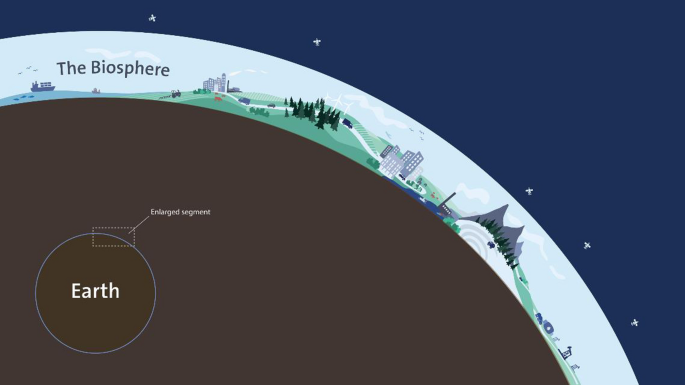
figure 1
Fig. 1

A dominant force on earth

The human population reached one billion around 1800. It doubled to two billion around 1930, and doubled again to four billion around 1974. The global population is now approaching 8 billion and is expected to stabilize around 9–11 billion towards the end of this century (UN 2019). During the past century, and especially since the 1950s, there has been an amazing acceleration and expansion of human activities into a converging globalized society, supported by the discovery and use of fossil energy and innovations in social organization, technology, and cultural evolution (Ellis 2015; van der Leeuw 2019). Globalization has helped focus attention on human rights, international relations, and agreements leading to collaboration (Keohane et al. 2009; Rogelj et al. 2016; Bain 2019) and, rather remarkably, it appears, at least so far, to have inhibited large-scale conflict between states that have plagued civilizations from time immemorial. Health and material standards of living for many have improved and more people live longer than at any time in history. Boundaries between developed and developing regions have become blurred, and global economic activity is increasingly dispersed across production networks that connect metropolitan areas around the world (Coe et al. 2004; Liu et al. 2015).

Now, there is ample evidence that the cumulative human culture has expanded to such an extent that it has become a significant global force affecting the operation of the Earth system and its biosphere at the planetary level (Steffen et al. 2018). As a reflection of this unprecedented expansion, a new geological epoch—the Anthropocene, the age of mankind—has been proposed in the Geological Time Scale (AWG 2019).

Work on anthropogenic biomes finds that more than 75% of Earth’s ice-free land is directly altered as a result of human activity, with nearly 90% of terrestrial net primary production and 80% of global tree cover under direct human influence (Ellis and Ramankutty 2008). Similarly, in the ocean, no area is unaffected by human influence and a large fraction (41%) is strongly affected by multiple human impacts (Halpern et al. 2008). For example, oxygen-minimum zones for life and oxygen concentrations in both the open ocean and coastal waters have been declining since at least the middle of the twentieth century, as a consequence of rising nutrient loads from human actions coupled with warmer temperatures (Limburg et al. 2020). Just as on land, there has been a blue acceleration in the ocean, with more than 50% of the vast ocean seabed claimed by nations (Jouffray et al. 2020).

The human dominance is further reflected in the weight of the current human population—10 times the weight of all wild mammals. If we add the weight of livestock for human use and consumption to the human weight, only 4% of the weight of mammals on Earth remain wild mammals. The weight of domesticated birds exceeds that of wild birds by about threefold (Bar-On et al. 2018). The human dimension has become a dominant force in shaping evolution of all species on Earth. Through artificial selection and controlled reproduction of crops, livestock, trees, and microorganisms, through varying levels of harvest pressure and selection, through chemicals and pollution altering life-histories of species, and by sculpting the new habitats that blanket the planet, humans, directly and indirectly, determine the constitution of species that succeed and fail (Jörgensen et al. 2019).

Humans are now primarily an urban species, with about 55% of the population living in urban areas. By mid-century, about 7 out of 10 people are expected to live in cities and towns (UN DESA 2018). In terms of urban land area, this is equivalent to building a city the size of New York City every 8 days (Huang et al. 2019). Urbanization leads to more consumption, and the power relations, inequalities, behaviours, and choices of urban dwellers shape landscapes and seascapes and their diversity around the world (Seto et al. 2012ab). There is growing evidence that urban areas accelerate evolutionary changes for species that play important functional roles in communities and ecosystems (Alberti et al. 2017).

In addition, essential features of the globalized world like physical infrastructure, technological artefacts, novel substances, and associated social and technological networks have been developing extraordinarily fast. The total weight of everything made by humans—from houses and bridges to computers and clothes—is about to exceed the mass of all living things on Earth (Elhacham et al. 2020). The extensive “technosphere” dimension underscores the novelty of the ongoing planetary changes, plays a significant role in shaping global biosphere dynamics, and has already left a deep imprint on the Earth system (Zalasiewicz et al. 2017).

The notion that humanity is external to the biosphere has allowed for models in which technological progress is expected to enable humanity to enjoy ever-growing GDP and thus consumption. This view was comparatively harmless, as long as the biosphere was sufficiently resilient to supply the demands humanity made of it. This is no longer the case, and it has far-reaching implications for contemporary models of economic possibilities that many still work with and draw policy conclusions from (Dasgupta and Ramanathan 2014; Dasgupta 2021).

The intertwined planet of people and nature

The Anthropocene is characterized by a tightly interconnected world operating at high speeds with hyper-efficiency in several dimensions. These dimensions include the globalized food production and distribution system, extensive trade and transport systems, strong connectivity of financial and capital markets, internationalized supply and value chains, widespread movements of people, social innovations, development and exchange of technology, and widespread communication capacities (Helbing 2013) (Fig. 2).
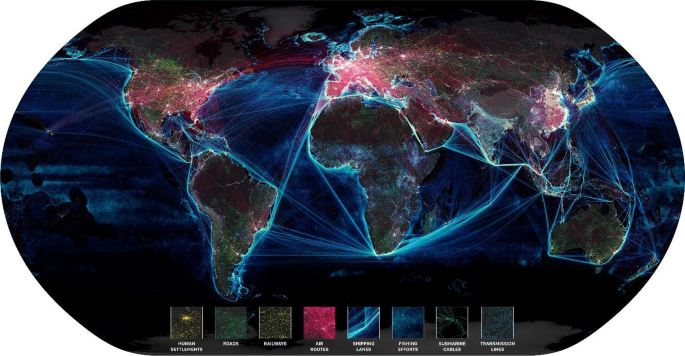
figure 2
Fig. 2

In the Anthropocene biosphere, systems of people and nature are not just linked but intertwined, and intertwined across temporal and spatial scales (Reyers et al. 2018). Local events can escalate into global challenges, and local places are shaped by global dynamics (Adger et al. 2009; Crona et al. 20152016; Liu et al. 2016; Kummu et al. 2020). The tightly coupled human interactions of globalization that allow for the continued flow of information, capital, goods, services, and people, also create global systemic risk (Centeno et al. 2015; Galaz et al. 2017). However, this interplay is not only global between people and societies but co-evolving also with biosphere dynamics shaping the preconditions for human wellbeing and civilizations (Jörgensen et al. 2018; Keys et al. 2019). For example, extreme-weather and geopolitical events, interacting with the dynamics of the food system (Cottrell et al. 2019), can spill over multiple sectors and create synchronous challenges among geographically disconnected areas and rapidly move across countries and regions (Rocha et al. 2018). The rise of antibiotic resistance, the rapid spread of the corona-pandemic, or altered moisture recycling across regions expose the intertwined world. Probabilities and consequences of the changes are not only scale dependent, but also changing over time as a result of human actions, where those actions can either exacerbate or mitigate the likelihood or consequences of a given event.

In the twenty-first century, people and planet are truly interwoven and coevolve, shaping the preconditions for civilizations. Our own future on Earth, as part of the biosphere, is at stake. This new reality has major implications for human wellbeing in the face of climate change, loss of biodiversity, and their interplay, as elaborated in the next section.

Climate change and loss of biodiversity

Contemporary climate change and biodiversity loss are not isolated phenomena but symptoms of the massive expansion of the human dimension into the Anthropocene. The climate system plays a central role for life on Earth. It sets the boundary for our living conditions. The climate system is integral to all other components of the Earth system, through heat exchange in the ocean, albedo dynamics of the ice sheets, carbon sinks in terrestrial ecosystems, cycles of nutrients and pollutants, and climate forcing through evapotranspiration flows in the hydrological cycle and greenhouse pollutants. Together these interactions in the Earth system interplay with the heat exchange from the sun and the return flow back to space, but also in significant ways with biosphere-climate feedbacks that either mitigate or amplify global warming. These global dynamics interact with regional environmental systems (like ENSO or the monsoon system) that have innate patterns of climate variability and also interact with one another via teleconnections (Steffen et al. 2020). The living organisms of the planet’s ecosystems play a significant role in these complex dynamics (Mace et al. 2014).

Now, human-induced global warming alters the capacity of the ocean, forests, and other ecosystems in sequestering about half of the CO2 emissions, as well as storing large amounts of greenhouse gases (GHG) in soils and peatlands (Steffen et al. 2018). Increased emissions of GHG by humans are creating severe climate shocks and extremes already at 1.2° warming compared to pre-industrial levels (WMO 2020). In addition, human homogenization and simplification of landscapes and seascapes cause loss of biosphere resilience, with subsequent erosion of the role of the fabric of nature in generating ecosystem services (Diaz et al. 2018) and serving as insurance to shocks and surprise and to tipping points and regime shifts (Nyström et al. 2019).

Climate change—stronger and faster than predicted

Earth has been oscillating between colder and warmer periods over a million years (the entire Pleistocene), but the average mean temperature has never exceeded 2 °C (interglacial) above or 6 °C below (deep ice age) the pre-industrial temperature on Earth (14 °C), reflecting the importance of feedbacks from the living biosphere as part of regulating the temperature dynamics of the Earth (Willeit et al. 2019) (Fig. 3b).
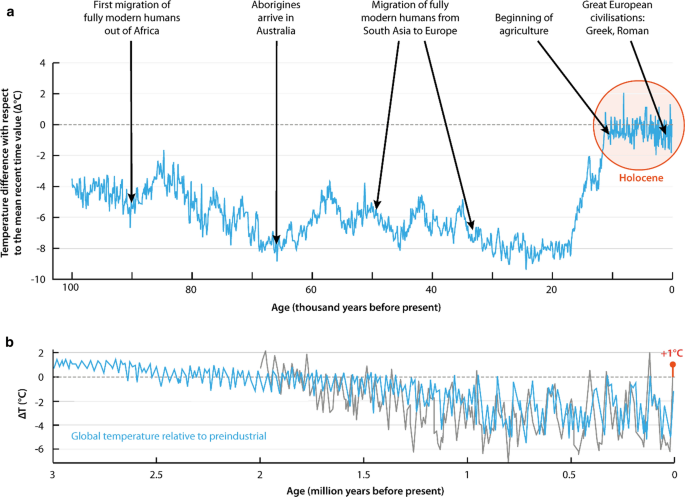
figure 3
Fig. 3

Human-induced global warming is unparalleled. For 98% of the planet’s surface, the warmest period of the past 2000 years occurred in the late twentieth century (Neukom et al. 2019) and has steadily increased into the twenty-first century with the average global temperature for 2015–2020 being the warmest of any equivalent period on record (WMO 2020). Already now at 1.2 °C warming compared to pre-industrial levels, we appear to be moving out of the accommodating Holocene environment that allowed agriculture and complex human societies to develop (Steffen et al. 2018) (Fig. 3a). Already within the coming 50 years, 1 to 3 billion people are projected to experience living conditions that are outside of the climate conditions that have served humanity well over the past 6000 years (Xu et al. 2020).

Currently, some 55% of global anthropogenic emissions causing global warming derive from the production of energy and its use in buildings and transport. The remaining 45% comes from human emissions that arise from the management of land and the production of buildings, vehicles, electronics, clothes, food, packaging, and other goods and materials (Ellen MacArthur Foundation 2019). The food system itself accounts for about 25% of the emissions (Mbow et al. 2019). Human-driven land-use change through agriculture, forestry, and other activities (Lambin and Meyfroidt 2011) causes about 14% of the emissions (Friedlingstein et al. 2020). Cities account for about 70% of CO2 emissions from final energy use and the highest emitting 100 urban areas for 18% of the global carbon footprint (Seto et al. 2014; Moran et al. 2018). About 70% of industrial greenhouse gas emissions are linked to 100 fossil-fuel producing companies (Griffin and Hede 2017). Collectively, the top 10 emitting countries account for three quarters of global GHG emissions, while the bottom 100 countries account for only 3.5% (WRI 2020). As a consequence of the pandemic, global fossil CO2 emission in 2020 decreased by about 7% compared to 2019 (Friedlingstein et al. 2020).

Climate change impacts are hitting people harder and sooner than envisioned a decade ago (Diffenbaugh 2020). This is especially true for extreme events, like heatwaves, droughts, wildfires, extreme precipitation, floods, storms, and variations in their frequency, magnitude, and duration. The distribution and impacts of extreme events are often region specific (Turco et al. 2018; Yin et al. 2018). For example, Europe has experienced several extreme heat waves since 2000 and the number of heat waves, heavy downpours, and major hurricanes, and the strength of these events, has increased in the United States. The risk for wildfires in Australia has increased by at least 30% since 1900 as a result of anthropogenic climate change (van Oldenborgh et al. 2020). The recent years of repeated wildfires in the western U.S. and Canada have had devastating effects (McWethy et al. 2019). Extreme events have the potential to widen existing inequalities within and between countries and regions (UNDP 2019). In particular, synchronous extremes are risky in a globally connected world and may cause disruptions in global food production (Cottrell et al. 2019; Gaupp et al. 2020). Pandemics, like the COVID-19 outbreak and associated health responses, intersect with climate hazards and are exacerbated by the economic crisis and long-standing socioeconomic and racial disparities, both within countries and across regions (Phillips et al. 2020).

Some of these changes will happen continuously and gradually over time, while others take the form of more sudden and surprising change (Cumming and Peterson 2017). In addition, some are to some extent predictable, others more uncertain and unexpected. An analysis of a large database of social-ecological regime shifts (large shifts in the structure and function of social-ecological systems, transitions that may have substantial impacts on human economies and societies), suggests that in the intertwined world one change may lead to another, or that events can co-occur because they simply share the same driver (Rocha et al. 2018). Large-scale transitions can unfold when a series of linked elements are all close to a tipping point, making it easier for one transition to set off the others like a chain reaction or domino effect (Scheffer et al. 2012; Lenton et al. 2019).

With increased warming, humanity risks departing the glacier-interglacial dynamics of the past 2.6 million years (Burke et al. 2018). If efforts to constrain emissions fail, the global average temperature by 2100 is expected to increase 3–5 °C (IPCC 2014) above pre-industrial levels. Although higher global temperatures have occurred in deep geological time, living in a biosphere with a mean annual global temperature exceeding 2 °C of the pre-industrial average (Fig. 3) is largely unknown terrain for humanity and certainly novel terrain for contemporary society.

The climate and the biosphere interplay

The relation between climate and the biosphere is being profoundly altered and reshaped by human action. The total amount of carbon stored in terrestrial ecosystems is huge, almost 60 times larger than the current annual emissions of global GHG (CO2 equivalents, 2017) by humans, and with the major part, about 70% (1500–2400 Gt C) found in soil (Ciais et al. 2013). The ocean holds a much larger carbon pool, at about 38 000 Gt of carbon (Houghton 2007). Thus far, terrestrial and marine ecosystems have served as important sinks for carbon dioxide and thereby contribute significantly to stabilizing the climate. At current global average temperature, the ocean absorbs about 25% of annual carbon emissions (Gruber et al. 2019) and absorbs over 90% of the additional heat generated from those emissions. Land-based ecosystems like forests, wetlands, and grasslands bind carbon dioxide through growth, and all in all sequester close to 30% of anthropogenic CO2 emissions (Global Carbon Project 2019).

The biosphere’s climate stabilization is a critical ecosystem service, or Earth system service, which cannot be taken for granted. Recent research has shown that not only human land-use change but also climate impacts, like extreme events and temperature change, increasingly threaten carbon sinks. For example, the vast fires in Borneo in 1997 released an equivalent of 13–40% of the mean annual global carbon emissions from fossil fuels at that time (Page et al. 2002; Folke et al. 2011). The devastating forest fires of 2019 in Australia, Indonesia, and the Amazon triggered emissions equivalent to almost 40% of the annual global carbon sink on land and in the ocean (www.globalfiredata.org).

The Earth system contains several biophysical sub-systems that can exist in multiple states and which contribute to the regulation of the state of the planet as a whole (Steffen et al. 2018). These so-called tipping elements, or sleeping giants (Fig. 4), have been identified as critical in maintaining the planet in favourable Holocene-like conditions. These are now challenged by global warming and human actions, threatening to trigger self-reinforcing feedbacks and cascading effects, which could push the Earth system towards a planetary threshold that, if crossed, could prevent stabilization of the climate at intermediate global warming and cause escalating climate change along a “Hothouse Earth” pathway even as human emissions are reduced (Steffen et al. 2018). Observations find that nine of these known sleeping giants, thought to be reasonably stable, are now undergoing large-scale changes already at current levels of warming, with possible domino effects to come (Lenton et al. 2019).
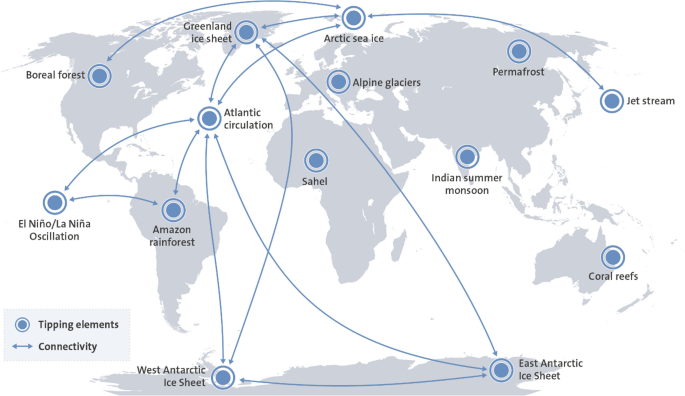
figure 4
Fig. 4

The significance of the challenge of holding global warming in line with the Paris climate target is obvious. As a matter of fact, the challenge is broader than climate alone. It is about navigating towards a safe-operating space that depends on maintaining a high level of Earth resilience. Incremental tweaking and marginal adjustments will not suffice. Major transformations towards just and sustainable futures are the bright way forward.

The living biosphere and Earth system dynamics

The interactions and diversity of organisms within and across the planet’s ecosystems play critical roles in the coevolution of the biosphere and the broader Earth system. For example, major biomes like tropical and temperate forests and their biological diversity transpire water vapour that connects distant regions through precipitation (Gleeson et al. 2020ab). Nearly a fifth of annual average precipitation falling on land is from vegetation-regulated moisture recycling, with several places receiving nearly half their precipitation through this ecosystem service. Such water connections are critical for semi-arid regions reliant on rain-fed agricultural production and for water supply to major cities like Sao Paulo or Rio de Janeiro (Keys et al. 2016). As many as 19 megacities depend for more than a third of their water supply on water vapour from land, a dependence especially relevant during dry years (Keys et al. 2018). In some of the world’s largest river basins, precipitation is influenced more strongly by land-use change taking place outside than inside the river basin (Wang-Erlandsson et al. 2018).

The biosphere contains life-supporting ecosystems supplying essential ecosystem services that underpin human wellbeing and socioeconomic development. For example, the biosphere strongly influences the chemical and physical compositions of the atmosphere, and biodiversity contributes through its influence in generating and maintaining soils, controlling pests, pollinating food crops, and participating in biogeochemical cycles (Daily 1997). The ocean’s food webs, continental shelves, and estuaries support the production of seafood, serve as a sink for greenhouse gases, maintain water quality, and hedge against unanticipated ecosystem changes from natural or anthropogenic causes (Worm et al. 2006). These services represent critical life-supporting functions for humanity (Odum 1989; Reyers and Selig 2020) and biological diversity plays fundamental roles in these nature’s contributions to people (Diaz et al. 2018).

Biodiversity performing vital roles in biosphere resilience

Organisms do not just exist and compete, they perform critical functions in ecosystem dynamics and in creating and providing social-ecological resilience (Folke et al. 2004; Hooper et al. 2005; Tilman et al. 2014) (Fig. 5). Resilience refers to the capacity of a system to persist with change, to continue to develop with ever changing environments (Reyers et al. 2018).

figure 5
Fig. 5

Biodiversity plays significant roles in buffering shocks and extreme events, and in regime shift dynamics (Folke et al. 2004). The diversity of functional groups and traits of species and populations are essential for ecosystem integrity and the generation of ecosystem services (Peterson et al. 1998; Hughes et al. 2007; Isbell et al. 2017). Variation in responses of species performing the same function is crucial in resilience to shocks or extreme events (Chapin et al. 1997). Such “response diversity”, serves as insurance for the capacity of ecosystems to regenerate, continue to develop after disturbance and support human wellbeing (Elmqvist et al. 2003).

The Amazon rainforest is a prime example. Conserving a diversity of plants species may enable the Amazon forests to adjust to new climate conditions and protect the critical carbon sink function (Sakschewski et al. 2016). Frequent extreme drought events have the potential to destabilize large parts of the Amazon forest especially when subsoil moisture is low (Singh et al. 2020), but the risk of self-amplified forest loss is reduced with increasing heterogeneity in the response of forest patches to reduced rainfall (Zemp et al. 2017). However, continuous deforestation and simultaneous warming are likely to push the forest towards tipping points with wide-ranging implications (Hirota et al. 2011; Staver et al. 2011; Lovejoy and Nobre 2018). Also, with greater climate variability, tree longevity is shortened, thus, influencing carbon accumulation and the role of the Amazon forest as a carbon sink (Brienen et al. 2015). A large-scale shift of the Amazon would cause major impacts on wellbeing far outside the Amazon basin through changes in precipitation and climate regulation, and by linking with other tipping elements in the Earth system (Fig. 4).

Hence, the resilience of multifunctional ecosystems across space and time, and in both aquatic and terrestrial environments, depends on the contributions of many species, and their distribution, redundancy, and richness at multitrophic levels performing critical functions in ecosystems and biosphere dynamics (Mori et al. 2013; Nash et al. 2016; Soliveres et al. 2016; Frei et al. 2020). Biodiversity and a resilient biosphere are a reflection of life continuously being confronted with uncertainty and the unknown. Diversity builds and sustains insurance and keeps systems resilient to changing circumstances (Hendershot et al. 2020).

Homogenization, hyper-connectivity, and critical transitions

Conversion and degradation of habitats have caused global biodiversity declines and defaunation (human-caused animal loss), with extensive cascading effects in marine, terrestrial, and freshwater ecosystems as a result, and altered ecosystem functions and services (Laliberte et al. 2010; Estes et al. 2011). Over the past 50 years of human acceleration, the capacity of nature to support quality of life has declined in 78% of the 18 categories of nature’s contributions to people considered by the Intergovernmental Science-Policy Platform on Biodiversity and Ecosystem Services (Diaz et al. 2018).

Much of the Earth’s biosphere has been converted into production ecosystems, i.e. ecosystems simplified and homogenized for the production of one or a few harvestable species (Nyström et al. 2019). Urbanization is a force in homogenizing and altering biodiversity in landscapes and seascapes (Seto et al. 2012b), and over the past decade land-use change (Meyfroidt et al. 2018) accounted for nearly a quarter of all anthropogenic greenhouse gas emissions (Arneth et al. 2019).

The increase in homogeneity worldwide denotes the establishment of a global standard food supply, which is relatively species rich at the national level, but species poor globally (Khoury et al. 2014). Globally, local varieties and breeds of domesticated plants and animals are disappearing (Diaz et al. 2018). Land-use intensification homogenizes biodiversity in local assemblages of species worldwide (Newbold et al. 2018) and counteracts a positive association between species richness and dietary quality. It also affects ecosystem services and wellbeing in low- and middle-income countries (Lachat et al. 2018; Vang Rasmussen et al. 2018). In much of the world more than half, up to 90%, of locally adapted varieties of major crop species (e.g. wheat and rice) have been lost due to replacement by single high-yielding varieties (Heal et al. 2004).

The simplification and intensification of production ecosystems and their tight connectivity with international markets have yielded a global production ecosystem that is very efficient in delivering goods to markets, but globally homogeneous, highly interconnected, and characterized by weakened internal feedbacks that mask or dilute the signals of loss of ecosystem resilience to consumers (Nyström et al. 2019; Ortiz et al. 2021). In addition, the global food trade network has over the past 20 years become progressively delocalized as a result of globalization (that is, modularity has been reduced) and as connectivity and homogeneity increase, shocks that were previously contained within a geographical area or a sector are becoming globally contagious and more prevalent (Tamea et al. 2016; Tu et al. 2019; Kummu et al. 2020).

Homogenization reduces resilience, the capacity to live and develop with change and uncertainty, and therby the diversity of ways in which species, people, sectors, and institutions can respond to change as well as their potential to functionally complement each other (Biggs et al. 2012; Grêt-Regamey et al. 2019; Nyström et al. 2019). In addition, homogeneous landscapes lack the diversity of ecosystem types for resilient responses when a single homogeneous landscape patch, such as a production forest or crop, is devastated by pathogens or declines in economic value. In addition, such ecosystem simplification and degradation increase the likelihood of disease emergence, including novel viruses (Myers and Patz 2009). In parallel, people, places, cultures, and economies are increasingly linked across geographical locations and socioeconomic contexts, making people and planet intertwined at all scales.

Evidence suggests that homogenization, simplification, intensification, strong connections, as well as suppression of variance, increase the likelihood of regime shifts, or critical transitions with thresholds and tipping points (Scheffer et al. 2012; Carpenter et al. 2015). These shifts may interact and cascade, thereby causing change at very large scales with severe implications for the wellbeing of human societies (Hughes et al. 2013; Rocha et al. 2018). Comparison of the present extent of biosphere conversion with past global-scale regime shifts suggests that global-scale biosphere regime shift is more than plausible (Barnosky et al. 2012). The biotic hallmark for each earlier biosphere regime shifts was pronounced change in global, regional, and local assemblages of species (Barnosky et al. 2012).

Planetary boundaries and a safe-operating space for humanity

It is in the self-interest of humanity to avoid pushing ecosystems or the entire Earth system across tipping points. Therefore, a major challenge is to enhance biosphere resilience and work towards stabilizing the Earth system and its biosphere in a state that, hopefully, is safe for humanity to operate within, albeit a warmer state than the Holocene and one with a human-dominated biosphere. Clearly, the climatic system and the biological diversity and functional integrity of the biosphere, as well as their interplay, are foundational for cultivating a resilient Earth system.

Climate and biosphere integrity constitute the two fundamental dimensions of the Planetary Boundaries framework, which delineates a Holocene-like state of the Earth system, the state that has enabled civilizations to emerge and flourish (Fig. 6). Four of the nine boundaries, including climate and biodiversity, are estimated to already have been transgressed. The framework provides a natural-science-based observation that human forcing has already, at the planetary scale, rapidly pushed the Earth system away from the Holocene-like conditions and onto an accelerating Anthropocene trajectory (Steffen et al. 2018).
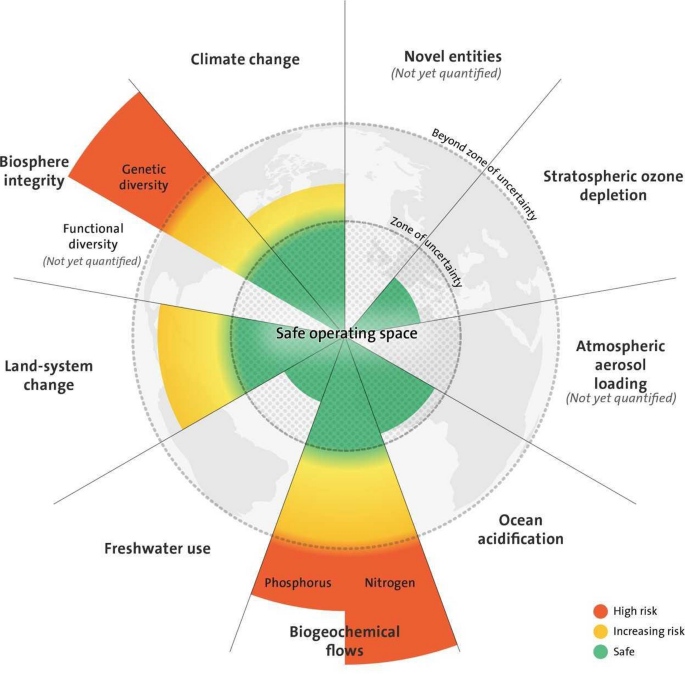
figure 6
Fig. 6

In recent years, there have been several efforts to further investigate and deepen the understanding of planetary boundaries and the safe-operating space for humanity. These include updates on the biodiversity boundary, the freshwater boundary, the biogeochemical flows (Carpenter and Bennett 2011; de Vries et al. 2013; Mace et al. 2014; Newbold et al. 2016; Gleeson et al. 2020b), multiple regime shifts and possible links between regional and planetary tipping points (Anderies et al. 2013; Hughes et al. 2013), regional perspectives on the framework (Häyhä et al. 2016; O’Neill et al. 2018), and creating safe-operating spaces (Scheffer et al. 2015). Attempts to quantify interactions between planetary boundaries suggest that cascades and feedbacks predominantly amplify human impacts on the Earth system and thereby shrink the safe-operating space for human actions in the Anthropocene (Lade et al. 2020).

There are also propositions for integrating the planetary boundaries framework with economic, social, and human dimensions (Raworth 2012; Dearing et al. 2014; Downing et al. 2019) as well as tackling the policy and governance challenges associated with the approach (Biermann et al. 2012; Galaz et al. 2012; Sterner et al. 2019; Pickering and Persson 2020; Engström et al. 2020). The global food system is also placed within the framework of the planetary boundaries (Gordon et al. 2017), like in the EAT-Lancet Commission’s report on healthy diets from sustainable food systems for nearly 10 billion people by 2050 (Willett et al. 2019).

In light of the profound challenges of navigating the future of human societies towards a stabilized Earth state, it becomes clear that modest adjustments on current pathways of societal development are not very likely to guide humanity into sustainable futures (Kates et al. 2012). Stabilizing the Earth system in a safe-operating space will require transformative changes in many dimensions of human actions and relations (Westley et al. 2011; Sachs et al. 2019).

Inequality and global sustainability

Inequality describes an unequal distribution of a scarce resource, benefit, or cost and does not necessarily represent a normative statement. Inequity is a more normative term that evokes an unfair or unjust distribution of privileges across society. There are complex interconnections between inequality, the biosphere, and global sustainability (Hamann et al. 2018) (Fig. 7) that go beyond unequal distribution of income or wealth, like distributional, recognitional, and procedural inequities (Leach et al. 2018). Distributional equity refers to how different groups may have access to resources, and how costs, harms, and benefits are shared. Recognitional equity highlights the ongoing struggle for recognition of a diversity of perspectives and groups, e.g. referring to nationality, ethnicity, or gender, whereas procedural equity focuses on how different groups and perspectives are able to engage in and influence decision-making processes and outcomes (Leach et al. 2018). Approaches to sustainability generally include some form of equality, universal prosperity, and poverty alleviation. Global environmental change and unsustainable practices may exacerbate inequalities (Hamann et al. 2018). Greater inequality may lead to weaker economic performance and cause economic instability (Stiglitz 2012). Increasing income inequality may also lead to more societal tension and increase the odds of conflict (Durante et al. 2017).
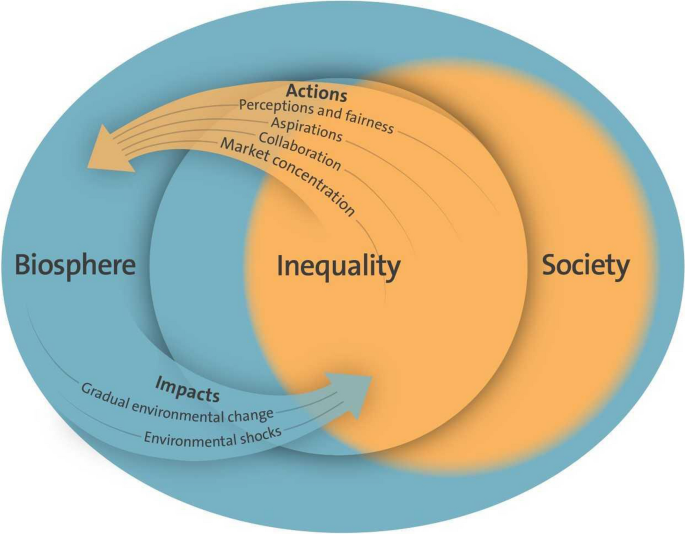
figure 7
Fig. 7

Rising inequality

The majority of countries for which adequate data exist have seen rising inequality in income and wealth over the past several decades (Piketty 2014). In the U.S., Europe, and China, the top 10% of the population own 70% of the wealth, while the bottom 50% own only 2%. In the U.S., the share of income going to the top 1% rose from around 11% in 1980 to above 20% in 2016 (World Inequality Report 2018), and the share of wealth of the top 0.1% more than tripled between 1978 and 2012, and is roughly equal to the share of wealth of the bottom 90% (Saez and Zucman 2016). Also, the wealthiest 1% of the world’s population have been responsible for more than twice as much carbon pollution as the poorest half of humanity (Kartha et al. 2020). Seventy-five per cent of the world’s cities have higher levels of income inequalities than two decades ago, and the spatial concentration of low-income unskilled workers in segregated residential areas acts as a poverty trap (UN-Habitat 2016). About 10% of the world population in 2015, or some 740 million people, were living in extreme poverty (World Bank 2019).

Inequality can impact the sense of community, common purpose, and trust (Jachimowicz et al. 2017) and influences successful management of common pool resources in different ways (Baland et al. 2007). Inequality may give rise to perceptions, behaviour, and social norms about status and wealth, and disparities in worth and cultural membership between groups in a society—so-called “recognition gaps” (Lamont 2018).

Inequalities and the environment

Greater inequality can lead to more rapid environmental degradation, because low incomes lead to low investment in physical capital and education. Such situations often cause excessive pressure and degradation of natural capital leading to declining incomes and further degradation in a downward spiral, a poverty trap (Bowles et al. 2006). Furthermore, interventions that ignore nature and culture can reinforce poverty traps (Lade et al. 2017), and economic and environmental shocks, food insecurity, and climate change may force people back into poverty (lack of resources and capacities to fulfil basic needs) (Kates and Dasgupta 2007; Wood et al. 2018).

Gender, class, caste, and ethnic identities and relationships, and the specific social, economic and political power, roles and responsibilities they entail, shape the choices and decisions open to individuals and households in dealing with the climate and environmental risks they face (Rao et al. 2020). Gender inequality has important reinforcing feedbacks with environmental change (Fortnam et al. 2019) and has, for example, been shown to change with shifts in tropical land use in Indonesia (Maharani et al. 2019) or with changes in levels of direct use of local ecosystem services by households in South Africa (Hamann et al. 2015). Climate change is projected to disproportionally influence disadvantaged groups, especially women, girls, and indigenous communities (Islam and Winkel 2017).

People with less agency and fewer resources at their disposal are more vulnerable to climate change (Althor et al. 2016; Morton 2007) and to environmental shocks and extreme events such as floods and droughts (Hallegatte et al. 2016; Jachimowicz et al. 2017). The COVID-19 pandemic has further exposed the inequality in vulnerability to shocks among communities that lack the financial resources and essentials for a minimum standard of living, feeding off existing inequalities and making them worse (Drefahl et al. 2020; Stiglitz 2020). There is significant concern that climate-driven events exacerbate conflict because they affect economic insecurity which, in itself, has been shown to be a major cause of violent conflict and unrest (Mach et al. 2019; Ide et al. 2020).

Vulnerability to climate change is also due to many low-income countries’ location in low latitudes where further warming pushes these countries ever further away from optimal temperatures for climate-sensitive economic sectors (King and Harrington 2018). Examples include countries with high numbers of vulnerable, poor or marginalized people in climate-sensitive systems like deltas, semi-arid lands, and river basins dependent on glaciers and snowmelt (Conway et al. 2019). Changes to glaciers, snow and ice in mountains will likely influence water availability for over a billion people downstream by mid-century (Pihl et al. 2019). Under future scenarios of land-use and climate change, up to 5 billion people face higher water pollution and insufficient pollination for nutrition, particularly in Africa and South Asia. Hundreds of millions of people face heightened coastal risk across Africa, Eurasia, and the Americas (Chaplin-Kramer et al. 2019).

Ocean inequity

In the ocean, inequity manifests, for example, in skewed distribution of commercial fish catches, limited political power of small-scale fishers, particularly women and other minority groups, limited engagement of developing nations in high-seas activities and associated decision making, and consolidated interests of global supply chains in a few transnational corporations, with evidence of poor transparency and human rights abuses (Österblom et al. 2019). The results of inequity include a loss of livelihoods and limited financial opportunities, increased vulnerabilities of already marginalized groups, who are facing nutritional and food security challenges, and negative impacts on marine ecosystems (Harper et al. 2013; Hicks et al. 2019).

Coastal communities are sensitive to climate-induced shifts in the distribution and abundance of fish stocks crucial to their livelihoods and nutrition (Blasiak et al. 2017). This accentuated sensitivity is coupled with comparatively low levels of adaptive capacity, as remote coastal communities often have limited access to education, health services and alternative livelihoods, all of which could buffer the projected negative impacts from climate change (Cinner et al. 2018).

As a means to improve fish abundance for coastal communities of low-income nations, there have been suggestions of closing the high seas to fishing through groups of states that commit to a set of international rules. This would not only slow the pace of overfishing, but would also rebuild stocks that migrate into countries’ Exclusive Economic Zones (EEZs), which could reduce inequality by 50% in the distribution of fisheries benefits among the world’s maritime countries (Sumaila et al. 2015; Green and Rudyk 2020).

Inequities and sustainability

Alleviating inequality and poverty is a central objective of the U.N. Sustainable Development Goals agreed to by national governments. Achieving global sustainability is another important set of objectives in the Sustainable Development Goals. The relation between inequality and sustainability is the outcome of this dynamics and not simply of cause and effect, but rather unfolding in different places, as experienced and understood by the people living there. Supporting and enhancing the emergence of capacities for dealing with shocks and surprises as part of strategies for learning and developing with change in the turbulent times of the Anthropocene will be central to confront inequality and advance wellbeing (Biggs et al. 2012; Clark and Harley 2020). Multiple inequities and sustainabilities will require diverse forms of responses, attuned to diverse contexts (Leach et al 2018; Clark and Harley 2020) (Fig. 8) and framed by transformations towards global sustainability as embedded in the biosphere (Westley et al. 2011).
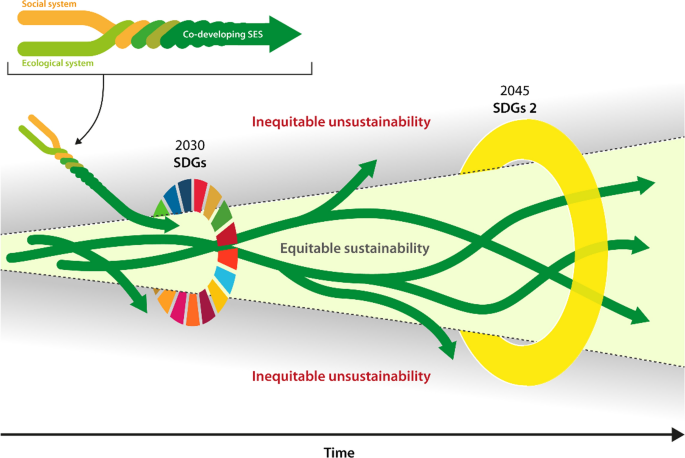
figure 8
Fig. 8

Societal transformation and technological change

By transformation, we refer to the capacity to create fundamentally new systems of human–environmental interactions and feedbacks when ecological, economic, or social structures make the continuation of the existing system untenable (Folke et al. 2010). It involves multiple elements, including agency, practices, behaviours, incentives, institutions, beliefs, values, and world views and their leverage points at multiple levels (Abson et al. 2017; Moore and Milkoreit 2020). Understanding transformation goes beyond a focus on the triggers, to unravelling the capacities for reducing resilience of an undesired, status quo, system, and nurturing and navigating the emergence of new, desired systems (Elmqvist et al. 2019); to confront path-dependencies, build capacities for new shocks and risks, and shift towards sustainable pathways (Olsson et al. 2017).

Here, we stress that technological change and social innovation in relation to sustainability will need a deeper focus on intertwined social-ecological interactions and feedbacks of the Anthropocene, since that will be necessary to understand and achieve large-scale changes towards global sustainability. We start this section with the role of emerging technologies and social media in this context, followed by findings from social innovation and transformation research and with an emphasis on the significance of narratives of hope for shifting towards sustainable futures.

Emerging technologies and sustainability

Most likely, technological change such as information technology, artificial intelligence, and synthetic biology will drastically change economies, human relations, social organization, culture and civilization, creating new unknown futures. However, technological change alone will not lead to transformations towards sustainability. It could lead humanity in diverse directions, pleasant and unpleasant ones, and with different social and environmental impacts. For example, rapid advances in sequencing technologies and bioinformatics have enabled exploration of the ocean genome, but the capacity to access and use sequence data is inequitably distributed among countries and companies (Blasiak et al. 20182020). The technological dimension of development has to be deliberately and strategically guided, to contribute to just and sustainable futures and guided how and by whom as a central challenge (Galaz 2014; van der Leeuw 2018).

On the other hand, it is most unlikely that transformations to sustainability will happen without the deployment of technologies that, e.g. help build resilience and development on the ground (Brown 2016), support transformations of current food production and innovation systems (Gordon et al. 2017; Costello et al. 2020), and contribute to a shift towards carbon neutral (or even negative) energy systems (Rockström et al. 2017).

The following categories of new technologies are already having bearing on global sustainability: the diversity of existing and emerging renewable energy technologies, like solar cells, hydrogen energy, wind generators, or geothermal heating; technologies that remove greenhouse gases from the atmosphere; the digital transformation, with Artificial Intelligence (AI), satellite remote sensing, quantum computing, and precision agriculture; synthetic biology, including biotechnology and genetic and molecular engineering, by redesigning and using organisms to solve problems in medicine, manufacturing and agriculture; mechanical engineering, like robotics and also nanotechnology. Their development, as embedded in the larger social-ecological systems, should be connected to and become part of ways forward when designing transformative pathways towards sustainability within planetary boundaries.

As human pressures on the biosphere increase, so does the hope that rapid advances in AI (including automated decision making, data mining, and predictive analytics) in combination with rapid progresses in sensor technology and robotics, will be able to increase society’s capacities to detect, adapt, and respond to climate and environmental change without creating new vulnerabilities (Joppa 2017). Such technologies are applied in a number of research fields related to the environment and climate change, including environmental monitoring, conservation, and “green” urban planning (Hino et al. 2018; Ilieva and McPhearson 2018; Wearn et al. 2019; Reichstein et al. 2019). While nascent in terms of both scale and impact, such technological “niche-innovations” have the potential to rapidly upscale and shape ecosystems and institutions in multiple geographies (Geels et al. 2017). Such innovations have been claimed to be central for a “digital revolution for sustainable development” (Sachs et al. 2019).

Applications of these technologies have effects that span beyond climate and environmental research and monitoring, and more efficient natural resource use. AI-supported recommender systems as an example, influence consumer choices already today (André et al. 2018). Targeted attacks in social media by social bots, applications of computer algorithms that automatically produce content and interact with humans on social media, “trying to emulate and possibly alter their behavior” (Ferrara et al. 2016; Grinberg et al. 2019), also influence conversations in social media about climate and environmental issues and affect institutions for deliberative democracy (Dryzek et al. 2019).

So far, the technological changes to our social systems have not come about with the purpose of promoting global sustainability (van der Leeuw 2019). This remains true of recent and emerging technologies, such as online social media and information technology, causing changes that are increasingly far-reaching, ambiguous, and largely unregulated (Del Vicario et al. 2016). For example, “online social networks are highly dynamic systems that change as a result of numerous feedbacks between people and machines”. Algorithms suggest connections, to which users respond, and the algorithms, trained to optimize user experience, adapt to the responses. “Together, these interactions and processes alter what information people see and how they view the world” (Bergstrom and Bak-Coleman 2019).

Hence, applications of novel technologies stemming from advancements in AI could at best be benevolent and lead to improved stewardship of landscapes, seascapes, water, or climate dynamics, through improved monitoring and interventions, as well as more effective resource use (Chaplin-Kramer et al. 2019). Negative impacts of novel technologies on vulnerable groups (Barocas et al. 2017) are also pertinent since they diffuse rapidly into society, or when used in sectors with clear impacts on the climate, or on land and ocean ecosystems. This issue needs to be taken seriously as technological changes influence decisions with very long-term climatic and biosphere consequences (Cave and Óhéigeartaigh 2019).

Social media and social change

The participatory nature of social media gives it a central role in shaping individual attitudes, feelings, and behaviours (Williams et al. 2015; Lazer et al. 2018), can underpin large social mobilization and protests (Steinert-Threlkeld et al. 2015), and influence social norms and policy making (Barbier et al. 2018; Stewart et al. 2019). It is well known that dire warnings can lead to disconnect of the audience if it is not accompanied by a feasible perspective for action (Weber 2015). Social media changes our perception of the world, by promoting a sense of crisis and unfairness. This happens as activist groups seek to muster support (Gerbaudo and Treré 2015) and lifestyle movements seek to inspire alternative choices (Haenfler et al. 2012). For instance, social media catalysed the Arab spring among other things by depicting atrocities of the regime (Breuer et al. 2015), and veganism is promoted by social media campaigns highlighting appalling animal welfare issues (Haenfler et al. 2012).

On the worrying side, isolationism stimulated by social-media-boosted discontent may hamper global cooperation needed to curb global warming, biodiversity loss, wealth concentration, and other trends. On the other hand, social media has powered movements such as school strikes, extinction rebellion, voluntary simplicity, bartering, flight shame, the eat-local movement and veganism to promote a steadily rising global awareness of pressing issues that may ultimately shift social norms (Nyborg et al. 2016), trigger reforms towards sustainability (Otto et al. 2020) and perhaps also towards wealth equalization at all institutional levels (Scheffer et al. 2017).

The combination of discontent and self-organization not only promotes rebellion against the old way of doing things, as in street protests, populist votes, radicalization, and terrorism, but also catalyses the search for alternative ways, as in bartering and sharing platforms, or voluntary simplicity and other lifestyle movements (Haenfler et al. 2012; Carpenter et al. 2019).

The rise of social media and technologies such as bots and profiling has been explosive, and the mere rate of change has made it difficult for society to keep pace (Haenfler et al. 2012). Crowd-sourced fact checking may be combined with computer-assisted analyses and judgements from professionals (Hassan et al. 2019), and labelling quality of media sources ranging from internet fora to newspapers and television stations may alert users to the risk of disinformation and heavy political bias (Pennycook and Rand 2019). With time, such approaches together with legislation, best-practice agreements, and individual skills of judging the quality of sources may catch up to control some of the negative side-effects (Walter et al. 2019).

The emerging picture is that social media have become a global catalyst for social change by facilitating shifts on scales ranging from individual attitudes to broad social norms and institutions. It remains unclear, however, whether this new “invisible hand” will move the world on more sustainable and just pathways. Can the global, fast moving capacity for information sharing and knowledge generation through social media help lead us towards a just world where future generations thrive within the limits of our planet’s capacity?

Social innovation and transformation

Transformations towards sustainability in the Anthropocene cannot be achieved by adaptation alone, and certainly not by incremental change only, but rather that more fundamental systemic transformations will be needed (Hackmann and St. Clair 2012; Kates et al. 2012; O’Brien 2012). Transformation implies fundamentally rewiring the system, its structure, functions, feedbacks, and properties (Reyers et al. 2018). But, despite such changes, there is hope for systemic transformations with dignity, respect and in democratic fashions (Olsson et al. 2017), in contrast to large-scale disruptive or revolutionary societal transformations like those of earlier civilizations (van der Leeuw 2019). It will require trust building, cooperation, collective action, and flexible institutions (Ostrom 2010; Westley et al. 2011).

A characteristic feature of transformations is that change across different system states (trajectories or pathways) is not predetermined but rather emerges through diverse interactions across scales and among diverse actors (Westley et al. 2011). Therefore, the literature on transformations towards sustainability emphasize framing and navigating transformations rather than controlling those. Work on socio-technical sustainability transitions, social-ecological transformations, and social innovation provide insights into these dynamics (Geels et al. 2017; Olsson et al. 2017; Westley et al. 2017).

These literatures have illustrated the importance of connectivity and cross-level interactions for understanding the role of technological and social innovation and transformative systemic change. The work emphasizes the importance of fostering diverse forms of novelty and innovations at the micro-level, supported by the creation of “transformative spaces”, shielded from the forces of dominant system structures. These allow for experimentation with new mental models, ideas, and practices that could help shift societies onto more desirable pathways (Loorbach et al. 2017; Pereira et al. 2018ab). The examples of the “Seeds of a Good Anthropocene” project reflect ongoing local experiments that, under the right conditions, could accelerate the adoption of pathways to transformative change (Bennett et al. 2016). As multiple demands and stressors degrade the ocean, transformative change in ocean governance seems required, shifting current economic and social systems towards ocean stewardship, e.g. through incorporation of niche innovations within and across economic sectors and stakeholder communities (Brodie Rudolph et al. 2020).

It has been shown that real-world transformations come about through the alignment of mutually reinforcing processes within and between multiple levels. For example, the alignment of “niche innovations” or “shadow networks’ (which differ radically from the dominant existing system but have been able to gain a foothold in particular market niches or geographical areas) with change at broader levels and scales can create rapid change. Both slow moving trends (e.g., demographics, ideologies, accumulation of GHG) and sudden shocks (e.g. elections, economic crises, pandemics, extreme events) can start to weaken or disturb the existing social-ecological system and create windows-of-opportunity for niche innovations—new practices, governance systems, value orientations—to become rapidly dominant (Olsson et al. 20042006; Chaffin and Gunderson 2016; Geels et al. 2017) (Fig. 9).
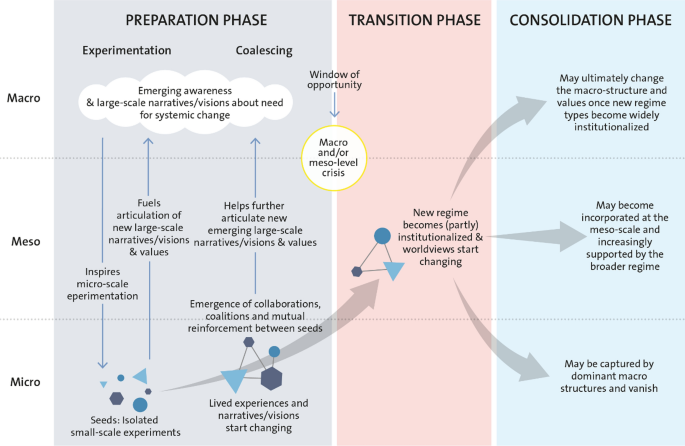
figure 9
Fig. 9

Hence, turbulent times may unlock gridlocks and traps and open up space for innovation and novelty (Gunderson and Holling 2002). Crises or anticipated risks can trigger people to experiment with new practices and alternative governance modes and key individuals, often referred to as policy, institutional or moral entrepreneurs, mobilize and combine social networks in new ways, preparing the system for change (Folke et al. 2005; Westley et al. 2013; O’Brien 2015). The preparation phase seems particularly important in building capacity to transform rather than simply returning to the status quo and reinforcing existing power structures following change. Bridging organizations tend to emerge, within or with new institutions, connecting governance levels and spatial and temporal scales (Cash et al. 2006; Hahn et al. 2006; Brondizio et al. 2009; Rathwell and Peterson 2012). In several cases, the broader social contexts provide an enabling environment for such emergence, for example, through various incentive structures or legal frameworks. When a window opens, there is skilful navigation of change past thresholds or tipping points and, thereafter, a focus on building resilience of the transformed system (Gelcich et al. 2010).

In general, the resulting transformation goes beyond the adoption of a new technology or a local social innovation alone. Instead it includes a portfolio of actions like investment in new infrastructures, establishment of new markets, changes in incentives, development of new social preferences, or adjustment of user practices. Furthermore, transformations gain momentum when multiple innovations are linked together, improving the functionality of each and acting in combination to reconfigure systems (Geels et al. 2017; Westley et al. 2017).

Successful social innovations are recognized by their capacity to radically shift broad social institutions (economies, political philosophies, laws, practices, and cultural beliefs) that provide structure to social life. In addition, social innovations seldom unfold in a deterministic manner, but with a kind of punctuated equilibrium, first languishing and then accelerating at times of opportunity or crisis. There is also the need for awareness of the shadow side of all innovation, the consequences of intervention in a complex system (Holling et al. 1998; Ostrom 2007). This is unavoidable but manageable if caught early, but needs attention, particularly in times of rapid change (Westley et al. 2017).

Social innovation is currently underway in many domains linked to climate change, like renewable energy (Geels et al. 2017) or agriculture (Pigford et al. 2018) and highlight the importance of innovations not only in science and technology, but also in institutions, politics, and social goals for sustainability. Substantial attention is also directed towards sustainability of the ocean, where policy makers, industries, and other stakeholders are increasingly engaged in collaboration (Österblom et al. 2017; Brodie Rudolf et al. 2020; UNGC 2020) and innovations (McCauley et al. 2016; Blasiak et al. 2018; Costello et al. 2020), aimed to create new incentives (Lubchenco et al. 2016; Jouffray et al. 2019; Sumaila et al. 2020) for action. However, for these to have transformative impact, shifts in cultural repertoires (schemas, frames, narratives, scripts, and boundaries that actors draw on in social situations) (Lamont et al. 2017) similar to those that accelerated the anti-smoking movement and the LGBTQ movement need to occur (Marshall et al. 2012; Moore et al. 2015; Nyborg et al. 2016).

There are suggestions for social tipping interventions to activate large-scale systemic shifts through, for example, rapidly spreading of technologies, shifts in social norms and behaviors, or structural reorganization of sectors, corporations, and societies (Folke et al. 2019; Otto et al. 2020). There are signs that such shifts are underway in western cultures, a desire for fundamental change towards a more sustainable way of life (Wibeck et al. 2019) aided by social movements such as the youth-led Extinction Rebellion, as well as a strong move to more healthy and sustainable diets (Willet et al. 2019). Again, all these changes unfold as part of cultural evolution, which needs attention as urgently as the decarbonization of our economy (Waring et al. 2015; Creanza et al. 2017; Jörgensen et al. 2019).

Narratives of action for the future

Social innovation and transformation require an individual and collective attention on the future. There are many documented obstacles to such future focus, from cognitive myopia to present-biased individual and institutional incentives and norms (Weber and Johnson 2016; Weber 20172020). Choice architecture provides tools that reduce status-quo bias and encourage more foresightful decisions in specific circumstances (Yoeli et al. 2017), but rapid and systemic change will require more fundamental shifts in narratives at a collective level (Lubchenco and Gaines 2019).

Narratives are ways of presenting or understanding a situation or series of events that reflects and promotes a particular point of view or set of values. Narratives can serve as meaning‐making devices, provide actors with confidence to act and coordinate action. They are of significance in shaping and anchoring worldviews, identities, and social interactions (van der Leeuw 2020).

Narratives of hope have proven essential for social resilience (Lamont 2019). Social resilience refers to the capacity of individuals, groups, communities, and nations “to secure favourable outcomes (material, symbolic, emotional) under new circumstances and when necessary by new means, even when this entails significant modifications to behaviour or to the social frameworks that structure and give meaning to behaviour” (Hall and Lamont 2012).

Transforming towards sustainable futures will require broadening cultural membership by promoting new narratives that resonate, inspire, and provide hope centred on a plurality of criteria of worth and social inclusion. Here, we are concerned with the challenge of motivating a collective recognition of our interdependence with the biosphere (Schill et al. 2019) and economic and political action based on that recognition.

Collective conceptions of the future have many aspects. They include (1) whether the future is conceived as near or far and is understood in terms of long, medium and short-term rewards; (2) what is likely and possible and how contingent these outcomes are; (3) whether the future will be good or bad; (4) how much agency individuals have on various aspects of their individual and collective future (concerning for instance, politics, societal orientation, personal and professional life; (5) who can influence the collective future (e.g., the role of the state policies and various societal forces in shaping them); (6) whether the future is conceived as a cyclical or as a linear progression; (7) how stable peoples’ conceptions of the future are and how they are influenced by events (terrorist attacks, recessions, pandemics); and (8) whether aspirations are concealed or made public.

Behind these various issues, one finds other basic conceptions about agency (to what extent are individuals master of their fate), the impact of networks (to what extent is fate influenced by peers, family, and others), the impact of social structure (what is the impact of class, race, gender, place of origin) on where we end up, and how much does our environment (segregation, resource availability, environmental conditions) influence our opportunities. Therefore, it is important to remember that, although individuals play essential roles in narratives of hope, such images of the future are seldom creations of individuals alone but shaped by many cultural intermediaries working in the media, in education, in politics, in social movements, and in other institutions.

Cultural scripts represent commonly held assumptions about social interaction, which serve as a kind of interpretive background against which individuals position their own acts and those of others (Lamont et al. 2017). Narratives of hope as cultural scripts are more likely to become widely shared if they offer possible course of action, something that reasonable people can aspire to. Such sharing bolsters people’s sense of agency, the perception that they can have an impact on the world and on their own lives that they can actually achieve what is offered to them (Lamont et al. 2017). In contrast to doomsday or climate-denying narratives, these scripts feed a sense of active agency. Such “fictional expectations”, anchored in narratives that are continually adapted, are at the core of market dynamics confronted with an uncertain future affecting money and credit, investment, innovation, and consumption (Beckert 2016).

Narratives of hope represent ideas about “imagined futures” or alternative ways of visualizing and conceptualizing what has yet to happen and motivate action towards new development pathways (Moore and Milkoreit 2020). As they circulate and become more widely shared, such imagined futures have the potential to foster predictable behaviours, and stimulate the emergence of institutions, investments, new laws, and regulations. Therefore, decisions under uncertainty are not only technical problems easily dealt with by rational calculation but are also a function of the creative elements of decision‐making (Beckert 2016).

There is a rich literature on scenarios for sustainable futures, narratives articulating multiple alternative futures in relation to critical uncertainties, increasingly emphasizing new forms of governance, technology as a bridge between people and the deep reconnection of humanity to the biosphere, and engaging diverse stakeholder in participatory processes as part of the scenario work (Carpenter et al. 2006; Bennett et al. 2016). The implication of inherent unpredictability is that transformations towards sustainable and just futures can realistically be pursued only through strategies that not only attend to the dynamics of the system, but also nurture our collective capacity to guide development pathways in a dynamic, adaptive, and reflexive manner (Clark and Harley 2020; Freeman et al. 2020). Rather than striving to attain some particular future it calls for a system of guided self-organization. It involves anticipating and imagining futures and behaving and acting on those in a manner that does not lead to loss of opportunities to live with changing circumstances, or even better enhances those opportunities, i.e. builds resilience for complexity and change (Berkes et al. 2003).

In order to better understand the complex dynamics of the Anthropocene and uncertain futures, work is now emerging on human behaviour as part of complex adaptive systems (Levin et al. 2013), like anticipatory behaviour (using the future in actual decision processes), or capturing behaviour as both “enculturated” and “enearthed“ and co-evolving with socio-cultural and biophysical contexts (Boyd et al. 2015; Waring et al. 2015; Poli 2017; Merçon et al. 2019; Schill et al. 2019; Schlüter et al. 2019; Haider et al. 2021), illustrating that cultural transmission and evolution can be both continuous and abrupt (Creanza et al. 2017).

Narratives of hope for transformations towards sustainable futures are in demand. Clearly, technological change plays a central role in any societal transformation. Technological change has been instrumental in globalization and will be instrumental for global sustainability. No doubt, the new era of technological breakthroughs will radically change the structure and operation of societies and cultures. But, as has been made clear here, the recipe for sustainable futures also concerns cultural transformations that guide technological change in support of a resilient biosphere; that reconnect development to the biosphere foundation.

Biosphere stewardship for prosperity

Transformation towards sustainability in the Anthropocene has at least three systemic dimensions. First, it involves a shift in human behaviour away from degrading the life-support foundation of societal development. Second, it requires management and governance of human actions as intertwined and embedded within the biosphere and the broader Earth system. Third, it involves enhancing the capacity to live and develop with change, in the face of complexity and true uncertainty, that is, resilience-building strategies to persist, adapt, or transform. For major pathways for such a transformation are presented below:

  1. 1.Recognize and act on the fact that societal development is embedded in and critically dependent on the biosphere and the broader Earth system for prosperity and wellbeing.
  2. 2.Create incentives and design policies that enable societies to collaborate towards just and sustainable futures within planetary boundaries.
  3. 3.Transform the current pathways of social, economic, cultural development into stewardship of human actions that enhance the resilience of the biosphere.
  4. 4.Make active use of emerging and converging technologies for enabling the societal stewardship transformation.

Biosphere stewardship incorporates economic, social, and cultural dimensions with the purpose of safeguarding the resilience of the biosphere for human wellbeing and fostering the sustainability of a rapidly changing planet. Stewardship is an active shaping of social-ecological change that integrates reducing vulnerability to expected changes, fostering resilience to sustain desirable conditions in the face of the unknown and unexpected, and transforming from undesirable pathways of development when opportunities emerge (Chapin et al. 2010). It involves caring for, looking after, and cultivating a sense of belonging in the biosphere, ranging from people and environments locally to the planet as a whole (Enqvist et al. 2018; Chapin 2020; Plummer et al. 2020).

Such stewardship is not a top-down approach forced on people, nor solely a bottom-up approach. It is a learning-based process with a clear direction, a clear vision, engaging people to collaborate and innovate across levels and scales as integral parts of the systems they govern (Tengö et al. 2014; Clark et al. 2016; Norström et al. 2020).

Here, we focus on biosphere stewardship in relation to climate change, biodiversity, and transformations for sustainable futures.Show more

From emission reductions alone to biosphere stewardship

Global sustainability involves shifting into a renewable energy-based economy of low waste and greater circularity within a broader value foundation. Market-driven progress combined with technological change certainly plays an important role in dematerialization (Schmidheiny 1992; McAfee 2019) but does not automatically redirect the economy towards sustainable futures. Public awareness, responsible governments, and international collaborations are needed for viable economic developments, acknowledging that people, nations, and the global economy are intertwined with the biosphere and a global force in shaping its dynamics.

Since climate change is not an isolated phenomenon but a consequence of the recent accelerating expansion of human activities on Earth, the needed changes concern social organization and dynamics influencing the emissions of greenhouse gases from burning fossil fuels, technologies, and policies for reducing such emissions, and various approaches for carbon capture and storage. However, to reduce the effects of climate change, it will not be sufficient to remove emissions only. The resilience of the biosphere and the Earth system needs to be regenerated and enhanced (Nyström et al. 2019). This includes governance of critical biosphere processes linked to climate change, such as in agriculture, forestry, and the ocean. In addition, guarding and enhancing biodiversity will help us live with climate change, mitigating climate change by storing and sequestering carbon in ecosystems, and building resilience and adaptive capacity to the inevitable effects of unavoidable climate change (Dasgupta 2021).

The global pandemic caused a sharp fall in CO2 emissions in 2020 (Le Quéré et al. 2020), while the cumulative emissions continue to rise (Friedlingstein et al. 2020). The fall was not caused by a long-term structural economic shift so it is unlikely to persist without strong government intervention. Political action is emerging from major nations and regions and on net-zero GHG emissions within decades. Shifts towards renewable energy are taking place in diverse sectors. Carbon pricing through taxes, tariffs, tradeable permits, as well as removal of fossil-fuel subsidies and incentives for renewable energy and carbon sequestration (e.g. CCS techniques) are on the table and increasingly implemented. There are substantial material and emission gains to be made from altered consumption patterns, infrastructure changes, and shifts towards a circular economy. Voluntary climate action among some large corporations is emerging (Vandenbergh and Gilligan 2017). There is general agreement that the pace of these promising changes must rapidly increase in order to meet the Paris climate target (Fig. 10).
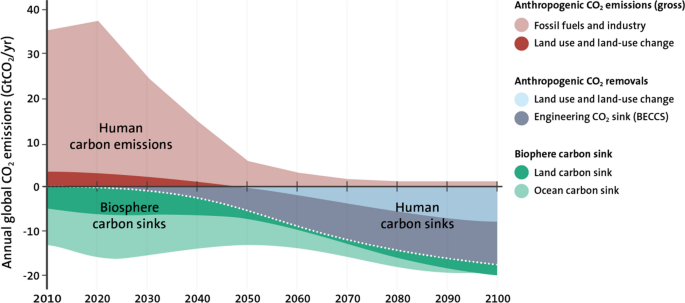
figure 10
Fig. 10

In addition, active biosphere stewardship of critical tipping elements and carbon sinks, as in forests, agricultural land, savannas, wetlands, and marine ecosystems is crucial to avoid the risk of runaway climate change (Steffen et al. 2018). Such stewardship involves protecting, sustaining, restoring, and enhancing such sinks. The existence of connections between finance actors, capital markets, and the tipping elements of tropical and boreal forests has also gained attention and needs to be acted upon in policy and practice (Galaz et al. 2018).

Furthermore, ecosystem restoration has the potential to sequester large amounts of carbon dioxide from the atmosphere. The amount of carbon dioxide in the atmosphere derived from destroyed and degraded land is roughly equal to the carbon that remains in ecosystems on land (about 450 billion tonnes of carbon) (Erb et al. 2018). The amount of degraded lands in the world is vast, and restoring their productivity, biodiversity, and ecosystem services could help keep global temperature increases within acceptable levels (Lovejoy and Hannah 2018). It has been estimated that nature-based solutions on land (from agriculture to reforestation and afforestation) have the potential to provide over 30% of the emission reductions needed by 2050 to keep global temperature increases to not more than 2 °C (Griscom et al. 2017; Roe et al. 2019).

There is scope for new policies and practices for nature-based solutions (Kremen and Merenlender 2018; Diaz et al. 2018). These solutions will require shifts in governance towards active stewardship of water and ecosystem dynamics and processes across landscapes, precipitation sheds, and seascapes (Österblom et al. 2017; Plummer et al. 2020), reconfiguring nation state governance, empowering the commons through justice, equity and knowledge, and making ownership regenerative by integrating rights with responsibilities (Brodie Rudolph et al. 2020). Also, the so-called “social tipping interventions” towards biosphere stewardship have the potential to activate contagious processes of rapidly spreading technologies, behaviors, social norms, and structural reorganization, where current patterns can be disrupted and lead to fast reduction in anthropogenic greenhouse gas emissions (Otto et al. 2020). The window of opportunity for such shifts may emerge in times of turbulence and social discontent with the status quo (Carpenter et al. 2019). Creating conditions for processes of deliberate democracy may guide such transformative change (Dryzek et al. 2019).

Resilience and biosphere stewardship

Societal development needs to strengthen biosphere capacity for dealing with extreme events, both climate driven and as a consequence of a tightly coupled and complex globalized world in deep interplay with the rest of the biosphere (Helbing 2013; Reyers et al. 2018). For example, the challenge of policy and practice in satisfying demands for food, water and other critical ecosystem services will most likely be set by the potential consequences of the emergent risk panorama and its consequences, rather than hard upper limits to production per se (Cottrell et al. 2019; Nyström et al. 2019; Xu et al. 2020).

In this sense, a resilience approach to biosphere stewardship becomes significant. Such an approach is very different from those who understand resilience as return to the status quo, to recover to business-as-usual. Resilience in relation to stewardship of complex adaptive systems concerns capacities to live with changing circumstances, slow or abrupt, predictable or surprising. It becomes especially relevant for dealing with the uncertain and unknown and is in stark contrast to strategies that support efficiency and effectiveness for short term gain at the expense of redundancy and diversity. Such strategies may work under relatively stable and predictable conditions but, as stressed here, will create vulnerability in periods of rapid change, during turbulent times, and are ill-suited to confront the unknown (Carpenter et al. 2009; Walker et al. 2009). Financial crises and pandemics serve as real-world examples of such vulnerabilities and make explicit the tension between connectivity and modularity in complex adaptive systems (Levin 1999).

In contrast, intertwined systems of people and nature characterized by resilience will have the capacity, whether through strategies like portfolio management, polycentric institutions, or building trust and nurturing diversity (Costanza et al. 2000; Ostrom 2010; Biggs et al. 2012; Carpenter et al. 2012), to confront turbulent times and the unknown. Policy decisions will no longer be the result of optimization algorithms that presuppose quantifiable uncertainty, but employ decision-making procedures that iteratively identify policy options most robust to present and future shocks under conditions of deep uncertainty (Polasky et al. 2011). Resilience provides capacities for novelty and innovation in times of change, to turn crises into opportunities for not only adapting, but also transforming into sustainable futures (Folke et al. 2016).

The immediate future will require capacities to confront challenges that we know we know little about (Kates and Clark 1996). Given the global connectivity of environmental, social, and economic systems, there is no scale at which resource pooling or trade can be used to hedge against all fluctuations at smaller scales. This begs the question of what types of investments may lead to a generalized capacity to develop with a wide range of potential and unknown events (Polasky et al. 2011). One strategy is to invest in global public goods common to all systems, e.g., education, capacity to learn and collaborate across sectors, multi-scale governance structures that enable systems to better detect changes and nimbly address problems by reconfiguring themselves through transformative change. Such strategies, often referred to as building “general resilience”, easily erode if not actively supported (Biggs et al. 2012; Carpenter et al. 2012; Quinlan et al. 2015). General resilience is critical for keeping options alive to face an uncertain turbulent world (Walker et al. 2009; Elmqvist et al. 2019).

Collaborating with the biosphere

Clearly, a shift in perspective and action is needed (Fig. 11) that includes extending management and governance from the focus on producing food, fibre, and timber in simplified ecosystems to rebuilding and strengthening resilience through investing in portfolios of ecosystem services for human wellbeing in diversity-rich social-ecological systems (Reyers et al. 2013; Bennett et al. 2015; Isbell et al. 2017).
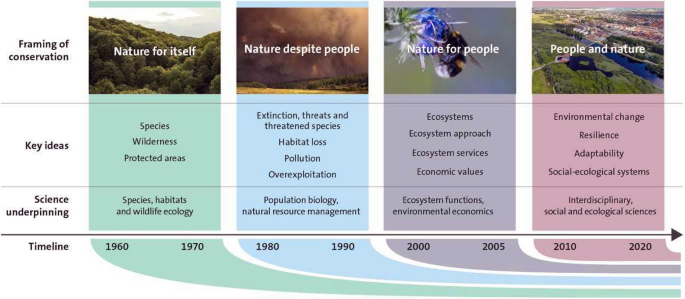
figure 11
Fig. 11

Numerous activities protecting, restoring, and enhancing diversity are taking place in this direction ranging from traditional societies, local stewards of wildlife habitats, marine systems, and urban areas, to numerous NGOs, companies and enterprises, and various levels of government, to international collaborations, agreements, and conventions (Barthel et al. 2005; Forbes et al. 2009; Raymond et al. 2010; Andersson et al. 2014; Barrett 2016; Brondizio and Le Tourneau 2016; Österblom et al. 2017; Barbier et al. 2018; Bennett et al. 2018).

Examples include widespread use of marine protected areas from local places to marine spatial planning to proposals for protecting the open ocean, enhancing marine biodiversity, rebuilding fisheries, mitigating climate change, and shifting towards ocean stewardship (Worm et al. 2009; Sumaila et al. 2015; Lubchenco and Grorud-Colvert 2015; Lubchenco et al. 2016; Sala et al. 2016; Gaines et al. 2018; Tittensor et al. 2019; Cinner et al. 2020; Duarte et al. 2020; Brodie Rudolph et al. 2020). The latter is the focus of the High Level Panel for a Sustainable Ocean Economy, with 14 heads of state and more than 250 scientists engaged. They aim to stimulate transformative change for the ocean by committing to sustainably managing 100% of their own waters by 2030 (Stuchtey et al. 2020).

There are major restoration programmes of forests, wetlands, and abandoned and degraded lands and even revival of wildlife and rewilding of nature (Perino et al. 2019). Other efforts include “working-lands conservation” like agroforestry, silvopasture, diversified farming, and ecosystem-based forest management, enhancing livelihoods and food security (Kremen and Merenlender 2018).

The world’s ecosystems can be seen as essential capital assets, if well managed, their lands, waters, and biodiversity yield a flow of vital life-support services (Daily et al. 2009). Investing in natural capital has become a core strategy of agencies and major nations, like China, for wellbeing and sustainability, providing greater resilience to climate change (Guerry et al. 2015; Ouyang et al. 2016). It involves combining science, technology, and partnerships to develop nature-based solutions and enable informed decisions for people and nature to thrive and invest in green growth (Mandle et al. 2019).

There are several examples of adaptive management and adaptive governance systems that have transformed social-ecological dynamics of landscapes and seascapes into biosphere stewardship (Chaffin et al. 2014; Schultz et al. 2015; Walker 2019; Plummer et al. 2020). Stewardship of diversity as a critical feature in resilience building is about reducing vulnerability to change and multiplying the portfolio of options for sustainable development in times of change. Stewardship shifts focus from commodity to redundancy to response diversity for dealing with change (Elmqvist et al. 2003; Grêt-Regamey et al. 2019; Dasgupta 2021).

Clearly, the economic contributions of biodiversity are highly significant as reflected in the many efforts to expose and capture economic values of biodiversity and ecosystem services (Daily et al. 2000; Sukhdev et al. 2010; Kinzig et al. 2011; Costanza et al. 2014; Naeem et al. 2015; Barbier et al. 2018; Dasgupta 2021). Inclusive (or genuine) wealth aims at capturing the aggregate value of natural, human, and social capital assets to provide a comprehensive, long-term foundation for human wellbeing (Dasgupta and Mäler 2000; Polasky et al. 2015). Inclusive wealth provides a basis for designing incentives for more sustainable market transactions (Dasgupta 2014; Clark and Harley 2020).

Also, the role of the cultural context is fundamental (Diaz et al. 2018) and biocultural diversity, and coevolution of people and nature is gaining ground as a means to understand dynamically changing social-ecological relations (Barthel et al. 2013; Merçon et al. 2019; Haider et al. 2019). Broad coalitions among citizens, businesses, nonprofits, and government agencies have the power to transform how we view and act on biosphere stewardship and build Earth resilience. Science has an important new role to play here as honest broker, engaging in evidence-informed action, and coproduction of knowledge in collaboration with practice, policy, and business (Reyers et al. 2015; Wyborn et al. 2019; Norström et al. 2020).

In this context, work identifying leverage points for anticipated and deliberate transformational change towards sustainability is gaining ground, centred on reconnecting people to nature, restructuring power and institutions, and rethinking how knowledge is created and used in pursuit of sustainability (Abson et al. 2017; Fischer and Riechers 2019). Such actions range from direct engagements between scientists and local communities (Tengö et al. 2014) or through the delivery of scientific knowledge and method into multi-stakeholder arenas, such as boundary or bridging organizations (Cash et al. 2003; Hahn et al. 2006; Crona and Parker 2012) where it can provide a basis for learning and be translated into international negotiations (Biermann and Pattberg 2008; Galaz et al. 2016; Tengö et al. 2017). It includes efforts to accelerate positive transformations by identifying powerful actors, like financial investors or transnational corporations, and articulating key domains with which these actors need to engage in order to enable biosphere stewardship (Österblom et al. 2017; Galaz et al. 2018; Folke et al. 2019; Jouffray et al. 2019). The International science-policy platform for biodiversity and ecosystem services (IPBES), an international body for biodiversity similar to the IPCC for the climate, has proposed key features for enabling transformational change (Fig. 12). These efforts serve an increasingly important space for scientists to engage in, helping hold corporations accountable, stimulating them to take on responsibility for the planet and develop leadership in sustainability. Such science-business engagement will become increasingly important to ensure that companies’ sustainability agendas are framed by science rather than the private sector alone (Österblom et al. 2015; Barbier et al. 2018; Blasiak et al. 2018; Galaz et al. 2018; Folke et al. 2019; Jouffray et al. 2019).
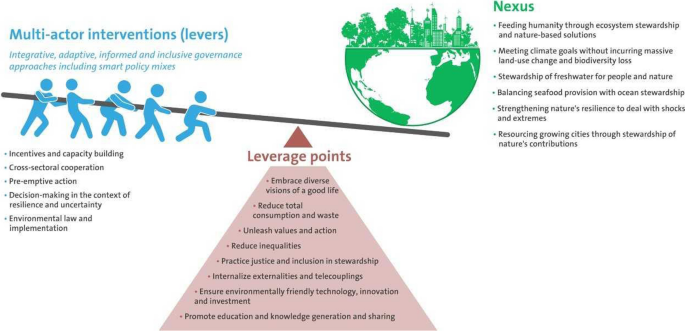
figure 12
Fig. 12

The rapid acceleration of current Earth system changes provides new motivations for action. Climate change is no longer a vague threat to some distant future generation but an environmental, economic, and social disruption that today’s youth, communities, corporations, and governments are increasingly experiencing. This provides both ethical and selfish motivations for individuals and institutions to launch transformative actions that shape their futures rather than simply reacting to crises as they emerge. Shaping the future requires active stewardship for regenerating and strengthening the resilience of the biosphere.

Given the urgency of the situation and the critical challenge of stabilizing the Earth system in Holocene-like conditions, the pace of current actions has to rapidly increase and expand to support a transformation towards active stewardship of human actions in concert with the biosphere foundation. It will require reform of critical social, economic, political, and cultural dimensions (Tallis et al. 2018; Diaz et al. 2018; Barrett et al. 2020).

Concluding remarks

The success of social organization into civilizations and more recently into a globalized world has been impressive and highly efficient. It has been supported by a resilient biosphere and a hospitable climate. Now, in the Anthropocene, a continuous expansion mimicking the development pathways of the past century is not a viable option for shifting towards sustainable futures.

Humanity is embedded within, intertwined with, and dependent upon the living biosphere. Humanity has become a global force shaping the operation and future of the biosphere and the broader Earth system. Climate change and loss of biodiversity are symptoms of the situation. The accelerating expansion of human activities has eroded biosphere and Earth system resilience and is now challenging human wellbeing, prosperity, and possibly even the persistence of societies and civilizations.

The expansion has led to hyper-connectivity, homogenization, and vulnerability in times of change, in contrast to modularity, redundancy, and resilience to be able to live with changing circumstances. In the Anthropocene, humanity is confronted with turbulent times and with new intertwined dynamics of people and planet where fast and slow change interplay in unexperienced and unpredictable ways. This is becoming the new normal.

Our future on our planet will be determined by our ability to keep global warming well below 2 °C and foster the resilience of the living biosphere. A pervasive thread in science is that building resilient societies, ecosystems, and ultimately the health of the entire Earth system hinges on supporting, restoring and regenerating diversity in intertwined social and ecological dimensions. Diversity builds insurance and keeps systems resilient to changing circumstances. Clearly, nurturing resilience is of great significance in transformations towards sustainability and requires collective action on multiple fronts, action that is already being tested by increasing turbulence incurred by seemingly unrelated shocks.

Equality holds communities together, and enables nations, and regions to evolve along sustainable development trajectories. Inequality, in terms of both social and natural capitals, are on the rise in the world, and need to be addressed as an integral part of our future on Earth.

We are facing a rapid and significant repositioning of sustainability as the lens through which innovation, technology and development is driven and achieved. What only a few years ago was seen as a sacrifice is today creating new purposes and meanings, shaping values and culture, and is increasingly seen as a pathway to novelty, competitiveness and progress.

This is a time when science is needed more than ever. Science provides informed consensus on the facts and trade-offs in times of misinformation and polemics. The planetary challenges that confront humanity need governance that mobilizes the best that science has to offer with shared visions for sustainable futures and political will and competence to implement choices that will sustain humanity and the rest of the living world for the next millennium and beyond.

There is scope for changing the course of history into sustainable pathways. There is urgent need for people, economies, societies and cultures to actively start governing nature’s contributions to wellbeing and building a resilient biosphere for future generations. It is high time to reconnect development to the Earth system foundation through active stewardship of human actions into prosperous futures within planetary boundaries.

References

  • Abson, D.J.J., J. Fischer, J. Leventon, J. Newig, T. Schomerus, U. Vilsmaier, H. von Wehrden, P. Abernethy, et al. 2017. Leverage points for sustainability transformation. Ambio 46: 30–39.
  • Adger, W.N., H. Eakin, and A. Winkels. 2009. Nested and teleconnected vulnerabilities to environmental change. Frontiers in Ecology and the Environment 7: 150–157.Google Scholar 
  • Alberti, M., C. Correa, J.M. Marzluff, A.P. Hendry, E.P. Palkovacs, K.M. Gotanda, V.M. Hunt, T.M. Apgar, et al. 2017. Global urban signatures of phenotypic change in animal and plant populations. Proceedings of the National Academy of Sciences, USA 114: 8951–8956.CAS Google Scholar 
  • Althor, G., J.E.M. Watson, and R.A. Fuller. 2016. Global mismatch between greenhouse gas emissions and the burden of climate change. Science Reports 6: 20281.CAS Google Scholar 
  • Anderies, J.M., S.R. Carpenter, W. Steffen, and J. Rockström. 2013. The topology of non-linear global carbon dynamics: From tipping points to planetary boundaries. Environmental Research Letters 8: 044048.Google Scholar 
  • Andersson, E., S. Barthel, S. Borgström, J. Colding, T. Elmqvist, C. Folke, and Å. Gren. 2014. Reconnecting cities to the biosphere: Stewardship of green infrastructure and urban ecosystem services. Ambio 43: 445–453.Google Scholar 
  • Arneth, A., F. Denton, F. Agus, A. Elbehri, K. Erb, B. Osman Elasha, M. Rahimi, M. Rounsevell, et al. 2019. Framing and Context. In Climate Change and Land. An IPCC Special Report on Climate Change, Desertification, Land Degradation, Sustainable Land Management, Food Security, and Greenhouse Gas Fluxes in Terrestrial Ecosystems (IPCC, 2019).
  • AWG. 2019. The Anthropocene Working Group http://quaternary.stratigraphy.org/working-groups/anthropocene/
  • Bain, W. 2019. Continuity and change in international relations 1919–2019. International Relations 33: 132–141.Google Scholar 
  • Baland, J.M., P. Bardhan, and S. Bowles, eds. 2007. Inequality, cooperation, and environmental sustainability. Princeton, USA: Princeton University Press.Google Scholar 
  • Barbier, E.B., J.C. Burgess, and T.J. Dean. 2018. How to pay for saving biodiversity. Science 360: 486–488.CAS Google Scholar 
  • Barnosky, A.D., E.A. Hadly, J. Bascompte, E.L. Berlow, J.H. Brown, M. Fortelius, W.M. Getz, J. Harte, et al. 2012. Approaching a state shift in Earth’s biosphere. Nature 486: 52–58.CAS Google Scholar 
  • Barocas, S., K. Crawford, A. Shapiro, H. Wallach. 2017. The problem with bias: from allocative to representational harms in machine learning Information and Society (SIGCIS) Special Interest Group for Computing.
  • Bar-On, Y.M., R. Phillips, and R. Milo. 2018. The biomass distribution on Earth. Proceedings of the National Academy of Sciences, USA 115: 6506–6511.CAS Google Scholar 
  • Barrett, S. 2016. Coordination vs. voluntarism and enforcement in sustaining international environmental cooperation. Proceedings of the National Academy of Sciences, USA 113: 14515–14522.CAS Google Scholar 
  • Barrett, S., A. Dasgupta, P. Dasgupta, W.N. Adger, J. Anderies, J. van den Bergh, C. Bledsoe, et al. 2020. Fertility behavior and consumption patterns in the Anthropocene. Proceedings of the National Academy of Sciences, USA 117: 6300–6307.CAS Google Scholar 
  • Barthel, S., C. Crumley, and U. Svedin. 2013. Bio-cultural refugia: Safeguarding diversity of practices for food security and biodiversity. Global Environmental Change 23: 1142–1152.Google Scholar 
  • Barthel, S., J. Colding, T. Elmqvist, and C. Folke. 2005. History and local management of a biodiversity rich, urban, cultural landscape. Ecology and Society 10: 10.Google Scholar 
  • Beckert, J. 2016. Imagined Futures: Fictional Expectations and Capitalist Dynamics. Cambridge, MA: Harvard University Press.Google Scholar 
  • Bennett, E.M., M. Solan, R. Biggs, T. McPhearson, A.V. Norström, P. Olsson, L. Pereira, G.D. Peterson, et al. 2016. Bright spots: Seeds of a good Anthropocene. Frontiers in Ecology and the Environment 14: 441–448.Google Scholar 
  • Bennett, E.M., W. Cramer, A. Begossi, G. Cundill, S. Diaz, B.N. Egoh, I.R. Geijzendorffer, C.B. Krug, et al. 2015. Linking biodiversity, ecosystem services, and human well-being: Three challenges for designing research for sustainability. Current Opinion in Environmental Sustainability 14: 76–85.Google Scholar 
  • Bennett, N.J., T.S. Whitty, E. Finkbeiner, J. Pittman, H. Bassett, S. Gelcich, and E.H. Allison. 2018. Environmental stewardship: A conceptual review and analytical framework. Environmental Management 61: 597–614.Google Scholar 
  • Bergstrom, C.T., and J.B. Bak-Coleman. 2019. Gerrymandering in social networks. Nature 573: 40–41.CAS Google Scholar 
  • Berkes, F., J. Colding, and C. Folke, eds. 2003. Navigating Social-ecological systems: Building resilience for complexity and change. Cambridg: Cambridge University Press.Google Scholar 
  • Biermann, F., and P. Pattberg. 2008. Global environmental governance: Taking stock, moving forward. Annual Review of Environment and Resources 33: 277–294.Google Scholar 
  • Biermann, F., K. Abbott, S. Andresen, K. Bäckstrand, S. Bernstein, M.M. Betsill, H. Bulkeley, B. Cashore, et al. 2012. Navigating the anthropocene: Improving earth system governance. Science 335: 1306–1307.CAS Google Scholar 
  • Biggs, R., M. Schlüter, D. Biggs, E.L. Bohensky, S. BurnSilver, G. Cundill, V. Dakos, T.M. Daw, et al. 2012. Toward principles for enhancing the resilience of ecosystem services. Annual Review of Environment and Resources 37: 421–448.Google Scholar 
  • Blasiak, R., J. Spijkers, K. Tokunaga, J. Pittman, N. Yagi, and H. Österblom. 2017. Climate change and marine fisheries: Least developed countries top global index of vulnerability. PLoS ONE 12: e0179632.Google Scholar 
  • Blasiak, R., J.-B. Jouffray, C.C.C. Wabnitz, E. Sundström, and H. Österblom. 2018. Corporate control and global governance of marine genetic resources. Sciences Advances 4: 5237.Google Scholar 
  • Blasiak, R., R. Wynberg, K. Grorud-Colvert, S. Thambisetty, N.M. Bandarra, A.V.M. Canário, J. da Silva, C.M. Duarte, et al. 2020. The ocean genome and future prospects for conservation and equity. Nature Sustainability 3: 588–596.Google Scholar 
  • Bowles, S., S.N. Durlauf, and K. Hoff. 2006. Poverty Traps. Princeton, NJ: Princeton University Press.Google Scholar 
  • Boyd, E., B. Nykvist, S. Borgström, and I.A. Stacewicz. 2015. Anticipatory governance for social-ecological resilience. Ambio 44: S149–S161.Google Scholar 
  • Breuer, A., T. Landman, and D. Farquhar. 2015. Social media and protest mobilization: Evidence from the Tunisian revolution. Democratization 22: 764–792.Google Scholar 
  • Brienen, R., O.L. Phillips, T.R. Feldpausch, E. Gloor, T.R. Baker, J. Lloyd, G. Lopez-Gonzalez, A. Monteagudo-Mendoza, et al. 2015. Long-term decline of the Amazon carbon sink. Nature 519: 344–348.CAS Google Scholar 
  • Brodie Rudolph, T., M. Ruckelshaus, M. Swilling, E.H. Allison, H. Österblom, S. Gelcich, and P. Mbatha. 2020. A transition to sustainable ocean governance. Nature Communication 11: 3600.Google Scholar 
  • Brondizio, E.S., and F.-M. Le Tourneau. 2016. Environmental governance for all. Science 352: 1272–1273.CAS Google Scholar 
  • Brondizio, E.S., E. Ostrom, and O.R. Young. 2009. Connectivity and the governance of multilevel social-ecological systems: The role of social capital. Annual Review of Environment and Resources 34: 253–278.Google Scholar 
  • Brown, K. 2016. Resilience, Development and Global Change. London, UK: Routledge.Google Scholar 
  • Burke, K.D., J.W. Williams, M.A. Chandler, A.M. Haywood, D.J. Lunt, and B.L. Otto-Bliesner. 2018. Pliocene and Eocene provide best analogs for near-future climates. Proceedings of the National Academy of Sciences, USA 115: 13288–13293.CAS Google Scholar 
  • Carpenter, S.R., and E.M. Bennett. 2011. Reconsideration of the planetary boundary for phosphorus. Environmental Research Letters 6: 014009.Google Scholar 
  • Carpenter, S.R., E.M. Bennett, and G.D. Peterson. 2006. Scenarios for ecosystem services: An overview. Ecology and Society 11: 29.Google Scholar 
  • Carpenter, S.R., C. Folke, M. Scheffer, and F. Westley. 2009. Resilience: Accounting for the non-computable. Ecology and Society 14: 13.Google Scholar 
  • Carpenter, S.R., K.J. Arrow, S. Barrett, R. Biggs, W.A. Brock, A.-S. Crépin, G. Engström, C. Folke, et al. 2012. General resilience to cope with extreme events. Sustainability 4: 3248–3259.Google Scholar 
  • Carpenter, S.R., W. Brock, C. Folke, E. van der Nees, and M. Scheffer. 2015. Allowing variance may enlarge the safe operating space for exploited ecosystems. Proceedings of the National Academy of Sciences, USA 112: 14384–14389.CAS Google Scholar 
  • Carpenter, S.R., C. Folke, M. Scheffer, and F.R. Westley. 2019. Dancing on the volcano: Social exploration in times of discontent. Ecology and Society 24: 23.Google Scholar 
  • Cash, D.W., W. Adger, F. Berkes, P. Garden, L. Lebel, P. Olsson, L. Pritchard, and O. Young. 2006. Scale and cross-scale dynamics: Governance and information in a multilevel world. Ecology and Society 11: 8.Google Scholar 
  • Cash, D.W., W.C. Clark, F. Alcock, N. Dickson, N. Eckley, D.H. Guston, J. Jäger, and R.B. Mitchell. 2003. Knowledge systems for sustainable development. Proceedings of the National Academy of Sciences, USA 100: 8086–8091.CAS Google Scholar 
  • Cave, S., and S.S. Óhéigeartaigh. 2019. Bridging near- and long-term concerns about AI. Nature Machine Intelligence 1: 5–6.Google Scholar 
  • Centeno, M.A., M. Nag, T.S. Patterson, A. Shaver, and A.J. Windawi. 2015. The emergence of global systemic risk. Annual Review of Sociology 41: 65–85.Google Scholar 
  • Chaffin, B.C., and L.H. Gunderson. 2016. Emergence, institutionalization, and renewal: rhythms of adaptive governance in complex social-ecological systems. Journal of Environmental Management 165: 81–87.Google Scholar 
  • Chaffin, B.C., H. Gosnell, and B.A. Cosens. 2014. A decade of adaptive governance scholarship: Synthesis and future directions. Ecology and Society 19: 56.Google Scholar 
  • Chapin, F.S., III., B.H. Walker, R.J. Hobbs, D.U. Hooper, J.H. Lawton, O.E. Sala, and D. Tilman. 1997. Biotic control over the functioning of ecosystems. Science 277: 500–504.CAS Google Scholar 
  • Chapin, F.S., III., S.R. Carpenter, G.P. Kofinas, C. Folke, N. Abel, W.C. Clark, P. Olsson, D.M.S. Smith, et al. 2010. Ecosystem stewardship: Sustainability strategies for a rapidly changing planet. Trends in Ecology and Evolution 25: 241–249.Google Scholar 
  • Chapin, F.S., III. 2020. Grassroots stewardship: Sustainability within our reach. Oxford: Oxford University Press.Google Scholar 
  • Chaplin-Kramer, R., R.P. Sharp, C. Weil, E.M. Bennett, U. Pascual, K.K. Arkema, K.A. Brauman, B.P. Bryant, et al. 2019. Global modelling of nature’s contributions to people. Science 366: 255–258.CAS Google Scholar 
  • Ciais, P., C. Sabine, B. Govindasamy, L. Bopp, V. Brovkin, J. Canadell, A. Chhabra, R. DeFries, et al. 2013. Chapter 6: Carbon and Other Biogeochemical Cycles. In Climate Change 2013: The Physical Science Basis, eds. T. Stocker, D. Qin, G.-K. Platner, et al. Cambridge, UK: Cambridge University Press.
  • Cinner, J.E., J. Zamborain-Mason, G.G. Gurney, N.A.J. Graham, M.A. MacNeil, A.S. Hoey, C. Mora, S. Villéger, et al. 2020. Meeting fisheries, ecosystem function, and biodiversity goals in a human-dominated world. Science 368: 307–311.CAS Google Scholar 
  • Cinner, J.E., W.N. Adger, E.H. Allison, M.L. Barnes, K. Brown, P.J. Cohen, S. Gelcich, C.C. Hicks, et al. 2018. Building adaptive capacity to climate change in tropical coastal communities. Nature Climate Change 8: 117–123.Google Scholar 
  • Clark, W.C., and A.G. Harley. 2020. Sustainability science: Towards a synthesis. Annual Review of Environment and Resources 45: 331–386.Google Scholar 
  • Clark, W.C., L. van Kerkhoff, L. Lebel, and G. Gallopi. 2016. Crafting usable knowledge for sustainable development. Proceedings of the National Academy of Sciences, USA 113: 4570–4578.CAS Google Scholar 
  • Conselice, C.J., A. Wilkinson, K. Duncan, and A. Mortlock. 2016. The evolution of galaxy number density at Z < 8 and its implications. The Astrophysical Journal 830: 83.Google Scholar 
  • Coe, N.M., M. Hess, H.W.-C. Yeung, P. Dicken, and J. Henderson. 2004. ‘Globalizing’ regional development: a global production networks perspective. Transactions of the Institute of British Geographers 29: 468–484.Google Scholar 
  • Conway, D., R.J. Nicholls, S. Brown, M.G.L. Tebboth, W.N. Adger, B. Ahmad, H. Biemans, F. Crick, et al. 2019. The need for bottom-up assessments of climate risks and adaptation in climate-sensitive regions. Nature Climate Change 9: 503–511.Google Scholar 
  • Costanza, R., H. Daly, C. Folke, P. Hawken, C.S. Holling, T. McMichael, D. Pimentel, and D. Rapport. 2000. Managing our environmental portfolio. BioScience 50: 149–155.Google Scholar 
  • Costanza, R., R. de Groot, P. Sutton, S. vad der Ploeg, S.J. Anderson, I. Kubiszewski, S. Farber, and R.K. Turner. 2014. Changes in the global value of ecosystem services. Global Environmental Change 26: 152–158.Google Scholar 
  • Costello, C., L. Cao, S. Gelcich, M.A. Cisneros-Mata, C.M. Free, H.E. Froehlich, C.G. Golden, G. Ishimura, et al. 2020. The future of food from the sea. Nature 588: 95–100.Google Scholar 
  • Cottrell, R.S., K.L. Nash, B.S. Halpern, T.A. Remeny, S.P. Corney, A. Fleming, E.A. Fulton, S. Hornborg, et al. 2019. Food production shocks across land and sea. Nature Sustainability 2: 130–137.
  • Creanza, N., O. Kolodny, and M.W. Feldman. 2017. Cultural evolutionary theory: how culture evolves and why it matters. Proceedings of the National Academy of Sciences, USA 114: 7782–7789.CAS Google Scholar 
  • Crona, B.I., and J.N. Parker. 2012. Learning in support of governance: Theories, methods, and a framework to assess how bridging organizations contribute to adaptive resource governance. Ecology and Society 17: 32.Google Scholar 
  • Crona, B.I., T. Daw, W. Swartz, A. Norström, M. Nyström, M. Thyresson, C. Folke, J. Hentati-Sundberg, et al. 2016. Masked, diluted, and drowned out: Global seafood trade weakens signals from marine ecosystems. Fish and Fisheries 17: 1175–1182.Google Scholar 
  • Crona, B.I., T. Van Holt, M. Petersson, T.M. Daw, and E. Buchary. 2015. Using social-ecological syndromes to understand impacts of international seafood trade on small-scale fisheries. Global Environmental Change 35: 162–175.Google Scholar 
  • Cumming, G.S., and G.D. Peterson. 2017. Unifying research on social-ecological resilience and collapse. Trends in Ecology & Evolution 32: 695–713.Google Scholar 
  • Daily, G.C., ed. 1997. Nature’s services: Societal dependence on natural ecosystems. Washington DC: Island Press.Google Scholar 
  • Daily, G., T. Söderqvist, S. Aniyar, K. Arrow, P. Dasgupta, P.R. Ehrlich, C. Folke, A.-M. Jansson, et al. 2000. The value of nature and the nature of value? Science 289: 395–396.CAS Google Scholar 
  • Daily, G.C., S. Polasky, J. Goldstein, P. Kareiva, H.A. Mooney, L. Pejchar, T.H. Ricketts, J. Salzman, et al. 2009. Ecosystem services in decision making: time to deliver. Frontiers in Ecology and the Environment 7: 21–28.Google Scholar 
  • Dasgupta, P. 2014. Measuring the wealth of nations. Annual Review of Resource Economics 6: 17–31.Google Scholar 
  • Dasgupta, P. 2021. The economics of biodiversity: The dasgupta review. London: HMTreasury.Google Scholar 
  • Dasgupta, P., and V. Ramanathan. 2014. Pursuit of the common good. Science 345: 1457–2145.CAS Google Scholar 
  • Dasgupta, P., and K.-G. Mäler. 2000. Net national product, wealth and social well-being. Environment and Development Economics 5: 69–93.Google Scholar 
  • de Vries, W., J. Kros, C. Kroeze, and S.P. Seitzinger. 2013. Assessing planetary and regional nitrogen boundaries related to food security and adverse environmental impacts. Current Opinion in Environmental Sustainability 5: 392–402.Google Scholar 
  • Dearing, J.A., R. Wang, K. Zhang, J.G. Dyke, H. Haberl, Md. Sarwar Hossain, P.G. Langdon, T.M. Lenton, et al. 2014. Safe and just operating spaces for regional social-ecological systems. Global Environmental Change 28: 227–238.Google Scholar 
  • Del Vicario, M., A. Bessi, F. Zollo, F. Petroni, A. Scala, G. Caldarelli, H.E. Stanley, and W. Quattrociocchi. 2016. The spreading of misinformation online. Proceedings of the National Academy of Sciences, USA 113: 554–559.Google Scholar 
  • Díaz, S., J. Settle, E.S. Brondízio, H.T Ngo, J. Agard, A. Arneth, P. Balvanera, K.A. Brauman, et al. 2019. Pervasive human-driven decline of life on Earth points to the need for transformative change. Science 366: eaax3100eaax3100.
  • Diaz, S., U. Pascual, M. Stenseke, B. Martín-López, R.T. Watson, Z. Molnár, R. Hill, K.M.A. Chan, et al. 2018. Assessing nature’s contributions to people: recognizing culture, and diverse sources of knowledge, can improve assessments. Science 359: 270–272.CAS Google Scholar 
  • Diffenbaugh, N.S. 2020. Verification of extreme event attribution: using out-of-sample observations to assess changes in probabilities of unprecedented events. Science Advances 6: 2368.Google Scholar 
  • Downing, A.S., A. Bhowmik, D. Collste, S.E. Cornell, J. Donges, I. Fetzer, T. Häyhä, J. Hinton, et al. 2019. Matching scope, purpose and uses of planetary boundaries science. Environmental Research Letters 14: 073005.Google Scholar 
  • Drefahl, S., M. Wallace, E. Mussino, S. Aradhya, M. Kolk, M. Brandén, and B.G. MalmbergAndersson. 2020. A population-based cohort study of socio-demographic risk factors for COVID-19 deaths in Sweden. Nature Communications 11: 5097.CAS Google Scholar 
  • Dryzek, J.S., A. Bächtiger, S. Chambers, J. Cohen, J.N. Druckman, A. Felicetti, J.S. Fishkin, D.M. Farrell, et al. 2019. The crisis of democracy and the science of deliberation. Science 363: 1144–1146.CAS Google Scholar 
  • Duarte, C.M., S. Agusti, E. Barbier, G.L. Britten, J.-C. Castilla, J.-P. Gattuso, R.W. Fulweiler, T.P. Hughes, et al. 2020. Rebuilding marine life. Nature 580: 39–51.CAS Google Scholar 
  • Durante, F., S.T. Fiske, M.J. Gelfand, F. Crippa, C. Suttora, A. Stillwell, F. Asbrock, Z. Aycan, et al. 2017. Ambivalent stereotypes link to peace, conflict, and inequality across 38 nations. Proceedings of the National Academy of Sciences, USA 114: 669–674.CAS Google Scholar 
  • Elhacham, E., L. Ben-Uri, J. Grozovski, Y.M. Bar-On, and R. Milo. 2020. Global human-made mass exceeds all living biomass. Nature 588: 442–444.CAS Google Scholar 
  • Ellen MacArthur Foundation. 2019. Completing the Picture: How the Circular Economy Tackles Climate Change. http://www.ellenmacarthurfoundation.org/publications
  • Ellis, E.C. 2015. Ecology in an anthropogenic biosphere. Ecological Monographs 85: 287–331.Google Scholar 
  • Ellis, E.C., and N. Ramankutty. 2008. Putting people in the map: Anthropogenic biomes of the world. Frontiers in Ecology and the Environment 6: 439–447.Google Scholar 
  • Elmqvist, T., C. Folke, M. Nyström, G. Peterson, J. Bengtsson, B. Walker, and J. Norberg. 2003. Response diversity, ecosystem change, and resilience. Frontiers in Ecology and the Environment 1: 488–494.Google Scholar 
  • Elmqvist, T., E. Andersson, N. Frantzeskaki, T. McPhearson, P. Olsson, O. Gaffney, K. Takeuchi, and C. Folke. 2019. Sustainability and resilience for transformation in the urban century. Nature Sustainability 2: 267–273.Google Scholar 
  • Engström, G., J. Gars, C. Krishnamurthy, D. Spiro, R. Calel, T. Lindahl, and B. Narayanan. 2020. Carbon pricing and planetary boundaries. Nature Communications 11: 4688.Google Scholar 
  • Enqvist, J.P., S. West, V.A. Masterson, L.J. Haider, U. Svedin, and M. Tengö. 2018. Stewardship as a boundary object for sustainability research: Linking care, knowledge and agency. Landscape and Urban Planning 179: 17–37.Google Scholar 
  • Erb, K.H., T. Kastner, C. Plutzar, A.L.S. Bais, N. Carvalhais, T. Fetzel, S. Gingrich, C. Lauk, et al. 2018. Unexpectedly large impact of forest management and grazing on global vegetation biomass. Nature 553: 73–76.CAS Google Scholar 
  • Estes, J.A., J. Terborgh, J.S. Brashares, M.E. Power, J. Berger, W.J. Bond, S.R. Carpenter, T.E. Essington, et al. 2011. Trophic downgrading of Planet Earth. Science 333: 301–306.CAS Google Scholar 
  • Falkenmark, M., L. Wang-Erlandsson, and J. Rockström. 2019. Understanding of water resilience in the Anthropocene. Journal of Hydrology X 2: 100009.Google Scholar 
  • Ferrara, E., O. Varol, C. Davis, F. Menczer, and A. Flammini. 2016. The rise of social bots. Communications of the ACM 59: 96–104.Google Scholar 
  • Fischer, J., and M. Riechers. 2019. A leverage points perspective on sustainability. People and Nature 1: 115–120.Google Scholar 
  • Folke, C., S.R. Carpenter, B. Walker, M. Scheffer, T. Elmqvist, L. Gunderson, and C.S. Holling. 2004. Regime shifts, resilience, and biodiversity in ecosystem management. Annual Review of Ecology, Evolution and Systematics 35: 557–581.Google Scholar 
  • Folke, C., T. Hahn, P. Olsson, and J. Norberg. 2005. Adaptive governance of social-ecological systems. Annual Review of Environment and Resources 30: 441–473.Google Scholar 
  • Folke, C., S.R. Carpenter, B.H. Walker, M. Scheffer, F.S. Chapin III., and J. Rockström. 2010. Resilience thinking: integrating resilience, adaptability and transformability. Ecology and Society 15: 20.Google Scholar 
  • Folke, C., Å. Jansson, J. Rockström, P. Olsson, S.R. Carpenter, F.S. Chapin III., A.-S. Crépin, G. Daily, et al. 2011. Reconnecting to the Biosphere. Ambio 40: 719–738.Google Scholar 
  • Folke, C., R. Biggs, A.V. Norström, B. Reyers, and J. Rockström. 2016. Social-ecological resilience and biosphere-based sustainability science. Ecology and Society 21: 41.Google Scholar 
  • Folke, C., H. Österblom, J.-B. Jouffray, E. Lambin, M. Scheffer, B.I. Crona, M. Nyström, S.A. Levin, et al. 2019. Transnational corporations and the challenge of biosphere stewardship. Nature Ecology & Evolution 3: 1396–1403.Google Scholar 
  • Folke, C., S. Polasky, J. Rockström, V. Galaz, F. Westley, M. Lamont, M. Scheffer, H. Österblom, et al. 2020. Our future in the Anthropocene biosphere: Global sustainability and resilient societies. Paper for the Nobel Prize Summit – Our Planet, Our Future. Beijer Discussion Paper 272. Beijer Institute, Royal Swedish Academy of Sciences, Stockholm, Sweden.
  • Forbes, B.C., F. Stammler, T. Kumpula, N. Meschtyb, A. Pajunen, and E. Kaarlejarvi. 2009. High resilience in the Yamal-Nenets social-ecological system, West Siberian Arctic, Russia. Proceedings of the National Academy of Sciences, USA 106: 22041–22048.CAS Google Scholar 
  • Fortnam, M., K. Brown, T. Chaigneau, B. Crona, T.M. Daw, D. Goncalves, C. Hicks, M. Revmatas, et al. 2019. The gendered nature of ecosystem services. Ecological Economics 159: 312–325.Google Scholar 
  • Freeman, J., J.A. Baggio, and T.R. Coyle. 2020. Social and general intelligence improves collective action in a common pool resource systems. Proceedings of the National Academy of Sciences, USA 117: 7712–7718.CAS Google Scholar 
  • Frei, B., C. Queiroz, B. Chaplin-Kramer, E. Andersson, D. Renard, J.M. Rhemtulla, and E.M. Bennett. 2020. A brighter future: Complementary goals of diversity and multifunctionality to build resilient agricultural landscapes. Global Food Security 26: 100407.Google Scholar 
  • Friedlingstein, P., M.W. Jones, M. O’Sullivan, R.M. Andrew, J. Hauck, A. Olsen, G.P. Peters, W. Peters, et al. 2020. Global carbon budget 2020. Earth Systems Science Data 12: 3269–3340.Google Scholar 
  • Gaines, S.D., C. Costello, B. Owashi, T. Mangin, J. Bone, J.G. Molinos, M. Burden, H. Dennis, et al. 2018. Improved fisheries management could offset many negative effects of climate change. Science Advances 4: 1378.Google Scholar 
  • Galaz, V. 2014. Global environmental governance, technology and politics: The anthropocene gap. Cheltenham: Edward Elgar Publishing.Google Scholar 
  • Galaz, V., B. Crona, H. Österblom, P. Olsson, and C. Folke. 2012. Polycentric systems and interacting planetary boundaries: Emerging governance of climate change – ocean acidification–marine biodiversity. Ecological Economics 81: 21–32.Google Scholar 
  • Galaz, V., H. Österblom, Ö. Bodin, and B. Crona. 2016. Global networks and global change-induced tipping points. International Environmental Agreements 16: 189–221.Google Scholar 
  • Galaz, V., J. Tallberg, A. Boin, C. Ituarte-Lima, E. Hey, P. Olsson, and F. Westley. 2017. Global governance dimensions of globally networked risks: the state of the art in social science research. Risk, Hazards, & Crisis in Public Policy 8: 4–27.Google Scholar 
  • Galaz, V., B. Crona, A. Dauriach, B. Scholtens, and W. Steffen. 2018. Finance and the Earth system: Exploring the links between financial actors and non-linear changes in the climate system. Global Environmental Change 53: 296–302.Google Scholar 
  • Gaupp, F., J. Hall, S. Hochrainer-Stigler, and S. Dadson. 2020. Changing risks of simultaneous global breadbasket failure. Nature Climate Change 10: 54–57.Google Scholar 
  • Geels, F.W. 2002. Technological transitions as evolutionary reconfiguration processes: A multi-level perspective and a case-study. Research Policy 31: 1257–1274.Google Scholar 
  • Geels, F.W., B.K. Sovacool, T. Schwanen, and S. Sorrell. 2017. Sociotechnical transitions for deep decarbonisation. Science 357: 1242–1244.CAS Google Scholar 
  • Gelcich, S., T.P. Hughes, P. Olsson, C. Folke, O. Defeo, M. Fernández, S. Foale, L.H. Gunderson, et al. 2010. Navigating transformations in governance of Chilean marine coastal resources. Proceedings of the National Academy of Sciences, USA 107: 16794–16799.CAS Google Scholar 
  • Gerbaudo, P., and E. Treré. 2015. In search of the ‘we’of social media activism: introduction to the special issue on social media and protest identities. Information, Communication & Society 18: 865–871.Google Scholar 
  • Gleeson, T., L. Wang-Erlandsson, M. Porkka, S.C. Zipper, F. Jaramillo, D. Gerten, I. Fetzer, S.E. Cornell, et al. 2020a. Illuminating water cycle modifications and Earth System resilience in the Anthropocene. Water Resources Research 56: e2019WR024957.
  • Gleeson, T., L. Wang-Erlandsson, S.C. Zipper, M. Porkka, F. Jaramillo, D. Gerten, I. Fetzer, S.E. Cornell, et al. 2020. The water planetary boundary: interrogation and revision. One Earth 2: 223–234.Google Scholar 
  • Gordon, L.J., V. Bignet, B. Crona, P. Henriksson, T. van Holt, M. Jonell, T. Lindahl, M. Troell, et al. 2017. Rewiring food systems to enhance human health and biosphere stewardship. Environmental Research Letters 12: 100201.Google Scholar 
  • Green, J.F., and B. Rudyk. 2020. Closing the high seas to fishing: A club approach. Marine Policy 115: 103855.Google Scholar 
  • Grêt-Regamey, A., S.H. Huber, and R. Huber. 2019. Actors’ diversity and the resilience of social-ecological systems to global change. Nature Sustainability 2: 290–297.Google Scholar 
  • Grinberg, N., K. Joseph, L. Friedland, B. Swire-Thompson, and D. Lazer. 2019. Fake news on Twitter during the 2016 U.S. presidential election. Science 363: 374–378.CAS Google Scholar 
  • Griscom, B.W., J. Adams, P.W. Ellis, R.A. Houghton, G. Lomax, D.A. Miteva, W.H. Schlesinger, D. Shoch, et al. 2017. Natural climate solutions. Proceedings of the National Academy of Sciences, USA 114: 11645–11650.CAS Google Scholar 
  • Gruber, N., D. Clement, B.R. Carter, R.A. Feely, S. van Heuven, M. Hoppema, M. Ishii, R.M. Key, et al. 2019. The oceanic sink for anthropogenic CO2 from 1994 to 2007. Science 363: 1193–1199.CAS Google Scholar 
  • Guerry, A.D., S. Polasky, J. Lubchenco, R. Chaplin-Kramer, G.C. Daily, R. Griffin, M. Ruckelshaus, I.J. Bateman, et al. 2015. Natural capital informing decisions: From promise to practice. Proceedings of the National Academy of Sciences, USA 112: 7348–7355.CAS Google Scholar 
  • Gunderson, L.H., and C.S. Holling, eds. 2002. Panarchy: Understanding transformations in human and natural systems. Washington DC: Island Press.Google Scholar 
  • Hackmann, H., A.L. St. Clair. 2012. Transformative cornerstones of social science research for global change. Paris: Report of the international Social Science Council.Google Scholar 
  • Haenfler, R., B. Johnson, and E. Jones. 2012. Lifestyle movements: Exploring the intersection of lifestyle and social movements. Social Movement Studies 11: 1–20.Google Scholar 
  • Hahn, T., P. Olsson, C. Folke, and K. Johansson. 2006. Trust building, knowledge generation and organizational innovations: The role of a bridging organization for adaptive co-management of a wetland landscape around Kristianstad, Sweden. Human Ecology 34: 573–592.Google Scholar 
  • Haider, L.J., W.J. Boonstra, A. Akobirshoeva, and M. Schlüter. 2019. Effects of development interventions on biocultural diversity: A case study from the Pamir Mountains. Agriculture and Human Values 37: 683–697.Google Scholar 
  • Haider, L.J., M. Schlüter, C. Folke, and B. Reyers. 2021. Rethinking resilience and development: A coevolutionary perspective. Ambiohttps://doi.org/10.1007/s13280-020-01485-8.Article Google Scholar 
  • Hall, P.A., and M. Lamont, eds. 2013. Social resilience in the Neoliberal Era. Cambridge: Cambridge University Press.Google Scholar 
  • Hallegatte, S., M. Bangalore, L. Bonzanigo, M. Fay, T. Kane, U. Narloch, J. Rozenberg, D. Treguer, et al. 2016. Shock waves: managing the impacts of climate change on poverty. Washington, DC: World Bank.Google Scholar 
  • Halpern, B.S., S. Walbridge, K.A. Selkoe, C.V. Kappel, F. Micheli, C. D’Agrosa, J.F. Bruno, K.S. Casey, et al. 2008. A global map of human impact on marine ecosystems. Science 319: 948–952.CAS Google Scholar 
  • Hamann, M., R. Biggs, and B. Reyers. 2015. Mapping social-ecological systems: identifying ‘green-loop’ and ‘red-loop’ dynamics based on characteristic bundles of ecosystem service use. Global Environmental Change 34: 218–226.Google Scholar 
  • Hamann, M., K. Berry, T. Chaigneau, T. Curry, R. Heilmayr, P.J.G. Henriksson, J. Hentati-Sundberg, A. Jina, et al. 2018. Inequality and the biosphere. Annual Review of Environment and Resources 43: 61–83.Google Scholar 
  • Harper, S., D. Zeller, M. Hauzer, D. Pauly, and U.R. Sumaila. 2013. Women and fisheries: Contribution to food security and local economies. Marine Policy 39: 56–63.Google Scholar 
  • Hassan, N., M. Yousuf, M.A. Mahfuzul Haque, J. Suarez Rivas, and M. Khadimul Islam. 2019. Examining the roles of automation, crowds and professionals towards sustainable fact-checking. Companion Proceedings of The 2019 World Wide Web Conference, 1001–1006.
  • Häyhä, T., P.L. Lucas, D.P. van Vuuren, S.E. Corell, and H. Hoff. 2016. From Planetary Boundaries to national fair shares of the global safe operating space: How can the scales be bridged? Global Environmental Change 40: 60–72.Google Scholar 
  • Heal, G., B.H. Walker, S.A. Levin, K. Arrow, P. Dasgupta, G. Daily, P. Ehrlich, K.-G. Maler, et al. 2004. Genetic diversity and interdependent crop choices in agriculture. Resource and Energy Economics 26: 175–184.Google Scholar 
  • Helbing, D. 2013. Globally networked risks and how to respond. Nature 497: 51–59.CAS Google Scholar 
  • Hendershot, J.N., J.R. Smith, C.B. Anderson, A.D. Letten, L.O. Frishkoff, J.R. Zook, T. Fukami, and G.C Daily. 2020. Intensive farming drives long-term shifts in community composition. Nature 579: 393–396.
  • Hicks, C.C., P.J. Cohen, N.A.J. Graham, K.L. Nash, E.H. Allison, C. D’Lima, D.J. Mills, M. Roscher, et al. 2019. Harnessing global fisheries to tackle micronutrient deficiencies. Nature 574: 95–98.CAS Google Scholar 
  • Hino, M., E. Benami, and N. Brooks. 2018. Machine learning for environmental monitoring. Nature Sustainability 1: 583–588.Google Scholar 
  • Hirota, M., M. Holmgren, E.H. van Nes, and M. Scheffer. 2011. Global resilience of tropical forest and savanna to critical transitions. Science 334: 232–235.CAS Google Scholar 
  • Holling, C.S., F. Berkes, and C. Folke. 1998. Science, sustainability, and resource management. In Linking social and ecological systems: Management practices and social mechanisms for building resilience, ed. F. Berkes and C. Folke, 342–362. Cambridge: Cambridge University Press.Google Scholar 
  • Hooper, D.U., F.S. Chapin III., J.J. Ewel, A. Hector, P. Inchausti, S. Lavorel, J.H. Lawton, D.M. Lodge, et al. 2005. Effects of biodiversity on ecosystem functioning: A consensus of current knowledge. Ecological Monographs 75: 3–35.Google Scholar 
  • Houghton, R.A. 2007. Balancing the global carbon budget. Annual Review of Earth and Planetary Sciences 35: 313–347.CAS Google Scholar 
  • Huang, K., X. Li, X. Liu, and K.C. Seto. 2019. Projecting global urban land expansion and heat island intensification through 2050. Environmental Research Letters 14: 114037.Google Scholar 
  • Hughes, T.P., M.J. Rodrigues, D.R. Bellwood, D. Ceccarelli, O. Hoegh-Guldberg, L. McCook, N. Moltschaniwsky, M.S. Pratchett, et al. 2007. Phase shifts, herbivory, and the resilience of coral reefs to climate change. Current Biology 17: 1–6.Google Scholar 
  • Hughes, T.P., S.R. Carpenter, J. Rockström, M. Scheffer, and B.H. Walker. 2013. Multiscale regime shifts and planetary boundaries. Trends in Ecology & Evolution 28: 389–395.Google Scholar 
  • Ide, T., M. Brzoska, J.F. Donges, and C.-F. Schleussner. 2020. Multi-method evidence for when and how climate-related disasters contribute to armed conflict risk. Global Environmental Change 62: 102063.Google Scholar 
  • Ilieva, R.T., and T. McPhearson. 2018. Social-media data for urban sustainability. Nature Sustainability 1: 553–565.Google Scholar 
  • IPCC. 2014. Climate Change 2014: Synthesis Report. Contribution of Working Groups I, II and III to the Fifth Assessment Report of the Intergovernmental Panel on Climate Change. Core Writing Team, R.K. Pachauri and L.A. Meyer (eds.). IPCC, Geneva, Switzerland, 151 pp.
  • Isbell, F., A. Gonzalez, M. Loreau, J. Cowles, S. Diaz, A. Hector, G.M. Mace, D.A. Wardle, et al. 2017. Linking the influence and dependence of people on biodiversity across scales. Nature 546: 65–72.CAS Google Scholar 
  • Islam, S.N., and J. Winkel. 2017. Climate Change and Social Inequality. DESA Working Paper 152. Department of Economic & Social Affairs, United Nations.
  • Jachimowicz, J.M., S. Chafik, S. Munrat, J. Prabhu, and E.U. Weber. 2017. Community trust reduces myopic decisions in low-income individuals. Proceedings of the National Academy of Sciences, USA 114: 5401–5406.CAS Google Scholar 
  • Joppa, L.N. 2017. AI for Earth. Nature 552: 325–328.CAS Google Scholar 
  • Jørgensen, P.S., A. Aktipis, Z. Brown, Y. Carrière, S. Downes, R.R. Dunn, G. Epstein, G.B. Frisvold, et al. 2018. Antibiotic and pesticide susceptibility and the Anthropocene operating space. Nature Sustainability 1: 632–641.Google Scholar 
  • Jørgensen, P.S., C. Folke, and S.P. Carroll. 2019. Evolution in the Anthropocene: Informing governance and policy. Annual Review of Ecology, Evolution, and Systematics 50: 527–546.Google Scholar 
  • Jouffray, J.-B., B. Crona, E. Wassenius, J. Bebbington, and B. Scholtens. 2019. Leverage points in the financial sector for seafood sustainability. Science Advances 5: eaax3324.
  • Jouffray, J.-B., R. Blasiak, A.V. Norström, H. Österblom, and M. Nyström. 2020. The blue acceleration: The trajectory of human expansion into the ocean. One Earth 2: 43–54.Google Scholar 
  • Kartha, S., E. Kemp-Benedict, E. Ghosh, A. Nazareth, and T. Gore. 2020. The Carbon Inequality Era: An assessment of the global distribution of consumption emissions among individuals from 1990 to 2015 and beyond. Joint Research Report. Stockholm Environment Institute and Oxfam International
  • Kates, R.W., and W.C. Clark. 1996. Environmental surprise: expecting the unexpected. Environment 38: 6–11.Google Scholar 
  • Kates, R.W., and P. Dasgupta. 2007. African poverty: A great challenge for sustainability science. Proceedings of the National Academy of Sciences, USA 104: 16747–16750.CAS Google Scholar 
  • Kates, R.W., W.R. Travis, and T.J. Wilbanks. 2012. Transformational adaptation when incremental adaptations to climate change are insufficient. Proceedings of the National Academy of Sciences, USA 109: 7156–7161.CAS Google Scholar 
  • Keohane, R.O., S. Macedo, and A. Moravcsik. 2009. Democracy-enhancing multilateralism. International Organization 63: 1–31.Google Scholar 
  • Keys, P.W., L. Wang-Erlandsson, and L.J. Gordon. 2016. Revealing invisible water: Moisture recycling as an ecosystem service. PLoS ONE 11: e0151993.Google Scholar 
  • Keys, P.W., L. Wang-Erlandsson, and L.J. Gordon. 2018. Megacity precipitationsheds reveal tele-connected water security challenges. PLoS ONE 13: e0194311.Google Scholar 
  • Keys, P., V. Galaz, M. Dyer, N. Matthews, C. Folke, M. Nyström, and S. Cornell. 2019. Anthropocene risk. Nature Sustainability 2: 667–673.Google Scholar 
  • Khoury, K.C., A.D. Bjorkman, H. Dempewolf, J. Ramirez-Villegas, L. Guarino, A. Jarvis, L.H. Rieseberg, and P.C. Struik. 2014. Increasing homogeneity in global food supplies and the implications for food security. Proceedings of the National Academy of Sciences, USA 111: 4001–4006.CAS Google Scholar 
  • King, A.D., and L.J. Harrington. 2018. The inequality of climate change from 1.5 to 2°C of global warming. Geophysical Research Letters 45: 5030–5033.Google Scholar 
  • Kinzig, A.P., C. Perrings, F.S. Chapin III., S. Polasky, V.K. Smith, D. Tilman, and B.L. Turner. 2011. Paying for ecosystem services: promise and peril. Science 334: 603–604.CAS Google Scholar 
  • Kremen, C., and A.M. Merenlender. 2018. Landscapes that work for biodiversity and people. Science 362: eaau6020
  • Kummu, M., P. Kinnunen, E. Lehikoinen, M. Porkka, C. Queiroz, E. Röös, M. Troell, and C. Weil. 2020. Interplay of trade and food system resilience: Gains on supply diversity over time at the cost of trade independency. Global Food Security 24: 100360.Google Scholar 
  • Lachat, C., J.E. Raneri, K. Walker Smith, P. Kolsteren, P. Van Damme, K. Verzelen, D. Penafiel, W. Vanhove, et al. 2018. Dietary species richness as a measure of food biodiversity and nutritional quality of diets. Proceedings of the National Academy of Sciences, USA 115: 127–132.CAS Google Scholar 
  • Lade, S.J., L.J. Haider, G. Engström, and M. Schlüter. 2017. Resilience offers escape from trapped thinking on poverty alleviation. Science Advances 3: e1603043.Google Scholar 
  • Lade, S.J., W. Steffen, W. de Vries, S.R. Carpenter, J.F. Donges, D. Gerten, H. Hoff, T. Newbold, et al. 2020. Human impacts on planetary boundaries amplified by Earth system interactions. Nature Sustainability 3: 119–128.Google Scholar 
  • Laliberte, E., J.A. Wells, F. DeClerck, D.J. Metcalfe, C.P. Catterall, C. Queiroz, I. Aubin, S.P. Bonser, et al. 2010. Land-use intensification reduces functional redundancy and response diversity in plant communities. Ecology Letters 13: 76–86.Google Scholar 
  • Lambin, E.F., and P. Meyfroidt. 2011. Global land use change, economic globalization, and the looming land scarcity. Proceedings of the National Academy of Sciences, USA 108: 3465–3472.CAS Google Scholar 
  • Lamont, M. 2018. Addressing recognition gaps: destigmatization and the reduction of inequality. American Sociological Review 83: 419–444.Google Scholar 
  • Lamont, M. 2019. From ‘having’ to ‘being’: self-worth and the current crisis of American society. The British Journal of Sociology 70: 660–707.Google Scholar 
  • Lamont, M., L. Adler, B.Y. Park, and X. Xiang. 2017. Bridging cultural sociology and cognitive psychology in three contemporary research programmes. Nature Human Behaviour 1: 886–872.
  • Lazer, D.M., M.A. Baum, Y. Benkler, A.J. Berinsky, K.M. Greenhill, F. Menczer, M.J. Metzger, B. Nyhan, et al. 2018. The science of fake news. Science 359: 1094–1096.CAS Google Scholar 
  • Le Quéré, C., R.B. Jackson, M.W. Jones, A.J.P. Smith, S. Abernethy, R.M. Andrew, A.J. De-Gol, D.R. Willis, et al. 2020. Temporary reduction in daily global CO2 emissions during the COVID-19 forced confinement. Nature Climate Change 10: 647–653.Google Scholar 
  • Leach, M., B. Reyers, X. Bai, E.S. Brondizio, C. Cook, S. Díaz, G. Espindola, M. Scobie, et al. 2018. Equity and sustainability in the Anthropocene: A social-ecological systems perspective on their intertwined futures. Global Sustainability 1: e13.Google Scholar 
  • Lenton, T.M. 2016. Earth system science. Oxford: Oxford University Press.Google Scholar 
  • Lenton, T.M., J. Rockström, O. Gaffney, S. Rahmstorf, K. Richardson, W. Steffen, and H.J. Schellnhuber. 2019. Climate tipping points: too risky to bet against. Nature 575: 592–595.CAS Google Scholar 
  • Levin, S.A., T. Xepapadeas, A.-S. Crepin, J. Norberg, A. de Zeeuw, C. Folke, T. Hughes, K. Arrow, et al. 2013. Social-ecological systems as complex adaptive systems: Modeling and policy implications? Environment and Development Economics 18: 111–132.Google Scholar 
  • Levin, S.A. 1999. Fragile dominion: Complexity and the commons. Cambridge MA: Helix Books. Perseus.Google Scholar 
  • Limburg, K.E., D. Breitburg, D.P. Swaney, and G. Jacinto. 2020. Ocean deoxygenation: A primer. One Earth 2: 24–29.Google Scholar 
  • Liu, J., H. Mooney, V. Hull, S.J. Davis, J. Gaskell, T. Hertel, J. Lubchenco, K.C. Seto, et al. 2015. Systems integration for global sustainability. Science 347: 1258832.Google Scholar 
  • Liu, J., W. Yang, and S.X. Li. 2016. Framing ecosystem services in the telecoupled Anthropocene. Frontiers in Ecology and the Environment 14: 27–36.Google Scholar 
  • Loorbach, D., N. Frantzeskaki, and F. Avelino. 2017. Sustainability transitions research: Transforming science and practice for societal change. Annual Review of Environment and Resources 42: 599–626.Google Scholar 
  • Lovejoy, T.E., and L. Hannah. 2018. Avoiding the climate failsafe point. Science Advances 4: eaau9981.
  • Lovejoy, T.E., and C. Nobre. 2018. Amazon tipping point. Sciences Advances 4: eaat2340
  • Lubchenco, J., and K. Grorud-Colvert. 2015. Making waves: The science and politics of ocean protection. Science 350: 382–383.CAS Google Scholar 
  • Lubchenco, J., and S.D. Gaines. 2019. A new narrative for the ocean. Science 364: 911.CAS Google Scholar 
  • Lubchenco, J., E.B. Cerny-Chipman, J.N. Reimer, and S.A. Levin. 2016. The right incentives enable ocean sustainability successes and provide hope for the future. Proceedings of the National Academy of Sciences, USA 113: 14507–14514.CAS Google Scholar 
  • Mace, G.M. 2014. Whose conservation? Science 345: 1558–1560.CAS Google Scholar 
  • Mace, G.M., B. Reyers, R. Alkemade, R. Biggs, F.S. Chapin III., S.E. Cornell, S. Díaz, S. Jennings, et al. 2014. Approaches to defining a planetary boundary for biodiversity. Global Environmental Change 28: 289–297.Google Scholar 
  • Mach, K.J., C.M. Kraan, W.N. Adger, H. Buhaug, M. Burke, J.D. Fearon, C.B. Field, C.S. Hendrix, et al. 2019. Climate as a risk factor for armed conflict. Nature 571: 193–197.CAS Google Scholar 
  • Maharani, C.D., M. Moelionon, G.Y. Wong, M. Brockhaus, R. Carmenta, and M. Kallio. 2019. Development and equity: A gendered inquiry in a swidden landscape. Forest Policy and Economics 101: 120–128.
  • Mandle, L., J. Salzman, and G.C. Daily, eds. 2019. Green Growth that works: Natural capital policy and finance mechanisms from around the world. Washington DC: Island Press.Google Scholar 
  • Marshall, N.A., S.E. Park, W.N. Adger, K. Brown, and S.M. Howden. 2012. Transformational capacity and the influence of place and identity. Environmental Research Letters 7: 034022.Google Scholar 
  • Mbow, C., C. Rosenzweig, L.G. Barioni, T.G. Benton, M. Herrero, et al. 2019. Food Security. In Climate Change and Land: an IPCC special report on climate change, desertification, land degradation, sustainable land management, food security, and greenhouse gas fluxes in terrestrial ecosystems, eds. P.R. Shukla, et al.
  • McAfee, A. 2019. More from less: The surprising story of how we learned to prosper using fewer resources, and what happens next. New York: Scribner.Google Scholar 
  • McCauley, D.J., P. Woods, B. Sullivan, B. Bergman, C. Jablonicky, A. Roan, M. Hirshfield, K. Boerder, and B. Worm. 2016. Ending hide and seek at sea: new technologies could revolutionize ocean observation. Science 351: 1148–1150.CAS Google Scholar 
  • McWethy, D.B., T. Schoennagel, P.E. Higuera, M. Krawchuk, B.J. Harvey, E.C. Metcalf, C. Schultz, C. Miller, et al. 2019. Rethinking resilience to wildfire. Nature Sustainability 2: 797–804.Google Scholar 
  • Merçon, J., S. Vetter, M. Tengö, M. Cocks, P. Balvanera, J.A. Rosell, and B. Ayala-Orozco. 2019. From local landscapes to international policy: Contributions of the biocultural paradigm to global sustainability. Global Sustainability 2: 1–11.Google Scholar 
  • Meyfroidt, P., R.R. Chowdhury, A. de Bremond, E.C. Ellis, K.H. Erb, T. Filatova, R.D. Garrett, J.M. Grove, et al. 2018. Middle-range theories of land system change. Global Environmental Change 53: 52–67.Google Scholar 
  • Moore, M.L., and M. Milkoreit. 2020. Imagination and transformations to sustainable and just futures. Elementa 8: 1.Google Scholar 
  • Moore, M.-L., D. Riddell, and D. Vosicano. 2015. Scaling out, up and deep. The Journal of Corporate Citizenship 58: 67–84.Google Scholar 
  • Moran, D., K. Kanemoto, M. Jiborn, R. Wood, J. Többen, and K.C. Seto. 2018. Carbon footprints of 13,000 cities. Environmental Research Letters 13: 064041.Google Scholar 
  • Mori, A.S., T. Furukawa, and T. Sasaki. 2013. Response diversity determines the resilience of ecosystems to environmental change. Biological Reviews 88: 349–364.Google Scholar 
  • Morton, J.F. 2007. The impact of climate change on smallholder and subsistence agriculture. Proceedings of the National Academy of Sciences, USA 104: 19680–19685.CAS Google Scholar 
  • Mounier, A., and M.M. Lahr. 2019. Deciphering African late middle Pleistocene hominin diversity and the origin of our species. Nature Communications 10: 3406.Google Scholar 
  • Myers, S.S., and J.J. Patz. 2009. Emerging threats to human health from global environmental change. Annual Review of Environment and Resources 34: 223–252.Google Scholar 
  • Naeem, S., J.C. Ingram, A. Varga, T. Agardy, P. Barten, G. Bennett, E. Bloomgarden, L.L. Bremer, et al. 2015. Get the science right when paying for nature’s services. Science 347: 1206–1207.CAS Google Scholar 
  • Nash, K.L., N.A. Graham, S. Jennings, S.K. Wilson, and D.R. Bellwood. 2016. Herbivore cross-scale redundancy supports response diversity and promotes coral reef resilience. Journal of Applied Ecology 53: 646–655.Google Scholar 
  • Neukom, R., N. Steiger, J.J. Gómez-Navarro, J. Wang, and J.P. Werner. 2019. No evidence for globally coherent warm and cold periods over the preindustrial Common Era. Nature 571: 550–572.CAS Google Scholar 
  • Newbold, T., L.N. Hudson, S. Contu, S.L.L. Hill, J. Beck, Y. Liu, C. Meyer, H.R.P. Philips, et al. 2018. Widespread winners and narrow-ranged losers: Land use homogenizes biodiversity in local assemblages worldwide. PLOS Biology 16: e2006841.Google Scholar 
  • Newbold, T., L.N. Hudson, A.P. Arnell, S. Contu, A. De Palma, S. Ferrier, S.L.L. Hill, A.J. Hoskins, et al. 2016. Has land use pushed terrestrial biodiversity beyond the planetary boundary? A global assessment. Science 353: 288–291.CAS Google Scholar 
  • Norström, A.V., C. Cvitanovic, M.F. Löf, S. West, C. Wyborn, P. Balvanera, A.T. Bednarek, E.M. Bennett, et al. 2020. Principles for knowledge co-production in sustainability research. Nature Sustainability 3: 182–190.Google Scholar 
  • Nyborg, K., J.M. Anderies, A. Dannenberg, T. Lindahl, C. Schill, M. Schluter, W.N. Adger, K.J. Arrow, et al. 2016. Social norms as solutions: policies may influence large-scale behavioral tipping. Science 354: 42–43.CAS Google Scholar 
  • Nyström, M., J.-B. Jouffray, A. Norström, P.S. Jørgensen, V. Galaz, B.E. Crona, S.R. Carpenter, and C. Folke. 2019. Anatomy and resilience of the global production ecosystem. Nature 575: 98–108.Google Scholar 
  • O’Brien, K. 2012. Global environmental change II: From adaptation to deliberate transformation. Progress in Human Geography 36: 667–676.Google Scholar 
  • O’Brien, K. 2015. Political agency: The key to tackling climate change. Science 350: 1170–1171.Google Scholar 
  • O’Neill, D.W., A.L. Fanning, W.F. Lamb, and J.K. Steinberger. 2018. A good life for all within planetary boundaries. Nature Sustainability 1: 88–95.Google Scholar 
  • Odum, E.P. 1989. Ecology and our endangered life-support systems. Sunderland, MA: Sinauer.Google Scholar 
  • Olsson, P., C. Folke, and T. Hahn. 2004. Social-ecological transformation for ecosystem management: The development of adaptive co-management of a wetland landscape in southern Sweden. Ecology and Society 9: 2.Google Scholar 
  • Olsson, P., L.H. Gunderson, S.R. Carpenter, P. Ryan, L. Lebel, C. Folke, and C.S. Holling. 2006. Shooting the rapids: Navigating transitions to adaptive governance of social-ecological systems. Ecology and Society 11: 8.Google Scholar 
  • Olsson, P., M.-L. Moore, F.R. Westley, and D.D.P. McCarthy. 2017. The concept of the Anthropocene as a game-changer: A new context for social innovation and transformations to sustainability. Ecology and Society 22: 31.Google Scholar 
  • Oppenheimer, S. 2004. Out of Eden: The Peopling of the World. London, UK: Little, Brown Book Group.
  • Ortiz, A.M., C.L. Outhwaite, C. Dalin, and T. Newbold. 2021. A review of the interactions between biodiversity, agriculture, climate change, and international trade: Research and policy priorities. One Earth 4: 88–101.Google Scholar 
  • Österblom, H., J.-B. Jouffray, C. Folke, and J. Rockström. 2017. Emergence of a global science–business initiative for ocean stewardship. Proceedings of the National Academy of Sciences, USA 114: 9038–9043.Google Scholar 
  • Österblom, H., C.C.C. Wabnitz, D. Tladi, E.H. Allison, S. Arnaud Haond, et al. 2019. Towards ocean equity. Washington, DC: World Resources Institute.Google Scholar 
  • Österblom, H., J.-B. Jouffray, C. Folke, B. Crona, M. Troell, A. Merrie, and J. Rockström. 2015. Transnational corporations as keystone actors in marine ecosystem. PLoS ONE 10: e0127533.Google Scholar 
  • Ostrom, E. 2007. A diagnostic approach for going beyond panaceas. Proceeding of the Natural Academy of Sciences, USA 104: 15181–15187.CAS Google Scholar 
  • Ostrom, E. 2010. Polycentric systems for coping with collective action and global environmental change. Global Environmental Change 20: 550–557.Google Scholar 
  • Otto, I.M., J.F. Donges, R. Cremades, A. Bhowmik, R.J. Hewitt, W. Lucht, J. Rockström, F. Allerberger, et al. 2020. Social tipping dynamics for stabilizing Earth’s climate by 2050. Proceedings of the National Academy of Sciences USA 117: 2354–2365.CAS Google Scholar 
  • Ouyang, Z., H. Zheng, Y. Xiao, S. Polasky, J. Liu, W. Xu, Q. Wang, L. Zhang, et al. 2016. Improvements in ecosystem services from investments in natural capital. Science 352: 1455–1459.CAS Google Scholar 
  • Page, S.E., F. Siegert, J.O. Rieley, H.-D.V. Boehm, A. Jayak, and S. Limink. 2002. The amount of carbon released from peat and forest fires in Indonesia during 1997. Nature 420: 61–65.CAS Google Scholar 
  • Pennycook, G., and D.G. Rand. 2019. Fighting misinformation on social media using crowdsourced judgments of news source quality. Proceedings of the National Academy of Sciences USA 116: 2521–2526.CAS Google Scholar 
  • Pereira, L.M., T. Karpouzoglou, N. Frantzeskaki, and P. Olsson. 2018. Designing transformative spaces for sustainability in social-ecological systems. Ecology and Society 23: 32.Google Scholar 
  • Pereira, L., E. Bennett, R. Biggs, G. Peterson, T. McPhearson, et al. 2018. Seeds of the future in the present: Exploring pathways for navigating towards “Good” anthropocenes. In Urban planet: Knowledge towards sustainable cities, ed. T. Elmqvist, X. Bai, N. Frantzeskaki, et al., 327–350. Cambridge: Cambridge University Press.Google Scholar 
  • Perino, A., H.M. Pereira, L.M. Navarro, N. Fernández, J.M. Bullock, S. Ceausu, A. Cortés-Avizanda, R. van Klink, et al. 2019. Rewilding complex ecosystems. Science 364: eaav5570.
  • Peterson, G., C.R. Allen, and C.S. Holling. 1998. Ecological resilience, biodiversity, and scale. Ecosystems 1: 6–18.Google Scholar 
  • Petit, J., J. Jouzel, D. Raynaud, N.I. Barkow, I. Basile, M. Bender, J. Chappelaz, M. Davis, et al. 1999. Climate and atmospheric history of the past 420,000 years from the Vostok ice core, Antarctica. Nature 399: 429–436.CAS Google Scholar 
  • Phillips, C.A., A. Caldas, R. Cleetus, K.A. Dahl, J. Declet-Barreto, R. Licker, L. Delta Merner, et al. 2020. Compound climate risk in the COVID-19 pandemics. Nature Climate Change 10: 586–588.CAS Google Scholar 
  • Pickering, J., and Å. Persson. 2020. Democratising planetary boundaries: Experts, social values and deliberative risk evaluation in Earth system governance. Journal of Environmental Policy & Planning 22: 59–71.Google Scholar 
  • Pigford, A.A., G. Hickey, and L. Klerkx. 2018. Beyond agricultural innovation systems? exploring an agricultural innovation ecosystems approach for niche design and development in sustainability transitions. Agricultural Systems 164: 116–121.Google Scholar 
  • Pihl, E., M.A. Martin, T. Blome, S. Hebden, M.P. Jarzebski, R.A. Lambino, C. Köhler, and J.G. Canadell. 2019. 10 New insights in climate science 2019. Stockholm: Future Earth & The Earth League.Google Scholar 
  • Piketty, T. 2014. Capital in the twenty-first century. Cambridge, MA: Belknap Press of Harvard University Press.Google Scholar 
  • Plummer, R., J. Baird, S. Farhad, and S. Witkowski. 2020. How do biosphere stewards actively shape trajectories of social-ecological change? Journal of Environmental Management 261: 110139.Google Scholar 
  • Polasky, S., B. Bryant, P. Hawthorne, J. Johnson, B. Keeler, and D. Pennington. 2015. Inclusive wealth as a metric of sustainable development. Annual Review of Environment and Resources 40: 445–446.Google Scholar 
  • Polasky, S., S.R. Carpenter, C. Folke, and B. Keeler. 2011. Decision-making under great uncertainty: Environmental management in an era of global change. Trends in Ecology & Evolution 26: 398–404.Google Scholar 
  • Poli, R. 2017. Introduction to Anticipation Studies. Berlin, Germany: Springer.Google Scholar 
  • Pörtner, H.-O., D.C. Roberts, V. Masson-Delmotte, P. Zhai, M. Tignor, E. Poloczanska, K. Mintenbeck, A. Alegría, et al. (eds.). 2019. IPCC Special Report on the Ocean and Cryosphere in a Changing Climate.
  • Quinlan, A.E., M. Berbés-Blázquez, L.J. Haider, and G.D. Peterson. 2015. Measuring and assessing resilience: Broadening understanding through multiple disciplinary perspectives. Journal of Applied Ecology 23: 677–687.Google Scholar 
  • Rao, N., C. Singh, D. Solomon, L. Camfield, R. Sidiki, M. Angula, P. Poonacha, A. Sidibé, and E.T. Lawson. 2020. Managing risk, changing aspirations and household dynamics: Implications for wellbeing and adaptation in semi-arid Africa and India. World Development 125: 104667.Google Scholar 
  • Rathwell, K.J., and G.D. Peterson. 2012. Connecting social networks with ecosystem services for watershed governance: A social-ecological network perspective highlights the critical role of bridging organizations. Ecology and Society 17: 24.Google Scholar 
  • Raworth, K. 2012. A safe and just space for humanity: can we live within the doughnut? Oxfam Discussion Papers, February 2012.
  • Raymond, C.M., I. Fazey, M.S. Reed, L.C. Stringer, G.M. Robinson, and A.C. Evely. 2010. Integrating local and scientific knowledge for environmental management. Journal of Environmental Management 91: 1766–1777.Google Scholar 
  • Reichstein, M., G. Camps-Valls, B. Stevens, M. Jung, J. Denzler, and N.P. Carvalhais. 2019. Deep learning and process understanding for data-driven Earth system science. Nature 566: 195–204.CAS Google Scholar 
  • Reyers, B., and E.R. Selig. 2020. Global targets that reveal the social-ecological interdependencies of sustainable development. Nature Ecology & Evolution 4: 1011–1019.Google Scholar 
  • Reyers, B., R. Biggs, G.S. Cumming, T. Elmqvist, A.P. Hejnowicz, and S. Polasky. 2013. Getting the measure of ecosystem services: A social-ecological approach. Frontiers in Ecology and Evolution 11: 268–273.Google Scholar 
  • Reyers, B., J.L. Nel, P.J. O’Farrell, N. Sitas, and D.C. Nel. 2015. Navigating complexity through knowledge coproduction: Mainstreaming ecosystem services into disaster risk reduction. Proceedings of the National Academy of Sciences, USA 112: 7362–7368.CAS Google Scholar 
  • Reyers, B., C. Folke, M.-L. Moore, R. Biggs, and V. Galaz. 2018. Social-ecological systems insights for navigating the dynamics of the Anthropocene. Annual Review of Environment and Resources 43: 267–289.Google Scholar 
  • Rocha, J.C., G. Peterson, Ö. Bodin, and S. Levin. 2018. Cascading regime shifts within and across scales. Science 362: 1379–1383.CAS Google Scholar 
  • Rockström, J., W. Steffen, K. Noone, Å. Persson, F.S. Chapin III., E.F. Lambin, T.M. Lenton, M. Scheffer, et al. 2009. A safe operating space for humanity. Nature 461: 472–475.Google Scholar 
  • Rockström, J., O. Gaffney, J. Rogelj, M. Meinshausen, N. Nakicenovic, and H.J. Schellnhuber. 2017. A roadmap for rapid decarbonization: Emissions inevitably approach zero with a “carbon law.” Science 355: 1269–1271.Google Scholar 
  • Roe, S., C. Streck, M. Obersteiner, S. Frank, B. Griscom, L. Drouet, O. Fricko, M. Gusti, et al. 2019. Contribution of the land sector to a 1.5°C world. Nature Climate Change 9: 817–828.Google Scholar 
  • Rogelj, J., M. den Elzen, N. Hohne, T. Fransen, H. Fekete, H. Winkler, R. Schaeffer, F. Sha, et al. 2016. Paris Agreement climate proposals need a boost to keep warming well below 2 degrees C. Nature 534: 631–639.
  • Sachs, J.D., G. Schmidt-Traub, M. Mazzucato, D. Messner, N. Nakicenovic, and J. Rockström. 2019. Six transformations to achieve the sustainable development goals. Nature Sustainability 2: 805–814.Google Scholar 
  • Saez, E., and G. Zucman. 2016. Wealth inequality in the United States since 1913: Evidence from capitalized income tax data. Quarterly Journal of Economics 131: 519–578.Google Scholar 
  • Sakschewski, B., W. von Bloh, A. Boit, L. Poorter, Ma.. Peña-Claros, J. Heinke, J. Joshi, and K. Thonicke. 2016. Resilience of Amazon forests emerges from plant trait diversity. Nature Climate Change 6: 1032–1036.Google Scholar 
  • Sala, E., C. Costello, J.D. Parme, M. Fiorese, G. Heal, K. Kelleher, R. Moffitt, L. Morgan, et al. 2016. Fish banks: An economic model to scale marine conservation. Marine Policy 73: 154–161.Google Scholar 
  • Scheffer, M., S.R. Carpenter, T.M. Lenton, J. Bascompte, W. Brock, V. Dakos, J. van de Koppel, I.A. van de Leemput, et al. 2012. Anticipating critical transitions. Science 338: 344–348.CAS Google Scholar 
  • Scheffer, M., S. Barrett, S. Carpenter, C. Folke, A.J. Greene, M. Holmgren, T.P. Hughes, S. Kosten, et al. 2015. Creating a safe operating space for the world’s iconic ecosystems. Science 347: 1317–1319.CAS Google Scholar 
  • Scheffer, M., B. Bavel, I.A. van de Leemput, and E.H. van Nes. 2017. Inequality in nature and society. Proceedings of the National Academy of Sciences, USA 114: 13154–13157.CAS Google Scholar 
  • Schill, C., J.M. Anderies, T. Lindahl, C. Folke, S. Polasky, J.C. Cárdenas, A.-S. Crépin, M.A. Janssen, et al. 2019. A more dynamic understanding of human behaviour for the Anthropocene. Nature Sustainability 2: 1075–1082.Google Scholar 
  • Schlüter, M., L.J. Haider, S. Lade, E. Lindkvist, R. Martin, K. Orach, N. Wijermans, and C. Folke. 2019. Capturing emergent phenomena in social-ecological systems: An analytical framework. Ecology and Society 24: 11.Google Scholar 
  • Schmidheiny, S., with the Business Council for Sustainable Development. 1992. Changing Course: A Global Business Perspective on Development and the Environment. Cambridge, MA: MIT Press
  • Schultz, L., C. Folke, H. Österblom, and P. Olsson. 2015. Adaptive governance, ecosystem management and natural capital. Proceedings of the National Academy of Sciences, USA 112: 7369–7374.CAS Google Scholar 
  • Seto, K.C., A. Reenberg, C.G. Boone, M. Fragkias, D. Haase, T. Langanke, P. Marcotullio, D.K. Munroe, et al. 2012. Urban land teleconnections and sustainability. Proceedings of the National Academy of Sciences, USA 109: 7687–7692.CAS Google Scholar 
  • Seto, K., B. Guneralp, and L. Hutyra. 2012. Global forecasts of urban expansion to 2030 and direct impacts on biodiversity and carbon pools. Proceedings of the National Academy of Sciences, USA 109: 16083–16088.CAS Google Scholar 
  • Seto, K.C., S. Dhakal, A. Bigio, H. Blanco, G.C. Delgado, et al. 2014. Human Settlements, Infrastructure and Spatial Planning. In Climate Change 2014: Mitigation of Climate Change. Contribution of Working Group III to the IPCC Fifth Assessment Report of the Intergovernmental Panel on Climate Change.
  • Singh, C., L. Wang-Erlandsson, I. Fetzer, J. Rockström, and R. van der Ent. 2020. Rootzone storage capacity reveals drought coping strategies along rainforest-savanna transitions. Environmental Research Letters 15: 124021.CAS Google Scholar 
  • Soliveres, S., F. van der Plas, P. Manning, D. Prati, M.M. Gossner, S.C. Renner, F. Alt, H. Arndt, et al. 2016. Biodiversity at multiple trophic levels is needed for ecosystem multifunctionality. Nature 536: 456–459.CAS Google Scholar 
  • Staver, C.A., S. Archibald, and S.A. Levin. 2011. The global extent and determinants of savanna and forest as alternative biome states. Science 334: 230–232.CAS Google Scholar 
  • Steffen, W., K. Richardson, J. Rockström, S.E. Cornell, I. Fetzer, E.M. Bennett, R. Biggs, S.R. Carpenter, et al. 2015. Planetary boundaries: Guiding human development on a changing planet. Science 347: 6223.Google Scholar 
  • Steffen, W., J. Rockström, K. Richardson, T.M. Lenton, C. Folke, D. Liverman, C.P. Summerhayes, A.D. Barnosky, et al. 2018. Trajectories of the Earth system in the Anthropocene. Proceedings of the National Academy of Sciences, USA 115: 8252–8259.CAS Google Scholar 
  • Steffen, W., K. Richardson, J. Rockström, H.J. Schellnhuber, O.P. Dube, T.M. Lenton, and J. Lubchenco. 2020. The emergence and evolution of Earth System Science. Nature Reviews 1: 54–63.Google Scholar 
  • Steinert-Threlkeld, Z.C., D. Mocanu, A. Vespignani, and J. Fowler. 2015. Online social networks and offline protest. EPJ Data Science 4: 19.Google Scholar 
  • Sterner, T., E.B. Barbier, I. Bateman, I. van den Bijgaart, A.-S. Crépin, O. Edenhofer, C. Fischer, W. Habla, et al. 2019. Policy design for the Anthropocene. Nature Sustainability 2: 14–21.Google Scholar 
  • Stewart, A.J., M. Mosleh, M. Diakonova, A.A. Arechar, and D.G. Rand. 2019. Information gerrymandering and undemocratic decisions. Nature 573: 117–121.CAS Google Scholar 
  • Stiglitz, J.E. 2012. The price of inequality. New York: W.W. Norton.Google Scholar 
  • Stiglitz, J.E. 2020. Conquering the great divide. Finance & Development, September 2020: 17–19.
  • Stuchtey, M., A. Vincent, A. Merkl, M. Bucher, P. Haugen, et al. 2020. Ocean solutions that benefit people, nature and the economy. Washington, DC: World Resources Institute. www.oceanpanel.org/ocean-solutions.
  • Sukhdev, P., H. Wittmer, C. Schröter-Schlaack, C. Nesshöver, J. Bishop, et al. 2010. Mainstreaming the Economics of Nature: A Synthesis of the Approach, Conclusions and Recommendations of TEEB. The Economics of Ecosystems and Biodiversity (TEEB). www.teebweb.org/our-publications/teeb-study-reports/synthesis-report/
  • Sumaila, U.R., V.W.Y. Lam, J.D. Miller, L. Teh, R.A. Watson, D. Zeller, W.W.L. Cheung, et al. 2015. Winners and losers in a world where the high seas is closed to fishing. Scientific Reports 5: 8481.CAS Google Scholar 
  • Sumaila, U.R., M. Walsh, K. Hoareau, A. Cox, et al. 2020. Ocean finance: Financing the transition to a sustainable ocean economy. Washington, DC: World Resources Institute. http://www.oceanpanel.org/bluepapers/ocean-finance-financing-transition-sustainable-ocean-economy.Google Scholar 
  • Tallis, H.M., P.L. Hawthorne, S. Polasky, J. Reid, M.W. Beck, K. Brauman, J.M. Bielicki, S. Binder, et al. 2018. An attainable global vision for conservation and human well-being. Frontiers in Ecology and the Environment 16: 563–570.Google Scholar 
  • Tamea, S., F. Laio, and L. Ridolfi. 2016. Global effects of local food production crises: A virtual water perspective. Scientific Reports 6: 18803.CAS Google Scholar 
  • Tengö, M., E.S. Brondizio, T. Elmqvist, P. Malmer, and M. Spierenburg. 2014. Connecting diverse knowledge systems for enhanced ecosystem governance: The multiple evidence base approach. Ambio 43: 579–591.Google Scholar 
  • Tengö, M., R. Hill, P. Malmer, C.M. Raymond, M. Spierenburg, F. Danielsen, T. Elmqvist, and C. Folke. 2017. Weaving knowledge systems in IPBES, CBD and beyond: Lessons learned for sustainability. Current Opinion in Environmental Sustainability 26–27: 17–25.Google Scholar 
  • Tilman, D., F. Isbell, and J.M. Cowles. 2014. Biodiversity and ecosystem functioning. Annual Review of Ecology, Evolution, and Systematics 45: 471–493.Google Scholar 
  • Tittensor, D.P., M. Berger, K. Boerder, D.G. Boyce, R.D. Cavanagh, A. Cosandey-Godin, G.O. Crespo, D.C Dunn, et al. 2019. Integrating climate adaptation and biodiversity conservation in the global ocean. Science Advances 5: eaay9969
  • Tu, C., S. Suweis, and P. D’Odorico. 2019. Impact of globalization on the resilience and sustainability of natural resources. Nature Sustainability 2: 283–289.Google Scholar 
  • Turco, M., J.J. Rosa-Cánovas, J. Bedia, S. Jerez, J.P. Montávez, M.C. Llasat, and A. Provenzale. 2018. Exacerbated fires in Mediterranean Europe due to anthropogenic warming projected with nonstationary climate-fire models. Nature Communications 9: 3821.Google Scholar 
  • UN DESA. 2018. The 2018 Revision of World Urbanization Prospects produced by the Population Division of the UN Department of Economic and Social Affairs (UN DESA) United Nations, New York.
  • UN. 2019. The 2019 Revision of World Population Prospects. The Population Division of the Department of Economic and Social Affairs of the United Nations Secretariat, United Nations, New York.
  • UNDP. 2019. United Nations Development Program. 2019. World Development Report 2019. Beyond Income, Beyond Averages, Beyond Today: Inequalities in Human Development in the 21st Century. New York: United Nations.
  • UNGC. 2020. Pretlove, B. Ocean Stewardship 2030-Ten ambitions and recommendations for growing sustainble ocean busines. United Nations Global Compact, New York
  • UN-Habitat. 2016. The widening urban divide. Chapter four in Urbanisation and Development: Emerging Futures. World Cities Report. 2016. United Nations Human Settlements Programme (UN-Habitat). Kenya: Nairobi.
  • van der Leeuw, S.E. 2019. Social sustainability past and present: undoing unintended consequences for the Earth’s survival. Cambridge: Cambridge University Press.Google Scholar 
  • van der Leeuw, S.E. 2020. The role of narratives in human-environmental relations: an essay on elaborating win-win solutions to climate change and sustainability. Climatic Change 160: 509–519.Google Scholar 
  • van Oldenborgh, G.J., F. Krikken, S. Lewis, N.J. Leach, F. Lehner, K.R. Saynders, M. van Weele, K. Haustein, et al. 2020. Attribution of the Australian bushfire risk to anthropogenic climate change. Natural Hazards and Earth System Sciences. https://doi.org/10.5194/nhess-2020-69.Article Google Scholar 
  • Vandenbergh, M.P., and J.M. Gilligan. 2017. Beyond politics: The private governance response to climate change. Cambridge: Cambridge University Press.Google Scholar 
  • Vang Rasmussen, L., B. Coolsaet, A. Martin, O. Mertz, U. Pascual, E. Corbera, N. Dawson, J.A. Fischer, et al. 2018. Social-ecological outcomes of agricultural Intensification. Nature Sustainability 1: 275–282.Google Scholar 
  • Walker, B.H. 2019. Finding resilience. Canberra: CSIRO Press.Google Scholar 
  • Walker, B.H., N. Abel, J.M. Anderies, and P. Ryan. 2009. Resilience, adaptability, and transformability in the Goulburn-Broken Catchment Australia. Ecology and Society 14: 12.Google Scholar 
  • Walter, N., J. Cohen, R.L. Holbert, and Y. Morag. 2019. Fact-checking: a meta-analysis of what works and for whom. Political Communication 37: 350–375.Google Scholar 
  • Wang-Erlandsson, L., I. Fetzer, P.W. Keys, R.J. van der Ent, H.H.G. Savenije, and L.J. Gordon. 2018. Remote land use impacts on river flows through atmospheric teleconnections. Hydrology and Earth System Sciences 22: 4311–4328.Google Scholar 
  • Waring, T.M., M.A. Kline, J.S. Brooks, S.H. Goff, J. Gowdy, M.A. Janssen, P.E. Smaldino, and J. Jacquet. 2015. A multilevel evolutionary framework for sustainability analysis. Ecology and Society 20: 34.Google Scholar 
  • Wearn, O.R., R. Freeman, and D.M.P. Jacoby. 2019. Responsible AI for conservation. Nature Machine Intelligence 1: 72–73.Google Scholar 
  • Weber, E.U. 2015. Climate change demands behavioral change: What are the challenges? Social Research 82: 561–581.Google Scholar 
  • Weber, E.U. 2017. Breaking cognitive barriers to a sustainable future. Nature Human Behavior 1: 0013.Google Scholar 
  • Weber, E.U. 2020. Heads in the sand: why we fail to foresee and contain catastrophe. Foreign Affairs, Nov/Dec
  • Weber, E.U., and E.J. Johnson. 2016. Can we think of the future? Cognitive barriers to future-oriented thinking. In Global cooperation and the human factor, ed. D. Messner and S. Weinlich, 139–154. New York, NY: Routledge.Google Scholar 
  • Westley, F., P. Olsson, C. Folke, T. Homer-Dixon, H. Vredenburg, D. Loorbach, J. Thompson, M. Nilsson, et al. 2011. Tipping toward sustainability: Emerging pathways of transformation. Ambio 40: 762–780.Google Scholar 
  • Westley, F., O. Tjörnbo, L. Schultz, P. Olsson, C. Folke, B. Crona, and Ö. Bodin. 2013. A theory of transformative agency in linked social-ecological systems. Ecology and Society 18: 27.Google Scholar 
  • Westley, F., K. McGowan, and O. Tjornbo, eds. 2017. The Evolution of social innovation. London: Edward Elgar Press.Google Scholar 
  • Wibeck, V., B.-O. Linnér, M. Alves, T. Asplund, A. Bohman, M.T. Boykoff, P.M. Feetham, Y. Huang, et al. 2019. Stories of transformation: a cross-country focus group study on sustainable development and societal change. Sustainability 11: 2427.Google Scholar 
  • Willeit, M., A. Ganopolski, R. Calov, and V. Brovkin. 2019. Mid-Pleistocene transition in glacial cycles explained by declining CO2 and regolith removal. Science Advances 5: eaav7337.
  • Willett, W., J. Rockström, B. Loken, M. Springmann, T. Lang, S. Vermeulen, T. Garnett, D. Tilman, et al. 2019. Food in the Anthropocene: The EAT–Lancet Commission on healthy diets from sustainable food systems. The Lancet Commission 393: 447–492.Google Scholar 
  • Williams, H.T.P., J.R. McMurray, T. Kurz, and F.H. Lambert. 2015. Network analysis reveals open forums and echo chambers in social media discussions of climate change. Global Environmental Change 32: 126–138.Google Scholar 
  • WMO. 2020. World meteorological organization state of the global climate 2020, provisional report. Geneva: WMO.Google Scholar 
  • Wood, S.A., M.R. Smith, J. Fanzo, R. Remans, and R. DeFries. 2018. Trade and the equitability of global food nutrient distribution. Nature Sustainability 1: 34–37.Google Scholar 
  • World Bank. 2019. Poverty. https://www.worldbank.org/en/topic/poverty/overview
  • World Inequality Report. 2018. https://wir2018.wid.world, UNESCO Publ. Paris.
  • Worm, B., E.B. Barbier, N. Beaumont, J.E. Duffy, C. Folke, B.S. Halpern, J.B.C. Jackson, H.K. Lotze, et al. 2006. Impacts of biodiversity loss on ocean ecosystem services. Science 314: 787–790.CAS Google Scholar 
  • Worm, B., R. Hilborn, J.K. Baum, T.A. Branch, J.S. Collie, C. Costello, M.J. Fogarty, E.A. Fulton, et al. 2009. Rebuilding global fisheries. Science 325: 578–585.CAS Google Scholar 
  • WRI. 2020. 4 Charts explain greenhouse gas emissions by countries and sectors. Washington DC: World Resources Institute.Google Scholar 
  • Wyborn, C., A. Datta, J. Montana, M. Ryan, P. Leith, B. Chaffin, C. Miller, and L. van Kerkhoff. 2019. Co-producing sustainability: reordering the governance of science, policy, and practice. Annual Review of Environment and Resources 44: 319–346.Google Scholar 
  • Xu, C., T.A. Kohler, T.M. Lenton, J.-C. Svenning, and M. Scheffer. 2020. Future of the human climate niche. Proceedings of the National Academy of Sciences, USA 117: 11350–11355.CAS Google Scholar 
  • Yin, J., P. Gentine, S. Zhou, S.C. Sullivan, R. Wang, Y. Zhang, and S. Guo. 2018. Large increase in global storm runoff extremes driven by climate and anthropogenic changes. Nature Communications 9: 4389.CAS Google Scholar 
  • Yoeli, E., D.V. Budescu, A.R. Carrico, M.A. Delmas, J.R. DeShazo, P.J. Ferraro, H.A. Forster, H. Kunreuther, et al. 2017. Behavioral science tools to strengthen energy and environmental policy. Behavioural Science and Policy 3: 69–79.Google Scholar 
  • Zalasiewicz, J., M. Williams, C.N. Waters, A.D. Barnosky, J. Palmesino, A.-S. Rönnskog, M. Edgeworth, C. Neal, et al. 2017. Scale and diversity of the physical technosphere: A geological perspective. The Anthropocene Review 4: 9–22.Google Scholar 
  • Zemp, D.C., C.F. Schleussner, H.M.J. Barbosa, M. Hirota, V. Montade, G. Sampaio, A. Staal, L. Wang-Erlandsson, et al. 2017. Self-amplified Amazon forest loss due to vegetation-atmosphere feedbacks. Nature Communications 8: 1468.Google Scholar 

The Anthropocene and the geo-political imagination: Re-writing Earth as political space

Eva Lövbrand a, Malin Mobjörk b, Rickard Söder b

https://doi.org/10.1016/j.esg.2020.100051

Abstract

The Anthropocene is described as a dangerous and unpredictable era in which fossil-fueled ways of life undermine the planetary systems on which human societies depend. It speaks of a new world of globalized and manufactured risks where neither security nor environment can be interpreted or acted upon in traditional ways. In this paper we examine how debates on the Anthropocene unfold in global politics and how they challenge core assumptions in International Relations. Through a structured analysis of 52 peer-reviewed journal articles, we identify three Anthropocene discourses that speak of new environmental realities for global politics. These are referred to as the endangered worldthe entangled world, and the extractivist world. While each discourse describes an increasingly interconnected and fragile world in which conventional binaries such as inside/outside, North/South and us/them can no longer be taken for granted, disagreement prevails over what needs to be secured and by whom.

1. Introduction

A new concept has entered the lexicon – the Anthropocene. The term was coined at the turn of the millennium to describe the profound and accelerating human imprint on the global environment (Crutzen and Stoermer, 2000). Rising global temperatures, melting glaciers, thawing permafrost, acidified oceans and irreversible species loss are some of the examples used to illustrate the dramatic shifts in the Earth’s biosphere caused by modern industrial civilization (IPCC, 2018). In contrast to the Holocene – the past 12 000 years of relative climate stability – the Anthropocene has been described as a dangerous and unpredictable era when fossil-fueled ways of life are undermining the planetary life-support systems upon which human societies depend (Rockström et al., 2009Steffen et al., 2018). It refers to a new phase in planetary history, we are told, when humanity has become a major force of nature that is changing the dynamics and functioning of Earth itself.

The proposition that we now live in a world entirely of our own making is uncomfortable and perplexing. It suggests a fundamental and dangerous rupture in the Earth’s trajectory that calls for new ways of thinking about humanity’s relationship to nature, ourselves and our collective existence (C. Hamilton, 2017Scranton, 2015). By tying the fate of humanity to the fate of our planet, the Anthropocene concept has invited intense interdisciplinary conversations across scholarly fields as varied as Earth system science, geology, history, philosophy, and sociology (Biermann and Lövbrand, 2019Hamilton et al., 2015Steffen et al., 2011). In recent years the Anthropocene has also arrived at the study of global politics and prompted critical debates about some of the core assumptions upon which International Relations (IR) rest (Simangan, 2020). Harrington (2016, p. 493) describes the Anthropocene as a watershed moment for a discipline that found its voice in the midst of the Cold War when apocalyptic visions of nuclear war were commonplace. It is a concept that speaks of a new world of globalized and manufactured risks in which neither security nor environment can be interpreted or acted upon in traditional ways (Dalby, 2009). In a time when modern technology, trade and consumerism is disrupting the planet’s life-upholding systems in unprecedented ways, a growing IR scholarship is searching for a new security language that brings our changing climate, melting glaciers and polluted oceans to the forefront of global affairs (Burke et al., 2016Harrington, 2016).

In this paper we trace how these Anthropocene debates are unfolding in the study of IR and ask how they may reconfigure Earth as political space. Just as geographical knowledge for long has been used by great powers to naturalize the exercise of power and control over distant places and people (Chaturvedi and Doyle, 2015), we examine how IR scholars now are drawing upon environmental knowledge to rethink nature as a stable ground for such global politics. While the profound material implications of a transformed global environment are central to this rethinking, we will in this paper primarily focus on the representational politics of contemporary Anthropocene debates. Informed by the critical geopolitics of scholars such as Gearoid O Tuathail (1996), John Agnew (1998) and Simon Dalby (2009), we approach the Anthropocene as a discursive event that is actively involved in the (re)writing of space for global politics. We thus ask how this new era in planetary history is staged as a geo-political drama. How is the Anthropocene written spatially and geographically? What risks and security concerns does it render visible? Who and what is endangered on this global scene? How are friends and enemies construed? What kinds of policy responses are deemed appropriate to meet the dangers of a transformed global environment?

Our study is based on a literature review of 52 peer-reviewed journal articles found in the database PROQUEST using the search words ‘Anthropocene’, ‘security’, ‘geopolitics’ and ‘politics’. The search was made in titles, abstracts and keywords of articles published during 2010–2018, and produced 143 results. As a first step, all articles were extracted into Excel and the abstracts were analyzed in view of how the Anthropocene is presented as a political problem. As a second step, we limited our sample to the articles that explicitly engage with the Anthropocene concept and its implications for global politics. These 52 articles were subject to thorough content analysis and sorted according to the analytical questions outlined above (for full list of articles, see appendix). From this analysis we identified reoccurring ontological claims, analytical themes and political concerns around which IR debates on the Anthropocene currently seem to circle. We used these categories to outline the contours of three discourses that we here call 1) the endangered world; 2) the entangled world and; 3) the extractivist world. In the following we present these discourses and compare how they stage our transforming Earth as political space. Although the Anthropocene debates drawn upon in this paper play out at the margins of mainstream IR,1 we find that they are actively confronting some of the spatial assumptions, meanings and orders upon which the latter rest. When engaging with the self-imposed dangers of a radically climate changed world, all three discourses project a world that is more interconnected and fragile than ever before and in which conventional binaries such as inside/outside, North/South, us/them no longer can be taken for granted. However, disagreement prevails over what needs to be secured and by whom in view of this new environmental reality.

2. The geopolitical imagination: imposing order and meaning on space

We live in confusing and troubled times. Three decades after the fall of the Berlin Wall and the peaceful end to Cold War rivalry, scholars and practitioners of global politics are again searching for a language that describes how the world works and what challenges global politics face. The 1990s often signify the triumph of liberal democracy and new political possibilities arising from multilateral cooperation and free trade (Hewson and Sinclair, 1999). In the aftermath of the Cold War, economic globalization and transnational flows of information, finance and people effectively unsettled the geopolitical map and challenged binary conceptions of political space such as East and West, modern and backward (Ó Tuathail, 1998). In the new world of global flows, networks and relations, the spellbinding ‘big picture’ of geopolitics seemed decidedly out of fashion and place (Ó Tuathail and Dalby, 1998). Instead global governance gained ground as a novel frame for understanding the character of global life (Latham, 1999). As outlined by James Rosenau in the first volume of the journal Global Governance, this new language signified an academic and political search for order, coherence and continuity in a time of disorder, contradiction and change. “To anticipate the prospects for global governance in the decades ahead”, Rosenau (1995, p. 13) suggested, “is to look for authorities that are obscure, boundaries that are in flux, and systems of rule that are emergent. And it is to experience hope embedded in despair.”

The rise of global environmental consciousness and governance belongs to this rethinking of global politics at the end of the 20th Century. Responding to a growing sense of ecological interdependence and urgency, state and non-state actors have since the mid-1990s engaged in a wide array of cooperative strategies and institutionalized forms of global governance. From the burgeoning field of global environmental governance studies, we have learned that these multilateral rule-systems today cut across traditional state-based jurisdictions and public-private divides and hereby link actors and places in ways that defy conventional understandings of IR (Biermann, 2014Bulkeley et al., 2014). In this new world of collaborative, networked and transnational forms of environmental governance, global politics no longer appears to be defined by international anarchy or the hierarchical authority of the state (Stripple and Bulkeley, 2013). As outlined by Biermann and Pattberg (2008) global life is instead characterized by new types of agency and actors, new mechanisms of governance that go beyond traditional forms of state led treaty-based regimes, and an increased segmentation and fragmentation of the overall governance system across levels and functional spheres.

While this largely liberal story of global politics has gained a powerful grip on the study of IR, we have recently experienced a revival of geopolitical thought and foreign policy practice. In response to the disorientation and identity crisis following the end of the Cold War, many foreign policy elites are again mobilizing allegedly objective geographical criteria to fix the role of the nation-state in world affairs and to keep ‘the Other’ out (Guzzini, 2012, p. 3). The new geographies of danger presented by melting glaciers, rising sea levels and more extreme weather feed into this re-territorialization of global affairs (Chaturvedi and Doyle, 2015) and have given rise to a new security language that accounts for the risks of climate-induced instability, conflict and displacement (Scheffran et al., 2012van Baalen and Mobjörk, 2018). While some work in this field draws upon the human security concept to examine how climate change may multiply existing vulnerabilities and threaten the livelihood of the poor (O’Brien et al., 2010), the scaling up of climate fear has also given new energy to realist scripts of international relations and state-centric security frames (Brzoska, 2012).

In the following we draw upon critical geopolitics to examine how the Anthropocene concept is mobilized in this struggle to (re)define global space in view of new environmental realities. Critical geopolitics is a sub-discipline to political geography that emerged during the 1980s to liberate geographical knowledge from the imperial geopolitics of domination (Chaturvedi and Doyle, 2015, p. 5). It is a scholarship that invites us to consider how certain “spatializations of identity, nationhood and danger manifest themselves across the landscape of states and how certain political, social and physical geographies in turn enframe and incite certain conceptual, moral and/or aesthetic understandings of self and other, security and danger, proximity and distance, indifference and responsibility” (Ó Tuathail and Dalby, 1998, p. 4). Hence, rather approaching the world as politically given, critical geopolitics critically interrogates the forms of knowledge and imaginations that underpin international politics and the cultural myths of the sovereign state (Agnew, 1998). A central assumption informing work in this field is that geographical representations of the world are far from innocent. As argued by Ó Tuathail (1996, p. 7), geographical knowledge constitutes a form of geo-power that is actively involved in the production, ordering and management of territorial space. Conscious and inspired by these insights, we here examine what forms of environmental knowledge that contemporary IR debates on the Anthropocene draw upon, and how they stage the future of world politics. In these unfolding debates we identify three discourses that we call the endangered world, the entangled world, and the extractivist world.

2.1. The endangered world: securing the future habitability of the planet

The endangered world is a discourse that draws energy from Earth system science and its proposition that humanity at the end of the 20th Century has become an Earth shaping agent that now rivals some of the great forces of nature (Brondizio et al., 2016Steffen et al., 2011). The Anthropocene here marks a shift from the stable Holocene era within which human civilizations have developed and thrived. As outlined by Steffen et al. (2011), the ‘great acceleration’ in human population, economic exchange, technological development, material consumption and international mobility following the end of World War II has left an unprecedented imprint on the global environment and fundamentally altered humanity’s relationship to Earth. By degrading the planet’s ecological systems and eroding its capacity to absorb our wastes, humanity has dangerously disrupted the Earth system and pushed the planet into a more hostile state from which we cannot easily return (Pereira and Freitas, 2017Steffen et al., 2011).

The endangered world presents a global scene where new environmental threats and dangers are causing socio-economic turbulence and gradually altering the geopolitical map. In the Arctic, for instance, Young (2012) finds that the interacting forces of climate change and globalization are transforming environments at unprecedented rates and opening up the region to outside forces. Non-linear shifts in sea ice and thawing permafrost have unleashed mounting interest in the region’s natural resources and invited Great Powers to enhance their commercial shipping, fossil fuel extraction and industrial fishing (Young, 2012). Similarly, Willcox (2016) outlines how climate change is posing a grave external threat to the self-determination of atoll island peoples in the Pacific region. As sea level rises and storms increase in frequency, states such as Tuvalu, Kiribati, and the Maldives are facing loss of habitable territory and relocation of entire populations (Willcox, 2016). In other parts of the world climate change is triggering vector-borne diseases, freshwater shortage, crop failure and food scarcity (Floyd, 2015). While these threats are most pressing in already fragile regions, they are multi-scalar, interconnected, and transboundary in nature and may therefore cause human insecurity and political instability in areas distant from their origin (Hommel and Murphy, 2013DeFries et al., 2012Pereira, 2015).

The endangered world is a discourse that challenges the modern spatialization of the world into a system of states with unquestionable political boundaries and mutually hostile armed camps (Agnew, 1998). As outlined by Pereira and Freitas (2017), many of the human-produced dangers of climate change have no parallel in history and work in complex, uncertain and unpredictable ways. The dangers are often diffuse, indirect and transnational and hereby make the world more interconnected and interdependent than ever imagined by IR. While this discourse recognizes that climate change may endanger the territories and populations of particular states, it is the global biosphere that is the primary referent object of security. The entire life-support system of the planet is under threat and the role of global politics is to regain control for the sake of human wellbeing and security (Floyd, 2015). As noted by Steffen at al. (2011, p. 749) the planetary nature of the challenge is unique and demands a global-scale response that transcends national boundaries and cultural divides. In order to avoid that large parts of the human population and modern society as a whole will collapse, humanity has to rise to the challenge and become a responsible steward of our own life-support system (Steffen et al., 2011). Geographical imbalances in human suffering and vulnerability form part of this new story for global politics (Biermann et al., 2016Da Costa Ferreira and Barbi, 2016O’Brien, 2011). However, in the endangered world it is the aggregated human effect on the Earth system that is the primary object of concern.

The endangered world draws energy from a long line of liberal institutionalist thinking to foster responsible Earth system stewardship. In order to gain control over the unfolding sustainability crisis and effectively govern the Anthropocene, this discourse insists that the world needs strong global institutions that can balance competing national interests and facilitate coordinated policy responses (Da Costa Ferreira and Barbi, 2016Young, 2012). Hence, the liberal democratic order organized around the United Nations and its various treaty-regimes remains central to the vision of global politics advanced here. However, given the complex and dispersed nature of 21st century challenges, international policy responses need to rest upon multi-level governance approaches that respond to the varied role of people and places in causation and effect of global environmental changes (Biermann et al., 2016Steffen et al., 2011). In order to build links across local, national and global scales, effective governance in the Anthropocene also hinges on integrated scientific assessments of critical Earth system processes and scenario planning that anticipates the systemic risks and security implications of ecosystem change (Hommel and Murphy, 2013Steffen et al., 2011). As outlined by Dumaine and Mintzer (2015) traditional security thinking makes little analytical sense in a world bound together by complex, non-linear and closely coupled environmental risks. In the Anthropocene security analysts must move beyond the assumption that the main purpose of defense is to secure the nation against external, state-based, mainly military threats. In order to respond to the dangers of a radically transformed global environment, states need to cultivate a shared view about common threats and improve collective capacities for early warning, rapid response, and disaster mitigation (Dumaine and Mintzer, 2015).

2.2. The entangled world: securing peaceful co-existence

In parallel to the science-driven and liberal institutionalist imagination informing the endangered world, the Anthropocene has also given energy to a post-humanist IR discourse that confronts the grand narratives of modernity and the forms of global politics they give rise to. Similar to the endangered world, this parallel discourse describes the Anthropocene as a complex and unpredictable era when human and natural processes have become deeply intertwined. However, the Anthropocene is here not approached as a problem that can be reversed, resolved or governed (Johnson and Morehouse, 2014). As outlined by Harrington (2016, p. 481) it instead reflects a new reality where humans, nonhumans, things, and materials co-exist in complex relations of life and non-life. In this entangled universe, the Cartesian separation between nature and culture has broken down and the world as conceived by modernity has ended. Dualistic understandings of the active, progressive and morally countable human (subject) and the passive and static externality of nature (object) are replaced by much more contingent, fragile and unpredictable networks of relations (Fagan, 2017). In a world marked by melting ice caps, thawing permafrost, acidified oceans, accelerating deforestation, degraded agricultural lands and dramatic species loss, human activity and nature are so enmeshed that they are existentially indistinguishable. A complex but singular “social nature” is now the new planetary real, claim Burke et al. (2016, p. 510).

The entangled world is a discourse that draws upon the Anthropocene to destabilize and radically rethink the conceptual frameworks that underpin contemporary global politics. It confronts a state-centric world obsessed with bargaining, power and interests with the monumental risks, threats, and physical effects of a transformed global environment (Burke et al., 2016Harrington, 2016). In a time when industrialized and profit-driven human societies are dangerously enmeshed with the biosphere, national security based on keeping ‘the Other’ out is failing the reality of the planet and portraying the wrong world picture. The magnitude and reach of contemporary environmental risks mean that “the Other is always already inside, so bound up with us in a common process that it no longer makes sense to speak of inside and outside” (Burke et al., 2016, p. 502). The dawning of the age of the human hereby challenges modern understandings of security at the most fundamental level. In the entangled world, the idea that we can secure humanity against external threats is precisely the problem that needs to be overcome (Chandler, 2018, p. 10). In the words of Hamilton (2017b, p. 586, italics in original), “(i)f humans are nature, and the Anthropocene demands the securing of humanity (and all life) from the unpredictable planetary conditions “we” are “making”, then the aim of security ultimately becomes that of securing oneself from oneself “.

The entangled world is as much a philosophical event as an environmental one that challenges modern conceptions of who we are as humans and how we relate to the world around us. Humans are conceived simultaneously as central and all-powerful, and fragmented and insignificant (Fagan, 2017). By reaching into deep geological time, the human-induced ecological crisis offers a new cosmological origin and ending story that alters today’s basic presuppositions of what the Earth and the ‘human condition’ are (Hamilton, 2018, p. 391). “Even in the study of deep time and geological shifts, we cannot escape ourselves” (Harrington, 2016, p. 479). Faced with humanity’s overwhelming Earth-shaping powers we appear adrift, claim Johnson and Morehouse (2014, p. 442), “alienated not only from a world that refuses to submit to long-held conceptual frameworks, but also alienated from ourselves in relation to this strange and allegedly destructive thing called ‘humanity’“. The entangled world hereby forces IR into an uncomfortable place where many of the discipline’s organizing categories break down: the logics of inclusion and exclusion; the idea of agency and a unified human subject; and the imagination of an intelligible world as a whole (Fagan, 2017, p. 294). In face of the ontological shift brought about by the Anthropocene, IR is called upon to rethink the narrow anthropocentric, state-led, economistic boundaries that solidify the bygone age of the Holocene (Harrington, 2016, p. 480).

The entangled world presents a global scene of complex interconnections and interdependencies that cut across conventional geographical and temporal scales and species boundaries. Security cannot be achieved by resolute actions grounded in expression of power targeting ‘external’ threats, but only by re-embedding modern humanity in the multi-species world that we now are remaking. As argued by Burke et al. (2016, p. 502) we cannot survive without accepting the cosmopolitan and enmeshed nature of this world. In a world of entangled relations security comes from being more connected, not less (ibid). Against this backdrop McClanahan and Brisman (2015) find proposals from the US security establishment to wage war on climate change deeply problematic. Militaristic assertions that we can win the fight against climate change reproduce the modern understanding of nature as exterior that we so desperately need to transcend. What the world needs is instead a new global political project that makes peace with Earth and hereby secures mutual co-existence (Burke et al., 2016McClanahan and Brisman, 2015). Such a project is by necessity post-human, claim Cudworth and Hobden (2013). In order to move beyond human centrism and domination we must recognize that social and political life always is bound up with non-human beings and things. In the Anthropocene the environment is not ‘out there’, but always ‘with’ and ‘in here’ (Cudworth and Hobden, 2013, p. 654). To end human-caused extinctions, prevent dangerous climate change, save the oceans, support vulnerable multi-species populations, and restore social justice, the entangled world therefore demands a ‘worldly politics’ that brings our multi-species interrelations to the foreground of global affairs (Burke et al., 2016).

2.3. The extractivist world: securing socio-ecological justice in capitalist ruins

The third IR discourse found in our sample pulls Anthropocene debates in a more neo-Marxist direction. Here we are also confronted with a world in radical transformation defined by unprecedented ecological destruction and insecurity. However, the Anthropocene is not primarily understood as geological marker of time or the symptom of anthropocentric modernity. In the extractivist world the center of concern is instead the global capitalist system and the monumental damage and injustice done by its ceaseless need for expansion, accumulation and extraction. As outlined by Sassen (2016, p. 90) the development of capitalism has, since its origins, been marked by violence, destruction, and appropriation. By digging up and burning large reserves of fossilized carbon, industrialized economies have long done damage to the biosphere and people living on the edges of the Western world. However, the past three decades of petroleum-powered economic globalization have reorganized human-nature relations on the largest possible scale. The extraordinary growth in industrial production, commodity markets, technological innovation and consumerism is now remaking the entire ecological context for humanity. The global ecological crisis must therefore be understood as a problem of production, claims Dalby (2014, p. 7). Making things now also means remaking ecologies and reconstructing the very geo of global politics.

The extractivist world presents a highly unstable, uncertain and risky political landscape in which the speed and scale of destruction has ruined the biosphere’s capacity to recover. As argued by Stubblefield (2018, p. 15) “capitalism does not merely produce commodities and (re)shape nature, but feasts upon and produces death—as it consumes the fossilized energy of the dead buried for millennia; as it inevitably kills cultures, ecosystems, humans, and non-human animals”. Degraded lands, polluted waters, destroyed livelihoods, and massive species extinction are therefore the dark signatures of the Anthropocene. The widespread production of devastated life spaces suggests that it is the process of expanding capital, and not humanity as such, that is at odds with nature (Stubblefield, 2018). As noted by Dalby (2017) human insecurity is now a matter relating to the global economy, its economic entitlements, and the technological systems in which those are enmeshed. While granting the rich unfettered access to resources and goods, the capitalist order increases the stress of those already at risk and hereby perpetuates landscapes of structural vulnerability and social injustice (Ribot, 2014). Waves of pain and suffering are now hitting people living on the edges of capitalist society and forcing vulnerable communities to give up their dead lands and join a growing urban precariat of “warehoused, displaced and trafficked laboring bodies” (Sassen, 2016, p. 90).

The extractivist world is a discourse that breaks with universalized stories of our contemporary ecological crisis. Although no one is immune to the terraforming effects of carboniferous capitalism, this discourse forefronts the diversity of human relations with nature and the political systems under which these relations emerge (Stubblefield, 2018). Rather than presenting the Anthropocene as the aggregated effect of an undifferentiated humanity, the extractivist world directs blame and liability and hereby links ecological damage to social organization and stratification (Ribot, 2014). In the extractivist world the climate stressors that arch through the sky are by no means natural. They are produced by a global political economy that requires an unending, cheap flow of fossil fuels for the concentration of wealth at the expense of vulnerable people and ecosystems (Daggett, 2018Ribot, 2014). While this fossil-fueled capitalist system is the real danger in the Anthropocene, it is forcefully protected by powerful economic and political elites. As proposed by Daggett (2018), fossil capitalism catalyzes the liberal democratic freedoms enjoyed by Western middle classes and fuels the energy-intensive and consumption-heavy lifestyles that extend across the planet. Concerns about climate change threaten these liberal consumer lifestyles and the white patriarchal orders that profit from them. This ‘catastrophic convergence’ between climate change, a threatened fossil fuel system, and an increasingly fragile liberal and patriarchal order, argues Daggett (2018), explains the rise of authoritarian movements marked by racism, misogyny, and climate denial in many Western states.

In the extractivist world the dangerous transformations of the global biosphere are symptoms of a political economy that commodifies and exploits environments and people. Serious efforts to come to terms with the damage done must therefore break with marketized solutions such as emissions trading or carbon offsetting and search for security beyond the circuits of capital. Everything else would be to accept, or even facilitate, the awaiting crises, claims Stubblefield (2018). As argued by Dalby (2013, p. 45), the rich industrial proportion of humanity has taken the fate of Earth into its own hands and is now determining what kinds of lives that get to be lived. Grasping the totality of material transformations is the pressing priority for anyone who thinks seriously about the future of humanity and our political arrangements. Rather than fiddling at the edges of carboniferous capitalism, security in the Anthropocene thus entails rapid social change that makes decarbonization of the global economy possible (Dalby, 2014). To break capital’s hold over life, argue Swyngedouw and Ernston (2018), we need to move beyond the depoliticized language of Earth system science and post-human philosophy and confront the contradictions of capitalist eco-modernization head on. In the extractivist world, technological fixes such as nuclear energy, carbon dioxide removal techniques or large-scale expansion of renewable energy technologies will not save us from the unfolding ecological crisis. Political renewal and security are instead sought in transformative social movements and local experimentation with less material-intensive and more just socio-ecological relations and ways of life (Roux-Rosier et al., 2018).

3. Rewriting Earth as political space

The Anthropocene is a troubling concept for troubled times. It speaks of a complex, interconnected and unstable world marked by globalized and manufactured risks that now are threatening the very life-upholding systems upon which human civilizations rest. In contrast to the hopeful and reassuring concept of sustainable development that has guided international environmental cooperation since the early 1990s, the Anthropocene is wedded into a language of fear and sorrow in view of irreparable loss of Arctic ice sheets, mass species extinction, acidified oceans and degraded lands. It confronts us with the dangers of a transformed global environment and the apparent failure of the modern state-system to offer effective and peaceful responses to the same. While this new vocabulary has gained widespread circulation in recent years, the Anthropocene remains a contested and ambiguous formulation that points in many different political directions (Biermann and Lövbrand, 2019). Since first introduced in Earth system science circles in the late 1990s, the concept has stirred heated interdisciplinary debate and been challenged, rejected and reworked by an expanding scholarship.

In this paper we have traced how the Anthropocene is interpreted and acted upon in the study of international relations. When navigating through our sample of 52 journal articles we found growing alarm in view of the self-imposed threats and security implications of a radically climate changed world, and mounting frustration with the failure of traditional IR theories and concepts to make analytical sense of the same. However, we also found important differences in the interpretations of the Anthropocene, with significant implications for the future of world politics. In the discourse that we call the endangered world the entire life-support system of the planet is under threat and the role of world politics is to regain control for the sake of human wellbeing and security. Rather than directing blame, this discourse is concerned with the aggregated human effects on the Earth system and the possibility of bringing the planet back to a safe Holocene-like state. In the endangered world, integrated scientific assessments and international policy coordination are the means for responsible Earth system stewardship and governance. In order to gain control over the unfolding sustainability crisis and hereby secure the future of modern civilization, this discourse insists that the world needs strong global institutions that can balance competing national interests and facilitate coordinated policy responses.

In the entangled world, by contrast, the idea that we can effectively govern the Anthropocene and hereby secure humanity against external threats is precisely the problem that needs to be overcome. In this discourse the modern spatializations of the world into nature and culture, subject and object, inside and outside are replaced by much more contingent, fragile and unpredictable networks of interrelations. In order to secure peaceful co-existence in the multi-species world that we now are re-making, the entangled world insists that we recognize modern civilization as a philosophical and political dead-end and search for a worldly politics that extends beyond human centrism and domination. The Anthropocene here becomes an invitation to rethink our institutions, commitments and rules and to forge new forms of cooperation built upon participation, solidarity and justice beyond the state and indeed the human (Burke et al., 2016, 507). While the entangled world is a discourse that seeks to break free from state-centric forms of global governance, the search for political alternatives remains unfinished and includes liberal institutionalist ideas of cosmopolitan democracy as well as bottom-up politics of subversion and resistance (Chandler et al., 2018).

The final Anthropocene discourse presented in this paper centers around the global capitalist system and the monumental damage and injustice done by its ceaseless need for expansion, accumulation and extraction. In the extractivist world degraded lands, polluted waters, destroyed livelihoods, and massive species extinction are the dark signatures of a fossil-fueled political economy that grants the rich unfettered access to resources and goods at the expense of vulnerable people and environments. In order to address the damage done and hereby secure socio-ecological justice, this discourse calls for transformative politics that breaks with technical fixes and marketized solutions and searches for political renewal in grassroots experiments and social movements operating beyond the circuits of capital.

The results from this discursive cartography are by no means ubiquitous. The geopolitical discourses emerging from our material are heterogeneous, partly overlapping and thus difficult to neatly separate. The articles analyzed here draw inspiration from a long heritage of liberal institutionalist, post-humanist and neo-Marxist thinking, and often combine these intellectual resources in intricate ways to make sense of our problem-ridden Earth. While the articles included in our study offer competing stories of Anthropocene endangerment and security, they all present a new scene for global politics. The damage done to the global biosphere is of such magnitude, we are told, that nature no longer functions as a stable and passive ground for the human drama that we can rely on. By digging up and burning large reserves of fossilized carbon, modern industrial society has pushed many ecosystems beyond their Holocene comfort zones and hereby altered the material context or the very geo of global politics. This new world of humanity’s own making effectively unsettles the geographical assumptions and ‘rules of the game’ that underpin familiar scripts of international relations (both realist and liberal). In the articles reviewed here we learn about non-linear, transboundary and closely coupled risks that now are travelling across the planet and linking states, people and environments in complex, unexpected and potentially dangerous ways. In this highly interconnected and risky world, neither state-centric representations of global space nor traditional security thinking make analytical or political sense. The traditional geopolitical categories of inside and outside, domestic and foreign, friends and foe are deeply questioned, along with conceptions of state, security and sovereignty. In the Anthropocene the political boundaries that constituted the Holocene world are eroding, we are told, and our transformed global environment now plays an integral and active part of the global drama.

Where this rethinking of global politics will lead us is too early to tell. IR debates on the Anthropocene are still unfolding and contain a broad mix of dystopian scenarios, social critique, novel ethical claims and challenging ontological propositions. So far, the discourses outlined here are found at the margins of the IR literature, and primarily seem to involve a Northern environmental scholarship. While the grand philosophical gestures and structural critique found in these debates may frustrate those who are interested in developing policy solutions to the environmental challenges of our times, we note that the Anthropocene is a travelling concept that already is beginning to shape policy thinking and practice. In Angela Merkel’s speech to the Munich security conference in 2019, the profound traces of humankind on Earth’s biological systems was staged as a major threat that requires new security responses (Merkel, 2019). Merkel’s speech was not the first time the Anthropocene concept entered policy debates, but likely the most recognized. Two additional policy sites where the Anthropocene concept now circulates include the Planetary Security Conference in the Hague, hosted by the Dutch Ministry of Foreign Affairs to develop knowledge and policies on climate-induced security risks (Chin and Kingham, 2016, p. 3), and the Centre for Climate and Security, a non-partisan security institute based in Washington DC (Werrell and Femia, 2017). Exactly how the Anthropocene vocabulary will influence direct frameworks, policies and decisions is of course difficult to tell, and given that the concept is debated, it will probably take time before its practical implications become clear. However, by challenging existing frameworks of thinking, we expect that the discursive scene of the Anthropocene will leave important marks on the study and practice of international relations in the years to come.

References

Appendix: Full list of reviewed journal articles

  1. Alcaraz et al., 2016Jose M. Alcaraz, Katherine Sugars, Katerina Nicolopoulou, Francisco TiradoCosmopolitanism or globalization: the anthropocene turnSoc. Bus. Rev. (2016), 10.1108/SBR-10-2015-0061OctoberView at publisher Google Scholar
  2. Baxi, 2016Upendra BaxiSome newly emergent geographies of injustice: boundaries and borders in international lawIndiana J. Global Leg. Stud., 23 (1) (2016), pp. 15-37View at publisher CrossrefView in ScopusGoogle Scholar
  3. Benedikter and Siepmann, 2015Roland Benedikter, Katja SiepmannGlobal Systemic Shift Redux: The State of the ArtNew Global Stud, 9 (2) (2015), pp. 167-198, 10.1515/ngs-2015-0014View at publisher View in ScopusGoogle Scholar
  4. Biermann et al., 2016Frank Biermann, Xuemei Bai, Ninad Bondre, Wendy Broadgate, Chen-Tung Arthur Chen, Opha Pauline Dube, Jan Willem Erisman, et al.Down to Earth: contextualizing the anthropoceneGlobal Environ. Change, 39 (July) (2016), pp. 341-350, 10.1016/j.gloenvcha.2015.11.004View PDFView articleView in ScopusGoogle Scholar
  5. Brondizio et al., 2016Eduardo S. Brondizio, Karen O’Brien, Xuemei Bai, Frank Biermann, Will Steffen, Frans Berkhout, Christophe Cudennec, et al.Re-conceptualizing the anthropocene: a call for collaborationGlobal Environ. Change, 39 (July) (2016), pp. 318-327, 10.1016/j.gloenvcha.2016.02.006View PDFView articleView in ScopusGoogle Scholar
  6. Burke, 2013Anthony BurkeThe good state, from a cosmic point of viewInt. Pol. Basingstoke, 50 (1) (2013), pp. 57-76, 10.1057/ip.2012.28View at publisher View in ScopusGoogle Scholar
  7. Burke et al., 2016Anthony Burke, Stefanie Fishel, Audra Mitchell, Simon Dalby, J. Daniel, LevinePlanet politics: a manifesto from the end of IRMillennium, 44 (3) (2016), pp. 499-523, 10.1177/0305829816636674View at publisher View in ScopusGoogle Scholar
  8. Cudworth and Hobden, 2013Erika Cudworth, Stephen HobdenComplexity, ecologism, and posthuman politicsRev. Int. Stud., 39 (3) (2013), pp. 643-664View in ScopusGoogle Scholar
  9. Da Costa Ferreira and Barbi, 2016Leila Da Costa Ferreira, Fabiana BarbiThe challenge of global environmental change in the anthropocene: an analysis of Brazil and ChinaChin. Pol. Sci. Rev. Singapore, 1 (4) (2016), pp. 685-697, 10.1007/s41111-016-0028-9 View at publisher This article is free to access.View in ScopusGoogle Scholar
  10. Daggett, 2018Cara DaggettPetro-Masculinity: fossil fuels and authoritarian desireMillenn. J. Int. Stud., 47 (1) (2018), pp. 25-44, 10.1177/0305829818775817 View at publisher This article is free to access.View in ScopusGoogle Scholar
  11. Dalby, 2013aSimon DalbyBiopolitics and climate security in the anthropoceneGeoforum, 49 (October) (2013), pp. 184-192, 10.1016/j.geoforum.2013.06.013View PDFView articleView in ScopusGoogle Scholar
  12. Dalby, 2013bSimon DalbyThe geopolitics of climate changePolit. Geogr., 37 (November) (2013), pp. 38-47, 10.1016/j.polgeo.2013.09.004View PDFView articleView in ScopusGoogle Scholar
  13. Dalby, 2014aSimon DalbyEnvironmental geopolitics in the twenty-first centuryAlternatives, 39 (1) (2014), p. 3View at publisher CrossrefView in ScopusGoogle Scholar
  14. Dalby, 2014bSimon DalbyRethinking geopolitics: climate security in the anthropoceneGlob. Pol., 5 (1) (2014), pp. 1-9, 10.1111/1758-5899.12074View at publisher View in ScopusGoogle Scholar
  15. Dalby, 2017Simon Dalby“Anthropocene formations: environmental security, geopolitics and disaster.” theoryCult. Soc., 34 (2–3) (2017), pp. 233-252, 10.1177/0263276415598629View at publisher View in ScopusGoogle Scholar
  16. DeFries et al., 2012Ruth S. DeFries, Erle C. Ellis, F. Stuart Chapin III, Pamela A. Matson, B.L. Turner II, Arun Agrawal, Paul J. Crutzen, et al.Planetary opportunities: a social contract for global change science to contribute to a sustainable futureBioscience, 62 (6) (2012), pp. 603-606, 10.1525/bio.2012.62.6.11 View at publisher This article is free to access.View in ScopusGoogle Scholar
  17. D’Souza, 2015Rohan D’SouzaNations without borders: climate security and the south in the epoch of the anthropoceneStrat. Anal., 39 (6) (2015), pp. 720-728, 10.1080/09700161.2015.1090678View at publisher View in ScopusGoogle Scholar
  18. Dumaine and Mintzer, 2015Carol Dumaine, Irving MintzerConfronting climate change and reframing securityThe SAIS Rev. Int. Affairs Baltimore, 35 (1) (2015), pp. 5-16View at publisher CrossrefGoogle Scholar
  19. Fagan, 2017Madeleine FaganSecurity in the anthropocene: environment, ecology, escapeEur. J. Int. Relat., 23 (2) (2017), pp. 292-314, 10.1177/1354066116639738View at publisher View in ScopusGoogle Scholar
  20. Floyd, 2015Rita FloydEnvironmental security and the case against rethinking criminology as ‘security-ologyCriminol. Crim. Justice, 15 (3) (2015), pp. 277-282, 10.1177/1748895815584720View at publisher View in ScopusGoogle Scholar
  21. Graybill, 2013Jessica K. GraybillImagining resilience: situating perceptions and emotions about climate change on Kamchatka, RussiaGeojournal, 78 (5) (2013), pp. 817-832View at publisher CrossrefView in ScopusGoogle Scholar
  22. Gupta and Vegelin, 2016Joyeeta Gupta, Courtney VegelinSustainable development goals and inclusive developmentInt. Environ. Agreements Polit. Law Econ., 16 (3) (2016), p. 433, 10.1007/s10784-016-9323-z View at publisher This article is free to access.View in ScopusGoogle Scholar
  23. Hamilton, 2017cScott Hamilton“Securing ourselves from ourselves? The paradox of ‘entanglement’ in the anthropocene.” crime, law and social changeDordrecht, 68 (5) (2017), pp. 579-595 View at publisher This article is free to access.CrossrefView in ScopusGoogle Scholar
  24. Hamilton, 2018Scott Hamilton“Foucault’s end of history: the temporality of governmentality and its end in the anthropocene.” millenniumJ. Int. Stud., 46 (3) (2018), pp. 371-395, 10.1177/0305829818774892View at publisher View in ScopusGoogle Scholar
  25. Harrington, 2016Cameron HarringtonThe ends of the world: international relations and the anthropoceneMillenn. J. Int. Stud., 44 (3) (2016), p. 478, 10.1177/0305829816638745View at publisher View in ScopusGoogle Scholar
  26. Harrington et al., 2017Cameron Harrington, Emma Lecavalier, Clifford ShearingFrom passengers to crew: introductory reflectionsCrime Law Soc. Change Dordrecht, 68 (5) (2017), pp. 493-498, 10.1007/s10611-017-9698-yView at publisher View in ScopusGoogle Scholar
  27. Hommel and Murphy, 2013Demian Hommel, Alexander B. MurphyRethinking geopolitics in an era of climate changeGeojournal, 78 (3) (2013), pp. 507-524View at publisher CrossrefView in ScopusGoogle Scholar
  28. Hussain et al., 2015Javeed Hussain, Ghulam Akhmat, Shukui Tan, Xiangbo Zhu“The way forward to strengthen human nature entente: an educated human presence at all the interfaces of this relationshipQual. Quantity, 49 (5) (2015), pp. 2107-2121, 10.1007/s11135-014-0096-6DordrechtView at publisher View in ScopusGoogle Scholar
  29. Johnson et al., 2014Elizabeth Johnson, Harlan Morehouse, Simon Dalby, Jessi Lehman, Sara Nelson, Rory Rowan, Stephanie Wakefield, Kathryn YusoffAfter the anthropocene: politics and geographic inquiry for a new epochProg. Hum. Geogr., 38 (3) (2014), pp. 439-456, 10.1177/0309132513517065View at publisher View in ScopusGoogle Scholar
  30. Karlsson, 2017Rasmus KarlssonThe environmental risks of incomplete globalizationGlobalizations, 14 (4) (2017), p. 550View at publisher CrossrefView in ScopusGoogle Scholar
  31. Kotzé, 2014Louis J. KotzéRethinking global environmental law and governance in the anthropoceneJ. Energy Nat. Resour. Law, 32 (2) (2014), pp. 121-156, 10.1080/02646811.2014.11435355View at publisher Google Scholar
  32. Kotzé and Duncan, 2018Louis J. Kotzé, French DuncanA critique of the global pact for the environment: a stillborn initiative or the foundation for lex anthropocenae?Int. Environ. Agreements Polit. Law Econ., 18 (6) (2018), pp. 811-838, 10.1007/s10784-018-9417-x View at publisher This article is free to access.View in ScopusGoogle Scholar
  33. McClanahan and Brisman, 2015Bill McClanahan, Avi BrismanClimate change and peacemaking criminology: ecophilosophy, peace and security in the ‘war on climate changeCrit. Criminol., 23 (4) (2015), pp. 417-431, 10.1007/s10612-015-9291-6DordrechtView at publisher View in ScopusGoogle Scholar
  34. O’Brien, 2011Karen O’BrienResponding to environmental change: a new age for human geographyProg. Hum. Geogr., 35 (4) (2011), pp. 542-549, 10.1177/0309132510377573View at publisher View in ScopusGoogle Scholar
  35. Pasztor, 2017Janos PasztorThe need for governance of climate geoengineeringEthics Int. Aff., 31 (4) (2017), pp. 419-430, 10.1017/S0892679417000405New YorkView at publisher View in ScopusGoogle Scholar
  36. Pereira, 2015Joana Castro PereiraEnvironmental issues and international relations, a new global (dis)order – the role of International Relations in promoting a concerted international systemRevista Brasileira de Politíca Internacional; Brasília, 58 (1) (2015), 10.1590/0034-7329201500110n/aView at publisher Google Scholar
  37. Pereira and Freitas, 2017Joana Castro Pereira, Miguel Rodrigues FreitasCities and water security in the anthropocene: research challenges and opportunities for international relationsContexto Internacional; Rio de Janeiro, 39 (3) (2017), pp. 521-544, 10.1590/S0102-8529.2017390300004View at publisher Google Scholar
  38. Picq, 2016Manuela PicqRethinking IR from the amazonRev. Bras. Política Int., 59 (2) (2016), 10.1590/0034-7329201600203View at publisher Google Scholar
  39. Ribot, 2014Jesse RibotCause and response: vulnerability and climate in the anthropoceneJ. Peasant Stud., 41 (5) (2014), pp. 667-705, 10.1080/03066150.2014.894911View at publisher View in ScopusGoogle Scholar
  40. Roux-Rosier et al., 2018Anahid Roux-Rosier, Ricardo Azambuja, Gazi IslamAlternative visions: permaculture as imaginaries of the anthropoceneOrganization, 25 (4) (2018), pp. 550-572, 10.1177/1350508418778647View at publisher View in ScopusGoogle Scholar
  41. Sassen, 2016Saskia SassenAt the systemic edge: expulsionsEur. Rev., 24 (1) (2016), pp. 89-104, 10.1017/S1062798715000472CambridgeView at publisher View in ScopusGoogle Scholar
  42. Seitzinger et al., 2012Sybil P. Seitzinger, Uno Svedin, Carole L. Crumley, Will SteffenPlanetary stewardship in an urbanizing worldAmbio, 41 (8) (2012), p. 787 View at publisher This article is free to access.CrossrefView in ScopusGoogle Scholar
  43. Silva and Pardo Buendía, 2016Alberto Teixeira da Silva, Mercedes Pardo BuendíaMegacities in climate governance: the case of rio de JaneiroMeridian, 47 17 (December) (2016), 10.20889/M47e17013View at publisher Google Scholar
  44. Slocum, 2018Rachel SlocumClimate politics and race in the pacific northwestSoc. Sci., 7 (10) (2018), p. 192, 10.3390/socsci7100192View at publisher View in ScopusGoogle Scholar
  45. Squire, 2015Vicki SquireReshaping critical geopolitics? The materialist challengeRev. Int. Stud. London, 41 (1) (2015), pp. 139-159, 10.1017/S0260210514000102View at publisher View in ScopusGoogle Scholar
  46. Steffen et al., 2011Will Steffen, Åsa Persson, Lisa Deutsch, Jan Zalasiewicz, Mark Williams, Katherine Richardson, Carole Crumley, et al.The anthropocene: from global change to planetary stewardship Ambio; Stockholm(2011), 10.1007/s13280-011-0185-x40 (7): 739–761View at publisher Google Scholar
  47. Stubblefield, 2018Charles StubblefieldManaging the planet: the anthropocene, good stewardship, and the empty promise of a solution to ecological crisisSocieties; Basel, 8 (2) (2018), 10.3390/soc8020038View at publisher Google Scholar
  48. Swyngedouw and Ernstson, 2018Erik Swyngedouw, Henrik ErnstsonInterrupting the anthropo-ObScene: immuno-biopolitics and depoliticizing ontologies in the anthropoceneTheor. Cult. Soc., 35 (6) (2018), pp. 3-30, 10.1177/0263276418757314View at publisher View in ScopusGoogle Scholar
  49. Tolia-Kelly and Divya, 2016Tolia-Kelly, P. DivyaAnthropocenic culturecide: an epitaphSoc. Cult. Geogr., 17 (6) (2016), p. 786, 10.1080/14649365.2016.1193623View at publisher View in ScopusGoogle Scholar
  50. Walker et al., 2018R.B.J. Walker, R. Shilliam, H. Weber, G.D. PlessisCollective Discussion: Diagnosing the PresentInter Polit. Sociol, 12 (1) (2018), pp. 88-107, 10.1093/ips/olx022View at publisher View in ScopusGoogle Scholar
  51. Willcox, 2016Susannah WillcoxClimate change inundation, self-determination, and atoll island statesHum. Right Q., 38 (4) (2016), pp. 1022-1037, 10.1353/hrq.2016.0055View at publisher View in ScopusGoogle Scholar
  52. Young, 2012Oran R. YoungArctic tipping points: governance in turbulent timesAmbio, 41 (1) (2012), pp. 75-84View at publisher CrossrefView in ScopusGoogle Scholar

Comparative capitalisms in the Anthropocene: a research agenda for green transition

Jeremy Green

Department of Politics and International Studies, University of Cambridge, Cambridge, UK

ABSTRACT

Climate change and broader Anthropogenic environmental risks pose existential threats to humanity. Human-driven environmental change has come to be understood through the concept of the ‘Anthropocene’. Anthropocene risks demonstrate that existing fossil-fuel intensive and growth-oriented capitalist development are unsustainable. The urgent need to transition towards greener forms of development is widely recognised. Comparative Political Economy (CPE) should be well placed to guide and evaluate green transition, yet it typifies a wider disconnect between political economy and environment. This article seeks to understand and transcend that disconnect. Developing a critical genealogy of CPE’s post-war emergence, the article examines CPE’s paradigmatic evolution and fitness for grappling with the Anthropocene. It argues that dominant theoretical paradigms (Varieties of Capitalism and Growth Models approaches) are grounded in a ‘nature/society’ dualism that treats national economic models as environmentally disembedded and causally independent from the Earth System. Economic growth is uncritically elevated as a dominant comparative metric, normative aspiration, and policy objective for capitalist development. These characteristics limit the capacity to engage with green transition. Embedding CPE within ecological considerations, the article selectively repurposes the field’s existing conceptual insights to develop hypotheses concerning comparative capitalisms and green transition in the Anthropocene.

KEYWORDS

Anthropocene, Comparative Political Economy, green transition, growth models, paradigms

Climate change poses existential threats to humanity. Our current trajectory risks a ‘Hothouse Earth’ scenario in which feedback loops within the Earth System trigger runaway warming and ecosystemic breakdown, heralding a planetary pathway inhospitable to human life. This scenario is possible even if the Paris Agreement target for keeping global warming to within 2 degrees Celsius is met (Steffen et al. 2018). Without large-scale efforts to rapidly decarbonise economies and promote environmentally sustainable practices, we face the possibility of civilisational collapse (Wallace-Wells 2019, Paterson 2020).

An expanding body of interdisciplinary scholarship comprehends this unique situation through the concept of the Anthropocene – a geological epoch in which human societies are primary drivers of climatic transformation (Steffen et al. 2011). More than a pseudonym for global warming, the Anthropocene represents a broader range of changing Earth System dynamics bearing the mark of human agency. Environmental consequences range from collapsing biodiversity prompted by industrial agriculture and rapid urbanisation, to the exhaustion of global fisheries and the reorientation of the Earth’s water, nitrogen, and phosphate cycles (Bonneuil & Fressoz 2016, p. 4).

Existing patterns of growth-oriented and fossil-fuel intensive human economic activity are unsustainable (Gough 2017, Raworth 2017). The need for a green transition towards a decarbonised and environmentally sustainable economy now has broad support. But the objects, actors, and goals of this transition remain ambiguous (Newell, Paterson & Craig 2020, p. 1). Comparative Political Economy (CPE) with its attentiveness to comparative institutional responses to common challenges and holistic theorisation of capitalism, should be well placed to guide and evaluate green transition. Yet CPE typifies the wider disconnect between political economy and ecological concerns, with climate change a troubling ‘blindspot’ (Paterson 2020). Even while environmental constraints on economic development become dangerously apparent, CPE remains silent on the ecological modalities of comparative capitalisms.

In this article, I critically interrogate CPE’s disciplinary foundations to assess its fitness for studying capitalism in the Anthropocene. Recognising the value of a comparative approach to green transition, I ask – how should we study comparative capitalisms in the Anthropocene? I argue that CPE’s theoretical foundations and research agenda limit its capacity to engage environmental issues. Ontologically and epistemologically, CPE is grounded in a ‘nature/society’ dualism that treats national economic models as environmentally disembedded and causally independent from the Earth System. Tracing the field’s post-war development, I show how this dualism is embodied by CPE’s elevation of economic growth as a dominant comparative metric, normative aspiration, and policy goal for capitalist development. The contemporary rise of the ‘Growth Models’ approach entrenches these disabling commitments at a time of heightened environmental crisis. These qualities render the field ill-equipped to grapple with the Anthropocene. Studying capitalism comparatively is, though, vitally important to guiding green transition. We need awareness of how institutional, sectoral, and holistic transformations within and between political economies can function in mutually beneficial and reinforcing ways. I propose that, despite the field’s unecological assumptions and uncritical entanglements with growth, existing analytical insights from comparative capitalism literature contain promising foundations and partial truths that can be environmentally embedded and productively reoriented to engage with green transition.1 This requires leveraging transdisciplinary insights, from ecological economics to Earth System governance, to retool CPE for the Anthropocene. It necessitates an approach to the comparative evaluation of political economies that prioritises issues of energy, emissions, and environmental impact.

I begin by tracing the ontological and epistemological significance of the Anthropocene for the social sciences. In the second section, I explore entanglements between CPE’s post-war emergence and the parallel rise of the economic growth paradigm, demonstrating how anthropogenic environmental threats challenge growth’s continued viability and desirability and question its status within dominant theoretical approaches. The third section evaluates the field’s paradigmatic shift from Varieties of Capitalism to the Growth Models approach, highlighting the field’s thematic narrowing and environmental silences, while revealing the continuity of growth-affirming and unecological assumptions. In the fourth section, I outline alternative hypotheses to guide CPE research into green transition. I conclude by calling for CPE to decentre growth analytically and normatively.

Anthropocene ontology and the nature/society dualism

The Anthropocene is premised on a transformative ontological claim – human societies and activities should be understood as highly interactive drivers of a ‘complex, adaptive Earth System’ (Steffen et al. 2018, p. 8526).2 This claim, supported by abundant empirical evidence linking socio-economic processes with environmental degradation, centres human agency within causal processes shaping the Earth System (Dryzek 2016, p. 940). How exactly human agency is imbricated within these processes is, nonetheless, sharply contested. Critics of the prevailing Anthropocene discourse have argued that it naturalises humanity’s destructive ecological imprint through a species-level analysis that elides sharply differentiated degrees of responsibility attached to sociologically and geographically distinctive social forces (Malm & Hornborg 2014, p. 63, Moore 20172018). Despite disagreements over exactly who bears responsibility for generating anthropogenic environmental risks, there is broad acceptance that destructive interdependencies between human societies and the Earth System disrupt modernist ontological and analytical binaries between ‘nature’ and ‘society’ (Malm & Hornborg 2014, p. 62–3, Bonneuil & Fressoz 2016, Moore 2017, Kelly 2019, p. 1).

Accepting the ontological premise of the Anthropocene means recognising that human institutions depend upon the regulative stability of ecosystemic and biogeophysical foundations. This has significant implications for the social sciences. Many social science disciplines emerged during a period of rapid European economic development in which humans appeared unconstrained by ecological limits (Moore 2017, p. 596). Sociology, for example, was profoundly shaped by the historical coincidence between its disciplinary emergence and accelerated economic development (Catton & Dunlap 1980, p. 24). This led to the construction of social theories premised, often unconsciously, on an idea of ‘human exemptionalism’ that represented human societies as, ‘exempt from ecological constraints’. Modern economic thought has been similarly anchored in a cornucopian postulate of infinitely exploitable natural resources and limitless ecological horizons, framed geographically through their representation as new frontiers to be harnessed for economic expansion (Jonsson 2014).3

Unecological suppositions within modern social sciences leave extant paradigms ill-equipped to respond to the Anthropocene. We need critical genealogies that interrogate paradigmatic foundations of contemporary approaches, opening new paths of enquiry. Scholars have called for the development of new ‘environmental humanities’ and a shift from social to ‘socio-ecological systems’, recognising social relations’ deep entanglement and co-constitutive relationship with biophysical processes (Bonneuil & Fressoz 2016, Moore 2017, p. 598, Dryzek 2016, p. 941). A disconnect remains between Anthropocene scholarship highlighting the nature/society separation underpinning modern social sciences, and the orientation of prevailing paradigms.

Within economics and political economy, dominant paradigms continue to treat economy and environment as causally dissociated. This is true of CPE. Threats posed by climate instability and ecological deterioration are increasingly apparent, and their political salience has risen dramatically, yet the field’s recent evolution has not kept pace. CPE has moved from a focus on ‘Varieties of Capitalism’ (VOC) to a concern with ‘Growth Models’. The Growth Models approach transcends the supply-side preoccupations of VOC, rebooting Keynesian-Kaleckian macroeconomics to identify institutional drivers of aggregate demand across distinctive national economies (Baccaro & Pontusson 2016). But it continues to treat ‘demand’, ‘growth’ and the ‘economy’ as neutral analytical categories, conceptually uncontroversial and independent from environmental contexts. Both VOC and GM approaches overlook the relevance of energy sources and sectors to comparative capitalism. This despite the existence of longstanding traditions of ecological economics that reckon with the perils of fossil-intensive growth within a finite global ecosystem (Georgescu-Roegen 1971, Daly 1974, Costanza et al. 2015). What explains this disconnect between Anthropocene environmental threats, the widely recognised need for green economic transition, and CPE’s narrowing around an unecological problematique of national pathways to economic growth? The following section explores the parallel rise of the economic growth paradigm and the post-war emergence of CPE. I argue that CPE’s rise was conditioned by the emergence of economic growth as a hegemonic developmental framing, becoming increasingly focussed on understanding national pathways to maximising economic growth. This leaves the field unable to critically interrogate the idea of growth itself, along with its deeper analytical foundations.

CPE and the problem of growth

Contemporary ‘ecopolitical’ discourses of green transition diverge over the viability of reconciling growth with environmental sustainability (Buch-Hansen & Carstensen 2021, p. 2). Dominant green growth discourses, supported by institutions such as the World Bank, stress capitalism’s compatibility with sustainability, suggesting that stronger environmental protections can enhance growth (Jacobs 2012, Meckling & Allan 2020, p. 436). De-growth and post-growth perspectives, conversely, argue that continued economic growth and environmental stability are most likely irreconcilable and the growth paradigm itself is an obstacle to an ecologically restorative political economy (Kallis, et al. 2018, Hickel 2020). Despite their breadth and disagreements, prevailing green transition discourses entail consideration of the environmental and energy dimensions of economic growth beyond that provided by dominant CPE approaches.4 These approaches treat growth as an objective, environmentally independent, and largely uncontested comparative metric. Questions of energy, emissions, and resource intensity hardly register. A brief genealogy of the field’s post-war development helps explain the schism between emerging discourses of green transition, historical traditions of ecological economics, and CPE.

The post-war emergence of CPE as a distinctive subfield coincided with the consolidation of economic growth as a hegemonic development goal. The growth paradigm can be understood as an institutionalised way of thinking that represents economic growth as ‘necessary, good, and imperative’ (Kallis et al. 2018, p. 294). Its history is deeply entangled with the rise of the ‘economy’ as an object of analysis. Early foundations date to the birth of political economy from the eighteenth century in France and Britain. As part of the broader fracturing of the natural and social sciences, liberal political economists conceived the economy as a distinctive and self-regulating sphere with independent governing principles (Kallis et al. 2018, 294, Tellmann 2018, p. 3).

It was during the 1930s and 1940s, though, that the modern notion of the economy as a geographically bounded, self-reproductive system crystallised. The formation of a new statistical construct to measure total national economic output, Gross Domestic Production (GDP), played a central role. Pioneering work on the measurement of national income, led by Simon Kuznets’s efforts in the US and the work of Colin Clark, Richard Stone and Keynes’s within the UK during the 1930s and 1940s, shaped the emergence of GDP as a new statistical imaginary that constructed the modern economy as a measurable and governable entity (Desrosières 1998, p. 172, Coyle 2015, p. 12–7, Schmelzer 2016, p. 81–92). These measurements did not account for the depletion of energy resources nor other environmental damage caused by economic expansion (Mitchell 2011, p. 124, 140, Schmelzer 2016, p. 100). By the 1950s economic growth, indicated by increasingly sophisticated techniques of national income accounting, had emerged as a policy goal. A transnational network of Western economic practitioners worked through international organisations to internationalise national income accounts and standardise the primacy of growth (Schmelzer 2016, p. 94).

Growth’s prevalence as a political-economic aspiration underlay the emergence of CPE after WWII. Disciplinary histories trace the post-war revitalisation of CPE to a common source – Andrew Shonfield’s 1965 magnus opus, Modern Capitalism. Shonfield’s comparative study of economic development in the UK, France, Germany and the US, became a touchstone for subsequent generations of scholarship (Hall & Soskice 2001, Clift 2014, p. 7, Baccaro & Pontusson 2016, p. 176, Menz 2017, p. 38). The book persuasively applied the comparative method. Shonfield anchored his investigation into a range of contemporary themes, from planning to full employment, within appreciation of the specific institutional foundations identifiable across capitalist states (Clift 2014, p. 7).

Intellectual histories of CPE usefully establish common points of origin. But these accounts tend to naturalise an important feature of Shonfield’s study – its preoccupation with the drivers, metrics, and possible futures of economic growth. Modern Capitalism is a book shaped by the dominance of growth. Shonfield set out to understand how the stagnation of the Depression-era had been overcome via the sustained economic growth of the post-war period. It was this context of the ‘high prosperity and rapid growth of post-war capitalism’ within the West that motivated Shonfield’s investigation (Shonfield 1965, p. 4–19). He argued that three key factors helped explain the period of unprecedented prosperity during the 1950s and 60s. Firstly, that economic growth ‘has been much steadier than in the past’. Secondly, production had expanded rapidly over the period. Finally, the benefits of the ‘new prosperity’ generated by the growth of economic output had been ‘very widely diffused’ (Shonfield 1965, p. 61–2). This explanatory framework bore all the hallmarks of the growth paradigm’s newfound hegemony. Shonfield sought to explain the overall prosperity of the West, understood as the fruits of economic growth, by arguing that growth had been more stable, rapid, and evenly distributed.

National economic statistics helped bring comparative representation of discreet economic units into being, heightening the empirical and conceptual possibilities of CPE. The interlocking origins of CPE and the growth paradigm had important normative implications too. Shonfield’s study carries the imprint of a liberal cornucopian optimism that conjures visions of unending progress and unlimited resource frontiers. He optimistically opines that ‘continuing prosperity and uninterrupted growth on the scale of recent years are possible in the future’, and suggests that, ‘the underlying conditions in the second half of the twentieth century are more favourable than at any time in the history of capitalism’ (Shonfield 1965, p. 63–4).

Shonfield’s work was critical to the emergence of CPE, reviving the comparative method and identifying core themes of post-war capitalism. Viewed from the vantage point of the Anthropocene, though, this growthist optimism rests on an ontological nature/society dualism that dangerously disguises ecological harms incumbent to capitalist development. The rise of the ‘Modern Capitalism’ that Shonfield celebrated was linked, causally and chronologically, to unprecedented intensification of environmental deterioration. Economic growth was central to this process (McNeill & Engelke 2016, p. 132–54, Dryzek & Pickering 2018, p. 13). Three quarters of human-induced carbon dioxide emissions into the atmosphere occurred post-1945. The number of motor vehicles increased from 40 million to 850 million. The volume of annual plastic production increased from 1 million tons in 1945 to almost 300 million by 2015. Production of nitrogen synthesisers, predominantly for use in agricultural fertilisers, increased from 4 million tons to over 85 million tons across the same period (McNeill & Engelke 2016, p. 4). Earth Scientists refer to this period as the ‘Great Acceleration’ – a concept that captures the ‘holistic, comprehensive and interlinked nature of the post-1950 changes simultaneously sweeping across the socio-economic and biophysical spheres of the Earth System, encompassing far more than climate change’ (Steffen et al. 2015, p. 82). From the 1950s, there is clear evidence of major shifts in the condition of the Earth System exceeding the normal range of variability of the Holocene, and driven by human socio-economic activity (Steffen et al. 2015, p. 93–4).

The Anthropocene prompts a critical re-evaluation of the drivers of growth and prosperity. It raises grave doubts over the viability of present and future economic growth if we are to respond to and contain multiple, intersecting, environmental threats. While orthodox economic thought elevated growth to an uncontested status, a shadow tradition of ecological thinking, stressing finitude, entropy, and waste, developed alongside (Boulding 1966, Georgescu-Roegen 1971, Daly 1974). Ecological economists have long acknowledged the biophysical dimensions of economic growth (Gowdy & Erickson 2005, p. 218). Economic processes involve the conversion of energy and natural resources into ‘goods, services and waste’ (Kallis et al. 2018, p. 292). This has important implications for addressing the leading edge of Anthropocene environmental instability – rapid global warming driven by greenhouse gas emissions. There are firm grounds for scepticism concerning the prospects of decoupling economic growth from resource use and, critically, carbon emissions. Even when efficiency gains are made, their impact in lowering costs within a market-based system tends to lead to ever higher consumption of finite resources and associated increases of environmentally damaging pollution (Kallis, et al. 2018, p. 292).

Green growth arguments have gained currency in policy discussions (Meckling & Allan 2020, p. 436).5 These arguments rest on optimistic outlooks for the possibility of ‘decoupling’ growth from both carbon emissions and wider resource use (Jackson 2017, p. 87). There is some evidence to support claims for ‘relative decoupling’, whereby the emissions or material intensity of economic output declines relative to the rate of economic growth, signalling an improvement in efficiency. But meeting the Paris Agreement target of 2 degrees warming, in the context of continued economic growth, requires ‘absolute decoupling’ with regard to carbon emissions – an absolute decline in emissions while economic output continues to rise. There is no historical evidence of absolute decoupling on this scale (Jackson 2017, p. 84–90). Hickel and Kallis’ literature survey (2019, p. 1) finds that absolute decoupling of growth from carbon emissions is, ‘highly unlikely to be achieved at a rate rapid enough to prevent global warming over 1.5C or 2C’ (Hickel and Kallis 2020, p. 1). Evidence suggests that although absolute decoupling of carbon emissions from economic output is possible (and underway in some countries) it is very unlikely to occur fast enough to meet the Paris Agreement targets within a context of continued economic growth. The problem, the authors conclude, is growth itself. Growth leads to increased demand for energy, making the transition to renewable energy harder and leading to increased emissions from changing land use and industrial processes (Hickel and Kallis 2020, p. 12). Whatever our view on the viability or otherwise of green growth, the nexus between energy and emissions concerns needs to be given much greater prominence in assessing comparative capitalisms.

Environmental anxieties surrounding economic growth are not new. From Malthusian predictions about population in the eighteenth century to the ‘Limits to Growth’ report in the 1970s, concerns about pressures on finite natural resources and fragile ecosystems have shadowed confident prognoses of economic progress (Jonsson 2014, p. 14, Dryzek 2016, p. 939). Scientific evidence and understanding surrounding the ecological impacts of economic growth is stronger than ever. Why, then, has CPE moved further away from a critical appraisal of the prospects for capitalism and growth over recent years? To understand this paradox, I argue, we need to understand disciplinary patterns of knowledge production within CPE.

From VOC to Growth Models

CPE has evolved in response to major transformations within the global economy (Clift 2014, p. 7, Baccaro and Pontusson 2016, p. 176). Accelerated economic globalisation in the 1990s inspired the emergence of Hall and Soskice’s (2001) influential ‘Varieties of Capitalism’ (VOC) framework, exploring possibilities for continued national economic diversity in a context of heightened international competition. After the 2007/8 financial crisis, a contending framework emerged. The ‘Growth Models’ (GM) perspective pioneered by Baccaro and Pontusson (20162020) addresses VOC’s limitations by highlighting neglected issues of inequality and distributional struggle. It has inspired a large volume of supportive scholarship (Perez & Matsaganis 2018, Amable et al. 2019, Bohle & Regan 2021, Rothstein 2021, Schedelik et al. 2021, Stockhammer 2021).

What are the core claims of these two approaches? I begin with VOC. Hall and Soskice introduced VOC in the early 2000s, during the high-water mark of globalisation. They rejected the premise that globalisation would drive comparative institutional convergence, seeking to demonstrate how distinctive forms of comparative advantage could be maintained. Hall and Soskice displaced CPE’s traditional focus on the state and positioned firms as the pivotal agents. Rational firms encounter specific ‘coordination problems’, with their capacity to deliver economic goods ultimately dependent on effective coordination with a diverse institutional actors, from employers’ associations to trade unions. Identifying five core spheres within which firms must overcome coordination problems, Hall and Soskice developed an influential twofold typology of ‘liberal market economies’ (LMEs) and ‘coordinated market economies’ (CMEs). Firms within each typology rely upon different mechanisms to secure effective coordination (Hall and Soskice 2001, p. 1–8).

Importantly, both types of economy could prosper under conditions of advanced globalisation, confounding expectations of cross-national convergence. This claim is underpinned by the notion of ‘institutional complementarities’ – whereby the presence of one institution increases the returns from/efficiency of another. Institutional complementarities lead to patterns of institutional clustering in response to the competitive pressures of international trade. Nations with specific forms of coordination in some spheres of the economy, ‘should tend to develop complementary practices in other spheres as well’ (Hall and Soskice 2001, p. 17). Complementarities generate self-reinforcing positive feedback loops incentivising further institutional alignment.

VOC dominated CPE from the early 2000s. Despite various critiques, VOC’s agenda-setting status endured. More recently, though, the paradigmatic centrality of VOC has been loosened. Scholarship has emerged utilising a new ‘Growth Models’ framework for comparative capitalism. The landmark contribution is Baccaro and Pontusson’s (2016) article, ‘Rethinking Comparative Political Economy’. They respond to a perceived fracturing of CPE scholarship during the post-crisis period – a division between those positing a common regressive developmental trajectory and others who claim that diversity endures. They seek to transcend this apparent division through greater sensitivity to both commonalities and differences between advanced capitalist economies (Baccaro & Pontusson 2016, p. 176)

Baccaro and Pontusson deploy a Post-Keynesian/Kaleckian macroeconomic perspective that emphasises the importance of different sources of aggregate demand, particularly exports and household consumption, as determinants of capitalist variation. Distinguishing between export-led and consumption-led models of growth, they associate each model with distinctive implications for inequality and distributive conflict. These growth models are both ‘more numerous’ and ‘more unstable’ than the VOC typologies. Emphasising the conditioning impetus of the post-Fordist period, they distinguish their view from the more deeply rooted institutional equilibria posited by VOC, hinting at greater (regulation school-inspired) sensitivity to transformations in capitalist production regimes (Baccaro & Pontusson 2016, p. 175-6, 186).

Exploring four cases, Germany, Sweden, Italy and the UK, they construct their model on observations of a cross-cutting post-Fordist decline of wage-led growth and an associated distributional shift in favour of capital and ‘high-income households’ (Baccaro & Pontusson 2016, p. 198). This presents a common puzzle for these economies – how can the ‘faltering wage driver’ of aggregate demand be replaced? How can economic growth be maintained in a context of secular wage decline? The divergent pathways of response to this common problem are the comparative crux for establishing patterns of continuity and variation across the cases. Germany, Sweden and the UK represent three different ‘solutions’ to the problem of how to generate post-Fordist growth, while Italy’s experiences of ‘sluggish growth’ and ‘overall stagnation’ cast it as a deviant failing case (Baccaro & Pontusson 2016, p. 176).

GM scholarship offers valuable correctives to VOC’s deficiencies. VOC’s technocratic and depoliticised representation of capitalism has been charged with ignoring crises and class struggles (Streeck 2010, Bruff 2011). GM literature counters VOC’s understatement of class and inequality through greater attentiveness to distributional dynamics. It also challenges the hallmark VOC distinction between LMEs and CMEs, which has been criticised for overlooking the unevenness of institutional development, neglecting the contingent and politically constructed nature of pressures for ‘convergence’ emerging from globalisation, and reifying ideal types into actually existing forms of capitalism (Brenner, Peck & Theodore 2010, p. 186–8, Hay 2004, p. 242–3, Hay 2020, p. 307). By contrast, GM scholarship highlights substantial degrees of variation within archetypal LMEs and CMEs across comparative variables such as inequality growth and household indebtedness (Baccaro & Pontusson 2016, p. 178–84).

The timing and content of this nascent theoretical shift from VOC to GM reflects both CPE’s sensitivity to changing structural conditions within global capitalism and the selectiveness of that sensitivity. The success of the GM perspective is attributable to VOC’s failure to depict actually existing capitalism. Post-2007/8, VOC’s depoliticised, supply-side vision of institutional dynamics no longer resonates with advanced capitalist economies characterised by rising inequality, divisive legitimation crises, and large-scale macroeconomic intervention. The GM approach substantively incorporates these themes. Simultaneously, though, it evades a critical question facing contemporary capitalism – how can advanced economies implement rapid and large-scale green political-economic transition in response to anthropogenic environmental instability? Despite the urgent need for decarbonisation, the GM approach continues VOC’s exclusion of energy, emissions, and environmental profiles from its typological representations. While opening to broader macroeconomic traditions, GM literature reproduces VOC’s neglect of ecological economics and green economic thought.

What explains this selective engagement with contemporary themes in global capitalism? Why are some traditions of economic thought leveraged while others are ignored? What determines issue hierarchies in the construction of theory? Social science paradigms shape future research patterns by identifying theoretically significant facts, creating a hierarchy of research questions, and determining appropriate forms of evidence (Geddes 2003, p. 7). Academic disciplines are highly networked communities guided by specific rules about ‘admissible’ work, norms about how research should be conducted and results presented, and frequently, ‘a clear sense of where disciplinary boundaries reside’ (Rosamond 2007, p. 235). These insights render CPE’s neglect of anthropogenic environmental threats intelligible. Despite notable differences between VOC and the GM perspective, foundational theoretical continuities hamper the field’s potential to engage green transition. Core background assumptions underpin CPE’s paradigmatic development. These assumptions delimit specific parameters about what constitutes a legitimate object of enquiry, permissible dimensions of comparative analysis, appropriate methods, and plausible assumptions regarding capitalism.

Two foundational continuities, defined in Figure 1 below as first order theoretical assumptions, situate both VOC and the Growth Models perspective within the growth-affirming lineage of CPE post-Shonfield. Firstly, at the ontological level, both perspectives maintain a nature/society dualism that represents capitalism as a bounded an internally self-reproductive system independent of environmental entanglements. Capitalism is understood to be exogenous to environmental considerations, with the analysis of how capitalist institutions change over time isolated from consideration of Earth System dynamics. These unecological assumptions are not confined to CPE. They form an often unconscious background to the majority of the social sciences (Catton & Dunlap 1980, p. 23). Holocene conditions of relative Earth System stability ensured that political and economic institutions could assume the continued stable presence of the ecological systems that support human society (Dryzek 2016, p. 938). Secondly, in a normative/analytical sense, GDP growth functions positively as a guiding aspiration and primary axis of comparative differentiation for evaluating capitalism.

Figure 1. Comparative capitalisms and the Anthropocence.

These assumptions shape the primary research questions and understanding of capitalist development. VOC asks which economic policies can enhance economic performance, focusing on increased institutional efficiency geared towards ‘higher rates of growth’ as an explicit objective (Hall & Soskice 2001, p. 2). GM literature relies on a normative/analytical binary between ‘successful’ and ‘failing’ growth strategies. Institutional characteristics of national economies are considered with regard to their propensity to threaten or unbalance economic growth (Baccaro & Benassi 2017, p. 85–6). Italy is considered as a deviant case due to its inability to secure high levels of growth (Baccaro & Pontusson 2016, p. 176). GDP is elevated as the dominant comparative metric and normative standard for evaluating economic development. Ecologically embedded indicators of capitalist development – central to ecological economics – are excluded. This prohibits recognition of potentially positive environmental and social impacts of displacing growth’s centrality.

Regarding second order foundations, the VOC approach identifies rational firms as primary agents. The economy is viewed as a sphere within which, ‘multiple actors develop competencies by devising better ways of coordinating their endeavours’ (Hall & Soskice 2001, p. 45). This neglects the environmental foundations of economic activity. From the firm to the macro-economic scale, specific assumptions about ‘efficiency’ and ‘complementarity’ are constructed outside of environmental considerations of energy intensity, waste, or emissions (Hall & Soskice 2001, p. 17, 32, Soskice 2007, p. 89, Iversen, Soskice & Hope 2016, p. 171). A Ricardian premise of efficient national economic responses to international trade competition, via comparative institutional advantage, naturalises unecological assumptions about economic efficiency by ignoring the environmental preconditions and consequences of trade and specialisation. In rare instances where the VOC framework has been mobilised to engage issues of climate change adaptation comparatively, its unecological foundations are left unquestioned (Mikler 2011, Mikler & Harrison 2012).

GM literature assumes a more macroeconomic vantage point and centres distributional struggles between social forces. The governing macroeconomic assumptions of CPE are shifted from a New Keynesian (VOC) to a Post-Keynesian (GM) axis. This move enhances recognition of aggregate demand’s impact on long-term productive potential, increases awareness of class power as a distributional determinant, and enables more optimistic views on the scope for, ‘growth-enhancing policy interventions’ (Baccaro & Pontusson 2020, p. 17–22). But it too treats core analytical categories such as consumption, demand, income and production as environmentally disembedded. It posits a set of logical macroeconomic interrelations independent of environmental context or consequences and fails to consider ecological constraints on aggregate demand management (Baccaro & Pontusson 2016, p. 182).

Ultimately, the principal disagreement between the two perspectives is fairly minor. It centres on the prospects for macroeconomic intervention to positively enhance long-term wage growth and employment. VOC’s New Keynesian origins lead to a more pessimistic reading, while the GM perspective leverages Post-Keynesian/Kaleckian insights to generate more auspicious conclusions. In reaching these contrasting conclusions, both theories explicitly draw inspiration from strands of twentieth century macroeconomic theory. Mainstream economic theory, from neoclassical to Keynesian, has systematically excluded ecological costs of economic activity, conceptualising the economy as an extra-natural system divorced from ecological foundations (Mitchell 2011, p. 136–41). The rise of Keynesian economic thought, a common lineage for both approaches, is causally imbricated with the Great Acceleration. Keynesian assumptions about the capacity to boost demand and attain full employment through increasing economic output discount the ecological foundations of capitalism (Mann & Wainwright 2018, p. 243–4). Energy and emissions considerations do not feature as constraints on the prospects for growth. This common theoretical inheritance severely limits the capacity of contemporary CPE to think ecologically about political economy. Ecological economics and Earth Systems scholarship provide more fertile transdisciplinary resources for CPE to engage with green transition.

Problematising CPE’s environmental silences is not sufficient to develop a comparative research agenda for green transition. Nor should we entirely discount achievements of prevailing approaches, which have been highly productive for understanding comparative capitalisms. Instead, we should consider how existing analytical insights might be repurposed to equip CPE for the Anthropocene. This requires reviewing additional conceptual deficiencies characteristic of the field. Firstly, concerning institutional dynamics, scholars have challenged VOC’s narrow, rational-functionalist, understanding of institutions that reduces the motivations of institutional development to efficiency gains, squeezing out the role of political struggles, accidental/unintended outcomes, and cultural or ideational causes (Watson 2003, p. 232, Hay 2004, p. Streeck 2010, p. 27, Clift 2014, p. 101–13). VOC has further been criticised for relying on a ‘punctuated equilibrium’ model that understates incremental institutional development (Streeck & Thelen 2005). Secondly, VOC’s methodological nationalism produces a truncated sense of the spatio-temporal parameters of capitalist development that reifies national territorial boundaries, obscures the unevenness of economic development, and occludes the relevance of different scalar determinants of institutional transformation (Peck & Theodore 2007, p. 738–40, Brenner, Peck & Theodore 2010, p. 187–8). Shallow historical contextualisation neglects longer-term developmental dynamics, including sources of crisis and instability, as well as the formative impact of deep-rooted historical antecedents such as distinctive trajectories of industrialisation (Jessop 2014, p. 48, Coates 2014, p. 173). Thirdly, critics have questioned VOC’s rationalist firm-centred ontology and a related down-playing of the importance of state capacity. Assuming rational firms exaggerates functional, utility maximising motives, and disregards cultural and contingent determinations of institutional development (Hay 2005, p. 111). By examining the firm-centred micro-foundations of capitalism, VOC offers an underdeveloped sense of macro-political structures (Hancké et al. 2007, p. 14–6). Finally, VOC has downplayed the importance of sectoral differences, determinants, and comparisons within and across states (Hay 2005, p. 110, Crouch, Schröeder & Voelzkow 2009, p. 656–7).

Owing to the field’s paradigmatic convergence around an increasingly demarcated research agenda, some of these limitations shape the GM perspective too. Conceptually, GM’s spatio-temporal coordinates are comparably narrow. The approach shares VOC’s methodological nationalism, treating coherent macro-economic models within territorial states as privileged units of analysis. GM’s scalar deficiencies render it similarly inattentive to subnational unevenness (Clift & McDaniel 2021, p. 2). In terms of historicising capitalism, Baccaro and Pontusson (2016, p. 176, 2020, p. 24) posit the post-Fordist transition of the 1970s, and the resultant decline of wage-led growth, as a common stimulus prompting divergent comparative responses. But the heavy reliance on macro-economic theory, with its ahistorical ontological foundations, ensures little attention is paid to the historicity of institutions.

Yet GM scholarship also transcends conceptual weaknesses of VOC to provide firmer foundations for engaging green transition. Regarding institutional dynamics, Baccaro and Pontusson draw on the ‘power resource tradition’ to foreground how competing social blocs and electoral coalitions shape institutional outcomes. A Gramscian conception of political hegemony gives greater scope for ideational determinants of institutional change too (Baccaro & Pontusson 2019, p. 1–3). Enhanced attentiveness to sectoral components of growth models provides clues for how we might examine green transition comparatively. Departing from VOC’s firm-centric foundations, Baccaro and Pontusson construct a broader ontology grounded in distributional struggles between distinctive socio-economic coalitions and sectoral interests.6 This enables a stronger foundation for considering the variety of actors that might shape green transition.

Despite their environmental elisions, then, CPE perspectives contain partial foundations for a comparative approach towards green transition. Existing scholarship often focuses narrowly on carbon markets (Newell & Paterson 2010, Bryant 2019), or the agency of particular actors (Wright & Nyberg 2015), without assessing comparative institutional variation and continuity. Literature on socio-technical transitions shares CPE’s institutionalist ontology and emphasis on path dependency, but lacks a wider macro understanding of comparative political-economic dynamics (Unruh 2000, Lockwood et al. 2017).

A CPE approach enables comparative assessment of national economic profiles, institutions, and sectors to inform specific pathways for green transition. Policy interventions required for green transition vary with the institutional characteristics, sectoral composition, and supply/demand drivers within political economies. For example, export-led (Germany) and consumption-driven (UK) economic models will likely have distinctive modalities of environmental impact. Understanding trade and payments interdependencies between countries, linked to comparative specialisation, enhances possibilities for mutually reinforcing and coordinated green transitions. Identifying comparative drivers of environmental harms can differentiate between multi-scalar clusters of institutions that produce negative environmental effects, and those that generate ecologically restorative prosperity. Comparative modelling could facilitate policies that identify and promote ecological complementarities – whereby the existence of one green institution/sector increases the ecological benefits available from another – between institutions and sectors. For example, enhancing sustainable, local non-meat agricultural production and promoting vegetarian offerings within the hospitality sector.

As I show in the research hypotheses below, theoretical insights from existing perspectives can be leveraged directly, or productively inverted, to equip CPE to engage with green transition. These hypotheses attempt to illuminate a path beyond the nature/society dualism within CPE and, correspondingly, to decentre the analytical primacy of growth while maintaining valuable insights from CPE scholarship to examine ecologically embedded variables.

Studying comparative capitalism in the Anthropocene

Capitalism in the Anthropocene no longer operates within Holocene conditions of benign climatic stability. Socio-economic institutions must be conceptualised in relation to a broad set of ‘Anthropocene risks’ related to different forms of environmental instability. They emerge from human-driven (anthropogenic) processes, demonstrate interactive patterns of global socio-ecological connectivity, and display ‘complex, cross-scale relationships’ (Keys, et al. 2019, p. 668). Acknowledging these risks has important implications for CPE, which situates institutional analysis at the core of its intellectual agenda (Clift 2014, p. 16). It makes sense, therefore, to begin our hypotheses with a consideration of institutional dynamics.

Hypothesis 1: Pathologically path dependent institutions drive environmental instability and face greater pressures for transformation

CPE emphasises path dependent institutional development (Clift 2014, p. 101–6).7 Within VOC, feedback mechanisms arising from ‘institutional complementarities’ shape path dependent development towards typological termini (Hall & Soskice 2001, p. 1, 17, Soskice 2007, p. 89, Iversen, Soskice & Hope 2016, p. 164). GM scholarship shares a conviction in path dependency (exemplified by two prevailing post-Fordist growth models), but views institutional development as more politically contingent. Path dependency is central to the political economy of green transition but must be properly integrated with environmental dynamics.

Path dependent processes of self-reproduction allow powerful institutions, from fossil-fuel companies to state agencies, to reassert dominance and propagate environmentally damaging behaviours. Dominant institutions maintain growth’s hegemony despite destructive environmental consequences. Dryzek and Pickering (2018, p. 23) describe these processes as ‘pathological path dependency’ – disconnecting human institutions from Earth System dynamics by privileging economic imperatives over ecological awareness. Such processes do not reflect a benign logic of environmentally neutral and efficient capitalist development as envisaged by VOC. They are ecologically embedded and dangerously disrupt Earth System dynamics (Dryzek 2016, p. 937, Dryzek & Pickering 2018, p. 23). Recognising pathological path dependency disrupts the nature/society dualism by highlighting the ecological foundations of institutions. Pathological path dependency is a critical comparative variable with material and ideational determinants. The institutional embeddedness of the growth paradigm itself is a pathologically path dependent force and an object for comparative evaluation.8

As scholarship on ‘carbon lock-in’ demonstrates (Unruh 2000, Seto et al. 2016) dominant capitalist institutions, social practices, and technologies are embedded in and (re)productive of environmentally damaging logics. CPE can connect these insights to a holistic, critical, assessment of comparative capitalism. Pathologically path dependent institutions, firms, sectors and economic discourses, those that are most carbon-dependent and environmentally damaging, will face greater transformative pressures and more contested institutional trajectories. National capitalisms with stronger environmental political coalitions and lesser dependency on pathologically path dependent energy sources, sectors, and accumulation strategies will likely respond more quickly and effectively to Anthropocene challenges.

Hypothesis 2: The Anthropocene stretches spatio-temporal determinants of capitalist development

The Anthropocene transforms spatio-temporal parameters of capitalist development. Temporally, the Anthropocene stretches diachronic determinants of institutional change (Malm 2016, p. 26). Imperatives for institutional change are determined by responses to historically rooted Earth Systems shifts and an anticipatory approach grounded in longer-term assessments of future environmental trajectories. Once effects of global warming, natural resource depletion, and ecosystemic exhaustion impinge radically on the functioning of capitalist institutions it will be too late for ameliorative action (Jackson 2017, p. 16). Goals for institutional development are increasingly shaped by scientific consensus (exemplified by IPCC reports) grounded in a broader temporal framing than typical calculations of business leaders, investors, and politicians. Concretely, temporal elongation manifests as comparatively distinctive time-frames and strategies for decarbonisation and infrastructural transformation, exemplified by national plans for reaching ‘Net Zero’ carbon emissions.9 These tendencies will likely generate common but differentiated movements towards extensive future-oriented and state-directed developmental goals across national capitalisms.

Temporal reconfigurations are linked to variegated spatial dynamics. Anthropocene risks are shaped by global socio-ecological connections and multi-scalar relationships (Keys et al., p. 2019). Responding to these threats also has multi-scalar dimensions. Scholarship on technological transitions demonstrates the multiple levels of infrastructural and social change involved in decarbonisation (Geels 20022014). Politically, responses to Anthropocene risks are increasingly articulated through multiple, interdependent, governance scales evidenced by the emergence of ‘transnational climate change governance’ (Bulkeley et al. 2014). Globally, UN climate conferences increasingly shape national economic policies around green transition. At regional and national scales, discussions of Green New Deals emphasise supranational and state capacities in pursuit of decarbonisation and wider sustainability goals. These scales are also increasingly interwoven. A genuinely multi-scalar approach to CPE, rather than exclusive prioritisation of the national, is required to engage with the different levels of agency involved in the political economy of green transition.

Hypothesis 3: States (not firms) are the pivotal actors in the political economy of green transition

The emergence of VOC displaced the state’s centrality from CPE. GM scholarship has restored Keynesian convictions in effective state intervention (Baccaro & Pontusson 2016, p. 178). Both approaches understate state capacity as a comparative variable. Green transition relies heavily on the political power, coordinative capacity, and infrastructural reach of states (Johnstone & Newell 2018, p. 72–3).10 Although interactions among multiple actors are involved in green transition, from corporations to social movements and individual consumers, these actors will likely pivot around attempts to contest legal, regulatory, and fiscal conditions underpinned by sovereign state authority. The urgency, scale, and complexity of activity required to effectively decarbonise and reorient economies within the prescribed time-frames requires the authority and coordinating capacity of states. This is exemplified by different proposals for Green New Deals, all of which rely on the fiscal, monetary, and legal-regulatory capacities of states to enact rapid transition away from fossil-fuel intensive economic models. Globally, inter-state bargaining within climate negotiations increasingly establishes (aspirational) parameters for national economic development.

State capacity is a critical determinant of comparative pathways towards green transition. Pre-existing modalities of state intervention are likely to condition national responses to environmental challenges. For example, the tradition of ‘Treasury Control’ within the UK has thwarted green developmental initiatives and propagated the dominant financial accumulation regime (Craig 2020). States are also pivotal sites for the political contestation of environmental issues by distinctive social forces and to the embedding of environmental concerns within public, legal, and regulatory institutions. Historically distinctive models of state authority facilitate differential degrees and forms of engagement with environmental movements (Dryzek et al. 2003). Growth Models’ Gramscian-inspired rediscovery of links between economic models, political coalitions, and legitimation strategies opens paths towards a more politicised understanding of the state that recognises the importance of environmental politics.

Hypothesis 4: Sectoral compositions and characteristics shape modalities of environmental damage and condition trajectories of green transition

Sectoral characteristics of national capitalisms are critical to producing (and ameliorating) Anthropocene risks. In aggregate, national capitalisms have distinctive environmental impacts dependent upon their sectoral make-up and specialisation within the global division of labour. For example, export-oriented economies characterised by strong manufacturing sectors are likely to have different energy and resource requirements, as well as waste and emissions implications, than consumption-led and services dominated economies. Industrial economies tend to have higher raw materials usage and physical imports compared to the lower material footprints of service economies (EU 2016).

At the level of analytically modelling comparative economies, GM’s focus on the sectoral and geographical orientation (export-led vs consumption-led) of demand drivers should be integrated with comparative environmental indicators. Measurements more commonly employed by ecological economics, such as Domestic Materials Consumption and Total Resource Consumption, should be central to CPE. This would facilitate understanding of which sectors must be contracted, or usefully expanded, in pursuit of ecological stability. Sectors may have disproportionately large environmental impacts relative to their contribution to growth, making them more salient for comparative analysis.11 Encouraging ecological complementarities between sectors can promote environmentally beneficial development.

Some sectors matter more than others. The absence of energy considerations from the typologies developed by VOC and GM literature signifies CPE’s environmental neglect. Whether or not different national capitalisms are powered by coal, oil, nuclear or renewables is a crucial variable for understanding patterns of cross-national continuity and difference in the political economy of green transition. For example, Germany has committed to much less ambitious targets for coal phase-out than the UK, due to the greater power of coal unions and companies (along with supportive energy-intensive sectors benefiting from low energy prices), as well as greater employment in the coal sector (Brauers, Oei & Walk 2020). Petrostates and those dominated by the coal industry are particularly significant, producing disproportionate CO2 emissions relative to GDP.12 Recognising that economic size alone does not accord with the importance of a national economy for green transition deprivileges GDP’s ordering of national economies’ analytical importance.

Given the vast investment requirements of green transition and the power of finance, financial sector characteristics are critical. The reluctance of powerful asset managers to endorse environmental shareholder resolutions suggests that considerable political mobilisation is required to harness the commanding heights of finance for green transition (Buller & Braun 2021). Agricultural orientations are significant. Environmental harms and emissions produced by the ‘industrial grain-oilseed-livestock complex’ point to the significance of livestock farming and meat consumption in environmental degradation (Weis 2013, p. 66). In large meat producing countries such as Brazil and the US, curbing these sectors is critical. National strategies and timeframes for green transition will be shaped by the environmental modalities of leading sectors, the relative power of social forces that standing to lose/benefit from curbing environmentally damaging sectors, and the relationship between energy sectors and the wider economy.

Conclusion

The arrival of the Anthropocene profoundly unsettles the modern social sciences. Theories grounded in the nature/society dualism are unsuited to reckoning with proliferating environmental risks and destructive interdependencies between socio-economic institutions and Earth Systems dynamics. Across the social sciences, critical genealogies of incumbent paradigms and new interdisciplinary perspectives are required to equip scholars for our rapidly changing environmental context. CPE has both an important responsibility for engaging in this project and much to offer if it does. Given the causal complicity of fossil-fuel capitalism in the making of the Anthropocene, and the centrality of economic transformation to ameliorating its effects, those of us who take capitalism as our object of study have a special responsibility to engage these issues. In a more concretely institutional sense, scholars of CPE have much to offer as a framework for understanding, evaluating, and guiding comparative pathways of green transition.

In this article, I have begun a critical genealogy of CPE’s modern development with the intention of appraising and encouraging the field’s capacity to engage substantively with the challenge of green transition. Retracing the field’s historical development, I argued that CPE’s post-war emergence alongside the crystallisation of growth’s hegemony instilled scholarship with an assumption of the environmental neutrality of economic development and an uncritical disposition towards growth. Appraising the more recent emergence of VOC and Growth Models approaches, I examined CPE’s paradoxical narrowing around an uncritical orientation to growth maximisation despite mounting environmental threats and heightened awareness of the links between capitalism and climate. In the penultimate section, I developed provisional hypotheses intended to tentatively recalibrate CPE scholarship towards fuller engagement with environmental issues. These hypotheses need to be evaluated through comparative empirical assessments of diverse national plans and pathways towards green transition.

I have made the case that ‘climate issues’ are not simply another empirical domain to be incorporated into existing CPE approaches, but rather require reconsideration of our approach to studying comparative capitalisms. I finish by calling for CPE to rediscover the conjunctural sensitivity and responsiveness that is a hallmark of the field, rather than succumbing to forms of intellectual path dependency that limit its analytical horizons and practical applications. Recognising capitalism’s environmental embeddedness requires rethinking theoretical foundations and decentring CPE’s preoccupations with economic growth. What we might establish as a comparative analytical metric and normative goal in place of growth, or whether indeed we should seek a direct substitute for GDP’s role, remains an open question requiring further consideration by scholars of CPE.

Notes

1.

Karl Polanyi’s (1944) concept of embeddedness offers a promising ontological foundation for this effort.

2.

Earth Systems science understands the Earth as a holistic complex system that contains subsystems, such as the atmosphere and biosphere, that are ‘pervaded and connected by constant flows of matter and energy, in immense feedback loops’ (Bonneuil & Fressoz, 2016).

3.

Jonsson (2014, p. 2) also draws attention to a shadow history of economic thought that recognises ecological ‘limits’.

4.

A recent ‘state of the art’ CPE contribution to the journal Socio-Economic Review makes only one, footnoted, reference to climate or environmental issues in its synopsis of ‘New approaches to political economy’ (Amable et al, 2019).

5.

Green growth perspectives range from Green Keynesian emphases on green investment’s employment-enhancing potential to Schumpeterian convictions in a new clean energy revolution (Jacobs, 2012, Meckling & Allan, 2020).

6.

Much like VOC, though, there is still a functionalist sense that Growth Models call forth their own self-reproduction (Clift & McDaniel, 2021, p. 6).

7.

Path dependency refers to the declining reversibility of institutional trajectories over time. It is driven by ‘positive feedback’ – the self-reinforcing nature of specific institutional arrangements (Pierson, 2004, p. 18).

8.

Contributions of ideational or discursive political economy, identifying how goals and policy framings for comparative economic development are socially constructed, are particularly salient here (Clift, 2014, Hay, 2016, Schmidt, 2008).

9.

Linear notions of temporal development are also likely to be disrupted by the triggering of potential ‘tipping points’ prompting disruptive step changes in Earth Systems dynamics (Spratt & Dunlop, 2018, Steffen et al., 2018, Keys et al., 2019).

10.

The state’s importance to green transition has been recognised within long-standing debates over the characteristics of the ‘green state’ and the ‘environmental state’ (Paterson, 2016).

11.

Food and drink, for example, have large environmental impacts across the value chain (European Commission, 2019, p. 5).

12.

Saudi Arabia, Iran, Indonesia, and Russia all feature in the top ten carbon emitting countries due to their large oil, gas, and coal industries, despite not figuring in the ten largest economies in the world (climatetrade.com).

References

Amable, B., et al., 2019. New approaches to political economy. Socio-economic review, 17 (2), 433–59. CrossrefISI.

Baccaro, L., and Benassi, C., 2017. Throwing out the ballast: growth models and the liberalization of German industrial relations. Socio-economic review, 15 (1), 85–115. ISI.

Baccaro, L., and Pontusson, J., 2016. Rethinking comparative political economy: the growth model perspective. Politics & society, 44 (2), 175–207. CrossrefISI.

Baccaro, L., and Pontusson, H.J. 2019. Social blocs and growth models: An analytical framework with Germany and Sweden as illustrative cases. Unequal Democracies Working Papers, 7, 1–46.

Baccaro, L., and Pontusson, J., 2020. Comparative political economy and varieties of macroeconomics. Oxford research encyclopedia of politicsCrossref.

Bohle, D., and Regan, A., 2021. The comparative political economy of growth models: Explaining the continuity of FDi-led growth in Ireland and Hungary. Politics & society, 49 (1), 75–106. CrossrefISI.

Bonneuil, C., and Fressoz, J.B., 2016. The shock of the Anthropocene: The earth, history and us. London: Verso Books.

Brauers, H., Oei, P.Y., and Walk, P., 2020. Comparing coal phase-out pathways: The United Kingdom’s and Germany’s diverging transitions. Environmental innovation and societal transitions, 37, 238–253. CrossrefPubMedISI.

Brenner, N., Peck, J., and Theodore, N., 2010. Variegated neoliberalization: geographies, modalities, pathways. Global networks, 10 (2), 182–222. CrossrefISI.

Bruff, I., 2011. What about the elephant in the room? Varieties of capitalism, varieties in capitalism. New political economy, 16 (4), 481–500. CrossrefISI.

Bryant, G., 2019. Carbon markets in a climate-changing capitalism. Cambridge: Cambridge University Press. Crossref.

Buch-Hansen, H., and Carstensen, M.B., 2021. Paradigms and the political economy of ecopolitical projects: Green growth and degrowth compared. Competition & changeCrossrefISI.

Bulkeley, H., et al., 2014. Transnational climate change governance. Cambridge: Cambridge University Press. Crossref.

Buller, A., and Braun, B., 2021. Under new management: share ownership and the growth of UK asset manager capitalism. London: Commonwealth.

Catton Jr, W.R., and Dunlap, R.E., 1980. A new ecological paradigm for post-exuberant sociology. American behavioral scientist, 24 (1), 15–47. CrossrefISI.

Clift, B., 2014. Comparative political economy: states, markets and global capitalism. London: Macmillan International Higher Education. Crossref.

Clift, B., and McDaniel, S., 2021. The politics of the British model of capitalism’s flatlining productivity and anaemic growth: lessons for the growth models perspective. The british journal of politics and international relationsCrossrefPubMedISI.

Coates, D., 2014. The UK: less a liberal market economy, more a post-imperial one. Capital & class, 38 (1), 171–182. Crossref.

Costanza, R., et al., 2015. An introduction to ecological economics: second edition. London: CRC Press.

Coyle, D., 2015. GDP. Princeton, NJ: Princeton University Press.

Craig, M.P., 2020. ‘Treasury control’ and the British environmental state: the political economy of green development strategy in UK central government. New political economy, 25 (1), 30–45. CrossrefISI.

Crouch, C., Schröder, M., and Voelzkow, H., 2009. Regional and sectoral varieties of capitalism. Economy and society, 38 (4), 654–678. CrossrefISI.

Daly, H.E., 1974. The economics of the steady state. The american economic review, 64 (2), 15–21. ISI.

Desrosières, A., 1998. The politics of large numbers: A history of statistical reasoning. Cambridge, MA: Harvard University Press.

Dryzek, J.S., et al., 2003. Green states and social movements: environmentalism in the United States, United Kingdom, Germany, and Norway. Oxford: Oxford University Press. Crossref.

Dryzek, J.S., 2016. Institutions for the Anthropocene: governance in a changing earth system. British journal of political science, 46 (4), 937–56. CrossrefISI.

Dryzek, J.S., and Pickering, J., 2018. The politics of the Anthropocene. Oxford: Oxford University Press. Crossref.

European Commission. 2019. Links between production, the environment and environmental policy. Summary report. Available from: https://ec.europa.eu/environment/enveco/economics_policy/pdf/studies/KH0319438ENN.pdf.

European Union. 2016. EU Resource Efficiency Scoreboard 2015. Available from: https://ec.europa.eu/environment/resource_efficiency/targets_indicators/scoreboard/pdf/EU%20Resource%20Efficiency%20Scoreboard%202015.pdf.

Geddes, B., 2003. Paradigms and sandcastles: theory building and research design in comparative politics. Ann Arbor, MI: University of Michigan Press. Crossref.

Geels, F.W., 2002. Technological transitions as evolutionary reconfiguration processes: a multi-level perspective and a case-study. Research policy, 31 (8-9), 1257–1274. CrossrefISI.

Geels, F.W., 2014. Regime resistance against low-carbon transitions: introducing politics and power into the multi-level perspective. Theory, culture & society, 31 (5), 21–40. CrossrefISI.

Georgescu-Roegen, N., 1971. The entropy law and the economic process. Cambridge, MA: Harvard University Press. Crossref.

Gough, I., 2017. Heat, greed and human need: climate change, capitalism and sustainable wellbeing. Cheltenham: Edward Elgar Publishing. Crossref.

Gowdy, J., and Erickson, J.D., 2005. The approach of ecological economics. Cambridge journal of economics, 29 (2), 207–22. CrossrefISI.

Hall, P.A., and Soskice, D.W., 2001. Varieties of capitalism: The institutional foundations of comparative advantage. Oxford: Oxford University Press. Crossref.

Hancké, B., Rhodes, M., and Thatcher, M., 2007. Introduction: beyond varieties of capitalism. In: B. Hancké, M. Rhodes, and M. Thatcher, eds. Beyond varieties of capitalism: conflict, contradictions, and complementarities in the European economy. Oxford: OUP, 3–38. Crossref.

Hay, C., 2004. Common trajectories, variable paces, divergent outcomes? models of European capitalism under conditions of complex economic interdependence. Review of international political economy, 11 (2), 231–262. CrossrefISI.

Hay, C., 2005. Two can play at that game … or can they? Varieties of capitalism, varieties of institutionalism. In: D Coates, ed. Varieties of capitalism, varieties of approaches. London: Palgrave Macmillan, 106–121. Crossref.

Hay, C., 2016. Good in a crisis: the ontological institutionalism of social constructivism. New political economy, 21 (6), 520–535. CrossrefISI.

Hay, C., 2020. Does capitalism (still) come in varieties? Review of international political economy, 27 (2), 302–19. CrossrefISI.

Hickel, J., 2020. Less is more: How degrowth will save the world. London: Random House.

Hickel, J., and Kallis, G., 2020. Is green growth possible? New Political Economy, 25 (4), 469–86. CrossrefISI.

Iversen, T., Soskice, D., and Hope, D., 2016. The Eurozone and political economic institutions. Annual review of political science, 19, 163–85. CrossrefISI.

Jackson, T., 2017. Prosperity without growth: foundations for the economy of tomorrow. London: Taylor & Francis.

Jacobs, M., 2012. Green growth: economic theory and political discourse (No. 92). London: Grantham Research Institute on Climate Change and the Environment.

Jessop, B., 2014. Capitalist diversity and variety: variegation, the world market, compossibility and ecological dominance. Capital & class, 38 (1), 45–58. Crossref.

Johnstone, P., and Newell, P., 2018. Sustainability transitions and the state. Environmental innovation and societal transitions, 27, 72–82. CrossrefISI.

Jonsson, F.A., 2014. The origins of Cornucopianism: A preliminary genealogy. Critical historical studies, 1 (1), 151–168. Crossref.

Kallis, G., et al., 2018. Research on degrowth. Annual review of environment and resources, 43, 291–316. CrossrefISI.

Kelly, D., 2019. Politics and the Anthropocene. London: John Wiley & Sons.

Keys, P.W., et al., 2019. Anthropocene risk. Nature sustainability, 2 (8), 667–73. CrossrefISI.

Lockwood, M., et al., 2017. Historical institutionalism and the politics of sustainable energy transitions: A research agenda. Environment and planning c: politics and space, 35 (2), 312–333. CrossrefISI.

Malm, A., 2016. Fossil capital: The rise of steam power and the roots of global warming. London: Verso Books.

Malm, A., and Hornborg, A., 2014. The geology of mankind? A critique of the Anthropocene narrative. The anthropocene review, 1 (1), 62–69. CrossrefISI.

Mann, G., and Wainwright, J., 2018. Climate Leviathan: A political theory of our planetary future. London: Verso Books.

McNeill, J.R., and Engelke, P., 2016. The great acceleration. Harvard, MA: Harvard University Press. Crossref.

Meckling, J., and Allan, B.B., 2020. The evolution of ideas in global climate policy. Nature climate change, 10 (5), 434–8. CrossrefISI.

Menz, G., 2017. Comparative political economy: contours of a subfield. Oxford: Oxford University Press. Crossref.

Mikler, J., 2011. Plus ça change? A varieties of capitalism approach to social concern for the environment. Global society, 25 (3), 331–52. Crossref.

Mikler, J., and Harrison, N.E., 2012. Varieties of capitalism and technological innovation for climate change mitigation. New political economy, 17 (2), 179–208. CrossrefISI.

Mitchell, T., 2011. Carbon democracy: political power in the age of oil. London: Verso.

Moore, J.W., 2017. The capitalocene, part I: on the nature and origins of our ecological crisis. The journal of peasant studies, 44 (3), 594–630. CrossrefISI.

Moore, J.W., 2018. The capitalocene part II: accumulation by appropriation and the centrality of unpaid work/energy. The journal of peasant studies, 45 (2), 237–79. CrossrefISI.

Newell, P., and Paterson, M., 2010. Climate capitalism: global warming and the transformation of the global economy. Cambridge: Cambridge University Press. Crossref.

Newell, P., Paterson, M., and Craig, M., 2020. The politics of green transformations: an introduction to the special section. New political economy, 1–4. CrossrefISI.

Paterson, M., 2016. Political economy of the greening of the state. In: T. Gabrielson, C. Hall, J. M. Meyer, and D Schlosberg, eds. The Oxford handbook of environmental political theory. Oxford: Oxford University Press, 475–90.

Paterson, M., 2020. Climate change and international political economy: between collapse and transformation. Review of international political economy, 28 (2), 394–405. CrossrefISI.

Peck, J., and Theodore, N., 2007. Variegated capitalism. Progress in Human Geography, 31 (6), 731–72. CrossrefISI.

Perez, S.A., and Matsaganis, M., 2018. The political economy of austerity in Southern Europe. New political economy, 23 (2), 192–207. CrossrefISI.

Pierson, P., 2004. Politics in time. Princeton, NJ: Princeton University Press. Crossref.

Polanyi, K., 1944. The great transformation. Boston, MA: Beacon.

Raworth, K., 2017. Doughnut economics. London: Random House Business Books.

Rosamond, B., 2007. European integration and the social science of EU studies: the disciplinary politics of a subfield. International Affairs, 83 (2), 231–52. CrossrefISI.

Rothstein, S.A., 2021. Toward a discursive approach to growth models: social blocs in the politics of digital transformation. Review of international political economy, 1–24. CrossrefISI.

Schedelik, M., et al., 2021. Comparative capitalism, growth models and emerging markets: The development of the field. New political economy, 26 (4), 514–26. CrossrefISI.

Schmelzer, M., 2016. The hegemony of growth: the OECD and the making of the economic growth paradigm. Cambridge: Cambridge University Press. Crossref.

Schmidt, V.A., 2008. Discursive institutionalism: The explanatory power of ideas and discourse. Annual review of political science, 11, 303–26. CrossrefISI.

Seto, K.C., et al., 2016. Carbon lock-in: types, causes, and policy implications. Annual review of environment and resources, 41, 425–52. CrossrefISI.

Shonfield, A., 1965. Modern capitalism: the changing balance of public and private power. Oxford: Oxford University Press.

Soskice, D., 2007. Macroeconomics and varieties of capitalism. In: B Hancké, ed. Debating varieties of capitalism: A reader. Oxford: Oxford University Press, 89–121. Crossref.

Spratt, D., and Dunlop, I., 2018. What lies beneath: the understatement of existential climate risk. Melbourne: Breakthrough.

Steffen, W., et al., 2011. The Anthropocene: from global change to planetary stewardship. Ambio, 40 (7), 739–61. CrossrefPubMedISI.

Steffen, W., et al., 2015. The trajectory of the anthropocene: the great acceleration. The anthropocene review, 2 (1), 81–98. CrossrefISI.

Steffen, W., et al., 2018. Trajectories of the earth system in the anthropocene. Proceedings of the national academy of sciences, 115 (33), 8252–9. CrossrefPubMedISI.

Stockhammer, E., 2021. Post-Keynesian macroeconomic foundations for comparative political economy. Politics & society, 1–32. CrossrefISI.

Streeck, W. 2010. E pluribus unum? Varieties and commonalities of capitalism. MPIfG Discussion Paper No. 10/12, Available at SSRN: https://ssrn.com/abstract = 1805522Crossref.

Streeck, W., and Thelen, K., 2005. Introdcution: institutional change in advanced political economies. In: W. Streeck, and K Thelen, eds. Beyond continuity: institutional change in advanced political economies. Oxford: Oxford University Press, 1–39.

Tellmann, U.A., 2018. Life and money. New York: Columbia University Press.

Unruh, G.C., 2000. Understanding carbon lock-in. Energy policy, 28 (12), 817–30. CrossrefISI.

Wallace-Wells, D., 2019. The uninhabitable earth. New York: Columbia University Press.

Watson, M., 2003. Ricardian political economy and the ‘varieties of capitalism’ approach: specialization, trade and comparative institutional advantage. Comparative european politics, 1 (2), 227–40. Crossref.

Weis, T., 2013. The meat of the global food crisis. The journal of peasant studies, 40 (1), 65–85. CrossrefISI.

Wright, C., and Nyberg, D., 2015. Climate change, capitalism, and corporations. Cambridge: Cambridge University Press. Crossref.

Prospective technology assessment in the Anthropocene: A transition toward a culture of sustainability

Martin Möller and Rainer Grießhammer

https://doi.org/10.1177/20530196221095700

Abstract

In the Anthropocene, humankind has become a quasi-geological force. Both the rapid development as well as the depth of intervention of new technologies result in far-reaching and irreversible anthropogenic changes in the Earth’s natural system. However, early and development-accompanying evaluation of technologies are not yet common sense. Against this background, this review article aims to compile the current state of knowledge with regard to the early sustainability assessment of technologies and to classify this status quo with respect to the key challenges of the Anthropocene. To that end, the paper initially outlines major existing definitions and framings of the term of sustainability. Key milestones, concepts and instruments with regard to the development of sustainability assessment and technology assessment (TA) methodologies are also presented. Based on this overview, the energy sector is used as an example to discuss how mirroring ongoing transformation processes can contribute to the further development of the TA framework in order to ensure an agile, goal-oriented, and future-proof assessment system.

Introduction

For the first time in history, human development is characterized by a coupling of technological, social and geological processes. In this new geological epoch of the Anthropocene (Crutzen and Stoermer, 2000), humankind has become a quasi-geological force that profoundly and irreversibly alters the functioning of the Earth’s natural system (Potsdam Memorandum, 2007).

The main reasons for this extraordinarily high range of human activity are the exponential increase in the world’s population, production and consumption, as well as an increasing acceleration of industrial processes. New technologies are being developed that enable a particular high sectoral depth of intervention as well as a fast marketing of products and applications. As a result, they impose significant pressure on a wide range of sectors to change and adapt to the speed of innovation. Ultimately, society as a whole is urged to react to the impacts generated by the new technologies. A prominent example of a technology with such a high level of intervention is additive manufacturing. Also known as 3D printing, additive manufacturing is seen as a key technology for digitalization due to their production flexibility, the possibilities for function integration and product individualization. Beyond acceleration of innovation times, however, their use also allows for a reduction in component weight and thus a reduction in operating costs, which can promote resource-efficient manufacturing (Bierdel et al., 2019). However, additive manufacturing can create new consumption incentives due to faster product cycles and poses risks to new producers by shifting work and related hazardous substance risks to residential environments (Umweltbundesamt, 2018).

Both the rapid development as well as the depth of intervention of new technologies and materials result in anthropogenic changes in Earth system processes that can otherwise only be caused by meteorite impacts, continental drift and cyclical fluctuations in the Sun-Earth constellation. For example, the effects on the Earth’s nitrogen cycle are particularly serious. Through the ability to synthesize artificial nitrogen compounds by means of the Haber Bosch process, humans have managed to feed 48% of the global population. With increases in fertilizer usage, however, the nitrogen cycle has been pushed far beyond sustainability and nitrate pollution being responsible for increasing dead zones in coastal areas. Furthermore, due to the use of fossil fuels and intensive agriculture, CO2 concentrations in the atmosphere have reached a level last approached about 3 to 5 million years ago, a period when global average surface temperature is estimated to have been about 2°C–3.5°C higher than in the pre-industrial period (NAS and Royal Society, 2020).

The harmful effects of the technologies on the biosphere are fueled by the fact that technological developments are usually faster than political and technical countermeasures. Moreover, in many cases, technical countermeasures still focus on efficiency improvement strategies, less hazardous substitutions of substances as well as end-of-pipe cleaning technologies. While this approach has yielded some success in the past, it also entails the risk of rebound effects.

Against this background, there is an increasing need for comprehensive approaches to analysis and solutions. Hence, the following key questions arise how to deal with the challenges regarding the prospective assessment of technologies in the era of the Anthropocene:

Firstly, which applications of technologies are beneficial with respect to a sustainable development, and which ones we should rather abandon?

Secondly, which methodological approach can be used to assess and influence the development of new technologies right from the beginning and with sufficient certainty of direction?

Thirdly, who is responsible and competent to perform the evaluation on the sustainability performance of technologies and to make corresponding decisions concerning their future roadmap?

Ultimately, how can we transform technosphere and society to a culture of sustainability, in other words: “Can humanity adapt to itself?” (Toussaint et al., 2012)

In order to elaborate viable answers to these fundamental questions, this paper aims to review existing definitions of sustainability as well as approaches of sustainability assessment of technologies and associated tools within the era of the Anthropocene. Hence, it first addresses the issue of framing the term of sustainability in the era of the Anthropocene (section 2). Based on a brief overview in section 3 how sustainability assessment methodologies evolved in the past, major milestones and concepts with regard to the technology assessment (TA) framework are described in section 4, with particular focus on the concept of prospective TA. In section 5, we use the energy sector as an example to discuss how mirroring ongoing transformation processes in major areas of need can contribute to the further development of the TA framework. Finally, section 6 is dedicated to conclusions and outlook.

Sustainability in the Anthropocene

Sustainability is a delicate term. Its inflationary use in politics, science and society has rendered it increasingly arbitrary and often blurs the view of its core meaning. Sustainability as a concept was introduced more than 300 years ago by chief miner Hans-Carl von Carlowitz on the occasion of a serious raw material crisis: Wood, at that time the most important raw material for ore mining, had become noticeably scarce and without appropriate countermeasures, the operation of smelting furnaces and consequently silver production would not have been further possible within a foreseeable future. Driven by these economic requirements, von Carlowitz proposed a new principle of forest management, which envisaged taking only as much wood from the forests in a given period of time as could grow back again in the same period (Töpfer, 2013von Carlowitz, 1713).

In the discussions about the scarcity of natural resources in the 1970s (cf. Meadows et al., 1972), the concept of sustainability was taken up again and experienced a renaissance through its further development in terms of content. Environmental and social aspects of sustainability have been placed more and more in the foreground. Hence, sustainability has increasingly been understood as a major global transformation process (Grießhammer and Brohmann, 2015; see also section 5), which is reflected in particular in the term of a “sustainable development.” Another milestone in the framing of sustainability as a concept with normative relevance has been achieved in the World Commission on Environment and Development. In its report, the so-called “Brundtland Report,” the commission defines sustainable development as “development that meets the needs of the present without compromising the ability of future generations to meet their own needs” (World Commission on Environment and Development, 1987: without page). With this definition, the aspects of intra– and intergenerational equity were introduced and particularly emphasized in the sustainability debate. Furthermore, the “Brundtland Report” frames sustainable development as a necessary transformation process of economy and society as it points out that:

“Sustainable development is not a fixed state of harmony, but rather a process of change in which the exploitation of resources, the direction of investments, the orientation of technological development, and institutional change are made consistent with future as well as present needs” (World Commission on Environment and Development, 1987: without page).

Since the 1990s, the debate on how intergenerational justice is to be achieved has been dominated by two diverging perceptions of the concept of sustainability, referred to as “strong sustainability” and “weak sustainability”:

Strong sustainability postulates to preserve the entire natural capital of the Earth. Human capital and natural capital are perceived to be complementary, but not interchangeable. This means that humans, as users of nature, may live only from the “interest” of the natural capital. Any consumption of non-renewable resources would therefore be ruled out, and renewable resources could only be used within their regeneration rate (Som et al., 2009).

Weak sustainability calls only for preserving of the Earth’s total anthropogenic and natural capital. Accordingly, humanity could reduce natural capital to any degree if it was substituted in return by anthropogenic capital with the same economic value (Solow, 1986).

At the UN Conference on Environment and Development at Rio de Janeiro in 1992, the concept of sustainable development was recognized as an internationally guiding principle. The underlying idea was that economic efficiency, social justice and the safeguarding of the natural basis of life are interests that are equally important for survival and complement each other. Although 27 fundamental principles for sustainable development are enshrined in the Rio Declaration on Environment and Development (United Nations, 1992), for more than 10 years no concrete sustainability goals and indicators existed that would have been suitable in particular for the sustainability assessment of products and technologies.

With the adoption of the 2030 Agenda and its Sustainable Development Goals (SDGs) in 2015, the member states of the United Nations for the first time agreed upon a universal catalog of fixed time-specific targets. These 17 SDGs (see Figure 1) and the corresponding 169 targets can be considered as the interdisciplinary normative basis of sustainability research, covering all three dimensions of sustainable development, that is, environmental, economic, and social aspects (United Nations, 2015).

Figure 1. The 17 Sustainable Development Goals of the 2030 Agenda.Source: UNDP (2016).

The 2030 Agenda is universal in scope, which means that it commits all countries to contribute toward a comprehensive effort for global sustainability in all its dimensions while ensuring equity, peace and security. Furthermore, with its central, transformative promise “leave no one behind,” it is based on the principle to take on board even the weakest and most vulnerable. Hence, it seeks to eradicate poverty in all its forms as well as to combat discrimination and rising inequalities within and amongst countries (BMUV, 2022SDGF, 2016United Nations, 2021).

As a major specification of the 2030 Agenda, the concept of Planetary Boundaries focusses on the environmental dimension of sustainability. This approach put forward by Rockström et al. (2009) echoes the concept of “strong sustainability” (see above) and has been updated and extended by Steffen et al. (2015). At its core, it identifies nine global biophysical processes, whose significant changes can lead to conditions on Earth that are no longer considered a “safe operating space for humanity.” According to Steffen et al. (2015), several of the global biophysical processes are already beyond an uncertainty range with a high risk of dangerous changes on the planetary scale. These include the integrity of the biosphere (expressed as genetic diversity) and biogeochemical material flows, especially nitrogen and phosphorus. Others (e.g. climate change and land use change) are considered to be in an area of high uncertainty with an increasing risk of dangerous changes.

In 2016, Rockström and Sukhdev presented a new way of framing the SDGs of the 2030 Agenda. According to the concept of “strong sustainability” they argued that economies and societies should be perceived as embedded parts of the biosphere (Stockholm Resilience Center, 2016). This perspective is illustrated by the so-called “Wedding Cake” model (see Figure 2) and challenges the predominant understanding expressed by the “Three Pillars” model of sustainability (cf. Barbier, 1987) that environmental, economic and social development can be regarded as separate parts. Hence, the “Wedding Cake” model of sustainability can be understood as a combination of the 2030 Agenda and the concept of Planetary Boundaries since it calls for a transition toward a world logic where the economy serves society so that both economy and society can evolve within the “safe operating space” of the planet.

Figure 2. The “Wedding Cake” model of sustainability.Source: Azote for Stockholm Resilience Centre, Stockholm University.

The link between SDGs and Planetary Boundaries is of paramount importance in the age of the Anthropocene. Even though the SDGs have been lauded for amplifying the global development agenda by including environmental, social and economic concerns, the 2030 Agenda remains committed to a growth-oriented development that potentially conflicts with keeping human development within the Planetary Boundaries as defined by Rockström et al. (2009). A striking example of the growth-oriented concept can be found in SDG target 8.1, which requires to “sustain per capita economic growth in accordance with national circumstances and, in particular, at least 7% gross domestic product growth per annum in the least developed countries” (United Nations, 2015). Against this background, substantial changes toward more sufficient consumption patterns that help to remain within the Earth’s environmental carrying capacity need to be established and promoted by setting corresponding political framework conditions (Fischer and Grießhammer, 2013).

Evolvement of sustainability assessment methodologies

The scientific methodology for assessing the sustainability of technologies, material or products is far less developed than the debate on sustainable development and sustainable consumption would suggest. However, initial approaches in this respect were developed by the Öko-Institut as early as 1987 (Öko-Institut, 1987). The concept of the Produktlinienanalyse (English “product line analysis”), representing a pioneering step in the development of methods for life cycle-based analyses, made it possible to record the environmental, economic, and social impacts of products along the whole product line.

Nevertheless, at the end of the 1990ies, the product-related Life Cycle Analysis (LCA) became established and standardized on the international level, representing a methodology which assesses only the environmental impacts of a product over its entire life-cycle. The decisive standards of LCA are ISO 14040 (2006) and ISO 14044 (2006), which have become widely applied. These international standards essentially describe the process of conducting LCAs, examining the impact of a product from “cradle to grave.” Particular attention is paid in ISO 14040 and ISO 14044 to the scoping of a LCA study, with concrete requirements on the choice of the system boundaries, the functional unit (i.e. the quantified performance of the investigated product system for use as a reference unit) and the data quality requirements. In addition, the performance of a critical review by an independent third party is envisaged as a quality assurance step.

Sustainability assessments, however, did not advance until the 2000s, with the detailed method descriptions PROSA (Product Sustainability Assessment) by the Öko-Institut (Grießhammer et al., 2007) and SEE-Balance (Socio-Eco-Efficiency Analysis) by the chemical company BASF (Kicherer, 2005Saling, 2016). Even for the sub-methods of Life Cycle Costing (Swarr et al., 2011) and Social Life Cycle Assessment (Grießhammer et al., 2006UNEP-SETAC Life Cycle Initiative, 2009), method descriptions were presented comparatively late. There are also proposals to combine the three sub-methods of Life Cycle Assessment, Life Cycle Costing and Social Life Cycle Assessment to form the Life Cycle Sustainability Assessment (LCSA) (Feifel et al., 2010Finkbeiner, 2011). However, in contrast to PROSA, the aim is not to analyze and evaluate needs and the realized product benefits, even though meeting basic needs through products is one of the central demands of Agenda 21. Whereas initially the sustainability of only relatively simple products such as food, textiles, or detergents had been assessed, in recent years the sustainability performance of complex products such as notebooks (Manhart and Grießhammer, 2006) and telecommunications services (Prakash et al., 2016) as well as emerging technologies and materials (Möller et al., 2012) has also been analyzed.

For many years, the comparatively open or specific selection of indicators for conducting sustainability assessment case studies was justified by the lack of a relevant normative framework as well as a generally accepted set of indicators. With the adoption of the United Nations’ 2030 Agenda in 2015, this has fundamentally changed (cf. section 2). In addition to its 17 SDGs and 169 targets, the 2030 Agenda provides a globally accepted system of indicators for measuring the SDGs. However, only a few dozen of the 169 targets explicitly refer to products and companies. In a recently completed research project (Eberle et al., 2021) funded by the German Federal Ministry on Education and Research a method was developed which provided for a reasoned restriction to those indicators to the achievement of which products, services and companies can actually contribute. By means of the method, it is possible for the first time to measure the contribution to the achievement of the SDGs at the level of products and services and thus to establish a link between LCA and SLCA results and the 2030 Agenda (Eberle and Wenzig, 2020). To complete the assessment, an in-depth analysis of societal benefits according to Möller et al. (2021a) can be supplemented, which is also based on the 2030 Agenda. In this way, additional benefit aspects of the products and services considered beyond their core benefits can be identified with a view to the SDGs.

As our experience from practice has shown, for the sustainability assessment of any object of investigation, the respective functionality is of utmost importance and must therefore be considered and defined in detail. In this context, a careful definition of the functional unit as defined in ISO 14040 and ISO 14044 is considered to be essential. In addition, a detailed analysis of the various benefit aspects of the studied object is recommended. Against this background, there is no technology, material or product that is sustainable per se. Only the way a technology, material or product is handled and used over its whole life-cycle may be more or less sustainable. Therefore, their sustainability performance always has to be analyzed and evaluated in the context of the intended application and with regard to a possible contribution to a sustainable development. Absolute statements such as “sustainable plastics,” often combined with the addition “due to recyclability,” must therefore be rated very critically. Recyclability, which is often regarded as synonymous with sustainability in the marketing of materials, depends on available recycling infrastructure, which typically only exists in the materials sector where it is economically viable.

Another important lesson learned from several decades of sustainability assessment is that assessment systems have changed and evolved significantly in the past. As sustainability assessment has been driven by emerging environmental risks, further developments in the normative framework and societal developments, the assessment methodology had to evolve as well. Notable examples of additions to the assessment methodology with respect to the environmental dimension of sustainability are the issues of greenhouse effect and ozone depletion in the 1980s and the microplastic problem in the recent past. It can be assumed that the aforementioned drivers will continue to influence sustainability assessment in the future. For a future-proof sustainability assessment methodology, it is therefore essential that newly emerging risks can be identified at an early stage. This calls for a flexible and adaptive assessment framework as well as an interdisciplinary exchange, especially between natural and social sciences (Möller et al., 2021b).

Evolvement of technology assessment

Roughly in the second half of the 20th century, undesirable side effects of progress in science and technology increasingly manifested themselves in the form of risks and concrete damaging events and thus found their way into the collective consciousness of society. The almost ubiquitous emergence of persistent pollutants like the pesticide DDT (Dichlorodiphenyltrichloroethane) in the environment and the risks of nuclear power can be regarded as particularly controversial examples in this respect (Carson, 1962Grunwald, 2019). Accordingly, the appearance of these phenomena is considered to mark the beginning of the Anthropocene era. As a result, a consensus previously largely in place, which equated scientific and technological progress with social progress, was increasingly questioned. Against this background, researchers were more and more confronted with the challenge of reflecting not only on the possible consequences of science-based technologies, but also on the epistemological foundations of their own actions (Kollek and Döring, 2012).

Consequently, the concept of TA became established in the 1960s, particularly in the United States, with early studies focusing on the issue of environmental pollution, but also issues like the supersonic transport, and ethics of genetic screening (Banta, 2009). One of the basic motivations of TA is to deal with possible short- and long-term consequences of scientific and technological progress (e.g. societal, economic, ethical, and legal impacts) as early and comprehensively as possible, in order to enable formative interventions (Grunwald, 20102019). The ultimate goal of early TA studies was to provide policy makers as primary target group with information on policy alternatives (Banta, 2009).

One of the key challenges for TA relates to the question of how to respond to emerging technologies, that is novel technologies that are still at an early stage of their development. Especially in the case of basic research-oriented R&D work, the new developments are characterized by low technology readiness levels (cf. Mankins, 1995), that is the R&D results are still relatively far away from entering the market in the form of tangible products. The relatively low maturity of the technologies results in a very limited availability of quantitative data on subsequent product specifications and potential environmental impacts. On the other hand, addressing sustainability aspects at such an early stage in the innovation process basically offers an excellent window of opportunity to avoid possible weaknesses with regard to sustainable development and to identify existing strengths. This situation is often referred as the Collingridge Dilemma (Collingridge, 1980): In the infancy of an emerging technology, the potential to influence its properties is particularly high, but the knowledge about its sustainability impacts is comparatively low. Later on, the understanding on the consequences of an emerging technology is expected to increase, yet the possibilities for shaping its design may already be significantly reduced by already existing path dependencies (see Figure 3).

Figure 3. Dependencies between the maturity of a technology, the knowledge about environmental, health safety and social (EHS/S) impacts as well as the ability to prevent corresponding risks.Source: Köhler and Som (2014).

Against this background, an ideal period for the assessment and eco-design of emerging technologies would be during the innovation stages of “applied technology development” or “product design.” In these stages, the ability to prevent sustainability risks is still relatively high (cf. curve with solid line in Figure 3) and, at the same time, the quantity and quality of data required for a sustainability assessment are increasing significantly. However, a sustainability assessment in the stage of “basic science and material research” is well before this ideal period.

Basically, the dilemma outlined by Collingridge presupposes a fundamental separation between cognition and action as well as between science and technology. With the emergence of the concept of “technosciences,” however, this hypothesis has been increasingly challenged since about the mid-1980s by postulating a constitutive relationship between science and technology (Haraway, 1997Hottois, 1984Latour, 1987). Hence, the characteristic feature of technosciences is a far-reaching convergence of science and technology on all levels of action and effect, of materiality and culture (Kastenhofer, 2010).

The concept of technosciences has been adopted by anthropologists, philosophers and sociologists in science and technology studies as well as in the field of philosophy of science (e.g. Hacking, 1983Nordmann, 2006Pickering, 1992). Other TA concepts attach less emphasis to the intertwining of science, technology and society, but rather aim to start TA as early as possible. These include the “constructive Technology Assessment” developed by Schot and Rip (1997), which does not focus primarily on the possible consequences of a technology but aims to assist in shaping its design, development and implementation process. In this context, it was also proposed that a “real-time assessment” should accompany technology development from the outset and integrate social science issues as well as policy and governance aspects at a very early stage (Guston and Sarewitz, 2002).

Nevertheless, the concept of technosciences generated important impulses to scrutinize and reconsider some of the central assumptions underlying many existing TA concepts. In this context, Liebert and Schmidt (2010) point out that the goals and purposes of innovation processes, which are often clearly articulated and recognizable in the context of technosciences, offer the possibility of unlocking knowledge about the respective technology development. Hence, they challenge the assumption of general knowledge deficits as stipulated by the Collingridge Dilemma. Furthermore, they argue that technosciences are usually developed and applied by many different actors. In this respect, the fiction of a control of technology (especially by political actors) as advocated in early TA concepts will increasingly shift to a paradigm of collaborative design.

Consequently, TA should be framed as a “Prospective Technology Assessment” (ProTA) and initiate phases of science- and technology-related reflection as early as possible:

“ProTA aims to shape technologies by shaping the goals, intentions and attitudes from the perspective of the anticipated consequences and realistic potentials” (Liebert and Schmidt, 2010: 114).

According to Liebert and Schmidt (2010), ProTA requires a normative framework that can be derived from the history of philosophical reflection. Concerning the underlying ethical criteria, two antagonistic principles are outlined: The “heuristics of fear” (Jonas, 1979) and the “principle of hope” (Bloch, 1959), which in combination serve as a mindset for shaping emerging technologies as well as technoscience as a whole and that entails four different types of orientation: human, social, environmental as well as future orientation.

Furthermore, ProTA is also strongly perceived as a participatory approach. In contrast to an observation from an external perspective (as practiced in earlier TA concepts), ProTA should become part of a of self-reflection and self-criticism among scientists and engineers within the R&D stage itself that also includes the perspective of societal and political actors (Fisher et al., 2006Liebert and Schmidt, 2010).

Discussion

As the evolutionary history of TA has shown, an early assessment of technologies and their impacts on environment and society is possible in principle. Despite of the epistemic limitations caused by the Collingridge Dilemma, the concept of ProTA provides a participatory and incremental self-reflection process that facilitates data acquisition even during the early stages of R&D and thus enables the shaping of technologies throughout the innovation process. One of the most important features of ProTA is a well-defined normative framework. Yet Liebert and Schmidt developed the associated criteria several years before the establishment of the 2030 Agenda. With its 17 SDGs and the 169 SDG targets, however, substantial opportunities have been created to concretize the normative framework of TA, especially with respect to a sustainable development. Hence, by referencing to the 2030 Agenda, a comprehensive sustainability assessment of technologies has become possible (Eberle et al., 2021Möller et al., 2021a). Even more than that, with the 2030 Agenda representing a globally accepted framework that all United Nation member states have committed themselves, sustainability assessment of technologies has become an obligation.

In order to ensure goal-oriented and future-proof assessments, TA methodology needs to be able to recognize changes regarding its assessment criteria at an early stage, as already pointed out in section 3. For early detection, the investigation of existing and predicted transformation processes plays an important role in this context.

Transformations can lead to structural paradigmatic changes at all levels of society, for example in culture, value attitudes, technologies, production, consumption, infrastructures and politics. The corresponding processes take place co-evolutionarily, simultaneously or with a time lag in different areas or sectors, and can significantly influence, strengthen or weaken each other. The decisive factor for a transformation is that those processes become more and more condensed over time and, in the sense of a paradigm shift, lead to fundamental irreversible changes in the prevailing system. Transformations can be unplanned or intentional, they can take several decades and proceed at very different speeds (Grießhammer and Brohmann, 2015).

In contrast to the non-targeted transformations of the past (such as the first and second industrial revolution), it is now presumed that intentional transformations (e.g. the “Energiewende,” i.e. the transition of the energy system in Germany) can be significantly influenced and accelerated in a desired direction, but nevertheless not controlled in detail. This assumption is based on the recently available knowledge and experience of complex control, governance and strategy approaches (Grießhammer and Brohmann, 2015). The fundamental possibility of influencing or even controlling transitions is expressed by the term “transition management” (Kemp and Loorbach, 2006).

For understanding transition management, a multi-level perspective is fundamental. Accordingly, three different levels exist in each system under consideration, referred to as niches, regime, and landscape, with interactions between these levels (see Figure 4).

Figure 4. Multi-level perspective of transition management (Grießhammer and Brohmann, 2015; modified based on Geels, 2002).

At the level of the prevailing regime, Grießhammer and Brohmann (2015) distinguish eight fields of action or sub-systems of society in which transformative innovations and initiatives can influence each other or proceed in a co-evolutionary manner. These eight fields of action are defined as follows:

Values and models: normative orientations such as values, socially or legally formulated goals, guiding principles or ideas for society as a whole or for individual areas of need (e.g. “Limits to Growth” according to Meadows et al., 1972);

Behaviors and lifestyles: individual and society-wide shared (consumption) actions, everyday practices and habits, which can often deviate significantly from values and consciousness (e.g. dietary habits);

Social and temporal structures: social and culturally determining structures (such as different gender roles or demographic shifts) as well as temporal factors (such as the duration of the transformation, windows of opportunities or diffusion processes of innovations);

Physical infrastructures: permanent material structures that influence or even dominate the action spaces for groups of actors (e.g. road network);

Markets and financial systems: market structures (e.g. degree of concentration, globalization) and market processes such as supply, demand and prices of goods and services;

Technologies, products, and services: individual products and services as well as overarching technologies that can act as a key driver of transformations;

Research, education, and knowledge: science, research and development in practice as well as their institutional constitution, appropriate educational measures at various levels as well as knowledge stocks required for transformations;

Policies and institutions: control instruments such as commandments and prohibitions, financial incentives or informational instruments, as well as the associated institutional and organizational framework (e.g. state bodies, competencies, separation of powers, course of the democratic process and legal framework).

The analysis of the determining factors of a transformation process and their possible impact on the method of sustainability assessment of technologies shall be exemplified by the transformation in the energy sector representing an area of need where general principles for the sustainability assessment of technologies have already been formulated (cf. Grunwald and Rösch, 2011). The following table summarizes the findings from this exercise and provides an overview of the determining factors for the fields of action in the energy sector. In this respect, it has to be noted that the scope of the investigation refers to the specific situation in Germany.

Many of the identified determining factors for the fields of action are transformation processes themselves. Digitalization, for example, is coupling the energy transition with the ongoing industrial revolution in information and communication technologies. Furthermore, the transition of the energy sector influences the energy supply for the transport system as well as for the building stock, and vice versa. The parallel transformations can influence, support, or hinder each other. For example, electromobility generates a higher demand for renewable electricity; on the other hand, the batteries installed in cars provide a storage option for electricity. In this context, it is also important to consider the various and partly rivaling innovations emerging from niches (cf. Figure 4). These include e-cars, for example, but also fuel cell cars and e-bikes as a fundamental alternative. The same is applicable for phenomena at the level of the greater landscape: The efforts of an increasing number of companies to achieve climate neutrality play an eminently important role here, as the demand for renewably generated energy will continue to grow significantly. However, the current consequences and long-term effects of the Corona pandemic could lead to significant energy savings through a reduction in air travel, at least in the short to medium term.

The concept of ProTA is currently implemented in the Cluster of Excellence “Living, Adaptive and Energy-autonomous Materials Systems” (livMatS) funded by the German Research Foundation. The vision of this cluster is to develop novel, bioinspired materials systems, which adapt autonomously to their environment and harvest clean energy from it. The research and development work in livMatS aims to provide innovative solutions for various applications, particularly in the field of energy technologies. Sustainability, psychological acceptance and ethical approval form essential claims of the work done in livMatS. Therefore, prospective reflection of the sustainability aspects as well as research into consumer acceptance and social relevance of the developed material systems form an integral part of livMatS work right from the very beginning (livMatS, 2022).

The prospective TA of the technologies and materials to be developed in the livMatS cluster is designed as a tiered approach called TAPAS (Tiered Approach for Prospective Assessment of Benefits and Challenges). The ultimate goal is the design of a new development-integrated sustainability assessment framework that starts with interactive early tools on a qualitative basis (e.g. questionnaires and prospective chemicals assessment) and also covers quantitative case studies. Development-integrated assessment entails that the methodology both encourages and enables the innovators themselves to carry out assessments on sustainability, ethics and consumer issues as part of the innovation process (Möller et al., 2021c).

With regard to the livMatS materials, the ongoing transformation in the energy sector has considerable influence on the potential application fields: In their efforts to become climate-neutral, companies will make much greater efforts to harness previously unused (waste) energy. Energy harvesting in industrial processes as well as in the mobility sector and in buildings will consequently gain considerably in importance and may become common practice. For example, due to progress in digitalization, there will be more and more sensors at peripheral locations requiring power supply. Moreover, prosumers may also find it attractive in the future to feed harvested energy of their own solar systems into the grid, especially at times of high energy prices.

For the methodology of the prospective sustainability assessment, however, no fundamentally new issues can be identified on the basis of the available findings, which could not be captured by the existing toolbox. This can be justified with a closer look to the relevant technological approaches (digitalization, hydrogen technology, energy harvesting) presented in Table 1, as their respective designs do not reveal any radically new materials and process configurations. This assessment, however, needs to be subject to continuous review as the new material systems mature. Furthermore, it should be noted that for sustainability assessments in living labs and citizen science projects, instruments are required that provide meaningful and consistent results even when used by laypersons. In this context, a tiered approach as described in section 4 is also expected to be beneficial.Table 1. Determining factors for the fields of action in the energy sector.

Fields of actionDetermining factors in the energy sector in Germany
Values and models“Energiewende” (English: “energy transition”) mission statement with a focus on renewable energies (Krause et al., 1980)
Rejection of nuclear energy by a vast majority of the German population (Statista, 2021)
Fridays for Future activities and demonstrations push debate about climate change and renewable energy back to the forefront of the political agenda (Marquardt, 2020)
Behaviors and lifestylesProsumer movement leads to a constantly increasing number of consumers who simultaneously consume electricity and supply it to the grid, for example via an own photovoltaic system (Agora Energiewende, 2017BMWi, 2016)
Social and temporal structuresFukushima nuclear disaster in 2011 as a major window of opportunity for the nuclear phase-out (Bernardi et al., 2018)
Increase in the share of smaller households with a specifically higher electricity demand (Umweltbundesamt, 2020)
Flexible and time-dependent pricing structures (e.g. variable electricity prices) and process conversions in industry and commerce (operating energy-intensive processes during the day instead of previously at night) foster load management (Agora Energiewende, 2017)
Physical infrastructuresDigitalization enables the networking of electricity generators and consumers, for example, through smart meter gateways, that is, intelligent metering systems consisting of a communication unit and a digital electricity meter (Agora Energiewende, 2017BMWi, 20162017)
Coupling of the electricity sector with the building, mobility and various industrial sectors, turning (renewably generated) electricity into the most important energy source (Agora Energiewende, 2017BMWi, 2017)
Markets and financial systemsDecentralization of power generation (formerly a few large fossil-based power plants to currently several million small and large renewable energy plants) creates new market players and enables new business models (Agora Energiewende, 2017)
Strong cost degression in electricity generation from renewable sources (e.g. by 90% regarding photovoltaics) enables an energy system based on solar and wind power (Agora Energiewende, 2017)
Technologies, products and servicesNew energy storage systems (especially “green” hydrogen technology) for intermediate storage of electricity from renewable sources (Matthes et al., 2020)
Efficiency increase in the use of electricity both at industrial plants and in household appliances (Agora Energiewende, 2017)
Energy harvesting technologies enable the use of previously dissipated photonic energy, thermal energy or kinetic energy (Fraunhofer, 2018)
Research, education and knowledgeLiving labs and citizen science projects explore sustainable energy technologies (e.g. hydrogen technology) under real conditions and on an industrial scale (BMWi, 2020)
Policies and institutionsLiberalization of the electricity market since the 1990ies enables a flexible and efficient response to volatile power generation from renewable energy sources (DENA, 2021)
 Substantial financial incentives for renewable energy generation through the Renewable Energy Sources Act since 2000 (EEG, 2021)
 Nuclear phase-out (by 2022) and coal phase-out (by 2038), that is political decision by the German federal government to stop operating nuclear power plants (Bundesregierung, 20112021)

Source: Own compilation.

Conclusions and outlook

In light of the findings and the results of the previous sections, the four fundamental questions from the introduction will be revisited and answered as far as possible.

With regard to the first question, it could be demonstrated that universal and absolute statements on the sustainability of technologies are just as misleading as they are for materials or products. Possible contributions to a sustainable development can only be discovered in a case-by-case analysis of the entire product-line and in the context of the functionality and benefits of the object under investigation.

Secondly, an early and prospective assessment of sustainability of technologies requires a flexible and tiered approach. In this respect, we reference the TAPAS framework that aims to establish a new tiered development-integrated assessment methodology within the livMatS Cluster of Excellence. To enable assessments at an early stage and with sufficient certainty of direction, TAPAS starts with interactive early tools (e.g. questionnaires and prospective chemicals assessment) which are incrementally underpinned with quantitative case studies in an iterative process. In order to ensure an agile, goal-oriented and future-proof evaluation system, TAPAS also includes a careful reflection of ongoing transformation processes in application sectors (e.g. the energy sector) that are relevant to the technology. The prospective mirroring of the determinants of transformation processes of related areas of need as described in section 5 aims to provide a further feature for the continuous refinement of the TA framework, especially with regard to ProTA.

As of third, the assessment of the sustainability performance of technologies should include much greater involvement of those actors who are particularly good at overseeing and influencing the innovation process—the innovators themselves. To ensure sufficient feedback with society, science has to open up to the public and the participation of society in the sense of transdisciplinary research. In this respect, initial assessments of the technology developers need to be discussed in real laboratories, that is, open-innovation environments that focus on cooperation between science and the public in an experimental environment. Hence, suggestions from society should in return become part of the innovation process (Möller et al., 2021b).

Ultimately, in order to give humankind a chance to adapt to itself (Toussaint et al., 2012), technology and society need to co-evolve. Global agreements on normative goals such as the Sustainable Development Goals of the 2030 Agenda form a good starting point in this respect. For a culture of sustainability, however, policy should promote cooperation between actors for societally desirable transformation processes to a much greater extent. Equally important is a “greening” of ongoing transformations that are not induced by environmental policy (Grießhammer and Brohmann, 2015). The need to foster cooperation can be illustrated by the example of the energy transition: Driving forces for the “Energiewende” can already be found in all stakeholder groups, that is in civil society and governmental actors, but also in science and companies. Unfortunately, however, these players in many cases still act independently of each other. Instead, earlier and greater involvement of business and industry in ongoing transformation processes, support for new business models, and greater international cooperation would be needed.

Funding

The author(s) disclosed receipt of the following financial support for the research, authorship, and/or publication of this article: Funded by the Deutsche Forschungsgemeinschaft (DFG, German Research Foundation) under Germany’s Excellence Strategy – EXC-2193/1 – 390951807.

References

Agora Energiewende (2017) Energiewende 2030: The big picture. Megatrends, targets, strategies and a 10-point agenda for the second phase of Germany’s energy transition. Available at: https://static.agora-energiewende.de/fileadmin/Projekte/2017/Big_Picture/134_Big-Picture_EN_WEB.pdf (accessed 29 March 2021).

Google Scholar

Banta D (2009) What is technology assessment? International Journal of Technology Assessment in Health Care 25: 7–9.

Crossref

PubMed

Google Scholar

Barbier EB (1987) The concept of sustainable economic development. Environmental Conservation 14: 101–110.

GO TO REFERENCE

Crossref

ISI

Google Scholar

Bernardi L, Morales L, Lühiste M, et al. (2018) The effects of the Fukushima disaster on nuclear energy debates and policies: A two-step comparative examination. Environmental Politics 27(1): 42–68.

GO TO REFERENCE

Crossref

Google Scholar

Bierdel M, Pfaff A, Kilchert S, et al. (2019) Ökologische und ökonomische Bewertung des Ressourcenaufwands. Additive Fertigungsverfahren in der industriellen Produktion. Available at: https://www.ressource-deutschland.de/fileadmin/user_upload/downloads/studien/VDI_ZRE_Studie_Additive_Fertigungsverfahren_bf.pdf (accessed 29 March 2021).

GO TO REFERENCE

Google Scholar

Bloch E (1959) Das Prinzip Hoffnung (Gesamtausgabe Band 5). Frankfurt: Suhrkamp.

GO TO REFERENCE

Google Scholar

BMUV (2022) 2030 Agenda. Available at: https://www.bmuv.de/en/topics/sustainability-digitalisation/sustainability/the-2030-agenda-for-sustainable-development (accessed 12 April 2022).

GO TO REFERENCE

Google Scholar

BMWi (2016) Was ist ein “Prosumer”? Available at: https://www.bmwi-energiewende.de/EWD/Redaktion/Newsletter/2016/06/Meldung/direkt-erklaert.html (accessed 29 March 2021).

Google Scholar

BMWi (2017) Strom 2030. Langfristige trends – Aufgaben für die kommenden Jahre. Available at: https://www.bmwi.de/Redaktion/DE/Publikationen/Energie/strom-2030-ergebnispapier.pdf?__blob=publicationFile&v=34 (accessed 29 March 2021).

Google Scholar

BMWi (2020) Reallabor der Energiewende bringt Wasserstoff voran. Available at: https://www.bmwi.de/Redaktion/DE/Pressemitteilungen/2020/20200803-reallabor-der-energiewende-bringt-wasserstoff-voran.html (accessed 29 March 2021).

GO TO REFERENCE

Google Scholar

Bundesregierung (2011) Bundesregierung beschließt Ausstieg aus der Kernkraft bis 2022. Available at: https://www.bundesregierung.de/breg-de/suche/bundesregierung-beschliesst-ausstieg-aus-der-kernkraft-bis-2022-457246 (accessed 12 April 2022).

GO TO REFERENCE

Google Scholar

Bundesregierung (2021) Von der Kohle hin zur Zukunft. Available at: https://www.bundesregierung.de/breg-de/themen/klimaschutz/kohleausstieg-1664496 (accessed 29 March 2021).

GO TO REFERENCE

Google Scholar

Carson RL (1962) Silent Spring. Boston: Houghton Mifflin.

GO TO REFERENCE

Google Scholar

Collingridge D (1980) The Social Control of Technology. London: Frances Pinter.

GO TO REFERENCE

Google Scholar

Crutzen PJ, Stoermer EF (2000) The “Anthropocene.” Global Change Newsletter 41: 17–18.

GO TO REFERENCE

Google Scholar

DENA (2021) Liberalisierung des Strommarktes. Available at: https://www.dena.de/themen-projekte/energiesysteme/strommarkt/ (accessed 29 March 2021).

GO TO REFERENCE

Google Scholar

Eberle U, Möller M, Grießhammer R, et al. (2021) SDG-Bewertung – Weiterentwicklung einer Nachhaltigkeitsbewertungsmethode auf Basis der Nachhaltigkeitsziele der Vereinten Nationen. Final report, Witten, Freiburg: Witten/Herdecke University and Öko-Institut.

Google Scholar

Eberle U, Wenzig J (2020) SDG-Evaluation of Products — SEP. Nachhaltigkeitsbewertung von Produkten und Dienstleistungen anhand der Sustainable Development Goals. Brochure. Available at: www.sdg-evaluation.com (accessed 26 March 2021).

GO TO REFERENCE

Google Scholar

EEG (2021) Gesetz für den Ausbau erneuerbarer Energien (Erneuerbare-Energien-Gesetz – EEG. Available at: https://www.gesetze-im-internet.de/eeg_2014/BJNR106610014.html (accessed 29 March 2021).

GO TO REFERENCE

Google Scholar

Feifel S, Walk W, Wursthorn S (2010) Die Ökobilanz im Spannungsfeld zwischen Exaktheit, Durchführbarkeit und Kommunizierbarkeit. Umweltwissenschaften und Schadstoff-Forschung 22(1): 46–55.

GO TO REFERENCE

Google Scholar

Finkbeiner M (ed.)(2011) Towards Life Cycle Sustainability Management. Dordrecht; Heidelberg; London; New York, NY: Springer-Verlag.

GO TO REFERENCE

Crossref

Google Scholar

Fischer C, Grießhammer R (2013) Mehr als nur weniger. Öko-Institut Working Paper 2/2013. Suffizienz: Begriff, Begründung und Potenziale. Available at: https://www.oeko.de/oekodoc/1836/2013-505-de.pdf (accessed 14 November 2021).

GO TO REFERENCE

Google Scholar

Fisher E, Mahajan RL, Mitcham C (2006) Midstream modulation of technology: Governance from within. Bulletin of Science Technology & Society 26(6): 485–496.

GO TO REFERENCE

Crossref

Google Scholar

Fraunhofer (2018) Integration of energy harvesting systems. Available at: https://www.iis.fraunhofer.de/content/dam/iis/de/doc/lv/los/energie/EnergyHarvesting_2018.pdf (accessed 29 March 2021).

GO TO REFERENCE

Google Scholar

Geels FW (2002) Technological transitions as evolutionary reconfiguration processes: A multi-level perspective and a case-study. Research Policy 31(8–9): 1257–1274.

GO TO REFERENCE

Crossref

ISI

Google Scholar

Grießhammer R, Benoit C, Dreyer LC, et al. (2006) Feasibility study: Integration of Social Aspects Into LCA. Freiburg: United Nations Environment Program.

GO TO REFERENCE

Google Scholar

Grießhammer R, Brohmann T (2015) How Transformations and Social Innovations Can Succeed. Transformation Strategies and Models of Change for Transition to a Sustainable Society. Baden-Baden: Nomos.

Google Scholar

Grießhammer R, Buchert M, Gensch C-O, et al. (2007) PROSA – Product Sustainability Assessment, Guideline. Freiburg: Öko-Institut e.V.

GO TO REFERENCE

Google Scholar

Grunwald A (2010) Technikfolgenabschätzung. Eine Einführung. Berlin: edition sigma.

GO TO REFERENCE

Crossref

Google Scholar

Grunwald A (2019) Technology Assessment in Theory and Practice. New York, NY: Routledge.

Google Scholar

Grunwald A, Rösch C (2011) Sustainability assessment of energy technologies: Towards an integrative framework. Energy Sustainability and Society 1: 3.

GO TO REFERENCE

Crossref

Google Scholar

Guston DH, Sarewitz D (2002) Real-time technology assessment. Technology and Society 24(1–2): 93–109.

GO TO REFERENCE

Crossref

Google Scholar

Hacking I (1983) Representing and Intervening. New York, NY: Cambridge University Press.

GO TO REFERENCE

Crossref

Google Scholar

Haraway DJ (1997) Modest_witness@second_millenium femaleman(c)_meets_oncomouse(TM). New York, NY; London: Routledge.

GO TO REFERENCE

Google Scholar

Hottois G (1984) Le signe et la technique. La philosophie à l’épreuve de la technique. Paris: Aubier Montaigne.

GO TO REFERENCE

Google Scholar

ISO 14040 (2006) Environmental Management – Life Cycle Assessment – Principles and Framework. Berlin: Beuth.

GO TO REFERENCE

Google Scholar

ISO 14044 (2006) Environmental Management – Life Cycle Assessment – Requirements and Guidelines. Berlin: Beuth.

GO TO REFERENCE

Google Scholar

Jonas H (1979) Das Prinzip Verantwortung. Frankfurt: Suhrkamp.

GO TO REFERENCE

Google Scholar

Kastenhofer K (2010) Do we need a specific kind of technoscience assessment? Taking the convergence of science and technology seriously. Poiesis & Praxis 7: 37–54.

GO TO REFERENCE

Crossref

Google Scholar

Kemp R, Loorbach D (2006) Transition management: A reflexive governance approach. In: Voß JP, Bauknecht D, Kemp R (eds) Reflexive Governance for Sustainable Development. Cheltenham: Edward Elgar, pp. 103–130.

GO TO REFERENCE

Crossref

Google Scholar

Kicherer A (2005) SEEbalance – the socio-eco-efficiency analysis. In: Congress PROSA – Product sustainability assessment – challenges, case studies, methodologies, Lausanne, Switzerland, July.

GO TO REFERENCE

Google Scholar

Köhler AR, Som C (2014) Risk preventative innovation strategies for emerging technologies the cases of nano-textiles and smart textiles. Technovation 34: 420–430.

GO TO REFERENCE

Crossref

Google Scholar

Kollek R, Döring M (2012) Science- und/oder Technology-Assessment? TA-Implikationen der komplexen Beziehung zwischen Wissenschaft und Technik TATuP. Journal for Technology Assessment in Theory and Practice 21(2): 4–9.

GO TO REFERENCE

Google Scholar

Krause F, Bossel H, Müller-Reissmann KF (1980) Energiewende. Frankfurt: S. Fischer Verlag.

GO TO REFERENCE

Crossref

Google Scholar

Latour B (1987) Science in Action. How to Follow Scientists and Engineers Through Society. Cambridge, MA: Harvard University Press.

GO TO REFERENCE

Google Scholar

Liebert W, Schmidt JC (2010) Towards a prospective technology assessment: Challenges and requirements for technology assessment in the age of technoscience. Poiesis & Praxis 7: 99–116.

Crossref

Google Scholar

livMatS (2022) Materials systems of the future. Available at: https://www.livmats.uni-freiburg.de/en (accessed 12 April 2022).

GO TO REFERENCE

Google Scholar

Manhart A, Grießhammer R (2006) Social impacts of the production of notebook PCs. Cambridge, MA: Freiburg: Öko-Institut.

GO TO REFERENCE

Google Scholar

Mankins JC (1995) Technology readyness levels. A white paper. Available at: http://www.artemisinnovation.com/images/TRL_White_Paper_2004-Edited.pdf (accessed 26 March 2021).

GO TO REFERENCE

Google Scholar

Marquardt J (2020) Fridays for future’s disruptive potential: An inconvenient youth between moderate and radical ideas. Frontiers in Communication 5: 48.

GO TO REFERENCE

Crossref

Google Scholar

Matthes FC, Heinemann C, Hesse T, et al. (2020) Wasserstoff sowie wasserstoffbasierte Energieträger und Rohstoffe. Eine Überblicksuntersuchung. Available at: https://www.oeko.de/fileadmin/oekodoc/Wasserstoff-und-wasserstoffbasierte-Brennstoffe.pdf (accessed 29 March 2021).

GO TO REFERENCE

Google Scholar

Meadows DH, Meadows DL, Randers J, et al. (1972) The Limits to Growth: A Report for the Club of Rome’s Project on the Predicament of Mankind. New York, NY: Universe Books.

Google Scholar

Möller M, Antony F, Grießhammer R, et al. (2021a) PROSA – Product Sustainability Assessment, Guideline. Available at: https://www.prosa.org/fileadmin/user_upload/pdf/PROSA_Guideline_final.pdf (accessed 29 March 2021).

Google Scholar

Möller M, Höfele P, Kiesel A, et al. (2021b) Reactions of sciences to the Anthropocene: Highlighting inter- and transdisciplinary practices in biomimetics and sustainability research. Elementa Science of the Anthropocene 9: 1.

Crossref

PubMed

Google Scholar

Möller M, Höfele P, Reuter L, et al. (2021c) How to assess technological developments in basic research? Enabling formative interventions regarding sustainability, ethics and consumer issues at an early stage. TATuP – Journal for Technology Assessment in Theory and Practice 30(1): 56–62.

GO TO REFERENCE

Google Scholar

Möller M, Groß R, Moch K, et al. (2012) Analysis and strategic management of nanoproducts with regard to their sustainability potential, nano-sustainability check. UBA-Texte 36/2012. Available at: https://www.umweltbundesamt.de/publikationen/analysis-strategic-management-of-nanoproducts (accessed 29 March 2021).

GO TO REFERENCE

Google Scholar

NAS and Royal Society (2020) Climate Change. Evidence & Causes. An overview from the Royal Society and the US National Academy of Sciences. Available at: https://royalsociety.org/-/media/Royal_Society_Content/policy/projects/climate-evidence-causes/climate-change-evidence-causes.pdf (accessed 29 March 2021).

GO TO REFERENCE

Google Scholar

Nordmann A (2006) Collapse of distance: Epistemic strategies of science and technoscience. Danish Yearbook of Philosophy 41: 7–34.

GO TO REFERENCE

Crossref

Google Scholar

Öko-Institut (1987) Produktlinienanalyse – Bedürfnisse, Produkte und ihre Folgen. Köln: Kölner Volksblatt Verlag.

GO TO REFERENCE

Google Scholar

Pickering A (ed.)(1992) Science as Practice and Culture. Chicago, IL; London: University of Chicago Press.

GO TO REFERENCE

Crossref

Google Scholar

Potsdam Memorandum (2007) Global sustainability: A nobel cause. Available at: https://www.iass-potsdam.de/sites/default/files/2021-01/Potsdam%20Memorandum_eng.pdf (accessed 29 March 2021).

GO TO REFERENCE

Google Scholar

Prakash S, Grießhammer R, Gröger J, et al. (2016) Sustainability Assessment Standard Framework for the Global ICT Industry. Brussels: GeSI.

GO TO REFERENCE

Google Scholar

Rockström J, Steffen W, Noone K, et al. (2009) A safe operating space for humanity. Nature 461(7263): 472–475.

Crossref

PubMed

ISI

Google Scholar

Saling P (2016) The BASF Eco-efficiency Analysis – A 20-Year Success Story. Ludwigshafen: Germany BASF SE.

GO TO REFERENCE

Google Scholar

Schot J, Rip A (1997) The past and future of constructive technology assessment. Technological Forecasting and Social Change 54: 251–268.

GO TO REFERENCE

Crossref

ISI

Google Scholar

SDGF (2016) Universality and the SDGs: A business perspective. Available at: https://www.sdgfund.org/sites/default/files/Report-Universality-and-the-SDGs.pdf (accessed 29 March 2021).

GO TO REFERENCE

Google Scholar

Solow RM (1986) On the intergenerational allocation of natural resources. Scandinavian Journal of Economics 88(1): 141–149.

GO TO REFERENCE

Crossref

ISI

Google Scholar

Som C, Hilty LM, Köhler AR (2009) The precautionary principle as a framework for a Sustainable Information Society. Journal of Business Ethics 85: 493–505.

GO TO REFERENCE

Crossref

Google Scholar

Statista (2021) Inwieweit sind Sie für oder gegen den Gebrauch von Atomenergie in Deutschland? Available at: https://de.statista.com/statistik/daten/studie/196207/umfrage/meinung-zum-gebrauch-von-atomenergie-in-deutschland/ (accessed 29 March 2021).

GO TO REFERENCE

Google Scholar

Steffen W, Richardson K, Rockström J, et al. (2015) Sustainability. Planetary boundaries: Guiding human development on a changing planet. Science 347(6223): 1259855.

Crossref

PubMed

ISI

Google Scholar

Stockholm Resilience Center (2016) How food connects all the SDGs. Available at: https://www.stockholmresilience.org/research/research-news/2016-06-14-how-food-connects-all-the-sdgs.html (accessed 29 March 2021).

GO TO REFERENCE

Google Scholar

Swarr TE, Hunkeler D, Klöpffer W, et al. (2011) Environmental life-cycle costing: A code of practice. The International Journal of Life Cycle Assessment 16(5): 389–391.

GO TO REFERENCE

Crossref

Google Scholar

Töpfer K (2013) Nachhaltigkeit im Anthropozän. Nova Acta Leopoldina: Abhandlungen Der Kaiserlich Leopoldinisch-Carolinisch Deutschen Akademie Der Naturforscher 117(398): 31–40.

GO TO REFERENCE

Google Scholar

Toussaint JF, Swynghedauw B, Boeuf G (2012) L’Homme peut-il s’adapter à lui-même? Versailles: Editions Quae.

Google Scholar

Umweltbundesamt (2018) Focus on the future: 3D printing. Trend report for assessing the environmental impacts. Available at: https://www.umweltbundesamt.de/sites/default/files/medien/1410/publikationen/fachbroschuere_3d_en_2018-07-04.pdf (accessed 29 March 2021).

GO TO REFERENCE

Google Scholar

Umweltbundesamt (2020) Bevölkerungsentwicklung und Struktur privater Haushalte. Available at: https://www.umweltbundesamt.de/daten/private-haushalte-konsum/strukturdaten-privater-haushalte/bevoelkerungsentwicklung-struktur-privater#832-millionen-menschen (accessed 29 March 2021).

GO TO REFERENCE

Google Scholar

UNDP (2016) What are the Sustainable Development Goals? Available at: https://www.undp.org/content/undp/en/home/sustainable-development-goals.html (accessed 29 March 2021).

GO TO REFERENCE

Google Scholar

UNEP-SETAC Life Cycle Initiative (2009) Guidelines for social life cycle assessment of products. Available at: https://wedocs.unep.org/handle/20.500.11822/7912 (accessed 29 March 2021).

GO TO REFERENCE

Google Scholar

United Nations (1992) Rio declaration on environment and development. Available at: https://www.un.org/en/development/desa/population/migration/generalassembly/docs/globalcompact/A_CONF.151_26_Vol.I_Declaration.pdf (accessed 29 March 2021).

GO TO REFERENCE

Google Scholar

United Nations (2015) Transforming our world: the 2030 Agenda for Sustainable Development: A/RES/70/1. Available at: https://www.un.org/en/development/desa/population/migration/generalassembly/docs/globalcompact/A_RES_70_1_E.pdf (accessed 7 February 2021).

Google Scholar

United Nations (2021) Principle two: Leave no one behind. Available at: https://unsdg.un.org/2030-agenda/universal-values/leave-no-one-behind (accessed 29 March 2021).

GO TO REFERENCE

Google Scholar

von Carlowitz HC (1713) Sylvicultura oeconomica, oder haußwirthliche Nachricht und Naturmäßige Anweisung zur Wilden Baum-Zucht. Munich: Oekom-Verlag, new edition 2013.

GO TO REFERENCE

Google Scholar

World Commission on Environment and Development (1987) Our Common Future. Oxford: Oxford University Press.

Google Scholar